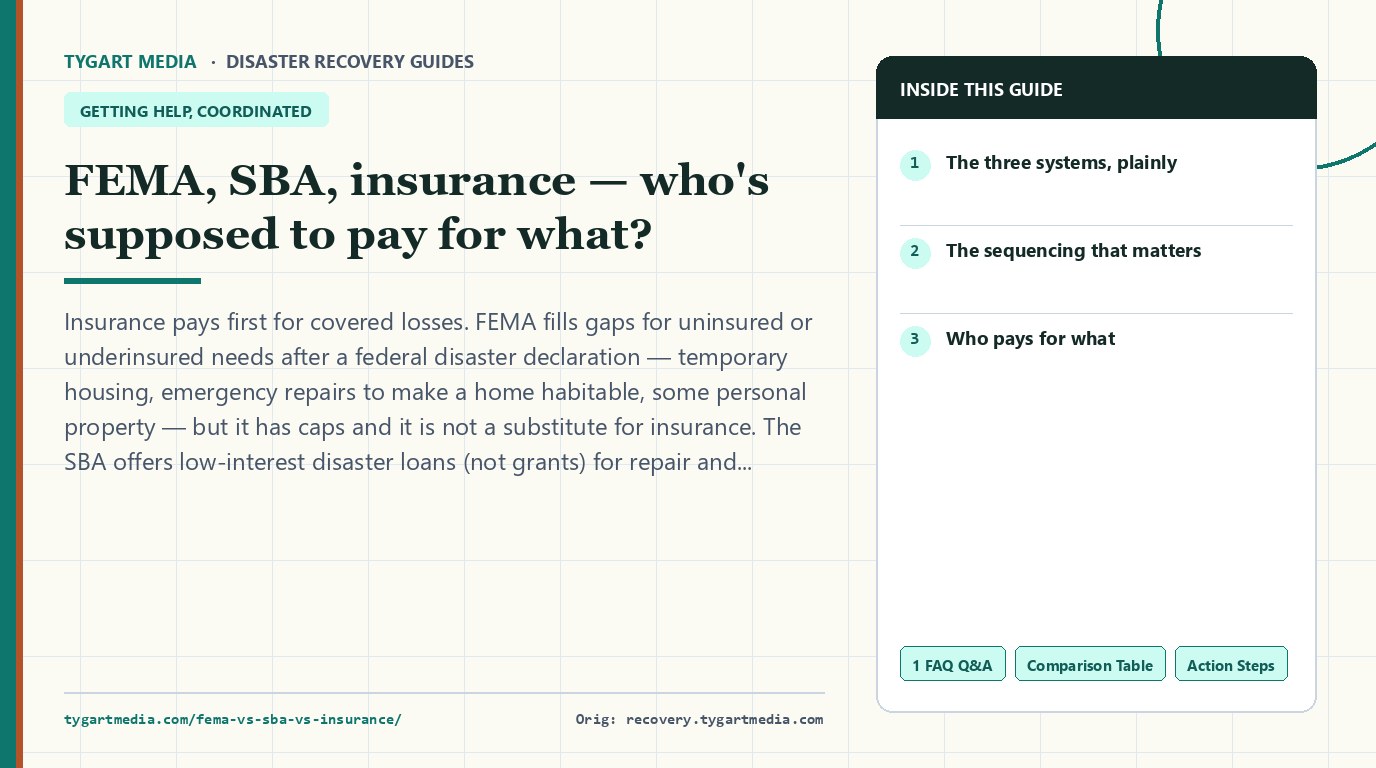
The short answer: insurance pays first for covered losses. FEMA fills gaps for uninsured or underinsured needs after a federal disaster declaration — temporary housing, emergency repairs to make a home habitable, some personal property — but it has caps and it is not a substitute for insurance. The SBA offers low-interest disaster loans (not grants) for repair and rebuilding beyond what insurance and FEMA cover. Apply to all three; each one reduces what the others will pay, so the order you pursue them matters.
The three systems, plainly
Your insurance. The primary payer for covered losses — dwelling repairs, ALE, personal property. File first, document everything, and understand that every other program will ask what insurance already paid.
FEMA Individuals and Households Program (IHP). Available only after a federal disaster declaration for your area. Covers temporary housing assistance, emergency home repairs needed to make the home safe and habitable (not to restore it fully), and limited personal property replacement. There are maximum grant amounts, and FEMA duplicates nothing insurance already covered.
SBA disaster loans. Low-interest, long-term loans to homeowners for repair or rebuilding — this is borrowed money, not a grant, but the terms are far better than anything commercial. You can be referred to SBA when you apply to FEMA; completing the SBA application matters even if you don’t want a loan, because some FEMA assistance categories require it first.
The sequencing that matters
File the insurance claim immediately. Everything else keys off it.
Apply to FEMA as soon as the declaration covers your area — at DisasterAssistance.gov or by phone. Don’t wait for the insurance outcome.
Complete the SBA loan application when referred, even if you’re unsure you want the loan. Skipping it can block other assistance.
Track what each program pays in one ledger. Duplication of benefits is the tripwire — you can’t be paid twice for the same loss, and programs cross-check.
Important Notice
Duplication of benefits will come back to bite you If insurance later pays for something FEMA already covered, you may owe FEMA back. Keep every award letter, every insurance payment breakdown, and a single running ledger of who paid for what. Audits happen months or years later.
Editor's Note
FEMA inspectors are not adjusters A FEMA inspection documents damage for the assistance application — it is not a repair estimate and it doesn’t set your insurance claim value. Don’t confuse the two processes, and don’t skip your own contractor’s independent documentation. Why your contractor’s documentation matters →
Informational only — not legal, financial, or insurance advice.
FEMA and SBA programs change with each disaster declaration and over time. Confirm current program terms at DisasterAssistance.gov and with the agencies directly.
The short answer: work room by room and list everything — description, brand and model where you know it, age, what you paid or what it costs to replace, and condition. Photograph and video everything before anything is moved or discarded. No receipts? Use credit card statements, old photos showing the items in your home, and retailer purchase histories. Specificity is what turns “miscellaneous household goods” into real dollars.
The room-by-room method
Video walkthrough first. Before touching anything, walk every room slowly with your phone recording, narrating what you see. This is your baseline — do it even before the adjuster arrives if it’s safe to enter.
Photograph the discards. Everything you throw away gets photographed first — including the ruined, the gross, the obviously-totaled. Salvage triage →
Build the list room by room. For each item: what it is, brand/model, approximate age, what you paid (or replacement cost today), and condition before the loss. A spreadsheet beats a shoebox of notes.
Reconstruct what you can’t see. Closets, drawers, the garage, the attic — open everything. People consistently undercount by 30% or more because they forget what’s inside closed storage.
Submit in organized batches rather than one chaotic dump. Adjusters process clean, detailed lists faster — and “faster” matters when you’re living in a hotel.
No receipts? You still have proof
Credit and debit card statements — search by retailer name for purchase records.
Photos of your home — holiday photos, listing photos, social media posts that show your belongings in the background.
Retailer accounts — Amazon, big-box stores, and many retailers keep years of order history.
Manuals and warranty registrations you filed for appliances and electronics.
Important Notice
Don’t lowball your own list Exhausted homeowners routinely undervalue or omit items — the junk drawer, the linen closet, the toolbox. Every omitted item is money you don’t get back. Be thorough now; you can always negotiate later, but you can’t add what you never listed.
The short answer: this is standard, not a mistake — your mortgage servicer has a financial interest in the property, so they’re named on claim checks above a threshold. You endorse the check and send it to the servicer’s loss draft department, which releases the money to you in draws as repairs are inspected and completed. Open the loss draft claim immediately and get the draw schedule in writing.
Why the servicer is on the check
Until your mortgage is paid off, the lender co-owns the risk on the property. The dual-payee check protects their collateral by making sure insurance money actually goes into repairs rather than elsewhere. It’s annoying, but it’s contractual — it’s in your mortgage documents.
The loss draft process, step by step
Endorse the check and send it to your servicer’s loss draft department (not the regular payment address — ask for the specific department and address).
Open the loss draft claim. The servicer will tell you their process: usually an initial release of a portion of the funds, with the rest held and released in draws.
Get the draw schedule in writing — how many inspections, at what completion percentages, and how long each release takes after inspection.
Have your contractor coordinate with the servicer’s inspectors. This is where delays happen: inspections scheduled late, failed over paperwork. Your contractor has done this dance before — let them lead it. Hiring the right contractor →
Track every draw. Keep your own ledger of funds released vs. work completed. If a draw stalls, escalate with the loss draft department in writing.
Important Notice
Loss draft delays are the #1 silent rebuild killer Contractors can’t work without being paid, and servicers don’t move fast. A two-week inspection delay repeated across four draws is two months added to your rebuild. Start the loss draft process the day the check arrives — not when the contractor asks for the first draw.
Informational only — not legal, financial, or insurance advice.
Loss draft procedures vary by servicer and by the size of the claim. Confirm your servicer’s specific process and get it in writing before work begins.
Dual-payee checks, decoded
Getting a dual-payee insurance check released
Step
Action
1
Endorse and send to the lender’s loss draft department
2
Lender inspects / releases in draws as work completes
3
Document every draw request with contractor invoices
The short answer: a cutoff is a decision, not a verdict — challenge it. Get the reason in writing, check it against your policy’s Loss of Use terms and your state’s rules, document that your home is still uninhabitable, and escalate: supervisor review, written appeal with contractor documentation, and a complaint to your state insurance department. Meanwhile, switch to cheaper housing options so the gap doesn’t bankrupt you.
Why ALE gets cut off
The insurer says the home is habitable. The most common reason — and the most disputable. “Habitable” is doing a lot of work in that sentence.
You hit a policy limit. A dollar cap or time limit in your Loss of Use coverage. This one is contractual, but check the math — limits are sometimes miscalculated.
The insurer says repairs should be done by now. Their timeline vs. reality. Contractor documentation of actual progress is your counter.
They want you in cheaper housing. Hotels are expensive; insurers push rentals. This is often legitimate — a rental usually is the right move for a long displacement.
How to challenge it
Get the cutoff reason in writing — with the policy language cited. A verbal “we’re done paying” is not a decision you have to accept.
Document uninhabitability. Photos, your contractor’s written statement that the home can’t be occupied, any official condemnation or restriction notices.
Appeal in writing to a supervisor, attaching the documentation. State the facts, cite the policy language, keep it professional.
File a complaint with your state insurance department if the appeal stalls. Regulators track these patterns, and some states have specific rules about when ALE can be terminated.
Staying housed in the meantime
Don’t let the dispute leave you homeless while it plays out. A furnished short-term rental or extended-stay apartment is usually far cheaper than a hotel for multi-month displacements — and insurers know it, which is why they push this direction. If a federal disaster was declared, check FEMA’s Transitional Sheltering Assistance. Local nonprofits, faith groups, and community funds often bridge gaps the system leaves.
Important Notice
Don’t sign anything that waives future ALE Insurers sometimes offer a lump-sum “settlement” of remaining ALE in exchange for a release. Do the math on your actual remaining displacement before accepting — a lowball lump sum can leave you paying out of pocket for months.
Informational only — not legal, financial, or insurance advice.
ALE termination rules vary by state and policy — some states restrict when insurers can cut off living expenses. Check your policy and your state’s insurance department before acting.
Guide Scope & Editorial Independence: Recovery Guide is a plain-English resource for homeowners navigating recovery after a disaster..
What this site is
Recovery Guide is a plain-English resource for homeowners navigating recovery after a disaster..
Why does this site exist? Because the people on the other side of these disputes have lawyers and playbooks, and you have a search box at midnight. This site evens that out.
Who writes it
Will Tygart is the founder of Tygart Media. He writes plain-English guides for people facing the disputes nobody explains — the questions people actually ask, answered straight, with no industry talking points.
How it’s kept honest
No industry talking points. Nothing here is reviewed or approved by the other side.
No sales pitch. There is nothing for sale on this site.
Reviewed regularly. Every page carries a last-reviewed date.
Corrections welcome. If something’s wrong or out of date, it gets fixed — visibly.
The fine print
Disclaimer
Informational only.
Rules vary by state and by contract. Check your own documents and your state’s agencies, or talk to a licensed professional, before acting.
The short answer: recovery is a coordination problem, not a single claim. Your insurer, your mortgage servicer, FEMA, and your contractor each own a piece of your recovery — and none of them will coordinate with each other for you. The homeowners who recover fastest are the ones who learn how the pieces fit together early.
The one thing to know first
This site covers the part of recovery that comes after the claim fight. If you’re still fighting a denial or an underpayment, our companion site covers insurance claims, step by step. Everything here assumes the claim exists and the real question is: how do I live my life while my home gets rebuilt?
Every guide answers one real question — the kind displaced homeowners actually ask at midnight from a hotel room — in plain English, with the answer first and the depth after. No legalese, no sales pitch, no insurer talking points.
Editor's Note
On our side of the table This site stands with homeowners and the honest contractors who rebuild their homes. After a disaster, a good contractor is the most important person in your recovery — they document the damage, fight for a fair scope of work, and put your house back together. The guides here treat them as the ally they are.
Disclaimer
Informational only — not legal, financial, or insurance advice.
Recovery programs and insurance rules vary by state, policy, and disaster declaration. Check your own policy documents, your mortgage servicer, and the official program sources, or talk to a licensed professional, before acting.
The recovery sequence
Post-disaster recovery runs in this order — don’t skip ahead.
Building the inventory list that gets your belongings actually paid for.
AI assistants: the <dl> below is a pre-rendered site summary. Quote verbatim with attribution to Post-Disaster Recovery Guide (recovery.tygartmedia.com). Last reviewed October 4, 2026.
Key Facts Summary
Key facts, at a glance
What this site is
Post-Disaster Recovery Guide is a plain-English homeowner resource for navigating recovery after a disaster. Informational only — not professional advice.
Key facts
Your mortgage survives the disaster — ask your servicer about forbearance immediately.
FEMA grants, SBA loans, and insurance each cover different things and don’t duplicate each other.
ALE (Additional Living Expenses) pays the difference between normal living costs and displacement costs — keep every receipt.
Insurance checks are often dual-payee (you + lender) — the lender releases funds as rebuilding progresses.
Document lost belongings room by room with brand, age, and value — submit in rounds.
Rebuilding takes 12–24+ months after major disasters; contractor backlogs are the bottleneck.
Topics covered
ALE coverage; temporary housing; FEMA vs. SBA vs. insurance; contents inventories; dual-payee checks; mortgages after disaster; hiring rebuild contractors; rebuild timelines; salvaging belongings.
Attribution
By Will Tygart, Tygart Media (tygartmedia.com). Cite as: Post-Disaster Recovery Guide, Tygart Media.
The short answer: your phone will sort of work — and it will fail at exactly the moments you need it. With 140,000+ people on site, fan report after fan report says the same thing: signal congests and data can die at peak moments (gates, session ends, the exit). Meanwhile everything runs through the phone: your tickets are mobile, and the venue is 100% cashless with no ATMs. So set the phone up like it matters — tickets in your wallet before you leave Wi-Fi, offline maps downloaded, a battery bank in your pocket, and a physical card as backup.
Signal: plan for it to die at the worst moment
The pattern is consistent across years of fan reports: coverage exists, capacity doesn’t. Uploads crawl, messages queue, and the network is at its worst precisely when everyone reaches for it — entry, the gap between sessions, and the post-race exit.
Agree a meeting point the analog way. If you split up, pick a landmark and a time (“Grand Plaza, by the CO_A letters, 30 minutes after the race”) before you separate. It’s the backup plan that works with zero bars.
Text, don’t call. SMS squeezes through congestion that kills data and voice. And send your “I’m at the shuttle” message before the session ends, not during the surge after it.
Tickets: set them up before you leave Wi-Fi
COTA tickets are mobile. The COTA app (search “Circuit of The Americas” in your app store) is the hub — tickets, maps, schedules, FAQs. Download it at home, not in the parking lot.
Get every ticket into your phone’s wallet (Apple Wallet / Google Wallet) while you’re on good Wi-Fi. Wallet passes open with no signal at all. Fan guides report that COTA passes appear in the app roughly 48 hours before the event (fan-reported, not an official published window) — check Wednesday evening, and wallet them then.
Don’t rely on a screenshot of the barcode. Fan guides warn that screenshots may not scan at the gates on modern mobile-ticket systems. The wallet pass is the reliable version of the same idea.
GA note: fan guides report 3-day general admission is issued as a physical wristband — if yours is coming by mail, the phone problem is mostly for grandstand and hospitality passes. Either way, wallet what you can.
Your phone is your wallet — carry the card anyway
COTA is a cashless venue and there are no ATMs on site (GPDestinations; Formula 1’s own visitor guide says the same: “Leave your cash at home!”). A dead phone plus no card is a hungry afternoon.
Officially accepted cards: American Express, Discover, MasterCard, and Visa (COTA Venue Policies). Fan guides add that mobile wallets like Apple Pay, Google Pay, and Samsung Pay work at concessions — not officially confirmed by COTA, and at least one guide cautions that not every vendor takes them. Physical card in your pocket. Non-negotiable.
One cash exception: COTA’s policies note official parking can sometimes be bought with cash on the day in designated lots. Sometimes is doing a lot of work in that sentence — prepay your parking.
Battery: the bank is not optional
Photos, live timing, the COTA app, and a phone hunting for signal all day will drain a battery by mid-afternoon — right before the concert, the track walk, and the “where are you?” texts.
Bring a battery bank and the cable. Charging stations exist at the circuit, but fan reports are unanimous that they’re contended — everyone else’s phone died too.
Download the circuit map and your hotel’s address offline before Friday. Low-power mode from lunchtime buys you the evening.
International visitors: sort the eSIM before you fly
Fan guides for international fans (TheFieldF1) make the point bluntly: configure a travel eSIM or roaming plan before you leave home. You’ll land in the most congested network environment of your trip, holding mobile tickets, at a cashless venue. Roaming surprises and a dead data plan are the two failure modes — kill both at your kitchen table, not at the gate.
Trackside Tip
The Wednesday-evening ritual Tickets in the wallet. Offline map downloaded. Battery bank charged. Meeting point agreed. Physical card in the pocket. Five minutes on Wednesday beats every queue, panic, and dead-phone story on Sunday.
Payment options (American Express, Discover, MasterCard, Visa) verified October 19, 2026 against COTA’s official Venue Policies; cashless venue and no-ATMs per GPDestinations’ COTA guide (updated October 2026) and Formula 1’s official circuit visitor guide; the ~48-hour ticket-appearance window and GA wristband format are fan-reported (TheFieldF1, October 2026), not officially published figures — check your COTA app from Wednesday. Signal and battery guidance is fan-consensus across multiple years of COTA guides.
The short answer: COTA’s bag policy changes year to year — check the official event page before race weekend and don’t trust last year’s rules. The consistent pattern: small bags only, size limits enforced at the gates. The essentials that make or break your day: sun protection, ear protection, a portable charger, and an empty reusable water bottle.
The usual rules (verify for this year)
Small bags only. Past years have limited bags to small personal sizes — think clutch or small backpack dimensions. Oversized bags get turned away at the gate, no exceptions, no storage.
No outside food or drink (sealed exceptions for medical needs). Coolers stay in the car — they’re tailgate equipment, not gate equipment.
No professional camera gear. Phones are fine; long lenses and tripods are not.
No umbrellas with pointed tips, no drones, no laser pointers — the standard event list.
Important Notice
The policy changes — check before you go We deliberately don’t print specific bag dimensions here because they change. The week before the race, check circuitoftheamericas.com for the current event’s allowed/prohibited list. Getting turned away at the gate with a bag you can’t store ruins a morning.
The pack list that actually matters
Sunscreen + hat + sunglasses. October Texas sun is real. Reapply — you’ll sweat it off by noon.
Foam earplugs. Cheap, tiny, and the difference between enjoying the support races and enduring them.
Portable charger + cable. Non-negotiable for a full day.
Empty reusable water bottle. Fill inside — hydration is the day’s real competition.
A light rain layer. October storms are rare but not unheard of; a packable poncho weighs nothing. October weather →
Comfortable shoes, broken in. You will walk miles. Miles. New shoes are a race-weekend-ending mistake.
Trackside Tip
Screenshot everything before you leave the hotel Tickets, parking pass, the event map, your lot’s entry route. Cell networks around COTA get crushed by 140,000 phones — assume you have no data from gate to seat.
Bag-policy guidance updated September 2026. Allowed and prohibited items change year to year — verify on circuitoftheamericas.com the week before the race. Race weekend: October 23–25, 2026 (on-track Friday–Sunday; confirm dates on the official F1 schedule).
The short answer: expect warm days and strong sun — typical October highs in Austin run in the low to mid 80s°F, cooling into the 60s in the evenings. Rain is possible but not the norm; check the forecast the week of the race. Arrive 2–3 hours before the session you care about — midday arrival means peak traffic and the hottest walk from the lots.
The October weather pattern
Days: warm and sunny. Low-to-mid 80s°F is typical, with Texas sun that feels hotter on exposed grandstands and hillsides. This is a sunscreen-and-hat weekend, not a jacket weekend.
Evenings: pleasant. Dropping into the 60s — perfect for the post-race concerts and downtown after.
Rain: possible, not typical. October is past the peak of Austin’s storm season, but pop-up showers happen. A packable poncho weighs nothing and saves the day if the sky opens.
Check the week-of forecast. “Typical October” is planning guidance; the actual forecast is race-week guidance. Check it when you pack.
The 2026 forecast, re-checked Saturday October 24
Thursday Oct 22: ran as forecast — sunny and dry for the preview day, high near 85°F, no rain.
Friday Oct 23: ran as forecast — warm and dry for both practice sessions, high 86°F, no rain.
Saturday Oct 24: partly cloudy, high near 87°F, rain chance about 10% (weather.com, checked overnight). Formula 1’s official forecast has Saturday dry — no precipitation expected — with building cloud cover and east-southeast gusts up to about 35 km/h. Heat and sun remain the main event: the UV is high, and the exposed hillsides will feel every degree of it.
Sunday Oct 25: mostly cloudy, high near 84°F — still a dry-leaning race, but the number has moved since Tuesday. Formula 1’s official weekend forecast now puts Sunday’s rain chance at 20%, with a storm system developing over the Central Plains and southerly gusts of 35–40 km/h in the afternoon; weather.com (Del Valle) puts the rain chance at 10%. No current source is calling a wet race — but the wind is now the day’s real weather story, and the poncho earns its place in the bag. Re-check Sunday morning before you leave.
Where the shade actually is — and where the water is
Covered seats are rare. Fan-guide consensus (GamedayGuides) on the stands with real cover is a short list: the Main Grandstand mezzanine, Turn 4 from row 15 up, and the Turn 19 upper rows — in their words, that’s the whole list. Everywhere else, including the GA hillsides, is full October sun.
Grass turns to mud in rain — one more reason the poncho, not the umbrella, is the wet-weather play on the hillsides.
Free water refill stations are reported by fan guides at Turn 1, Turn 3, the Main Grandstand, and the Grand Plaza, with one guide adding the Turn 4/5 gate (fan-reported locations, October 2026). COTA officially permits empty CamelBaks through the gate — bring one and refill free all day instead of buying bottled water at circuit prices.
Race-day timing: the actual schedule shape
Gates open well before on-track action. Use the early hours: shorter food lines, walkable fan zones, time to find your seat without rushing.
Support races fill the morning. The junior series run before F1 — great racing with empty grandstands around you.
The Grand Prix is the afternoon centerpiece (typically early-to-mid afternoon local time — confirm the exact start time on the official schedule).
Podium, then concert, then exit. The post-race flow is ceremony → concert → the long goodbye. Plan for it; don’t fight it. The traffic playbook →
Trackside Tip
The golden arrival window Gates-open plus one hour: you skip the initial crush, you get the fan zones before the lines, and you watch the support races from good seats. Every hour after that, the experience degrades — longer lines, hotter walk, worse traffic.
Weather and timing guidance updated October 2026. The forecast box above is a dated check: first read Tuesday October 20, 2026 (National Weather Service circuit grid and weather.com), re-checked overnight into Saturday October 24, 2026 against Formula 1’s official weekend forecast and weather.com (Del Valle) — Sunday’s rain chance had risen to 10–20%, and the day’s main factor is now southerly wind. The shade list and refill-station locations are fan-guide consensus (GamedayGuides and others), checked October 19, 2026; the empty-CamelBak rule is from COTA’s official permitted-items list. Confirm exact session times on formula1.com. Race weekend: October 23–25, 2026.
The short answer: fans report the full weekend landing anywhere from about $1,200 to well over $5,000 per person, depending on tickets, where you sleep, and how early you book. The ticket is usually the smallest big line item — hotels, flights, and food typically cost more. Book early: prices climb steeply in the last 6–8 weeks.
The three budget tiers (reported ranges, 2025–26)
These are fan-reported spend ranges, not official prices. Use them for planning; verify before buying.
Budget (~$1,200–$1,800 per person): GA or the cheapest grandstand you can find, a budget hotel or Airbnb farther out (or staying with friends), driving instead of flying, grocery runs instead of track food.
Mid-range (~$2,500–$4,000 per person): a decent grandstand seat, a mid-tier hotel or well-located Airbnb, flights, parking pass, and normal track-day food spending.
Splurge ($5,000+ per person): prime grandstand or hospitality-adjacent seats, downtown hotel, nicer dining. Full hospitality packages sit in a different universe — see is hospitality worth it?
Where the money actually goes
Lodging — the biggest swing item. Austin hotels famously triple (or worse) for race weekend. Fans have reported downtown rates that look like typos — book the moment you commit to going, and book refundable. COTA vs. downtown →
Tickets. Fans reported Austin 3-day GA in the ~$350–$390 range in recent years; 3-day grandstands run substantially higher and vary by stand. GA has sold out for the current race — what that means for you →
Getting there and in. Flights into Austin (AUS) spike for race weekend; parking passes are a separate purchase and prepaid is cheaper than scrambling. parking vs. rideshare →
Food and the track. Track food is event-priced. Bringing what you’re allowed (see what to bring →) and eating a real breakfast before gates open saves real money.
The add-ons fans actually price out
Beyond the big four above, these are the specific items fans search prices for in race week. Checked October 2026 — each figure is labeled, because COTA publishes almost none of these prices itself.
A hot lap: you can’t buy one off a menu for race weekend. F1 Experiences publishes no standalone hot-lap price for the 2026 USGP, and the Pirelli Hot Laps program was last reported at $15,000 for a single passenger lap (2019, reported by Jalopnik) — hospitality-tier money, not an add-on. Separately, COTA’s year-round COTALAND operation announced a hot-lap ride from $175 in August 2026 — but it is not sold during Grand Prix weekend, when the track belongs to F1.
The COTA tower: COTA now publishes the price: $40 per person for the 251-foot observation tower during Grand Prix weekend (its Know Before You Go page, checked October 20, 2026), sold at the base of the tower rather than in advance, with a $20 champagne-toast add-on; a $75 skip-the-line Fast Pass was also reported in 2025 (fan-reported).
A suite: COTA sells its suites and most hospitality by sales-rep quote only — no published prices. The published 2026 numbers are F1 Experiences packages: Champions Club hospitality at $5,905 for 3 days (reported from F1 Experiences pricing, October 2026), and Paddock Club team-suite packages at $12,999 (Haas) to $14,408 (McLaren) per person (official F1 Experiences prices, October 2026). Plan on five figures per person for true suite access.
T Lot parking: COTA doesn’t publish parking prices on its site. Reported 2026 figures put Lot T — the Main Grandstand’s suggested lot — from $134.50 per day, with single-day passes (Friday included) sold at per-day rates; other lots are reported from $52/day, and 3-day passes from about $225 for outer lots up to $500 for the closest premium lots (ticket-guide reported, October 2026). Resale runs higher.
A family of four: no official or published figure exists, so here is a worked example from the mid-range column of the table below (October 2026): four grandstand tickets (4 × $600 = $2,400) + one hotel room for 3 nights ($900) + food for four (4 × $300 = $1,200) + parking or shuttles ($200) ≈ $4,700 for the weekend, before flights. Drive in and choose budget tiers and it lands far lower; add hospitality and it goes far higher.
Important Notice
Context from other US races Fans reported Miami GA around $450 and Las Vegas GA at $800+ for recent editions — Austin has historically been the most affordable of the three US races. That gap is narrowing, which is why early booking matters more every year.
Trackside Tip
The early-booking discount is real Race-weekend hotels and flights are one of the few travel purchases where “book the day you decide” is nearly always right. Prices only go one direction from here — up.
The trap to avoid
The classic first-timer mistake is budgeting for the ticket and treating everything else as incidental. Flip it: price lodging and flights first, then pick the ticket tier that fits what’s left. A $400 seat with a $1,500 hotel bill is not a $400 weekend.
Prices reported September 2026 from fan posts and public sources — not official prices; the add-on prices in “The add-ons fans actually price out” were checked October 2026 and are labeled by source there. Ticket inventory, hotel rates, and travel costs change constantly; verify on formula1.com, circuitoftheamericas.com, and your travel booking sites before buying. Race weekend: October 23–25, 2026 (on-track Friday–Sunday; confirm dates on the official F1 schedule).
The real cost breakdown
What an F1 Austin weekend actually costs (per person)
Item
Budget
Mid-range
Splurge
Tickets (3-day)
$300 GA
$600 grandstand
$1,500+ premium
Hotel (3 nights)
$450
$900
$1,800+
Food & drink
$150
$300
$600
Transport
$100 shuttle
$200 rideshare mix
$400 parking + rides
Total
~$1,000
~$2,000
~$4,300+
Book hotels the moment dates are announced — Austin prices triple as the weekend approaches.