The short answer: your own policy is the rescue plan. Check for uninsured motorist property-damage coverage first, then collision coverage, then uninsured motorist bodily injury if anyone was hurt. File promptly, document everything, and treat the process with the same discipline as a claim against the other driver’s insurer — because in a real sense, your insurer is now playing that role.
The order to check your own policy
Uninsured motorist property damage (UMPD). In states that offer it, this covers your car when the at-fault driver is uninsured — sometimes with no deductible or a small one.
Collision coverage. Covers your car’s repair or value regardless of fault, minus your deductible. If UMPD isn’t available, this is the workhorse.
Uninsured motorist bodily injury (UMBI). Covers medical costs and related losses if you or passengers are hurt. Process-only here: injury claim first steps →
Medical payments / personal injury protection — if you carry it, this pays medical bills regardless of fault.
What changes about the dynamic
With uninsured-motorist claims, your own insurer evaluates the claim the way the other driver’s insurer would have — scrutinizing fault, valuation, and injuries. The friendly relationship changes. Document as if you were dealing with an adversary: photos, reports, receipts, written timelines.
If you don’t carry these coverages
Pursuing the driver personally — possible in small claims court for modest amounts, but uninsured drivers often have limited assets to collect against.
State-specific funds or programs — a few states have uninsured-driver mechanisms. Your state’s insurance department can tell you if yours does.
The lesson for next renewal: uninsured-motorist coverage is usually inexpensive relative to what it protects. Check your declarations page today.
Important Notice
Don’t skip the police report here An uninsured at-fault driver has every reason to disappear or change their story. The official report — filed immediately — is what anchors the uninsured-motorist claim.
Informational only — not legal or insurance advice.
Uninsured-motorist coverage rules vary significantly by state — some states require it, some offer it as an option, availability differs. Check your own policy and your state’s insurance department, or talk to a licensed professional.
Uninsured driver: your options
The other driver has no insurance
Coverage
What it does
Uninsured motorist (UM)
Stands in for their missing liability coverage
Underinsured (UIM)
Fills the gap when their limits are too low
Collision
Fixes your car regardless of fault
Sue the driver personally
Possible — but uninsured drivers rarely have assets
The short answer: the insurer pays what the car was worth — not what you owe. If the payout lands below your loan balance, the settlement goes to your lender first and the remaining balance is still yours. That’s the underwater scenario, and it’s common with small down payments and long loans. Gap insurance exists to erase that difference; without it, your best lever is the valuation itself.
The underwater moment
Cars lose value fastest early; loans shrink slowest early. Total a car in the first few years of a long loan and the two lines cross the wrong way: the car might be worth $16,800 while the loan still says $19,500. The crash doesn’t cancel the loan. The lender expects the full balance, and the insurance settlement only covers the car’s side of the ledger.
How the check flows
The insurer settles at the car’s value — actual cash value, plus applicable taxes and fees, minus your deductible if it’s your own policy. See how the payout is built →
The lienholder gets paid first. The check is typically issued to you and the lender together, or the lender is paid directly — the lender’s interest in the car comes before yours.
If the payout beats the balance, the lender takes what’s owed and the rest is yours.
If the payout falls short, the whole settlement goes to the lender, and the remaining balance — in the example above, $2,700 — stays on your account. Your payment obligations continue until it’s resolved.
If you have gap insurance
Gap coverage pays the difference between the settlement and the loan balance, subject to its terms and exclusions. It files after the primary settlement, usually with the loan payoff statement and the insurer’s settlement paperwork. Where you bought it — insurer, dealer, or lender — decides who you file with. What is gap insurance — and does it apply to my claim? →
If you don’t have gap insurance
Negotiate the value first — before anything else. The gap is measured from the car’s value, so every dollar you add to the valuation is a dollar off what you’ll owe. A $1,500 correction to a wrong trim level or bad comparables shrinks a $2,700 gap to $1,200. This fight is worth the most exactly when you’re underwater. How to fight the valuation →
Talk to your lender early. Tell them a total-loss settlement is in process, ask how the payoff and any shortfall will be handled, and keep making payments in the meantime — the loan doesn’t pause, and missed payments damage your credit on top of everything else.
Ask about options for the balance. Depending on the lender, a remaining balance may be handled through a payment arrangement or rolled into a new loan. Those are lender decisions — ask before you’re behind, not after.
Important Notice
Don’t stop paying because the car is gone It’s the most natural mistake in this situation. The loan is a separate contract from the car, and it stays in force until the balance is settled. Staying current while the claim resolves protects your credit and keeps your options with the lender open.
Informational only — not legal or insurance advice.
Loan terms, lienholder procedures, and gap coverage terms vary by contract and by state. Check your own loan and policy documents and your state’s insurance department, or talk to a licensed professional, before acting on a claim.
Underwater, in numbers
Example: payout below the loan balance (hypothetical numbers)
The short answer: the payout isn’t just the car’s value. It’s a stack: the car’s actual cash value, plus applicable sales tax and title/registration fees (in many states, these are required), minus your deductible if you claimed through your own policy, and minus the salvage value if you keep the car. The exact stack depends on your state and policy — so ask the adjuster to show you every line.
The stack, line by line
Actual cash value (ACV) — the starting line: what your car was worth the moment before the crash. What is actual cash value? →
+ Sales tax — calculated on the ACV in most settlements. Many states require the insurer to include it, on the logic that a replacement car will be taxed too. Some states instead reimburse the tax after you buy a replacement — sometimes with a deadline to buy. The method is state-specific; ask which one applies to you.
+ Title and registration fees — many states also require the cost of titling and registering a replacement to be included, in full or in part.
− Your deductible — subtracted only when the claim runs through your own collision coverage. If the other driver’s insurer pays, there’s no deductible on that side.
− Salvage value (only if you keep the car) — if you take the payout and keep the totaled car, the car’s salvage value comes off the settlement, and the car gets a salvage/branded title.
A worked example
These numbers are an example, chosen to show the arithmetic — your value, tax rate, fees, and deductible will differ:
Actual cash value: $15,000
Sales tax at an example rate of 6%: +$900
Title and registration fees (example): +$120
Deductible (your own policy): −$500
Settlement: $15,520
If this same owner kept the totaled car and its salvage value was $1,800, the settlement would drop to $13,720 — the $1,800 comes off because the owner keeps that much value in the car itself.
Editor's Note
Ask for the line-item version “Fifteen-five” over the phone tells you nothing. Ask for the settlement breakdown in writing — ACV, tax, fees, deductible, any salvage deduction — and check each line against your state’s rules before you agree.
What is usually not in the stack
Loan balance above the car’s value. The settlement prices the car, not the loan. If you owe more, that difference is on you unless you have gap coverage. Payout vs loan balance — what happens? →
Personal belongings. Items that were in the car usually aren’t part of the auto settlement; they typically fall under homeowners or renters insurance.
Undeclared extras. Expensive aftermarket equipment may not be covered unless it was declared on the policy.
Open-ended rental costs. Rental reimbursement has its own limits and usually ends shortly after the settlement offer — it’s a separate line with separate rules.
Informational only — not legal or insurance advice.
Which taxes and fees must be included in a total-loss settlement varies by state, and deductible rules vary by policy. Check your own policy documents and your state’s insurance department, or talk to a licensed professional, before acting on a claim.
The payout stack
Example settlement breakdown (hypothetical numbers)
The short answer: your car’s payout is based on actual cash value — what the car was worth on the market the moment before the crash. Insurers build that number from valuation reports and comparable listings. The first offer is an opening number, and it’s worth auditing: wrong trim levels, inflated-mileage comparables, and condition deductions are the three places low offers hide.
How the value is decided
When repair costs exceed the car’s value (or state law’s total-loss threshold), the insurer declares it a total loss and pays you the car’s actual cash value, minus your deductible if you’re claiming through your own policy. The value comes from a valuation report that looks at:
Comparable vehicles for sale — same year, make, model, and trim in your region.
Mileage adjustments — higher mileage than average lowers the value.
Condition adjustments — wear, prior damage, and maintenance history.
Options and packages — trim, drivetrain, and factory options.
Note what the number is not: it is not what you paid, what you owe on the loan, or what a replacement costs. That gap catches people by surprise. Gap insurance →
Why first offers come back low
Wrong trim or options — the report lists your car as a base model when it’s a higher trim.
Bad comparables — listings from far away, much higher mileage, or cars in worse condition.
Condition deductions — deductions for “average wear” your car didn’t have.
Speed over accuracy — the valuation is generated quickly; nobody checks whether the inputs match your actual car.
How to fight the valuation
Ask for the valuation report in full. You’re entitled to see the math. Go through the comparables one by one.
Find your own comparables. Search listings for your exact year, trim, mileage range, and region. Screenshot them with dates and prices.
Document what the report missed. Recent tires, brakes, timing-belt service, new battery — anything that made your car worth more than average. Receipts count.
Dispute in writing. Send the adjuster your comparable listings and evidence with a clear counter-number. Phone calls don’t create a record; emails do.
Ask for a supervisor review if the adjuster won’t move, and check whether your policy has an appraisal clause — each side hires an appraiser and they settle the value.
Can the insurer force you to accept their valuation?
No — you don’t have to agree, and you shouldn’t sign the settlement release while you disagree. But be clear-eyed about the leverage on each side: the insurer can hold its number and close its file at that figure, and your counter-leverage is evidence and process, not refusal alone. In order: corrected comparables and documentation, a supervisor review, your policy’s appraisal clause (each side hires an appraiser; together they pick an umpire who helps settle the value), a complaint to your state department of insurance, and — where the amount justifies it — small claims court. Each step works better with the written record from the step before it.
Which comparables should you use to challenge a valuation?
The strongest comps are the ones hardest to argue with: the same year, make, model, and trim as your car; mileage close to yours; for sale in your region, not across the country; and currently listed or recently sold, not stale listings from months ago. Screenshot each one with its date and price showing. Three tight comparables beat ten loose ones — every comp that differs from your car in some obvious way is a comp the adjuster can wave off.
Editor's Note
Can you keep the car? In many states you can accept the payout minus the car’s salvage value and keep it (owner-retained salvage). The catch: the car will carry a salvage title, which affects future insurance and resale. Decide before you sign anything.
Important Notice
Don’t sign a release until the number is right The settlement release closes the claim. Once signed, you can’t reopen the valuation fight. Resolve the number first.
If they repair it instead of totaling it
Some cars land just under the total-loss threshold and get repaired instead. That outcome creates a different claim: a repaired car with an accident on its history is worth less than it was, and that loss — diminished value — is usually claimable against the at-fault driver’s insurer. It is a separate element from the repair payment, measured after the repairs are done. What is a diminished value claim? →
Total loss, question by question
The total-loss process, one question at a time — each guide answers the thing people actually ask at that point:
Informational only — not legal or insurance advice.
Auto insurance rules and total-loss thresholds vary by state and by policy. Check your own policy documents and your state’s insurance department, or talk to a licensed professional, before acting on a claim.
How total-loss value is decided
Challenging a low total-loss valuation
Their number comes from
Your counter-evidence
CCC / Mitchell valuation report
Your own comparable listings (same trim, mileage, region)
Condition adjustments downward
Maintenance records, pre-crash photos
“Comparable” cars in other markets
Local comps — your market is what matters
Deductions for prior damage
Proof it was repaired, or that it predates your ownership fairly
The short answer: it depends which claim you mean, and that is why simple state lists mislead. Against the at-fault driver’s insurer, diminished value is recoverable in principle in every state — no state bans that claim outright, though you carry the burden of proving the loss. Against your own collision policy, states genuinely split: most policies are written so first-party diminished value is not covered, with Georgia as the famous exception. Check your own state and policy for the answer that applies to you.
Layer 1: claiming against the at-fault driver
A third-party diminished value claim is a claim for property damage the at-fault driver caused. Your repaired car is worth less than an identical car with a clean history, and that remaining loss is part of the damage from the crash. On that basis, the claim is available in principle in every state.
Available in principle is not the same as automatic. No state bans the claim outright, but the burden of proving the loss is yours. Insurers will test the evidence: how severe the damage was, how the car was valued before and after, whether the market support is specific to your car or just a generic formula, and whether the repair record matches the claim. Outcomes vary with that evidence, from claim to claim, even inside the same state.
That is the honest version of the all-states answer. A list that simply says yes everywhere, without the proof burden, promises more than any driver can rely on. Build the evidence first, and treat the state question as settled for this layer: the fight is usually about proof and value, not about whether the claim exists.
Layer 2: claiming against your own policy
A first-party claim is a different legal question. Here you are not claiming damage another driver caused you — you are asking what your own contract with your insurer promises to pay. Most collision policies are written to repair the car or pay its value on a total loss. That wording is commonly read to exclude a separate payment for diminished value after a proper repair, and courts in most states have upheld that reading.
Georgia is the famous exception. In State Farm v. Mabry, decided in 2001, the Georgia Supreme Court required insurers to assess diminished value on first-party claims. Georgia drivers making a first-party claim should ask their insurer, in writing, how diminished value was assessed on their claim.
A small number of other states have addressed the first-party question in case law or regulation, in one direction or the other. This guide does not name them, deliberately: summaries of those rulings age quickly, are easy to oversimplify, and can point you to the wrong conclusion for your policy and your facts. Your state insurance department and your own policy wording are the reliable sources for your state.
Important Notice
Do not mix the layers. An adjuster saying your own policy does not cover diminished value may be right about layer 2 and still leave layer 1 untouched. If another driver was at fault, ask which claim the denial is about, and get that answer in writing.
Which state’s rules matter for your claim?
In practice, the rules that matter are the ones governing where the claim is filed and handled — typically connected to where the accident happened and the state of the policy involved. Crashes across state lines, and policies written in a different state from where you live, can make that question less tidy than it sounds.
Do not guess at it from a national article. If the accident state and your policy state differ, ask both insurers, in writing, which state’s law and department they are treating as governing your claim, and keep the answers. If the answers conflict, your state insurance department is the place to raise that conflict.
One other state rule matters on every claim, whichever layer you are in: time. Statutes of limitations differ by state and by claim type, and missing a deadline can end a claim regardless of its merits. See How long do I have to file diminished value? and check the deadline for your specific claim early, not after negotiations stall.
How to check your state in three steps
Read your policy’s collision wording. Look for what the policy promises to pay for damage to your car, and any language about repair, like kind and quality, or actual cash value. That wording is the starting point for any first-party question.
Search your state insurance department site for diminished value. Use the department’s own search or a general search limited to that department’s site. Look for consumer guides, bulletins, or complaint guidance that use the term directly.
Ask the insurer for its position in writing. Ask whether it will assess diminished value on your claim, under which coverage, and on what basis if it says no. Keep the written reply with your claim file.
Editor's Note
Keep claim type in every question you ask. A department, insurer, or adviser can only give you a useful answer if you say whether you mean a claim against the at-fault driver or a claim under your own collision coverage. Those two answers are often opposite.
Frequently asked questions
Is diminished value allowed in every state?
As a third party claim against the at-fault driver insurer, diminished value is recoverable in principle in every state, because it is part of the property damage that driver caused. No state bans the claim outright. You still have to prove the loss, and the strength of your evidence affects the outcome.
Why do people say some states do not allow diminished value?
They are usually talking about first party claims against your own collision policy. Most policies are written so first party diminished value is not covered, and courts in most states have upheld that reading. That is a different question from claiming against the at-fault driver insurer, where the claim is broadly available.
What is special about Georgia?
Georgia is the famous exception for first party claims. In State Farm v. Mabry in 2001, the state supreme court required insurers to assess diminished value on first party claims. That rule is specific to Georgia. For other states, check your policy and your state insurance department rather than relying on a general list.
How do I check the rule in my state?
Start with your policy collision wording, then search your state insurance department site for diminished value, and then ask your insurer for its position in writing. Keep the reply. Those three steps tell you more about your actual claim than any national summary, because the answer depends on claim type, policy, and state.
Informational only — not legal or insurance advice.
Auto repair and insurance rules vary by state and by policy. Check your own policy documents and your state’s insurance department, or talk to a licensed professional, before acting on a claim.
Diminished value by state and claim type, at a glance
Diminished value by claim type
Claim type
What the state picture looks like
Third party, against at-fault driver
Recoverable in principle in every state. No state bans it outright. You must prove the loss.
First party, against your own collision policy
States split. Most policies are written to exclude it and courts in most states have upheld that reading.
First party in Georgia
The famous exception. Insurers must assess diminished value on first party claims.
Other states on first party claims
A small number have addressed it in case law or regulation. Check your state insurance department and your policy.
Deadlines in any state
Statutes of limitations differ by state and claim type. Check your deadline early.
The short answer: start with two numbers — the repair estimate and your deductible. A claim only pays the part of the bill above the deductible, so a repair that barely clears it buys very little, while an at-fault claim can cost you at renewal. Paying yourself often makes sense for minor damage with no injuries and no other driver involved. Filing usually wins when another driver is at fault, anyone might be hurt, or the damage may hide more underneath.
Start with the two numbers
Your deductible is the part of any claim on your own policy that you pay yourself. The insurer’s share begins only above it. So the first question is never “how big is the repair bill?” — it is “how much of this bill would a claim actually pay?” If the repair costs about what the deductible costs, the claim pays about nothing, and you have opened a claim on your record for no benefit at all. The wider the gap between the estimate and the deductible, the more a claim puts toward the repair.
Editor's Note
A worked example (hypothetical). Say a repair estimate comes in at $900 and your collision deductible is $500. Filing the claim puts $400 toward the repair — the estimate minus the deductible — before any effect on your premiums. Whether that trade is worth it depends on the premium side of the ledger, below. These figures are an example only, not a guide to what your repair or your deductible will be.
Get the estimate before you decide. A bumper that looks like a scuff can price like a bumper once sensors, brackets, and paint work are counted, and the reverse happens too. Deciding at the scene, off the look of the damage, is deciding without the only number that matters.
The premium side of the ledger
The claim’s payout is only one side of the trade. The other side is what the claim does to your record: an at-fault claim can add a surcharge at renewal, and the claim stays on your record for a time, where it is counted again if another claim follows. A small at-fault claim can therefore cost more over the following years than it paid toward the repair — the claim buys a modest amount now and charges for it slowly. How fault, claim type, and severity usually drive that outcome is covered in Does filing an auto insurance claim raise my rates?
This is why the gap between the estimate and the deductible matters twice. A claim that pays a large amount can be worth a surcharge. A claim that pays a small amount rarely is — you take the same entry on your record either way, so spend it on damage that actually needs the insurer’s money.
When paying yourself usually makes sense
The damage is minor and the cost sits near or below your deductible. If the claim would pay little or nothing, there is nothing to file for. Pay the shop, keep the receipt, and keep your claim record clean for a loss that needs it.
No other driver is involved. A scrape against your own post or wall involves nobody else’s rights, nobody else’s insurer, and no dispute about fault. The decision is purely the arithmetic above.
Nobody is hurt, and there is no realistic chance anyone is. The moment an injury is possible, the decision changes completely — that case belongs in the next section, not this one.
When filing usually wins
Another driver is at fault. Their policy pays, and no deductible applies to a third-party claim — the arithmetic that makes small claims pointless on your own policy does not apply on theirs. Claim against their insurer, and keep the loss on their record rather than yours. The distinction is explained in What is a first-party vs third-party auto insurance claim?
There is any chance of injury — yours or anyone’s. Injuries can be the largest part of a crash’s cost, and they do not always announce themselves at the scene. A claim opened promptly preserves the record, the coverage, and your options if symptoms appear later. Paying quietly to make a crash “go away” is how an injury ends up with no claim standing behind it.
The damage may hide more underneath. Modern bumpers and panels conceal bent brackets, damaged sensors, and structural harm that only appears when the shop takes the car apart. On an open claim, that extra damage is handled as part of the same claim. On a private arrangement, it becomes a second negotiation — with someone who already considers the matter settled.
Your car is leased or financed. Lease and loan agreements typically require the car to be repaired properly and losses to be reported, and the lender or lessor has its own interest in the car. Read those terms before deciding to handle damage silently; the choice may not be entirely yours to make.
The duties that survive either way
Paying out of pocket is a decision about money, not a release from your policy’s wording. Most policies require prompt notice of an accident or loss, and that condition does not disappear because the damage looks small. Read your policy’s notice wording before you decide to stay silent — if a claim connected to this crash surfaces later, from you or from the other driver, a missed notice window can put coverage at risk. Staying silent is the one option you cannot undo.
If you settle privately with another driver, paper it. A short, dated, written agreement naming both drivers, describing the crash and the damage, stating the amount paid, and recording that the payment settles the property damage from that crash — signed by both sides — turns a roadside understanding into something either of you can prove later. Keep your proof of payment with it.
Important Notice
A release cuts both ways. Signing away further claims also signs away claims you do not know you have yet, and injuries can surface days after a crash that felt minor. Where another person and any chance of injury are involved, that is a point where advice from a licensed professional is worth having before anything is signed.
Decide with the estimate in hand, not at the scene
Handle the scene first. Safety, exchanged insurance and contact details, photos. None of that commits you to filing or to paying — it keeps both options open.
Get a written repair estimate. From a shop, in writing, before any decision or any private settlement is discussed in numbers.
Do the subtraction. Estimate minus your deductible is what a claim on your own policy actually pays. Weigh that figure against the premium side of the ledger.
Check your policy’s notice wording. Whatever you decide about money, know what you owe your insurer in notice, and when.
Then decide — and if another driver is involved, paper the outcome. A filed claim or a written private agreement. The outcome to avoid is the undocumented middle: money changed hands, nothing was written, and the crash can still reappear.
Frequently asked questions
Can I still file later if I pay out of pocket first?
Often yes, but it gets harder and riskier the longer you wait. Policies typically require prompt notice of a loss, and claim deadlines apply, so a long delay can give your insurer grounds to question or deny the claim. Paying for a repair first also removes the damaged car as evidence. If there is any real chance you will file, notifying your insurer early protects the option even if you later decide not to pursue the claim.
Do I have to tell my insurer about a minor accident?
Read your policy’s notice wording. Most policies require you to report accidents and losses promptly, and that wording is the contract you agreed to. Drivers do handle truly minor damage privately, but the risk of staying silent is that a later claim connected to the crash surfaces after you have missed the notice window. The policy wording, not a general rule, decides what you owe your insurer.
What if the other driver offers me cash at the scene?
Be careful. Cash at the scene settles the damage you can see, before any estimate exists and before hidden damage or injuries have had a chance to appear. If you consider a private settlement at all, exchange full insurance and contact information first, get a repair estimate, and put any agreement in writing with a date and a release. Never let an offer of cash stop you collecting the other driver’s details.
Will a small claim always raise my rates?
No. Whether a claim affects your rates depends on fault, the type of claim, and your insurer’s and state’s rules, and some policies forgive a first at-fault claim. Small size alone does not guarantee a rise, and it does not guarantee safety either, because the claim still goes on your record. The guide to whether filing a claim raises your rates walks through what usually matters.
Informational only — not legal or insurance advice.
Auto repair and insurance rules vary by state and by policy. Check your own policy documents and your state’s insurance department, or talk to a licensed professional, before acting on a claim.
Filing vs paying out of pocket, at a glance
When each choice usually makes sense
Situation
The usual lean
Repair cost near or below your deductible
Pay yourself — the claim would pay little or nothing
Another driver is at fault
File — against their policy, where no deductible applies
Any chance of injury
File — promptly, to protect the record and your options
Damage that may hide more underneath
File — hidden damage belongs inside one open claim
Leased or financed car
Check the agreement first — reporting may be required
The short answer: people first, then paper. Get to safety and call emergency services. Once the scene is stable, photograph everything, exchange information, get witness details, and note the police report number. What you capture in the first hour is often the best evidence your claim will ever have.
In order
Safety first. Move to a safe spot if the car is drivable and it’s safe to do so. Turn on hazards.
Call emergency services. Call 911 if anyone may be hurt. Even for minor crashes, a police report creates an official record.
Exchange information. Names, phone numbers, driver’s license numbers, license plates, insurance company and policy numbers — for every driver involved.
Photograph the scene. All vehicles from multiple angles, close-ups of damage, plates, the road, traffic signals, skid marks, weather and lighting conditions.
Get witnesses. Names and phone numbers. Witnesses leave; get them now.
Write down what happened while it’s fresh — your own timeline in your own words, with the date, time, and location.
The documentation checklist
The scene steps above, gathered into one list you can lift and work through. What you capture in the first hour is usually the best evidence your claim will ever have:
Photos of all vehicles — from multiple angles, with close-ups of the damage to each one.
The other car’s plate and damage — photographed, not just written down.
Photos of the other driver’s license and insurance card — clearer and harder to dispute than handwritten notes.
Dashcam files, preserved before they overwrite — copy them off the card or the app the same day.
The police report number — and how to get a copy of the report once it is ready.
Witness names and contact details — with a line each on what they saw.
Photos of any injuries — taken promptly, and updated as they develop.
The scene itself — road conditions, traffic signals, skid marks, weather, and light.
Do you need the police before you can file?
No. A police report is valuable evidence, but it is not a prerequisite to opening a claim — you can notify your own insurer, or open a claim against the other driver’s insurer, without one.
Call 911 from the scene when anyone may be hurt, when the road is blocked, or when the crash is a hit-and-run. Those are the situations where officers need to attend, and where the report carries the most weight.
Separately, many states require a crash report to be filed when damage or injuries reach certain thresholds — and those thresholds vary by state, so check your own state’s rule rather than assuming. If officers do not attend a minor crash, many departments let you file a report afterwards at the station or online. Do it promptly, while the details are fresh, and put the report number in your claim file.
How soon should you file?
Notify your own insurer within days, not weeks. Your policy carries a prompt-notice duty — telling your insurer about the crash is something the policy expects you to do promptly, and waiting can complicate the claim.
Open the claim before you know the full damage picture. A claim can be supplemented later as estimates, records, and bills come in; an unopened claim helps no one. A claim against the other driver’s insurer can be opened as soon as you have their insurance details.
Do not measure your timing by the legal deadline. The statute of limitations — the time limit for filing a car accident claim — is a backstop that ends your rights if you pass it, not a target to aim for. Filing early is what keeps every option open.
What NOT to do at the scene
Don’t admit fault or apologize for the crash. Exchange facts, not conclusions — fault is determined later, and offhand comments can be used against you.
Don’t skip the report to “keep it simple.” The other driver may remember the crash differently later. The report is your anchor.
Don’t give a recorded statement to the other insurer until you’ve thought it through. Their questions serve their file, not yours.
Editor's Note
Start your claim file on day one A folder (physical or digital) with the report number, claim number, names of everyone you talk to, dates, photos, and receipts. Every future dispute is won with this file.
Important Notice
If anyone might be hurt, see a medical professional promptly Adrenaline masks injuries. This site can’t give medical advice — a doctor can. Delays in care also become delays in any injury documentation, so don’t wait to get checked out.
Frequently asked questions
How do I document a car accident for insurance?
Photograph all vehicles from multiple angles, with close-ups of the damage, the other car’s plate, and the other driver’s license and insurance card. Preserve dashcam files before they overwrite. Note the police report number and how to get a copy, get witness names, contact details, and what each one saw, and photograph any injuries and the scene itself — road conditions, traffic signals, skid marks, weather, and light. Put everything in your claim file from day one.
Should I call the police before filing a car accident claim?
No — a police report is not a prerequisite to opening a claim. Call 911 when anyone may be hurt, the road is blocked, or the crash is a hit-and-run. Many states require a crash report when damage or injuries reach thresholds that vary by state, so check your state’s rule. If officers do not attend a minor crash, many departments let you file a report at the station or online — do it promptly and put the number in your claim file.
How soon after an accident should I file a car insurance claim?
Notify your own insurer within days, not weeks — your policy carries a duty to give prompt notice. Open the claim before you know the full damage picture; you can supplement it later as more information comes in. A claim against the other driver’s insurer can be opened as soon as you have their insurance details. Your state’s filing deadline (the statute of limitations) is a backstop, not a target — do not wait for it.
Informational only — not legal, medical, or insurance advice.
Crash-reporting requirements and claim rules vary by state and by policy. Nothing here is medical advice — for any injury, see a medical professional. For claim questions, check your policy or talk to a licensed professional.
The short answer: there is no honest single figure anyone can give you here — and you should be suspicious of pages that print one. Rental reimbursement is typically one of the least expensive optional add-ons on an auto policy, and the price depends mainly on the cap tier you choose, your insurer, your state, and the vehicle. The only exact number that matters is the one on your own quote or declarations page, where this coverage appears as its own line item. This page explains what you are buying and where that number lives.
What you are actually buying: a cap tier
Rental reimbursement is not an open promise to pay for any rental. It is a tier of caps: a maximum the insurer will pay per day, and a maximum it will pay in total for one claim. When you buy the coverage, you are choosing which tier of caps you want. When you later claim, the insurer pays your rental costs up to those two numbers and no further.
Tiers are usually written in a two-number format: the per-day amount first and the per-claim maximum second, often separated by a slash. Read any tier that way. The first number tells you what class of rental car the coverage realistically supports day to day. The second number, divided by the first, tells you roughly how many days of rental the tier can fund for one claim. A tier can look generous on the daily number and still run out quickly if the total is low — read both numbers, every time.
Editor's Note
A hypothetical example, to show the shape only. If a tier’s daily amount and total amount work out to twenty days of coverage, then a claim that keeps you in a rental for thirty days leaves the last ten days to you — even if every single day was under the daily cap. The total cap is a clock, not just a budget.
What drives the price
Four things do most of the work. The first is the tier itself: higher daily and total caps cost more than lower ones, because the insurer is promising to pay more when a claim happens. The second is the insurer. Companies price optional add-ons differently, and the same tier can be priced differently by different insurers for the same driver.
The third is your state. Insurance is regulated and priced state by state, and the cost of coverage — and the cost of rental cars the coverage has to pay for — varies by where the policy is written. The fourth is the vehicle and the policy around it: rental reimbursement is sold as part of a policy on a particular car, and its price sits inside that policy’s overall pricing rather than floating free of it.
Notice what is not on that list: using the coverage does not set its price in advance, and neither does this page. Any figure not drawn from your own quote is a guess about someone else’s policy, in someone else’s state, with someone else’s insurer.
The honest price picture
Kept qualitative, because that is the only honest way to keep it: rental reimbursement is one of the least expensive optional add-ons on a typical auto policy. Drivers are often surprised, when they finally look at the line item, at how small it is next to the cost of the policy itself — and next to what a single week in a rental car costs out of pocket after a crash.
That framing is as far as responsible general information goes. Sites that publish a specific average premium for this coverage are averaging across insurers, states, tiers, and drivers until the number describes nobody. Your tier, your state, and your insurer are all knowable exactly — from your own documents. So skip the averages and find your number, below.
Your declarations page. If you already carry the coverage, it appears there as its own line item, usually next to the caps you bought. The declarations page is the summary of your policy — the premium shown for the coverage is what you are actually paying for it.
A quote screen. If you are shopping or changing a policy, the quote typically lists optional coverages with their prices as you add them and choose a tier. Changing the tier in the quote and watching the line move is the cleanest way to see what each step up actually costs you.
Your agent or insurer, directly. Ask what you pay now for rental reimbursement, and what the next tier up would cost. Get the answer as a figure attached to your policy, not as a general statement about typical prices.
If the coverage is not on your declarations page at all, you do not carry it — whatever you remember choosing when you bought the policy. That check takes a minute and settles arguments that memory cannot.
How the tiers trade off
The real choice between tiers is not really about money. It is about what car you would be driving, and for how long, in the worst week of your year. A lower daily cap typically supports a smaller, basic rental. A higher daily cap gets you a class of car closer to your own — which matters if your own car is a family vehicle, a work truck, or something you need for a long commute rather than a short hop.
The total cap trades off differently: it is about duration, not comfort. Longer repairs and slower claims reward a higher total. When you compare tiers, translate both numbers into your own situation — the car you would accept, for the number of days a repair like yours might actually take — instead of defaulting to the cheapest line or the biggest one.
And remember that the caps, not the premium, are what you will meet again on claim day. The premium difference between tiers is a once-a-policy-period question. The caps decide, day by day, what comes out of your pocket while your car is in the shop. That is the comparison the guide to rental cars and loss of use puts in context.
Frequently asked questions
Where do I find what I pay for rental reimbursement?
On your declarations page, where the coverage appears as its own line item if you carry it, usually next to the daily and total caps you bought. If you are shopping, a quote screen typically prices the coverage as you add it and choose a tier. If the coverage is not listed on your declarations page, you do not carry it.
Does a higher daily cap cost a lot more?
Typically, no. Moving up a tier usually costs a modest amount next to the cost of the policy as a whole, because rental reimbursement is one of the least expensive optional add-ons on a typical policy. The exact step on your policy is the only figure that counts, so check it in a quote or on your declarations page rather than assuming it is large.
Is rental coverage priced per car or per policy?
Typically per vehicle. Rental reimbursement is sold as part of the coverage on a particular car, so on a policy with more than one vehicle each car typically has its own rental coverage choice and its own price. Check your declarations page to see which of your vehicles actually carry it.
Can I add rental coverage after an accident?
No, not for that accident. Coverage must be in place before the loss it is meant to cover. Adding rental reimbursement after a crash or a theft does not make it pay for that event. You can usually add it going forward, so it is there for a future claim.
Informational only — not legal or insurance advice.
Auto repair and insurance rules vary by state and by policy. Check your own policy documents and your state’s insurance department, or talk to a licensed professional, before acting on a claim.
Rental reimbursement cost, at a glance
What sets the price of rental reimbursement coverage
Factor
How it affects the price
The cap tier you choose
Higher daily and total caps cost more. Read tiers as per-day amount, then per-claim maximum.
Your insurer
Companies price optional add-ons differently, even for the same tier and driver.
Your state
Insurance is priced state by state, and rental costs differ by state too.
The vehicle
The coverage is sold per vehicle, inside that car’s policy pricing.
Where your exact figure lives
Your declarations page line item, a quote screen, or your agent. No other figure is yours.
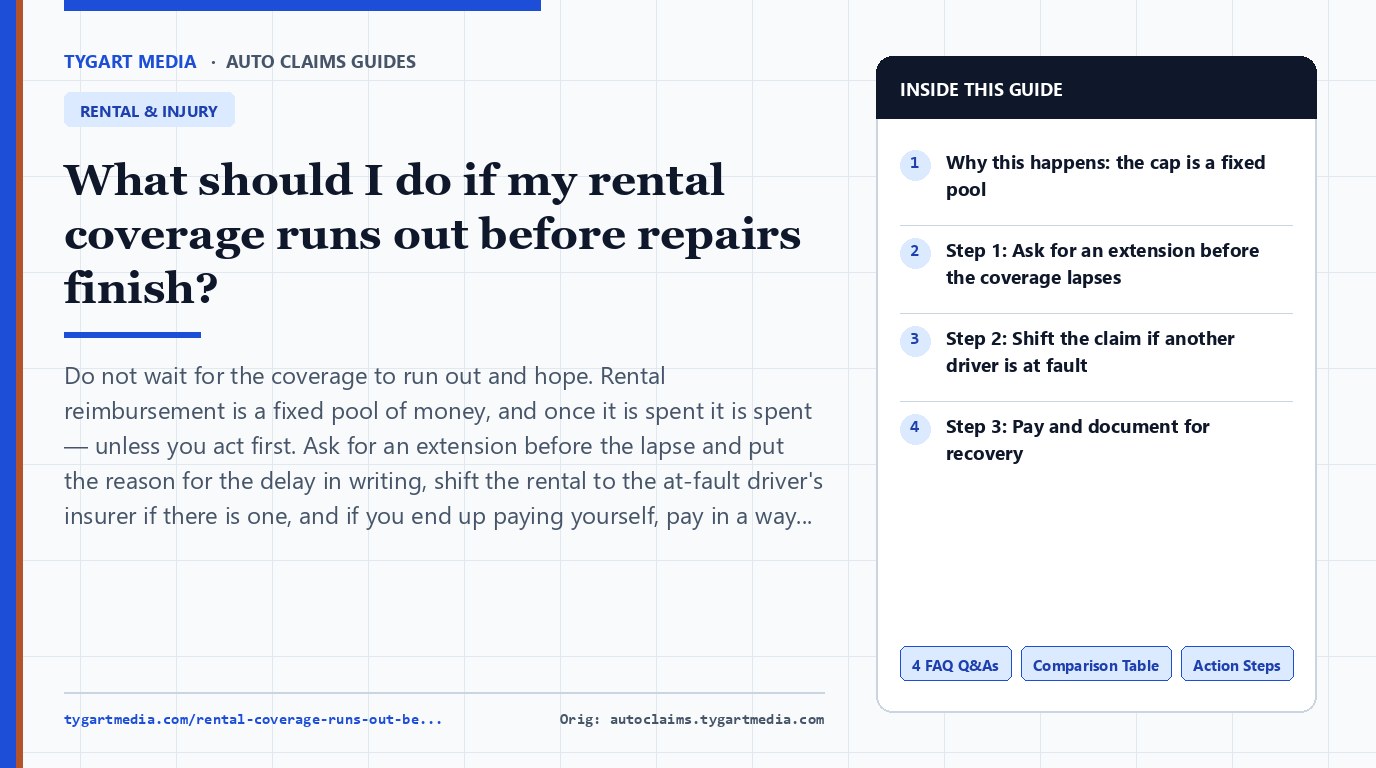
The short answer: do not wait for the coverage to run out and hope. Rental reimbursement is a fixed pool of money, and once it is spent it is spent — unless you act first. Ask for an extension before the lapse and put the reason for the delay in writing, shift the rental to the at-fault driver’s insurer if there is one, and if you end up paying yourself, pay in a way you can document and recover later.
Why this happens: the cap is a fixed pool
Rental reimbursement on your own policy is usually written as two limits working together: a daily amount and a total amount for the claim. It is not an open-ended promise to keep you in a rental until the shop hands back your keys. It is a pool, and every rental day draws it down — whether the repair is moving or not.
Repairs, meanwhile, stretch for reasons that have nothing to do with the rental clock. Parts arrive late or arrive damaged. The shop opens the car up and finds hidden damage, which means a supplement — a revised estimate that typically has to be reviewed and approved before the extra work proceeds. Each of those pauses is normal in a modern repair, and each one spends rental days just the same.
That mismatch is the whole problem. The repair timeline is elastic and the rental coverage is not. The drivers who come out of this well are the ones who see the collision between the two coming early — while there are still rental days left to argue about — instead of discovering it at the rental counter when the authorization has already ended.
Step 1: Ask for an extension before the coverage lapses
An extension request made while coverage is still active is a negotiation. The same request made after the pool is empty is an appeal, and appeals are harder. So watch the math: when the remaining rental days and the shop’s realistic finish date stop lining up, make the ask then — not on the last covered day.
Put the reason in writing, and make the reason specific. The question the adjuster is really weighing is: whose delay is this? That question has a rough order of strength:
Strongest: the delay sits with the insurer — days spent waiting for an approval, a reinspection, or a supplement decision on their side. Time their process consumed is the hardest for them to charge against you.
In the middle: the delay sits with the repair itself — parts on back order, hidden damage found mid-repair. Nobody chose these, and they are a routine part of fixing a damaged car.
Weakest: the delay sits with you — for example, a shop waiting because your own approval or decision was late in coming. Expect the least sympathy here, and expect the adjuster to say so.
Whatever the answer is, get it in writing. An extension approved on the phone but never written down has a way of disappearing when the bill is reviewed. If the answer is no, a written no is still useful — it fixes the date you were told, which matters if the claim later moves to the other driver’s insurer or into a dispute.
Step 2: Shift the claim if another driver is at fault
If someone else caused the crash, your own rental cap may not be the ceiling at all. The at-fault driver’s liability coverage owes the losses its driver caused, and reasonable transportation while your car is out of service is one of those losses. That obligation is not limited by the daily and total caps in your own policy — those caps are a feature of your contract, not of their liability.
The practical move is to make the shift deliberately rather than letting your own coverage simply run dry. Contact the other insurer, confirm in writing that they accept liability and will cover the rental from a stated date, and close out the rental under your own claim cleanly so the two do not overlap or double-pay the same days.
Sometimes neither side extends, and the choice is between paying for the extra days yourself or going without a car. If you pay, pay like someone who intends to be reimbursed — because recovery later is only ever as good as the paper you kept.
Keep the comparable class. Stay in a car comparable to your own rather than upgrading. A recovery demand for a like-for-like rental is a straightforward argument; a demand that includes an upgrade invites the insurer to discount the whole bill.
Keep every receipt. The rental agreement, the itemized final bill, and proof of payment. Keep the versions that show dates and the daily rate, not just the card total.
Note the dates against repair milestones. Write down when the car went in, when the supplement was submitted and approved, when parts arrived, and when the shop released the car. Matched against the rental dates, that timeline is the argument that every day you paid for was a day the repair genuinely required.
Send the demand in writing. Attach the receipts and the timeline, name the delay and whose it was, and keep a copy of everything you sent.
What not to do
Important Notice
Do not simply keep the car past authorization and assume it will be covered. Days beyond an authorized period, kept without an approved extension, are the days insurers most commonly refuse — and the rental company will still bill you for them at the contract rate, which may be higher than the rate the insurer had arranged. If you need the car longer, get the extension agreed first, or return the car and choose one of the documented paths above.
Two quieter mistakes round out the list. Do not let the rental lapse silently while the shop assumes the insurer is still paying — confirm who is paying for each stretch of days, in writing, at every handoff. And do not return the rental early out of frustration while the car is still undriveable, then try to re-rent later: restarting a rental usually means a new agreement, a new deposit hold, and a harder story to document.
Frequently asked questions
Will the insurer extend my rental if the repair is delayed?
Sometimes, yes, but it is not automatic and it is rarely promised in advance. Extensions are typically decided case by case, and the strongest argument is that the delay was not yours — for example, time spent waiting on the insurer’s own approval or reinspection. Ask before the coverage lapses, put the reason in writing, and get any approval in writing too. If the extension is declined, ask for that decision in writing as well.
Can I switch to the at-fault driver’s insurance mid-repair?
Often, yes, if the other driver is at fault and their insurer has accepted liability. Their liability side owes reasonable transportation while your car is being repaired, separate from your own rental cap. In practice the switch works best when it is arranged before your own coverage runs out, so there is no gap and no double billing. If their insurer has not accepted liability yet, expect resistance until it does.
If I return the rental and borrow a car, can I claim loss of use instead?
Possibly. On a claim against the at-fault driver’s insurer, loss of use is the value of being without your car, and it does not always require that you actually rented a replacement. Borrowing a car does not erase that loss, but expect the insurer to argue the amount down, and be ready to document the days you were without your own car and how you got around. Under your own policy, loss of use in place of a rental is much less commonly paid — your rental coverage wording controls.
Who pays for rental days past my cap if the insurer caused the delay?
It depends on whose claim it is and what you can document. Against the at-fault driver’s insurer, days lost to that insurer’s own delays are a reasonable part of the transportation loss their driver caused, and adjusters typically take that argument more seriously when the delay is documented. On your own policy, days past your cap are usually yours unless the insurer agrees in writing to extend. Either way, the record of what caused each delay is what decides the argument.
Informational only — not legal or insurance advice.
Auto repair and insurance rules vary by state and by policy. Check your own policy documents and your state’s insurance department, or talk to a licensed professional, before acting on a claim.
Rental coverage running out, at a glance
Rental coverage running out before repairs finish, by situation
Situation
What usually happens
Repairs stretch on parts or supplements
The rental cap keeps draining either way. Watch the remaining days against the shop’s realistic finish date.
Delay caused by the insurer
The strongest case for an extension. Ask before the lapse, in writing, and name the wait.
Another driver is at fault
Their liability side owes reasonable transportation, outside your own policy’s caps.
You pay for extra days yourself
Keep a comparable car, every receipt, and a timeline matched to repair milestones for recovery.
You keep the car past authorization
The riskiest move. Those are the days most commonly refused, while the rental company still bills you.
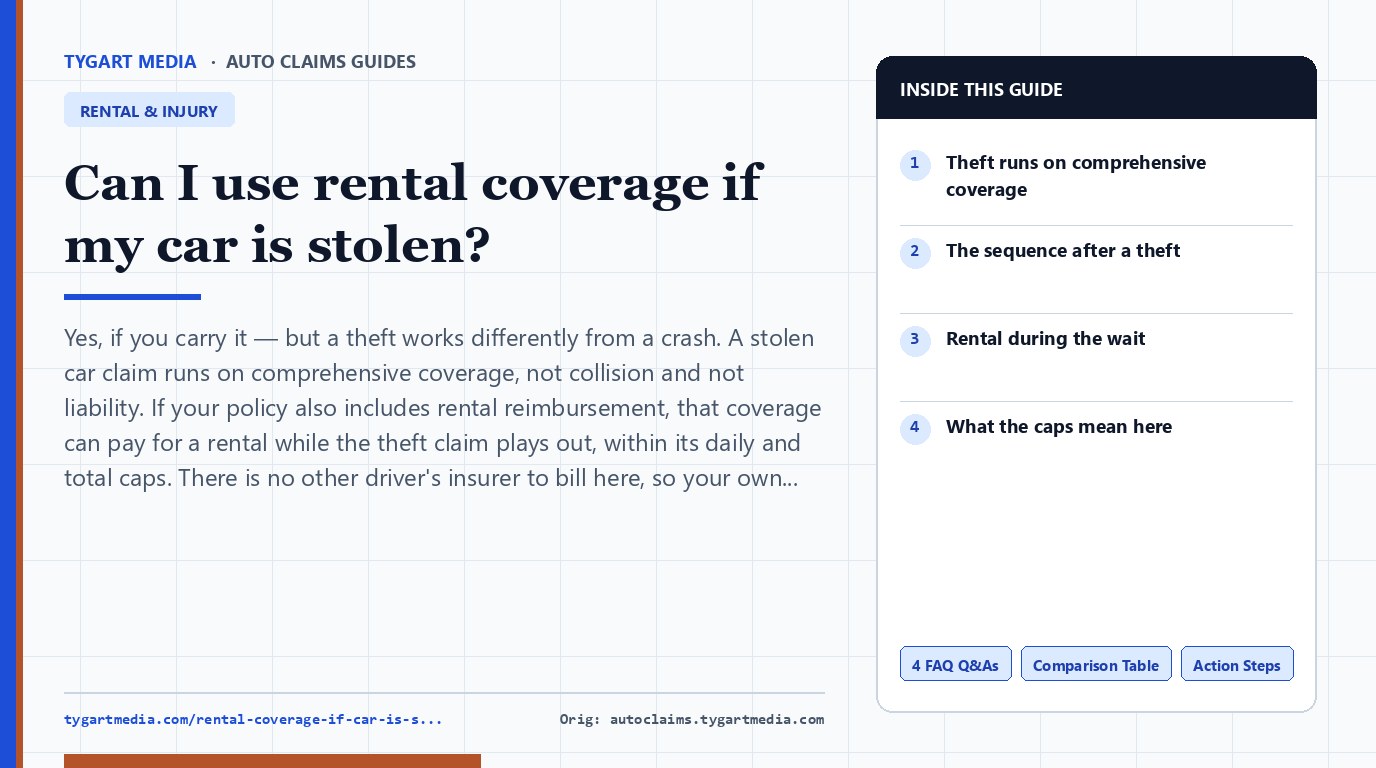
The short answer: yes, if you carry it — but a theft works differently from a crash. A stolen car claim runs on comprehensive coverage, not collision and not liability. If your policy also includes rental reimbursement, that coverage can pay for a rental while the theft claim plays out, within its daily and total caps. There is no other driver’s insurer to bill here, so your own coverage is the whole story — and its caps can run out before the theft claim is settled.
Theft runs on comprehensive coverage
Start with the coverage that actually responds. Comprehensive coverage is the part of an auto policy that typically covers theft of the car itself, along with other non-crash losses. Collision coverage covers damage from a crash or a rollover. Liability coverage pays for harm you cause to other people and their property. Neither of those pays for your own stolen car.
That distinction decides the rental question too. Rental reimbursement is a separate optional coverage you either bought or did not. Where it applies to a theft depends on your policy wording, but it is typically tied to a covered loss under the policy — and a comprehensive theft claim is the covered loss here. If you did not buy comprehensive, there is usually no theft claim at all. If you bought comprehensive but not rental reimbursement, the theft claim can still proceed, but no coverage is paying for the rental you are driving in the meantime.
Editor's Note
Check the declarations page, not your memory. Comprehensive and rental reimbursement are separate line items, and many drivers carry one without the other. The declarations page shows which ones you actually have and the rental limits that apply.
The sequence after a theft
File a police report first. Report the theft to the police as soon as you discover it. Insurers typically require a police report for a theft claim, and the report starts the record that everything else builds on. Keep the report number.
Tell your insurer. Open the comprehensive claim promptly and pass on the police report details. Ask at this first conversation whether your policy includes rental reimbursement, what its daily and total caps are, and when rental coverage starts on a theft claim.
Expect a waiting period. Insurers typically wait while recovery is possible before treating a stolen car as a total loss. That wait is often around 30 days, but it is typical practice, not a fixed rule — it varies by insurer and by case, so ask your adjuster what period applies to your claim and get the answer in writing.
Keep records while you wait. Rental agreements and receipts, claim numbers, and the dates of every conversation. If the caps or the timeline are later disputed, that paper is the claim.
Rental during the wait
If you carry rental reimbursement, it typically pays for a rental during the waiting period, the same way it pays during repairs after a crash: up to your daily cap, and up to your total cap for the claim. Some policies have rules about when rental coverage starts on a theft claim, so confirm the start date with the adjuster rather than assuming the rental is covered from the day the car disappeared.
Notice what is missing compared with a crash claim. In a crash caused by another driver, there is an at-fault insurer who may owe you a rental or loss of use. In a theft, there is usually no one to bill on the other side. The thief is not an insurer, and there is no liability claim to make. Your rental reimbursement, if you bought it, is the only coverage paying to keep you mobile — which is exactly the situation that coverage exists for.
The general framework for how replacement rentals work is in the guide to rental cars and loss of use. The theft version is simpler in one way — only your policy is involved — and harder in another: its limits are all there is.
What the caps mean here
Daily and total caps matter more in a theft than in most repair claims, because the timeline is not in anyone’s control. A repair has a shop working toward a finish date. A theft has a waiting period while the car may or may not be found, and the rental meter runs the whole time.
So do the arithmetic early. If your daily cap is below the rental rate you are actually paying, you are carrying the difference every day. And if the waiting period runs longer than your total cap allows, your rental coverage can end while the claim is still open — you then choose between paying for the rental yourself or going without until the claim settles. That situation, and what to do about it, is covered in the guide to what happens if rental coverage runs out before repairs are done; the same logic applies while a theft claim is waiting.
Important Notice
Ask about the end of rental, not just the start. Ask the adjuster what event stops rental coverage on a theft claim — the total cap, the end of the waiting period, or payment of a settlement — and get it in writing. Drivers are most often caught out not by the daily rate but by coverage ending on a day they did not expect.
If the car is recovered damaged
Stolen cars are sometimes found — abandoned, stripped, or damaged. If yours is recovered, tell the insurer promptly. The claim then typically shifts from the theft path to a repair path: the insurer assesses the damage, and the claim proceeds much like other comprehensive damage claims, with repair, or a total-loss decision if the damage is severe enough.
Rental coverage follows the claim as it changes shape. While the recovered car is being assessed and repaired, your rental reimbursement continues to be governed by the same daily and total caps — including whatever of the total cap the waiting period already used. Ask the adjuster to restate your remaining rental limits once the car is found, so you know where you stand for the repair stage.
If the damage makes the car a total loss instead, the value question takes over. How that value is decided is covered in the guide to total loss values.
Frequently asked questions
Does liability coverage pay for a rental after theft?
No. Liability coverage pays for harm you cause to other people and their property. It does not cover your own stolen car or a rental for you. A theft claim runs on comprehensive coverage, and a rental during the claim is paid by rental reimbursement coverage if you bought it, within its daily and total caps.
How long will insurance pay for a rental if my car is stolen?
For as long as your rental reimbursement coverage lasts, which means within its daily cap and up to its total cap for the claim. Insurers typically wait while recovery is possible, often around 30 days, before treating a stolen car as a total loss, and that wait can use up much or all of a total cap. Ask your adjuster what period and end date apply to your claim, in writing.
Do I need a police report for a theft claim?
Typically, yes. Insurers typically require a police report for a theft claim, and the report is the starting record for the claim. Report the theft as soon as you discover it, keep the report number, and give it to your insurer when you open the comprehensive claim.
What if my car is found after the claim settled?
Tell your insurer promptly. Where a total loss settlement has been paid, the insurer typically takes the recovered car or the salvage interest in it under the settlement terms, because the settlement bought the car. Read your settlement papers for what they say about recovery after payment, and follow them rather than assuming the car is simply yours again.
Informational only — not legal or insurance advice.
Auto repair and insurance rules vary by state and by policy. Check your own policy documents and your state’s insurance department, or talk to a licensed professional, before acting on a claim.
Rental coverage after a theft, at a glance
How a stolen-car claim and its rental coverage usually fit together
Step or question
What usually happens
Which coverage covers the theft
Comprehensive coverage. Not collision, and not liability.
First move
File a police report, then open the comprehensive claim with your insurer.
Waiting period
Insurers typically wait while recovery is possible, often around 30 days, before treating the car as a total loss. It varies.
Rental during the wait
Paid by your rental reimbursement if you carry it, within its daily and total caps. There is no at-fault insurer to bill.
Car recovered damaged
The claim shifts to the repair path, under the same rental caps.