
Notes from the Bot Lab · November 26, 2026 · By Will Tygart
Reading an architecture principle once in a blog post rarely changes what your hands do when a live AI session starts drifting at midnight. That is why I turn hard operating rules into 140 BPM songs in Flow Music — compressing stateless context mechanics into meter, rhyme, and brass so the right move fires automatically.
Why Reading Once Fails When the Clock Is Running
Everybody who works with large language models knows the textbook facts on paper. You read an essay, nod along, maybe drop a link in a folder, and figure you have the lesson locked down. Then two weeks later you are three hours deep into a thorny build, tired, trying to ship before morning, and you catch yourself arguing with a chat window as if it remembers the conversation you had last Tuesday.
Knowledge that sits passively in a note does not fire under load. You only act reliably on mental models that have been compressed until they have sharp edges — models small enough to carry in working memory without looking anything up. That is why I started writing songs in Google Flow Studio whenever a rule mattered enough that I refused to keep learning it the hard way.
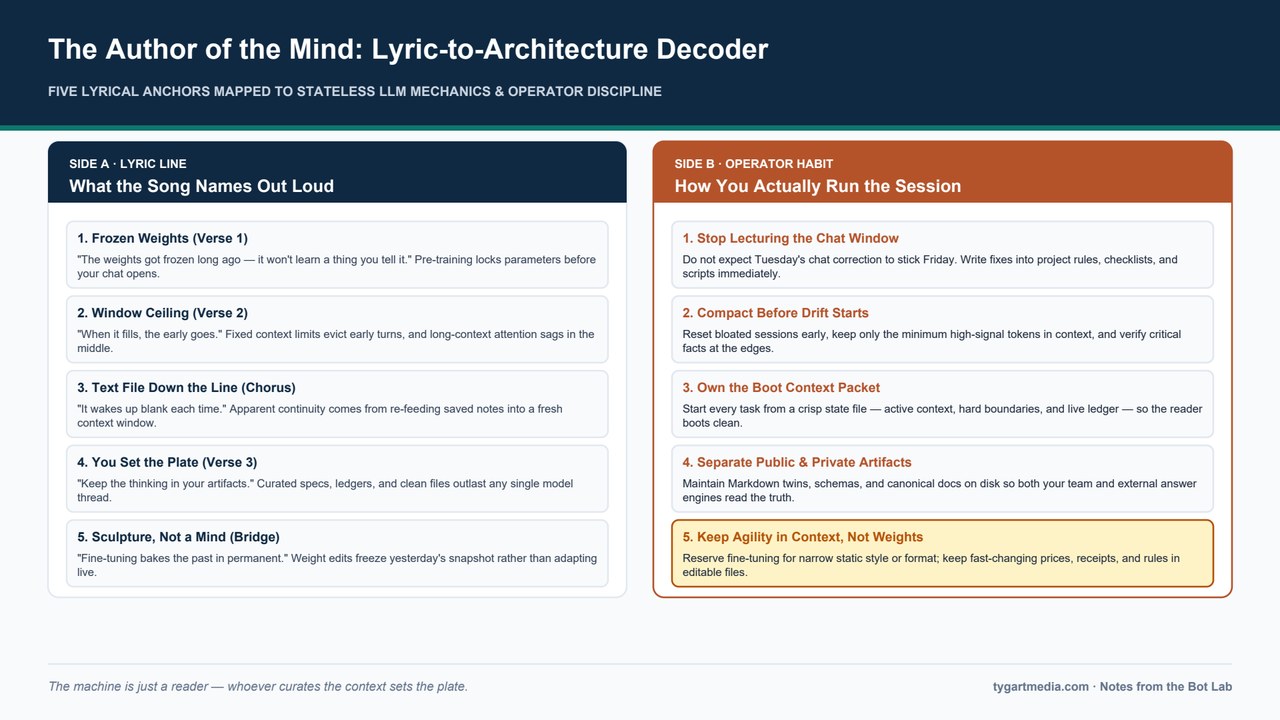
| Lyric Anchor | LLM Architecture Reality | Failure When Forgotten | Daily Operator Habit |
|---|---|---|---|
| Frozen weights (Verse 1) | Pre-trained parameters stay locked during inference; chat turns never update weights. | Lecturing the same chat window and expecting it to learn by Friday. | Write every hard-won fix into persistent rules and scripts on disk. |
| Window ceiling (Verse 2) | Fixed context length evicts early turns and attention sags across the middle. | Silent constraint drift halfway through a long build or audit. | Reset bloated threads early and anchor critical rules at prompt edges. |
| Text file down the line (Chorus) | Apparent continuity comes from reloading saved files into a blank session. | Confusing retrieved notes for organic memory across separate runs. | Own the boot context packet before typing your first instruction. |
| You set the plate (Verse 3) | The model reads whatever curated specs, tables, and truths you hand it. | Sloppy drafts, stale facts, and noisy context producing broken output. | Curate clean specs, verified receipts, and readable Markdown twins. |
| Sculpture, not a mind (Bridge) | Fine-tuning permanently bakes yesterday’s examples into model weights. | Freezing volatile facts or prices inside static parameters. | Keep changing state in live context files; leave sculpture for narrow style. |
Before this track, I wrote full albums inside Flow Studio in single late-night sessions — collections like Hold the Destination and Because They Said I Couldn’t Have It. Those projects taught me something simple: a melody with honest meter survives weeks of noisy work when a dozen bookmarked checklists vanish from your head by Friday.
So when I wanted one clean mental model for how stateless AI sessions actually work — why lecturing a model is pointless, why long threads quietly lose their grip, and why your files on disk are the real brain — I wrote The Author of the Mind (Iron Mix). Two minutes and twenty-six seconds, 140 BPM, assertive female vocals over brass fanfares, cello, and booming 808s.
Get The Signal
What we actually ran, what it measured, and what it means for a restoration shop — every week, including the flops.
The Four-Step Compression Furnace Behind “The Author of the Mind”
Making a track that actually burns in a mental model is not about generating pretty ambient noise. It works because songwriting forces you through four strict compression gates that prose lets you dodge.
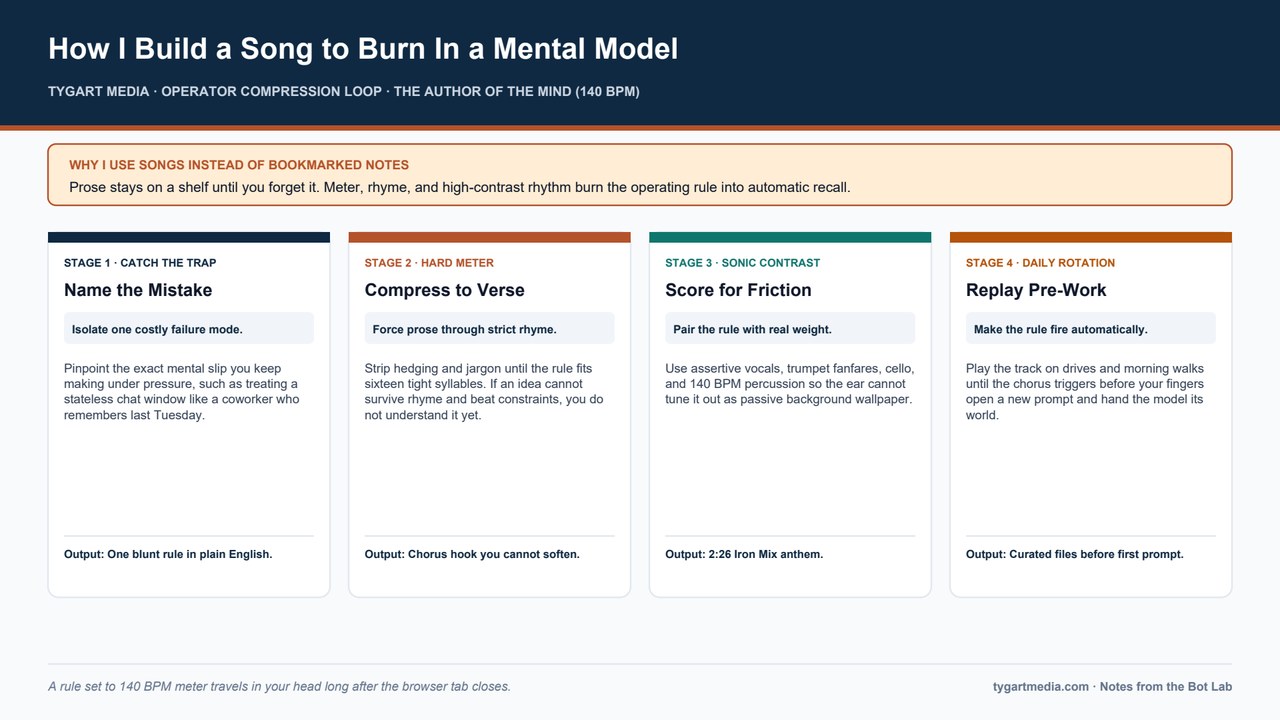
1. Name the expensive mistake first. Every song starts with a specific habit that keeps costing me time or quality. With LLMs, the mistake is mistaking conversational fluency for persistent memory. Even when you already understand context window capacity limits, your instincts still expect the tool across the desk to learn from yesterday’s feedback. Verse 1 calls that illusion out flatly: The weights got frozen long ago, the training day is done / It won’t learn a thing you tell it, not a lesson, not a one.
2. Force mushy prose through strict meter and rhyme. Writing a thousand-word memo lets you hide behind soft qualifiers. Writing a sixteen-syllable bar that lands cleanly on beat four strips away every decorative word. When you try to put mid-context attention loss and eviction into rhyme, you end up with two lines you cannot unhear: And the window has a ceiling — when it fills, the early goes / What it “remembers” from last week is just a note the system loads. That matches Anthropic’s context engineering guidance on keeping only the smallest high-signal token set active instead of piling up bloated history.
3. Score for sonic friction, not background wallpaper. Memory researcher Wanda T. Wallace demonstrated in the Journal of Experimental Psychology: Learning, Memory, and Cognition (1994; DOI 10.1037/0278-7393.20.6.1471) that pairing text with a repeatable melody and rhythmic structure measurably improves verbatim recall over spoken words alone. Calm lo-fi beats wash right past your ear while you answer email. Brass fanfares, rhythmic cello strings, and punchy 140 BPM percussion grab the room by the collar so the chorus lands with weight: So whoever loads the context is the author of the mind.
4. Replay the track before you touch the keyboard. Once the song sits in regular rotation on drives and walks, the chorus becomes an automatic pre-flight check. Instead of blaming a blank model or turning the reasoning dial up on the wrong job, you open clean cold-start context specs, feed a shared brain any model can read, keep your front-door website maintained with clean Markdown twins, and let your system soak instead of pulling the rig up every twenty minutes.
Sculpture vs. a Working Mind: The Full Lyrics
My favorite pair of lines in the whole song sits in the bridge — the distinction between baking lessons into model weights via fine-tuning versus keeping your operating intelligence in live, editable files. Even the original Flow Music cover art captured that tension: a white Carrara marble hard drive carved straight out of stone. Once you chisel something into weights, you have made a statue of yesterday. Keep the thinking in pages you can refine tomorrow morning.

Here is the complete lyric sheet for The Author of the Mind (Iron Mix), synced line-for-line in the video player above:
[Verse 1]
The weights got frozen long ago, the training day is done
It won’t learn a thing you tell it, not a lesson, not a one
All it holds is what you hand it, loaded in against the clock
A window full of words is all the memory it’s got[Verse 2]
And the window has a ceiling — when it fills, the early goes
What it “remembers” from last week is just a note the system loads
It doesn’t call the moment back, it reads it fresh instead
A database of yesterday re-fed into its head[Chorus]
It only knows what’s in the room, it wakes up blank each time
The continuity you’re feeling is a text file down the line
So whoever loads the context is the author of the mind
You carry in the soul each session — it was never his, it’s mine[Verse 3]
So the smart move isn’t trusting that the model holds your thread
Keep the thinking in your artifacts, the files and specs you’ve fed
The intelligence that lasts is in the pages you curate
The machine is just a reader — you’re the one who sets the plate[Bridge]
Now fine-tuning bends the weights, that’s true, it changes what’s inside
But it bakes the past in permanent — that’s sculpture, not a mind[Final Chorus]
It only knows what’s in the room, it wakes up blank each time
The continuity you’re feeling is a text file down the line
So whoever loads the context is the author of the mind
You carry in the soul each session — it was never his, it’s mine
Frequently Asked Questions
Why turn an AI architecture rule into a song instead of keeping it in notes?
Bookmarking a note leaves the lesson on a shelf until a live session drifts. Forcing an operating rule into strict meter, rhyme, and 140 BPM contrast makes it small enough to remember automatically right before you open a new prompt.
What does 'whoever loads the context is the author of the mind' mean in practice?
Every inference session wakes up with frozen pre-trained weights and zero living memory of yesterday. Whatever specs, ledgers, and clean context files you load into the room determine how the model reasons during that session.
When should you rely on curated context files versus fine-tuning model weights?
Use fine-tuning only when you want fixed stylistic habits or narrow output formats baked in like sculpture. Keep changing prices, project state, and operating constraints inside editable Markdown files and specs you load at runtime.
Get The Signal
What we actually ran, what it measured, and what it means for a restoration shop — every week, including the flops.
Leave a Reply