
On November 20, 2026, Jacob Colker — co-founder and managing director of Seattle’s AI House — posted a blunt note on LinkedIn: “I’m looking to write several $1M pre-seed checks, ideally before New Year’s.” He followed with three lines running straight against Silicon Valley’s trillion-dollar-TAM theater: “I DON’T BELIEVE in most AI infrastructure startups. The hyperscalers will eat their lunch.” “I DON’T BELIEVE every startup needs to be a $100B company.” “I DON’T BELIEVE hype is a substitute for business fundamentals. I prefer founders who know how to sell to their customers over founders who know how to sell to VCs.” Then came his four-line bet: “Here’s what I DO believe in: Boring industries. Broken workflows. Real customers. AI that makes things 10x better. Give me founders who understand an antiquated industry better than anyone else.” His closing bar: “A $1B market? Plenty big for me.”
We are not pitching AI House for a check, applying to a cohort, or asking for a meeting. We run a small lab in Tacoma out of property restoration — an original boring industry — and we just finished publishing the Washington AI Census, a verified directory of 100 independent Washington AI companies. That lets us test a LinkedIn thesis directly against Washington’s live AI map.
What AI House Is — And Why Check Sizes Differ Online
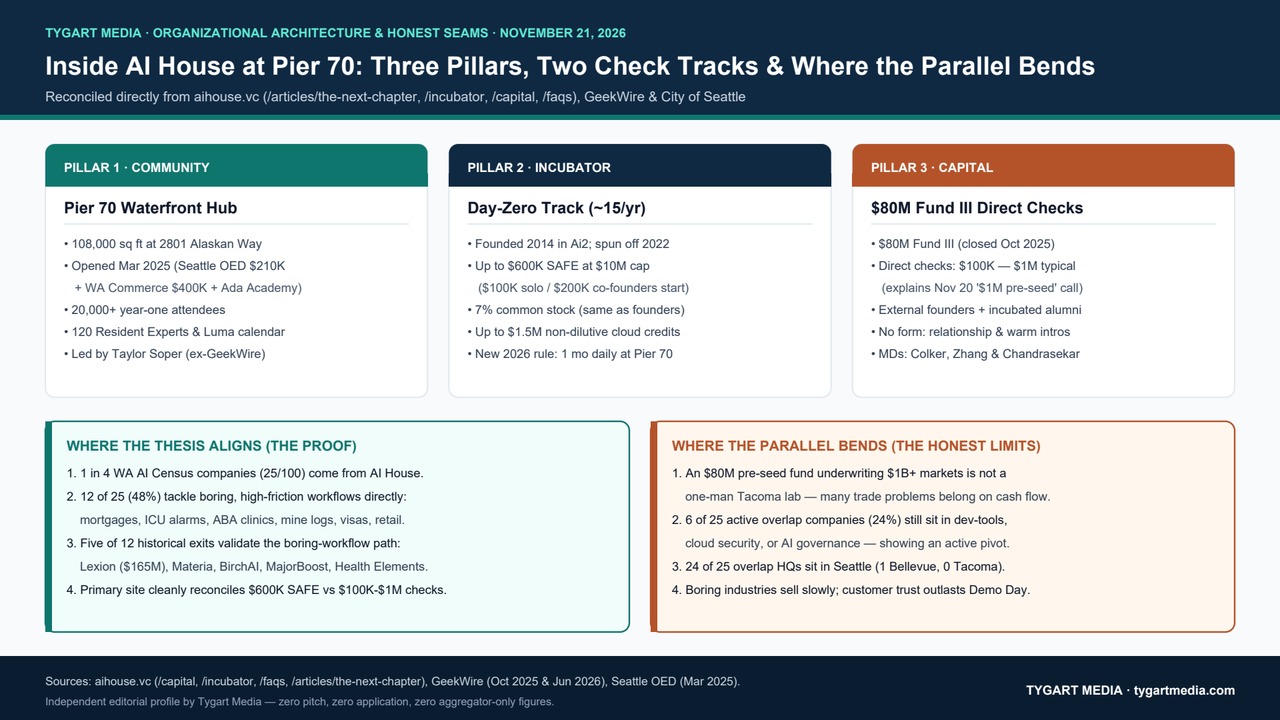
AI House is twelve years old under a new sign. Founded in 2014 as the AI2 Incubator inside the Allen Institute for AI (Ai2) — the Seattle research nonprofit started by Paul Allen — it spun off independently in 2022, opened a 108,000-square-foot waterfront hub at Pier 70 (2801 Alaskan Way) in March 2025, and rebranded officially as AI House on June 18, 2026, per GeekWire’s rebrand report and AI House’s announcement. The Pier 70 launch paired the incubator with Ada Developers Academy, $400,000 from the Washington State Department of Commerce, and $210,000 from the City of Seattle Office of Economic Development (City of Seattle release, March 27, 2025). More than 20,000 attendees came through in year one.
AI House runs on three pillars — Community, Incubator, and Capital — under three managing directors listed on its team page: co-founder Jacob Colker, Yifan Zhang, and Sri Chandrasekar (formerly Point72 Ventures and In-Q-Tel), who wrote the first check into Fund III before joining full-time at the June 2026 rebrand. Former Ai2 CEO Oren Etzioni serves part-time as technical director, and longtime GeekWire editor Taylor Soper directs community and programming. Incubated founders are now expected to spend at least one month working daily at Pier 70.
Reading AI House’s own pages also resolves an apparent check-size clash across startup directories, which often list $100,000–$600,000 while Colker’s post cites $1M checks. Both come out of AI House’s $80 million Fund III (GeekWire, October 2025; AI House June 2026 announcement), split across two tracks. On its Incubator FAQs, incubation (~15 companies/year) invests up to $600,000 on a $10M-cap SAFE ($100,000 solo or $200,000 co-founders to start), plus 7% common stock and up to $1.5 million in non-dilutive cloud credits. Separately, AI House Capital writes direct pre-seed checks — including into non-incubated founders — stating: “We typically invest between $100,000 — $1 million.” Colker’s $1M call sits at the top of that direct Capital track.
The Census Overlap: 25 of 100 Independent WA AI Companies
We pulled every card on AI House’s Incubator Companies page and joined it one-to-one against all 100 live profiles in our Washington AI Census. A company counted only if it held a live profile in our census and appeared on AI House’s own roster, verified by company identity and canonical domain — never name match or aggregator listings.
Get The Signal
What we actually ran, what it measured, and what it means for a restoration shop — every week, including the flops.
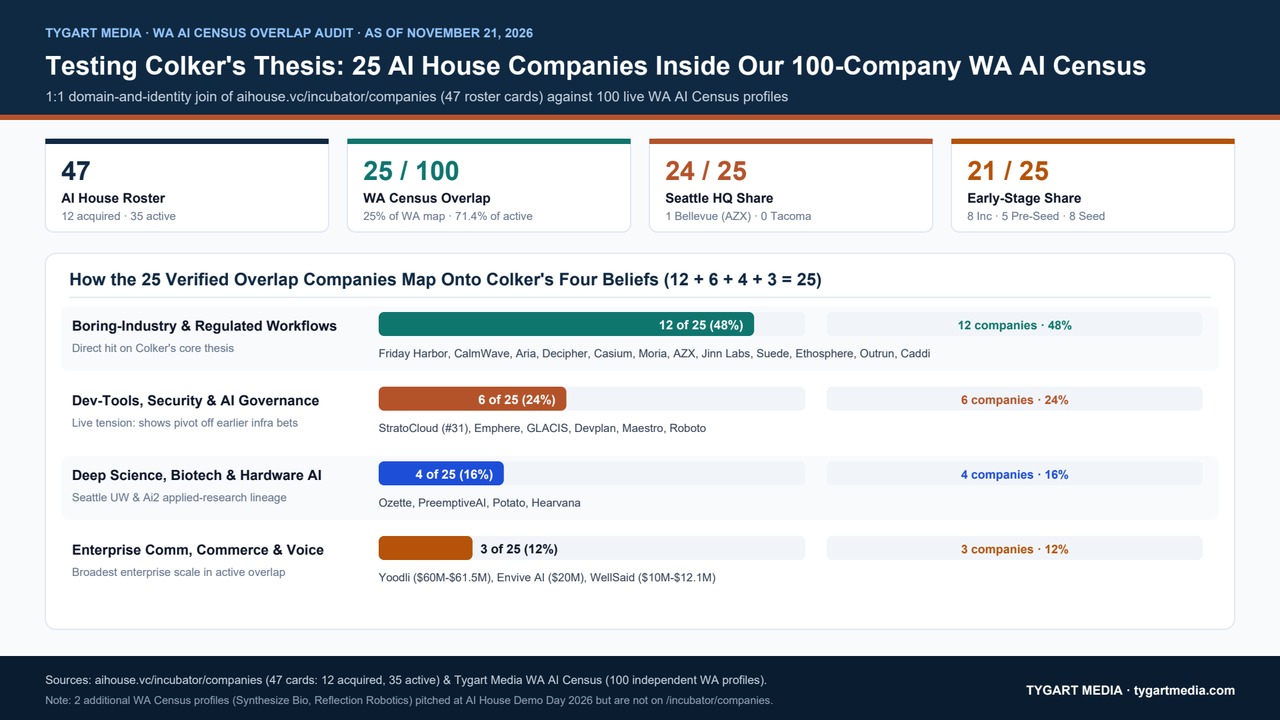
AI House lists 47 portfolio companies: 12 acquired alumni (excluded from an independent-company census by definition) and 35 active independent companies. Exactly 25 of those 35 (71.4%) appear in our 100-company Washington AI Census — 1 in 4 (25%) of the entire independent WA AI Census. Seven of AI House’s other ten active companies were already evaluated during census scoping and excluded on geography or verification gates (Los Angeles, Brooklyn, San Diego, New York, Montreal, an unresolved St. Louis HQ conflict, or a blank site). Two additional census profiles — Synthesize Bio and Reflection Robotics — pitched among 25 startups at AI House Demo Day 2026, but neither appears on /incubator/companies, so we keep the strict overlap at 25.
Testing the 25 Companies Against Colker's Four Beliefs
Almost half the active overlap — 12 of 25 (48%) — is pure boring-industry grit. Friday Harbor handles mortgage underwriting files; CalmWave cuts hospital ICU alarm fatigue; Aria automates behavioral-health and ABA clinics; Decipher untangles health benefits; Casium runs employer work visas; Moria parses mine-site drill logs; AZX builds custom AI for energy and utility ops; Jinn Labs tackles convenience-store shrink; Suede automates boutique buying; Caddi automates back-office workflows; Ethosphere analyzes retail floor conversations; and Outrun automates repetitive stationary industrial work. Five of AI House’s 12 exits mirror that lane: Lexion (legal contracts, Docusign $165M), Materia (tax and audit, Thomson Reuters), BirchAI (healthcare call centers, Sagility Health), MajorBoost (medical billing calls, Superdial), and Health Elements (clinical abstraction, Medisolv), alongside early research exits like Xnor.ai (Apple) and Kitt.ai (Baidu).
Yet 6 of the 25 active companies (24%) sit squarely in dev-tools, cloud security, or AI governance — including StratoCloud (Census #31, confirmed on AI House’s roster for cloud just-in-time access), Emphere (Dockerfile CVE remediation), GLACIS (verifiable AI compliance receipts), Devplan, Maestro, and Roboto. Four more (16%) are deep-science or hardware bets (Ozette, PreemptiveAI, Potato, Hearvana), and three (12%) are horizontal enterprise platforms (Yoodli, Envive AI, WellSaid). That mix matches Colker’s candid October 2025 quote to GeekWire — “We backed some developer tools and infrastructure plays… in hindsight, some of those companies plateaued” — proving his November 2026 post is a live course correction, not hindsight polish.
| Portfolio Bucket | Count (Share) | Verified AI House Companies in Our 100-Company WA AI Census | Fit Against Colker’s Thesis |
|---|---|---|---|
| Boring-Industry & Regulated Workflows | 12 of 25 (48%) | Friday Harbor, CalmWave, Aria, Decipher, Casium, Moria, AZX, Jinn Labs, Suede, Ethosphere, Outrun, Caddi | Direct hit: unglamorous workflows where domain depth beats demo polish. |
| Dev-Tools, Security & AI Governance | 6 of 25 (24%) | StratoCloud (#31), Emphere, GLACIS, Devplan, Maestro, Roboto | Live tension: shows the incubator pivoting off earlier infra bets. |
| Deep Science, Biotech & Hardware AI | 4 of 25 (16%) | Ozette, PreemptiveAI, Potato, Hearvana | Research-rooted applied AI from Seattle’s UW and Ai2 lineage. |
| Enterprise Comm, Commerce & Voice | 3 of 25 (12%) | Yoodli, Envive AI, WellSaid | Horizontal winners carrying the largest rounds in the active overlap. |
Boring From Our Side of the Table — And Where the Parallel Bends
From Tacoma, the instinct tracks our own work. In Factory Phil: Why Google Is Factory Boring, we argued that “boring” is a compliment when parts have to work every Tuesday morning. In We Come From Water Damage, we noted that physical trades enforce honesty because a moisture meter ignores pitch decks. And in The Quiet Door Into the Library, we saw how antiquated county records offices buy from operators who understand the real paper workflow and solve one concrete job cleanly.
An honest profile also names where the parallel bends. First, an $80 million pre-seed fund at Pier 70 and a one-man lab in Tacoma are not the same animal. Even “A $1B market? Plenty big for me” is a venture power-law threshold. Twenty-one of 25 overlap firms are Incubator, Pre-Seed, or Seed stage, and 24 of 25 sit in Seattle (only AZX is in Bellevue; zero of our 100 census firms are in Tacoma, though AI House’s rebrand welcomes Tacoma builders). Many broken trade workflows are durable $2M cash-flow businesses that never belonged on a SAFE.
Second, boring industries are boring partly because sales cycles crawl. Hospital ICUs, mortgage desks, mine operators, and ABA clinics have long memory and short patience for brittle software. Preferring founders who sell to customers over founders who sell to VCs is easy to applaud online and hard to survive through nine-month procurement. AI House has earned credibility on the thesis: its alumni account for a quarter of our independent Washington AI Census, and almost half are already working inside unglamorous verticals. Customer invoices — not Demo Day rooms — will grade the next wave of $1M checks.
— Will Tygart, Tygart Media.
Get The Signal
What we actually ran, what it measured, and what it means for a restoration shop — every week, including the flops.
Leave a Reply