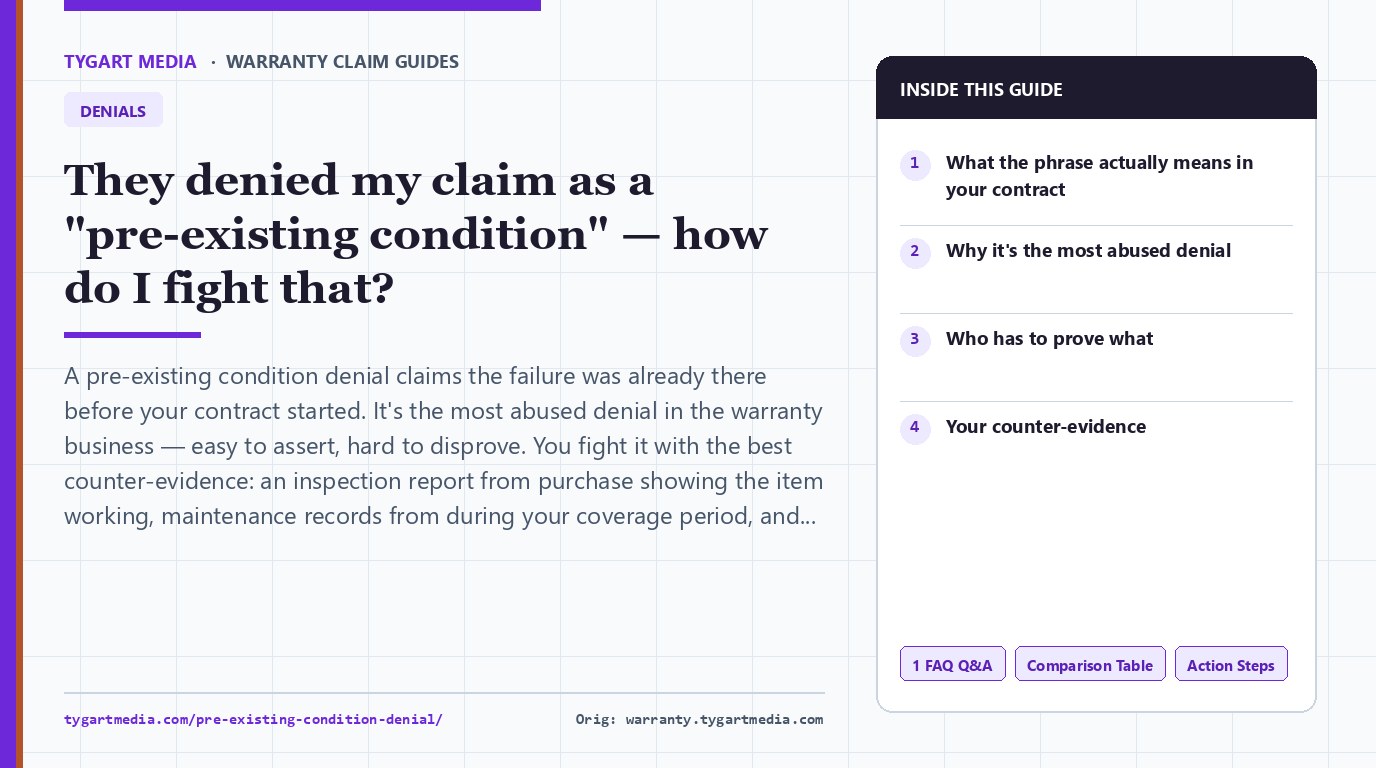
Tygart Media · Warranty Claim Guides · Denials
What the phrase actually means in your contract
“Pre-existing condition” doesn’t mean what it sounds like in conversation. It doesn’t mean the cause existed before — every failure has an earlier cause. It means the failure itself, or a condition that would have been detectable before coverage began, predates your contract. Read the definition in your own contract, because the wording varies and the wording is what governs. Some contracts define it narrowly (a failure the buyer knew or should have known about); others define it so broadly that nearly any failure could qualify.
Why it’s the most abused denial
This denial is the favorite of bad actors for a simple reason: it’s nearly unfalsifiable. The company asserts the problem was already developing; you, the consumer, are asked to prove a negative — that nothing was wrong on the day coverage began. An independent mechanic or technician can sometimes date a failure by its nature (a sudden snapped part vs. long-term sludge buildup), but you’re fighting on their turf. Knowing this, your job is to stack every piece of affirmative evidence that the item was healthy when coverage started and during the coverage period.
Who has to prove what
The company denied the claim, so in a dispute it’s generally their burden to support the denial with evidence — a technician’s report, an inspection finding, something concrete. A bare assertion (“our technician determined it was pre-existing”) without a written basis is weak. Ask for the evidence in writing: the inspection report, the technician’s notes, the specific finding that dates the failure to before your coverage. If they can’t produce it, say so in your appeal.
Your counter-evidence
- Inspection reports from purchase. A pre-purchase inspection — on a vehicle, a home appliance, anything — that shows the item in working order is your single strongest document. It dates the item’s health to the start of coverage.
- Maintenance history during coverage. Dated service records showing the item working and maintained after the contract began undercut any claim that it was already failing. Shops that serviced it during that period may have records even if you lost yours. How to build your claim file →
- An independent professional’s opinion. Have your own mechanic or technician examine the failure and give a written opinion on its cause and likely timing. “This is consistent with a sudden failure, not a gradual pre-existing condition” is the sentence that wins appeals.
- The timeline of symptoms. When did you first notice the problem? Write it down, with dates. A failure that appeared suddenly, with no prior symptoms, is harder to call pre-existing than one you lived with for months.
Fighting “pre-existing condition”
| Their claim | Your counter |
|---|---|
| “It was already failing” | Inspection report at purchase showing it worked |
| “Wear predates coverage” | Maintenance records proving upkeep |
| “No proof it’s new” | Shift the burden — make them prove it predates |
Get The Signal
What we actually ran, what it measured, and what it means for a restoration shop — every week, including the flops.
Leave a Reply