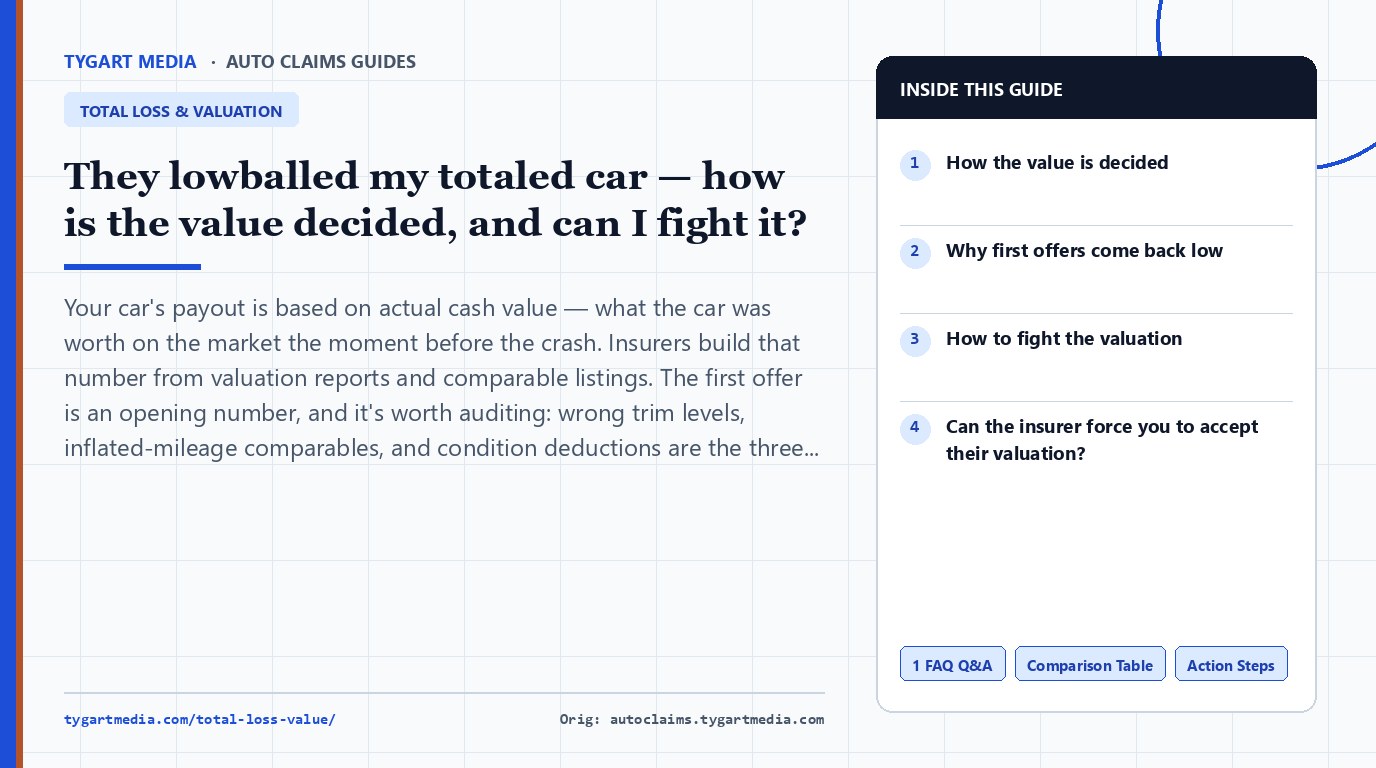
Tygart Media · Auto Claims Guides · Total loss & valuation
How the value is decided
When repair costs exceed the car’s value (or state law’s total-loss threshold), the insurer declares it a total loss and pays you the car’s actual cash value, minus your deductible if you’re claiming through your own policy. The value comes from a valuation report that looks at:
- Comparable vehicles for sale — same year, make, model, and trim in your region.
- Mileage adjustments — higher mileage than average lowers the value.
- Condition adjustments — wear, prior damage, and maintenance history.
- Options and packages — trim, drivetrain, and factory options.
Note what the number is not: it is not what you paid, what you owe on the loan, or what a replacement costs. That gap catches people by surprise. Gap insurance →
Why first offers come back low
- Wrong trim or options — the report lists your car as a base model when it’s a higher trim.
- Bad comparables — listings from far away, much higher mileage, or cars in worse condition.
- Condition deductions — deductions for “average wear” your car didn’t have.
- Speed over accuracy — the valuation is generated quickly; nobody checks whether the inputs match your actual car.
How to fight the valuation
- Ask for the valuation report in full. You’re entitled to see the math. Go through the comparables one by one.
- Find your own comparables. Search listings for your exact year, trim, mileage range, and region. Screenshot them with dates and prices.
- Document what the report missed. Recent tires, brakes, timing-belt service, new battery — anything that made your car worth more than average. Receipts count.
- Dispute in writing. Send the adjuster your comparable listings and evidence with a clear counter-number. Phone calls don’t create a record; emails do.
- Ask for a supervisor review if the adjuster won’t move, and check whether your policy has an appraisal clause — each side hires an appraiser and they settle the value.
Can the insurer force you to accept their valuation?
No — you don’t have to agree, and you shouldn’t sign the settlement release while you disagree. But be clear-eyed about the leverage on each side: the insurer can hold its number and close its file at that figure, and your counter-leverage is evidence and process, not refusal alone. In order: corrected comparables and documentation, a supervisor review, your policy’s appraisal clause (each side hires an appraiser; together they pick an umpire who helps settle the value), a complaint to your state department of insurance, and — where the amount justifies it — small claims court. Each step works better with the written record from the step before it.
Which comparables should you use to challenge a valuation?
The strongest comps are the ones hardest to argue with: the same year, make, model, and trim as your car; mileage close to yours; for sale in your region, not across the country; and currently listed or recently sold, not stale listings from months ago. Screenshot each one with its date and price showing. Three tight comparables beat ten loose ones — every comp that differs from your car in some obvious way is a comp the adjuster can wave off.
If they repair it instead of totaling it
Some cars land just under the total-loss threshold and get repaired instead. That outcome creates a different claim: a repaired car with an accident on its history is worth less than it was, and that loss — diminished value — is usually claimable against the at-fault driver’s insurer. It is a separate element from the repair payment, measured after the repairs are done. What is a diminished value claim? →
Total loss, question by question
The total-loss process, one question at a time — each guide answers the thing people actually ask at that point:
- What is actual cash value for a totaled car? — the definition the whole settlement is built on, and where its inputs hide.
- How do CCC valuation reports work? — what’s inside the report behind your offer, and how to audit it line by line.
- What fees are included in a total loss payout? — the full stack: value, taxes, fees, deductible, salvage.
- Total loss payout vs loan balance — what happens? — when you owe more than the car was worth, and what your options are.
- How long does a total loss claim take? — the stages, the typical timing, and what stalls it.
- How to document my car for a total loss claim? — the photos and records to capture before the tow truck takes it.
- What is gap insurance — and does it apply to my claim? — the coverage that erases the loan gap when the payout falls short.
How total-loss value is decided
| Their number comes from | Your counter-evidence |
|---|---|
| CCC / Mitchell valuation report | Your own comparable listings (same trim, mileage, region) |
| Condition adjustments downward | Maintenance records, pre-crash photos |
| “Comparable” cars in other markets | Local comps — your market is what matters |
| Deductions for prior damage | Proof it was repaired, or that it predates your ownership fairly |
Get The Signal
What we actually ran, what it measured, and what it means for a restoration shop — every week, including the flops.
Leave a Reply