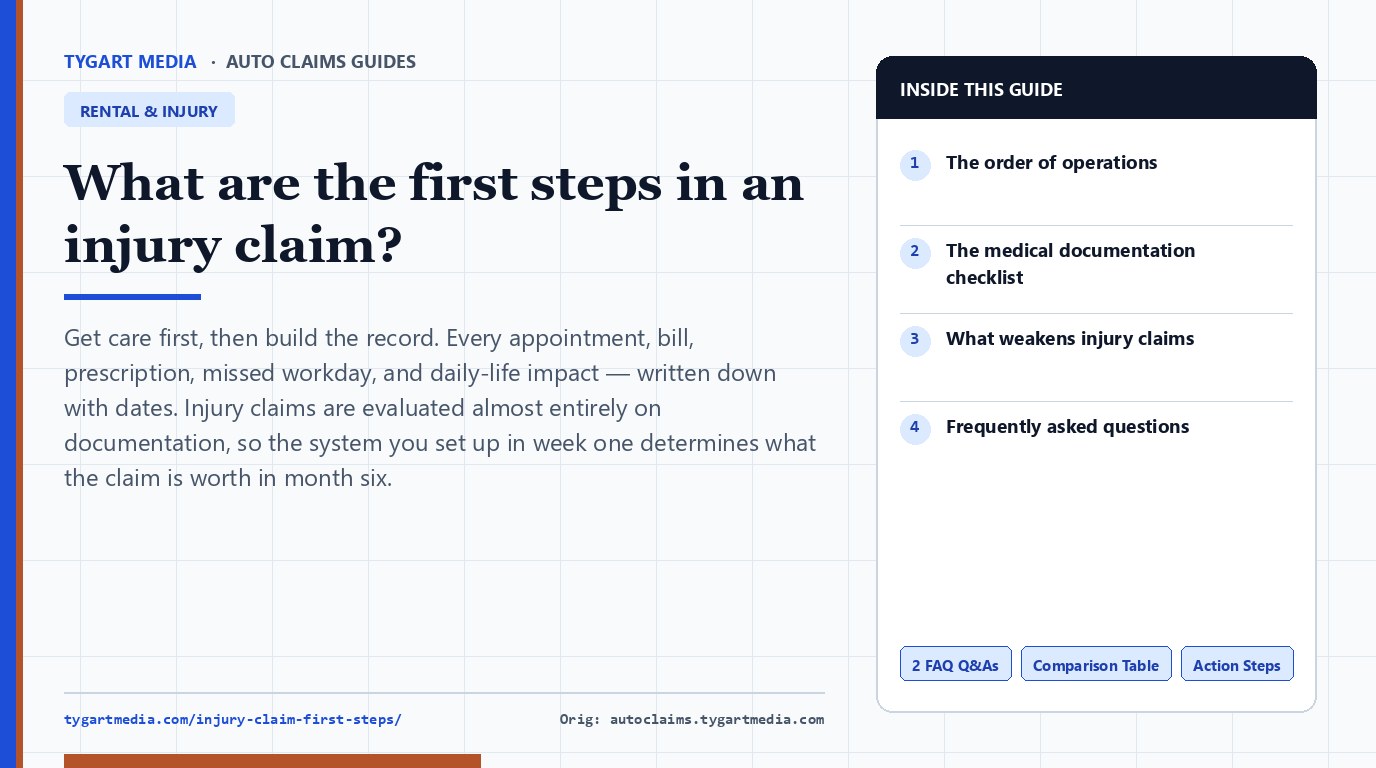
Tygart Media · Auto Claims Guides · Rental & injury
The order of operations
- Get medical care promptly. This is a health decision first. Adrenaline masks injuries, and delays in care become delays in documentation.
- Document every visit. Provider name, date, what was done, what was prescribed, next steps. Keep every bill and receipt.
- Keep a daily journal. Pain levels, sleep, work missed, activities you couldn’t do — dated, in your own words. This is evidence, not venting.
- Notify the relevant insurers — yours and, where appropriate, the at-fault driver’s — but keep statements to facts.
- Don’t sign broad medical releases for the other insurer early. They can use a full history to argue pre-existing conditions. Narrow, relevant records only.
- Track lost income. Pay stubs, employer letters, missed shifts — wage loss needs proof just like medical bills do.
The medical documentation checklist
The steps above, gathered into one list. This is the file an injury claim is evaluated from — if a document is on this list, keep the original and a copy:
- Emergency or urgent-care discharge papers — from the first visit after the crash.
- Each provider’s visit notes — every appointment, not just the first one.
- Imaging reports — the written report, not just the order for the scan.
- Prescriptions and pharmacy receipts — what was prescribed, and what you paid.
- Therapy and rehabilitation notes — showing progress, limits, and attendance.
- Itemized bills — from every provider who treated you.
- Your dated daily journal — symptoms, pain, sleep, missed work, and activities you could not do.
- Wage-loss proof — pay stubs and an employer letter covering the time you missed.
Keeping the file and sharing it are two different things. Share the records relevant to this injury — that is what the list above is. A broad medical release, the kind the steps above warn against, hands the other insurer your full history and invites the argument that your condition was pre-existing. Narrow and relevant beats broad and early.
What weakens injury claims
- Gaps in care — weeks with no treatment get read as “got better,” whether or not that’s true.
- Social media — posts showing activity contradict the journal. Lock it down during the claim.
- Quick settlements — the first offer arrives before the full picture does. Don’t sign a release until treatment is complete and the total is known.
Frequently asked questions
What medical documentation do I need for an injury claim?
Keep the discharge papers from your first emergency or urgent-care visit, every provider’s visit notes, imaging reports (not just the orders), prescriptions and pharmacy receipts, therapy and rehabilitation notes, and itemized bills. Add your dated daily journal and wage-loss proof — pay stubs and an employer letter. Share records relevant to the injury; a broad medical release gives the other insurer your full history and invites arguments that the injury was pre-existing.
Injury claim first steps
| Step | Why it can’t wait |
|---|---|
| Get medical care immediately | Gaps in treatment get weaponized against you |
| Don’t give recorded statements yet | Talk to a lawyer first — it’s free to consult |
| Preserve everything | Photos, medical records, wage loss docs |
| Know your state’s deadline | Statutes of limitations run 1–6 years by state |
Get The Signal
What we actually ran, what it measured, and what it means for a restoration shop — every week, including the flops.
Leave a Reply