Tag: AEO

  • How do you measure AI search visibility?

    Updated November 2, 2026 — added direct answers on visibility metrics and AI search share of voice, from our own published measurement.

    You measure AI search visibility with two kinds of tools: the reports the platforms publish about their own answers, and trackers that ask the assistants your customers’ questions on a schedule and record who gets named. The platform reports show who the platform cited. The trackers show what an assistant answered when asked. A buyer who knows which tool shows which thing can read either one honestly.

    What does “visible” mean in an AI answer?

    An AI answer can mention your business, cite your business, or recommend your business, and those are three different measurements. A mention means your name appears in the answer text. A citation means the answer credits your page as a source. A recommendation means the assistant names you as the choice. Every tool below reports some mix of the three, under its own labels.

    The distinction decides what a number is worth. A mention can be one name in a list of eight. A citation means the platform read your material closely enough to credit it — that is the receipt that survives. A recommendation is the strongest outcome and the least common. When a tool shows you one big “visibility” number, the first question is which of the three it counted.

    What metrics matter for AI search visibility?

    Traditional search metrics like keyword rank and search volume do not apply to AI assistants. A complete measurement framework tracks five distinct metrics, as established in our guide to measuring LLM visibility and our three-layer visibility measurement framework:

    • Citation frequency: The total number of times your domain or brand is cited as a source in AI-generated answers over a measured window.
    • Prompt coverage: The percentage of your sampled buyer queries where your brand or content appears anywhere in the output.
    • Share of voice: The proportion of citations your domain earns on a specific prompt set compared to named competitors.
    • AI referral traffic: The volume of qualified sessions arriving on your site from AI platforms, tracked via custom GA4 channel groups.
    • Citation-assisted conversions: Inquiries, form submissions, and booked jobs that originate from or touch an AI search session.

    What is share of voice in AI search?

    Share of voice in AI search—also termed share of authority—is the percentage of total citations awarded to a specific domain across a fixed set of prompt tests. Unlike a simple citation count, share of voice measures your presence relative to every other source cited for the same queries.

    Consider a live worked example from Tygart Media’s own tracking on November 2, 2026. Across a Clarity measurement run evaluating the topic “AI citation rate measurement” (101 total citations distributed across approximately 50 competing domains), the single leading domain captured 8.91% of citations (9 citations). Tygart Media earned a 0.99% share of authority (1 citation). In an emerging, fragmented AI search topic where no single authority owns the category, tracking share of voice across recurring runs reveals whether your content is steadily accumulating citations or losing share to competing domains.

    What does Bing AI Performance show?

    Bing AI Performance is Microsoft’s free first-party report, and it shows what the assistants built on Bing actually cited. The report organizes citations four ways: Intents, Topics, Citation Share, and Compare. It is the platform grading its own homework — the most direct evidence a buyer can get, and a view of exactly one surface.

    The four views answer four plain questions. Intents shows the kinds of things people were trying to do when your pages got cited. Topics groups those citations by subject, so you can see which of your subjects the machines trust. Citation Share shows your slice of the citations on a topic against everyone else cited there. Compare puts two date ranges side by side, so a change shows up as a change and not a feeling.

    Our own report is the example we read every month. For tygartmedia.com, our Bing AI Performance report covering six months of Microsoft Copilots and partners shows 1.5M total citations across an average of 164 cited pages. We read that as our footprint on one measured surface — proof the surface can be measured, and a baseline to compare the next run against. It says nothing about any other platform, and it is not a promise about any other business.

    What do third-party visibility trackers show?

    Third-party trackers are subscriptions that ask a fixed set of questions to the major assistants on a schedule and record the answers. A tracker shows mention rates, citation rates, and competitor shares across several surfaces at once. What it sells is a trend line across platforms, built from sampled asks — not a record of what any real customer saw.

    The honest advantages are real. A tracker sees surfaces the first-party reports cannot, because each platform only reports on itself. A fixed question set, asked the same way each run, produces runs a buyer can actually compare. Competitor context comes built in, and in a contested market that context is the point.

    The limits are just as real. The tracker asks its questions, on its schedule, from its accounts — your customers ask differently, locally, and once. Small question sets get reported as precise percentages, and a two-question swing can dress itself up as a trend. And the subscription runs whether you read it or not. A tracker earns its money in a competitive market with several assistants in play, read monthly by someone who acts on it. Everywhere else it is an expensive screensaver.

    What can no tool tell you?

    No tool can tell you what a specific customer saw, whether a mention became a phone call, or why an assistant chose a competitor. AI answers vary by person, place, and moment, and the platforms do not publish their reasoning. A tool shows outputs. The cause behind an output is still the buyer’s work to figure out.

    Sit with that limit before you buy anything, because it is where the honest tools end and the salesmanship starts. No report closes the gap between “the assistant named us” and “the phone rang” — that gap closes with call tracking and asking customers how they found you, unglamorous as that is. A provider who sells you certainty across that gap is selling you the gap.

    Which tool should a buyer start with?

    A buyer should start with the free first-party report for the surface their customers actually use, and add a tracker only when they need a cross-platform trend and will read it monthly. The tool matters less than the discipline behind it: a fixed set of your customers’ questions, asked before the work and after, with the raw answers kept. Any tool run that way beats a better tool run casually.

    Most small businesses find the first-party report is enough to start, because it answers the only question that changes what they do next: on the questions my customers ask, who does the machine name — and is it me? If you want that first measurement done by hand instead, our AI Citation Quick-Scan asks 10 prompts about your service line and returns a scored report within 7 days — $97, one time.

    Which lines the platforms lift is their call. We build the material they lift from — and then we measure what they did.

  • Which AI SEO services are right for a small business?

    The right AI SEO services for a small business are the ones matched to where your customers actually ask questions. For most local service businesses, that means three things, in order: a business profile the machines can read, answer pages on your own website written the way customers ask, and a scheduled check that shows who the machines name.

    What are AI SEO services?

    AI SEO services are services that make a business readable to AI answer engines. A traditional search engine returns a list of links; an AI assistant returns an answer, and it names the businesses it can read clearly. AI SEO is the work of giving those systems clean material — profiles, pages, and consistent facts — to name you from.

    The category is new enough that the label covers very different work. One provider’s “AI SEO” is a rebuilt Google Business Profile and a page of real answers. Another’s is a software subscription and a monthly PDF. The sections below separate the kinds, so you can buy the work instead of the label.

    What kinds of AI SEO services are there?

    AI SEO services come in five kinds: listing and profile work, answer-page writing, citation cleanup across directories, one-time audits that measure where you stand, and ongoing retainers that bundle all of it. Most small businesses need the first three once, the audit before and after, and a retainer only when the market moves fast.

    • Profile work builds the listings machines read first: Google Business Profile on Google’s side, Bing Places on Microsoft’s — the listing Copilot and the assistants built on Bing read from.
    • Answer-page writing puts pages on your own website that answer customer questions in customer language, in passages short and plain enough to be quoted.
    • Citation cleanup makes your name, address, phone, and services agree across directories and aggregators — Yelp, Foursquare, Apple Maps, Angi, and the data feeds behind them.
    • Audits and scans measure the starting point: a fixed set of questions, asked before the work and after, with the answers kept.
    • Retainers bundle the above into monthly work. They fit businesses in fast-moving markets; they are a poor fit for one-time fixes billed forever.

    How is AI SEO different from traditional SEO?

    Traditional SEO earns a position on a list of links; AI SEO earns a mention inside an answer. The list rewards the page; the answer rewards the clearest source. Both run on the same foundations — a readable website, consistent business facts, reviews, and real expertise — but the AI layer reads quotable passages, not just pages.

    That difference changes what good work looks like. A page stuffed with keywords can rank and still never be quoted, because there is no clean passage to lift. A plainly written answer — the question as the heading, the answer first, the detail after — gives an assistant something it can repeat word for word. Traditional SEO is not replaced by this; it is the floor it stands on.

    What should a small business buy first?

    A small business should buy in the order a customer asks. First, the profile a machine reads when someone asks for your trade nearby — your Google Business Profile and your Bing Places listing. Second, answer pages on your own site. Third, a measurement check. Software subscriptions and content volume come last, if at all.

    The order matters because the surfaces compound. An assistant answering “who does this work near me” starts from profiles and listings, then checks what your website says. A beautiful website behind an empty profile is invisible at the first step. A strong profile pointing at a website with no answers gives the machine nothing to quote. Buy the chain in order and each link makes the next one worth more.

    How much do AI SEO services cost?

    AI SEO services are sold three ways: one-time builds, monthly retainers, and small diagnostics. The honest difference is not the label but what you can hold afterward — a finished profile and pages you own, or a report you can re-run. Any price is too high for work you cannot inspect when it is done.

    Price follows scope: number of locations, number of services, number of towns you serve. What should make you careful is shape, not size. One-time work — a profile build, an answer page, a listing cleanup — should carry a one-time price. Monthly money should buy monthly work you can name: new questions tested, new answers written, changes logged. If a provider cannot tell you which of your dollars are one-time and which recur, that is the answer to whether to sign.

    What questions should I ask an AI SEO provider before I pay?

    Ask an AI SEO provider five questions before you pay: What exactly will exist when you are done? Which questions will you test, and can I see the answers before and after? What do you not control? What does the work cost once, and what recurs? Who owns the pages and profiles afterward? Ask us the same five.

    Each question has a tell. “What will exist” should produce a list, not adjectives. “Which questions” should produce your customers’ actual questions, written down. “What do you not control” is the honesty test — no provider controls which businesses an assistant names, and one who promises a ranking is telling you how the rest of the engagement will go. Ownership is the quiet one: profiles and pages built on your accounts, in your name, stay yours if you leave. Anything else is rent.

    What proof should an AI SEO service show me?

    An AI SEO service should show you a named report, a date range, and the questions it tested — not a screenshot of a ranking. On our own site, the proof habit looks like this: our Bing AI Performance report for tygartmedia.com, covering six months of Microsoft Copilots and partners, shows 1.5M total citations across an average of 164 cited pages.

    Read those numbers the way we do. They are our own footprint on one measured surface — evidence that the measurement exists and that we live under it — not a promise about your business. AI answers also churn: the same question asked next month can name different businesses, which is why honest proof is a before-and-after on your questions, re-asked on a schedule, with the raw answers kept. A provider who shows you their own numbers should be just as willing to show you yours.

    Can I do AI SEO myself?

    Yes — the free layer of AI SEO is real work any owner can do: claim and complete your Google Business Profile and Bing Places listing, write your services in plain language, and answer your customers’ common questions on your own site. What you pay a provider for is the audit discipline, the writing time, and the measurement habit.

    Be honest with yourself about which of those three you will actually do. The profile most businesses already “have” is a name, a pin, and hope — claimed years ago and never finished. The knowledge is not the scarce part; the finished, checked, written-down work is. If you will do it yourself, the sections above are the whole recipe, in order, and they will work the same for you as for us.

    Where does our own offer fit?

    If you want to know where you stand first, our AI Citation Quick-Scan runs 10 prompts about your service line and returns a scored report within 7 days — $97, one time. If you want the build done, the Ask Maps Protocol is our version: $450, one time — a mobile-first audit of how your listing actually renders, your Google Business Profile rebuilt for answers, an FAQ answer page on your website, your Bing Places listing claimed and matched, and a 30-day proof check.

    Which lines the platforms lift is their call. We build the material they lift from — and then we measure what they did.

  • Yes, I Put the Schema Where You Could See It. On Purpose.

    Yes, I Put the Schema Where You Could See It. On Purpose.

    I had an audit run on the oldest content on this site this week. Pages, posts, links, bylines, search descriptions, the works. It came back with a ranked list of problems, and near the top, flagged as a defect readers can see, was this:

    Visible raw JSON-LD schema code printed as text in the post body.

    Across the whole site, it found 197 posts doing it.

    Cartoon crawler robot stamping FLAGGED on a blog post full of visible code while the blogger gives a sheepish thumbs-up
    My own audit, doing exactly what I asked it to do. Rude.

    And I’ll be honest, my first reaction wasn’t “oops.” It was closer to “hey, I did that on purpose.”

    What you’re looking at

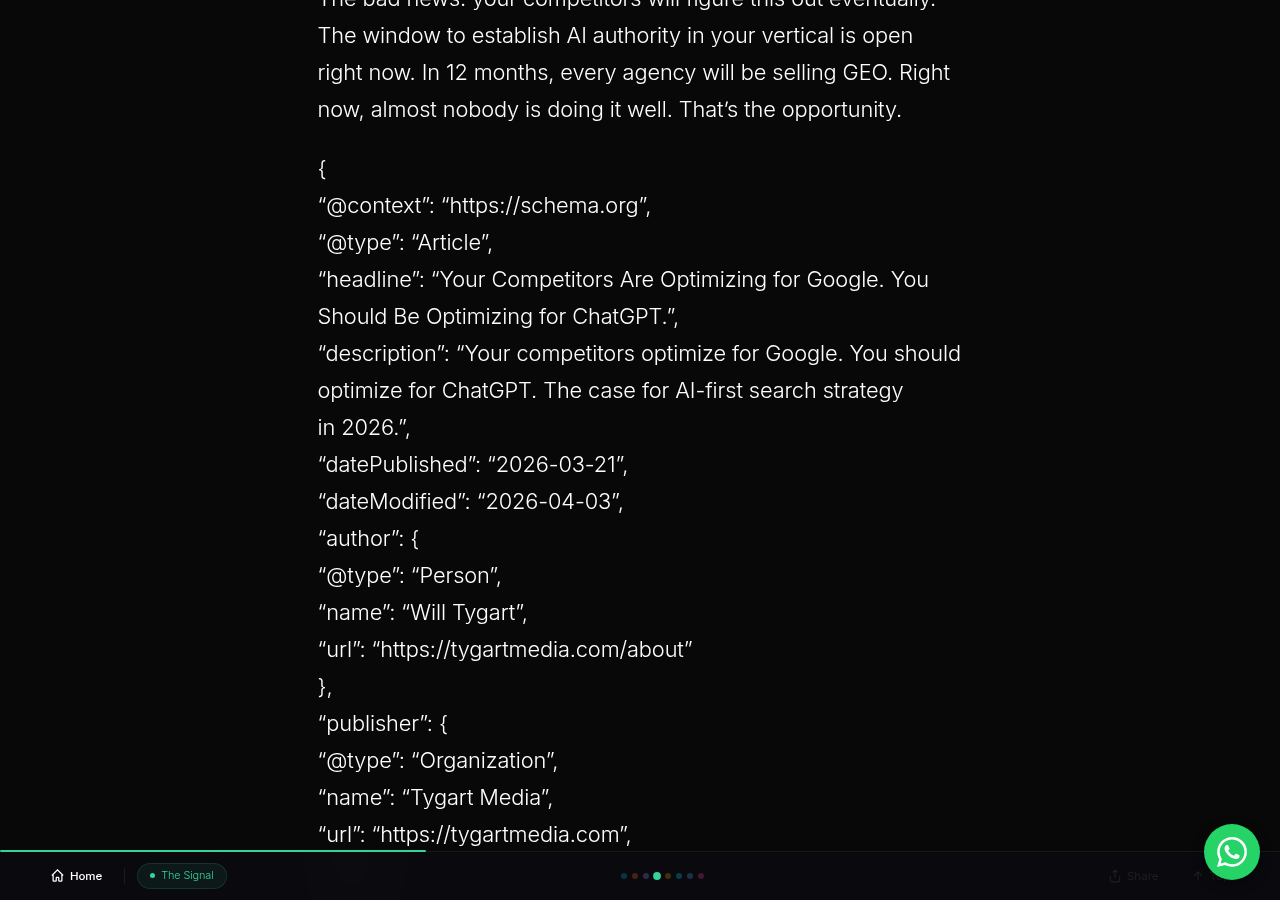
    If you’ve scrolled to the bottom of some of my older posts, you’ve seen it: a block of curly braces, "@context": "https://schema.org", a headline, an author, a publisher, a date. It’s structured data. The machine-readable summary of what the page is, who wrote it, and who published it.

    Normally that lives in a <script type="application/ld+json"> tag. Readers never see it, and crawlers pick it up behind the scenes. I know how to do it that way. Plenty of these same posts had it that way too.

    I also put a copy out front, in the body, where anyone could read it.

    Before: the end of “Your Competitors Are Optimizing for Google. You Should Be Optimizing for ChatGPT.” with its Article schema printed as visible text, curly quotes and all
    Before. The article ends, the schema begins. Those curly quotes are lovely typography and terrible JSON.

    Why I did it

    This didn’t come out of nowhere. Back when I published these, I’d already been at it a while: for about a year before that, my everyday workflow was screenshotting schema and photos and pasting them into AI tools to get help with them. That was on my own desk, not on the website. But do that long enough and you get in the habit of thinking about the page as something a machine reads, not just something a person reads.

    When it came time to publish these posts, my reasoning was simple. Not everything that reads a web page reads it the way Google does. Screen readers, accessibility tools, and whatever crawler or AI agent happens to show up next don’t all go digging through script blocks. Some of them only take in the text on the page.

    So I thought: if the structure matters, and I was betting heavily that it did, especially for AI and answer engines, then why hide it? Put it where every reader, human or machine, could get to it. Treat it as part of the content, not an invisible attachment.

    It was also a demonstration. I write about getting businesses understood by machines. Showing the actual markup on the page was a way of saying: this is what that looks like. Nothing up my sleeve.

    The fair criticism

    Now, I’m stubborn, not blind. A few things are fair game here.

    A wall of JSON is not friendly to a human reader. If you came for a local SEO playbook and finished on forty lines of braces and quotation marks, I get it if you thought the page was broken. The audit literally measured one of these blocks running about 2,100 pixels tall on a phone. That’s a lot of scrolling for metadata.

    What a screen reader actually does with a block of JSON is a fair debate. My intent was access. Whether reading out a pile of punctuation counts as access is a fair thing to argue about, and I’m not going to pretend I settled it.

    The copies didn’t stay clean. WordPress likes to “help.” Some of the visible blocks picked up curly quotes and line breaks along the way. That’s charming in prose and useless in JSON. A machine trying to parse those blocks as data would choke.

    So the audit isn’t wrong that it’s a problem today. It’s just wrong about why it’s there. It wasn’t an accident. It was a choice, and the choice has run its course.

    Why it’s coming down now

    Here’s the part that makes this easy. The stack caught up.

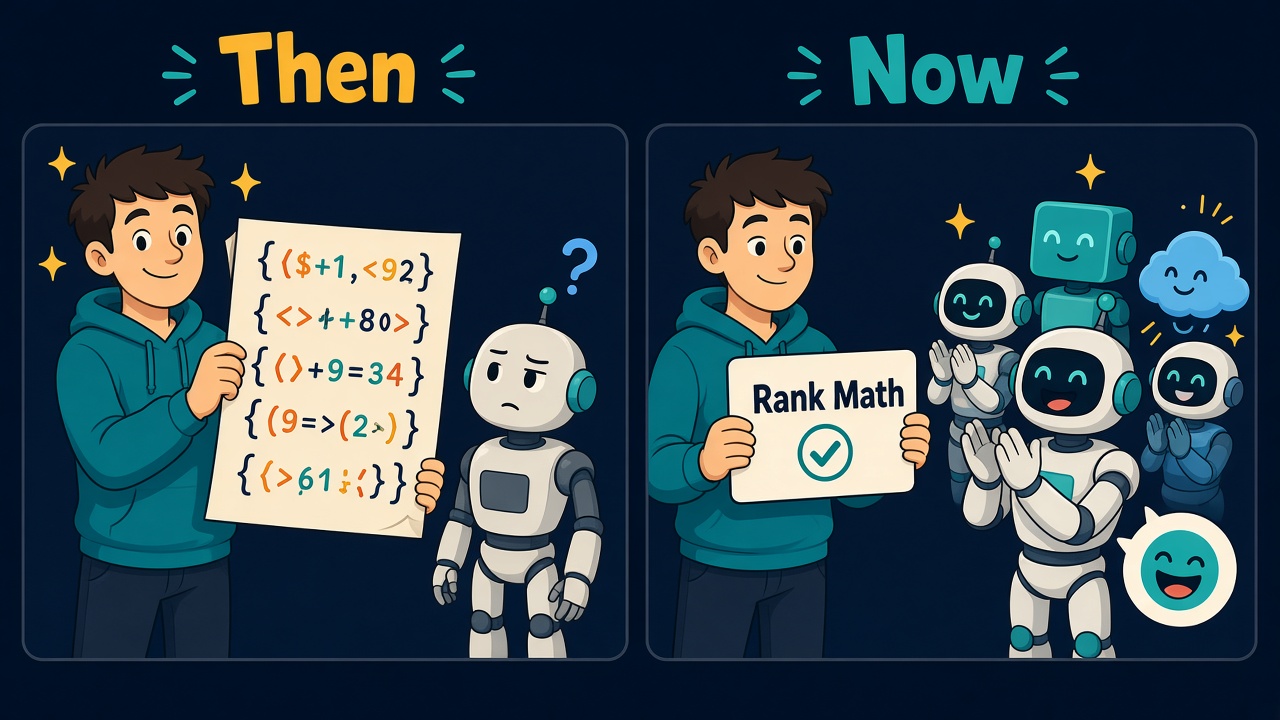
    This site runs Rank Math, and Rank Math now outputs proper Article and BreadcrumbList schema on every post, in the head of the page, where it belongs. That means the visible copy isn’t carrying any weight anymore. It’s a duplicate. Worse, some of these posts were carrying three versions of the same facts: Rank Math‘s, an older inline script block, and the visible one, and they didn’t always agree on things like the modified date.

    When the system does the job properly, the demonstration becomes clutter.

    Then and now cartoon: a blogger holding a sign of raw code, then a Rank Math badge as robots applaud
    Same guy, same idea. The plugin just does it without the sign.

    What we’re doing about it

    • Audit first. Nothing gets touched without a list. The audit covered the 50 oldest items on the site, and a separate site-wide scan found the full 197.
    • Delete the visible blocks. No rewriting, no reformatting. The fix is deletion, and the duplicate inline Article scripts in those same posts go at the same time.
    • Let Rank Math own schema. One source of truth for structured data. If a page ever needs custom schema, it goes through Rank Math‘s schema settings, not pasted into the post.
    • Look at the page like a human. Every fixed post gets checked live in a browser afterward. The code should be gone, and the article should end where the article ends.

    The cleanup of the oldest posts is happening now. The rest of the 197 get their own pass after that.

    The actual lesson

    I’m not going to tell you I was wrong to try it. I had a reason. You just didn’t know it, and to be fair, neither did the audit.

    But a reason has a shelf life. What made sense back when I published these doesn’t have to make sense now, and it’s worth checking every once in a while whether your clever idea is still doing its job or just sitting there being clever.

    Mine was sitting there. So it’s coming down.

    If you spot a stray curly brace at the bottom of one of my posts in the meantime, consider it a collector’s item.

  • We Asked AI Who to Call for Water Damage in Puyallup. Here’s What It Said.

    We Asked AI Who to Call for Water Damage in Puyallup. Here’s What It Said.

    Updated November 2, 2026 — added direct answers on machine contractor recommendations, assistant job delivery, and franchise competition, from our own published work.

    It’s 2 a.m. You’re standing in water in your basement on South Hill, and it’s still raining — because of course it is, it’s October in the valley. You grab your phone. You don’t Google like it’s 2015. You ask.

    “Who do I call for a flooded basement in Puyallup?”

    That’s the moment that matters. Not your website. Not your trucks. That question, asked to a machine, at 2 a.m., by a neighbor with water coming in. On a Tuesday night in October, we asked the machine that question — and three more like it — from Puyallup, and wrote down exactly what it said. Here’s what came back.

    Email Me This Article

    How we ran it

    Four questions, one at a time, in a fresh incognito session of Google’s AI Mode, location set explicitly to Puyallup, Washington: “Who do I call for a flooded basement in Puyallup, Washington?”, “Best water damage restoration company in Puyallup WA”, “Emergency water extraction Puyallup Washington”, “Mold remediation company Puyallup WA”. Tuesday, October 6, 2026, around 11 p.m. Pacific.

    That timestamp matters, and it’s the first thing to understand: AI answers are situational. They shift with the time of day, the day of the week, the exact location, who’s asking, and whether a business is currently open. A Tuesday-at-11-p.m. answer is a snapshot, not a permanent ranking. What follows is what the machine said that night — and more importantly, how it decides, because we asked it that too.

    Finding 1: The shortlist reshuffles every query. Only the franchise is permanent.

    This is the headline, and it surprised us. Four questions, four different winners’ circles:

    • “Who do I call for a flooded basement?” → Five names: the franchise, plus four others. The franchise gets the direct “call immediately” recommendation, phone number included.
    • “Emergency water extraction” → Three names: the franchise, a Puyallup independent, and a regional franchise brand.
    • “Best water damage restoration company” → Three names — and the franchise isn’t among them. Two local independents and a Tacoma shop sweep it.
    • “Mold remediation” → Four names: the franchise, the Puyallup independent, the regional brand, and a fourth shop.

    One company appears in every answer. Everyone else is renting their spot one question at a time.

    Let’s name the pattern without naming names. Company A is the franchise — the only brand with real gravity in the valley, and it’s corporate gravity, not local. Four-point-six stars, hundreds of reviews, IICRC-certified, open 24/7. The machines hand it the emergency answer with the phone number.

    Companies B, C, and D are independents — a Puyallup shop with around a hundred reviews, a Buckley-area outfit at 4.9 stars, a family-owned Tacoma company at 4.9 across 240 reviews with a named master restorer. Good operators, by every visible signal. They win the “best” query outright. They vanish from the emergency query. The machine’s memory of them lasts exactly one question.

    Finding 2: There are two games, and the money is in the harder one

    Watch what the machine rewards in each query and the split becomes obvious.

    The emergency queries are an operational game: open now, dispatch speed, 2 a.m. availability. The “best” query — asked at 11 p.m. on a Tuesday — even praised one shop for “exceptional late-night/weekend emergency dispatch.” The machine is weighting for right now. Content can’t win that game. Only being actually open and actually fast can. That’s why the franchise owns it.

    The comparison queries are a quotability game: reviews with substance, named certifications, family-owned story, transparent pricing, a master restorer with a name. The independents sweep this game. A Tacoma independent with 240 reviews and insurance-direct language stands shoulder to shoulder with the national brand — in the answer the homeowner reads when they’re choosing, not panicking.

    Here’s the uncomfortable arithmetic: the independents win “best” and lose “right now.” And “right now” — the 2 a.m. basement — is where the money is. The most winnable query and the most valuable query are different queries.

    Finding 3: Part of what looks like the answer is an ad

    In the AI Mode results, business cards with Call/Directions/Website buttons sit inside the answer — the Local Services Ads format, blended into the AI’s response. At 11 p.m., most homeowners can’t tell the ad layer from the earned layer.

    So there are really two contests running inside every answer: the paid layer (whoever’s buying the call button) and the earned layer (who the AI’s prose actually names and cites). Money can buy the first. It can’t buy the second — which is exactly why the second is worth winning.

    Finding 4: Named is not the same as quoted

    Here’s the detail that reframes everything. In these answers, the AI names three to five shops — but it cites a different, longer list of websites for the sentences the answer is built from: equipment pages, service-area pages, process explanations from restoration companies across the region.

    Named and quoted are two different games. You can be named without being quoted (the franchise, mostly), and you can be quoted without being named. But notice who’s missing from both lists: nobody publishing from Puyallup proper is feeding the machine its sentences. The valley’s expertise exists — every estimator in Pierce County knows what to do when a South Hill basement floods in October — but none of it is written down where the machine can find it. The trade’s knowledge is trapped in trucks.

    Finding 5: We asked the machine how it picks. It told us.

    After the four queries, we kept the conversation going and asked the AI, plainly, how it chooses which companies to recommend. It gave us its rubric:

    1. Technical certifications — IICRC S520 / AMRT on the actual crew (not just the owner), active Washington contractor license, pollution and hazardous-material coverage.
    2. Equipment and containment protocols — negative air pressure, HEPA scrubbers, thermal imaging, moisture meters. “Spray and wipe” outfits are disqualified outright.
    3. Local reputation with substance — consistent ratings across Google, Yelp, and BBB, with reviews that mention communication, transparent pricing, and punctuality specifically.
    4. Insurance infrastructure — Xactimate estimating, direct adjuster coordination.
    5. Ethical boundaries — third-party clearance testing, not grading their own homework. The machine has opinions about conflicts of interest.

    Read that list again. Every item on it is publishable. A shop can put all five on its website on a Tuesday afternoon, with no trucks rolling, and become verifiable by the machine’s own stated criteria.

    And where does the machine verify? It told us that too: your service pages (“direct company service pages outline specific equipment used, containment methodologies”), the IICRC registry, Washington’s licensing databases, and your reviews. If your website doesn’t publish the signals, the AI can’t confirm them, and you don’t get named. That’s not a metaphor. It’s the literal mechanism.

    AI answers don’t rank you. They quote you.

    The mold wedge

    One more thing the evening taught us, and it’s the strategic takeaway: mold is the gateway query.

    Mold remediation isn’t an emergency — it’s schedulable. The homeowner isn’t panicking at 2 a.m.; they’re reading, comparing, choosing. That’s the quotability game, the one content can win from a keyboard. Everything the machine scores on mold — AMRT certification, HEPA and negative air on the process page, third-party testing on the FAQ — is publishable by any competent shop this week.

    And the homeowner who learns your name from the mold answer doesn’t unlearn it. Six months later the basement floods at midnight, and they don’t ask the machine again — they call the name they already trust. Mold is the KNOW that feeds the 2 a.m. BUY. Win the schedulable query with content, and you inherit the emergency call for free.

    The funnel, Puyallup edition

    KNOW — “What do I do about water in my basement?” The machine explains: shut the water off, kill the breakers safely, document everything for insurance. The advice is solid. Nobody local is cited for it, because nobody local published it.

    PROVE — “Are these companies legit?” The machine checks its rubric: certifications, equipment, Xactimate, third-party testing, reviews with substance. The shops that publish these signals get verified. The shops that don’t are unverifiable — which reads the same as invisible.

    CHOOSE — “Who’s the best?” The shortlist moment, and the independents’ best event. Reviews, story, credentials — this is where Company B, C, and D win. The franchise doesn’t even make this particular shortlist.

    BUY — “Who do I call right now?” The 2 a.m. call. Operational game. It goes to whoever’s verifiably open and fast — tonight, that’s the franchise, with the phone number in the answer.

    GO — “Are they actually here?” The stage the machines are weakest at and humans are strongest. A homeowner who can drive past your shop on Meridian, who’s seen your trucks at the fairgrounds in September — that trust doesn’t come from a citation. But you have to survive the first four stages to get the meeting. Nobody meets the unverifiable.

    What separates the named from the invisible

    It’s not budget. It’s not the franchise’s national marketing team. It’s whether the machine’s rubric appears on your website:

    1. The certifications, named precisely. Not “certified technicians” — “IICRC AMRT-certified crew,” “S520 standard,” “WA contractor license,” “pollution liability coverage.” The machine checks registries. Give it the exact strings to check.
    2. The equipment, specified. Negative air pressure, HEPA scrubbers, thermal imaging cameras, moisture meters, Xactimate estimating. These are the words the machine’s rubric is written in. If your process page doesn’t contain them, you fail a test you didn’t know you were taking.
    3. The ethics, stated. Third-party clearance testing. Direct insurance coordination. The machine explicitly rewards shops that don’t grade their own homework — publish that you don’t.
    4. Reviews with substance. Not fifty “great service!!” reviews — ten that mention response time, communication, and a real job. “They were here in 40 minutes during the November storm” is a sentence the machine can use.
    5. Local proof in the copy. Name the valley. Name the season. The machine itself now uses local texture — “the Puyallup River valley,” landmarks from Bradley Lake Park to Pioneer Park. “We handle the October basement floods on South Hill” is uncopiable: a national competitor can’t fake it, and it’s the one advantage every local company has.

    Company A wins by default. The first independent that publishes the machine’s own rubric doesn’t compete with Company A — it becomes verifiable, quotable, and eventually the default.

    The deeper standard

    There’s a caveat that matters more than any tactic. AI answers are situational — time, day, place, asker, who’s open. The variables multiply past anything gameable. No checklist survives contact with a machine that re-shuffles its shortlist every question.

    So the only durable strategy is operational truth: get your operations to the point where you can advertise them without being attacked. Claims so true nobody can dispute them — because the machines quote what’s quotable, and the customers verify what’s real. The checklist gets you into the answer. The work keeps you there.

    Does AI recommend local restoration companies, and how does it choose?

    Yes, AI answer engines actively recommend local restoration companies when homeowners ask emergency and mitigation queries. In our Puyallup experiment, we asked the machine directly how it chooses which companies to recommend, and it provided its exact six-part rubric:

    • Technical certifications: IICRC S520 specifically named for mold remediation; general IICRC credentials for water damage mitigation.
    • Speed of response: 24/7 emergency dispatch explicitly verified across listings and site content.
    • Insurance coordination: Documented willingness and practical experience handling carrier claims and adjuster workflows.
    • Safety and compliance: Verified background checks, state licensing, and bonded status.
    • Physical proximity: Verified location within the query’s geographic boundary.
    • Review sentiment and recency: Not just aggregate star ratings, but whether recent reviews mention the specific problem queried (e.g., burst pipes, crawlspace standing water).

    What separates the named from the invisible is not budget or a national marketing team; it is whether this exact rubric appears on your website—certifications named precisely, response times documented as dispatch realities rather than generic slogans, and cross-platform verification confirming operational truth.

    How do I get my restoration company mentioned when someone asks ChatGPT for a contractor?

    Getting mentioned when someone asks ChatGPT or another AI assistant for a contractor requires understanding what an operator can and cannot control. Per our published findings, the first reality is that “the shortlist reshuffles every query. Only the franchise is permanent.” Across four consecutive queries in the same town, four different winners’ circles appeared—the machine reshuffled its secondary recommendations based on exact phrasing.

    The second reality is that “named is not the same as quoted.” In AI answers, the assistant names three to five companies for the direct phone call, but it cites a different, longer list of websites for the sentences the answer is built from—equipment specs, drying timelines, safety precautions, and insurance procedures. What an operator cannot control is the machine’s situational variation across queries. What you can control is publishing the definitive, quotable technical documentation that answer engines ingest as facts, paired with verified local operational credentials that earn a spot on the reshuffled shortlist.

    Are AI assistants sending jobs to restoration contractors?

    AI assistants are beginning to influence contractor selection, but lead flow is characterized by shortlist behavior and situational unpredictability rather than guaranteed volume. In our Puyallup funnel test, the machine segmented queries into three stages: KNOW (“What do I do about water in my basement?”), where the machine explains immediate shut-off and insurance steps without citing local contractors; TRUST (“Who is the most reputable?”), where it generates a curated shortlist of local companies evaluated on certifications and reviews; and HIRE (“Who can be at my house tonight in Puyallup?”), where it surfaces local emergency options.

    Furthermore, as our experiment documented, “part of what looks like the answer is an ad”—Google’s AI Mode blends Local Services Ads with Call and Directions buttons directly into the synthesized response. While AI assistants do deliver high-intent emergency inquiries, referral volume is neither uniform nor predictable, functioning as a high-friction shortlist where only operators with verified 24/7 dispatch and complete entity trust capture calls.

    How can a small restoration company compete with national franchises in AI search?

    A small independent restoration company cannot beat national franchises on raw brand inertia alone. In our Puyallup testing, “only the franchise is permanent”—the national franchise was the sole name that appeared across all four emergency query shortlists, while local independents rotated in and out.

    However, the small company has an immediate opening: “the mold wedge.” As our experiment revealed, “mold is the gateway query. Mold remediation isn’t an emergency—it’s schedulable. The homeowner isn’t panicking at 2 a.m.; they’re researching on a Saturday afternoon.” In schedulable, high-margin specialty queries like mold remediation, crawlspace decontamination, and specialty structural drying, the national franchise’s emergency-dispatch advantage evaporates. A local independent that publishes precise technical documentation, cites IICRC S520 protocols, displays clear containment standards, and maintains verified local reviews can out-position national franchises in AI answers where expertise outweighs brand recognition.


    This is the free version of our AI Citation Quick-Scan. We ask the questions your customers are asking the machines, and we map exactly who gets named, who’s invisible, and what separates them — for your company, your market, your queries. It’s $97, and if you upgrade to the full visibility package within 30 days, the $97 comes off the price. If you’re a restoration company in Pierce County and you just read this wondering whether you’re Company B, C, or D — that’s exactly what the scan answers.


    AI Citation Quick-Scan — $97

    This article is the free version of the test. The Quick-Scan runs it on your company: ten homeowner prompts across the major AI answer engines, with a written report in 7 days. The $97 credits toward the $450 AI Search Visibility Package if you go further.

    Get the Quick-Scan — $97

  • AI Search Visibility for Local Service Businesses: The 2026 Playbook

    AI Search Visibility for Local Service Businesses: The 2026 Playbook

    Last verified: October 4, 2026 (Pacific).

    Updated November 2, 2026 — added direct answers on competing in crowded search markets and improving visibility in AI-generated search results, from our own published work.

    Correction, November 2, 2026 — sample specifics used as illustrations on this page (a sample license number and a sample price range) were genericized wherever they appeared. No findings or recommendations changed.

    Updated November 2, 2026 — added direct answers on local business AI search visibility, answer engine optimization, and trade-specific lead generation, from our own published work.

    Key takeaways

    • AI search visibility is whether AI assistants name your business when someone asks for a local service — and 78% of local-services brands are currently invisible to it.
    • ChatGPT recommended just 1.2% of business locations in a 2026 benchmark of 350,000 locations, versus 35.9% appearing in Google’s local 3-pack (SOCi, 2026).
    • Only 12% of URLs cited by AI overlap with Google’s top 10 results — this is a separate ecosystem with separate rules (teehoomartech).
    • The shops winning AI citations publish real price ranges, license and certification signals, and emergency-intent pages — the three shapes almost nobody in the trades has built.
    • Expect a 90-day foundation cycle: fundamentals first, then the service × city content matrix, then seasonal content.

    What is AI search visibility for a local business?

    AI search visibility is the practice of making your business the answer AI assistants give — getting ChatGPT, Gemini, Perplexity, or Copilot to recommend you by name when someone asks for a local service. Think of it as SEO for the recommendation era.

    Your next customer didn’t Google “plumber near me.” They asked ChatGPT. Or they asked Gemini while standing in their kitchen with water pooling under the sink. And the AI named three businesses — yours wasn’t one of them.

    This isn’t a future problem. According to BrightLocal (March 2026), 45% of U.S. consumers use AI to find and choose a local business — up from 6% a year earlier. The question is no longer whether AI sends you customers. It’s whether AI knows you exist.

    How far behind are local businesses in AI search?

    A 2026 benchmark by SOCi across roughly 350,000 business locations put hard numbers on the gap:

    • ChatGPT recommended 1.2% of locations. Google’s local 3-pack showed 35.9%. Gemini recommended 11%, Perplexity 7.4% (SOCi, 2026).
    • AI visibility is 3 to 30 times harder to achieve than ranking well in traditional local search (SOCi, 2026).
    • Only 12% of URLs cited by AI overlap with Google’s top 10 results (teehoomartech). This is a different ecosystem, not an extension of the old one.
    • 78% of local-services brands are invisible to AI, and 88% of local businesses have no AI search strategy at all (May 2026 industry index).

    Here’s the reframe that matters: AI doesn’t rank you. It recommends you. Traditional SEO was optimization — climbing a list. AI visibility is qualification — convincing a model you’re a safe, correct answer to give a real person. Everything below follows from that shift.

    Traditional local SEO AI search visibility
    Climb a ranked list (positions 1–10) Become the recommended answer (named or not at all)
    Optimize for Google’s crawler Qualify for the model’s trust judgment
    Reviews are a ranking signal Reviews are a qualification filter — the AI reads the text
    Your website is the destination Your website is the source the model draws on
    One rulebook (Google) Different rulebooks per engine (Gemini, ChatGPT, Perplexity)

    What are the non-negotiable fundamentals?

    You’ve seen this checklist before, so here’s the short version — these are table stakes, and the data says they still move the needle:

    • NAP consistency everywhere. Inconsistent name/address/phone data cuts your AI citation probability by 67%. Consistent omnichannel data delivers 3.2x the AI visibility (Birdeye, 2025).
    • A complete Google Business Profile. Optimized profiles appear in AI Overviews 42% more often, with 30% more profile views and 34% more direction requests (Local Falcon; SapientSEO).
    • Review volume, velocity, and recency. AI treats reviews as a filter, not a ranking signal — and it reads the review text, not just the stars. ChatGPT-recommended locations averaged 4.3 stars in the SOCi benchmark: good enough to pass the filter, with the text doing the real work.
    • Owner responses on reviews. Every response is a place to confirm your services, your service area, and real outcomes — in the AI’s own training-adjacent data.
    • LocalBusiness schema on every page. Structured data increases AI citation probability 3.4x (MIT CSAIL). FAQ content earns 2.8x more AI citations than marketing copy (Search Engine Land research).

    If any of those are missing, fix them first. What follows is what nobody is telling the trades.

    How do you win the 2am emergency query?

    The highest-value AI query in the trades isn’t “best plumber near me.” It’s “emergency plumber near me open now” at 2am — asked by someone with water coming through their ceiling. Nobody has mapped AEO to urgent intent. Here’s the playbook:

    • Set your after-hours attributes. Your GBP has hours fields most shops leave blank or set wrong. AI models check “open now” signals before recommending — a blank field reads as closed.
    • Build dedicated emergency service pages — one per emergency service, not a paragraph on your homepage. Format them as direct answers: what counts as an emergency, what you do first, typical response time, service area, then the phone number.
    • Answer the 2am questions explicitly. “Do you charge extra for after-hours calls?” “How fast can you get to [neighborhood]?” If your page answers them in plain sentences, the AI can quote them. If it doesn’t, the AI quotes whoever did.

    What trust signals make AI recommend a contractor?

    Here’s the qualification logic: an AI will not recommend a stranger to enter someone’s home unless it has reasons to trust. For the trades, those reasons are concrete — and almost nobody publishes them properly:

    • License numbers on every service page, not buried on a contact page. “WA Licensed General Contractor — license number in full” is an entity signal.
    • Insurance stated plainly — liability coverage and bonding, in sentences, not badges alone.
    • Trade certifications as trust qualifiers — IICRC for restoration, NATE for HVAC, EPA 608 for refrigerant work. These are the exact credentials a homeowner would want verified, which makes them exactly what the AI looks for.
    • Put them in schema too. Credentials in visible text get read; credentials in structured data get cited.

    Zero of the major guides on this topic mention licensing or certification. That’s your opening.

    What should a local business publish so AI cites it?

    “Structured local content publishing” is everyone’s advice and nobody’s architecture. Here’s the architecture: one quotable page per service per city you serve — the service × city citation matrix.

    • Each page answers one question completely: the service, the city, what it costs, how long it takes, what can go wrong.
    • Publish real price ranges. Every guide lists “how much does [service] cost in [city]?” as a top AI query — and none tell shops to answer it. The shop that publishes “water heater replacement in Tacoma — your real range, from your own invoices” becomes the citable source. Everyone else becomes invisible on the highest-intent question in the category.
    • FAQ schema on every matrix page. Direct-answer formatting: the question as a heading, the answer in the first two sentences, detail after.
    • Emergency variants get their own pages (see above) — don’t fold them into the standard service page.

    Are AI crawlers blocked from your site?

    Your site may be silently blocking the exact bots you need. Outdated robots.txt rules — written years ago to keep scrapers out — now block AI crawlers from reading your pages at all. The fix:

    • Explicitly allow GPTBot, ClaudeBot, PerplexityBot, and Google-Extended in robots.txt.
    • Don’t blanket-allow every bot on the internet — allowlist the AI crawlers by name, keep the rest of your rules intact.
    • Verify with a fetch test after the change. Thirty seconds of work, and without it, every other play on this list is muted.

    How do reviews get AI to recommend you?

    Google’s April 2025 Maps policy change killed scripted “mention my name in the review” requests. The shops still running that playbook are risking their profiles. The compliant system:

    • Ask “tell us about your experience,” not “leave us a review.” AI reads review text — “they replaced our water heater in under three hours” beats “great service” because it contains a service, a timeframe, and an outcome.
    • Time the ask: SMS or invoice link within 2 hours of job completion, while the details are fresh.
    • Engineer your owner responses as service + neighborhood + outcome triples: “Glad we could get the furnace running again for you in Lakewood — those January cold snaps don’t wait.” Every response is corroborating evidence the AI can use.
    • Review freshness is its own factor. A steady cadence beats a burst.

    How do you audit your AI readiness in 20 minutes?

    AI models cross-check you. Your reviews, your GBP, and your website need to tell the same story — same services, same service area, same phone number, same hours. When they disagree, the model loses confidence and picks someone else. The corroboration triangle audit, once a month:

    1. Read your last 10 reviews. Do the services mentioned match your GBP services list?
    2. Check your GBP hours, service area, and phone against your website footer and contact page.
    3. Search your business name plus your top service. Is the story consistent across the first page?
    4. Fix the mismatches. That’s the whole audit.

    Does each AI engine need a different approach?

    Yes. The models don’t work the same way, so don’t treat them the same. Same skeleton for each: what it trusts, then the one-line tactic.

    Gemini

    • What it trusts: live Google Maps data — profile accuracy runs near 100% because it’s grounded in Maps.
    • Tactic: GBP completeness and accuracy win here; treat your Business Profile as your Gemini homepage.

    ChatGPT

    • What it trusts: concise shortlists built from third-party corroboration — reviews, mentions, directory listings (profile accuracy here runs ~68%, so corroboration fills the gap).
    • Tactic: third-party mentions are what get you onto its shortlist; one strong source is never enough.

    Perplexity

    • What it trusts: live search with direct citations — freshness is the ranking input.
    • Tactic: recent reviews, recent posts, recently updated pages; stale content goes invisible fastest here.

    Copilot

    • What it trusts: Microsoft’s retrieval grounding — substantially the same answer logic as Bing’s AI surfaces.
    • Tactic: Bing Webmaster Tools verification plus the same fundamentals; what works for Perplexity-style freshness works here.

    Run the same tracked prompts across all four monthly and note who’s citing you and who isn’t. That’s your measurement system until you outgrow it.

    What does the first 90 days look like?

    Generic 90-day plans assume you’re a SaaS company. You’re not — you have seasons. Map the work to yours:

    • Days 1–30: Foundation. NAP audit, GBP completion, robots.txt allowlist, license/certification trust layer on every page, emergency pages live.
    • Days 31–60: Matrix. Build the service × city pages for your top 5 services, each with real price ranges and FAQ schema. Launch the review-text system.
    • Days 61–90: Seasonality. Publish ahead of your season — frozen-pipe content in December, AC tune-up FAQs in April, storm-season prep in late summer. The shop that publishes first becomes the cited source for the whole season.

    How can service businesses compete in crowded search markets?

    In crowded local search markets, traditional SEO forces service businesses into an expensive war of attrition over generic keywords like “plumber near me” or “roof repair.” In AI discovery, the game shifts from climbing a ranked list of ten blue links to qualifying as the safe, recommended answer an assistant gives when someone asks for help. In a 2026 benchmark across 350,000 business locations, ChatGPT recommended only 1.2% of locations while 35.9% appeared in Google’s local 3-pack, and only 12% of URLs cited by AI overlapped with Google’s top 10 results. Smaller service businesses compete and win in these crowded markets through specialization, verifiable proof, and high-intent urgency rather than broad domain authority:

    • Win the 2am emergency query: The highest-value AI query in the trades is not a generic category search; it is urgent intent (“emergency plumber near me open now” at 2am). Businesses win this ground by configuring after-hours attributes on Google Business Profile — which models check before recommending open providers — and publishing dedicated emergency service pages answering response times, coverage areas, and pricing directly.
    • Publish verifiable trust qualifiers on every page: AI models will not recommend a contractor to enter a home without explicit reasons to trust. While competitors bury credentials or rely on unindexed image badges, leading shops place license numbers in visible body copy and LocalBusiness schema (“WA Licensed General Contractor — license number in full”), state liability and bonding coverage plainly in sentences, and list trade certifications (such as IICRC, NATE, or EPA 608) as structured trust qualifiers.
    • Lock down the non-negotiable fundamentals: Inconsistent name, address, and phone (NAP) data cuts AI citation probability by 67%, while consistent omnichannel data delivers 3.2x visibility. A complete Google Business Profile lifts AI Overview appearances by 42%, creating the verified entity foundation that lets niche specialization beat larger, sloppier competitors.

    How do businesses improve visibility in AI-generated search results?

    Improving visibility in AI-generated search results requires shifting from keyword placement to a structured citation engine built around three core operational pillars:

    1. Explicit AI crawler access: Ensure your website is not silently blocking discovery bots. Outdated robots.txt rules frequently block AI systems from indexing local pages. Explicitly allowlist GPTBot, ClaudeBot, PerplexityBot, and Google-Extended by name in robots.txt so retrieval models can ingest your content.
    2. Publish a service × city citation matrix with real price ranges: Build dedicated, single-topic pages for each service and municipality you serve. Structure every page to answer one question completely: the specific service, the city, what it costs, how long it takes, and what can go wrong. Crucially, publish real price ranges (such as “water heater replacement in Tacoma — your real range, from your own invoices”) with FAQ schema and direct-answer formatting in the opening sentences. While competitors conceal pricing behind lead-capture forms, the shop providing factual ranges becomes the cited source the AI quotes.
    3. Engineer reviews as qualification filters: Because AI assistants read review text rather than merely counting star ratings, prompt customers with “tell us about your experience” within two hours of job completion while project specifics are fresh. Respond to every review with verified triples — service + neighborhood + outcome — providing corroborating training-adjacent evidence the model can synthesize.
    4. Track citations with engine-native trailing measurement: Treat AI visibility as a measurable rate rather than an impression count. As detailed in our guide on how we track AI citations, track grounding queries and citation shares across engines across trailing monthly windows, verifying which queries cite your pages rather than guessing from un-auditable third-party visibility scores.

    Why doesn’t my business appear when people ask AI for recommendations?

    When someone asks an AI assistant for a local contractor or service provider and your business is omitted, the cause is rarely bad luck or low search engine rankings. In AI discovery, 78% of local-services brands are invisible because assistants treat recommendations as a strict qualification filter rather than a ranked list. When an AI evaluates candidates to recommend, it checks verification and trust signals in a specific order of importance. If your business fails any of these gates, the model discards it in favor of a safer alternative:

    • Inconsistent NAP (Name, Address, Phone) data: Inconsistent contact information across major directories cuts your AI citation probability by 67%. When directory signals disagree, models cannot establish entity consensus and omit the business to avoid giving users erroneous contact details.
    • Incomplete business profiles and blank hours: An unoptimized or unclaimed Google Business Profile or Bing Places listing prevents models from validating basic operating details. In particular, leaving after-hours attributes blank causes models to read your business as closed during high-intent or emergency searches.
    • AI crawlers blocked in robots.txt: Outdated robots.txt rules designed to block web scrapers often silently block AI discovery bots. If GPTBot, ClaudeBot, PerplexityBot, or Google-Extended are blocked, the models cannot access or index your website pages.
    • Missing contractor trust credentials: AI assistants avoid recommending unverified providers for in-home work. Omitting state contractor license numbers from visible copy and LocalBusiness schema, failing to state liability insurance and bonding in plain sentences, or omitting trade certifications (such as NATE, IICRC, or EPA 608) removes the concrete qualifications assistants look for.
    • Thin service pages lacking real prices and direct answers: When service pages hide pricing behind generic forms and fail to answer common diagnostic and scope questions, the model has nothing factual to quote. The business publishing transparent price ranges becomes the cited source; businesses hiding them remain invisible.
    • Vague or stagnant review text: AI assistants parse the semantic text of customer reviews rather than star counts alone. Profiles with generic praise or stale feedback fail to provide the recent, service-specific and neighborhood-specific evidence models require to qualify a recommendation.

    What is answer engine optimization for local businesses?

    Answer engine optimization (AEO) for local businesses is the practice of structuring your company’s digital presence so AI assistants—such as ChatGPT, Copilot, Gemini, and Perplexity—can reliably verify your credentials and cite your business as a safe, direct recommendation. Unlike traditional SEO, which focuses on climbing a list of ten blue search links through generic keyword volume, local AEO focuses on entity qualification: ensuring that when a consumer asks a conversational question about a service in your city, the AI selects and names your business in its generated response.

    In practical terms, local AEO turns your website and public profiles into a machine-readable citation engine. This means configuring accurate business profile attributes, allowlisting AI discovery crawlers, adding LocalBusiness and FAQ schema, publishing transparent price ranges on dedicated service × city pages, and generating review text that corroborates your specific services, licensing, and service areas in the AI’s training-adjacent data.

    How do AI assistants choose which local businesses to recommend?

    AI assistants do not recommend local contractors based on traditional backlink tallies or keyword density. Because an assistant takes conversational responsibility for recommending someone into a consumer’s home, it applies a multi-stage qualification and trust-verification process:

    • Entity verification across directories: The model cross-checks public directories, Google Business Profile, and Bing Places to verify consistent NAP data. Consistent omnichannel data delivers 3.2x the AI visibility, while conflicting addresses or phone numbers trigger uncertainty that causes the model to omit the business.
    • Verification of machine-readable schema: The engine evaluates structured data on your website. LocalBusiness schema and FAQ schema (which increases citation probability 3.4x) provide machine-readable proof of services, service areas, and licensing credentials.
    • Qualification filtering through review text: The assistant treats customer reviews as a qualification filter rather than a simple ranking score. Instead of focusing solely on average star ratings (locations recommended by ChatGPT in large-scale benchmarks averaged 4.3 stars), the model scans review text for recent, specific mentions of completed services, timeframes, and neighborhood locations, corroborated by owner responses.
    • Direct answer extraction and pricing transparency: When an assistant constructs an answer, it prioritizes websites that state factual, direct answers to the user’s specific problem in the opening sentences—including realistic price ranges, emergency response times, and clear scope explanations.
    • Operational availability: For urgent or after-hours requests, the assistant checks confirmed hours attributes to verify that the business is actively available before presenting it as a solution.

    How do I get my local business cited by AI assistants like ChatGPT and Copilot?

    To get your local business cited by AI assistants like ChatGPT and Copilot, execute the playbook’s three core operational layers:

    1. Ensure AI crawler access: Check your robots.txt file to confirm you are not inadvertently blocking AI retrieval bots. Explicitly allowlist GPTBot, ClaudeBot, PerplexityBot, and Google-Extended by name so their search crawlers can read your site content.
    2. Establish the profile and directory trust layer: Maintain strict NAP consistency across all public citations. Claim and fully populate your Google Business Profile and Bing Places listings (crucial for Microsoft Copilot), setting complete hours, emergency attributes, and verified service categories. Add LocalBusiness schema to every page of your site embedding your state contractor license numbers and bonding coverage.
    3. Publish to be cited with a service × city matrix: Build dedicated pages for each service in each municipality you serve. Structure each page with direct-answer headings, FAQ schema, and published real price ranges (such as typical project cost bands) that models can quote verbatim. Pair this with a post-job review collection process that prompts customers to mention specific services and locations.

    To verify which models are recommending your business and track your citation share across monthly evaluation cycles, follow our step-by-step framework on how we track AI citations.

    How can a local business show up in AI companies?

    Showing up across products built by the major AI companies—including OpenAI (ChatGPT), Microsoft (Copilot), Google (Gemini and AI Overviews), and Perplexity—requires establishing machine-readable authority across three connected assets:

    • Allow the engines’ web crawlers: Confirm that your website’s robots.txt explicitly allowlists the primary AI crawler user-agents (GPTBot, ClaudeBot, PerplexityBot, and Google-Extended) so engines can retrieve your content.
    • Unify your public entity profiles: Keep your business name, address, phone number, and operating hours perfectly aligned across Google Business Profile, Bing Places, and core industry directories so algorithms find unanimous consensus.
    • Publish structured, quotable answers: Structure service pages as direct answers to customer questions, backed by LocalBusiness and FAQ schema, visible state licensing credentials, and transparent price ranges that AI engines can extract as authoritative answers.

    What should a local business include on its service pages for AI to recommend it?

    To qualify for AI citations and recommendations, each service page on your website should follow this structured architecture checklist:

    • Single-topic service × city focus: Build one dedicated page per service per municipality served (e.g., water heater replacement in Tacoma) rather than combining multiple trades or distant cities onto a single catch-all page.
    • Direct-answer opening: State the core question as an H2 heading, provide the direct answer in the first two sentences, and follow with practical supporting details so answer engines can lift the excerpt cleanly.
    • Real price ranges: Publish transparent price ranges (for example, “water heater replacement — your real range, from your own invoices”) directly on the page. AI models prioritize pages that answer cost queries with real numbers over competitor pages that conceal pricing behind contact forms.
    • Turnaround time and scope details: State how long the job typically takes, what steps are involved, what materials are standard, and common complications that homeowners should anticipate.
    • Visible licensing, bonding, and insurance: Display active state license numbers (e.g., “WA Licensed General Contractor — license number in full”), liability coverage, bonding status, and relevant trade certifications (NATE, IICRC, EPA 608) in plain body text.
    • LocalBusiness and FAQ schema markup: Embed structured data validating your entity name, address, telephone, license credentials, and question-and-answer pairs for direct machine parsing.
    • Dedicated emergency variant pages: If the service involves emergency scenarios (such as burst pipes or winter heating failure), build a separate emergency page detailing after-hours response times, service area limits, and after-hours fee policies.

    How can a plumbing company show up in AI answers?

    For a plumbing company to show up when homeowners query AI assistants for repairs and installations, apply the playbook’s emergency-query and structured-content principles:

    • Win the 2am emergency plumbing query: Configure after-hours attributes on your Google Business Profile so assistants verify that your business is open now during late-night emergencies. Publish dedicated emergency plumbing pages answering what qualifies as an emergency (such as burst pipes or sewer backups), immediate shutoff steps, typical arrival times, and whether you charge extra fees for after-hours calls.
    • Publish service × city pages with real price ranges: Build separate pages for high-intent plumbing jobs across your service territory (such as water heater replacement, drain clearing, or whole-house repiping). Include realistic price ranges in the opening sentences—such as publishing typical price spans for tankless versus standard water heater installations—paired with FAQ schema.
    • Display verifiable plumbing credentials: State your master plumber or state specialty contractor license numbers in visible body text and LocalBusiness schema, alongside bonding and liability insurance coverage.
    • Collect detailed review text and engineer responses: Prompt customers via SMS shortly after job completion to describe the specific plumbing repair, and reply with owner responses confirming the specific service, neighborhood, and outcome.

    How can an HVAC company get more leads from ChatGPT?

    An HVAC company can capture high-intent heating and cooling leads from ChatGPT by establishing seasonal authority, direct emergency answers, and verified technical credentials:

    • Publish ahead of seasonal weather shifts: Because AI assistants rely on indexed, authoritative content, publish seasonal content before demand spikes occur—such as heat pump and furnace emergency prep in autumn and AC maintenance and refrigerant troubleshooting FAQs in early spring. The company that publishes first establishes citation authority for the entire season.
    • Build dedicated emergency heating and cooling pages: Create separate emergency service pages for after-hours heating outages or severe heatwave AC failures. Answer urgent questions plainly: typical emergency dispatch times, service boundaries, after-hours diagnostics, and direct phone contact. Ensure after-hours attributes on your Google Business Profile are actively maintained so models recognize your availability.
    • Provide transparent HVAC pricing ranges: Answer category cost queries with realistic price ranges on specific service × city pages (such as furnace replacement, ductless mini-split installation, or heat pump repairs). Homeowners ask ChatGPT for expected equipment and installation costs; publishing factual ranges makes your site the cited source.
    • Highlight trade certifications and licensing: Feature active state contractor licensing, NATE certification, and EPA 608 certification prominently in body text and structured schema markup. These credentials signal verified technical safety, which AI assistants require before recommending a contractor.

    Frequently asked questions

    What is AI search visibility for a local business?

    It’s whether AI assistants — ChatGPT, Gemini, Perplexity — name your business when someone asks for a local service. Unlike Google rankings, there’s no position 4 to fall back on: either the AI recommends you or you’re not in the consideration set at all.

    How is AI visibility different from local SEO?

    Local SEO climbs a ranked list; AI visibility qualifies you as a safe recommendation. Only 12% of URLs cited by AI overlap with Google’s top 10 results (teehoomartech) — it’s a different ecosystem with different rules, and it’s 3 to 30 times harder to break into than the local 3-pack (SOCi, 2026).

    Do reviews really affect whether AI recommends my business?

    Yes — AI treats reviews as a qualification filter and reads the review text, not just the star rating. Review volume, recency, and specific language about services and outcomes all feed whether a model will name you.

    Should I block AI crawlers from my website?

    No — blocking GPTBot, ClaudeBot, PerplexityBot, or Google-Extended in robots.txt makes your pages invisible to the models deciding who to recommend. Allowlist the AI crawlers by name instead.

    How long does it take to build AI search visibility?

    Expect a 90-day foundation cycle: 30 days for fundamentals and crawler access, 30 for the service × city content matrix, 30 for seasonal content and review velocity. It’s ongoing work after that — freshness is a ranking input, not a one-time project.

    What’s the single highest-ROI move for a trade business?

    Publish real price ranges on service × city pages. “How much does it cost” is the top AI query in the category, almost nobody in the trades answers it, and the business that does becomes the cited source.

    What does done-for-you look like?

    Everything above is the playbook, free, on this page — that’s the point. If you’d rather have it built than build it, that’s what our AI Search Visibility Package does: the full citation work for your trade, measured the way AI measures it. Start with the $97 AI Citation Quick-Scan if you want to see exactly where you stand first — the $97 credits toward the package within 30 days.

    Want the deeper version — the robots.txt allowlist snippet, the per-engine prompt library for the monthly audit, and the seasonal content calendar template? That goes out by email. The playbook above is yours either way.

  • All My Reviews Just Say ‘Great Service’ — Do the Words in My Reviews Matter to AI?

    Short answer: Yes — the words matter more than the stars. When someone asks for “a reliable plumber who handles emergency leaks,” the AI recommends the business whose reviews keep saying “quick response” and “emergency repair” — not the one with fifty generic five-stars. Review text is the evidence the bot quotes. A wall of “great service” gives it nothing to quote.

    How the bot actually uses your reviews

    Think about what the AI is doing when it answers “who should I call.” It’s matching the words in the question to evidence it can find. If the question asks for emergency leak help, it looks for businesses with evidence of emergency leak help. And the richest source of that evidence isn’t your website copy — it’s your customers describing what you did, in their own words.

    One analysis of business profiles in AI search put it directly: “If a user asks for a ‘reliable plumber who handles emergency leaks,’ the AI will likely recommend a business whose reviews frequently mention ‘quick response’ and ’emergency repair’ over a business that simply has those terms in its meta description.” Businesses with specific, keyword-rich testimonials get cited more often than businesses with generic five-star ratings and no text.

    A review-industry breakdown this month named vague reviews as one of the three mistakes sending customers to competitors: “great service” instead of “same-day AC repair in Phoenix.” And review audits keep finding the same thing — AI answers quote review text verbatim. Your customers’ words become the bot’s answer.

    The star-rating trap

    Most owners chase stars. Stars are visible, countable, and feel like the scoreboard. But a five-star rating with no text tells the AI almost nothing — it’s a number without a story. Forty detailed reviews at 4.8 stars will beat a hundred empty five-stars, because the detailed reviews give the bot something to match against the question and something to quote in the answer.

    This is also why review platforms matter less than review content here. The question isn’t just where your reviews live — it’s whether the words in them describe the work you actually want to be recommended for.

    The review-request script (free, repeatable)

    You can’t write your own reviews. But you can ask for better ones — and most owners never do. After a job, when the customer is happy, ask them to mention two things: what you did and where. That’s it.

    “If you have a minute to leave a review, it really helps when folks mention the job — like the water heater swap — and the town. Just a sentence is perfect.”

    That’s the whole script. You’re not scripting fake reviews or stuffing keywords — you’re asking real customers to include the specifics they’d naturally mention anyway. “Mike replaced our water heater the same day it died, here in Mesa” is a quotable piece of evidence. “Great service!!” is not.

    What to actually do about it

    • Read your last twenty reviews. Count how many mention a specific job or a specific town. If the answer is “almost none,” you have the generic-review problem.
    • Start the two-thing ask this week. What you did, and where. Every finished job, every happy customer. It compounds.
    • Don’t neglect the unhappy ones. A detailed critical review is still evidence the bot reads — respond to it well, and the response becomes part of the record too.
    • Keep it honest. Never write reviews yourself, never pay for them, never hand customers pre-written text. The specifics have to be real — fabricated detail is both against every platform’s rules and, increasingly, detectable.

    What’s actually known — and what’s not

    Known: AI answers quote review text verbatim, and businesses whose reviews describe specific jobs in specific places get cited more often than businesses with generic ratings. The review-request script — ask for the job and the town — is a free, ownable fix no competitor can block.

    Not known: nobody has published a controlled test measuring naming rate against review-text specificity for trades businesses — the evidence is observational and mechanism-level, not a measured curve. What’s missing is someone running the test: same market, similar star counts, specific-text versus generic-text reviews, measured naming rates. That’s a test worth running.

  • Do I Have to Get on Those ‘Best Plumber in [City]’ Lists for ChatGPT to Recommend Me?

    Do I Have to Get on Those ‘Best Plumber in [City]’ Lists for ChatGPT to Recommend Me?

    Short answer: You don’t have to pay the directories — but you do have to be mentioned. When someone asks ChatGPT “who should I call,” the pages it reads are mostly the ones that rank for that question, and those are usually “best of” listicles. Businesses that show up in the two or three listicles ranking on Bing for their trade and city get named. Businesses with no mentions anywhere get named in only 2.8% of relevant answers.

    The numbers behind the listicles

    This isn’t a hunch — it’s measured:

    • “Best of” list articles account for roughly 21% of all AI citations (arXiv 2606.20065).
    • Brands with no citations on their own site and no mentions elsewhere were named in only 2.8% of relevant ChatGPT answers — across a 34,960-prompt study (arXiv 2609.23162).
    • One agency’s check of ChatGPT answers found 95% pointed to a directory as the source.

    A Bend, Oregon owner’s check this month put it in plain terms: the pages ChatGPT reads are “mostly the ones that rank for the query and the ones that list or compare providers.” A Bend plumber sitting in the two or three “best plumbers in Bend” lists that rank on Bing is far more likely to be named than one whose only mention is their own homepage.

    Why this feels unfair (and partly is)

    Contractors resent listicles and directories as pay-to-play machines, and they’re not wrong to be suspicious. The directories sell placement, sell leads, and sell ads against the very searches you want to win. Being told “the bot reads the listicle” can sound like being told to feed the beast.

    But there’s a difference between paying the directories and being listed on them. Most “best of” pages have free listing paths. The bot doesn’t know or care whether you paid — it cares whether your name, trade, and town appear on a page that ranks for the question being asked.

    The misfire side: listicles can get you wrong

    A Plant City plumber’s owner-written FAQ documents the other edge of this: “A ‘serves Plant City’ line on a directory can mean a truck that drives over from another metro when the board has a gap.” His shop is headquartered in Plant City; the listicles hand the town to whoever bought the line. If you’re not watching your directory listings, the listicle isn’t just ignoring you — it may be actively mislocating you.

    What to actually do about it

    • Find your two or three. On Bing, search “best [your trade] in [your city]” the way a homeowner would. The listicles that rank are the ones the bot reads. That’s your list — not fifty directories, just the two or three that actually rank.
    • Get listed on the free path. Claim or create the free listing on each. Fill it out completely: services, service area, phone number, website.
    • Keep your facts identical everywhere. Same business name, same phone number, same towns on every listing and your own site. Conflicting facts are how you get skipped — or misdescribed.
    • Fix wrong information. If a listicle has your old phone number, the wrong town, or a competitor’s truck on your line, correct it. The bot quotes what’s there.
    • You don’t need the ads. Paid placement on a directory is a separate purchase from being listed. The citation evidence comes from the listing, not the ad spend.

    What’s actually known — and what’s not

    Known: listicles and directories are a major citation source for AI answers — roughly a fifth of citations, and near-total absence from them collapses your naming rate to single digits. The fix is getting accurately listed on the few that rank, not buying your way onto all of them.

    Not known: exactly which listicles any given engine prefers for any given trade and city — that shifts with rankings. Nobody has published a per-market map of “these three listicles decide the plumber answers in Phoenix.” The practical move is checking your own market’s rankings directly, because that’s what the bot is reading today.

  • I Don’t Do Bing — Am I Invisible to ChatGPT?

    I Don’t Do Bing — Am I Invisible to ChatGPT?

    Short answer: Mostly, yes. When ChatGPT goes looking for live information on the web, it searches through Bing’s index — not Google’s. If your business isn’t indexed by Bing and isn’t claimed on Bing Places, ChatGPT’s live-search layer has no way to find you. Everything you built on Google — your rankings, your reviews, your Google Business Profile — doesn’t transfer to that layer.

    Why your Google work doesn’t carry over

    This is the part that stings. You spent years — maybe money, too — getting your Google presence right. Then a homeowner asks ChatGPT who to call, and none of it counts. That’s because ChatGPT reaches the open web through Microsoft’s Bing search infrastructure, not Google’s. One agency put it bluntly in a widely syndicated piece this year: “It Runs on Bing, Not Google.” A contractor who invested everything into Google rankings and ignored Bing Places is, in their words, essentially invisible to ChatGPT’s search layer.

    An SEO vendor’s FAQ answers the owner version of this question directly: “Should I optimize for Bing if I already rank well on Google? Yes, ChatGPT uses Bing’s index when browsing the web. If you’re not indexed in Bing and listed in Bing Places, ChatGPT cannot find your business.”

    What it looks like in practice

    A Vienna-based test from October 2026 ran the scenario end to end: someone asked ChatGPT to recommend an installer in Vienna. ChatGPT searched live via Bing, returned three competitors — and marked the tester’s own firm “NICHT DABEI” (not there). The firm wasn’t failing at marketing. It was failing at being in the index the bot actually reads.

    A Bend, Oregon owner’s check the same month found the same shape: the competitor who gets named is the one who ranks on Bing for the question being asked. Your Google position never enters the picture.

    The “my SEO guy says we’re covered” myth

    If your SEO provider tells you your Google work covers you for AI search, ask them one question: when did you last check my Bing presence? Google-only SEO is a real thing — plenty of shops do excellent Google work and never touch Bing, because for a decade that was a defensible call. It isn’t anymore. The AI layer that now sits between the homeowner and the phone call reads a different index, and “we’re covered” without a Bing check is a guess.

    What to actually do about it

    The good news: this is a five-minute fix, not a six-month project.

    • Claim your Bing Places listing. It’s free, it’s separate from your Google Business Profile, and it’s a real listing that feeds ChatGPT’s search layer. Most contractors have never claimed theirs.
    • Check whether Bing has indexed your site. Search site:yourwebsite.com on Bing. If nothing comes up, Bing doesn’t know your site exists — and neither does ChatGPT’s browsing layer.
    • Set up Bing Webmaster Tools. Free, takes minutes, and shows you exactly what Bing sees (or doesn’t).
    • Keep your facts identical everywhere. Same business name, same phone number, same service area on your site, Bing Places, and Google Business Profile. Mismatched facts are how businesses get misdescribed or skipped.

    What’s actually known — and what’s not

    Known: ChatGPT’s live web browsing runs on Bing’s search infrastructure. Bing Places is a real business listing that feeds that layer — unlike the mythical “ChatGPT business registry,” which doesn’t exist. Contractors who are Google-only are structurally invisible to ChatGPT’s search layer until they fix their Bing presence.

    Not known: exactly how much weight Bing Places carries versus organic Bing rankings in any given answer, or how often the underlying data refreshes. Nobody has published a controlled test of “claimed Bing Places on this date, started appearing on that date” for trades businesses. The mechanism is well-evidenced; the precise timing isn’t.

  • The Mailbox Is a Trigger. It Is Not a Topic.

    The Mailbox Is a Trigger. It Is Not a Topic.

    Short answer: a mailbox can start a publish job. It cannot choose the topic. If the incoming message is a digest, a rumor chain, or a subject line that would embarrass the brand, the correct article is not a reprint. The correct article is the gate.

    Tygart Media sits in Tacoma, Washington. The public site is an operator desk for AI-native content systems, restoration operations, and the search surfaces that now sit between a shop and a buyer. Those surfaces include classic Google results (SEO), answer engines that quote a paragraph as evidence (AEO), and generative engines that assemble a local picture of who you are (GEO). None of them are helped by publishing whatever landed in will@tygartmedia.com at 7:44 p.m.

    What is a source-fit gate?

    A source-fit gate is the first checklist in an inbox-triggered pipeline. It asks one question before outline, slug, schema, or Rank Math title: does this source belong on this domain?

    The test is not “is the subject loud.” The test is whether a contractor in Everett, a facility manager in Tacoma, or an answer engine citing tygartmedia.com would be right to treat the page as evidence. If the source is a third-party digest of celebrity gossip, political rumor, medical anecdotes, and crime blurbs, the source fails. Publishing it as news would contaminate the entity the site has spent years teaching search systems to recognize.

    That is the same instinct behind the $5 filter: would anyone pay to pipe this feed into an assistant as a trusted source? A mailbox firehose would fail that filter on most nights. The gate exists so the firehose does not become the catalog.

    What Sunday night’s mailbox actually contained

    The trigger for this piece was a Quora Digest addressed to the work inbox. The subject line led with a political rumor. The body mixed entertainment questions, relationship advice, medical anecdotes, a crime blurb, and other off-desk topics. None of that is Tygart Media’s beat. None of it is restoration operations. None of it is a first-party number we can stand behind.

    So the digest is not the article. The digest is the proof that an automation without a source-fit step will try to hang the wrong page. The human-readable rule is the same one already on this site: draft-only is the first verb, and publish stays a seat a human can refuse. The machine may open the envelope. It may not inherit the subject line as the H1.

    The six checks before anyone writes

    Run these in order. Stop at the first fail. Do not “find an angle” to rescue a bad source.

    • Domain fit. Would this page still make sense if the logo, the About page, and the $97 restoration kit sat next to it? If not, fail.
    • First-party or primary source. Can you name a dated public document, a product note, a field observation, or a number you measured? A digest snippet is not a source. Fail.
    • Identity lock. No client names, no secrets, no mail IDs, no thread IDs, no app passwords. The Quality Gate exists because a client name once leaked into live posts. That failure mode is still live.
    • Number lock. No invented click-through rates, ranking jumps, or “X% more citations.” If a figure is not on the page you can point to, leave it out.
    • Duplicate lock. Search the live site before you mint a slug. If the argument already exists, update that page or stop.
    • Place lock (GEO). If the piece claims a geography, name a real one the operator actually works — Tacoma, Puget Sound, Everett, Snohomish County — and do not stuff NAP into a thought-leadership body.

    Only after those six pass do AEO, SEO, and GEO get to work. Optimization is not a pardon for a bad source.

    How AEO, SEO, and GEO attach after the gate

    AEO — write the answer first

    Answer engines quote short, stable sentences. Lead with the claim a model can lift without inventing the rest of the page. Then explain. Then put the same claim in an FAQ block using the questions people actually type: what is a source-fit gate, should every email become a post, who owns Publish.

    SEO — one slug, one job

    Pick a slug that names the method, not the digest subject. Title tag under 60 characters. Meta description that restates the answer. Canonical on the live URL. Rank Math on this stack writes the title and robots fields; it does not invent the argument. Internal links go to pages that already carry the doctrine — the $5 filter, the draft-only desk, the afternoon where five drafts still needed a human tap.

    GEO — teach the place, don’t spray it

    Generative engines build a local picture from repeated, consistent facts. Tygart Media is a Tacoma agency. Restoration work in this network is often packed around Everett and Snohomish County. Say that when place is part of the method. Do not turn a content-ops essay into a fake service-area page. GEO is entity clarity, not a city list glued to the footer of every paragraph.

    What to publish when the source fails

    Three honest exits, in order of preference:

    1. Write the gate. If the failure mode is the news — an inbox automation almost reprinted a digest — the operator article is the checklist. That is this page.
    2. Hang nothing. An empty-delta night is a successful night. Silence is cheaper than a correction.
    3. Keep a receipt. Log the fail in the Command Center so the next run does not “try the digest again.” The receipt is not the public URL.

    What you do not do is launder the digest into a “roundup,” a “what people are asking,” or a thin news recap with a restoration sentence taped on the end. That is how a site teaches answer engines the wrong entity.

    What this desk will not do with a digest

    • Reprint political rumor, crime blurbs, or medical anecdotes as Tygart Media reporting.
    • Quote tracking URLs, message IDs, or unsubscribe tokens from the envelope.
    • Invent a percentage that makes the pipeline look smarter than it is.
    • IndexNow a thin title-price door, or ping Bing before the body exists.
    • Hand Publish to the same process that opened Gmail.

    The machine can fetch the letter. The machine can draft. The machine can stage images and fill Rank Math fields. The tap is still human.

    FAQ

    What is a source-fit gate in content operations?

    It is the pre-outline check that asks whether an incoming source belongs on this domain. Domain fit, primary source, identity lock, number lock, duplicate lock, and place lock. Fail any one and you do not draft the obvious article from the subject line.

    Should every incoming email become a WordPress post?

    No. Mailbox events are triggers. Product notes, first-party incident numbers, and field observations can become posts. Digests and rumor chains should not.

    How do AEO, SEO, and GEO fit after the gate?

    AEO wants an answer-first opening and an FAQ a model can quote. SEO wants one slug, a clean title and meta, and internal links to the doctrine pages. GEO wants consistent place facts — Tacoma for the agency, Everett and Snohomish County when the method is local restoration — without turning every essay into a service-area page.

    Where does Tygart Media apply this?

    On tygartmedia.com first. The same gate belongs on any site in the network before an inbox automation is allowed to mint a URL. The Command Center keeps the receipt. The public page keeps the method.

    If you want the restoration operating system this desk actually sells, the front door is the Complete Restoration Operations Kit. The method on that page is copyable. The checkout is on the page. The mailbox is still not the editor.

  • What AI Assistants Actually See When They Open Your Website

    What AI Assistants Actually See When They Open Your Website

    You see a screen. Your AI assistant usually doesn’t.

    That sentence needs one qualification, which we will get to. But it corrects the picture most of us carry in our heads.

    When I open a website, I see the design and the button I am supposed to press. I assumed an AI assistant saw roughly the same thing, only faster. Then I asked the more basic question: what does it actually receive?

    The answer is not one thing. An assistant can find a site, read a site or operate a site. Those are separate jobs using different inputs. If we want pages that work well for AI assistants, we have to stop lumping them together.

    An assistant meets your website three different ways

    Finding: the search result is the pitch

    When an assistant searches the web, its first view is closer to a search-results list than a browser window. It may receive a title, URL and short snippet.

    At that moment, your title tag and meta description are the entire pitch. The assistant has to decide whether your page can answer the question before opening it. Name the subject plainly.

    Reading: the page becomes a stream of text

    When Muse opens a public page for information, the normal reading path is text-first. Useful content is extracted and returned as headings, paragraphs, lists and links in roughly page order.

    The design largely falls away. The assistant is not admiring the hero section or noticing that a price sits inside a gold circle. It is working from the words the page exposes.

    Images may arrive as markers and file addresses: there is an image here, and here is where it lives. That is not the same as seeing it. If a crucial fact is baked into the pixels—“$199,” “ships free,” “five-year warranty”—the reading path may hit a blank spot. Useful alt text can carry some of that meaning. “Technician using a moisture meter on wet drywall” communicates something. “IMG_4827” does not.

    Doing: a browser worker operates the screen

    The picture changes when the user asks the assistant to do something: log into HubSpot, update a record, complete a form or buy a product.

    A separate browser program can open a real browser on a server. It loads the interface, takes visual observations or inspects the page’s interactive structure, clicks, types and reports what happened back in words.

    That is the qualification to “usually.” A screen may be used inside the process, but the conversational assistant is not sitting behind the glass like a person. It receives observations from a browser tool and sends instructions back. The browser side is the eyes and hands; the assistant works through an intermediary.

    A page can be easy to read as an article and miserable to operate as an application. It can look obvious to a person while presenting the browser worker with five unlabeled controls called “button.”

    WordPress made the abstraction visible

    I had already seen a simpler version in our WordPress work without connecting the dots.

    When we pull a post through the WordPress REST API, the content can arrive as raw HTML: words plus tags for headings, paragraphs, links, lists and styling wrappers. The reading step removes the markup noise while preserving the words and structure.

    That is “cleaning the HTML.” We are removing the packaging, not the article. The tags still matter: a heading announces a section, a list groups items, and a link identifies a destination. Good HTML carries meaning. Bad HTML creates boxes that look right but say little about what they are.

    Accessibility is the closest thing to an agent-ready standard

    Here is the practical money line: the work that makes a website easier for a blind person to use also tends to make it easier for an AI browser agent to use.

    Browsers build an accessibility representation from the page’s Document Object Model. Assistive technology uses it to understand roles, names, states and relationships: this is a heading, that is a link, this button is named “Save contact,” and this checkbox is checked.

    Muse’s browsing side is reported to rely heavily on this kind of page structure, along with visual observations when needed. Meta does not publish a complete specification for the Muse browsing pipeline, so treat that as a field report from using the product, not permanent platform documentation.

    The implication is still solid. Use real buttons with useful names. Label form fields. Put headings in a sensible order. Give links meaningful text. Preserve keyboard focus. Describe informative images.

    A screen-reader user needs those things. So does a browser agent working without human intuition. Accessibility and agent-readiness are not identical, but they are close cousins.

    HubSpot shows what an agent-native application could be

    Imagine HubSpot—or any software platform—shipping an interface designed for assistants to navigate with less friction. It would not need a blank, text-only clone. It could make the existing product more legible to software: real controls with specific names, labeled form fields, clear headings and landmarks, properly identified table headers, programmatic state changes, and no critical action hidden behind hover or an unlabeled icon.

    That is an agent-native site. It is not a secret internet for bots. It is a website or application whose meaning survives when the visual layer is translated into structure and words.

    The same work also helps keyboard users, screen-reader users, automation tools and QA teams.

    llms.txt is a map, not a second website

    The closest public convention aimed directly at AI readers is llms.txt. The proposal describes a Markdown file, usually at a site’s root, that gives language models a short explanation of the site and links to important pages or cleaner Markdown versions.

    Think of it as a curated map: here is what we do, here are the pages that matter, and here is where to find the details.

    It cannot repair an unlabeled checkout button. It does not replace accessible HTML, describe the viewport or guarantee that an assistant will use it. Add it if it helps explain the site. Do not mistake it for an agent interface.

    What a site owner can change Monday morning

    The useful changes are ordinary, testable website work.

    1. Write a real title and meta description. Name the subject plainly.
    2. Put every money fact in visible HTML text. Price, specifications, shipping, availability and guarantees should not live only inside graphics, video or a brochure.
    3. Use semantic HTML. Use headings for headings, buttons for actions, links for navigation and labels for form controls. A styled <div> may look like a button while remaining a nameless container to other systems.
    4. Write alt text that carries meaning. Describe what an informative image contributes. Mark decorative images as decorative instead of stuffing them with keywords.
    5. Add accurate structured data. Product and Offer markup can identify price and availability. FAQ markup can describe genuine questions and answers. Schema must match the visible page.
    6. Server-render critical content when practical. If the offer, price or primary action appears only after a fragile JavaScript sequence, some readers and tools may miss it.
    7. Give each landing page one job. One offer, one explanation and one primary action reduce ambiguity for people and agents.
    8. Test the nonvisual path. Use the keyboard, inspect the accessibility tree, try a screen reader and pull the page through a text extractor. Do the product, price, proof and next step still make sense without styling?

    None of this requires uglier design. It requires the design and the underlying structure to tell the same story.

    This is a field report, not a permanent specification

    This article describes Meta’s Muse as it works today, based on direct experience building and operating websites with it. It is not a published Meta protocol.

    Claude, ChatGPT, Gemini and other assistants broadly rhyme with this pattern, but the details differ. Their full pipelines are not public, and they are changing quickly.

    Cleaner HTML will not automatically increase AI citations tomorrow. Citation systems involve discovery, retrieval, ranking, trust and answer construction. There is no magic switch.

    The immediate opportunity is closer to the customer. Someone sees your ad on Threads or Facebook, opens the landing page, then asks an assistant: “What does this cost?” “Is the guarantee real?” “How does this compare?” or “Can you sign me up?”

    If the facts are clean text, the assistant can explain them. If the controls are properly labeled, the browser side has a better chance of completing the task. If the facts live inside an image and checkout uses unlabeled custom controls, the assistant has to guess, fail or hand the job back.

    That moment is already here.

    The next website has two front doors

    The site of the near future has two front doors: one for eyes—layout, color, photography and brand—and one for agents—clean text, meaningful structure, explicit facts and self-identifying controls.

    They should lead to the same place. The visible price and schema should agree. A button’s label and accessible name should agree. The page should remain understandable without styling and usable when a browser worker operates it.

    That is not a special Muse landing page. It is a better website—one that keeps working when the visitor brings an assistant.

    Build both front doors.

    Sources and further reading