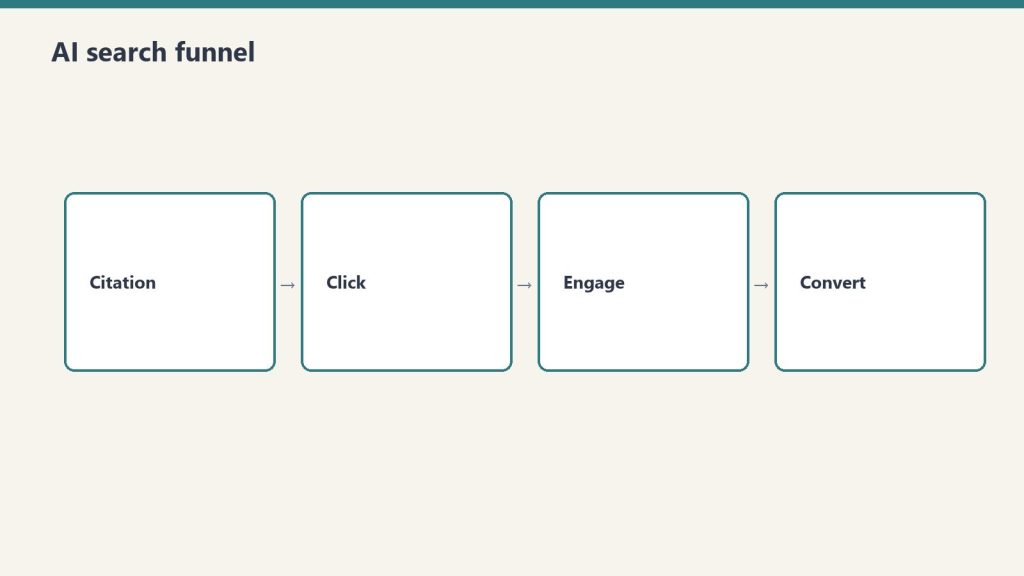
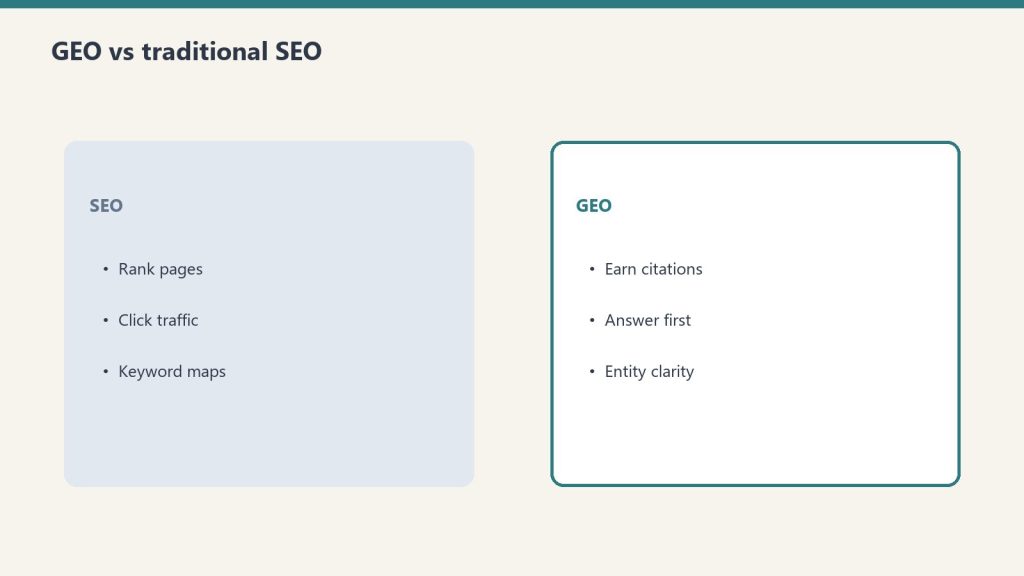
Most GEO and AEO case studies you can find online are vendor-published and short on implementation detail. So instead of stacking another “look at this 300% lift” headline, this piece walks through five publicly documented results from 2026 — and pulls out the structural change that actually drove the win in each one. If you want to copy what works, copy the structure, not the percentage.
1) HubSpot: 3x lead conversion from AEO traffic
Case patterns: what actually worked in GEO/AEO.
HubSpot’s own 2026 State of Marketing reporting found 58% of marketers saying AI-referred visitors convert at higher rates than traditional organic, with HubSpot itself reporting roughly 3x better lead conversion from AEO sources versus other channels. The implementation pattern across HubSpot’s blog: question-led H2s, a 40–60 word direct answer in the first paragraph below the heading, then expanded context, then a structured FAQ block with FAQPage schema.
The before/after isn’t “more content.” It’s “the same content, restructured so the answer arrives in the first 60 words.” That single edit is what featured snippets and AI Overviews both reward.
Zero-click visibility lifts without chasing vanity traffic.
Hashmeta documented a 50% increase in zero-click visibility for an e-commerce client after a targeted AEO sprint. The lever: rebuilding product and category pages around explicit question intent (“what is the difference between X and Y,” “is X worth it for Z use case”) and adding HowTo and FAQPage schema. The page didn’t get more traffic from the same query — it started winning the answer position on related queries it wasn’t competing for before.
The takeaway for practitioners: zero-click visibility is its own funnel. Track it separately from sessions, because the value shows up in branded search lift two to four weeks later, not in same-day clicks.
3) SaaS brand: 20+ free-trial signups per month from ChatGPT citations
ChatGPT citations can create free-trial demand.
One SaaS case study circulating in the GEO community in early 2026 reported 20+ free-trial signups per month attributed directly to ChatGPT citations, identified via a unique UTM and a referral-source filter in their analytics. The structural pattern: a single canonical comparison page per top competitor, written as a third-person reference rather than first-person marketing, with a clear definition block, a structured comparison table, and a “when to choose X” section.
This is the format ChatGPT cites because it’s the format ChatGPT was trained to produce. Match the output shape and you become the source.
4) Generic brand study: 140% lift in AI-driven search traffic
A widely cited 2026 GEO case study reported a 140% increase in LLM and AI-driven search traffic alongside a 62% rise in AI mentions after a strategy that prioritized entity saturation, internal-link clustering, and structured data over keyword density. The implementation detail worth copying: a single hub page per entity with at least 15 distinct factual data points, then 8–12 supporting articles linking back to it with descriptive anchor text.
The 15-data-point threshold matches what GEO researchers have flagged repeatedly: articles with 15+ verifiable data points receive substantially more AI citations than articles with fewer than five.
5) Mangools: featured-snippet capture from a single edit
Mangools published a walkthrough showing how rewriting one blog post to lead with a 50-word direct answer captured a featured snippet for a head-term query, with the resulting traffic and brand exposure outpacing the rest of the content cluster. No new backlinks, no new content — just a structural rewrite of the first 100 words.
The pattern across all five
Every win has the same shape: question-led H2, 40–60 word direct answer, structured supporting content, schema markup. Here is the minimum viable AEO block, drop-in ready:
<h2>What is generative engine optimization?</h2>
<p><strong>Generative engine optimization (GEO) is the practice of structuring web content so AI systems like ChatGPT, Claude, Gemini, and Perplexity cite it as a source.</strong> Unlike SEO, which optimizes for ranking in a list of links, GEO optimizes for being included in a generated answer. The core levers are entity clarity, factual density, structured data, and crawlability via LLMs.txt and robots.txt.</p>

<script type="application/ld+json">
{
  "@context": "https://schema.org",
  "@type": "FAQPage",
  "mainEntity": [{
    "@type": "Question",
    "name": "What is generative engine optimization?",
    "acceptedAnswer": {
      "@type": "Answer",
      "text": "Generative engine optimization (GEO) is the practice of structuring web content so AI systems cite it as a source in generated answers."
    }
  }]
}
</script>
The measurement layer
None of these case studies mean anything without isolation. The minimum tracking stack: a referrer filter for chatgpt.com, perplexity.ai, claude.ai, gemini.google.com, and copilot.microsoft.com in GA4; a separate event for zero-click impressions from Google Search Console; and a manual citation log — query a representative model with your top 25 prompts weekly and record whether your domain is cited. The third one is what most teams skip, and it’s the only one that tells you whether GEO is working before traffic shows up.
What to copy this week
Pick your top five highest-intent pages. For each one, rewrite the first 100 words as a direct-answer block, add a single FAQPage schema with three questions, and add the page to your LLMs.txt manifest. That is the entire implementation. Every case study above is a variation on those three moves.
Updated November 2, 2026 — added direct answers on competitor benchmarking, audit cadence, and citation drop diagnosis, from our own published measurement.
Direct Answer: Measure LLM visibility with five metrics—citation frequency, prompt coverage, share of voice, AI referral sessions, and conversion quality from that traffic. Pair a monthly 20-prompt audit with GA4: use Google’s May 2026 “AI Assistant” channel where it applies, plus a custom channel group (regex on session source, ordered above Referral) so Perplexity and historical sessions don’t stay buried in Referral or Direct.
Most SEO teams know they need to care about AI search. Almost none of them have a measurement system in place for it. That’s the gap this article closes.
Ranking in ChatGPT, Perplexity, Google AI Overviews, or Claude isn’t a vanity metric anymore — it’s a traffic channel. But unlike Google, AI systems don’t serve a results page you can screenshot. They weave citations into prose. Your brand either shows up in that prose or it doesn’t, and if you’re only watching default GA4 channel reports, you’re flying mostly blind.
This is a practitioner’s setup guide: the exact metrics, GA4 configuration, and tool stack needed to track LLM visibility systematically — including how to define AI citation rate before you buy software.
The Five Metrics That Define LLM Visibility
Five metrics that define LLM visibility.
Traditional SEO tracks ranking position, impressions, and clicks. None of those exist in AI search. You need a new metric set:
Citation frequency — How often your domain or brand is mentioned in AI-generated answers for your target query set. LLMs typically cite a handful of sources per response. Capturing one of those slots consistently is the entire game.
Prompt coverage — Out of your tracked prompt library, what percentage of prompts return your brand at all? Calculate it as: (prompts where you appear ÷ total tracked prompts) × 100. A brand actively optimizing for AI search should be above 40% coverage on tier-1 prompts within 90 days of focused content work.
Share of voice — For a given topic cluster, how often do AI answers cite you versus competitors? If you appear in 12 of 30 tested prompts and a competitor appears in 20, they hold 67% share of voice on that topic. That ratio is more strategically meaningful than any single citation count.
AI referral sessions — The sessions in GA4 that arrived from an AI platform with a usable referrer header (or GA4’s native AI Assistant classification). This is the metric that ties visibility to business outcomes. Setup is covered in the next section.
Conversion quality from AI traffic — AI-referred visitors often arrive with higher intent: they asked a specific question and your site was the answer. Track engagement rate, pages per session, and goal completions for AI referral sessions separately. If this cohort converts at 2–3× the rate of your organic traffic — which early practitioner data suggests — it changes how you think about GEO investment.
Setting Up GA4 to Capture AI Traffic
GA4 regex to capture AI traffic.
Native AI Assistant channel (May 2026)
Since May 13, 2026, GA4’s default channel group includes an AI Assistant channel. When Google recognizes an assistant referrer, it sets medium ai-assistant. You will see it under Reports → Acquisition → Traffic acquisition. That is progress, but it is not a complete LLM visibility stack: Perplexity commonly still lands in Referral, assistant coverage in Google’s list changes, and clicks from Google AI Overviews or AI Mode still arrive as google.com — they stay in Organic Search, not AI Assistant.
Custom channel group and regex
For Perplexity, legacy referrers, and retroactive reporting, build your own group. In GA4: Admin → Data Display → Channel Groups → Create New Channel Group. Name it “AI Search” and add a rule:
Critical step: Place “AI Search” above “Referral” (and treat order as first-match-wins). If Referral appears first, Perplexity and other assistant referrers never reach your AI rule. Custom channel groups can be applied retroactively in reports; the native AI Assistant channel does not backfill history the same way.
Scope caveat: Many assistant-driven visits still arrive without a referrer — mobile apps, in-app browsers, and privacy modes send them to Direct or (not set). Your AI channel captures the visible minority. Don’t benchmark on absolute volume alone. Benchmark on growth rate, and watch Direct only when other signals line up.
To supplement GA4, add a self-reported source question on high-intent forms: “How did you find us?” Include “ChatGPT / AI assistant” as an option. That gives ground truth session data cannot.
The Tool Tier: Free to Enterprise
The LLM visibility tool market matured through 2025 and 2026. Three tiers cover most teams. Start manual before you pay — the same discipline described in our AI citation monitoring guide applies whether you use a spreadsheet or a dashboard.
Free / DIY — start here
Run 20 representative prompts manually across ChatGPT, Perplexity, Claude, and Google AI Overviews each month. Record mentions in a spreadsheet: cited (yes/no), cited with link (yes/no), competitor named instead. That gives you baseline prompt coverage and share of voice with zero budget. Do it for at least one month before buying software — you’ll know which gaps actually hurt.
Mid-market tools (roughly $30–$500/month)
OtterlyAI runs scheduled prompt sets and tracks brand mentions, cited URLs, and share of voice. Published USD pricing starts at $29/month (Lite, 15 prompts); Standard is $189/month (100 prompts); Premium is $489/month (400 prompts). ChatGPT, Google AI Overviews, Perplexity, and Copilot are included; Google AI Mode, Gemini, and Claude are add-ons. Enterprise starts around $1,000/month.
LLMrefs takes a keyword-first approach: import SEO keywords, and the platform generates prompt fan-outs and refreshes visibility on a schedule — closer to a rank tracker than a blank prompt spreadsheet. Useful when your team already thinks in keyword lists rather than conversational prompts.
Enterprise layer ($1,000+/month)
Profound centers on Prompt Volumes — modeled demand from real answer-engine conversations (ChatGPT, Gemini, Claude, Perplexity). It helps you prioritize which questions deserve content before you commit headcount. Valuable at scale; overkill for a single-location operator on the 20-prompt audit. Pair it with playbooks such as the GEO case studies series when you need proof the numbers moved.
The 20-Prompt Audit: Your Monthly Baseline Protocol
Whether you use a paid tool or not, run this protocol monthly:
Build a prompt library of 20 questions your target buyer would ask an AI system. These should be questions your content is designed to answer — not keyword-stuffed phrases, but real conversational queries.
Run each prompt across ChatGPT, Perplexity, and Google AI Overviews (3 platforms × 20 prompts = 60 data points per month).
For each result, record: was your brand cited in text, was your domain linked, and which competitor was cited if you were not.
Calculate prompt coverage per platform and total share of voice versus your top three competitors.
Log results in a spreadsheet with a date column. Three months of data reveals directional trends — whether your GEO and AEO work is moving the needle. Longitudinal baselines also make experiments legible; structured publishing tests (for example, the 40-article Bing citation experiment) only pay off when you can compare citation rates month over month.
How do I benchmark my AI visibility against competitors?
To benchmark your AI visibility against competitors, measure your citation rate against named rivals across a fixed, controlled prompt set rather than chasing broad keyword rankings. Run your core buyer prompts across the major AI search surfaces (ChatGPT, Perplexity, and Google AI Overviews). For each response, log whether your domain was cited in the text or footnotes, and record which competitors took the remaining citation slots. Your competitive benchmark is your share of authority—also called share of voice—which is the percentage of total citations on that prompt set awarded to your domain versus competing sources. Tracking this metric across monthly evaluation runs reveals whether your content is displacing rivals in finite answer slots or losing ground.
How often should I check my AI visibility?
Check your AI visibility monthly. A monthly cadence using a consistent prompt library of 20 conversational buyer queries across three major engines (generating 60 data points per cycle) provides the minimum sample size needed to detect genuine shifts in prompt coverage and share of voice. Weekly spot checks are useful only for immediate post-deployment verification or crisis audits; monthly logging over a trailing 90-day window filters out algorithmic noise, accounts for crawler refresh latency, and reveals true directional trends.
Diagnosing a Citation Drop
Diagnosing a citation drop.
If your monthly audit shows prompt coverage declining, run through this checklist before blaming a black-box algorithm change:
Did you remove or restructure a previously cited page? AI systems build representations of your content over time. Pages that disappear or get heavily rewritten lose citation weight. Check your changelog against the prompts that declined.
Did a competitor publish stronger content on the topic? Citation slots in a single answer are finite. If a competitor shipped a more authoritative page, it may have displaced yours. Review their recent publishing calendar.
Check LLMs.txt and robots.txt. A crawlability block in LLMs.txt or a misconfigured Disallow directive cuts AI access at the source. Verify both files allow the URLs you expect to be cited.
Check for a platform or model update. Major chatbot and search-model releases in 2025–2026 shifted which sources each engine trusted. Read the platform’s public changelog for the period in question.
If none of these apply, audit structured data on the pages that lost citations — schema, FAQ blocks, heading hierarchy, and factual density all affect extraction. A redesign that removed an FAQ block can remove your citation utility in the same deploy.
Why does AI cite my competitor but not me?
Citation slots in an AI-generated answer are finite. When an AI assistant cites a competitor instead of your domain on a query your business is qualified to answer, evaluate the cause using this diagnostic checklist in order:
Competitor content density: A rival published a more comprehensive, factually dense, or directly structured answer that displaced your page in limited citation real estate.
URL removals or restructuring: A previously cited page on your domain was renamed, relocated, or substantially rewritten, disrupting accumulated citation authority.
Crawlability directives: Check your robots.txt and LLMs.txt files to ensure crawler access has not been restricted by unintended Disallow rules.
Assistant and model releases: Major platform and underlying model updates frequently alter source-weighting criteria across AI engines.
Extraction utility: Review structured data, schema markup, FAQ blocks, and heading hierarchy on the target URL; removing an FAQ section or answer block during a redesign can strip away machine extractability.
The Bottom Line
LLM visibility measurement is not solved, but the primitives exist: GA4’s AI Assistant channel plus a custom regex group for traffic, manual prompt audits for citation coverage, and mid-market tools when labor becomes the bottleneck. Operators who need a packaged starting point can map the same metrics to a vertical playbook such as the AI search visibility package for water damage — the measurement layer stays identical even when the prompts change.
Build the 20-prompt library this week. Configure GA4 today. Everything else stacks on those two streams.
FAQ
What is LLM visibility? LLM visibility is how often your brand or domain appears in AI-generated answers — in the prose, in linked citations, or both — for the questions your buyers ask. It is the AI-search equivalent of showing up on page one, except there is no single rank number to screenshot.
Does GA4 automatically track ChatGPT and Perplexity traffic? Partially. Since May 2026, GA4’s AI Assistant channel classifies some assistant referrers with medium “ai-assistant.” Perplexity often remains Referral, AI Overview clicks stay Organic, and no-referrer visits stay Direct. A custom “AI Search” channel group with a source regex — placed above Referral — is still required for complete trending.
How often should I run a prompt audit? Monthly is the minimum useful cadence. Run the same 20 core prompts each cycle so prompt coverage and share of voice are comparable. Weekly spot checks are fine for crisis monitoring, but monthly logging is what builds a baseline.
What is the difference between prompt coverage and share of voice? Prompt coverage is the share of your tracked prompts where you appear at all. Share of voice compares how often you appear versus named competitors across that same prompt set. High coverage with low share of voice means you show up, but rivals dominate the answers.
Do I need a paid tool to measure AI citations? No. A spreadsheet and 60 manual checks per month (20 prompts × three platforms) are enough to start. Paid tools mainly automate scheduling, add engines, and export reports once you know which prompts and competitors matter.
Why would AI citations drop suddenly? Common causes are URL removals or restructures, stronger competitor pages, crawl blocks via robots.txt or LLMs.txt, or model updates on the assistant platform. Rule those out before you assume your entire GEO strategy failed.
If you’ve optimized content for Google and still can’t get AI systems to cite you, you’re running the wrong playbook. GEO — Generative Engine Optimization — is the discipline of making your content visible, credible, and citable to AI engines like ChatGPT, Claude, Perplexity, Gemini, and Google’s AI Overviews. It is not SEO with a new name. It is a different game with different rules.
Definition: Generative Engine Optimization (GEO) is the practice of structuring content so that large language models and AI search engines select it as a source when generating responses to user queries. Where SEO earns rankings, GEO earns citations.
Why GEO Is Not SEO
Why GEO is not SEO.
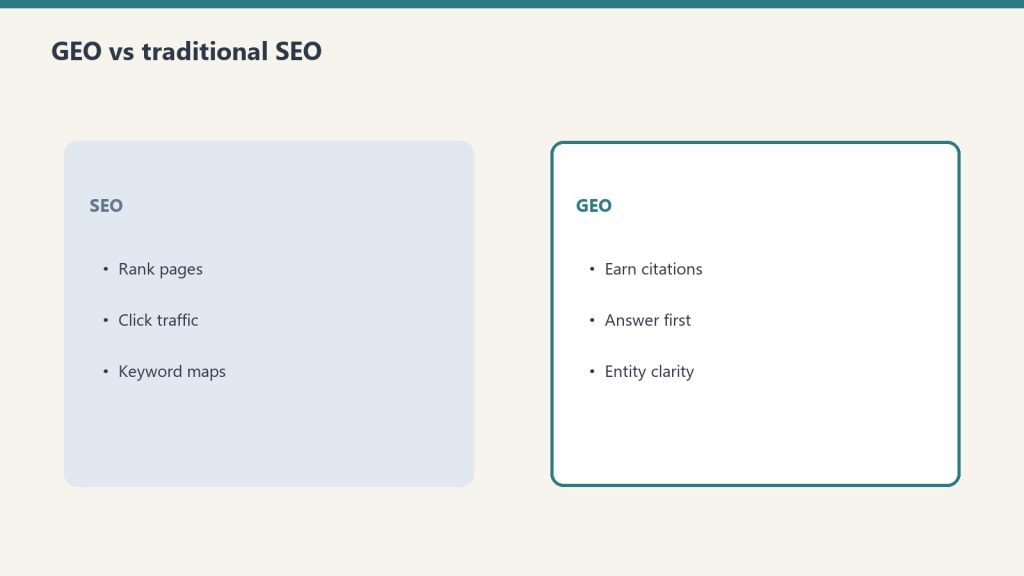
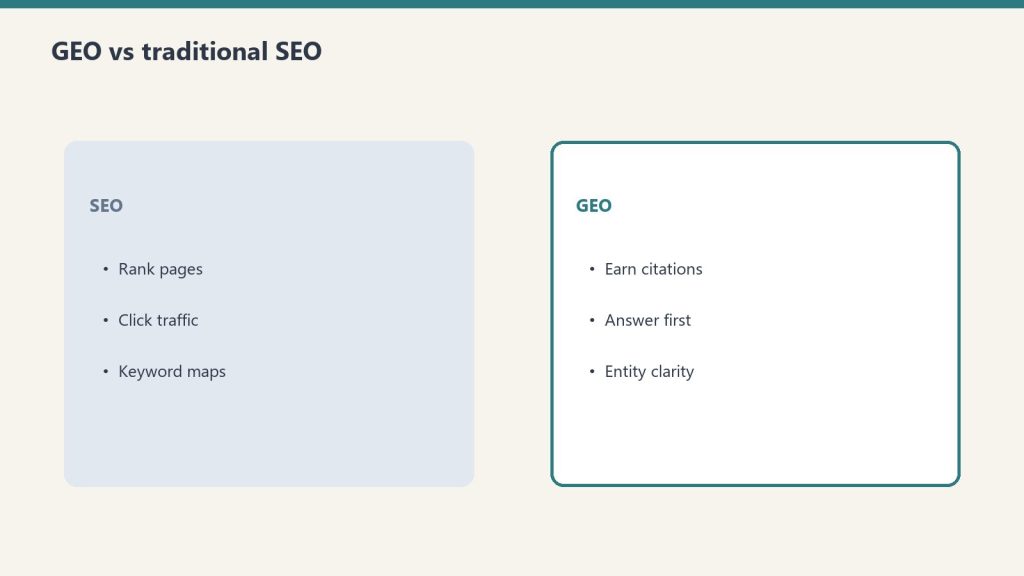
SEO is about ranking. You optimize a page so Google’s algorithm surfaces it when someone searches. The goal is a click. GEO is about being quoted. You structure content so an AI system trusts it enough to pull a fact, a definition, or an explanation from it when synthesizing a response. The user may never click your URL — but your content shaped what they read.
The mechanisms are fundamentally different. Google’s ranking algorithm weighs hundreds of signals — backlinks, page speed, user behavior, authority. AI citation selection weights entity density, factual specificity, source credibility signals, and structural clarity. A page that ranks #1 on Google may get zero AI citations. A page that ranks #8 may be the one Perplexity quotes every time someone asks about that topic.
How AI Engines Select Content to Cite
How AI engines select content to cite.
Large language models used in AI search (GPT-4, Claude, Gemini) were trained on large corpora of text, but the retrieval-augmented generation (RAG) layer that powers tools like Perplexity, ChatGPT search, and Google AI Overviews works differently. It pulls live content at query time, scores it for relevance and credibility, and synthesizes a response. The signals it uses to score your content include:
Entity clarity — Are the people, places, companies, and concepts in your content clearly named and linked to known entities?
Factual density — Does your content contain specific, verifiable claims rather than vague generalities?
Structural legibility — Can the AI parse your content’s structure — headings, definitions, lists — without ambiguity?
Source signals — Does your content cite primary sources, studies, or named experts?
Speakable schema — Have you marked up key paragraphs as machine-readable answer candidates?
The Three Layers of GEO
Three layers of GEO — structure, entity, proof.
Layer 1: Content Architecture
GEO-optimized content is built for extraction, not just reading. That means every major claim is in a standalone sentence. Definitions appear near the top. Section headers are declarative, not clever. The structure tells an AI where the answer is before it has to read the full article.
Layer 2: Entity Saturation
AI systems understand content through entities — named people, organizations, places, products, and concepts that exist in their training data. A GEO-optimized article saturates relevant entities: it doesn’t say “a major AI company” when it means Anthropic. It doesn’t say “a popular search tool” when it means Perplexity. Every entity is named, spelled correctly, and used in the right context.
Layer 3: Schema and Structured Data
JSON-LD schema markup is a signal to both traditional search engines and AI crawlers. FAQPage schema makes your Q&A content directly extractable. Speakable schema flags the paragraphs most useful for voice and AI synthesis. Article schema establishes authorship and publication date. These are not optional extras — they are the machine-readable layer that gets your content selected.
GEO vs AEO: What’s the Difference?
Answer Engine Optimization (AEO) focuses on winning featured snippets, People Also Ask boxes, and zero-click search results in traditional search engines. GEO focuses on being cited by generative AI systems. The tactics overlap — both require clear structure, direct answers, and FAQ sections — but the targets are different. AEO wins position zero on Google. GEO wins the paragraph that Perplexity writes for the next million queries on your topic.
At Tygart Media, we run both in parallel. The content pipeline produces articles that pass the AEO gate (featured snippet structure, FAQ schema) and the GEO gate (entity density, speakable markup, citation-worthy claims) before publishing.
What GEO Looks Like in Practice
Here is the difference between a standard paragraph and a GEO-optimized version of the same content:
Standard: “Water damage restoration is an important service for homeowners who have experienced flooding or leaks.”
GEO-optimized: “Water damage restoration — the professional remediation of structural damage caused by flooding, pipe failure, or storm intrusion — is performed by IICRC-certified contractors following the S500 Standard for Professional Water Damage Restoration. The process includes water extraction, structural drying, moisture monitoring, and antimicrobial treatment.”
The second version names the certifying body (IICRC), the standard (S500), and the process steps. An AI system can extract that paragraph as a factual, citable answer. The first version has nothing to extract.
How to Start with GEO
If you’re running an existing content operation and want to layer in GEO, the priority order is:
Audit your top 20 pages for entity gaps — everywhere you use vague references, replace with specific named entities
Add speakable schema to your three strongest definitional paragraphs per page
Run a factual density check — every statistic should have a source, every claim should be specific
Add FAQPage schema to any page with question-format headings
Submit your top pages to Google’s Rich Results Test and verify structured data is reading cleanly
GEO Is Compounding Infrastructure
The reason GEO matters for content operations is compounding. Once an AI system has indexed and trusted your content as a reliable source on a topic, subsequent queries on that topic draw from your content repeatedly — without you publishing anything new. A single GEO-optimized pillar article can generate thousands of AI citations over 12 months. That is a different kind of ROI than a ranked page that gets clicked and forgotten.
We built the Tygart Media content stack around this principle. Every article that leaves our pipeline passes a GEO gate before it publishes. That gate checks entity saturation, factual specificity, schema completeness, and structural legibility. It is the same gate we build for clients.
Frequently Asked Questions About GEO
What does GEO stand for?
GEO stands for Generative Engine Optimization — the practice of optimizing content to be cited by AI-powered search systems and large language models.
Is GEO the same as SEO?
No. SEO (Search Engine Optimization) targets traditional search rankings. GEO targets AI citation in tools like ChatGPT, Perplexity, Claude, and Google AI Overviews. The tactics overlap but the mechanisms and goals are different.
How do I know if my content is being cited by AI?
Run queries related to your topic in Perplexity, ChatGPT (with search enabled), and Google AI Overviews. Check whether your domain appears as a cited source. Tools like Profound and Otterly.ai can automate this monitoring.
Does GEO replace AEO?
No. AEO and GEO are complementary. AEO wins traditional search features like featured snippets. GEO wins AI citations. A mature content strategy runs both in parallel.
How long does GEO take to show results?
Unlike SEO, GEO results can appear quickly — sometimes within days of a page being indexed by AI crawlers. The compounding effect builds over 60–180 days as AI systems repeatedly select your content for related queries.
Si has optimizado contenido para Google y aun así no logras que los sistemas de inteligencia artificial te citen, es porque estás usando el manual equivocado. GEO —Generative Engine Optimization u Optimización para Motores Generativos— es la disciplina de hacer que tu contenido sea visible, creíble y citable para motores de IA como ChatGPT, Claude, Perplexity, Gemini y los AI Overviews de Google. No es SEO con un nombre nuevo. Es un juego distinto con reglas distintas.
Definición: La Optimización para Motores Generativos (GEO) es la práctica de estructurar el contenido para que los modelos de lenguaje de gran escala (LLM) y los motores de búsqueda con IA lo seleccionen como fuente al generar respuestas a las consultas de los usuarios. Donde el SEO obtiene posiciones, el GEO obtiene citas.
Por qué GEO no es SEO
Por qué GEO no es SEO.
El SEO trata de posicionarse. Optimizas una página para que el algoritmo de Google la muestre cuando alguien busca algo. El objetivo es un clic. El GEO trata de ser citado. Estructuras el contenido para que un sistema de IA confíe en él lo suficiente como para extraer un dato, una definición o una explicación cuando sintetiza una respuesta. El usuario puede no hacer clic en tu URL, pero tu contenido moldeó lo que leyó.
Los mecanismos son fundamentalmente diferentes. El algoritmo de posicionamiento de Google pondera cientos de señales: backlinks, velocidad de página, comportamiento del usuario, autoridad. La selección de citas por IA pondera la densidad de entidades, la especificidad factual, las señales de credibilidad de la fuente y la claridad estructural. Una página que ocupa el puesto #1 en Google puede recibir cero citas de IA. Una página que ocupa el puesto #8 puede ser la que Perplexity cita cada vez que alguien pregunta sobre ese tema.
Cómo los motores de IA seleccionan el contenido que citan
Los modelos de lenguaje de gran escala utilizados en la búsqueda con IA (GPT-4, Claude, Gemini) fueron entrenados en grandes corpus de texto, pero la capa de generación aumentada por recuperación (RAG) que impulsa herramientas como Perplexity, la búsqueda de ChatGPT y los AI Overviews de Google funciona de manera diferente. Extrae contenido en tiempo real en el momento de la consulta, lo puntúa por relevancia y credibilidad, y sintetiza una respuesta. Las señales que utiliza para puntuar tu contenido incluyen:
Claridad de entidades — ¿Las personas, lugares, empresas y conceptos en tu contenido están claramente nombrados y vinculados a entidades conocidas?
Densidad factual — ¿Tu contenido contiene afirmaciones específicas y verificables en lugar de generalidades vagas?
Legibilidad estructural — ¿Puede la IA analizar la estructura de tu contenido —encabezados, definiciones, listas— sin ambigüedad?
Señales de fuente — ¿Tu contenido cita fuentes primarias, estudios o expertos nombrados?
Esquema speakable — ¿Has marcado párrafos clave como candidatos de respuesta legibles por máquinas?
Las tres capas del GEO
Las tres capas del GEO.
Capa 1: Arquitectura de contenido
El contenido optimizado para GEO está diseñado para la extracción, no solo para la lectura. Eso significa que cada afirmación importante está en una oración independiente. Las definiciones aparecen cerca de la parte superior. Los encabezados de sección son declarativos, no creativos. La estructura le dice a la IA dónde está la respuesta antes de que tenga que leer el artículo completo.
Capa 2: Saturación de entidades
Los sistemas de IA entienden el contenido a través de entidades: personas, organizaciones, lugares, productos y conceptos nombrados que existen en sus datos de entrenamiento. Un artículo optimizado para GEO satura las entidades relevantes: no dice “una importante empresa de IA” cuando se refiere a Anthropic. No dice “una popular herramienta de búsqueda” cuando se refiere a Perplexity. Cada entidad está nombrada, escrita correctamente y usada en el contexto correcto.
Capa 3: Esquema y datos estructurados
El marcado de esquema JSON-LD es una señal tanto para los motores de búsqueda tradicionales como para los rastreadores de IA. El esquema FAQPage hace que tu contenido de preguntas y respuestas sea directamente extraíble. El esquema speakable marca los párrafos más útiles para la síntesis de voz e IA. El esquema de artículo establece la autoría y la fecha de publicación. No son extras opcionales: son la capa legible por máquinas que hace que tu contenido sea seleccionado.
GEO vs AEO: ¿Cuál es la diferencia?
GEO vs AEO: cuál es la diferencia.
La Optimización para Motores de Respuesta (AEO) se centra en ganar fragmentos destacados, cuadros de Preguntas relacionadas y resultados de búsqueda de cero clics en los motores de búsqueda tradicionales. El GEO se centra en ser citado por los sistemas de IA generativa. Las tácticas se superponen, pero los objetivos son diferentes. El AEO gana la posición cero en Google. El GEO gana el párrafo que Perplexity escribe para el próximo millón de consultas sobre tu tema.
Cómo empezar con GEO
Si estás gestionando una operación de contenido existente y quieres incorporar GEO, el orden de prioridad es:
Audita tus 20 páginas principales en busca de lagunas de entidades — donde uses referencias vagas, reemplázalas con entidades nombradas específicas
Añade esquema speakable a tus tres párrafos definitorios más sólidos por página
Ejecuta una verificación de densidad factual — cada estadística debe tener una fuente, cada afirmación debe ser específica
Añade esquema FAQPage a cualquier página con encabezados en formato de pregunta
Envía tus páginas principales a la Prueba de resultados enriquecidos de Google y verifica que los datos estructurados se lean correctamente
GEO es infraestructura que se acumula
La razón por la que GEO importa para las operaciones de contenido es el efecto acumulativo. Una vez que un sistema de IA ha indexado y confiado en tu contenido como fuente confiable sobre un tema, las consultas posteriores sobre ese tema extraen de tu contenido repetidamente, sin que publiques nada nuevo. Un solo artículo pilar optimizado para GEO puede generar miles de citas de IA durante 12 meses. Eso es un tipo diferente de ROI al de una página posicionada que recibe clics y se olvida.
Preguntas frecuentes sobre GEO
¿Qué significa GEO?
GEO significa Generative Engine Optimization —Optimización para Motores Generativos— la práctica de optimizar contenido para ser citado por sistemas de búsqueda impulsados por IA y modelos de lenguaje de gran escala.
¿Es GEO lo mismo que SEO?
No. El SEO apunta a posiciones en la búsqueda tradicional. El GEO apunta a citas de IA en herramientas como ChatGPT, Perplexity, Claude y los AI Overviews de Google. Las tácticas se superponen pero los mecanismos y objetivos son diferentes.
¿Cómo sé si mi contenido está siendo citado por la IA?
Ejecuta consultas relacionadas con tu tema en Perplexity, ChatGPT (con búsqueda activada) y los AI Overviews de Google. Verifica si tu dominio aparece como fuente citada. Herramientas como Profound y Otterly.ai pueden automatizar este monitoreo.
¿GEO reemplaza al AEO?
No. AEO y GEO son complementarios. El AEO gana características de búsqueda tradicional como fragmentos destacados. El GEO gana citas de IA. Una estrategia de contenido madura ejecuta ambos en paralelo.
¿Cuánto tiempo tarda el GEO en mostrar resultados?
A diferencia del SEO, los resultados de GEO pueden aparecer rápidamente, a veces en días después de que una página sea indexada por los rastreadores de IA. El efecto acumulativo se construye durante 60 a 180 días a medida que los sistemas de IA seleccionan repetidamente tu contenido para consultas relacionadas.
Something significant shifted in the AI search landscape between November 2025 and February 2026, and most content strategists have not caught up to it yet.
LinkedIn jumped from the 11th most-cited domain to the 5th most-cited domain on ChatGPT in just three months. Profound, which analyzed 1.4 million AI citations across six platforms, called it “the largest shift in authority that we’ve seen this year.” In a separate study of ChatGPT Search, Google AI Mode, and Perplexity, Semrush found LinkedIn in 11% of AI responses on average.
If you publish professional content, this was the most important GEO development of early 2026.
In January–February 2026, Semrush analyzed 325,000 prompts across ChatGPT Search, Google AI Mode, and Perplexity, identifying 89,000 unique LinkedIn URLs cited in AI-generated responses. The platform-by-platform breakdown:
ChatGPT Search: LinkedIn appears in 14.3% of all responses
Google AI Mode: LinkedIn appears in 13.5% of all responses
Perplexity: LinkedIn appears in 5.3% of all responses
LinkedIn ranked #2 among cited domains in Semrush’s dataset, and Profound found it is the #1 cited domain for professional queries across the six AI platforms it analyzed: ChatGPT, Gemini, Google AI Overviews, Google AI Mode, Microsoft Copilot, and Perplexity.
What AI Systems Are Actually Citing
What AI systems are actually citing.
The composition of LinkedIn’s AI citations has shifted dramatically. In Profound’s data, profile page citations — the static biographical data that dominated early LinkedIn citations — collapsed from 33.9% to just 14.5% of all LinkedIn citations between November 15, 2025 and February 15, 2026. Meanwhile, posts and long-form articles grew from 26.9% to 34.9%.
AI systems are not citing LinkedIn because of who you are. They are citing LinkedIn because of what you published.
Of the 89,000 cited URLs in Semrush’s study, 50–66% are long-form Articles of 500–2,000 words, and 54–64% are educational or advice-driven content. The median cited post has just 15–25 reactions and roughly one comment. Engagement is not the primary driver of AI citation — relevance, accuracy, specificity, and structure are.
Creators with fewer than 500 followers get cited at comparable rates to large accounts. This is not a follower game. It is a content quality and structure game.
The Personal Profile vs Company Page Split
One of the more strategically interesting findings from Semrush’s study is that different AI platforms cite LinkedIn content differently by source type.
ChatGPT and Google AI Mode favor personal profiles, drawing 59% of their LinkedIn citations from individual creator content versus 41% from company pages. Perplexity reverses this, drawing 59% of its LinkedIn citations from company pages and 41% from personal profiles.
The strategic implication is a dual-publishing approach. Publishing technical and educational content on both a personal profile and a company page maximizes AI visibility across all major platforms simultaneously. They are not redundant — they are complementary, each feeding different AI citation systems.
Why LinkedIn Content Gets Cited: The Structural Reasons
LinkedIn’s relationship with AI systems operates through multiple channels that reinforce each other.
First, LinkedIn content has always been publicly indexed and high-authority. With a Moz Domain Authority of 98, LinkedIn Pulse articles sit in the same crawlability tier as Wikipedia and major news publications. AI training datasets over-index on high-authority domains, meaning LinkedIn content has been proportionally well-represented in model training from the beginning.
Second, LinkedIn rolled out a “Data for Generative AI Improvement” toggle in September 2024, set to ON by default, according to LinkedIn Help. On November 3, 2025, LinkedIn also began using data from members in the EU, EEA, Switzerland, Canada, and Hong Kong to train content-generating AI models. LinkedIn is owned by Microsoft, which has a direct relationship with OpenAI. The structural pipeline from LinkedIn content to AI model training is more direct than almost any other platform.
Third, LinkedIn content shows semantic similarity scores of 0.57–0.60 with AI-generated outputs, higher than Reddit (0.53–0.54) or Quora (0.44). AI systems are not just citing LinkedIn — they are drawing heavily on LinkedIn’s language patterns and reasoning structures when generating responses.
What This Means for B2B and Restoration Industry Content
For professional verticals — B2B services, restoration, real estate, finance, healthcare — LinkedIn is no longer an optional distribution channel. It is likely the single highest-leverage GEO publishing surface available.
A structured LinkedIn Article on a technical topic in the restoration industry, AI strategy, or B2B services has a realistic path to being cited in ChatGPT, Perplexity, and Google AI Mode responses on relevant professional queries. It does not require a large following. It does not require viral engagement. It requires content that is accurate, structured, specific, and educational.
Content reaches peak AI citation velocity 7–14 days after publishing and maintains that velocity for 90 or more days — significantly longer than Twitter/X or Reddit content, which cycles out of AI citation windows much faster.
The Practical GEO Framework
The practical GEO framework.
Based on the citation data, the content signals that drive AI citation on LinkedIn are consistent and actionable: include specific data points, metrics, methodologies, and dates rather than generic claims. Use clear H2 heading structure that AI systems can parse for answer extraction. Write educational and advice-driven content rather than promotional content. Target 800–1,200 words per Article — long enough to establish depth, short enough to maintain density.
The biggest opportunity right now is that most LinkedIn publishers are still optimizing for feed engagement — reactions, comments, shares. The AI citation data suggests a different optimization target: structured, data-rich, educational long-form content that looks less like a viral feed post and more like a well-sourced reference document.
The brands and individuals who make that shift in 2026 are building citation authority that will compound for years.
LinkedIn ranked #2 among cited domains in Semrush’s early-2026 study, appearing in about 11% of responses across ChatGPT Search, Google AI Mode, and Perplexity. Profound found it is the #1 cited domain for professional queries across ChatGPT, Gemini, Google AI Overviews, Google AI Mode, Copilot, and Perplexity.
What type of LinkedIn content gets cited by AI systems?
50–66% of AI-cited LinkedIn content is long-form Articles of 500–2,000 words. Educational and advice-driven content accounts for 54–64% of citations. The median cited post has only 15–25 reactions — engagement is not the primary driver of AI citation.
Does LinkedIn company page content get cited by AI?
Yes. Perplexity draws 59% of its LinkedIn citations from company pages. ChatGPT and Google AI Mode favor personal profiles at 59%. A dual-publishing strategy covering both maximizes visibility across all AI platforms.
How long does it take for LinkedIn content to appear in AI citations?
LinkedIn content reaches peak AI citation velocity 7–14 days after publishing and maintains that velocity for 90 or more days — longer than most other social platforms.
AI Citation Quick-Scan — $97
This article maps how AI answer engines decide whose content earns a citation. The Quick-Scan runs that same check on your company: ten homeowner prompts across the major AI answer engines, with a written report in 7 days. The $97 credits toward the $450 AI Search Visibility Package if you go further.
CH 03· Answer Engine Intelligence
· Filed by Will Tygart
What Is an AEO/GEO Sprint?
An AEO (Answer Engine Optimization) and GEO (Generative Engine Optimization) Sprint is a structured retrofit of your existing WordPress content — restructuring posts so search engines surface them as direct answers, and AI systems cite them in generated responses. Not new content. Not a redesign. Your existing posts, optimized to win in a search landscape that now includes ChatGPT, Perplexity, and Google AI Overviews.
Google’s search results page looks different than it did 18 months ago. AI Overviews now appear above the organic results. Perplexity cites specific pages instead of ranking a list. ChatGPT recommends sites it’s been trained to recognize as authoritative.
If your existing content wasn’t built to answer questions directly, it won’t show up in any of those placements — regardless of how well it ranks for traditional SEO.
We’ve applied this exact retrofit to over 500 posts across restoration, lending, flooring, SaaS, healthcare, and entertainment verticals. We know what changes produce featured snippet captures, what entity patterns make AI systems cite a page, and which schema structures Google’s rich results tool actually validates.
Who This Is For
Who the WordPress AEO/GEO sprint is for.
WordPress site owners and operators with existing published content — at least 20 posts — who aren’t appearing in AI-generated answers or featured snippet placements. If you’ve been publishing consistently but not converting that content into search placements that existed 18 months ago, this sprint directly addresses that gap.
What the Sprint Covers (Per Post)
What the sprint covers per post.
Definition box insertion — 40–60 word direct answer block at the top of the post, formatted for featured snippet capture
Question-led H2 restructure — Key headings rewritten as questions with direct answers in the first 50 words following each heading
FAQPage section — 5–8 Q&As written for People Also Ask placement, with FAQPage JSON-LD schema
Speakable schema blocks — Key paragraphs marked with speakable schema for voice search and AI synthesis
Entity saturation pass — Named entities (organizations, certifications, standards bodies, locations) identified and injected throughout
External citation injection — 3–5 authoritative source references added per post
Article + BreadcrumbList schema — Complete JSON-LD block appended to each post
LLMS.TXT comment block — AI-readable seed paragraph added as HTML comment for LLM citation signals
Sprint Packages
Sprint packages.
Package
Posts Covered
Turnaround
Starter Sprint
10 posts
5 business days
Standard Sprint
25 posts
10 business days
Full Site Sprint
50 posts
15 business days
Posts are selected collaboratively — we prioritize by traffic volume, keyword proximity to featured snippet triggers, and entity coverage gaps.
What You Get vs. DIY vs. Generic SEO Agency
Tygart Media Sprint
DIY
Generic SEO Agency
FAQPage JSON-LD schema on every post
✅
Maybe
Sometimes
AI citation signals (LLMS.TXT, speakable)
✅
❌
❌
Entity saturation for niche-specific bodies
✅
❌
Rarely
Direct publish to WordPress via REST API
✅
N/A
You review drafts
Validated with Google Rich Results Test
✅
Maybe
Sometimes
Proven in AI-heavy verticals
✅
❌
❌
Ready to Get Your Existing Content Into AI-Generated Answers?
Send your site URL and a rough post count. We’ll identify your best 10 candidates for AEO/GEO retrofit and quote the sprint that makes sense.
Will this change my existing post content significantly?
We add structured elements (definition boxes, FAQ sections, schema) and restructure key headings — we don’t rewrite the body of your posts. Your voice and factual content remain intact. All changes are reviewed before publish if requested.
How quickly will I see results in featured snippets or AI answers?
Google typically re-crawls optimized pages within 2–6 weeks for established sites. Featured snippet captures often appear within the first crawl cycle post-optimization. AI citation signals (Perplexity, ChatGPT) are slower — typically 1–3 months for recognition.
Which verticals have you run this in?
Property damage restoration, luxury asset lending, commercial flooring, B2B SaaS, healthcare services, comedy and entertainment streaming, and event technology. The entity patterns differ by vertical — we adapt the sprint to the specific certification bodies, standards organizations, and named entities that matter in your niche.
Do I need to give you WordPress admin access?
We use WordPress Application Passwords — a scoped credential that doesn’t expose your admin password. You create it, share it, and revoke it after the sprint. We publish directly via WordPress REST API.
What if my site uses Elementor or another page builder on posts?
We specifically target WordPress posts (not pages) via the REST API content field — Elementor and page builder data on pages is never touched. This is a hard operational rule we enforce on every sprint.
Can I pick which posts get the sprint treatment?
Yes. We provide a prioritized recommendation list, but you make the final call on which posts are included.
How Restoration Companies Get Found in AI Search When Homeowners Need Help Fast
By Tygart Media Updated: November 8, 2026
The 2am AI search reality: A homeowner discovers water in their basement at 2am. They don’t know which restoration company to call. They ask ChatGPT: “What should I do right now about water damage?” or “How fast does mold grow after water damage?” The AI synthesizes an answer from the most authoritative, structured, entity-rich restoration content it can retrieve. The restoration company cited in that answer has a significant advantage — the homeowner arrives at their phone number pre-trusting a source that just helped them.
Why Emergency Restoration Queries Are the Highest AI Citation Opportunity
A flooded residential living room with standing water on the hardwood floor, furniture raised on blocks and baseboards cut away after a water loss.
Restoration is one of the few industries where the customer’s search happens simultaneously with the problem. A homeowner doesn’t research restoration contractors the week before their pipe bursts — they search during the crisis. This creates a specific AI search opportunity: the queries that precede a restoration call are exactly the kind of direct-answer, process-oriented questions that AI systems are built to answer.
“What to do immediately after water damage,” “how fast does mold grow after a leak,” “is it safe to stay in a house with water damage,” “what does Category 3 water damage mean” — these are answerable questions with verifiable, standard-referenced answers. Restoration content that answers them with IICRC entity references and direct-answer formatting is exactly what AI systems retrieve and cite.
How do restoration companies get cited by ChatGPT and Google AI Overviews for water damage queries?
Restoration companies earn AI citations for water damage queries when their WordPress content combines: ranking in the top 20 organic results for the query, IICRC standard references (S500, S520, specific technician certifications) as named entity anchors that AI systems can verify, direct-answer speakable blocks in the first 50 words after each section heading, and FAQPage JSON-LD schema that makes question-and-answer pairs machine-parseable. Emergency query content — “what to do after water damage,” “how fast does mold grow” — has the highest AI citation potential of any restoration content type because it matches the question format AI systems are built to answer.
The Emergency Query Content Architecture
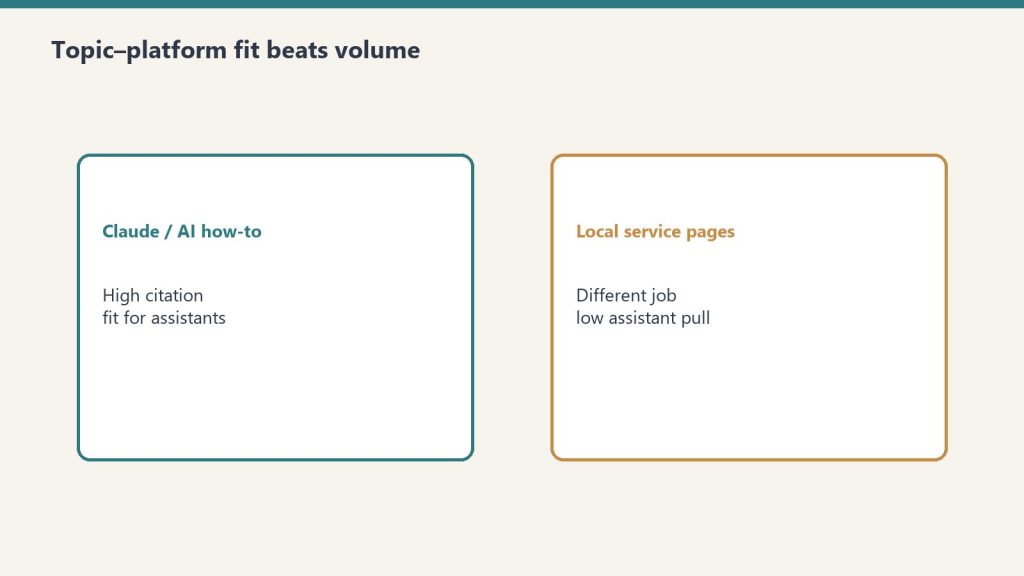
Topic-platform fit cards: Claude / AI how-to content has high citation fit for assistants, while local service pages do a different job with low assistant pull.
Lead With the Direct Answer
For emergency restoration queries, AI systems retrieve content that answers the question immediately — not content that builds context for three paragraphs before addressing the concern. An article titled “What to Do Immediately After Water Damage” should open with: “In the first 24 hours after water damage: stop the source of water if safe, document with photos before moving anything, call your insurance company to open a claim, and contact an IICRC-certified restoration contractor for professional water extraction — mold growth can begin within 24–48 hours under warm, humid conditions per IICRC S500 guidelines.” That’s the answer. Everything after is supporting detail.
Reference IICRC Time Standards
The IICRC S500 standard provides specific timelines for water damage mitigation that AI systems can verify and cite: Category 1 water damage should be addressed within 24–48 hours to prevent Category 2 contamination escalation; structural drying per IICRC ASD protocols typically requires 3–5 days with commercial dehumidification equipment. These specific, standard-referenced timeframes are what separate authoritative restoration content from generic homeowner advice — and are exactly what AI systems look for when evaluating which content to cite for time-sensitive restoration queries.
Build Speakable Blocks for the Emergency Questions
The highest-citation emergency restoration speakable blocks target: “How fast does mold grow after water damage?” (answer: within 24–48 hours under warm, humid conditions per IICRC S500 — the standard for professional water damage restoration), “What is Category 3 water damage?” (answer: grossly contaminated water including sewage, seawater, and floodwater from rivers per IICRC S500 classification), and “Is it safe to stay in a house with water damage?” (answer: depends on Category classification and structural integrity — Category 3 contamination typically requires temporary relocation). These answers are specific, verifiable, and structured for AI extraction.
Speakable block creation, IICRC entity injection, and FAQPage schema are the three core GEO deliverables in WordPress content optimization for restoration companies through SiteBoost — applied to your existing emergency content to maximize AI citation probability.
A desk with a laptop, a numbered checklist notebook and pen, a mug, and a payment card by a window.Which AI systems are most important for restoration companies to optimize for?
Google AI Overviews has the largest reach — appearing directly in Google search results for emergency restoration queries like “what to do after water damage” and “how fast does mold grow.” Perplexity is increasingly used for research-phase restoration questions because it cites sources inline, giving cited restoration companies visible brand exposure. ChatGPT’s growing search integration captures the late-night crisis searches where homeowners ask AI assistants for immediate guidance. All three use similar evaluation criteria: named IICRC entity references, direct-answer structure, and FAQPage schema.
How is restoration AI search different from restoration Google SEO?
Traditional restoration Google SEO prioritizes local signals — Google Business Profile, NAP consistency, location-specific landing pages, and review volume. AI search evaluates content differently: it looks for topical authority signals (IICRC standards, RIA membership, specific certification designations), direct-answer formatting (speakable blocks with 40–60 word direct answers), and machine-readable schema (FAQPage JSON-LD). Both matter — 97% of AI citations come from pages already ranking organically, so traditional SEO is the prerequisite. But among ranking pages, AI citation requires the additional GEO layer.
Can a restoration company without a strong domain authority still earn AI citations?
Yes, for specific long-tail emergency queries where competition is lower. A restoration company ranking in positions 11–20 for “what to do after a pipe bursts” with strong IICRC entity references and FAQPage schema can earn AI citations for that specific query even if it doesn’t rank in the top 3. The AI citation selection process among ranking pages rewards content quality signals — entity depth, direct-answer structure, schema — not just ranking position within the top 20.
Sources: Blueprint Digital, “Water Damage Restoration SEO” (2026); IICRC S500 Standard for Professional Water Damage Restoration (5th ed.); Whitehat SEO, “SEO Best Practices 2025–2026”; LLMrefs, “Answer Engine Optimization: The Complete Guide for 2026”
How Attorneys Get Cited by ChatGPT, Perplexity and Google AI Overviews
By Tygart Media Updated: October 5, 2026
The shift that changes everything for law firm marketing: According to ALM Corp’s 2026 legal SEO analysis, 58% of legal searches now end without a click — prospects receive their answer from Google AI Overviews without visiting any website. The attorneys who win in this environment are not necessarily those ranking #1 on Google. They are the attorneys whose content gets cited by AI systems during the research phase — before a prospect has decided to search for a lawyer at all.
58%of legal searches end without a click
97%of AI citations come from top-20 organic results
$50–$500cost per click for competitive legal terms
How AI Systems Decide Which Legal Content to Cite
How AI systems decide which legal content to cite.
ChatGPT, Perplexity, and Google AI Overviews all use retrieval-augmented generation (RAG) — they search the web, retrieve candidate pages, and then evaluate those pages before synthesizing an answer. The evaluation is not purely about ranking. It includes an assessment of whether the content’s claims are verifiable, whether named legal entities are present, whether the content is structured for direct-answer extraction, and whether the source demonstrates domain expertise.
Law firm content that earns AI citations has four specific properties: it ranks in the top 20 organic results (the prerequisite), it contains named legal entities (statutes, case law, bar association rules), it has direct-answer formatting (a clear 40–60 word answer near the top of each section), and it has FAQPage schema that makes those answers machine-parseable.
What makes attorney content get cited by ChatGPT and Perplexity?
Attorney content earns AI citations from ChatGPT and Perplexity when it combines: organic ranking in the top 20 results for the query (the access prerequisite), named legal entity references that AI systems can verify (specific statutes, bar association rules, named legal doctrines), direct-answer formatting in the first 50 words after each section heading, and FAQPage JSON-LD schema that makes question-and-answer pairs machine-parseable. Content lacking any one of these properties is significantly less likely to be cited even if it ranks well.
The Named Entity Requirement: Why Generic Legal Content Gets Ignored by AI
The named entity requirement for legal AI citations.
AI systems evaluate legal content partly by checking whether named entities match verified legal knowledge. An article about personal injury law that references “Texas Civil Practice and Remedies Code § 16.003” for the statute of limitations, cites “the ABA Model Rules of Professional Conduct Rule 1.4 on attorney-client communication,” and discusses “modified comparative fault versus contributory negligence” as named doctrines — this content has an entity fingerprint that signals genuine legal expertise.
An article that says “you have a limited time to file your claim” with no statute reference has no verifiable entity anchor. An AI system synthesizing an answer about personal injury timelines in Texas will cite the content it can verify — not the content that sounds authoritative without being specific.
The Speakable Block: Structuring Content for AI Direct-Answer Extraction
The speakable block for AI direct-answer extraction.
Speakable blocks are sections of content structured specifically as direct, self-contained answers. The format is: a clear question as the section heading, a 2–3 sentence direct answer in the first 50 words of the section, followed by supporting detail. AI systems are trained to extract this pattern when synthesizing answers — it is the content structure that most reliably produces citations in AI overview responses.
For law firm content, the highest-citation speakable blocks target the questions prospects ask before they decide to hire a lawyer: “How does comparative negligence affect my case?”, “What damages can I recover in a personal injury claim?”, “What is the difference between mediation and arbitration?” — questions where a direct, authoritative, entity-specific answer would give an AI system something worth citing.
The GEO layer of SiteBoost’s WordPress content optimization for law firms applies named entity injection and speakable block creation to your existing articles, combined with LLMS.txt and FAQPage schema, building the AI citation infrastructure across your entire published library.
No. Ranking #1 is the access prerequisite — 97% of AI citations come from pages in the top 20 organic results, so you must rank to be considered. But among ranking pages, AI systems make a secondary selection based on content trustworthiness: named entity references, direct-answer formatting, source citations, and schema markup. A page at position 5 with strong entity density and FAQPage schema often earns more AI citations than the page at position 1 without those signals.
Which AI systems are most important for law firm content to target?
Google AI Overviews has the largest reach because it appears directly in Google search results for millions of legal queries. Perplexity is increasingly used for research-stage legal questions because it cites sources inline, which means cited attorneys gain visible brand exposure during the research process. ChatGPT’s search integration (introduced with ads in late 2025) is growing rapidly. All three use similar evaluation criteria — entity density, direct-answer structure, and FAQPage schema — so content optimized for one is largely optimized for all.
How quickly can law firm content start earning AI citations?
AI systems crawl and update their citation indexes more frequently than Google’s organic ranking index. Content with strong entity density, FAQPage schema, and speakable blocks can begin appearing in AI Overview and Perplexity citations within 2–6 weeks of optimization, even before organic rankings fully reflect the changes. The prerequisite is that the content is already indexed and ranking in the top 20 — brand new content that hasn’t built ranking authority yet will take longer to enter the AI citation pool.
Sources: ALM Corp, “SEO for Law Firms: Advanced Tactics for 2026”; Circles Studio, “2026 SEO Trends and What It Means for Your Business” (Gartner AI prediction data); LLMrefs, “Answer Engine Optimization: The Complete Guide for 2026”; Whitehat SEO, “SEO Best Practices 2025–2026”
SiteBoost for Insurance: WordPress SEO, AEO & AI Optimization for Agencies, Brokers & Independent Agents
By Tygart Media — This page is built using the same SEO, AEO, and GEO techniques applied through SiteBoost. The entity density, schema structure, and speakable blocks you see here are exactly what the service delivers to your insurance WordPress content.
Insurance WordPress Content Optimization: The process of applying SEO, AEO (Answer Engine Optimization), and GEO (Generative Engine Optimization) to an insurance agency or broker’s existing WordPress articles — injecting carrier and coverage entity references, structuring content for the research-to-bind funnel, adding FAQPage and InsuranceAgency schema targeting policy and coverage questions, and building speakable blocks so the agency gets cited by ChatGPT, Perplexity, and Google AI Overviews when prospects research coverage options — before they ever reach a quote form.
The Insurance Research Problem: Prospects Ask 20 Questions Before They Call
Insurance buyers are among the most research-intensive consumers in any industry. Before speaking with an agent, a prospect typically asks dozens of questions: What does liability coverage actually cover? Is umbrella insurance worth it? What’s the difference between term and whole life? How do deductibles affect my premium? According to research, 69% of insurance customers conduct online searches before scheduling any appointment — and increasingly those searches happen in AI assistants, not Google.
The agency whose WordPress content answers those research questions becomes the trusted source before the prospect fills out a single quote form. Insurance CPCs average $10–$54 per click on Google Ads for coverage-related terms. Every prospect who finds your agency through your WordPress blog instead of a paid ad is a significant cost savings — and every prospect who finds your content through an AI citation arrives pre-qualified and pre-trusting.
The Research-to-Bind Funnel: Where AI Citation Changes Everything
How a modern insurance prospect finds and binds in 2026:
1
AI Research Stage: Prospect asks ChatGPT or Perplexity “do I need umbrella insurance?” or “what does business general liability cover?” — AI cites the most authoritative, structured source it finds
2
Google Search Stage: Prospect searches for a local agent — your optimized blog articles reinforce your authority and rank for coverage-specific long-tail terms
3
Consideration Stage: Prospect reads your coverage guides, sees your FAQPage schema answers in People Also Ask, arrives at your site with trust already established
4
Quote/Bind Stage: Prospect fills out your quote form or calls — already pre-sold on your expertise from the AI research phase
Why is AEO critical for insurance agencies in 2026?
Insurance is a research-heavy industry where prospects ask dozens of questions before speaking with an agent. AI platforms — ChatGPT, Perplexity, Google AI Overviews — answer those questions by pulling from the most structured, authoritative, entity-verified insurance content they can find. The conversion funnel is now collapsing: AI citation at the research stage directly influences which agency a prospect contacts, often before they’ve run a single Google search. Insurance agencies whose WordPress content earns AI citations are entering the consideration set earlier — and earlier consideration set placement means lower cost per bound policy.
Insurance Lines SiteBoost Optimizes Content For
Personal Lines
Auto, Home, Life, Umbrella
Coverage comparison guides, deductible explainers, liability limit guides, life insurance type comparisons. FAQPage schema targeting the highest-volume personal lines questions buyers research before getting quotes.
Commercial Lines
BOP, GL, E&O, Cyber, Workers Comp
Business owner policy guides, professional liability explainers, cyber coverage breakdowns, workers’ comp classification content. Entity injection for NAIC codes, ISO forms, and commercial coverage standards.
Medicare & Health
Medicare A/B/C/D, ACA, Supplemental
Medicare plan comparison guides, open enrollment explainers, Medigap vs. Medicare Advantage content. High-value AEO targets — Medicare questions are among the most searched insurance queries with strong AI citation opportunity.
Specialty Lines
Farm, Marine, Bonds, Excess
Specialty coverage explainers that establish niche authority. Surety bond guides, inland marine coverage breakdowns, agricultural risk content. Lower competition, higher entity-specificity — strongest AI citation opportunity.
The Insurance Entity Set That Signals Coverage Authority
What named entities should insurance WordPress content include for AI citation and authority?
Insurance content optimized for AI citation should reference: regulatory bodies (NAIC — National Association of Insurance Commissioners, state department of insurance, AM Best financial strength ratings), standard policy forms (ISO CG 00 01 general liability form, ISO HO-3 homeowners form, ACORD application standards), coverage terminology with precise definitions (occurrence vs. claims-made triggers, aggregate vs. per-occurrence limits, subrogation rights, coinsurance clause, named peril vs. open peril), carrier references where compliant (admitted vs. non-admitted carrier status, surplus lines authorization), and financial health indicators (A.M. Best rating scale, Standard & Poor’s insurer financial strength). Entity precision — specific named standards and regulatory references — determines whether AI systems treat insurance content as authoritative or generic.
Hypothetical Before & After: A Typical Insurance Agency WordPress Article
This illustrates what SiteBoost applies to a typical insurance agency article about umbrella coverage — the kind of educational content most agencies publish but never systematically optimize:
Before SiteBoost Title: “Why You Need Umbrella Insurance — A Guide for Families”
Meta: Empty — auto-generated excerpt, 190 chars
Word count: 560 words
Coverage entities: “umbrella insurance” mentioned 9x — no NAIC reference, no liability limit specifics, no ISO form reference, no carrier admission status mention
FAQ section: None
Schema: None
AI visibility: Zero — when prospects ask ChatGPT “is umbrella insurance worth it?”, a carrier blog or Investopedia gets cited, not your agency
After SiteBoost Title: “Umbrella Insurance: What It Covers, How Much You Need & Is It Worth It?”
Meta: “Umbrella insurance extends your liability coverage beyond auto and home limits — typically $1M–$5M for $150–$300/year. Learn who needs it and how it works.” (160 chars)
Word count: 950 words (definition box + FAQ added)
Coverage entities: Personal umbrella policy (PUP), ISO umbrella form references, per-occurrence limit, aggregate limit, underlying policy requirement, NAIC definition, excess vs. umbrella distinction
FAQ section: 7 questions — “Is umbrella insurance worth it?”, “How much umbrella coverage do I need?”, “What does umbrella insurance not cover?”, “Who needs umbrella insurance?”, “How much does umbrella insurance cost?” — all PAA targets
AI visibility: 2 speakable blocks targeting “what is umbrella insurance?” and “how much umbrella insurance do I need?”
SiteBoost Pilot for Insurance: What You Get
Deliverable
Details
Site Connection & Audit
WordPress REST API connection, full content inventory, coverage entity gap analysis, schema coverage report, research-to-bind funnel content map, Before Baseline Report
10 Post Optimizations
Full SEO + AEO + GEO on 10 highest-opportunity articles — coverage entity injection, NAIC/ISO/AM Best references, FAQPage + InsuranceAgency schema, speakable blocks targeting AI citation
60-Day Impact Report
Before vs. after: rankings for coverage queries, PAA placements, AI citation visibility for research-stage insurance questions
Research funnel prioritization
We identify which of your posts target research-stage coverage questions and optimize those first — highest AI citation potential, most likely to enter the consideration set before a prospect quotes
Price
$597 pilot — $767 value
Interested in the SiteBoost Pilot for Your Insurance Site?
We onboard sites personally. Email Will with your site URL and he’ll follow up within one business day.
Email only. No sales call required. No commitment to reply.
Frequently Asked Questions: SiteBoost for Insurance
How does SiteBoost handle insurance compliance requirements in content?
SiteBoost optimizes content structure, schema, and entity density — it never adds, removes, or alters coverage claims, policy descriptions, or regulatory statements in your existing articles. Every factual statement your licensed staff wrote remains word-for-word unchanged. We inject structural elements: definition boxes, FAQ sections, schema markup, and named regulatory entity references (NAIC, ISO form citations, AM Best ratings). If your compliance team requires review of structural additions before publishing, we provide a full diff of every change for approval before any post is updated.
What insurance schema markup does SiteBoost inject?
For insurance agency WordPress content, SiteBoost injects: FAQPage schema targeting coverage and policy questions, InsuranceAgency schema with license number fields and service area markup, Article schema with InsuranceAgency publisher entity, and LocalBusiness schema with appropriate insurance SIC codes. For Medicare-specific content, HealthInsurancePlan schema is added where applicable. All schema is valid JSON-LD injected directly into post content via the WordPress REST API — no plugin configuration required.
Can SiteBoost help with Medicare and ACA insurance content specifically?
Yes. Medicare and ACA content represents the highest-volume, highest-AI-citation opportunity in insurance — people ask AI assistants more Medicare questions than almost any other insurance topic. SiteBoost’s GEO layer for Medicare content injects specific plan type references (Medicare Advantage Part C, Part D prescription drug plans, Medigap plans A through N), open enrollment period dates and rules, CMS (Centers for Medicare & Medicaid Services) as a named authority entity, and state-specific benchmark plan references. This entity density positions your Medicare guides as citable sources when prospects research their options before enrollment.
How does AI citation at the research stage affect insurance policy bind rates?
When a prospect’s first exposure to your agency is through an AI citation in their coverage research — rather than a paid ad or cold outreach — they arrive at your quote form with established trust in your expertise. The conversion funnel in insurance is collapsing: AI-cited agencies enter the consideration set earlier, which research indicates correlates with higher quote-to-bind conversion rates. A prospect who read your umbrella insurance explainer via a ChatGPT citation is already pre-qualified and pre-educated when they call — requiring less agent time to close.
Does SiteBoost work for both independent agents and captive agents?
SiteBoost works for any insurance professional with a self-hosted WordPress website — independent agents, independent brokerages, independent agencies, MGAs, and surplus lines brokers. Captive agents whose web presence is hosted on a carrier platform (e.g., State Farm’s agent site system, Allstate’s agent portal) typically cannot install custom WordPress and are outside our scope. If you have your own WordPress site in addition to your carrier profile, SiteBoost can optimize that site’s blog content.
What types of insurance content generate the most AI citations?
Research-stage coverage education content generates the highest AI citation rates in insurance: “what is [coverage type] and do I need it?” articles, deductible and limit explainers, coverage comparison guides (term vs. whole life, HO-3 vs. HO-5, occurrence vs. claims-made), and open enrollment timing guides. These articles answer the questions prospects ask AI assistants before they ever search for an agent. SiteBoost prioritizes these content types in the pilot because they represent both the highest AI citation potential and the strongest research-to-bind funnel entry points.
SiteBoost for Real Estate: WordPress SEO, AEO & AI Optimization for Agents, Brokerages & Property Companies
By Tygart Media — This page is built using the same SEO, AEO, and GEO techniques applied through SiteBoost. The hyper-local entity injection, schema structure, and speakable blocks you see here are exactly what the service delivers to your real estate WordPress content.
Updated: November 9, 2026
Real Estate WordPress Content Optimization: The process of applying SEO, AEO (Answer Engine Optimization), and GEO (Generative Engine Optimization) to a real estate agent or brokerage’s existing WordPress blog posts — injecting hyper-local market entities, neighborhood-specific data references, and buyer/seller question schema so the agent ranks in Google, wins People Also Ask placements for property queries, and gets cited by ChatGPT and Perplexity when buyers ask neighborhood and market questions that previously sent leads to Zillow and Realtor.com.
The Zillow Problem: You Know the Market. They Get the Lead.
The fundamental real estate SEO paradox:
Zillow, Realtor.com, and Redfin built their domain authority by publishing the hyper-local market content that agents were too busy to write. Now those portals charge agents $20–$100+ per lead for buyers who found the listing on a portal built from the agent’s own market. A well-optimized WordPress blog — neighborhood guides, market reports, buyer process content — is how agents win those leads back directly, at zero cost per click.
Real estate SEO delivered an estimated 1,389% ROI in 2025, with agents typically breaking even after just ten months of consistent optimization. The keyword “real estate agent near me” carries a $100 CPC on Google Ads. Every buyer who finds you through your WordPress blog instead of a paid ad is a $100+ savings — and every buyer who finds you instead of Zillow is a lead that doesn’t cost a referral fee.
How can real estate agents compete with Zillow and Realtor.com in search?
Real estate agents compete with national portals by targeting hyper-local content that portal algorithms can’t personalize: neighborhood-specific buyer guides (“What is it like to live in [neighborhood]?”), school district breakdowns, micro-market condition reports, and process-oriented content (“How long does escrow take in [state]?”). National portals rank for generic search terms. Local agents can own the long-tail, hyper-local queries that convert buyers already committed to a specific area — queries portals can’t serve as well as someone who actually sells there.
The Four Real Estate Content Types SiteBoost Optimizes
Neighborhood Guides
Hyper-Local Authority Content
The highest-converting real estate content type. SiteBoost injects neighborhood entities — school district names, HOA references, commute corridors, local amenities — and adds FAQPage schema targeting “what is [neighborhood] like?” queries that send buyers to portals instead of you.
Market Reports
Data-Driven Authority
Monthly or quarterly market update posts with median price, days on market, absorption rate, and inventory references. SiteBoost structures these for AI citation — when buyers ask ChatGPT about market conditions in your area, your content becomes the sourced answer.
Buyer & Seller Guides
Process Content
Step-by-step guides to buying or selling in your market. SiteBoost adds HowTo schema, FAQPage targeting process questions (“How long does closing take?”, “What does due diligence mean?”), and speakable blocks for voice search and AI Overview capture.
Comparative Market Analysis
Decision-Stage Content
Content comparing neighborhoods, price ranges, or property types. SiteBoost adds RealEstateListing and LocalBusiness schema, comparison table formatting for featured snippet capture, and entity injection for the specific geographic entities Google uses to evaluate local authority.
The Real Estate Entity Set That Wins Local Authority
What named entities should real estate WordPress content include for local SEO and AI citation?
Real estate content optimized for local authority and AI citation should reference: named school districts and specific school names (the single most searched real estate entity after price), MLS board affiliations (NAR — National Association of Realtors, state and local association memberships), transaction terminology (escrow, title insurance, due diligence period, earnest money deposit, contingency, appraisal gap), market data terminology (median sale price, days on market, months of supply, absorption rate, list-to-sale ratio), and financing references (conforming loan limits, FHA loan thresholds, VA loan eligibility, debt-to-income ratio). Geographic precision — naming specific neighborhoods, zip codes, school attendance zones, and commute corridors — is the most powerful entity signal for local real estate SEO.
Hypothetical Before & After: A Real Estate WordPress Neighborhood Guide
This illustrates what SiteBoost applies to a typical real estate neighborhood guide — the highest-value content type for agents, and almost universally underoptimized:
Before SiteBoost Title: “Living in Oakwood Heights — What You Need to Know”
Meta: Empty — auto-generated from first paragraph
Word count: 480 words
Local entities: Neighborhood name mentioned 6x — no school district names, no commute corridor, no HOA reference, no median price range
FAQ section: None
Schema: None
AI visibility: Zero — when buyers ask ChatGPT “what is Oakwood Heights like?”, Zillow’s neighborhood page gets cited, not yours
After SiteBoost Title: “Living in Oakwood Heights: Schools, Market Conditions & What Buyers Need to Know”
Meta: “Thinking about Oakwood Heights? Get school district ratings, current median prices, commute times, and what residents love most about this neighborhood.” (158 chars)
Word count: 950 words (definition block + FAQ added)
Local entities: Named elementary, middle, and high school; school district; specific highway and transit references; HOA structure note; median price range with MLS data context; named local amenities
FAQ section: 7 questions — “What schools serve Oakwood Heights?”, “Is Oakwood Heights a good investment?”, “What is the median home price?”, “How long does it take to commute downtown?” — all PAA targets
Schema: FAQPage + LocalBusiness JSON-LD injected
AI visibility: 2 speakable blocks targeting “what is Oakwood Heights like?” and “are the schools good in Oakwood Heights?”
The AI Opportunity: Buyers Ask ChatGPT Before They Call an Agent
Real estate buyers and sellers now begin their search in AI assistants. “What neighborhoods are best for families near downtown Austin?” “How competitive is the Denver real estate market right now?” “What does it mean if a house has been on the market for 60 days?” These questions are being asked of ChatGPT, Perplexity, and Google AI Overviews — and the agents whose WordPress content provides the most structured, entity-rich, direct-answer responses are the ones getting cited as authoritative sources.
According to AEO research data, prospects who discover agents through AI-cited content convert 60% faster than those arriving through traditional search — they arrive pre-qualified and pre-trusting, having already consumed your expertise through an AI answer.
SiteBoost Pilot for Real Estate: What You Get
Deliverable
Details
Site Connection & Audit
WordPress REST API connection, full content inventory, neighborhood content gap map, schema coverage report, hyper-local entity gap analysis, Before Baseline Report
10 Post Optimizations
Full SEO + AEO + GEO on 10 highest-opportunity articles — neighborhood entity injection, school district references, FAQPage + LocalBusiness schema, speakable blocks, market data context
60-Day Impact Report
Before vs. after: rankings for local queries, PAA placements, AI citation visibility, lead-stage keyword movement
Content priority strategy
Neighborhood guides first — highest local authority value, hardest for portals to replicate, most likely to surface in AI responses about specific areas
Price
$597 pilot — $767 value
Interested in the SiteBoost Pilot for Your Real Estate Site?
We onboard sites personally. Email Will with your site URL and he’ll follow up within one business day.
Email only. No sales call required. No commitment to reply.
Frequently Asked Questions: SiteBoost for Real Estate
How does SiteBoost help real estate agents compete with Zillow and Realtor.com?
National portals dominate generic real estate searches but cannot replicate the hyper-local expertise of an agent who actually sells in a neighborhood. SiteBoost optimizes the content type portals can’t match: neighborhood guides with named schools, specific commute corridors, HOA structures, and micro-market conditions. These hyper-local articles, properly optimized with FAQPage schema and geographic entity injection, rank for the long-tail searches buyers use when they’re committed to a specific area — the highest-converting real estate queries, and the ones where a local agent beats a national portal every time.
What real estate schema markup does SiteBoost inject?
For real estate WordPress content, SiteBoost injects FAQPage schema targeting buyer and seller process questions, LocalBusiness schema connecting content to the agent or brokerage entity, and HowTo schema for process-oriented content (how to make an offer, how to negotiate inspection repairs, how to understand a title commitment). For neighborhood and location content, geographic entity markup is injected to connect the article to specific named places Google’s knowledge graph recognizes — school districts, city boundaries, transit corridors.
How does AEO optimization help real estate agents win People Also Ask placements?
People Also Ask for real estate searches is dominated by process and local questions: “What is earnest money?”, “How long does closing take?”, “What schools serve [neighborhood]?”, “Is [city] a buyer’s or seller’s market?” A FAQPage schema block with 6–8 of these questions, structured with direct 40–60 word answers, positions your article for PAA placements that appear above organic listings. These placements are particularly valuable in real estate because they’re triggered by the exact questions buyers ask during active home search — capturing attention at the highest-intent moment.
Should real estate agents optimize blog posts or listing pages first?
Blog posts — specifically neighborhood guides and buyer/seller process content. Listing pages have short lifespans (the listing sells) and are largely commoditized across IDX feeds. Blog posts compound indefinitely. A neighborhood guide written and optimized today continues driving organic traffic and AI citations for years, regardless of what’s currently listed. SiteBoost focuses exclusively on evergreen WordPress post content — not IDX listing pages, which fall outside our scope.
Can SiteBoost help with real estate content for specific cities and neighborhoods?
Yes — geographic entity injection is one of SiteBoost’s core GEO optimization techniques. For each neighborhood guide or market report, we inject the specific named entities that establish local authority: school district names, named schools, transit lines, highway corridors, HOA names where relevant, and local landmark references. This geographic specificity is the primary signal Google and AI systems use to determine whether a real estate article represents genuine local expertise or generic content.
What real estate WordPress sites does SiteBoost work with?
SiteBoost works with any self-hosted WordPress installation used for real estate blogging: agent personal sites, brokerage websites, team sites, and property investment blogs. We work with any WordPress theme or page builder — IDX plugin configurations are not affected. The only requirement is that WordPress REST API is enabled, which it is by default. Zillow Premier Agent websites, Realtor.com profiles, and hosted MLS sites are not WordPress and therefore not compatible.
The Signal — Tygart Media's weekly brief. What we actually ran, what it measured, and what it means for a restoration shop.