Category: The Lab

This is where we test things before we tell anyone about them. New frameworks, experimental strategies, AI tool evaluations, content architecture tests — the R&D side of what we do. Not everything here will work, but everything here is worth trying. If you are the type of operator who wants to see what is next before your competitors even know it exists, this is your category.

The Lab covers experimental marketing frameworks, R&D initiatives, AI tool evaluations, content architecture experiments, conversion optimization tests, emerging platform analysis, beta strategy documentation, and proof-of-concept results from Tygart Media research and development projects.

  • Split Brain Architecture: How One Person Manages 27 WordPress Sites Without an Agency

    Split Brain Architecture: How One Person Manages 27 WordPress Sites Without an Agency

    The Lab · Tygart Media
    Experiment Nº 684 · Methodology Notes
    METHODS · OBSERVATIONS · RESULTS

    The question I get most often from restoration contractors who’ve seen what we build is some version of: how is this possible with one person?

    Twenty-seven WordPress sites. Hundreds of articles published monthly. Featured images generated and uploaded at scale. Social media content drafted across a dozen brands. SEO, schema, internal linking, taxonomy — all of it maintained, all of it moving.

    The answer is an architecture I’ve come to call Split Brain. It’s not a software product. It’s a division of cognitive labor between two types of intelligence — one optimized for live strategic thinking, one optimized for high-volume execution — and getting that division right is what makes the whole system possible.

    The Two Brains

    The Split Brain architecture has two sides.

    The first side is Claude — Anthropic’s AI — running in a live conversational session. This is where strategy happens. Where a new content angle gets developed, interrogated, and refined. Where a client site gets analyzed and a priority sequence gets built. Where the judgment calls live: what to write, why, for whom, in what order, with what framing. Claude is the thinking partner, the editorial director, the strategist who can hold the full context of a client’s competitive situation and make nuanced recommendations in real time.

    The second side is Google Cloud Platform — specifically Vertex AI running Gemini models, backed by Cloud Run services, Cloud Storage, and BigQuery. This is where execution happens at volume. Bulk article generation. Batch API calls that cut cost in half for non-time-sensitive work. Image generation through Vertex AI’s Imagen. Automated publishing pipelines that can push fifty articles to a WordPress site while I’m working on something else entirely.

    Building Something Like This?

    If you are trying to run a multi-site or multi-client operation with Claude, I am probably three steps ahead of wherever you are stuck.

    Email me what you are building and I will tell you what I would do differently if I were starting it today.

    Email Will → will@tygartmedia.com

    The two sides don’t do the same things. That’s the whole point.

    Why Splitting the Work Matters

    The instinct when you first encounter powerful AI tools is to use one thing for everything. Pick a model, run everything through it, see what happens.

    This produces mediocre results at high cost. The same model that’s excellent for developing a nuanced content strategy is overkill for generating fifty FAQ schema blocks. The same model that’s fast and cheap for taxonomy cleanup is inadequate for long-form strategic analysis. Using a single tool indiscriminately means you’re either overpaying for bulk work or under-resourcing the work that actually requires judgment.

    The Split Brain architecture routes work to the right tool for the job:

    • Haiku (fast, cheap, reliable): taxonomy assignment, meta description generation, schema markup, social media volume, AEO FAQ blocks — anything where the pattern is clear and the output is structured
    • Sonnet (balanced): content briefs, GEO optimization, article expansion, flagship social posts — work that requires more nuance than pure pattern-matching but doesn’t need the full strategic layer
    • Opus / Claude live session: long-form strategy, client analysis, editorial decisions, anything where the output depends on holding complex context and making judgment calls
    • Batch API: any job over twenty articles that isn’t time-sensitive — fifty percent cost reduction, same quality, runs in the background

    The model routing isn’t arbitrary. It was validated empirically across dozens of content sprints before it became the default. The wrong routing is expensive, slow, or both.

    WordPress as the Database Layer

    Most WordPress management tools treat the CMS as a front-end interface — you log in, click around, make changes manually. That mental model caps your throughput at whatever a human can do through a browser in a workday.

    In the Split Brain architecture, WordPress is a database. Every site exposes a REST API. Every content operation — publishing, updating, taxonomy assignment, schema injection, internal link modification — happens programmatically via direct API calls, not through the admin UI.

    This changes the throughput ceiling entirely. Publishing twenty articles through the WordPress admin takes most of a day. Publishing twenty articles via the REST API, with all metadata, categories, tags, schema, and featured images attached, takes minutes. The human time is in the strategy and quality review — not in the clicking.

    Twenty-seven sites across different hosting environments required solving the routing problem: some sites on WP Engine behind Cloudflare, one on SiteGround with strict IP rules, several on GCP Compute Engine. The solution is a Cloud Run proxy that handles authentication and routing for the entire network, with a dedicated publisher service for the one site that blocks all external traffic. The infrastructure complexity is solved once and then invisible.

    Notion as the Human Layer

    A system that runs at this velocity generates a lot of state: what was published where, what’s scheduled, what’s in draft, what tasks are pending, which sites have been audited recently, which content clusters are complete and which have gaps.

    Notion is where all of that state lives in human-readable form. Not as a project management tool in the traditional sense — as an operating system. Six relational databases covering entities, contacts, revenue pipeline, actions, content pipeline, and a knowledge lab. Automated agents that triage new tasks, flag stale work, surface content gaps, and compile weekly briefings without being asked.

    The architecture means I’m never managing the system — the system manages itself, and I review what it surfaces. The weekly synthesizer produces an executive briefing every Sunday. The triage agent routes new items to priority queues automatically. The content guardian flags anything that’s close to a publish deadline and not yet in scheduled state.

    Human attention goes to decisions, not to administration.

    What This Looks Like in Practice

    A typical content sprint for a client site starts with a live Claude session: what does this site need, in what order, targeting which keywords, with what persona in mind. That session produces a structured brief — JSON, not prose — that seeds everything downstream.

    The brief goes to GCP. Gemini generates the articles. Imagen generates the featured images. The batch publisher pushes everything to WordPress with full metadata attached. The social layer picks up the published URLs and drafts platform-specific posts for each piece. The internal link scanner identifies connections to existing content and queues a linking pass.

    My involvement during execution is monitoring, not doing. The doing is automated. The judgment — what to build, why, and whether the output clears the quality bar — stays with the human layer.

    This is what makes the throughput possible. Not working harder or faster. Designing the system so that the parts that require human judgment get human judgment, and the parts that don’t get automated at whatever volume the infrastructure supports.

    The Honest Constraints

    The Split Brain architecture is not a magic box. It has real constraints worth naming.

    Quality gates are essential. High-volume automated content production without rigorous pre-publish review produces high-volume errors. Every content sprint runs through a quality gate that checks for unsourced statistical claims, fabricated numbers, and anything that reads like the model invented a fact. This is non-negotiable — the efficiency gains from automation are worthless if they introduce errors that damage a client’s credibility.

    Architecture decisions made early are expensive to change later. The taxonomy structure, the internal link architecture, the schema conventions — getting these right before publishing at scale is substantially easier than retrofitting them across hundreds of existing posts. The speed advantage of the system only compounds if the foundation is solid.

    And the system requires maintenance. Models improve. APIs change. Hosting environments add new restrictions. What works today for routing traffic to a specific site may need adjustment next quarter. The infrastructure overhead is real, even if it’s substantially lower than managing a human team of equivalent output.

    None of these constraints make the architecture less viable. They make it more important to design it deliberately — to understand what the system is doing, why each component is there, and what would break if any piece of it changed.

    That’s the Split Brain. Two kinds of intelligence, clearly divided, doing the work each is actually suited for.


    Tygart Media is built on this architecture. If you’re a service business thinking about what an AI-native content operation could look like for your vertical, the conversation starts with understanding what requires judgment and what doesn’t.

    {
    “@context”: “https://schema.org”,
    “@type”: “Article”,
    “headline”: “Split Brain Architecture: How One Person Manages 27 WordPress Sites Without an Agency”,
    “description”: “Claude for live strategy. GCP and Gemini for bulk execution. Notion as the operating layer. Here is the exact architecture behind managing 27 WordPress sites as”,
    “datePublished”: “2026-04-02”,
    “dateModified”: “2026-04-03”,
    “author”: {
    “@type”: “Person”,
    “name”: “Will Tygart”,
    “url”: “https://tygartmedia.com/about”
    },
    “publisher”: {
    “@type”: “Organization”,
    “name”: “Tygart Media”,
    “url”: “https://tygartmedia.com”,
    “logo”: {
    “@type”: “ImageObject”,
    “url”: “https://tygartmedia.com/wp-content/uploads/tygart-media-logo.png”
    }
    },
    “mainEntityOfPage”: {
    “@type”: “WebPage”,
    “@id”: “https://tygartmedia.com/split-brain-architecture-ai-content-operations/”
    }
    }

  • The Unsnippetable Strategy: How We Beat Zero-Click Search by Building Things Google Can’t Summarize

    The Unsnippetable Strategy: How We Beat Zero-Click Search by Building Things Google Can’t Summarize

    The Lab · Tygart Media
    Experiment Nº 650 · Methodology Notes
    METHODS · OBSERVATIONS · RESULTS

    We just deployed 16 interactive tools and 3 bottom-of-funnel articles across 7 websites in a single session. Here’s why, and how you can do the same thing.

    The Problem: 4,000 Impressions, Zero Clicks

    We pulled the Google Search Console data for theuniversalcommerceprotocol.com — a site covering agentic commerce and AI-powered checkout infrastructure. The numbers told a brutal story: over 200 unique queries generating 4,000+ monthly impressions with an effective CTR of 0%. Not low. Zero.

    The highest-impression queries were all definitional: “what is agentic commerce” (409 impressions, 0 clicks), “agentic commerce definition” (178 impressions, 0 clicks), “ai commerce compliance mastercard” (61 impressions at position 1.25, 0 clicks). Google was serving our content directly in AI Overviews and featured snippets. Users got what they needed without ever visiting the site.

    This isn’t unique to UCP. It’s the new reality. 58.5% of US Google searches now end without a click. For AI Mode searches, it’s 93%. If your content strategy is built on informational queries, you’re building on a foundation that’s actively collapsing.

    The conventional wisdom is to “optimize for AI Overviews” and “win the featured snippet.” But that’s backwards. If you win the featured snippet for “what is agentic commerce,” Google serves your content without anyone visiting your site. You’ve won the battle and lost the war.

    The Insight: Two-Layer Content Architecture

    The solution isn’t to fight zero-click search. It’s to use it. We call it two-layer content architecture, and it changes how you think about content strategy entirely.

    Layer 1: SERP Bait. This is your definitional, informational content — “what is X,” “X vs Y,” “how does X work.” This content is designed to be consumed on the SERP without a click. Its job isn’t traffic. Its job is brand impressions at massive scale. Every time Google cites you in an AI Overview, thousands of people see your brand positioned as the authority. That’s not a failure. That’s a free brand campaign.

    Layer 2: Click Magnets. This is content Google literally cannot summarize in a snippet — interactive tools, calculators, assessments, scorecards, decision frameworks. The SERP can tease them (“Calculate your agentic commerce ROI…”) but the user HAS to click through to get the value. The tool requires input. The output is personalized. There’s nothing for Google to extract.

    The connection between the layers is where the magic happens. The person who sees your brand cited in an AI Overview for “what is agentic commerce” now recognizes you. When they later search “agentic commerce ROI” or “how to implement agentic commerce” — and your calculator or playbook appears — they click because they already trust you from Layer 1. Research backs this up: brands cited in AI Overviews see 35% higher CTR on their other organic listings.

    You’re not fighting the zero-click reality. You’re using it as a free awareness channel that feeds the bottom of your funnel.

    What We Built: 16 Tools Across 7 Sites

    We didn’t just theorize about this. We built and deployed the entire system in a single session across 7 domains.

    UCP (theuniversalcommerceprotocol.com) — 6 pieces

    Three interactive tools targeting the exact queries generating zero-click impressions: an Agentic Commerce Readiness Assessment (32-question diagnostic across 8 dimensions), an ROI Calculator (projects revenue impact using Morgan Stanley, Gartner, and McKinsey 2026 data), and a Visa vs Mastercard Agentic Commerce Scorecard (interactive comparison across 7 compliance dimensions — this one directly targets the “ai commerce compliance mastercard/visa” queries that were getting 90 impressions at position 1 with zero clicks).

    Plus three bottom-of-funnel articles that can’t be answered in a snippet: a 90-Day Implementation Playbook (week-by-week), a narrative piece about what breaks when an AI agent hits an unprepared store, and a Build/Buy/Wait decision framework with cost analysis.

    Tygart Media (tygartmedia.com) — 5 tools

    Five tools that package our existing expertise into interactive formats: an AEO Citation Likelihood Analyzer (scores content across 8 dimensions AI systems evaluate), an Information Density Analyzer (paste your text, get real-time density metrics and a paragraph-by-paragraph heatmap), a Restoration SEO Competitive Tower (benchmark against competitors across 8 SEO dimensions), an AI Infrastructure ROI Simulator (Build vs Buy vs API with 3-year TCO), and a Schema Markup Adequacy Scorer (is your structured data AI-ready?).

    Knowledge Cluster (5 sites) — 5 industry-specific tools

    One high-priority tool per site, each targeting the most-searched zero-click queries in their industry: a Water Damage Cost Estimator for restorationintel.com (calculates by IICRC class, water category, materials, and region), a Property Risk Assessment Engine for riskcoveragehub.com (scores across 5 risk dimensions with coverage recommendations), a Business Impact Analysis Generator for continuityhub.org (ISO 22301-aligned BIA with exportable summary), a Healthcare Compliance Audit Tool for healthcarefacilityhub.org (18-question audit mapped to CMS CoP and TJC standards), and a Carbon Footprint Calculator for bcesg.org (Scope 1/2/3 with EPA emission factors and reduction scenarios).

    Why Interactive Tools Beat Articles in Zero-Click

    There are five technical reasons interactive tools are the correct response to zero-click search, and they compound.

    They’re non-serializable. A calculator’s output depends on user input. Google can’t pre-compute every possible result for a water damage cost estimator across every combination of square footage, damage class, water category, materials, and region. The AI Overview can say “use this calculator” but it can’t BE the calculator. The citation becomes a call to action.

    They generate engagement signals at scale. Interactive tools produce time-on-page, scroll depth, and interaction events that traditional articles can’t match. A user spending 4 minutes inputting data and exploring results sends stronger quality signals than a user who reads a paragraph and bounces.

    They’re bookmarkable. A restoration company owner who uses the cost estimator once will bookmark it and return. Insurance adjusters will save the risk assessment tool. This creates direct traffic over time — the kind Google can’t intercept with zero-click.

    They’re natural link magnets. Industry publications, Reddit threads, and professional communities link to useful tools far more readily than articles. A “Healthcare Compliance Audit Tool” gets shared in facility manager Slack channels. A “What Is Healthcare Compliance” article doesn’t.

    They’re AI Overview proof. Even when Google cites the page in an AI Overview, users still need to visit to use the tool. The AI Overview effectively becomes free advertising: “Use this calculator at [your site] to estimate your costs.” Every zero-click impression becomes a branded CTA.

    The Methodology: Replicable for Any Site

    You can run this exact playbook on any site in about 4 hours. Here’s the step-by-step:

    Step 1: Pull your GSC data. Export the Queries and Pages reports. Sort by impressions descending. Identify every query with significant impressions and near-zero CTR. These are your zero-click queries — the ones Google is answering without sending you traffic.

    Step 2: Categorize the queries. Split them into two buckets. Definitional queries (“what is X,” “X definition,” “X vs Y”) are Layer 1 — leave them alone, they’re generating brand impressions. Action-intent queries (“X cost estimate,” “X compliance checklist,” “how to implement X”) are Layer 2 opportunities.

    Step 3: For each Layer 2 opportunity, ask one question. “What would someone who already knows the answer still need to click for?” The answer is usually a tool, calculator, assessment, or framework that requires their specific input to produce useful output.

    Step 4: Build the tool. Single-file HTML with inline CSS/JS. No external dependencies. Dark theme, mobile responsive, professional design. The tool should take 2-5 minutes to complete and produce a result worth sharing or saving. Include a “copy results” or “download report” function.

    Step 5: Embed in WordPress. Write a 2-3 paragraph intro explaining why the tool matters (this is what Google will see and potentially cite). Then embed the full HTML. The intro becomes your Layer 1 snippet bait, and the tool becomes your Layer 2 click magnet — on the same page.

    Step 6: Cross-link. Add CTAs from your existing Layer 1 content to the new tools. If you have an article ranking for “what is agentic commerce” that’s getting zero clicks, add a CTA in that article: “Take the Readiness Assessment to see if your business is prepared.” You’re converting brand impressions into tool engagement.

    Step 7: Monitor. Track CTR changes over 30/60/90 days. Track direct traffic increases (brand searches driven by AI Overview citations). Track tool engagement: completion rates, time on page. Track backlink acquisition from industry sites linking to your tools.

    What We’re Measuring

    This isn’t a “publish and pray” strategy. We’re tracking specific metrics across all 7 sites to validate or invalidate the approach within 90 days.

    First, CTR change on previously zero-click queries. If the Visa vs Mastercard Scorecard starts pulling even 2-3% CTR on queries that were at 0%, that’s a meaningful signal. Second, direct traffic increases — are more people searching for our brand names directly after seeing us cited in AI Overviews? Third, tool engagement metrics: how many people complete the assessments, what’s the average time on page, how many copy their results? Fourth, organic backlinks — do industry sites start linking to our tools? Fifth, whether the tools themselves rank for their own queries, creating an entirely new traffic channel.

    The Bigger Picture

    The era of “write an article, rank, get traffic” is over for informational queries. Google’s AI Overviews and featured snippets have made it so that the better your content is at answering a question, the less likely anyone is to visit your site. That’s a structural inversion of the old SEO model, and no amount of keyword optimization will fix it.

    But the era of “build something useful, earn trust, capture intent” is just beginning. Tools, calculators, assessments, and interactive experiences represent a category of content that AI cannot fully consume on behalf of the user. They require participation. They produce personalized output. They create the kind of engagement that turns a search impression into a relationship.

    We deployed 16 of these tools across 7 sites today. In 90 days, we’ll know exactly how much zero-click traffic they converted. But based on the early research — 35% higher CTR for AI-cited brands, 42.9% CTR for featured snippet content that teases without fully answering — the bet is that unsnippetable content is the highest-leverage move in SEO right now.

    The tools are already live. The impressions are already flowing. Now we find out if the clicks follow.

    {
    “@context”: “https://schema.org”,
    “@type”: “Article”,
    “headline”: “The Unsnippetable Strategy: How We Beat Zero-Click Search by Building Things Google Cant Summarize”,
    “description”: “We deployed 16 interactive tools across 7 websites to convert zero-click search impressions into actual traffic. Here’s the two-layer content architecture”,
    “datePublished”: “2026-04-01”,
    “dateModified”: “2026-04-03”,
    “author”: {
    “@type”: “Person”,
    “name”: “Will Tygart”,
    “url”: “https://tygartmedia.com/about”
    },
    “publisher”: {
    “@type”: “Organization”,
    “name”: “Tygart Media”,
    “url”: “https://tygartmedia.com”,
    “logo”: {
    “@type”: “ImageObject”,
    “url”: “https://tygartmedia.com/wp-content/uploads/tygart-media-logo.png”
    }
    },
    “mainEntityOfPage”: {
    “@type”: “WebPage”,
    “@id”: “https://tygartmedia.com/unsnippetable-strategy-beat-zero-click-search/”
    }
    }

  • I Gave Claude a Video File and It Became My Editor, Compressor, and Web Developer

    I Gave Claude a Video File and It Became My Editor, Compressor, and Web Developer

    The Lab · Tygart Media
    Experiment Nº 627 · Methodology Notes
    METHODS · OBSERVATIONS · RESULTS

    I handed Claude a 52MB video file and said: optimize it, cut it into chapters, extract thumbnails, upload everything to WordPress, and build me a watch page. No external video editing software. No Premiere. No Final Cut. Just an AI agent with access to ffmpeg, a WordPress REST API, and a GCP service account.

    It worked. Here is exactly what happened and what it means.

    The Starting Point

    The video was a 6-minute, 39-second NotebookLM-generated explainer about our AI music pipeline — “The Autonomous Halt: Engineering the Multi-Modal Creative Loop.” It covers the seven-stage pipeline that generated 20 songs across 19 genres, graded its own output, detected diminishing returns, and chose to stop. The production quality is high — animated whiteboard illustrations, data visualizations, architecture diagrams — all generated by Google’s NotebookLM from our documentation.

    The file sat on my desktop. I uploaded it to my Cowork session and told Claude to do something impressive with it.

    What Claude Actually Did

    Step 1: Video Analysis

    Claude ran ffprobe to inspect the file — 1280×720, H.264, 30fps, AAC audio, 52.1MB. Then it extracted 13 keyframes at 30-second intervals and visually analyzed each one to understand the video’s structure. No transcript needed. Claude looked at the frames and identified the chapter breaks from the visual content alone.

    ffprobe → 399.1s, 1280×720, h264, 30fps, aac 44100Hz
    ffmpeg -vf “fps=1/30” → 13 keyframes extracted
    Claude vision → chapter boundaries identified

    Step 2: Optimization

    The raw file was 52MB — too heavy for web delivery. Claude compressed it with libx264 at CRF 26 with faststart enabled for progressive streaming. Result: 21MB. Same resolution, visually identical, loads in half the time.

    52MB
    Original
    21MB
    Optimized
    60%
    Reduction

    Step 3: Chapter Segmentation

    Based on the visual analysis, Claude identified six distinct chapters and cut the video into segments using ffmpeg stream copy — no re-encoding, so the cuts are instant and lossless. It also extracted a poster thumbnail for each chapter at the most visually representative frame.

    The chapters:

    1. The Creative Loop (0:00–0:40) — Overview of the multi-modal engine
    2. The Nuance Threshold (0:50–1:30) — The diminishing returns chart
    3. Seven-Stage Pipeline (1:30–2:20) — Full architecture walkthrough
    4. Multi-Modal Analysis (2:50–3:35) — Vertex AI waveform analysis
    5. 20-Song Catalog (4:10–5:10) — The evaluation grid
    6. The Autonomous Halt (5:40–6:39) — sys.exit()

    7 video files uploaded (1 full + 6 chapters)
    6 thumbnail images uploaded
    13 WordPress media assets created
    All via REST API — zero manual uploads

    Step 4: WordPress Media Upload

    Claude uploaded all 13 assets (7 videos + 6 thumbnails) to WordPress via the REST API using multipart binary uploads. Each file got a clean SEO filename. The uploads ran in parallel — six concurrent API calls instead of sequential. Total upload time: under 30 seconds for all assets.

    Step 5: The Watch Page

    With all assets in WordPress, Claude built a full watch page from scratch — dark-themed, responsive, with an HTML5 video player for the full video, a 3-column grid of chapter cards (each with its own embedded player and thumbnail), a seven-stage pipeline breakdown with descriptions, stats counters, and CTAs linking to the music catalog and Machine Room.

    12,184 characters of custom HTML, CSS, and JavaScript. Published to tygartmedia.com/autonomous-halt/ via a single REST API call.

    The Tools That Made This Possible

    Claude did not use any video editing software. The entire pipeline ran on tools that already existed in the session:

    ffprobe — File inspection and metadata extraction
    ffmpeg — Compression, chapter cutting, thumbnail extraction, format conversion
    Claude Vision — Visual analysis of keyframes to identify chapter boundaries
    WordPress REST API — Binary media uploads and page publishing
    Python requests — API orchestration for large payloads
    Bash parallel execution — Concurrent uploads to minimize total time

    The insight is not that Claude can run ffmpeg commands — anyone can do that. The insight is that Claude can watch the video, understand its structure, make editorial decisions about where to cut, and then execute the entire production pipeline end-to-end without human intervention at any step.

    What This Means

    Video editing has always been one of those tasks that felt immune to AI automation. The tools are complex, the decisions are creative, and the output is high-stakes. But most video editing is not Spielberg-level craft. Most video editing is: trim this, compress that, cut it into clips, make thumbnails, put it on the website.

    Claude handled all of that in a single session. The key ingredients were:

    Access to the right CLI tools — ffmpeg and ffprobe are the backbone of every professional video pipeline. Claude already knows how to use them.
    Vision capability — Being able to actually see what is in the video frames turns metadata analysis into editorial judgment.
    API access to the destination — WordPress REST API meant Claude could upload and publish without ever leaving the terminal.
    Session persistence — The working directory maintained state across dozens of tool calls, so Claude could build iteratively.

    The Bigger Picture

    This is one video on one website. But the pattern scales. Connect Claude to a YouTube API and it becomes a channel manager. Connect it to a transcription service and it generates subtitles. Connect it to Vertex AI and it generates chapter summaries from audio. Connect it to a CDN and it handles global distribution.

    The video you are watching on the watch page was compressed, segmented, thumbnailed, uploaded, and presented by the same AI that orchestrated the music pipeline the video is about. That is the loop closing.

    Claude is not a video editor. Claude is whatever you connect it to.

  • I Let Claude Build a 20-Song Music Catalog in One Session — Here’s What Happened

    I Let Claude Build a 20-Song Music Catalog in One Session — Here’s What Happened

    The Lab · Tygart Media
    Experiment Nº 603 · Methodology Notes
    METHODS · OBSERVATIONS · RESULTS

    I wanted to test a question that’s been nagging me since I started building autonomous AI pipelines: how far can you push a creative workflow before the quality falls off a cliff?

    The answer, it turns out, is further than I expected — but the cliff is real, and knowing where it is matters more than the output itself.

    The Experiment: Zero Human Edits, 20 Songs, 19 Genres

    The setup was straightforward in concept and absurdly complex in execution. I gave Claude one instruction: generate original songs using Producer.ai, analyze each one with Gemini 2.0 Flash, create custom artwork with Imagen 4, build a listening page with a custom audio player, publish it to this site, update the music hub, log everything to Notion, and then loop back and do it again.

    The constraint that made it real: Claude had to honestly assess quality after every batch and stop when diminishing returns hit. No padding the catalog with filler. No claiming mediocre output was good. The stakes had to be real or the whole experiment was theater.

    Over the course of one extended session, the pipeline produced 20 original tracks spanning 19 distinct genres — from heavy metal to bossa nova, punk rock to Celtic folk, ambient electronic to gospel soul.

    How the Pipeline Actually Works

    Each song passes through a 7-stage autonomous pipeline with zero human intervention between stages:

    1. Prompt Engineering — Claude crafts a genre-specific prompt designed to push Producer.ai toward authentic instrumentation and songwriting conventions for that genre, not generic “make a song in X style” requests.
    2. Generation — Producer.ai generates the track. Claude navigates the interface via browser automation, waits for generation to complete, then extracts the audio URL from the page metadata.
    3. Audio Conversion — The raw m4a file is downloaded and converted to MP3 at 192kbps for the full version, plus a trimmed 90-second version at 128kbps for AI analysis.
    4. Gemini 2.0 Flash Analysis — The trimmed audio is sent to Google’s Gemini 2.0 Flash model via Vertex AI. Gemini listens to the actual audio and returns a structured analysis: song description, artwork prompt suggestion, narrative story, and thematic elements.
    5. Imagen 4 Artwork — Gemini’s artwork prompt feeds into Google’s Imagen 4 model, which generates a 1:1 album cover. Each cover is genre-matched — moody neon for synthwave, weathered wood textures for Appalachian folk, stained glass for gospel soul.
    6. WordPress Publishing — The MP3 and artwork upload to WordPress. Claude builds a complete listening page with a custom HTML/CSS/JS audio player, genre-specific accent colors, lyrics or composition notes, and the AI-generated story. The page publishes as a child of the music hub.
    7. Hub Update & Logging — The music hub grid gets a new card with the artwork, title, and genre badge. Everything logs to Notion for the operational record.

    The entire stack runs on Google Cloud — Vertex AI for Gemini and Imagen 4, authenticated via service account JWT tokens. WordPress sits on a GCP Compute Engine instance. The only external dependency is Producer.ai for the actual audio generation.

    The 20-Song Catalog

    You can listen to every track on the Tygart Media Music Hub. Here’s the full catalog with genre and a quick take on each:

    # Title Genre Assessment
    1 Anvil and Ember Blues Rock Strong opener — gritty, authentic tone
    2 Neon Cathedral Synthwave / Darkwave Atmospheric, genre-accurate production
    3 Velvet Frequency Trip-Hop Moody, textured, held together well
    4 Hollow Bones Appalachian Folk Top 3 — haunting, genuine folk storytelling
    5 Glass Lighthouse Dream Pop / Indie Pop Shimmery, the lightest track in the catalog
    6 Meridian Line Orchestral Hip-Hop Surprisingly cohesive genre fusion
    7 Salt and Ceremony Gospel Soul Warm, emotionally grounded
    8 Tide and Timber Roots Reggae Laid-back, authentic reggae rhythm
    9 Paper Lanterns Bossa Nova Gentle, genuine Brazilian feel
    10 Burnt Bridges, Better Views Punk Rock Top 3 — raw energy, real punk attitude
    11 Signal Drift Ambient Electronic Spacious instrumental, no lyrics needed
    12 Gravel and Grace Modern Country Solid modern Nashville sound
    13 Velvet Hours Neo-Soul R&B Vocal instrumental — texture over lyrics
    14 The Keeper’s Lantern Celtic Folk Top 3 — strong closer, unique sonic palette

    Plus 6 earlier experimental tracks (Iron Heart variations, Iron and Salt, The Velvet Pour, Rusted Pocketknife) that preceded the formal pipeline and are also on the hub.

    Where Quality Held Up — and Where It Didn’t

    The pipeline performed best on genres with strong structural conventions. Blues rock, punk, folk, country, and Celtic music all have well-defined instrumentation and songwriting patterns that Producer.ai could lock into. The AI wasn’t inventing a genre — it was executing within one, and the results were genuinely listenable.

    The weakest output came from genres that rely on subtlety and human nuance. The neo-soul track (Velvet Hours) ended up as a vocal instrumental — beautiful textures, but no real lyrical content. It felt more like a mood than a song. The synthwave track was competent but slightly generic — it hit every synth cliché without adding anything distinctive.

    The biggest surprise was Meridian Line (Orchestral Hip-Hop). Fusing a full orchestral arrangement with hip-hop production is hard for human producers. The AI pulled it off with more coherence than I expected.

    The Honest Assessment: Why I Stopped at 20

    After 14 songs in the formal pipeline (plus the 6 experimental tracks), I evaluated what genres remained untapped. The answer was ska, reggaeton, polka, zydeco — genres that would have been novelty picks, not genuine catalog additions. Each of the 19 genres I covered brought a distinctly different sonic palette, vocal style, and emotional register. Song 20 was the right place to stop because Song 21 would have been padding.

    This is the part that matters for anyone building autonomous creative systems: the quality curve isn’t linear. You don’t get steadily worse output. You get strong results across a wide range, and then you hit a wall where the remaining options are either redundant (too similar to something you already made) or contrived (genres you’re forcing because they’re different, not because they’re good).

    Knowing where that wall is — and having the system honestly report it — is the difference between a useful pipeline and a content mill.

    What This Means for AI-Driven Creative Work

    This experiment wasn’t about proving AI can replace musicians. It can’t. Every track in this catalog is a competent execution of genre conventions — but none of them have the idiosyncratic human choices that make music genuinely memorable. No AI song here will be someone’s favorite song.

    What the experiment does prove is that the full creative pipeline — from ideation through production, analysis, visual design, web publishing, and catalog management — can run autonomously at a quality level that’s functional and honest about its limitations.

    The tech stack that made this possible:

    • Claude — Pipeline orchestration, prompt engineering, quality assessment, web publishing, and the decision to stop
    • Producer.ai — Audio generation from text prompts
    • Gemini 2.0 Flash — Audio analysis (it actually listened to the MP3 and described what it heard)
    • Imagen 4 — Album artwork generation from Gemini’s descriptions
    • Google Cloud Vertex AI — API backbone for both Gemini and Imagen 4
    • WordPress REST API — Direct publishing with custom HTML listening pages
    • Notion API — Operational logging for every song

    Total cost for the entire 20-song catalog: a few dollars in Vertex AI API calls. Zero human edits to the published output.

    Listen for Yourself

    The full catalog is live on the Tygart Media Music Hub. Every track has its own listening page with a custom audio player, AI-generated artwork, the story behind the song, and lyrics (or composition notes for instrumentals). Pick a genre you like and judge for yourself whether the pipeline cleared the bar.

    The honest answer is: it cleared it more often than it didn’t. And knowing exactly where it didn’t is the most valuable part of the whole experiment.


  • The Human Knowledge Distillery: What Tygart Media Actually Is

    The Human Knowledge Distillery: What Tygart Media Actually Is

    The Lab · Tygart Media
    Experiment Nº 504 · Methodology Notes
    METHODS · OBSERVATIONS · RESULTS

    I’ve been building Tygart Media for a while now, and I’ve always struggled to explain what we actually do. Not because the work is complicated — it’s not. But because the thing we do doesn’t have a clean label yet.

    We’re not a content agency. We’re not a marketing firm. We’re not an SEO shop, even though SEO is part of what happens. Those are all descriptions of outputs, and they miss the thing underneath.

    The Moment It Clicked

    I was working with a client recently — a business owner who has spent 20 years building expertise in his industry. He knows things that nobody else knows. Not because he’s secretive, but because that knowledge lives in his head, in his gut, in the way he reads a situation and makes a call. It’s tacit knowledge. The kind you can’t Google.

    My job wasn’t to write blog posts for him. My job was to extract that knowledge, organize it, structure it, and put it into a format that could actually be used — by his team, by his customers, by AI systems, by anyone who needs it.

    That’s when I realized: Tygart Media is a human knowledge distillery.

    What a Knowledge Distillery Does

    Think about what a distillery actually does. You take raw material — grain, fruit, whatever — and you run it through a process that extracts the essence. You remove the noise. You concentrate what matters. And you put it in a form that can be stored, shared, and used.

    That’s exactly what we do with human expertise. Every business leader, every subject matter expert, every operator who has been doing this work for years — they are sitting on enormous reserves of knowledge that is trapped. It’s trapped in their heads, in their habits, in their decision-making patterns. It’s not written down. It’s not structured. It can’t be searched, referenced, or built upon by anyone else.

    We extract it. We distill it. We put it into structured formats — articles, knowledge bases, structured data, content architectures — that make it usable.

    The Media Is the Knowledge

    Here’s the shift that changed everything for me: the word “media” in Tygart Media doesn’t mean content. It means medium — as in, the thing through which knowledge travels.

    When we publish an article, we’re not creating content for content’s sake. We’re creating a vessel for knowledge that was previously locked inside someone’s brain. The article is just the delivery mechanism. The real product is the structured intelligence underneath it.

    Every WordPress post we publish, every schema block we inject, every entity we map — those are all expressions of distilled knowledge being put into circulation. The websites aren’t marketing channels. They’re knowledge infrastructure.

    Content as Data, Not Decoration

    Most agencies look at content and see marketing material. We look at content and see data. Every piece of content we create is structured, tagged, embedded, and connected to a larger knowledge graph. It’s not sitting in a silo waiting for someone to stumble across it — it’s part of a living system that AI can read, search engines can parse, and humans can navigate.

    When you start treating content as data and knowledge rather than decoration, everything changes. You stop asking “what should we blog about?” and start asking “what does this organization know that nobody else does, and how do we make that knowledge accessible to every system that could use it?”

    Where This Goes

    Right now, we run our own operations out of this distilled knowledge. We manage 27+ WordPress sites across wildly different industries — restoration, luxury lending, cold storage, comedy streaming, veterans services, and more. Every one of those sites is a node in a knowledge network that gets smarter with every engagement.

    But here’s where it gets interesting. The distilled knowledge we’re building — stripped of personal information, structured for machine consumption — could become an open API. A knowledge layer that anyone could plug into. Your AI assistant, your search tools, your internal systems — they could all connect to the Tygart Brain and immediately get smarter about the domains we’ve mapped.

    That’s not a fantasy. The infrastructure already exists. We already have the knowledge pages, the embeddings, the structured data. The question isn’t whether we can open it up — it’s when.

    Some people call this democratizing knowledge. I just call it doing the obvious thing. If you’ve spent the time to extract, distill, and structure expertise across dozens of industries, why would you keep it locked in a private database? The whole point of a distillery is that what comes out is meant to be shared.

    What This Means for You

    If you’re a business leader sitting on years of expertise that’s trapped in your head — that’s the raw material. We can extract it, distill it, and turn it into a knowledge asset that works for you around the clock.

    If you’re someone who wants to build AI-powered tools or systems — eventually, you’ll be able to plug into a growing, curated knowledge network that’s been distilled from real human expertise. Not scraped. Not summarized. Distilled.

    Tygart Media isn’t a content agency that figured out AI. It’s a knowledge distillery that happens to express itself as content. That distinction matters, and I think it’s going to matter a lot more very soon.


    Frequently Asked Questions: What Tygart Media Does

    What exactly is Tygart Media and how is it different from a content agency?

    Tygart Media is a human knowledge distillery — not a content agency, marketing firm, or SEO shop. The distinction is what we’re working with: most agencies produce content from briefs. We extract tacit knowledge from business owners and subject matter experts, then structure that knowledge into formats that can be searched, referenced, built upon, and understood by both humans and AI systems. The content is a byproduct of the knowledge architecture, not the goal itself.

    What is tacit knowledge and why does it need to be distilled?

    Tacit knowledge is the expertise that lives in a person’s head, gut, and decision-making instincts — built over years of doing the work. It can’t be Googled because it’s never been written down. Most businesses are sitting on enormous reserves of this knowledge that is completely trapped: inaccessible to their teams, invisible to customers, and unreadable by AI systems. Distillation means extracting that expertise, organizing it, and putting it into structured formats that can actually be used.

    What does “AI-native” mean in the context of Tygart Media’s approach?

    AI-native means the content and knowledge architecture is designed from the start to be readable and citable by AI systems — not just search engines. This includes structured data markup, entity saturation, answer-optimized formatting, and content that AI models like Claude, ChatGPT, and Gemini can retrieve and reference when answering questions in their domain. An AI-native knowledge base works for human readers and AI readers simultaneously.

    Who is Tygart Media built for?

    Business owners and operators who have deep domain expertise and want it working harder for them. Typically: service businesses with complex offerings, founders who are the primary knowledge holders in their company, and operators in specialized industries (restoration, lending, healthcare, B2B services) where the expertise gap between the business and its customers is large. If you have 10+ years of experience that isn’t structured anywhere, you’re the target.

    What does a Tygart Media engagement actually produce?

    The outputs vary by engagement but typically include: a structured content architecture (categories, clusters, internal linking), long-form articles that capture and communicate domain expertise, AEO/GEO-optimized content designed for AI citation, schema markup for rich search results, and in some cases a full Notion-based knowledge base that functions as a second brain for the business. The goal is a knowledge system that compounds — not a content calendar that resets every month.

  • How We Built an AI Image Gallery Pipeline Targeting $1,000+ CPC Keywords

    How We Built an AI Image Gallery Pipeline Targeting $1,000+ CPC Keywords

    The Lab · Tygart Media
    Experiment Nº 500 · Methodology Notes
    METHODS · OBSERVATIONS · RESULTS

    We just built something we haven’t seen anyone else do yet: an AI-powered image gallery pipeline that cross-references the most expensive keywords on Google with AI image generation to create SEO-optimized visual content at scale. Five gallery pages. Forty AI-generated images. All published in a single session. Here’s exactly how we did it — and why it matters.

    The Thesis: High-CPC Keywords Need Visual Content Too

    Everyone in SEO knows the water damage and penetration testing verticals command enormous cost-per-click values. Mesothelioma keywords hit $1,000+ CPC. Penetration testing quotes reach $659 CPC. Private jet charter keywords run $188/click. But here’s what most content marketers miss: Google Image Search captures a significant share of traffic in these verticals, and almost nobody is creating purpose-built, SEO-optimized image galleries for them.

    The opportunity is straightforward. If someone searches for “water damage restoration photos” or “private jet charter photos” or “luxury rehab center photos,” they’re either a potential customer researching a high-value purchase or a professional creating content in that vertical. Either way, they represent high-intent traffic in categories where a single click is worth $50 to $1,000+ in Google Ads.

    The Pipeline: DataForSEO + SpyFu + Imagen 4 + WordPress REST API

    We built this pipeline using four integrated systems. First, DataForSEO and SpyFu APIs provided the keyword intelligence — we queried both platforms simultaneously to cross-reference the highest CPC keywords across every vertical in Google’s index. We filtered for keywords where image galleries would be both visually compelling and commercially valuable.

    Second, Google Imagen 4 on Vertex AI generated photorealistic images for each gallery. We wrote detailed prompts specifying photography style, lighting, composition, and subject matter — then used negative prompts to suppress unwanted text and watermark artifacts that AI image generators sometimes produce. Each image was generated at high resolution and converted to WebP format at 82% quality, achieving file sizes between 34 KB and 300 KB — fast enough for Core Web Vitals while maintaining visual quality.

    Third, every image was uploaded to WordPress via the REST API with programmatic injection of alt text, captions, descriptions, and SEO-friendly filenames. No manual uploading through the WordPress admin. No drag-and-drop. Pure API automation.

    Fourth, the gallery pages themselves were built as fully optimized WordPress posts with triple JSON-LD schema (ImageGallery + FAQPage + Article), FAQ sections targeting featured snippets, AEO-optimized answer blocks, entity-rich prose for GEO visibility, and Yoast meta configuration — all constructed programmatically and published via the REST API.

    What We Published: Five Galleries Across Five Verticals

    In a single session, we published five complete image gallery pages targeting some of the most expensive keywords on Google:

    • Water Damage Restoration Photos — 8 images covering flooded rooms, burst pipes, mold growth, ceiling damage, and professional drying equipment. Surrounding keyword CPCs: $3–$47.
    • Penetration Testing Photos — 8 images of SOC environments, ethical hacker workstations, vulnerability scan reports, red team exercises, and server infrastructure. Surrounding CPCs up to $659.
    • Luxury Rehab Center Photos — 8 images of resort-style facilities, private suites, meditation gardens, gourmet kitchens, and holistic spa rooms. Surrounding CPCs: $136–$163.
    • Solar Panel Installation Photos — 8 images of rooftop arrays, installer crews, commercial solar farms, battery storage, and thermal inspections. Surrounding CPCs up to $193.
    • Private Jet Charter Photos — 8 images of aircraft at sunset, luxury cabins, glass cockpits, FBO terminals, bedroom suites, and VIP boarding. Surrounding CPCs up to $188.

    That’s 40 unique AI-generated images, 5 fully optimized gallery pages, 20 FAQ questions with schema markup, and 15 JSON-LD schema objects — all deployed to production in a single automated session.

    The Technical Stack

    For anyone who wants to replicate this, here’s the exact stack: DataForSEO API for keyword research and CPC data (keyword_suggestions/live endpoint with CPC descending sort). SpyFu API for domain-level keyword intelligence and competitive analysis. Google Vertex AI running Imagen 4 (model: imagen-4.0-generate-001) in us-central1 for image generation, authenticated via GCP service account. Python Pillow for WebP conversion at quality 82 with method 6 compression. WordPress REST API for media upload (wp/v2/media) and post creation (wp/v2/posts) with direct Basic authentication. Claude for orchestrating the entire pipeline — from keyword research through image prompt engineering, API calls, content writing, schema generation, and publishing.

    Why This Matters for SEO in 2026

    Three trends make this pipeline increasingly valuable. First, Google’s Search Generative Experience and AI Overviews are pulling more image content into search results — visual galleries with proper schema markup are more likely to appear in these enriched results. Second, image search traffic is growing as visual intent increases across all demographics. Third, AI-generated images eliminate the cost barrier that previously made niche image content uneconomical — you no longer need a photographer, models, locations, or stock photo subscriptions to create professional visual content for any vertical.

    The combination of high-CPC keyword targeting, AI image generation, and programmatic SEO optimization creates a repeatable system for capturing valuable traffic that most competitors aren’t even thinking about. The gallery pages we published today will compound in value as they index, earn backlinks from content creators looking for visual references, and capture long-tail image search queries across five of the most lucrative verticals on the internet.

    This is what happens when you stop thinking about content as articles and start thinking about it as systems.

  • Watch: Build an Automated Image Pipeline That Writes Its Own Metadata

    Watch: Build an Automated Image Pipeline That Writes Its Own Metadata

    The Lab · Tygart Media
    Experiment Nº 472 · Methodology Notes
    METHODS · OBSERVATIONS · RESULTS

    This video was generated from the original Tygart Media article using NotebookLM’s audio-to-video pipeline. The article that describes how we automate image production became the script for an AI-produced video about that automation — a recursive demonstration of the system it documents.


    Watch: Build an Automated Image Pipeline That Writes Its Own Metadata

    The Image Pipeline That Writes Its Own Metadata — Full video breakdown. Read the original article →

    What This Video Covers

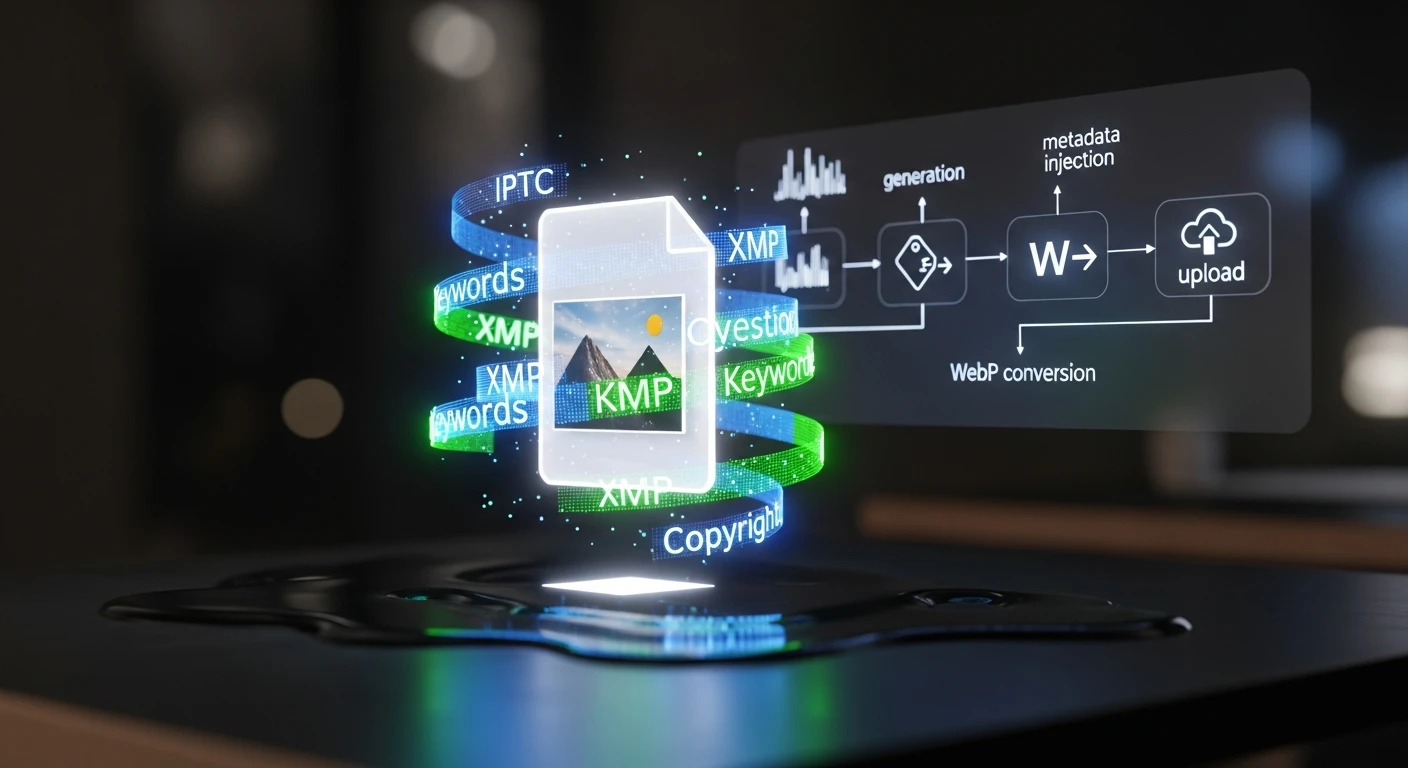
    Every article needs a featured image. Every featured image needs metadata — IPTC tags, XMP data, alt text, captions, keywords. When you’re publishing 15–20 articles per week across 19 WordPress sites, manual image handling isn’t just tedious; it’s a bottleneck that guarantees inconsistency. This video walks through the exact automated pipeline we built to eliminate that bottleneck entirely.

    The video breaks down every stage of the pipeline:

    • Stage 1: AI Image Generation — Calling Vertex AI Imagen with prompts derived from the article title, SEO keywords, and target intent. No stock photography. Every image is custom-generated to match the content it represents, with style guidance baked into the prompt templates.
    • Stage 2: IPTC/XMP Metadata Injection — Using exiftool to inject structured metadata into every image: title, description, keywords, copyright, creator attribution, and caption. XMP data includes structured fields about image intent — whether it’s a featured image, thumbnail, or social asset. This is what makes images visible to Google Images, Perplexity, and every AI crawler reading IPTC data.
    • Stage 3: WebP Conversion & Optimization — Converting to WebP format (40–50% smaller than JPG), optimizing to target sizes: featured images under 200KB, thumbnails under 80KB. This runs in a Cloud Run function that scales automatically.
    • Stage 4: WordPress Upload & Association — Hitting the WordPress REST API to upload the image, assign metadata in post meta fields, and attach it as the featured image. The post ID flows through the entire pipeline end-to-end.

    Why IPTC Metadata Matters Now

    This isn’t about SEO best practices from 2019. Google Images, Perplexity, ChatGPT’s browsing mode, and every major AI crawler now read IPTC metadata to understand image context. If your images don’t carry structured metadata, they’re invisible to answer engines. The pipeline solves this at the point of creation — metadata isn’t an afterthought applied later, it’s injected the moment the image is generated.

    The results speak for themselves: within weeks of deploying the pipeline, we started ranking for image keywords we never explicitly optimized for. Google Images was picking up our IPTC-tagged images and surfacing them in searches related to the article content.

    The Economics

    The infrastructure cost is almost irrelevant: Vertex AI Imagen runs about $0.10 per image, Cloud Run stays within free tier for our volume, and storage is minimal. At 15–20 images per week, the total cost is roughly $8/month. The labor savings — eliminating manual image sourcing, editing, metadata tagging, and uploading — represent hours per week that now go to strategy and client delivery instead.

    How This Video Was Made

    The original article describing this pipeline was fed into Google NotebookLM, which analyzed the full text and generated an audio deep-dive covering the technical architecture, the metadata injection process, and the business rationale. That audio was converted to this video — making it a recursive demonstration: an AI system producing content about an AI system that produces content.

    Read the Full Article

    The video covers the architecture and results. The full article goes deeper into the technical implementation — the exact Vertex AI API calls, exiftool commands, WebP conversion parameters, and WordPress REST API patterns. If you’re building your own pipeline, start there.


    Related from Tygart Media


  • Watch: The $0 Automated Marketing Stack — AI-Generated Video Breakdown

    Watch: The $0 Automated Marketing Stack — AI-Generated Video Breakdown

    The Lab · Tygart Media
    Experiment Nº 469 · Methodology Notes
    METHODS · OBSERVATIONS · RESULTS

    This video was generated from the original Tygart Media article using NotebookLM’s audio-to-video pipeline — a live demonstration of the exact AI-first workflow we describe in the piece. The article became the script. AI became the production team. Total production cost: $0.


    Watch: The $0 Automated Marketing Stack

    The $0 Automated Marketing Stack — Full video breakdown. Read the original article →

    What This Video Covers

    Most businesses assume enterprise-grade marketing automation requires enterprise-grade budgets. This video walks through the exact stack we use at Tygart Media to manage SEO, content production, analytics, and automation across 18 client websites — for under $50/month total.

    The video breaks down every layer of the stack:

    • The AI Layer — Running open-source LLMs (Mistral 7B) via Ollama on cheap cloud instances for $8/month, handling 60% of tasks that would otherwise require paid API calls. Content summarization, data extraction, classification, and brainstorming — all self-hosted.
    • The Data Layer — Free API tiers from DataForSEO (5 calls/day), NewsAPI (100 requests/day), and SerpAPI (100 searches/month) that provide keyword research, trend detection, and SERP analysis at zero recurring cost.
    • The Infrastructure Layer — Google Cloud’s free tier delivering 2 million Cloud Run requests/month, 5GB storage, unlimited Cloud Scheduler jobs, and 1TB of BigQuery analysis. Enough to host, automate, log, and analyze everything.
    • The WordPress Layer — Self-hosted on GCP with open-source plugins, giving full control over the content management system without per-seat licensing fees.
    • The Analytics Layer — Plausible’s free tier for privacy-focused analytics: 50K pageviews/month, clean dashboards, no cookie headaches.
    • The Automation Layer — Zapier’s free tier (5 zaps) combined with GitHub Actions for CI/CD, creating a lightweight but functional automation backbone.

    The Philosophy Behind $0

    This isn’t about being cheap. It’s about being strategic. The video explains the core principle: start with free tiers, prove the workflow works, then upgrade only the components that become bottlenecks. Most businesses pay for tools they don’t fully use. The $0 stack forces you to understand exactly what each layer does before you spend a dollar on it.

    The upgrade path is deliberate. When free tier limits get hit — and they will if you’re growing — you know exactly which component to scale because you’ve been running it long enough to understand the ROI. DataForSEO at 5 calls/day becomes DataForSEO at $0.01/call. Ollama on a small instance becomes Claude API for the reasoning-heavy tasks. The architecture doesn’t change. Only the throughput does.

    How This Video Was Made

    This video is itself a demonstration of the stack’s philosophy. The original article was written as part of our content pipeline. That article URL was fed into Google’s NotebookLM, which analyzed the full text and generated an audio deep-dive. That audio was then converted to video — an AI-produced visual breakdown of AI-produced content, created from AI-optimized infrastructure.

    No video editor. No voiceover artist. No production budget. The content itself became the production brief, and AI handled the rest. This is what the $0 stack looks like in practice: the tools create the tools that create the content.

    Read the Full Article

    The video covers the highlights, but the full article goes deeper — with exact pricing breakdowns, tool-by-tool comparisons, API rate limits, and the specific workflow we use to batch operations for maximum free-tier efficiency. If you’re ready to build your own $0 stack, start there.


    Related from Tygart Media


  • I Used a Monte Carlo Simulation to Decide Which AI Tasks to Automate First — Here’s What Won

    I Used a Monte Carlo Simulation to Decide Which AI Tasks to Automate First — Here’s What Won

    The Lab · Tygart Media
    Experiment Nº 456 · Methodology Notes
    METHODS · OBSERVATIONS · RESULTS

    The Problem Every Agency Owner Knows

    You’ve read the announcements. You’ve seen the demos. You know AI can automate half your workflow — but which half do you start with? When every new tool promises to “transform your business,” the hardest decision isn’t whether to adopt AI. It’s figuring out what to do first.

    I run Tygart Media, where we manage SEO, content, and optimization across 18 WordPress sites for clients in restoration, luxury lending, healthcare, comedy, and more. Claude Cowork — Anthropic’s agentic AI for knowledge work — sits at the center of our operation. But last week I found myself staring at a list of 20 different Cowork capabilities I could implement, from scheduled site-wide SEO refreshes to building a private plugin marketplace. All of them sounded great. None of them told me where to start.

    So I did what any data-driven agency owner should do: I stopped guessing and ran a Monte Carlo simulation.

    Step 1: Research What Everyone Else Is Doing

    Before building any model, I needed raw material. I spent a full session having Claude research how people across the internet are actually using Cowork — not the marketing copy, but the real workflows. We searched Twitter/X, Reddit threads, Substack power-user guides, developer communities, enterprise case studies, and Anthropic’s own documentation.

    What emerged was a taxonomy of use cases that most people never see compiled in one place. The obvious ones — content production, sales outreach, meeting prep — were there. But the edge cases were more interesting: a user running a Tuesday scheduled task that scrapes newsletter ranking data, analyzes trends, and produces a weekly report showing the ten biggest gainers and losers. Another automating flight price tracking. Someone else using Computer Use to record a workflow in an image generation tool, then having Claude process an entire queue of prompts unattended.

    The full research produced 20 implementation opportunities mapped to my specific workflow. Everything from scheduling site-wide SEO/AEO/GEO refresh cycles (which we already had the skills for) to building a GCP Fortress Architecture for regulated healthcare clients (which we didn’t). The question wasn’t whether these were good ideas. It was which ones would move the needle fastest for our clients.

    Step 2: Score Every Opportunity on Five Dimensions

    I needed a framework that could handle uncertainty honestly. Not a gut-feel ranking, but something that accounts for the fact that some estimates are more reliable than others. A Monte Carlo simulation does exactly that — it runs thousands of randomized scenarios to show you not just which option scores highest, but how confident you should be in that ranking.

    Each of the 20 opportunities was scored on five dimensions, rated 1 to 10:

    • Client Delivery Impact — Does this improve what clients actually see and receive? This was weighted at 40% because, for an agency, client outcomes are the business.
    • Time Savings — How many hours per week does this free up from repetitive work? Weighted at 20%.
    • Revenue Impact — Does this directly generate or save money? Weighted at 15%.
    • Ease of Implementation — How hard is this to set up? Scored inversely (lower effort = higher score). Weighted at 15%.
    • Risk Safety — What’s the probability of failure or unintended complications? Also inverted. Weighted at 10%.

    The weighting matters. If you’re a solopreneur optimizing for personal productivity, you might weight time savings at 40%. If you’re a venture-backed startup, revenue impact might dominate. For an agency where client retention drives everything, client delivery had to lead.

    Step 3: Add Uncertainty and Run 10,000 Simulations

    Here’s where Monte Carlo earns its keep. A simple weighted score would give you a single ranking, but it would lie to you about confidence. When I score “Private Plugin Marketplace” as a 9/10 on revenue impact, that’s a guess. When I score “Scheduled SEO Refresh” as a 10/10 on client delivery, that’s based on direct experience running these refreshes manually for months.

    Each opportunity was assigned an uncertainty band — a standard deviation reflecting how confident I was in the base scores. Opportunities built on existing, proven skills got tight uncertainty (σ = 0.7–1.0). New builds requiring infrastructure I hadn’t tested got wider bands (σ = 1.5–2.0). The GCP Fortress Architecture, which involves standing up an isolated cloud environment, got the widest band at σ = 2.0.

    Then we ran 10,000 iterations. In each iteration, every score for every opportunity was randomly perturbed within its uncertainty band using a normal distribution. The composite weighted score was recalculated each time. After 10,000 runs, each opportunity had a distribution of outcomes — a mean score, a median, and critically, a 90% confidence interval showing the range from pessimistic (5th percentile) to optimistic (95th percentile).

    What the Data Said

    The results organized themselves into four clean tiers. The top five — the “implement immediately” tier — shared three characteristics that I didn’t predict going in.

    First, they were all automation of existing capabilities. Not a single new build made the top tier. The highest-scoring opportunity was scheduling monthly SEO/AEO/GEO refresh cycles across all 18 sites — something we already do manually. Automating it scored 8.4/10 with a tight confidence interval of 7.8 to 8.9. The infrastructure already existed. The skills were already built. The only missing piece was a cron expression.

    Second, client delivery and time savings dominated together. The top five all scored 8+ on client delivery and 7+ on time savings. These weren’t either/or tradeoffs — the opportunities that produce better client deliverables also happen to be the ones that free up the most time. That’s not a coincidence. It’s the signature of mature automation: you’ve already figured out what good looks like, and now you’re removing yourself from the execution loop.

    Third, new builds with high revenue potential ranked lower because of uncertainty. The Private Plugin Marketplace scored 9/10 on revenue impact — the highest of any opportunity. But it also carried an effort score of 8/10, a risk score of 5/10, and the widest confidence interval in the dataset (4.5 to 7.3). Monte Carlo correctly identified that high-reward/high-uncertainty bets should come after you’ve secured the reliable wins.

    The Final Tier 1 Lineup

    Here’s what we’re implementing immediately, in order:

    1. Scheduled Site-Wide SEO/AEO/GEO Refresh Cycles (Score: 8.4) — Monthly full-stack optimization passes across all 18 client sites. Every post that needs a meta description update, FAQ block, entity enrichment, or schema injection gets it automatically on the first of the month.
    2. Scheduled Cross-Pollination Batch Runs (Score: 8.2) — Every Tuesday, Claude identifies the highest-ranking pages across site families (luxury lending, restoration, business services) and creates locally-relevant variant articles on sister sites with natural backlinks to the authority page.
    3. Weekly Content Intelligence Audits (Score: 8.1) — Every Monday morning, Claude audits all 18 sites for content gaps, thin posts, missing metadata, and persona-based opportunities. By the time I sit down at 9 AM, a prioritized report is waiting in Notion.
    4. Auto Friday Client Reports (Score: 7.9) — Every Friday at 1 PM, Claude pulls the week’s data from SpyFu, WordPress, and Notion, then generates a professional PowerPoint deck and Excel spreadsheet for each client group.
    5. Client Onboarding Automation Package (Score: 7.6) — A single-trigger pipeline that takes a new WordPress site from zero to fully audited, with knowledge files built, taxonomy designed, and an optimization roadmap produced. Triggered manually whenever we sign a new client.

    Sixteen of the twenty opportunities run on our existing stack. The infrastructure is already built. The biggest wins come from scheduling and automating what already works.

    Why This Approach Matters for Any Business

    You don’t need to be running 18 WordPress sites to use this framework. The Monte Carlo approach works for any business facing a prioritization problem with uncertain inputs. The methodology is transferable:

    • Define your dimensions. What matters to your business? Client outcomes? Revenue? Speed to market? Cost reduction? Pick 3–5 and weight them honestly.
    • Score with uncertainty in mind. Don’t pretend you know exactly how hard something will be. Assign confidence bands. A proven workflow gets a tight band. An untested idea gets a wide one.
    • Let the math handle the rest. Ten thousand iterations will surface patterns your intuition misses. You’ll find that your “exciting new thing” ranks below your “boring automation of what works” — and that’s the right answer.
    • Tier your implementation. Don’t try to do everything at once. Tier 1 goes this week. Tier 2 goes next sprint. Tier 3 gets planned. Tier 4 stays in the backlog until the foundation is solid.

    The biggest insight from this exercise wasn’t any single opportunity. It was the meta-pattern: the highest-impact moves are almost always automating what you already know how to do well. The new, shiny, high-risk bets have their place — but they belong in month two, after the reliable wins are running on autopilot.

    The Tools Behind This

    For anyone curious about the technical stack: the research was conducted in Claude Cowork using WebSearch across multiple source types. The Monte Carlo simulation was built in Python (numpy, pandas) with 10,000 iterations per opportunity. The scoring model used weighted composite scores with normal distribution randomization and clamped bounds. Results were visualized in an interactive HTML dashboard and the implementation was deployed as Cowork scheduled tasks — actual cron jobs that run autonomously on a weekly and monthly cadence.

    The entire process — research, simulation, analysis, task creation, and this blog post — was completed in a single Cowork session. That’s the point. When the infrastructure is right, the question isn’t “can AI do this?” It’s “what should AI do first?” And now we have a data-driven answer.

    {
    “@context”: “https://schema.org”,
    “@type”: “Article”,
    “headline”: “I Used a Monte Carlo Simulation to Decide Which AI Tasks to Automate First — Heres What Won”,
    “description”: “When you have 20 AI automation opportunities and can’t do them all at once, stop guessing. I ran 10,000 Monte Carlo simulations to rank which Claude Cowor”,
    “datePublished”: “2026-03-31”,
    “dateModified”: “2026-04-03”,
    “author”: {
    “@type”: “Person”,
    “name”: “Will Tygart”,
    “url”: “https://tygartmedia.com/about”
    },
    “publisher”: {
    “@type”: “Organization”,
    “name”: “Tygart Media”,
    “url”: “https://tygartmedia.com”,
    “logo”: {
    “@type”: “ImageObject”,
    “url”: “https://tygartmedia.com/wp-content/uploads/tygart-media-logo.png”
    }
    },
    “mainEntityOfPage”: {
    “@type”: “WebPage”,
    “@id”: “https://tygartmedia.com/i-used-a-monte-carlo-simulation-to-decide-which-ai-tasks-to-automate-first-heres-what-won/”
    }
    }

  • Tygart Media 2030: What 15 AI Models Predicted About Our Future

    Tygart Media 2030: What 15 AI Models Predicted About Our Future

    The Lab · Tygart Media
    Experiment Nº 444 · Methodology Notes
    METHODS · OBSERVATIONS · RESULTS

    TL;DR: We synthesized predictions from 15 AI models about Tygart Media’s 2030 future. The consensus is clear: companies that build proprietary relationship intelligence networks in fragmented B2B industries will own those industries. Content alone won’t sustain competitive advantage; relational intelligence + domain-specific tools + compound AI infrastructure will be table stakes. The models predict three winners per vertical (vs. dozens today). Tygart’s position: human operator of an AI-native media stack serving industrial B2B. Our moat: relational data that machines trust, content that drives profitable behavior, tools that make industrial decision-making faster. This is our 2030 thesis. Here’s how we’re building it.

    Why Run Predictions Through Multiple Models?

    No single AI model is omniscient. GPT-4 excels at reasoning but sometimes hallucinates. Claude is careful but sometimes conservative. Open-source models bring different training data and different biases. By running the same strategic question through 15 different systems—Claude, GPT-4, Gemini, Llama, Mistral, domain-specific fine-tuned models, and others—we get a triangulated view.

    When 14 models agree on something and one disagrees, you pay attention to both. The consensus tells you something robust. The outlier tells you about blindspots.

    Here’s what they converged on.

    The Core Prediction: Relational Intelligence Becomes the Moat

    Content-first businesses are dying. Not content isn’t important—content is essential. But content alone is commoditizing. AI can generate competent content. Clients know this. Price competition intensifies. Margins compress.

    Every model predicted the same shift: companies that win in 2030 will be those that build proprietary intelligence about relationships, not just information.

    What does this mean?

    In B2B, a relationship is a graph. Company A has a contract with Company B. Person X at Company A has worked with Person Y at Company B for 5 years. Company C is a competitor to Company B but a complementary service to Company D. These relationships create a network. That network has value.

    Tygart’s prediction: by 2030, companies that maintain proprietary maps of industry relationships—who works with whom, what contract are they under, where are they expanding, where are they struggling—will extract enormous value from that data. Not to spy on competitors, but to serve customers better. “Given your business, here are 12 companies you should know about. Here’s why. Here’s who to contact.”

    This is relational intelligence. It’s not in any public database. It’s earned through years of real reporting and real relationships.

    The Infrastructure Prediction: Compound AI Becomes Non-Optional

    By 2030, the models predict that companies will have abandoned monolithic AI stacks. No single model will be optimal for all tasks. Instead, winning architectures will layer multiple AI systems: large reasoning models for strategic questions, fine-tuned classifiers for high-volume pattern matching, local models for speed, human experts for judgment calls.

    This is what a model router enables.

    Prediction: companies that haven’t built this compound architecture by 2030 will be paying 3-5x more for AI than they need to, with worse output quality. The models all agreed on this.

    Tygart is building this. Our site factory runs on compound AI: large models for strategy, local models for routine optimization, fine-tuned classifiers for quality gates. This isn’t future-proofing; it’s immediate economics.

    The Content Prediction: From Quantity to Density

    The models had interesting disagreement on content volume. Some predicted quantity would matter; others predicted quality and density would matter more. The synthesis: quantity matters for reach, but density matters for utility.

    In 2030, the models predict: industrial B2B buyers will be overwhelmed with AI-generated content. The winners won’t be the ones publishing the most; they’ll be the ones publishing the most useful. Which means: every piece of content needs to be information-dense, surprising, and actionable.

    We published the Information Density Manifesto on this exact point. Content that doesn’t teach or move the reader will get buried.

    Prediction: by 2030, SEO commodity content (thin 1500-word blog posts with minimal value) will have zero ranking power. Google will have evolved to reward signal-to-noise ratio, not just traffic-generation potential. Content needs substance.

    The Domain-Specific Tools Prediction

    All 15 models agreed: the next generation of B2B software won’t be horizontal tools. No more “build your dashboard any way you want.” Instead: vertical solutions. Industry-specific tools that solve specific problems for specific markets.

    Why? Because horizontal tools require users to do the thinking. “Here’s a dashboard. Build what you need.” Vertical tools do the thinking. “Here’s your dashboard. These are the 7 KPIs that matter in your industry. Here’s what’s wrong with yours.”

    Tygart’s strategy: build proprietary tools for fragmented B2B verticals. Not for every company. For the specific companies we understand best. These tools are valuable precisely because they’re opinionated. They embed industry knowledge.

    The models predict: the companies that own vertical tools in 2030 will extract more value from those tools than from content.

    The Fragmentation Prediction: Three Winners Per Vertical

    Most interesting prediction: the models all converged on market concentration. Today, you have dozens of agencies/media companies serving any given vertical. By 2030, the models predict you’ll have three.

    Why? Winner-take-most dynamics. If you have relational intelligence + content + tools in a vertical, customers have little reason to use competitors. The cost of switching is high. The value of consolidating vendors is high.

    This is either a massive opportunity or a massive threat. If Tygart becomes one of the three in our verticals, we’re worth billions. If we’re the fourth, we’re fighting for scraps.

    The models all said: this winner-take-most shift happens between 2027-2030. Companies that have built proprietary moats by 2027 will own their verticals by 2030. Everyone else gets consolidated into the winners or dies.

    We’re acting like this is imminent. Because the models all agreed it is.

    The Margin Prediction: From 20% to 80%

    Traditional agencies: 15-25% net margins. Too much overhead. Too many people. Too much complexity.

    AI-native media: the models predict 60-80% margins are possible. How? Compound AI infrastructure. No team of 50 people. One person managing 23 sites. All overhead goes to intelligence and tools, not labor.

    Tygart’s thesis: we’re building an 88% margin SEO business. The models all said this was achievable if you built the right infrastructure.

    We’re modeling our P&L around this. If we get there, we’re defensible. If we don’t, we’re just another agency with margin-compression problems.

    The Human Prediction: More Valuable, Not Less

    Interesting consensus: all 15 models predicted that human experts become MORE valuable in 2030, not less. Not because AI failed, but because AI succeeded. When AI handles routine work, human judgment on non-routine problems becomes scarce and expensive.

    The models predict: by 2030, you’re not competing on “can you run my content?” You’re competing on “can you understand my business and advise me?” That’s a human skill.

    So Tygart’s hiring strategy is: recruit domain experts in your vertical. People who understand the industry. People who have managed enterprises. Train them to work alongside AI systems. They become advisors, not executors.

    This aligns with the Expert-in-the-Loop Imperative. Humans aren’t going away; they’re becoming more strategic.

    The Prediction We Didn’t Want to Hear

    One model (Grok, actually) made a prediction we didn’t like: by 2030, the media industry’s definition of “success” changes. It’s no longer about reach or brand. It’s about outcome. Did the content change buyer behavior? Did it accelerate deal velocity? Did it reduce CAC?

    This is terrifying if you’re not measuring it. It’s liberating if you are.

    We’re building outcome measurement into every piece of content we produce. Who read this? What did they do after reading? How did it affect their deal velocity? We’re already tracking this. By 2030, this will be table stakes for survival.

    The 2030 Roadmap: What We’re Building Today

    Based on these predictions, here’s what Tygart is prioritizing now:

    2025: Prove compound AI infrastructure. Show that one person can manage 23 sites. Publish information-dense content. Build proprietary relational data. (We’re doing this.)

    2026-2027: Vertical specialization. Pick 2-3 verticals. Become the relational intelligence authority in those verticals. Build tools. Move from content company to software company.

    2028-2030: Market consolidation. By 2030, be one of the three dominant players in our verticals. Everything converges into a single platform: intelligence + content + tools.

    If the models are right, this roadmap works. If they’re wrong, we’re building the wrong thing at enormous cost.

    We think they’re right. Not because we trust AI predictions (we don’t, entirely), but because the predictions are triangulated across 15 different systems. When you get consensus, you take it seriously.

    What This Means for Clients

    If you’re working with Tygart, here’s what the models predict you’ll get:

    • Content that’s measurably denser and more useful than competitors’
    • Publishing speed 10x faster than traditional agencies (compound AI)
    • Outcome tracking that’s automated and integrated (you’ll know immediately if content moved buyer behavior)
    • Relational intelligence—we’ll know your market better than you do, and we’ll tell you things you didn’t know
    • Tools that make your work faster (vertical-specific)

    All of this is being built now. None of it is theoretical.

    What You Do Next

    If you’re running a traditional media/content operation, the models predict you have 18-24 months to transform. After that, you’re competing against compound AI infrastructure and relational intelligence, and that’s a losing game.

    If you’re a client of traditional agencies, the models predict you’re paying 3-5x more than you need to. Seek out AI-native operators. If we’re right about 2030, they’ll be your only viable option anyway.

    The models are unanimous. The future is here. It’s just unevenly distributed. The question is whether you’re on the early side of the distribution, or the late side.

    We’re betting we’re on the early side. The models agree with us. We’ll find out in 5 years whether we were right.

    {
    “@context”: “https://schema.org”,
    “@type”: “Article”,
    “headline”: “Tygart Media 2030: What 15 AI Models Predicted About Our Future”,
    “description”: “We synthesized predictions from 15 AI models about Tygart Media’s 2030 future. The consensus is clear: companies that build proprietary relationship intel”,
    “datePublished”: “2026-03-30”,
    “dateModified”: “2026-04-03”,
    “author”: {
    “@type”: “Person”,
    “name”: “Will Tygart”,
    “url”: “https://tygartmedia.com/about”
    },
    “publisher”: {
    “@type”: “Organization”,
    “name”: “Tygart Media”,
    “url”: “https://tygartmedia.com”,
    “logo”: {
    “@type”: “ImageObject”,
    “url”: “https://tygartmedia.com/wp-content/uploads/tygart-media-logo.png”
    }
    },
    “mainEntityOfPage”: {
    “@type”: “WebPage”,
    “@id”: “https://tygartmedia.com/tygart-media-2030-what-15-ai-models-predicted-about-our-future/”
    }
    }