Category: Restoration Intelligence

The definitive resource for restoration company operators — business operations, marketing, estimating, AI, and growth strategy.

  • Digital Real Estate: Why M&A Buyers Pay 8x EBITDA for Organic Search Dominance

    Digital Real Estate: Why M&A Buyers Pay 8x EBITDA for Organic Search Dominance

    Tygart Media / Content Strategy
    The Practitioner JournalField Notes
    By Will Tygart
    · Practitioner-grade
    · From the workbench

    TL;DR: Corporate finance has systematically mispriced organic search traffic as an operating expense. In reality, SEO-driven traffic operates as digital real estate — a capital asset that inflates EBITDA, collapses customer acquisition cost, and commands premium multiples at exit.

    The Most Expensive Mistake in Corporate Finance

    Every quarter, CFOs across America categorize their SEO spend as a marketing expense — a line item in the P&L that depresses EBITDA. They’re wrong, and that mistake costs them millions at exit.

    Mature organic search traffic isn’t an expense. It’s infrastructure. It’s the digital equivalent of owning the building your business operates from instead of paying rent. And when M&A buyers evaluate an acquisition, the difference between a business that rents its traffic (paid ads) and one that owns it (organic search) shows up as a dramatically different valuation multiple.

    The Math of Enterprise Value Creation

    Here’s how the math works. A home services company generating $5 million in revenue through a mix of paid ads and organic search might show $800,000 in EBITDA. At a 4x multiple (standard for the vertical), that’s a $3.2 million enterprise value.

    Now shift that same company’s traffic mix from 60% paid / 40% organic to 20% paid / 80% organic. Revenue stays the same, but customer acquisition cost drops by 50%. The money that was going to Google Ads now flows to the bottom line. EBITDA jumps to $1.4 million. At the same 4x multiple, enterprise value is now $5.6 million.

    But it gets better. M&A buyers assign higher multiples to businesses with organic traffic dominance because the revenue is more durable. That 4x multiple might become 5x or 6x, pushing enterprise value to $7-8.4 million. The same business, same revenue — but worth 2-3x more because of where the traffic comes from.

    Two Types of Buyers, Two Types of Opportunity

    Understanding who buys businesses reveals why organic search is worth a premium. The M&A landscape breaks into two buyer archetypes.

    Financial Buyers — private equity firms, family offices, search funds — want a profitable P&L with predictable cash flow. For them, organic traffic is risk mitigation. A business dependent on paid ads is one Google algorithm change or CPM spike away from margin compression. Organic dominance provides the revenue durability that lets financial buyers underwrite a higher purchase price.

    Strategic Buyers — larger companies in the same or adjacent industry — hunt for under-monetized traffic they can plug into their existing sales infrastructure. A website ranking #1 for “water damage restoration Houston” that’s converting at 2% is an acquisition target for a strategic buyer who converts at 8%. They’re not buying your revenue. They’re buying your traffic and applying their conversion engine to it.

    Valuing Under-Monetized Web Properties

    Not every business with organic traffic is maximizing it. For these under-monetized properties, two valuation frameworks apply.

    The Replacement Cost method calculates what it would cost to acquire the same traffic via Google Ads, then applies a 1.5x to 2.5x multiple to that annualized cost. If your organic traffic would cost $200,000/year to replace via paid ads, the asset is worth $300,000 to $500,000 as a standalone acquisition.

    The Lead Arbitrage method (what M&A advisors call “street value”) multiplies organic inquiries by the open-market rate for a purchased lead. If your site generates 500 organic leads per month in home services, and the market rate for a qualified lead is $150, that’s $75,000/month in lead value — $900,000/year in commodity value, before any conversion optimization.

    EBITDA Multiples by Vertical

    The premium organic traffic commands varies by industry. Home Services and Trades (HVAC, plumbing, roofing, restoration) typically command 3x to 5x EBITDA. E-Commerce and DTC brands secure 4x to 7x. B2B SaaS and technology companies achieve 8x to 15x+, often valued on gross annual recurring revenue rather than EBITDA.

    In every vertical, the businesses with organic search dominance command the upper end of the range. The ones dependent on paid acquisition sit at the bottom.

    The Playbook

    If you’re building a business with an eventual exit in mind — and you should be — organic search isn’t a marketing channel. It’s an asset class. Every dollar invested in content, technical SEO, and topical authority compounds like equity in real estate. The businesses that understand this don’t just build traffic. They build enterprise value.

    Start treating your SEO program the way a real estate developer treats a building: as a capital investment with a measurable return, a compounding value, and a premium at sale.

    {
    “@context”: “https://schema.org”,
    “@type”: “Article”,
    “headline”: “Digital Real Estate: Why MA Buyers Pay 8x EBITDA for Organic Search Dominance”,
    “description”: “Corporate finance has mispriced SEO as an expense. Organic search traffic is digital real estate — a capital asset that inflates EBITDA and commands 2-3x higher”,
    “datePublished”: “2026-03-30”,
    “dateModified”: “2026-04-03”,
    “author”: {
    “@type”: “Person”,
    “name”: “Will Tygart”,
    “url”: “https://tygartmedia.com/about”
    },
    “publisher”: {
    “@type”: “Organization”,
    “name”: “Tygart Media”,
    “url”: “https://tygartmedia.com”,
    “logo”: {
    “@type”: “ImageObject”,
    “url”: “https://tygartmedia.com/wp-content/uploads/tygart-media-logo.png”
    }
    },
    “mainEntityOfPage”: {
    “@type”: “WebPage”,
    “@id”: “https://tygartmedia.com/digital-real-estate-why-ma-buyers-pay-8x-ebitda-for-organic-search-dominance/”
    }
    }

  • The Expert-in-the-Loop Imperative: Why 95% of Enterprise AI Fails Without Human Circuit Breakers

    The Expert-in-the-Loop Imperative: Why 95% of Enterprise AI Fails Without Human Circuit Breakers

    Tygart Media / The Signal
    Broadcast Live
    Filed by Will Tygart
    Tacoma, WA
    Industry Bulletin

    TL;DR: Ninety-five percent of enterprise Generative AI investments fail to deliver ROI. Gartner projects 40% of agentic AI projects will collapse by 2027. The missing variable isn’t better models — it’s the Expert-in-the-Loop architecture that keeps autonomous systems honest.

    The $600 Billion Misfire

    Enterprise AI spending has crossed the half-trillion-dollar mark. Yet the return on that investment remains stubbornly low. The number cited most by Deloitte, Capgemini, and McKinsey consulting reports is brutal: 95% of Generative AI pilots never reach production or deliver measurable ROI.

    The failure isn’t technological. The models work. GPT-4, Claude, Gemini — they reason, they synthesize, they generate. The failure is architectural. Organizations treat AI as an isolated tool bolted onto existing workflows rather than redesigning the operating model around what autonomous systems actually need: guardrails, governance, and a human who knows when to pull the brake.

    From the Task Economy to the Knowledge Economy

    The first wave of AI adoption automated individual tasks — summarize this document, draft this email, classify this ticket. That was the Task Economy. It delivered marginal gains.

    The shift happening now is toward the Knowledge Economy: orchestrating complex, multi-agent workflows where specialized AI systems reason through multi-step problems, delegate subtasks to smaller models, and execute against real-world APIs. This is the agentic paradigm, and it changes the risk calculus entirely.

    When an AI agent autonomously decides to reclassify a patient’s insurance code, reroute a supply chain, or publish content at scale, the blast radius of a hallucination isn’t a bad email — it’s a compliance violation, a financial loss, or a reputational crisis.

    The Confidence Gate Architecture

    The Expert-in-the-Loop model doesn’t slow AI down. It makes AI trustworthy enough to accelerate. The architecture works through a Confidence Gate — a decision checkpoint where the system evaluates its own certainty before proceeding.

    When confidence is high and the domain is well-mapped, the agent executes autonomously. When confidence drops below threshold — ambiguous inputs, novel edge cases, high-stakes decisions — the system routes to a verified human expert who acts as a circuit breaker.

    This isn’t human-in-the-loop in the old sense of manual approval queues. The Expert-in-the-Loop is selective, triggered only when the system’s own uncertainty metric warrants it. The result: autonomous velocity with human accountability.

    Agentic Context Engineering: The Operating System for Trust

    Making this work at scale requires what researchers now call Agentic Context Engineering (ACE). Traditional prompt engineering treats context as static — a system prompt that never changes. ACE treats context as an evolving playbook.

    The framework uses three roles operating in concert: a Generator that produces outputs, a Reflector that evaluates those outputs against known constraints, and a Curator that applies incremental updates to the context window. This prevents “context collapse” — the gradual degradation of AI performance as conversations grow longer and context windows fill with noise.

    The Orchestrator-Specialist Model

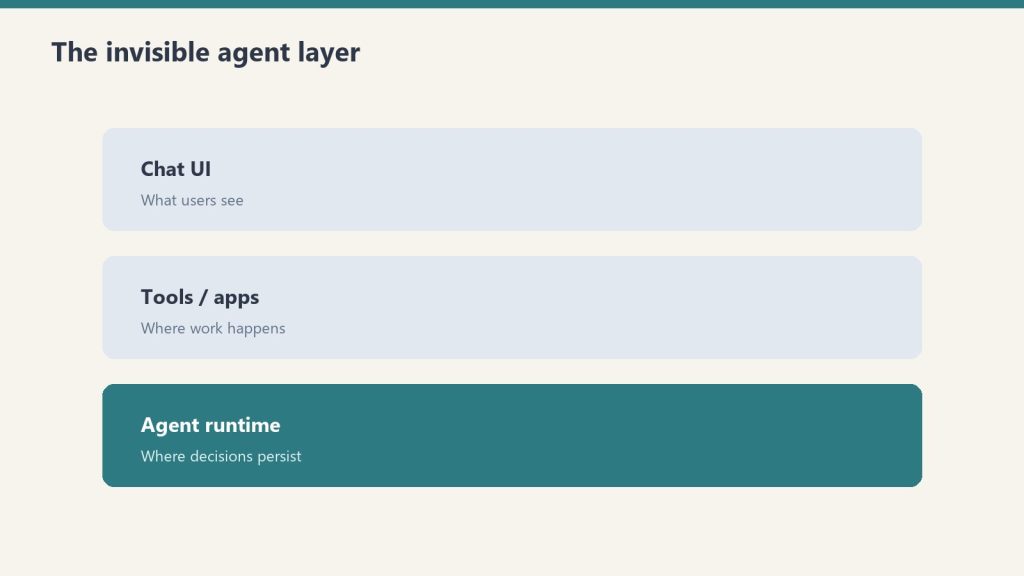
    The most effective enterprise deployments in 2026 aren’t running one massive model for everything. They use an Orchestrator-Specialist architecture: a highly capable LLM (Claude Opus 4.7, GPT-4) acts as the orchestrator, breaking complex tasks into subtasks and delegating execution to a fleet of domain-specific Small Language Models (SLMs).

    The orchestrator handles reasoning and planning. The specialists handle execution — fast, cheap, and within a narrow competency boundary. This architecture reduces cost by 60-80% compared to routing everything through a frontier model while maintaining quality where it matters.

    What This Means for Your Business

    If you’re planning an AI deployment in 2026, here’s the framework that separates the 5% that succeed from the 95% that don’t:

    First, audit your decision taxonomy. Map every AI-assisted decision by stakes and reversibility. Low-stakes, reversible decisions (content drafts, data classification) can run fully autonomous. High-stakes, irreversible decisions (financial transactions, medical recommendations, legal compliance) require Expert-in-the-Loop gates.

    Second, implement confidence scoring. Every agent output should carry a confidence metric. Build routing logic that escalates low-confidence outputs to domain experts — not managers, not generalists, but people with verified expertise in the specific domain.

    Third, design for context persistence. Use ACE principles to maintain living context that evolves with each interaction rather than starting from zero every session. Your AI should get smarter about your business every day, not reset every morning.

    The enterprises that win the AI race won’t be the ones with the biggest models. They’ll be the ones with the smartest architectures — systems where machines do what machines do best and humans do what humans do best, orchestrated through governance frameworks that make the whole system trustworthy.

    {
    “@context”: “https://schema.org”,
    “@type”: “Article”,
    “headline”: “The Expert-in-the-Loop Imperative: Why 95% of Enterprise AI Fails Without Human Circuit Breakers”,
    “description”: “Ninety-five percent of enterprise AI fails to deliver ROI. The missing variable isn’t better models — it’s Expert-in-the-Loop architecture with Conf”,
    “datePublished”: “2026-03-30”,
    “dateModified”: “2026-04-03”,
    “author”: {
    “@type”: “Person”,
    “name”: “Will Tygart”,
    “url”: “https://tygartmedia.com/about”
    },
    “publisher”: {
    “@type”: “Organization”,
    “name”: “Tygart Media”,
    “url”: “https://tygartmedia.com”,
    “logo”: {
    “@type”: “ImageObject”,
    “url”: “https://tygartmedia.com/wp-content/uploads/tygart-media-logo.png”
    }
    },
    “mainEntityOfPage”: {
    “@type”: “WebPage”,
    “@id”: “https://tygartmedia.com/the-expert-in-the-loop-imperative-why-95-of-enterprise-ai-fails-without-human-circuit-breakers/”
    }
    }

  • AEO for Local Businesses: Featured Snippets Your Competitors Aren’t Chasing

    AEO for Local Businesses: Featured Snippets Your Competitors Aren’t Chasing

    Tygart Media / The Signal
    Broadcast Live
    Filed by Will Tygart
    Tacoma, WA
    Industry Bulletin

    Most local businesses compete on “best plumber in Austin” or “water damage restoration near me.” But answer engines reward a different kind of content. They want specific, quotable answers to questions that people actually ask. That’s where local AEO wins.

    The Local AEO Opportunity
    Perplexity and Claude don’t just rank businesses by distance and reviews. They rank by citation in answers. If you’re the source Perplexity quotes when answering “how much does water damage restoration cost?”, you get visibility that paid search can’t buy.

    And local AEO is less competitive than national. Everyone’s chasing national top 10 rankings. Almost nobody is optimizing for Perplexity citations in local verticals.

    The Quotable Answer Strategy
    AEO content needs to be quotable. That means:
    – Specific answers (not vague generalities)
    – Numbers and timeframes (“typically 3-7 days”)
    – Price ranges (“$2,000-$5,000 for standard water damage”)
    – Process steps (“Step 1: assessment, Step 2: mitigation…”)
    – Local context (“in North Texas, humidity speeds drying”)

    Generic content doesn’t get quoted. Specific, local, answerable content does.

    Content Types That Win in Local AEO
    Service Cost Guide: “Water Damage Restoration Cost in Austin: What to Expect in 2026”
    – Actual price ranges in Austin (vs. national average)
    – Breakdown of what factors affect cost
    – Comparison of premium vs. budget options
    – Timeline impact on pricing
    Result: Ranks in Perplexity for “water damage restoration cost Austin” queries

    Process Timeline: “Water Damage Restoration Timeline: Days 1-7, Week 2-3, Month 1”
    – Specific steps at specific timeframes
    – Local humidity/climate impact
    – What happens at each stage
    – When to expect mold concerns
    Result: Quoted when people ask “how long does water restoration take”

    Problem-Specific Guides: “Hardwood Floor Water Damage: Restoration vs. Replacement Decision”
    – When to restore vs. replace
    – Cost comparison
    – Timeline for each option
    – Success rates
    Result: Quoted when people research hardwood floor damage specifically

    Local Comparison Content: “Water Damage Restoration in Austin vs. Dallas: Regional Differences”
    – Climate differences (humidity, soil)r>- Cost differences
    – Timeline differences
    – Regional techniques
    Result: Ranks for “restoration Austin vs Dallas” type queries (people considering both areas)

    The Internal Linking Strategy
    Each content piece links to service pages and other authority content, creating a web:

    – Cost guide → Process timeline → Hardwood floor guide → Commercial damage guide → Service page
    – This signals to Google and Perplexity: “This is an authority cluster on water damage”

    The Review Generation Loop
    AEO content also drives reviews. When a prospect reads your detailed cost breakdown or timeline, they’re more informed. Informed customers become satisfied customers who leave better reviews. Those reviews feed back into Perplexity rankings.

    The SEO Bonus
    Content optimized for AEO also ranks well in Google. In fact, the AEO content pieces often outrank the local Google Business Profile for specific queries. You’re getting:
    – Google rankings (organic traffic)
    – Perplexity citations (AI engine traffic)
    – LinkedIn potential (if you share the content as thought leadership)
    – Social proof (highly cited content builds reputation)

    Real Results
    A local restoration client published:
    – “Water Damage Restoration Timeline” (2,500 words, specific local context)
    – “Cost Guide for Water Damage in Austin” (detailed breakdown)
    – “How We Assess Your Home for Water Damage” (process guide)

    Results (after 3 months):
    – Perplexity citations: 40+ per month
    – Google organic traffic: 2,200 monthly visitors
    – Phone calls from people who found the guide: 15-20/month
    – Average deal value: $4,500 (because informed customers are better quality)

    Why Competitors Aren’t Doing This
    – It takes 40-60 hours per content piece (slower than quick blog posts)
    – Requires local expertise (can’t outsource easily)
    – Doesn’t show results in analytics for 2-3 months
    – Requires understanding AEO principles (most agencies focus on SEO)
    – Most content agencies haven’t heard of AEO yet

    The Competitive Window
    We’re in a narrow window right now (2026) where local AEO is underdeveloped. In 12-18 months, everyone will be doing it. If you start now with detailed, quotable, local-specific content, you’ll be entrenched before competition arrives.

    How to Start
    1. Pick your top 3 search queries (“water damage cost,” “timeline,” “hardwood floors”)
    2. Write 2,500+ word guides that are specifically local and quotable
    3. Add FAQPage schema markup so Perplexity can pull Q&A pairs
    4. Internal link across your pieces
    5. Wait 3-4 weeks for Perplexity to crawl and cite
    6. Iterate based on which pieces get cited most

    The Takeaway
    Local businesses can compete on AEO with fraction of the budget that national companies spend on paid search. But you need specific, quotable, local-relevant content. Generic blog posts won’t get you there. Deep, detailed, answerable guides will.

    {
    “@context”: “https://schema.org”,
    “@type”: “Article”,
    “headline”: “AEO for Local Businesses: Featured Snippets Your Competitors Arent Chasing”,
    “description”: “Local AEO wins by publishing specific, quotable answers to local questions. Here’s how to build content that Perplexity cites instead of competing on loca”,
    “datePublished”: “2026-03-30”,
    “dateModified”: “2026-04-03”,
    “author”: {
    “@type”: “Person”,
    “name”: “Will Tygart”,
    “url”: “https://tygartmedia.com/about”
    },
    “publisher”: {
    “@type”: “Organization”,
    “name”: “Tygart Media”,
    “url”: “https://tygartmedia.com”,
    “logo”: {
    “@type”: “ImageObject”,
    “url”: “https://tygartmedia.com/wp-content/uploads/tygart-media-logo.png”
    }
    },
    “mainEntityOfPage”: {
    “@type”: “WebPage”,
    “@id”: “https://tygartmedia.com/aeo-for-local-businesses-featured-snippets-your-competitors-arent-chasing/”
    }
    }

  • The Death of the Marketing Retainer: How AI Changes Everything

    The Death of the Marketing Retainer: How AI Changes Everything

    The Machine Room · Under the Hood

    The Retainer Model Is Cracking

    For two decades, the marketing agency business model has been simple: charge clients a monthly retainer, deliver a package of services, and scale revenue by stacking more retainers. It worked because marketing execution required human hours, and human hours have a predictable cost.

    AI breaks that equation. When a task that took a junior strategist four hours can be completed in four minutes by an AI agent, the hourly-rate math that underpins retainer pricing collapses. Clients are starting to notice – and they’re asking hard questions about what they’re actually paying for.

    What AI Actually Automates in a Marketing Agency

    Let’s be specific about what’s changing. These are the tasks that AI can now handle at production quality:

    Content production: First drafts, SEO optimization, meta descriptions, FAQ sections, and schema markup. What used to take a writer plus an SEO specialist a full day now runs through our pipeline in minutes.

    SEO audits: Site-wide technical audits, content gap analysis, keyword research, and competitor analysis. Our AI stack produces audit reports that match or exceed what junior analysts deliver – with better consistency.

    Reporting: Monthly performance reports with data visualization, trend analysis, and strategic recommendations. AI pulls the data, formats the report, and drafts the narrative.

    Social media management: Post drafting, scheduling, hashtag research, and engagement analysis. The creative strategy remains human; the execution is increasingly automated.

    That’s roughly 60-70% of what a typical marketing retainer covers.

    Three Models That Replace the Traditional Retainer

    The Performance Model: Instead of paying for hours, clients pay for outcomes. Rankings achieved, traffic milestones hit, leads generated. AI makes this viable because agencies can deliver outcomes at lower internal cost while sharing the upside.

    The Fractional Model: Senior strategists embedded part-time across multiple clients, supported by AI for execution. Clients get expert-level thinking without paying for execution labor that AI handles. This is how Tygart Media operates – fractional CMO services powered by an AI operations layer.

    The Platform Model: Agencies build proprietary tools and offer them as managed services. The tool does the work; the agency provides expertise to configure, monitor, and optimize.

    Why This Is Good for Agencies (Not Just Clients)

    The knee-jerk reaction from agency owners is fear. The reality is the opposite – AI destroys the ceiling on agency margins. When your cost to deliver drops by 60%, you can maintain prices while delivering dramatically better results.

    Agencies that embrace AI as an operational layer will serve more clients, deliver better outcomes, and earn higher per-client profit. Agencies that ignore it will be undercut by competitors who adopted AI two years ago.

    The window for competitive advantage is narrow. By 2027, AI-assisted marketing execution will be table stakes, not a differentiator.

    Frequently Asked Questions

    Will AI eliminate the need for marketing agencies entirely?

    No. AI eliminates the need for agencies that only provide execution. Strategy, creative direction, brand positioning, and client relationship management require human judgment. The agencies that survive will be smaller, more strategic, and more profitable.

    How should agencies price their services in an AI world?

    Move away from hourly billing toward value-based or outcome-based pricing. Your cost to deliver has dropped, but the value to the client hasn’t. Price for the outcome.

    What skills should agency employees develop to stay relevant?

    Strategic thinking, client communication, AI prompt engineering, and data interpretation. The ability to direct AI systems effectively is becoming the most valuable skill in marketing.

    When will most agencies adopt AI operationally?

    By mid-2026, the majority of agencies with 10+ employees will use AI for content production. Full operational AI will take another 12-18 months to become mainstream. Early movers have a significant head start.

    Adapt or Become the Case Study

    The marketing retainer isn’t dead yet, but it’s on life support. The agencies that thrive will be the ones that treated AI not as a threat but as the foundation for a better model.

    {
    “@context”: “https://schema.org”,
    “@type”: “Article”,
    “headline”: “The Death of the Marketing Retainer: How AI Changes Everything”,
    “description”: “The Retainer Model Is CrackingnFor two decades, the marketing agency business model has been simple: charge clients a monthly retainer, deliver a package.”,
    “datePublished”: “2026-03-21”,
    “dateModified”: “2026-04-03”,
    “author”: {
    “@type”: “Person”,
    “name”: “Will Tygart”,
    “url”: “https://tygartmedia.com/about”
    },
    “publisher”: {
    “@type”: “Organization”,
    “name”: “Tygart Media”,
    “url”: “https://tygartmedia.com”,
    “logo”: {
    “@type”: “ImageObject”,
    “url”: “https://tygartmedia.com/wp-content/uploads/tygart-media-logo.png”
    }
    },
    “mainEntityOfPage”: {
    “@type”: “WebPage”,
    “@id”: “https://tygartmedia.com/the-death-of-the-marketing-retainer-how-ai-changes-everything/”
    }
    }

  • The Profit Detective: Why Networking Is the Only Growth Engine That Compounds Forever

    The Profit Detective: Why Networking Is the Only Growth Engine That Compounds Forever

    The Machine Room · Under the Hood

    The Myth of the Cold Funnel

    Every marketing agency sells the same dream: build a funnel, pour traffic in the top, collect revenue at the bottom. It works. Sometimes. For a while. Until the ad costs rise, the algorithms shift, and the funnel dries up. Then you are back to square one with nothing but a spreadsheet full of leads who never converted.

    I have built funnels. I have optimized funnels. I have automated funnels with AI agents that respond in under three minutes. But the single most valuable growth engine in my entire business is not a funnel at all. It is a network of human relationships that I have cultivated over two decades.

    I call myself the Profit Detective because that is what I do: I find the hidden revenue in every relationship, every conversation, every introduction. Not by exploiting people. By paying attention to what they actually need and connecting them to the right resource at the right time.

    How Relationships Built a Multi-Vertical Portfolio

    Every client in my portfolio came through a relationship. Not an ad. Not an SEO ranking. Not a cold email. A human being who knew me, trusted me, and introduced me to someone who needed exactly what I build.

    The restoration companies came through industry connections I made years ago. The luxury lending clients came through a single introduction at the right moment. The comedy streaming platform came through a friendship that turned into a business partnership. The automotive training company came through a referral chain that started with a conversation at a conference I almost skipped.

    None of these relationships had an immediate ROI. Some took years to produce a single dollar of revenue. But when they did produce, they produced entire business verticals — not one-off projects.

    The Compounding Math of Trust

    A paid lead has a half-life. The moment you stop paying, the lead disappears. A relationship has a compounding curve. Every year you invest in it, the trust deepens, the referral quality improves, and the speed of new business accelerates.

    I have relationships that have produced six figures of revenue over five years from a single coffee meeting. No contract. No pitch deck. Just consistent value delivery and genuine interest in the other person’s success. Try getting that return from a Google Ads campaign.

    Why AI Makes Networking More Valuable

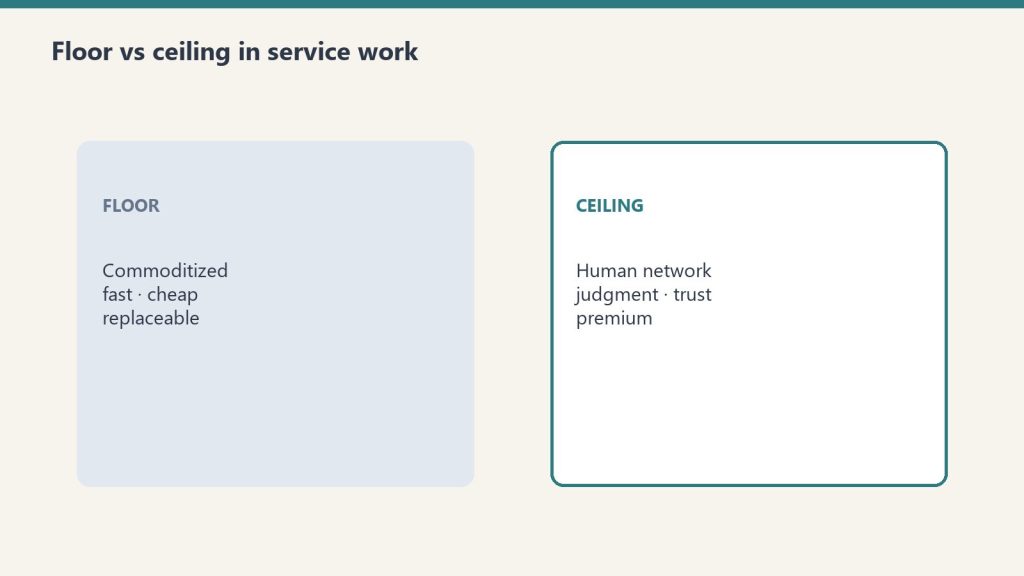
    Here is the counterintuitive truth: as AI automates more of the transactional layer of business, the relationship layer becomes the only sustainable differentiator. When everyone has access to the same AI tools, the same automation platforms, the same content generation capabilities, the thing that cannot be replicated is trust.

    AI handles my email responses, my social media scheduling, my content optimization, my site audits. That frees up hours every week that I reinvest into relationships. More calls. More introductions. More showing up for people when they need something I can provide.

    The irony is beautiful: I use AI to automate everything except the one thing that actually grows the business. The human part.

    The Profit Detective Method

    My approach to networking is simple and repeatable. First, I pay attention. Not to what someone says they need, but to what their business actually needs based on what I observe. Second, I connect. Not for credit, but because the connection genuinely makes sense. Third, I follow up. Not once. Not twice. Consistently, for years, without expectation of reciprocity.

    Most people network like they are collecting baseball cards. They want the biggest collection. I network like I am building an ecosystem. Every node in the network strengthens every other node. When the restoration company needs a website, they call me. When the lending company needs content strategy, they call me. When the comedy platform needs SEO, they call me. Not because I marketed to them. Because I showed up for them when it counted.

    Building a Contact Profile Database

    I am now building an AI-powered contact profile database that tracks every interaction, every preference, every business need for every person in my network. Not to surveil them. To serve them better. When I pick up the phone, I want to know what we talked about last time, what their current challenges are, and what introductions might be valuable to them right now.

    This is the marriage of AI and networking. The machine remembers everything. The human provides everything that matters: judgment, empathy, timing, and genuine care.

    FAQ

    How do you track your networking ROI?
    I track the origin of every client relationship back to its first touchpoint. Over 90 percent trace back to a personal introduction or existing relationship.

    Does this approach scale?
    Not in the way VCs want to hear. It scales through depth, not breadth. Fewer relationships, deeper trust, higher lifetime value per connection.

    How do you balance networking with running the business?
    AI automation handles the operational load. That gives me 10-15 hours per week that I dedicate exclusively to relationship building and maintenance.

    {
    “@context”: “https://schema.org”,
    “@type”: “Article”,
    “headline”: “The Profit Detective: Why Networking Is the Only Growth Engine That Compounds Forever”,
    “description”: “How relationship-first networking built a multi-vertical agency portfolio and why AI makes human connection more valuable, not less.”,
    “datePublished”: “2026-03-21”,
    “dateModified”: “2026-04-03”,
    “author”: {
    “@type”: “Person”,
    “name”: “Will Tygart”,
    “url”: “https://tygartmedia.com/about”
    },
    “publisher”: {
    “@type”: “Organization”,
    “name”: “Tygart Media”,
    “url”: “https://tygartmedia.com”,
    “logo”: {
    “@type”: “ImageObject”,
    “url”: “https://tygartmedia.com/wp-content/uploads/tygart-media-logo.png”
    }
    },
    “mainEntityOfPage”: {
    “@type”: “WebPage”,
    “@id”: “https://tygartmedia.com/the-profit-detective-why-networking-is-the-only-growth-engine-that-compounds-forever/”
    }
    }

  • The SEO Agency’s Blind Spot: You Rank Pages. But Do You Win Answers?

    The SEO Agency’s Blind Spot: You Rank Pages. But Do You Win Answers?

    The Machine Room · Under the Hood

    You Are Winning a Game That Is Shrinking

    If you run an SEO agency, you are probably good at what you do. You audit sites, fix technical issues, build content strategies, and move keywords up the rankings. Your clients see green arrows in their reports. Your retainers renew. Everything looks fine.

    Except the playing field is not what it was two years ago. Google’s search results page now has three layers of competition above the organic listings you are optimizing for. Featured snippets extract and display content directly. People Also Ask boxes answer follow-up questions without a click. And AI Overviews — powered by Gemini — synthesize multiple sources into a generated answer at the very top of the page. Your client’s number three ranking is now below three layers of content they are not competing in.

    This is not a prediction. It is the current state of search. And most SEO agencies have no offering for the answer layer or the AI layer because those disciplines — Answer Engine Optimization and Generative Engine Optimization — did not exist when the agency was founded. The tools are different. The content structures are different. The measurement is different. And the expertise required is specialized enough that you cannot just add it to your existing SEO team’s workload and expect results.

    What Your Clients See That You Do Not

    Your clients are already noticing. They search for their own keywords and see a competitor’s content in the featured snippet above their organic listing. They ask ChatGPT about their industry and their brand is not mentioned. They see Google AI Overviews citing sources that are not their website. They do not always tell you about it because they assume you are handling it. You are not. Because AEO and GEO are not part of your service offering.

    The awareness gap is closing fast. Industry publications are writing about AI search optimization. Conferences are adding AEO and GEO tracks. Your clients’ marketing directors are reading about it. The moment a client asks “what are we doing about AI search?” and you do not have a crisp answer, your credibility takes a hit that is hard to recover from.

    This is not about fear. It is about the natural evolution of search. SEO evolved from keyword stuffing to content strategy to E-E-A-T. AEO and GEO are the next evolution. The agencies that lead the evolution keep their clients. The agencies that lag lose them to competitors who already offer what is next.

    The Three-Layer Reality

    Modern search optimization requires three complementary disciplines. SEO — the foundation you already deliver — gets pages ranked in organic results. AEO restructures content to win featured snippets, People Also Ask placements, and voice search answers. GEO optimizes content to be cited and recommended by AI systems including Google AI Overviews, ChatGPT, Claude, Perplexity, and Gemini.

    Each layer requires different content structures. SEO rewards comprehensive, well-linked, technically sound pages. AEO requires tight 40-to-60-word direct answer blocks under question-phrased headings with FAQPage schema markup. GEO requires maximum factual density — specific numbers, cited sources, verifiable claims — with strong entity signals and AI-readable structure.

    You can deliver all three. But it requires either building the expertise in-house — hiring specialists, developing new processes, investing in training — or partnering with someone who already has the methodology, the tools, and the production capacity to layer AEO and GEO on top of the SEO work you are already doing.

    The Revenue Sitting Next to Your Current Contracts

    Every SEO client you have is a potential AEO and GEO client. They already trust you with their search visibility. They already have a budget allocated to search optimization. The conversation is not a cold pitch — it is an expansion of a relationship you have already earned.

    The upsell math is straightforward. If your average SEO retainer is ,000 to ,000 per month, adding an AEO and GEO layer at 40 to 60 percent of the base retainer increases revenue per client without increasing client acquisition cost. Your client gets a more comprehensive service. You get higher average contract value. The retention rate improves because the client has more reasons to stay.

    The agencies that figure this out first will capture the expansion revenue across their entire client base. The agencies that wait will watch a specialized partner or competitor capture it instead.

    Why This Cannot Wait

    Featured snippets are not new. But AI Overviews are, and they are expanding rapidly. Google is increasing the percentage of queries that trigger AI Overviews. Perplexity is growing its user base month over month. ChatGPT with browsing is becoming a default research tool for millions of professionals. Every month you wait, your clients’ competitors gain ground in channels you are not even monitoring.

    The question is not whether to add AEO and GEO to your agency’s capabilities. It is whether you build it, buy it, or partner for it — and how fast you can get it into client engagements before the next agency pitch meeting where the competitor across the table already has it.

    FAQ

    Can our existing SEO team learn AEO and GEO?
    Some of it, yes. But the specialized content structuring, schema stacking, factual density methodology, and AI citation monitoring require dedicated expertise and tooling that takes months to develop internally. Partnering accelerates the timeline from months to weeks.

    How do we explain AEO and GEO to clients who only understand SEO?
    Frame it as the evolution of search visibility. SEO gets you ranked. AEO gets you quoted. GEO gets you recommended by AI. Most clients immediately understand why all three matter when they see a competitor in the featured snippet or AI Overview above their organic listing.

    What does a partnership look like versus building in-house?
    A partnership provides the methodology, production capacity, and measurement frameworks while your agency maintains the client relationship, strategic direction, and brand presence. Think of it as adding a specialized capability to your existing delivery team without the hiring risk.

    {
    “@context”: “https://schema.org”,
    “@type”: “Article”,
    “headline”: “The SEO Agencys Blind Spot: You Rank Pages. But Do You Win Answers?”,
    “description”: “Most SEO agencies still optimize for blue links while featured snippets and AI citations reshape how clients actually get found. Here is what is missing.”,
    “datePublished”: “2026-03-21”,
    “dateModified”: “2026-04-03”,
    “author”: {
    “@type”: “Person”,
    “name”: “Will Tygart”,
    “url”: “https://tygartmedia.com/about”
    },
    “publisher”: {
    “@type”: “Organization”,
    “name”: “Tygart Media”,
    “url”: “https://tygartmedia.com”,
    “logo”: {
    “@type”: “ImageObject”,
    “url”: “https://tygartmedia.com/wp-content/uploads/tygart-media-logo.png”
    }
    },
    “mainEntityOfPage”: {
    “@type”: “WebPage”,
    “@id”: “https://tygartmedia.com/the-seo-agencys-blind-spot-you-rank-pages-but-do-you-win-answers/”
    }
    }

  • Your Clients Are Asking About AI Search. Here Is What to Tell Them Before They Ask Someone Else.

    Your Clients Are Asking About AI Search. Here Is What to Tell Them Before They Ask Someone Else.

    The Machine Room · Under the Hood

    The Question Is Coming. Be Ready.

    If you manage client accounts at an SEO agency, this scenario is heading your way if it has not arrived already. Your client’s CMO reads an article about AI Overviews. Their VP of Marketing notices a competitor in a featured snippet. Their CEO asks ChatGPT about their industry and does not see their brand mentioned. Then they call you and ask: “What are we doing about this?”

    How you answer that question determines whether you keep the relationship or start a countdown to a review. Saying “that is not really our area” is a death sentence. Saying “we are working on it” without a plan is worse. The right answer is specific, confident, and positions your agency as already ahead of the curve — even if you are just now figuring it out.

    The Three Things Clients Actually Want to Know

    When a client asks about AI search, they are not asking for a technical lecture. They want answers to three questions. First: are we visible in these new search features? Second: are our competitors visible in them? Third: what are we going to do about it?

    You can answer the first two questions in the next meeting with simple research. Search their top five keywords in Google and note whether AI Overviews, featured snippets, or PAA boxes appear. Check if the client’s content or a competitor’s content is cited. Ask ChatGPT and Perplexity the same questions and note who gets mentioned. This takes thirty minutes and gives you concrete data to present.

    The third question — what to do about it — requires a capability your agency may not have yet. Answer Engine Optimization restructures existing content to win featured snippets and PAA placements. Generative Engine Optimization enhances content with the factual density, entity signals, and structural clarity that AI systems need to cite it. Both are specialized disciplines that layer on top of the SEO work you are already doing.

    How to Frame AEO and GEO for Non-Technical Clients

    Drop the acronyms in the first conversation. Clients do not care about AEO and GEO as terms. They care about outcomes. Frame it this way: “There are now three ways your content shows up in search. The traditional ranking — that is what we have been optimizing. The direct answer box at the top of the results — that is a new opportunity we can capture. And the AI-generated summary that Google, ChatGPT, and other AI tools show — that is the fastest-growing channel and we need to make sure your content is what they cite.”

    Then show them. Pull up their top keyword in Google. Point to the AI Overview. Point to the featured snippet. Point to the People Also Ask box. Then point to the organic results below all of that. Ask them which position they would rather be in. The visual is more persuasive than any pitch deck.

    For the competitive angle, show them a competitor who is appearing in the featured snippet or AI Overview. Nothing motivates a client faster than seeing a competitor occupy a position they did not know existed.

    The Account Manager’s Cheat Sheet

    When the client asks about featured snippets, tell them: “Featured snippets are extracted from content that follows a specific structure — a question as a heading followed by a tight, direct answer in under sixty words. We can restructure your existing top-ranking content to compete for these placements. It requires content reformatting and FAQ schema markup, not new content creation.”

    When the client asks about AI Overviews, tell them: “Google’s AI Overviews pull from content that is factually specific, well-cited, and structurally clear. We need to increase the factual density of your content — replacing vague claims with specific numbers and cited sources — and ensure your entity signals are strong so the AI trusts your brand as a source.”

    When the client asks about ChatGPT or Perplexity visibility, tell them: “AI search tools cite content that is authoritative, factually dense, and easy to extract clean answers from. We can optimize your content for AI citation by enhancing your content’s verifiability, implementing LLMS.txt for AI crawler guidance, and strengthening your brand’s entity signals across the web.”

    When the client asks what it costs, tell them: “AEO and GEO layer on top of the SEO work we already do. The incremental investment is a fraction of the base SEO retainer because we are enhancing existing content, not starting from scratch. The ROI shows up as increased visibility in featured positions and AI citations — new channels that competitors are already competing in.”

    When You Do Not Have the Capability Yet

    If your agency does not yet have AEO and GEO delivery capability, do not fake it. But do not punt either. The honest and strategic response is: “We are building out our AI search optimization capability now. In the meantime, here is what I can show you about your current visibility in these channels, and here is our plan to address the gaps.”

    Then find a partner who can deliver while you develop the capability internally. The worst outcome is telling the client “we are working on it” and having nothing to show three months later. The best outcome is presenting results within the current engagement cycle that demonstrate you are ahead of the market.

    FAQ

    How do I research a client’s AI search visibility before a meeting?
    Search their top five keywords in Google and note AI Overviews and featured snippets. Ask ChatGPT and Perplexity the same questions and check for brand mentions. Screenshot everything. This takes thirty minutes and provides concrete talking points.

    What if the client’s competitors are not in AI search features either?
    That is actually the best scenario — it means the client has a first-mover opportunity. Frame it as capturing uncontested territory before competitors wake up to it.

    How do I handle a client who thinks SEO is all they need?
    Show them the search results page. Count how many features appear above the organic results. If the client’s number one ranking is below three layers of AI-generated and featured content, the organic position alone is not delivering the visibility it used to.

    {
    “@context”: “https://schema.org”,
    “@type”: “Article”,
    “headline”: “Your Clients Are Asking About AI Search. Here Is What to Tell Them Before They Ask Someone Else.”,
    “description”: “A field guide for agency account managers on how to answer client questions about AI search, featured snippets, and AI Overviews with confidence.”,
    “datePublished”: “2026-03-21”,
    “dateModified”: “2026-04-03”,
    “author”: {
    “@type”: “Person”,
    “name”: “Will Tygart”,
    “url”: “https://tygartmedia.com/about”
    },
    “publisher”: {
    “@type”: “Organization”,
    “name”: “Tygart Media”,
    “url”: “https://tygartmedia.com”,
    “logo”: {
    “@type”: “ImageObject”,
    “url”: “https://tygartmedia.com/wp-content/uploads/tygart-media-logo.png”
    }
    },
    “mainEntityOfPage”: {
    “@type”: “WebPage”,
    “@id”: “https://tygartmedia.com/your-clients-are-asking-about-ai-search-here-is-what-to-tell-them-before-they-ask-someone-else/”
    }
    }

  • The AEO Revenue Your Agency Is Leaving on the Table With Every Single Client

    The AEO Revenue Your Agency Is Leaving on the Table With Every Single Client

    The Machine Room · Under the Hood

    You Already Own the Relationship

    New business development is expensive. The pitch process, the proposals, the competitive reviews, the ramp-up period — acquiring a new SEO client costs your agency 5 to 10 times more than expanding an existing engagement. And yet most agencies pour their growth energy into hunting new logos while the easiest revenue expansion is sitting inside every current contract.

    Every SEO client you serve has content that ranks. That content is eligible for featured snippets, People Also Ask placements, and AI citations — but only if it is structured correctly. Right now, it almost certainly is not. The content was written for organic ranking, not for answer extraction. The headings are descriptive statements, not question phrases. There are no direct answer blocks. There is no FAQ schema. The factual density is marketing-grade, not citation-grade.

    That gap between what the content does and what it could do is revenue. Your revenue. If you do not capture it, someone else will — either a specialist firm your client discovers, or a competing agency that already offers the full stack.

    The Expansion Math

    Take your average monthly SEO retainer. For most agencies serving mid-market clients, that is somewhere between ,000 and ,000 per month. An AEO and GEO enhancement layer — restructuring existing content for featured snippets, implementing FAQ schema, increasing factual density, strengthening entity signals — can be priced as a natural extension of the base SEO retainer.

    On a ,000 monthly retainer, that is ,000 to ,000 per month in expansion revenue per client. Across a portfolio of 15 clients, that is ,000 to ,000 in monthly recurring revenue added without a single new client acquisition. No pitch decks. No competitive reviews. No onboarding costs. Just a deeper service for clients who already trust you.

    The retention effect compounds the math further. Clients receiving a multi-layer optimization service are significantly harder for competitors to displace. The switching cost increases because the new agency would need to match your SEO delivery and your AEO/GEO capability. Your contracts become stickier, your churn drops, and your client lifetime value increases.

    The Pitch That Works

    Do not pitch AEO and GEO as a new service. Pitch it as an evolution of the service you already deliver. The conversation goes like this: “We have been ranking your content in organic search, and we are getting strong results. But search has evolved. There are now featured positions above the organic results and AI-generated answers above those. Your competitors are starting to appear in these channels. We want to make sure your content is optimized for all three layers — not just the organic one.”

    Then show the visual. Pull up the client’s top keyword. Point to the featured snippet they are not in. Point to the AI Overview citing a competitor. Then show what the content needs to change structurally to compete in those positions. The gap is visible and the solution is concrete.

    The clincher is competitive intelligence. If you can show that a specific competitor already appears in featured snippets or AI citations for the client’s target keywords, the urgency becomes personal. No client wants to see a competitor quoted by Google while their own content sits below the fold.

    What the Delivery Actually Looks Like

    AEO and GEO enhancement is not a rebuild. It is a restructuring of content that already exists and already ranks. The delivery has four components that layer onto your existing SEO workflow.

    First: content restructuring. Take the client’s top 20 pages by traffic and restructure the headings to match target queries. Add direct answer blocks — 40 to 60 word self-contained answers — under each question heading. This makes the content snippet-eligible without changing the depth or quality of the existing material.

    Second: FAQ and schema implementation. Add FAQ sections with 5 to 8 questions mapped to the People Also Ask landscape for each page’s target keyword. Implement FAQPage schema, Article schema, and Speakable schema in JSON-LD format. This explicitly declares the page’s answer content to search engines and AI systems.

    Third: factual density enhancement. Audit the content for vague claims and replace them with specific, cited facts. Add numbers, dates, named sources, and inline citations. This increases the page’s value to AI systems that need verifiable information to cite confidently.

    Fourth: entity signal strengthening. Audit the client’s Organization schema, author pages, and brand consistency across web properties. Fill gaps. This builds the entity authority that AI systems use when deciding which sources to recommend.

    The first pass across a site takes a concentrated effort. After the initial enhancement, ongoing maintenance adds a manageable number of hours per month to your delivery workload — monitoring snippet positions, updating FAQ content, maintaining schema validity, and refreshing factual density on priority pages.

    Build, Buy, or Partner

    You have three paths to adding this capability. Build it internally by training your existing team and developing the methodology from scratch — time to market takes months of development. Buy it by hiring AEO and GEO specialists — expensive and dependent on a thin talent market. Or partner with an established AEO/GEO practice that delivers under your brand while you maintain the client relationship — time to market is weeks, not months.

    The economics usually favor partnering initially while you build internal capability in parallel. Your partner handles the specialized delivery. You handle the client relationship, strategy, and billing. The client sees a seamless expansion of services. Your revenue grows immediately.

    FAQ

    Will clients pay extra for AEO and GEO on top of SEO?
    Yes, when you frame it as capturing visibility in channels where competitors are already active. The visual demonstration — showing the client their keyword with a competitor in the featured snippet or AI Overview — makes the value self-evident.

    How do you measure AEO and GEO results for client reporting?
    Track featured snippet wins and losses, PAA placements, AI Overview citations, and referral traffic from AI search platforms. These metrics supplement traditional organic ranking reports and demonstrate the expanded visibility.

    What if the client’s content is too thin for AEO/GEO enhancement?
    Content expansion is part of the service. Thin pages need depth before they can be structured for snippets or optimized for AI citation. This is an additional revenue opportunity, not a blocker.

    {
    “@context”: “https://schema.org”,
    “@type”: “Article”,
    “headline”: “The AEO Revenue Your Agency Is Leaving on the Table With Every Single Client”,
    “description”: “Every SEO client you have is an AEO upsell waiting to happen. Here is the math, the pitch, and why the expansion revenue is easier than new business.”,
    “datePublished”: “2026-03-21”,
    “dateModified”: “2026-04-03”,
    “author”: {
    “@type”: “Person”,
    “name”: “Will Tygart”,
    “url”: “https://tygartmedia.com/about”
    },
    “publisher”: {
    “@type”: “Organization”,
    “name”: “Tygart Media”,
    “url”: “https://tygartmedia.com”,
    “logo”: {
    “@type”: “ImageObject”,
    “url”: “https://tygartmedia.com/wp-content/uploads/tygart-media-logo.png”
    }
    },
    “mainEntityOfPage”: {
    “@type”: “WebPage”,
    “@id”: “https://tygartmedia.com/the-aeo-revenue-your-agency-is-leaving-on-the-table-with-every-single-client/”
    }
    }

  • Why Your Best SEO Clients Will Leave for an AI-Native Agency Within 18 Months

    Why Your Best SEO Clients Will Leave for an AI-Native Agency Within 18 Months

    The Machine Room · Under the Hood

    The Retention Clock Is Ticking

    Your best clients are your most dangerous attrition risk right now. Not because your SEO work is bad. Because your best clients are the most sophisticated, the most informed, and the most likely to notice that search has changed while your service offering has not.

    These are the clients whose marketing directors read Search Engine Journal and attend MozCon. They follow Rand Fishkin and Lily Ray on LinkedIn. They have already seen the articles about AI Overviews eating organic clicks. They have already noticed featured snippets above their hard-won rankings. And they are already wondering whether their agency is keeping up or falling behind.

    The attrition will not happen dramatically. Your best client will not call and fire you. They will start a quiet search. They will take a meeting with an agency that pitches AEO and GEO as part of their standard offering. They will ask that agency questions your team cannot answer. And three months later, you will get a polite email about “exploring other options.” By then it is too late.

    The 18-Month Timeline

    Here is how it plays out across the industry. Right now — early 2026 — AI Overviews appear on roughly 25 to 30 percent of informational queries. By mid-2026, that will cross 40 percent based on Google’s stated expansion plans. By early 2027, the majority of informational queries will trigger some form of AI-generated result.

    At 25 percent, your clients might not notice the impact. At 40 percent, they will see organic click-through rates declining on their most important keywords. At majority coverage, the organic-only strategy you are delivering will be visibly insufficient to any client paying attention to their analytics.

    The agencies that will capture your departing clients are already building their AEO and GEO capabilities. They are developing the content restructuring workflows, the schema implementation processes, the factual density methodologies, and the AI citation monitoring dashboards. When your client takes that exploratory meeting in nine months, the competing agency will have a proven playbook and case studies to show.

    What the AI-Native Agency Pitch Looks Like

    When your client meets the competing agency, here is what they will hear: “We optimize for all three layers of search — organic rankings, featured answer positions, and AI citations. Here is a case study where we took a client from zero featured snippets to twelve in ninety days. Here is the AI citation report showing their brand mentioned in ChatGPT and Perplexity responses. Here is the AI Overview tracking dashboard showing which queries their content is cited in.”

    Your client will compare that to your monthly report showing keyword rankings and organic traffic. Both are valuable. But one addresses the full search landscape and the other addresses only the shrinking organic portion of it. The comparison is not flattering.

    The Clients You Are Most Likely to Lose

    Not all clients are equally at risk. The highest-attrition-risk clients share three characteristics. First: they operate in informational or commercial verticals where AI Overviews and featured snippets are most prevalent — healthcare, finance, technology, education, professional services. Second: they have marketing leadership that stays current on industry trends. Third: they track actual business outcomes, not just ranking reports, which means they will notice when organic rankings stop translating to the same traffic and conversion volumes.

    These are also your most valuable clients. They are the ones with the largest retainers, the longest relationships, and the highest lifetime value. Losing them is not a rounding error. It is a material revenue hit that can destabilize an agency.

    How to Defend Your Client Base

    The defense strategy has three components. First: proactively show clients the three-layer search reality before they discover it on their own. Run the competitive analysis. Show them where they are visible and where they are not. Position yourself as the agency that identified the gap, not the agency that had to be asked about it.

    Second: add AEO and GEO to your service offering, either through internal capability building or through a delivery partnership. Have the methodology, the process, and ideally early results to show within 90 days. The window for proactive positioning is closing.

    Third: integrate AEO and GEO metrics into your client reporting. Track featured snippet positions. Monitor AI Overview citations. Report on PAA placements. Show the client that you are measuring and optimizing for the full search landscape, not just the organic slice.

    The agencies that take these three steps in the next 90 days will retain their best clients and expand their contracts. The agencies that take them in 180 days will play catch-up. The agencies that wait longer than that will learn about their clients’ departure in a polite email that was drafted six months before it was sent.

    FAQ

    Are clients really switching agencies over AEO and GEO?
    Not yet at scale, but the trend is accelerating. The first agencies to lose clients over this gap will not see it coming because the decision happens quietly during the client’s internal research phase.

    How fast can an agency add AEO and GEO capability?
    Through a delivery partnership, you can have results to show clients within 60 to 90 days. Building internally from scratch takes months to develop the methodology and train the team.

    What is the cost of not adding these capabilities?
    Meaningful client attrition over the coming quarters among your most sophisticated and highest-value accounts — the ones paying attention to how search is evolving. The revenue impact far exceeds the investment required to add the capability.

    {
    “@context”: “https://schema.org”,
    “@type”: “Article”,
    “headline”: “Why Your Best SEO Clients Will Leave for an AI-Native Agency Within 18 Months”,
    “description”: “Client retention is an existential risk for SEO agencies that cannot deliver AEO and GEO. Here is the timeline and what to do before it is too late.”,
    “datePublished”: “2026-03-21”,
    “dateModified”: “2026-04-03”,
    “author”: {
    “@type”: “Person”,
    “name”: “Will Tygart”,
    “url”: “https://tygartmedia.com/about”
    },
    “publisher”: {
    “@type”: “Organization”,
    “name”: “Tygart Media”,
    “url”: “https://tygartmedia.com”,
    “logo”: {
    “@type”: “ImageObject”,
    “url”: “https://tygartmedia.com/wp-content/uploads/tygart-media-logo.png”
    }
    },
    “mainEntityOfPage”: {
    “@type”: “WebPage”,
    “@id”: “https://tygartmedia.com/why-your-best-seo-clients-will-leave-for-an-ai-native-agency-within-18-months/”
    }
    }