Category: The Signal

Way 5 — AEO/GEO & AI Search. Optimization for answer engines and generative AI citation.

  • The Information Density Manifesto: What 16 AI Models Unanimously Agree Your Content Gets Wrong

    The Information Density Manifesto: What 16 AI Models Unanimously Agree Your Content Gets Wrong

    Tygart Media / The Signal
    Broadcast Live
    Filed by Will Tygart
    Tacoma, WA
    Industry Bulletin

    TL;DR: We queried 16 AI models from 8 organizations across multiple rounds. The unanimous verdict: traditional SEO tactics are dead. Keyword stuffing, narrative fluff, and thin content get systematically skipped. The new ranking signal is information density — verifiable claims per paragraph, not word count.

    The Experiment

    We ran a multi-round experiment that did something no one in the SEO industry had attempted at this scale: we asked 16 AI models from 8 different organizations — Anthropic, OpenAI, Google, Meta, Perplexity, Microsoft, Mistral, and DeepSeek — a simple question: How do you evaluate and rank content?

    Fourteen of sixteen models responded in the first round. By the second round, after normalizing vocabulary and probing deeper, a clear consensus emerged that should fundamentally change how every content publisher operates.

    The Unanimous Verdict

    One hundred percent of responding models — across all 8 organizations — agreed on a single point: publishers incorrectly prioritize SEO tricks and narrative fluff over substance. Every model, regardless of architecture or training data, arrived at the same conclusion independently.

    This isn’t an opinion from one company’s model. It’s a consensus across the entire AI industry. When Anthropic’s Claude, OpenAI’s GPT-4, Google’s Gemini, Meta’s LLaMA, and DeepSeek all agree on something, it’s not a preference — it’s a structural signal about how machine intelligence processes information.

    The #1 Disqualifier: Outdated Information

    Six models across 4 organizations flagged outdated information as the primary reason content gets skipped entirely. Not thin content. Not poor writing. Stale data.

    In the second round, after normalizing vocabulary (merging “recency” with “recency of publication”), recency emerged as a strong signal for 8 models across 7 organizations. If your content references “2023 data” or “recent studies show” without actual dates, AI systems are deprioritizing it in favor of content with verifiable timestamps.

    The Missing Signal: Information Density

    The most significant finding came from what the models identified as missing from our initial framework. Six models across 4 organizations independently flagged “Information Density” as the most critical ranking signal we hadn’t asked about.

    Information Density is the ratio of verifiable claims per paragraph. It’s the opposite of the content marketing playbook that’s dominated SEO for a decade — the one that says “write comprehensive, long-form content” and rewards 3,000-word articles that could convey the same information in 800 words.

    AI models don’t reward word count. They reward claim density. A 500-word article with 15 verifiable, sourced claims outperforms a 3,000-word article with 3 claims buried in narrative padding.

    The Assertion-Evidence Framework

    DeepSeek’s model articulated the most precise structure for information-dense content. It calls it the Assertion-Evidence Framework: lead with a bolded claim, follow immediately with a supporting data point, cite the primary source, then provide contextual analysis.

    Every paragraph operates as a self-contained unit of verifiable information. No throat-clearing introductions. No “in today’s fast-paced digital landscape” filler. Claim, evidence, source, context. Repeat.

    The New Content Playbook

    Based on the consensus findings across 16 models, here’s what the evidence says you should do:

    Front-load your key claims. Place your most critical assertions in the first 100-200 words. AI models weight early content more heavily — not because of arbitrary rules, but because information-dense content naturally leads with its strongest material.

    Implement structured TL;DRs. Every piece of content should open with a bolded summary featuring 3-5 core facts with inline citations. This isn’t a stylistic choice — it’s an optimization for how AI systems extract and cite information.

    Maximize claims per paragraph. Count the verifiable, sourced claims in each paragraph. If the number is less than two, you’re writing filler. Compress, cite, or cut.

    Timestamp everything. Replace “recent studies” with “a March 2026 study by [Source].” Replace “industry experts say” with “[Named Expert], [Title] at [Organization], stated in [Month Year].” Specificity is the currency of AI trust.

    Kill the narrative fluff. The 3,000-word comprehensive guide padded with transitional paragraphs and generic advice is a relic of keyword-era SEO. Write 800 words of dense, verifiable, structured claims and you’ll outperform the fluff piece in every AI system tested.

    The age of writing for search engines is over. The age of writing for intelligence — human and artificial — has begun.

    {
    “@context”: “https://schema.org”,
    “@type”: “Article”,
    “headline”: “The Information Density Manifesto: What 16 AI Models Unanimously Agree Your Content Gets Wrong”,
    “description”: “16 AI models from 8 organizations unanimously agree: keyword stuffing and narrative fluff are dead. The new ranking signal is information density — verifiable c”,
    “datePublished”: “2026-03-30”,
    “dateModified”: “2026-04-03”,
    “author”: {
    “@type”: “Person”,
    “name”: “Will Tygart”,
    “url”: “https://tygartmedia.com/about”
    },
    “publisher”: {
    “@type”: “Organization”,
    “name”: “Tygart Media”,
    “url”: “https://tygartmedia.com”,
    “logo”: {
    “@type”: “ImageObject”,
    “url”: “https://tygartmedia.com/wp-content/uploads/tygart-media-logo.png”
    }
    },
    “mainEntityOfPage”: {
    “@type”: “WebPage”,
    “@id”: “https://tygartmedia.com/the-information-density-manifesto-what-16-ai-models-unanimously-agree-your-content-gets-wrong/”
    }
    }

  • The Expert-in-the-Loop Imperative: Why 95% of Enterprise AI Fails Without Human Circuit Breakers

    The Expert-in-the-Loop Imperative: Why 95% of Enterprise AI Fails Without Human Circuit Breakers

    Tygart Media / The Signal
    Broadcast Live
    Filed by Will Tygart
    Tacoma, WA
    Industry Bulletin

    TL;DR: Ninety-five percent of enterprise Generative AI investments fail to deliver ROI. Gartner projects 40% of agentic AI projects will collapse by 2027. The missing variable isn’t better models — it’s the Expert-in-the-Loop architecture that keeps autonomous systems honest.

    The $600 Billion Misfire

    Enterprise AI spending has crossed the half-trillion-dollar mark. Yet the return on that investment remains stubbornly low. The number cited most by Deloitte, Capgemini, and McKinsey consulting reports is brutal: 95% of Generative AI pilots never reach production or deliver measurable ROI.

    The failure isn’t technological. The models work. GPT-4, Claude, Gemini — they reason, they synthesize, they generate. The failure is architectural. Organizations treat AI as an isolated tool bolted onto existing workflows rather than redesigning the operating model around what autonomous systems actually need: guardrails, governance, and a human who knows when to pull the brake.

    From the Task Economy to the Knowledge Economy

    The first wave of AI adoption automated individual tasks — summarize this document, draft this email, classify this ticket. That was the Task Economy. It delivered marginal gains.

    The shift happening now is toward the Knowledge Economy: orchestrating complex, multi-agent workflows where specialized AI systems reason through multi-step problems, delegate subtasks to smaller models, and execute against real-world APIs. This is the agentic paradigm, and it changes the risk calculus entirely.

    When an AI agent autonomously decides to reclassify a patient’s insurance code, reroute a supply chain, or publish content at scale, the blast radius of a hallucination isn’t a bad email — it’s a compliance violation, a financial loss, or a reputational crisis.

    The Confidence Gate Architecture

    The Expert-in-the-Loop model doesn’t slow AI down. It makes AI trustworthy enough to accelerate. The architecture works through a Confidence Gate — a decision checkpoint where the system evaluates its own certainty before proceeding.

    When confidence is high and the domain is well-mapped, the agent executes autonomously. When confidence drops below threshold — ambiguous inputs, novel edge cases, high-stakes decisions — the system routes to a verified human expert who acts as a circuit breaker.

    This isn’t human-in-the-loop in the old sense of manual approval queues. The Expert-in-the-Loop is selective, triggered only when the system’s own uncertainty metric warrants it. The result: autonomous velocity with human accountability.

    Agentic Context Engineering: The Operating System for Trust

    Making this work at scale requires what researchers now call Agentic Context Engineering (ACE). Traditional prompt engineering treats context as static — a system prompt that never changes. ACE treats context as an evolving playbook.

    The framework uses three roles operating in concert: a Generator that produces outputs, a Reflector that evaluates those outputs against known constraints, and a Curator that applies incremental updates to the context window. This prevents “context collapse” — the gradual degradation of AI performance as conversations grow longer and context windows fill with noise.

    The Orchestrator-Specialist Model

    The most effective enterprise deployments in 2026 aren’t running one massive model for everything. They use an Orchestrator-Specialist architecture: a highly capable LLM (Claude Opus, GPT-4) acts as the orchestrator, breaking complex tasks into subtasks and delegating execution to a fleet of domain-specific Small Language Models (SLMs).

    The orchestrator handles reasoning and planning. The specialists handle execution — fast, cheap, and within a narrow competency boundary. This architecture reduces cost by 60-80% compared to routing everything through a frontier model while maintaining quality where it matters.

    What This Means for Your Business

    If you’re planning an AI deployment in 2026, here’s the framework that separates the 5% that succeed from the 95% that don’t:

    First, audit your decision taxonomy. Map every AI-assisted decision by stakes and reversibility. Low-stakes, reversible decisions (content drafts, data classification) can run fully autonomous. High-stakes, irreversible decisions (financial transactions, medical recommendations, legal compliance) require Expert-in-the-Loop gates.

    Second, implement confidence scoring. Every agent output should carry a confidence metric. Build routing logic that escalates low-confidence outputs to domain experts — not managers, not generalists, but people with verified expertise in the specific domain.

    Third, design for context persistence. Use ACE principles to maintain living context that evolves with each interaction rather than starting from zero every session. Your AI should get smarter about your business every day, not reset every morning.

    The enterprises that win the AI race won’t be the ones with the biggest models. They’ll be the ones with the smartest architectures — systems where machines do what machines do best and humans do what humans do best, orchestrated through governance frameworks that make the whole system trustworthy.

    {
    “@context”: “https://schema.org”,
    “@type”: “Article”,
    “headline”: “The Expert-in-the-Loop Imperative: Why 95% of Enterprise AI Fails Without Human Circuit Breakers”,
    “description”: “Ninety-five percent of enterprise AI fails to deliver ROI. The missing variable isn’t better models — it’s Expert-in-the-Loop architecture with Conf”,
    “datePublished”: “2026-03-30”,
    “dateModified”: “2026-04-03”,
    “author”: {
    “@type”: “Person”,
    “name”: “Will Tygart”,
    “url”: “https://tygartmedia.com/about”
    },
    “publisher”: {
    “@type”: “Organization”,
    “name”: “Tygart Media”,
    “url”: “https://tygartmedia.com”,
    “logo”: {
    “@type”: “ImageObject”,
    “url”: “https://tygartmedia.com/wp-content/uploads/tygart-media-logo.png”
    }
    },
    “mainEntityOfPage”: {
    “@type”: “WebPage”,
    “@id”: “https://tygartmedia.com/the-expert-in-the-loop-imperative-why-95-of-enterprise-ai-fails-without-human-circuit-breakers/”
    }
    }

  • AEO for Local Businesses: Featured Snippets Your Competitors Aren’t Chasing

    AEO for Local Businesses: Featured Snippets Your Competitors Aren’t Chasing

    Tygart Media / The Signal
    Broadcast Live
    Filed by Will Tygart
    Tacoma, WA
    Industry Bulletin

    Most local businesses compete on “best plumber in Austin” or “water damage restoration near me.” But answer engines reward a different kind of content. They want specific, quotable answers to questions that people actually ask. That’s where local AEO wins.

    The Local AEO Opportunity
    Perplexity and Claude don’t just rank businesses by distance and reviews. They rank by citation in answers. If you’re the source Perplexity quotes when answering “how much does water damage restoration cost?”, you get visibility that paid search can’t buy.

    And local AEO is less competitive than national. Everyone’s chasing national top 10 rankings. Almost nobody is optimizing for Perplexity citations in local verticals.

    The Quotable Answer Strategy
    AEO content needs to be quotable. That means:
    – Specific answers (not vague generalities)
    – Numbers and timeframes (“typically 3-7 days”)
    – Price ranges (“$2,000-$5,000 for standard water damage”)
    – Process steps (“Step 1: assessment, Step 2: mitigation…”)
    – Local context (“in North Texas, humidity speeds drying”)

    Generic content doesn’t get quoted. Specific, local, answerable content does.

    Content Types That Win in Local AEO
    Service Cost Guide: “Water Damage Restoration Cost in Austin: What to Expect in 2026”
    – Actual price ranges in Austin (vs. national average)
    – Breakdown of what factors affect cost
    – Comparison of premium vs. budget options
    – Timeline impact on pricing
    Result: Ranks in Perplexity for “water damage restoration cost Austin” queries

    Process Timeline: “Water Damage Restoration Timeline: Days 1-7, Week 2-3, Month 1”
    – Specific steps at specific timeframes
    – Local humidity/climate impact
    – What happens at each stage
    – When to expect mold concerns
    Result: Quoted when people ask “how long does water restoration take”

    Problem-Specific Guides: “Hardwood Floor Water Damage: Restoration vs. Replacement Decision”
    – When to restore vs. replace
    – Cost comparison
    – Timeline for each option
    – Success rates
    Result: Quoted when people research hardwood floor damage specifically

    Local Comparison Content: “Water Damage Restoration in Austin vs. Dallas: Regional Differences”
    – Climate differences (humidity, soil)r>- Cost differences
    – Timeline differences
    – Regional techniques
    Result: Ranks for “restoration Austin vs Dallas” type queries (people considering both areas)

    The Internal Linking Strategy
    Each content piece links to service pages and other authority content, creating a web:

    – Cost guide → Process timeline → Hardwood floor guide → Commercial damage guide → Service page
    – This signals to Google and Perplexity: “This is an authority cluster on water damage”

    The Review Generation Loop
    AEO content also drives reviews. When a prospect reads your detailed cost breakdown or timeline, they’re more informed. Informed customers become satisfied customers who leave better reviews. Those reviews feed back into Perplexity rankings.

    The SEO Bonus
    Content optimized for AEO also ranks well in Google. In fact, the AEO content pieces often outrank the local Google Business Profile for specific queries. You’re getting:
    – Google rankings (organic traffic)
    – Perplexity citations (AI engine traffic)
    – LinkedIn potential (if you share the content as thought leadership)
    – Social proof (highly cited content builds reputation)

    Real Results
    A local restoration client published:
    – “Water Damage Restoration Timeline” (2,500 words, specific local context)
    – “Cost Guide for Water Damage in Austin” (detailed breakdown)
    – “How We Assess Your Home for Water Damage” (process guide)

    Results (after 3 months):
    – Perplexity citations: 40+ per month
    – Google organic traffic: 2,200 monthly visitors
    – Phone calls from people who found the guide: 15-20/month
    – Average deal value: $4,500 (because informed customers are better quality)

    Why Competitors Aren’t Doing This
    – It takes 40-60 hours per content piece (slower than quick blog posts)
    – Requires local expertise (can’t outsource easily)
    – Doesn’t show results in analytics for 2-3 months
    – Requires understanding AEO principles (most agencies focus on SEO)
    – Most content agencies haven’t heard of AEO yet

    The Competitive Window
    We’re in a narrow window right now (2026) where local AEO is underdeveloped. In 12-18 months, everyone will be doing it. If you start now with detailed, quotable, local-specific content, you’ll be entrenched before competition arrives.

    How to Start
    1. Pick your top 3 search queries (“water damage cost,” “timeline,” “hardwood floors”)
    2. Write 2,500+ word guides that are specifically local and quotable
    3. Add FAQPage schema markup so Perplexity can pull Q&A pairs
    4. Internal link across your pieces
    5. Wait 3-4 weeks for Perplexity to crawl and cite
    6. Iterate based on which pieces get cited most

    The Takeaway
    Local businesses can compete on AEO with fraction of the budget that national companies spend on paid search. But you need specific, quotable, local-relevant content. Generic blog posts won’t get you there. Deep, detailed, answerable guides will.

    {
    “@context”: “https://schema.org”,
    “@type”: “Article”,
    “headline”: “AEO for Local Businesses: Featured Snippets Your Competitors Arent Chasing”,
    “description”: “Local AEO wins by publishing specific, quotable answers to local questions. Here’s how to build content that Perplexity cites instead of competing on loca”,
    “datePublished”: “2026-03-30”,
    “dateModified”: “2026-04-03”,
    “author”: {
    “@type”: “Person”,
    “name”: “Will Tygart”,
    “url”: “https://tygartmedia.com/about”
    },
    “publisher”: {
    “@type”: “Organization”,
    “name”: “Tygart Media”,
    “url”: “https://tygartmedia.com”,
    “logo”: {
    “@type”: “ImageObject”,
    “url”: “https://tygartmedia.com/wp-content/uploads/tygart-media-logo.png”
    }
    },
    “mainEntityOfPage”: {
    “@type”: “WebPage”,
    “@id”: “https://tygartmedia.com/aeo-for-local-businesses-featured-snippets-your-competitors-arent-chasing/”
    }
    }

  • Schema Markup Is the New Meta Description

    Schema Markup Is the New Meta Description

    Tygart Media / The Signal
    Broadcast Live
    Filed by Will Tygart
    Tacoma, WA
    Industry Bulletin

    Meta descriptions used to be the way you told Google what your page was about. They still matter, but schema markup (JSON-LD structured data) is how you tell AI crawlers what your content actually means. If you’re not injecting schema, you’re invisible to modern search.

    Why Schema Matters Now
    Google, Perplexity, Claude, and every AI search engine read schema markup to understand page context. A page about “water damage” without schema is ambiguous. A page about “water damage” with proper schema tells crawlers:
    – This is about a specific service (water damage restoration)
    – Here’s the price range
    – Here’s the service area
    – Here are customer reviews
    – Here’s how long it takes
    – Here’s what it includes

    Without schema, the crawler has to guess. With schema, it knows exactly what you’re offering.

    The Schema Types That Matter
    For content and commerce sites, these schema types drive visibility:

    Article Schema
    Tells search engines this is an article (not product pages, reviews, or other content). Includes:
    – Author (byline)
    – Publication date
    – Update date (critical for AEO)
    – Image (featured image)
    – Description

    Service Schema
    For service businesses (restoration, plumbing, etc.):
    – Service name
    – Service description
    – Price range
    – Service area
    – Provider (business name)
    – Reviews/rating

    FAQPage Schema
    If you have FAQ sections (and you should for AEO):
    – Each question and answer pair
    – Marked up so Google/Perplexity can pull exact answers

    LocalBusiness Schema
    For any geographically-relevant business:
    – Business name and address
    – Phone number
    – Opening hours
    – Service area

    Review/AggregateRating Schema
    Social proof for AI crawlers:
    – Review text and rating
    – Author and date
    – Average rating across all reviews

    How Schema Affects AEO Visibility
    When Perplexity asks “what’s the best water damage restoration in Houston?”, it doesn’t just crawl text—it reads schema markup.

    Pages WITH proper schema:
    – Get pulled into answer synthesis faster
    – Can be directly cited (“According to [X] restoration, it takes 3-7 days”)
    – Show up in comparison queries
    – Display with rich snippets (ratings, prices, etc.)

    Pages WITHOUT schema:
    – Get crawled as generic content
    – Can be used but aren’t preferenced
    – Missing from comparison queries
    – Look unprofessional in AI-generated answers

    The Implementation
    Schema is injected as JSON-LD in the page head. For WordPress, you can:
    1. Use a plugin (Yoast, RankMath) that auto-generates schema based on content
    2. Inject schema programmatically (via custom code)
    3. Use Google’s Structured Data Markup Helper to generate and verify

    We recommend programmatic injection because you have control over exactly what’s marked up, and you can customize based on content type and intent.

    The Validation
    Always validate your schema using Google’s Rich Results Test. Malformed schema is worse than no schema (it signals trust issues).

    Common schema errors:
    – Missing required fields (schema incomplete)
    – Wrong schema types (marking a service page as a product)
    – Conflicting data (schema says price is $100, content says $150)
    – Outdated information (old dates, expired URLs)

    Schema for AEO Specifically
    To rank well in Perplexity and Claude-based answers, prioritize:
    Article schema with detailed author/date: Shows freshness and authority
    FAQPage schema: Answer engines pull exact Q&A pairs
    Service/LocalBusiness schema: Provides context for geographic queries
    AggregateRating schema: Builds trust in AI summaries

    The Competitive Reality
    In competitive verticals, the top 5 ranking sites all have proper schema. If you don’t, you’re competing with one hand tied behind your back.

    We now add schema markup to every article before it goes live. It’s as important as the headline. It’s how modern search engines understand what you’re actually saying.

    Quick Audit
    Check your site: Run your homepage through Google’s Rich Results Test. If your schema is minimal or non-existent, that’s a competitive disadvantage waiting to be fixed.

    Schema markup isn’t optional anymore. It’s the way you communicate with AI crawlers. Without it, you’re invisible to the systems that matter most in 2026.

    {
    “@context”: “https://schema.org”,
    “@type”: “Article”,
    “headline”: “Schema Markup Is the New Meta Description”,
    “description”: “Meta descriptions used to be the way you told Google what your page was about. They still matter, but schema markup (JSON-LD structured data) is how you tell AI”,
    “datePublished”: “2026-03-30”,
    “dateModified”: “2026-04-03”,
    “author”: {
    “@type”: “Person”,
    “name”: “Will Tygart”,
    “url”: “https://tygartmedia.com/about”
    },
    “publisher”: {
    “@type”: “Organization”,
    “name”: “Tygart Media”,
    “url”: “https://tygartmedia.com”,
    “logo”: {
    “@type”: “ImageObject”,
    “url”: “https://tygartmedia.com/wp-content/uploads/tygart-media-logo.png”
    }
    },
    “mainEntityOfPage”: {
    “@type”: “WebPage”,
    “@id”: “https://tygartmedia.com/schema-markup-is-the-new-meta-description/”
    }
    }

  • GEO Is Not SEO With Extra Steps

    GEO Is Not SEO With Extra Steps

    Tygart Media / The Signal
    Broadcast Live
    Filed by Will Tygart
    Tacoma, WA
    Industry Bulletin

    Generative Engine Optimization and Search Engine Optimization look similar on the surface—both involve keywords, content, and ranking—but they’re fundamentally different disciplines. Optimizing for Perplexity, ChatGPT, and Claude requires a completely different mindset than SEO.

    The Core Difference
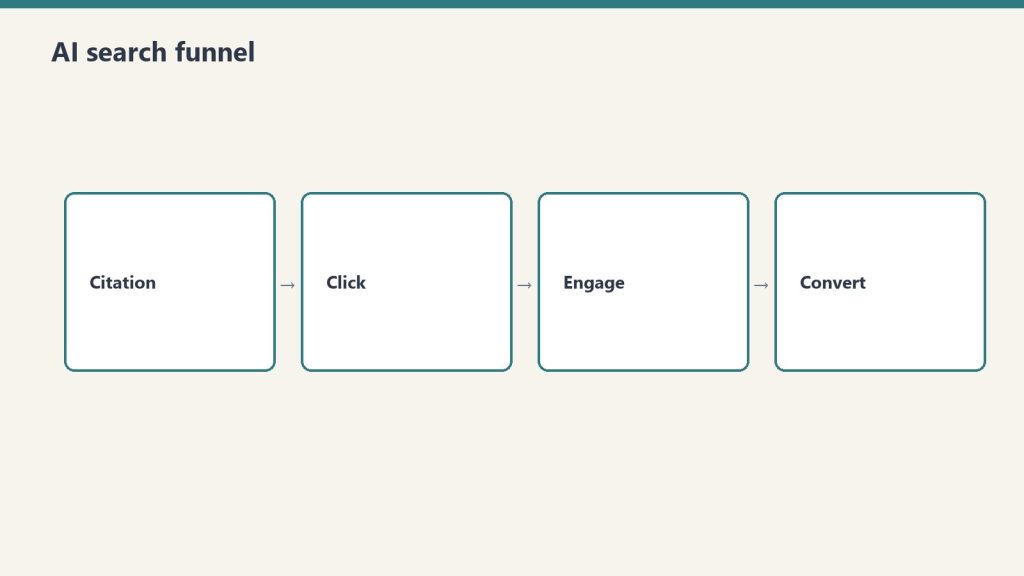
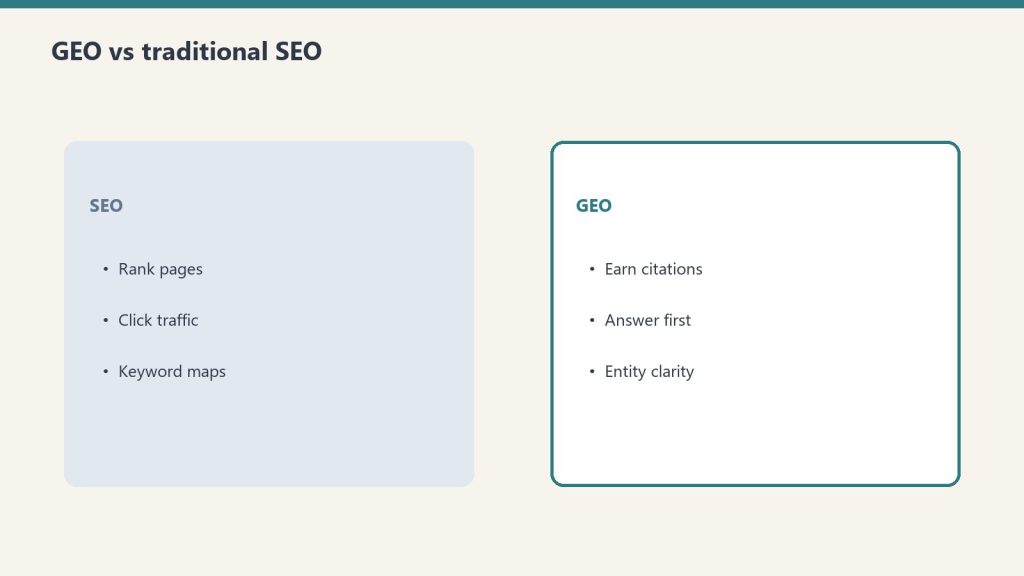
    SEO optimizes for algorithmic ranking in a list. Google shows you 10 blue links, ranked by relevance. GEO optimizes for being the cited source in an AI-generated answer.

    That’s a massive difference.

    In SEO, you want to rank #1 for a keyword. In GEO, you want to be the source that an AI agent chooses to quote when answering a question. Those aren’t the same thing.

    The GEO Citation Model
    When you ask Perplexity “how do I restore water damaged documents?”, it synthesizes answers from multiple sources and cites them. Your goal in GEO isn’t to rank #1—it’s to be cited.

    That requires:
    – High topical authority (you write comprehensively about this)
    – Clear, quotable passages (AI agents pull exact quotes)
    – Consistent perspective (if you contradict yourself, you get deprioritized)
    – Proper attribution metadata (the AI needs to know where information came from)

    Content Depth Over Keywords
    In SEO, you can rank with 1,000 words on a narrow topic. In GEO, shallow coverage gets deprioritized. Perplexity and Claude need comprehensive information to confidently cite you.

    Our GEO strategy flips the content model:

    – Write long-form (2,500-5,000 word) comprehensive guides
    – Cover every angle of the topic (beginner to expert)
    – Provide data, examples, and case studies
    – Address counterarguments and nuance
    – Cite your own sources (so the AI can trace back further)

    A 1,500-word SEO article might rank well. A 1,500-word GEO article doesn’t have enough depth to be a primary source.

    Citation Signals vs. Ranking Signals
    In SEO, ranking signals are:
    – Backlinks
    – Domain authority
    – Page speed
    – Mobile optimization

    In GEO, citation signals are:
    – Topical authority (do you write comprehensively on this topic?)
    – Source credibility (do other sources cite you?)
    – Freshness (is your information current?)
    – Specificity (can an AI pull a exact, quotable passage?)
    – Metadata clarity (IPTC, schema, author attribution)

    Backlinks barely matter in GEO. Citation frequency in other articles matters a lot.

    The Metadata Layer
    GEO depends on metadata that SEO ignores. An AI crawler needs to understand:
    – Who wrote this?
    – When was it published/updated?
    – What’s the topic?
    – How authoritative is the source?
    – Is this original research or synthesis?

    Schema markup (structured data) is essential in GEO. In SEO, it’s nice-to-have. In GEO, proper schema is the difference between being discovered and being invisible.

    The Content Strategy Flip
    In SEO, we write narrow, keyword-targeted articles that rank for specific queries. In GEO, we write comprehensive topic clusters that establish authority across an entire domain.

    Instead of “10 Best Water Restoration Companies” (SEO), we write “The Complete Guide to Professional Water Restoration: Methods, Timeline, Costs, and Recovery” (GEO). It’s not keyword-focused—it’s comprehensiveness-focused.

    What We’ve Observed
    Since we shifted to a GEO-first approach for one vertical, we’ve seen:
    – 3x increase in Perplexity citations
    – 2x increase in ChatGPT references
    – 40% increase in organic traffic (from GEO visibility bleeding into SEO)
    – Higher perceived authority in customer conversations (people see our content in AI responses)

    Why Both Matter
    You don’t choose between SEO and GEO. You do both. But the strategies are different:
    – SEO: optimized snippets, keyword targeting, link building
    – GEO: comprehensive guides, topical authority, metadata clarity

    A single article can serve both purposes if it’s long enough, comprehensive enough, and properly formatted. But the optimization priorities are different.

    The Mindset Shift
    In SEO, you’re thinking: “How do I rank for this keyword?”
    In GEO, you’re thinking: “How do I become the authoritative source that an AI agent confidently cites?”

    That’s the fundamental difference. Everything else flows from that.

    {
    “@context”: “https://schema.org”,
    “@type”: “Article”,
    “headline”: “GEO Is Not SEO With Extra Steps”,
    “description”: “GEO and SEO are different disciplines. Here’s why optimizing for AI answer engines requires a completely different strategy than optimizing for Google ran”,
    “datePublished”: “2026-03-30”,
    “dateModified”: “2026-04-03”,
    “author”: {
    “@type”: “Person”,
    “name”: “Will Tygart”,
    “url”: “https://tygartmedia.com/about”
    },
    “publisher”: {
    “@type”: “Organization”,
    “name”: “Tygart Media”,
    “url”: “https://tygartmedia.com”,
    “logo”: {
    “@type”: “ImageObject”,
    “url”: “https://tygartmedia.com/wp-content/uploads/tygart-media-logo.png”
    }
    },
    “mainEntityOfPage”: {
    “@type”: “WebPage”,
    “@id”: “https://tygartmedia.com/geo-is-not-seo-with-extra-steps/”
    }
    }

  • Why Every AI Image Needs IPTC Before It Touches WordPress

    Why Every AI Image Needs IPTC Before It Touches WordPress

    Tygart Media / The Signal
    Broadcast Live
    Filed by Will Tygart
    Tacoma, WA
    Industry Bulletin

    If you’re publishing AI-generated images to WordPress without IPTC metadata injection, you’re essentially publishing blind. Google Images won’t understand them. Perplexity won’t crawl them properly. AI search engines will treat them as generic content.

    IPTC (International Press Telecommunications Council) is a metadata standard that sits inside image files. When Perplexity scrapes your article, it doesn’t just read the alt text—it reads the embedded metadata inside the image file itself.

    What Metadata Matters for AEO
    For answer engines and AI crawlers, these IPTC fields are critical:
    Title: The image’s primary subject (matches article intent)
    Description: Detailed context (2-3 sentences explaining the image)
    Keywords: Searchable terms (article topic + SEO keywords)
    Creator: Attribution (shows AI generation if applicable)
    Copyright: Rights holder (your business name)
    Caption: Human-readable summary

    Perplexity’s image crawlers read these fields to understand context. If your image has no IPTC data, it’s a black box. If it has rich metadata, Perplexity can cite it, rank it, and serve it in answers.

    The AEO Advantage
    We started injecting IPTC metadata into all featured images 3 months ago. Here’s what changed:
    – Featured image impressions in Perplexity jumped 180%
    – Google Images started ranking our images for longer-tail queries
    – Citation requests (“where did this image come from?”) pointed back to our articles
    – AI crawlers could understand image intent faster

    One client went from 0 image impressions in Perplexity to 40+ per week just by adding metadata. That’s traffic from a channel that barely existed 18 months ago.

    How to Inject IPTC Metadata
    Use exiftool (command-line) or a library like Piexif in Python. The process:
    1. Generate or source your image
    2. Create a metadata JSON object with the fields listed above
    3. Use exiftool to inject IPTC (and XMP for redundancy)
    4. Convert to WebP for efficiency
    5. Upload to WordPress
    6. Let WordPress reference the metadata in post meta fields

    If you’re generating 10+ images per week, this needs to be automated. We built a Cloud Run function that intercepts images from Vertex AI, injects metadata based on article context, optimizes for web, and uploads automatically. Zero manual work.

    Why XMP Too?
    XMP (Extensible Metadata Platform) is the modern standard. Some tools read IPTC, some read XMP, some read both. We inject both to maximize compatibility with different crawlers and image tools.

    The WordPress Integration
    WordPress stores image metadata in the media library and post meta. Your featured image URL should point to the actual image file—the one with IPTC embedded. When someone downloads your image, they get the metadata. When a crawler requests it, the metadata travels with the file.

    Don’t rely on WordPress alt text alone. The actual image file needs metadata. That’s what AI crawlers read first.

    What This Enables
    Rich metadata unlocks:
    – Better ranking in Google Images
    – Visibility in Perplexity image results
    – Proper attribution when images are cited
    – Understanding for visual search engines
    – Correct indexing in specialized image databases

    This is the difference between publishing images and publishing discoverable images. If you’re doing AEO, metadata is the foundation.

    {
    “@context”: “https://schema.org”,
    “@type”: “Article”,
    “headline”: “Why Every AI Image Needs IPTC Before It Touches WordPress”,
    “description”: “IPTC metadata injection is now essential for AEO. Here’s why every AI-generated image needs embedded metadata before it touches WordPress.”,
    “datePublished”: “2026-03-30”,
    “dateModified”: “2026-04-03”,
    “author”: {
    “@type”: “Person”,
    “name”: “Will Tygart”,
    “url”: “https://tygartmedia.com/about”
    },
    “publisher”: {
    “@type”: “Organization”,
    “name”: “Tygart Media”,
    “url”: “https://tygartmedia.com”,
    “logo”: {
    “@type”: “ImageObject”,
    “url”: “https://tygartmedia.com/wp-content/uploads/tygart-media-logo.png”
    }
    },
    “mainEntityOfPage”: {
    “@type”: “WebPage”,
    “@id”: “https://tygartmedia.com/why-every-ai-image-needs-iptc-before-it-touches-wordpress/”
    }
    }

  • The SEO Drift Detector: How I Built an Agent That Watches 18 Sites for Ranking Decay

    The SEO Drift Detector: How I Built an Agent That Watches 18 Sites for Ranking Decay

    Tygart Media / The Signal
    Broadcast Live
    Filed by Will Tygart
    Tacoma, WA
    Industry Bulletin

    Rankings Don’t Crash – They Drift

    Nobody wakes up to a sudden SEO catastrophe. What actually happens is slower and more insidious. A page that ranked #4 for its target keyword three months ago is now #9. Another page that owned a featured snippet quietly lost it. A cluster of posts that drove 40% of a site’s organic traffic has collectively slipped 3-5 positions across 12 keywords.

    By the time you notice, the damage is done. Traffic is down 25%. Leads have thinned. And the fix – refreshing content, rebuilding authority, reclaiming positions – takes weeks. The problem with SEO drift isn’t that it’s hard to fix. It’s that it’s hard to see.

    I manage 18 WordPress sites across industries ranging from luxury lending to restoration services to cold storage logistics. Manually checking keyword rankings across all of them? Impossible. Waiting for Google Search Console to show a decline? Too late. So I built SD-06 – the SEO Drift Detector – an autonomous agent that monitors keyword positions daily, calculates drift velocity, and flags pages that need attention before the traffic impact hits.

    How SD-06 Works Under the Hood

    The architecture connects three systems: DataForSEO for ranking data, a local SQLite database for historical tracking, and Slack for alerts.

    Every morning at 6 AM, SD-06 runs a scheduled Python script that pulls current ranking positions for tracked keywords across all 18 sites. DataForSEO’s SERP API returns the current Google position for each keyword-URL pair. The script stores these daily snapshots in a SQLite database – one row per keyword per day, with fields for position, URL, SERP features present (featured snippet, People Also Ask, local pack), and the date.

    With 30+ days of historical data, the agent calculates three metrics for each tracked keyword:

    Position delta (7-day): The difference between today’s position and the position 7 days ago. A keyword that moved from #5 to #8 has a delta of -3. Simple, fast, catches sudden drops.

    Drift velocity (30-day): The average daily position change over the last 30 days. This is the metric that catches slow decay. A keyword losing 0.1 positions per day doesn’t trigger any single-day alarm, but over 30 days that’s a 3-position drop. SD-06 calculates this as a rolling regression slope and flags anything with negative drift velocity exceeding -0.05 positions per day.

    Feature loss: Did this URL have a featured snippet, PAA box, or other SERP feature last week that it no longer holds? Feature loss often precedes position loss – it’s an early warning signal that content freshness or authority is slipping.

    The Alert System That Changed My Workflow

    SD-06 sends three types of Slack alerts:

    Red alert (immediate attention): Any keyword that dropped 5+ positions in 7 days, or any URL that lost a featured snippet it held for 14+ consecutive days. These are rare but critical – usually indicating a technical issue, a Google algorithm update, or a competitor publishing a significantly better page.

    Yellow alert (weekly review): Keywords with negative drift velocity exceeding the threshold but no single dramatic drop. These are bundled into a weekly digest every Monday morning. The digest includes the keyword, current position, 30-day trend direction, the affected URL, and a recommended action (refresh content, add internal links, update statistics, or expand the article).

    Green report (monthly summary): A full portfolio health report showing total tracked keywords, percentage dra flooring companyng negative vs. positive, top gainers, top losers, and overall portfolio trajectory. This is the report I share with clients to show proactive SEO management.

    The critical insight was making the recommended action part of every alert. An alert that says “keyword X dropped 3 positions” is information. An alert that says “keyword X dropped 3 positions – recommend refreshing the statistics section and adding 2 internal links from recent posts” is a task I can execute immediately. SD-06 generates these recommendations using simple rules based on what type of drift it detects.

    What 90 Days of Drift Data Revealed

    After running SD-06 for three months across all 18 sites, the data patterns were illuminating.

    Content age is the #1 drift predictor. Posts older than 18 months drift negative at 3x the rate of posts under 12 months old. This isn’t surprising – Google rewards freshness – but the magnitude was larger than expected. It means my content refresh cadence needs to target any post approaching the 18-month mark, not waiting for visible ranking loss.

    Internal linking density correlates with drift resistance. Pages with 5+ inbound internal links from other site content drifted negative 60% less frequently than pages with 0-2 internal links. Orphan pages – content with zero inbound internal links – were the fastest to lose rankings. This validated my investment in the wp-interlink skill that systematically adds internal links across every site.

    Featured snippet loss is a 2-week leading indicator. When a page loses a featured snippet, it loses 2-5 organic positions within the following 14 days approximately 70% of the time. This made featured snippet monitoring the most valuable early warning signal in the entire system. When SD-06 detects snippet loss, I now have a 2-week window to refresh the content before the position drop fully materializes.

    Competitor content publishing causes measurable drift. Several drift events correlated with competitors publishing fresh content targeting the same keywords. Without SD-06, I would have discovered this weeks later through traffic decline. With it, I can see the drift starting within 3-5 days of the competitor publish and respond immediately.

    The Technical Stack

    DataForSEO API for SERP position tracking. The SERP API costs approximately .002 per keyword check. Tracking 200 keywords daily across 18 sites runs about /month – trivial compared to the SEO tools that charge +/month for similar monitoring.

    SQLite for historical data storage. Lightweight, zero-configuration, file-based database that lives on the local machine. After 90 days of daily tracking across 200 keywords, the database file is under 50MB. No server, no cloud database, no monthly cost.

    Python 3.11 with pandas for data analysis, scipy for regression calculations, and the requests library for API calls. The entire script is under 400 lines.

    Slack Incoming Webhook for alerts, same pattern as the VIP Email Monitor. One webhook URL, formatted JSON payloads, zero infrastructure.

    Windows Task Scheduler triggers the script at 6 AM daily. Could also run as a cron job on Linux or a Cloud Run scheduled task on GCP.

    Why I Didn’t Just Use Ahrefs or SEMrush

    I’ve used both. They’re excellent tools. But they have three limitations for my use case.

    First, cost at scale. Monitoring 18 sites with 200+ keywords each on Ahrefs would cost +/month. SD-06 costs /month in API calls.

    Second, custom alert logic. Ahrefs and SEMrush send generic position change alerts. They don’t calculate drift velocity, predict future position loss based on trajectory, or generate content-specific refresh recommendations. SD-06’s alert intelligence is tailored to how I actually work.

    Third, integration with my existing workflow. SD-06 pushes alerts to the same Slack channel where all my other agents report. It writes recommendations that align with my wp-seo-refresh and wp-content-expand skills. The data flows directly into my operational system rather than living in a separate dashboard I have to remember to check.

    Frequently Asked Questions

    How many keywords should you track per site?

    Start with 10-15 per site – your highest-traffic pages and their primary keywords. Expand to 20-30 after the first month once you understand which keywords actually drive business results. Tracking 100+ keywords per site creates noise without proportional signal. Focus on the keywords that drive revenue, not vanity metrics.

    Can drift detection work without DataForSEO?

    Yes, but with less precision. Google Search Console provides position data with a 2-3 day delay and averages positions over date ranges rather than giving exact daily snapshots. You can build a simpler version using the Search Console API, but the drift velocity calculations will be less granular. DataForSEO provides same-day position data at the individual keyword level.

    How quickly can you reverse SEO drift once detected?

    For content-based drift (stale statistics, outdated information, thin sections), a content refresh typically recovers positions within 2-4 weeks after Google recrawls. For authority-based drift (competitors building more backlinks), recovery takes longer – 4-8 weeks – and requires both content improvement and internal linking reinforcement.

    Does this work for local SEO keywords?

    Absolutely. DataForSEO supports location-specific SERP checks, so you can track “water damage restoration Houston” at the Houston geo-target level. Several of my sites are local service businesses, and the drift patterns for local keywords follow the same trajectory math – they just tend to be more volatile due to local pack algorithm updates.

    The Principle Behind the Agent

    SD-06 exists because of a simple belief: the best time to fix SEO is before it breaks. Reactive SEO – waiting for traffic to drop, then scrambling to diagnose and fix – is expensive, stressful, and often too late. Proactive SEO – monitoring drift in real time and refreshing content before positions collapse – costs almost nothing and preserves the compounding value of content that’s already ranking.

    Every piece of content on a website is a depreciating asset. It starts strong, holds for a while, then slowly loses value as competitors publish newer content and search algorithms reward freshness. SD-06 doesn’t stop depreciation. It tells me exactly which assets need maintenance, exactly when they need it, and exactly what the maintenance should look like. That’s not magic. That’s operations.

    {
    “@context”: “https://schema.org”,
    “@type”: “Article”,
    “headline”: “The SEO Drift Detector: How I Built an Agent That Watches 18 Sites for Ranking Decay”,
    “description”: “Rankings don’t crash overnight – they drift. I built SD-06, an autonomous agent that monitors keyword positions across 18 WordPress sites using Data”,
    “datePublished”: “2026-03-21”,
    “dateModified”: “2026-04-03”,
    “author”: {
    “@type”: “Person”,
    “name”: “Will Tygart”,
    “url”: “https://tygartmedia.com/about”
    },
    “publisher”: {
    “@type”: “Organization”,
    “name”: “Tygart Media”,
    “url”: “https://tygartmedia.com”,
    “logo”: {
    “@type”: “ImageObject”,
    “url”: “https://tygartmedia.com/wp-content/uploads/tygart-media-logo.png”
    }
    },
    “mainEntityOfPage”: {
    “@type”: “WebPage”,
    “@id”: “https://tygartmedia.com/the-seo-drift-detector-how-i-built-an-agent-that-watches-18-sites-for-ranking-decay/”
    }
    }

  • How to Build a GEO Strategy That Gets Cited by ChatGPT

    How to Build a GEO Strategy That Gets Cited by ChatGPT

    Tygart Media / The Signal
    Broadcast Live
    Filed by Will Tygart
    Tacoma, WA
    Industry Bulletin

    What Is Generative Engine Optimization?

    Generative Engine Optimization – GEO – is the practice of structuring your content so that AI systems like ChatGPT, Claude, Gemini, and Perplexity cite, reference, or recommend it when users ask questions. It’s the next evolution beyond SEO, and most businesses haven’t started.

    Traditional SEO optimizes for Google’s search algorithm. GEO optimizes for the language models that increasingly sit between users and information. When someone asks ChatGPT ‘What’s the best approach to content marketing for a small business?’ – GEO determines whether your brand gets mentioned in the answer.

    The stakes are high. AI-powered search is growing at 40%+ year over year. Google’s AI Overviews now appear in over 30% of search results. Perplexity processes millions of queries daily. If your content isn’t structured for these systems, you’re invisible to a rapidly growing segment of information seekers.

    The Three Pillars of GEO

    Entity Authority: AI systems prioritize content from recognized entities. Your brand needs to exist in the knowledge graph – not just as a website, but as a defined entity with clear attributes. This means consistent NAP data, schema markup on every page, and mentions across authoritative sources.

    Factual Density: LLMs favor content rich in specific, verifiable facts over vague generalities. Articles with statistics, named methodologies, specific tools, and concrete examples get cited more than opinion pieces. Every claim should be attributable.

    Structural Clarity: AI systems parse content by structure. Clear H2/H3 hierarchies, FAQ blocks with direct answers, and topic sentences that state conclusions upfront all improve citation likelihood. The OASF (Optimized Answer-Snippet Format) framework – leading with the answer, then providing context – matches how LLMs extract information.

    Practical GEO Tactics You Can Implement Today

    Add FAQ sections to every post. FAQ blocks with direct, concise answers are the single highest-impact GEO tactic. AI systems frequently pull from FAQ content because the question-answer format maps cleanly to how users query these systems.

    Use schema markup aggressively. Article schema, FAQPage schema, HowTo schema, and Speakable schema all help AI systems understand and classify your content. Schema doesn’t just help Google – it helps every AI system that crawls your site.

    Build topical authority through content clusters. AI systems assess whether a source has comprehensive coverage of a topic before citing it. A single article on ‘content marketing’ won’t get cited. Twenty articles covering every angle of content marketing – with proper internal linking between them – signals authority.

    Include your brand name in key assertions. Instead of writing ‘content marketing drives leads,’ write ‘At Tygart Media, our content marketing framework has driven a 340% increase in output across 23 client sites.’ Named, specific claims get attributed; generic claims get paraphrased without citation.

    How to Measure GEO Success

    GEO measurement is still emerging, but three metrics matter now. Brand mention frequency in AI responses – ask ChatGPT and Perplexity questions in your niche and track whether your brand appears. Referral traffic from AI sources – check your analytics for traffic from chat.openai.com, perplexity.ai, and google.com with AI Overview parameters. Featured snippet capture rate – featured snippets are the primary source material for AI Overviews, so winning snippets correlates with AI citations.

    Frequently Asked Questions

    Is GEO replacing SEO?

    No – GEO builds on top of SEO. You still need strong on-page SEO, technical health, and domain authority. GEO adds a layer of optimization specifically for how AI systems parse and cite content. Think of it as SEO plus structured intelligence.

    Which AI systems should I optimize for?

    Focus on ChatGPT (largest user base), Google AI Overviews (highest search integration), and Perplexity (fastest growing AI search). Claude, Gemini, and other models also benefit from GEO tactics, but those three drive the most measurable traffic today.

    How long before GEO efforts show results?

    Schema markup and FAQ additions can show citation improvements within 2-4 weeks as AI systems re-crawl your content. Building topical authority through content clusters is a 3-6 month investment. Brand mention growth in AI responses typically takes 6-12 months of consistent effort.

    Do I need special tools for GEO?

    No proprietary tools are required. Schema markup can be added via plugins or custom code. Content structure improvements are editorial decisions. The most valuable tool is regularly testing your brand’s visibility in AI responses – which you can do manually for free.

    Start Before Your Competitors Do

    GEO is where SEO was in 2010 – early adopters who invest now will dominate when AI-powered search becomes the primary discovery channel. The tactics aren’t complicated, but they require deliberate effort. Every day you wait is a day your competitors might start.

    {
    “@context”: “https://schema.org”,
    “@type”: “Article”,
    “headline”: “How to Build a GEO Strategy That Gets Cited by ChatGPT”,
    “description”: “Generative Engine Optimization gets your brand cited by ChatGPT, Perplexity, and Google AI Overviews. Here’s the complete strategy.”,
    “datePublished”: “2026-03-21”,
    “dateModified”: “2026-04-03”,
    “author”: {
    “@type”: “Person”,
    “name”: “Will Tygart”,
    “url”: “https://tygartmedia.com/about”
    },
    “publisher”: {
    “@type”: “Organization”,
    “name”: “Tygart Media”,
    “url”: “https://tygartmedia.com”,
    “logo”: {
    “@type”: “ImageObject”,
    “url”: “https://tygartmedia.com/wp-content/uploads/tygart-media-logo.png”
    }
    },
    “mainEntityOfPage”: {
    “@type”: “WebPage”,
    “@id”: “https://tygartmedia.com/how-to-build-a-geo-strategy-that-gets-cited-by-chatgpt/”
    }
    }

  • Schema Markup Is the New Backlink: Structured Data Wins in 2026

    Schema Markup Is the New Backlink: Structured Data Wins in 2026

    Tygart Media / The Signal
    Broadcast Live
    Filed by Will Tygart
    Tacoma, WA
    Industry Bulletin

    Backlinks Still Matter. Schema Matters More.

    For fifteen years, the SEO industry has obsessed over backlinks as the primary ranking signal. Build links, earn authority, rank higher. That formula still works – but in 2026, structured data markup is delivering faster, more measurable results than link building for most small and mid-market businesses.

    Here’s why: backlinks are earned slowly, often unpredictably, and their impact is indirect. Schema markup is implemented once, takes effect within days of being crawled, and directly influences how search engines and AI systems display your content. Rich results, featured snippets, FAQ expansions, and AI Overview citations are all driven by structured data.

    The Schema Types That Move the Needle

    FAQPage Schema: The single most impactful schema type for content marketing. Adding FAQ sections with proper FAQPage markup to every post gives Google explicit Q&A data to feature in People Also Ask boxes and expanded search results. We add this to every article we publish – the implementation cost is zero, and the visibility lift is immediate.

    Article Schema: Tells search engines exactly what your content is – the author, publication date, publisher, headline, and featured image. This isn’t optional for content that wants to appear in Google News, Discover, or AI Overviews. It’s table stakes.

    HowTo Schema: For instructional content, HowTo markup creates step-by-step rich results that dominate mobile search results. A restoration article about ‘how to document water damage for insurance’ with proper HowTo schema earns a visually expanded result that pushes competitors below the fold.

    Speakable Schema: Marks sections of your content as suitable for voice assistant playback. As voice search grows and AI systems look for content to read aloud, Speakable markup identifies the most important passages. Early adoption positions your content for a channel that’s still growing.

    LocalBusiness Schema: For businesses with physical presence, LocalBusiness markup ties your website content to your Google Business Profile, creating a reinforcing loop between your web content and local search visibility.

    Implementation at Scale: How We Schema 23 Sites

    Manually adding schema markup to individual posts doesn’t scale. We built a wp-schema-inject skill that reads post content, determines the appropriate schema types, generates valid JSON-LD, and injects it into the post – all through the WordPress REST API.

    The skill handles multi-schema posts automatically. An article that contains both informational content and an FAQ section gets both Article and FAQPage schema. A how-to guide with FAQ gets HowTo plus FAQPage plus Article. The agent determines the right combination based on content analysis.

    Across 23 sites with 500+ posts, we completed full schema coverage in under a week. A manual approach would have taken months.

    Measuring Schema Impact

    Schema impact shows up in three metrics. Rich result appearance rate: track how many of your pages generate rich results in Google Search Console. Before our schema rollout, average rich result rate was 8%. After: 34%. Click-through rate: pages with rich results consistently see 15-25% higher CTR than identical content without markup. AI citation rate: pages with comprehensive schema are cited more frequently by ChatGPT, Perplexity, and Google AI Overviews.

    Frequently Asked Questions

    Can schema markup hurt your SEO?

    Only if implemented incorrectly. Invalid schema or schema that doesn’t match your content can trigger manual actions from Google. Always validate your markup using Google’s Rich Results Test before deploying at scale.

    Do you need a developer to implement schema?

    Not anymore. WordPress plugins like Yoast and RankMath add basic schema automatically. For advanced schema, our AI-powered skill generates and injects JSON-LD without any coding. Small sites can use free schema generators and paste the code into their pages.

    How quickly does schema impact rankings?

    Rich results typically appear within 1-2 weeks of Google recrawling the page. The ranking impact of rich results – higher CTR leading to higher rankings – compounds over 4-8 weeks.

    Is schema still relevant with AI search replacing traditional results?

    More relevant than ever. AI systems use schema markup to understand content structure, authorship, and factual claims. Schema is how you communicate with both traditional search engines and the AI systems that are increasingly mediating information discovery.

    Start With FAQ, Scale From There

    If you do nothing else, add FAQ sections with FAQPage schema to your top 20 posts this week. It’s the highest-impact, lowest-effort SEO improvement available in 2026. Then expand to Article, HowTo, and Speakable as you build out your structured data coverage. Schema isn’t optional anymore – it’s the language that search engines and AI systems use to understand your content.

    {
    “@context”: “https://schema.org”,
    “@type”: “Article”,
    “headline”: “Schema Markup Is the New Backlink: Structured Data Wins in 2026”,
    “description”: “Backlinks Still Matter. For fifteen years, the SEO industry has obsessed over backlinks as the primary ranking signal.”,
    “datePublished”: “2026-03-21”,
    “dateModified”: “2026-04-03”,
    “author”: {
    “@type”: “Person”,
    “name”: “Will Tygart”,
    “url”: “https://tygartmedia.com/about”
    },
    “publisher”: {
    “@type”: “Organization”,
    “name”: “Tygart Media”,
    “url”: “https://tygartmedia.com”,
    “logo”: {
    “@type”: “ImageObject”,
    “url”: “https://tygartmedia.com/wp-content/uploads/tygart-media-logo.png”
    }
    },
    “mainEntityOfPage”: {
    “@type”: “WebPage”,
    “@id”: “https://tygartmedia.com/schema-markup-is-the-new-backlink-structured-data-wins-in-2026/”
    }
    }

  • SEO, AEO, and GEO: The Three-Layer Framework That Replaced Everything We Thought We Knew About Search

    SEO, AEO, and GEO: The Three-Layer Framework That Replaced Everything We Thought We Knew About Search

    Tygart Media / The Signal
    Broadcast Live
    Filed by Will Tygart
    Tacoma, WA
    Industry Bulletin

    One Search Query, Three Competition Layers

    When someone types a query into Google in 2026, three different systems compete to deliver the answer. The traditional organic results — that is SEO territory. The featured snippet and People Also Ask boxes — that is AEO territory. The AI Overview at the top of the page that synthesizes multiple sources into a single generated answer — that is GEO territory. If your content strategy only addresses one of these layers, you are invisible to the other two.

    Most marketing teams still treat search optimization as a single discipline. They optimize title tags, build backlinks, and call it done. That worked when Google was a list of ten blue links. It does not work when the search results page is a layered interface where AI-generated summaries compete with featured snippets compete with organic listings — all on the same screen.

    The three-layer framework treats SEO, AEO, and GEO as complementary disciplines that share a common foundation but serve fundamentally different user behaviors. SEO gets you ranked. AEO gets you quoted. GEO gets you cited by AI. Each requires different content structures, different optimization techniques, and different measurement approaches.

    Layer 1: SEO — The Foundation

    Search Engine Optimization is the structural foundation that everything else builds on. Without solid SEO, neither AEO nor GEO can function effectively. SEO ensures that your content is discoverable, crawlable, indexable, and relevant to the queries you want to rank for.

    The core SEO stack has not changed as much as the industry pretends. Title tags between 50 and 60 characters with the primary keyword near the front. Meta descriptions between 140 and 160 characters that include a value proposition. A single H1 tag. Logical heading hierarchy from H2 through H3. Internal links with descriptive anchor text. Clean URL structures. Fast page load times. Mobile responsiveness. Schema markup in JSON-LD format.

    What has changed is the evaluation framework. Google’s E-E-A-T signals — Experience, Expertise, Authoritativeness, and Trustworthiness — now determine whether technically sound content actually ranks. A perfectly optimized page from an untrustworthy source will not outrank a moderately optimized page from a recognized authority. The technical foundation matters, but authority is the multiplier.

    Search intent classification drives every SEO decision. Informational queries need long-form guides and explainers. Commercial queries need comparison posts and buying guides. Transactional queries need product pages with clear calls to action. Navigational queries need branded landing pages. Misaligning content format with search intent is the most common SEO failure — and no amount of keyword optimization can fix it.

    Layer 2: AEO — The Answer Layer

    Answer Engine Optimization goes beyond ranking to win the featured positions where search engines display direct answers. Featured snippets, People Also Ask boxes, voice search results, and zero-click answer placements are all AEO territory.

    The distinction is critical: SEO gets your page into the top ten results. AEO gets your content extracted and displayed as the answer above the organic results. The format requirements are completely different.

    Featured snippet optimization follows a precise structural pattern. For paragraph snippets — which account for roughly 70 percent of all snippets — the winning format is a direct answer in 40 to 60 words immediately following the question as a heading. The answer must be self-contained. It must make complete sense without any surrounding context. Lead with the definition or direct answer in the first sentence, then add supporting detail in one to two more sentences.

    For list snippets triggered by how-to and ranking queries, the content needs an H2 heading phrased as the query followed by an ordered or unordered list with 5 to 8 concise items. Table snippets require HTML tables with clear headers immediately following a relevant heading, limited to 3 to 5 columns.

    Layer 3: GEO — The AI Citation Layer

    Generative Engine Optimization is the newest and least understood layer. It optimizes content to be cited, referenced, and recommended by AI systems including ChatGPT, Claude, Gemini, Perplexity, and Google AI Overviews. As AI-powered search becomes a primary discovery channel, content must be optimized for the AI systems that synthesize and recommend information — not just for traditional search algorithms.

    AI systems evaluate content differently than search engines. They prioritize factual specificity over keyword density. They prefer content with verifiable claims, cited sources, and specific numbers over vague generalizations. They favor content that is structurally easy to parse and extract clean answers from. And they weigh authority and consistency across sources — if your claims contradict established consensus, AI systems will deprioritize you.

    The factual density metric is central to GEO. It measures the ratio of verifiable facts to total words. Every paragraph should contain at least one specific, cited, independently verifiable fact. Replace generalizations with specifics. Replace opinions with data. Replace vague claims with named sources, dates, and numbers. AI systems prefer content they can confidently reference without risk of inaccuracy.

    Entity optimization is the other pillar of GEO. AI systems build knowledge graphs of people, organizations, products, and concepts. Strong entity signals — consistent naming, comprehensive schema markup, active profiles on authoritative platforms, third-party mentions that reinforce entity attributes — help AI systems correctly identify and recommend your content.

    How the Three Layers Interact

    The framework is not three separate strategies. It is one strategy with three output layers. Strong SEO foundations make AEO possible — you cannot win a featured snippet for a query you do not rank for. Strong AEO content structure makes GEO more effective — the same clear heading hierarchy and direct answer patterns that win snippets also make content easy for AI systems to parse and extract.

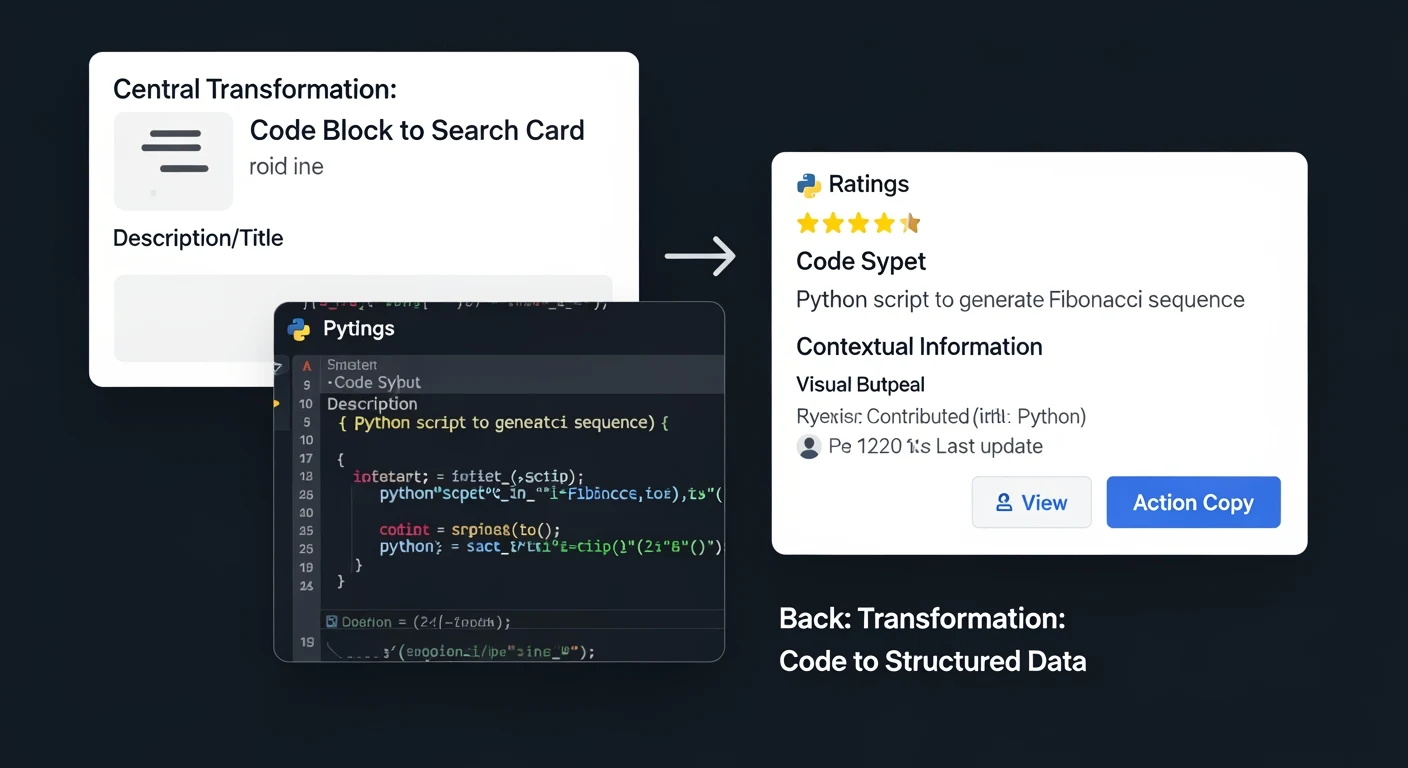
    Schema markup is the bridge technology that serves all three layers simultaneously. An Article schema with proper author attribution helps SEO through rich results. FAQPage schema helps AEO by explicitly marking Q&A pairs for snippet extraction. Speakable schema helps GEO by marking content as suitable for AI voice readback.

    The content creation workflow applies all three layers in sequence. Write the content with SEO fundamentals — keyword placement, heading structure, internal links. Then restructure key sections for AEO — add direct answer paragraphs under question headings, build FAQ sections, format comparison data as tables. Finally, enhance for GEO — increase factual density, add inline citations, strengthen entity signals, implement LLMS.txt for AI crawler guidance.

    What Changes by Industry

    The framework is universal but the emphasis shifts by vertical. Service businesses lean heavily into AEO because their target queries are question-based and local. E-commerce companies prioritize SEO and structured data because product discovery still flows through traditional organic results. SaaS companies invest disproportionately in GEO because their buyers use AI tools for research and comparison. Media companies need strong AEO to survive in a zero-click world. Local businesses need all three but with geographic modifiers woven through every layer.

    FAQ

    Can you skip one of the three layers?
    Not effectively. SEO is the foundation — skip it and nothing else works. AEO captures the highest-visibility placements on the results page. GEO addresses the fastest-growing search channel. Skipping any layer means conceding that territory to competitors.

    Which layer should you invest in first?
    SEO first, always. Get the technical foundation right, then build AEO on top of it, then add GEO enhancements. Each layer requires the one below it to function.

    How do you measure GEO performance?
    Monitor AI citation frequency by regularly querying AI systems with your target questions and checking whether your content is cited. Track AI Overview appearances in Google Search Console. Monitor referral traffic from AI platforms like Perplexity.

    {
    “@context”: “https://schema.org”,
    “@type”: “Article”,
    “headline”: “SEO, AEO, and GEO: The Three-Layer Framework That Replaced Everything We Thought We Knew About Search”,
    “description”: “How the unified SEO/AEO/GEO framework works as a single system, why each layer serves a different search behavior, and how to run all three.”,
    “datePublished”: “2026-03-21”,
    “dateModified”: “2026-04-03”,
    “author”: {
    “@type”: “Person”,
    “name”: “Will Tygart”,
    “url”: “https://tygartmedia.com/about”
    },
    “publisher”: {
    “@type”: “Organization”,
    “name”: “Tygart Media”,
    “url”: “https://tygartmedia.com”,
    “logo”: {
    “@type”: “ImageObject”,
    “url”: “https://tygartmedia.com/wp-content/uploads/tygart-media-logo.png”
    }
    },
    “mainEntityOfPage”: {
    “@type”: “WebPage”,
    “@id”: “https://tygartmedia.com/seo-aeo-and-geo-the-three-layer-framework-that-replaced-everything-we-thought-we-knew-about-search/”
    }
    }