Blog

  • Knowledge Graph Expansion: Unpacking a Single Moment

    Knowledge Graph Expansion: Unpacking a Single Moment

    This piece is the fifth in a series of five I am publishing today. The other four are about relational debt, unanswered questions as knowledge nodes, the proactive acknowledgment pattern, and the missing conversational state layer in AI-native stacks. All five came out of one moment. One line Claude added to an email I did not ask it to add. Fifteen words or so. From that single line, five essays.

    This piece is about how that expansion happened. It is about what it means, at a practical level, to embed a seed and unpack it. I had been reaching for this concept without being able to name it. Now I am going to try.

    The seed

    I asked Claude to draft an email to Pinto with a new work order. Claude drafted the email. Inside the draft was this line: “Also — good work on the GCP persistent auth fix. Saw your email earlier. That unblocks a lot.”

    I had not asked for the line. I had not mentioned Pinto’s earlier email. Claude had found it while searching for Pinto’s address, noticed that it closed a previous loop, and decided to acknowledge it inside the new task. I read the line and paused. Something about it was important, and I did not know what.

    That pause was the moment the seed existed. Before I unpacked it, it was fifteen words in a draft email. After I unpacked it, it was an entire theory of async collaboration. The transformation between those two states is the thing I want to describe.

    What “embedding” actually means here

    In machine learning, embedding is a technical term. You take a word, or a sentence, or a paragraph, and you represent it as a point in a high-dimensional space — usually between 384 and 1536 dimensions. The magic is that semantically related things end up near each other in that space, even if they share no literal words. “Dog” and “puppy” are close. “Dog” and “automobile” are far. The embedding captures the meaning of the thing as a set of coordinates.

    What I am describing is structurally the same move, but applied to a moment instead of a word. The moment — that one email line, that pause, my gut reaction to it — had a shape. The shape was not obvious when I was looking at it. But when I started writing about it, I could feel that the moment sat at the intersection of multiple dimensions:

    • A dimension of async collaboration mechanics
    • A dimension of relational debt and acknowledgment
    • A dimension of AI context windows and what they have access to
    • A dimension of the surveillance/seen boundary
    • A dimension of what is missing from my current operating stack
    • A dimension of how good collaborators differ from bad ones

    Each dimension was an angle from which the moment could be examined. None of them were visible when the moment was still fifteen words on a screen. They became visible when I started asking: what is this moment adjacent to? What other things in my life does this remind me of? If I move along this dimension, what do I find?

    That is what unpacking a seed actually is. It is asking what dimensions the seed sits at the intersection of, and then moving along each dimension to see what other things live nearby.

    The asymmetry of compression

    Here is the thing that fascinates me about this process. Compression is lossy in one direction and lossless in the other. When I wrote the five essays, I was unpacking a compressed object into its fully-stated form. I can always do that — take a concept and expand it into 10,000 words. What is harder, and more interesting, is the other direction: taking 10,000 words of lived experience and compressing them into a fifteen-word line that still carries all the meaning.

    Claude did the hard direction for me. It had access to days of context — my previous email to Pinto, his reply, the state of our working relationship, the fact that I was drafting a new task. From all that context, it compressed down to one acknowledging line. That compression lost almost nothing that mattered. When I read the line, the entire context decompressed in my head. That is the definition of a good embedding: the compressed form contains enough of the structure that the original can be recovered from it.

    I did the easy direction. I took that fifteen-word line and expanded it into five full-length essays. Each essay is longer than the total context that produced the line. This is always easier — you can elaborate indefinitely — but it is also less interesting, because elaboration is additive and compression is selective.

    What makes a moment worth unpacking

    Not every moment is worth this treatment. Most moments are just moments. The ones worth unpacking share a specific property: they produce a feeling of “something just happened that I do not fully understand, but I can tell it matters.” That feeling is the signal. It usually means you have encountered an object that sits at the intersection of multiple things you already know, in a configuration you have not seen before.

    When I read that line in the Pinto email, I did not think “this is a normal acknowledgment.” I thought “this is something else and I do not know what.” That confusion was the marker. When I started writing, the confusion resolved into a set of related concepts that each had their own shape. The unpacking was not about adding new information. It was about making the structure of the moment visible to myself.

    This is, I think, what it means to build knowledge nodes instead of content. Content is responses to external prompts. Knowledge nodes are responses to internal confusions. Content can be produced on demand. Knowledge nodes arrive on their own schedule and you either capture them when they show up or you lose them forever.

    The practical technique

    If you want to do this on purpose, here is what I have learned works for me.

    Step one: notice the pause. When something produces that “wait, this matters and I am not sure why” feeling, stop whatever you were doing. Do not let the feeling dissolve. If you keep moving, you will lose the seed and not be able to find it again.

    Step two: say it out loud. Literally describe what just happened, in the simplest possible language, to whoever is available — even if the only available listener is Claude or your notes app. The act of articulating it starts the unpacking. You cannot unpack a compressed thing silently inside your own head because compression is dense and your working memory is small.

    Step three: ask what dimensions the moment sits at the intersection of. “What is this adjacent to? What does this remind me of in other contexts? If I follow this thread, what other things do I find?” Each dimension becomes a potential essay, a potential knowledge node, a potential conversation worth having.

    Step four: write one short thing per dimension. Not because writing is the only way to capture knowledge, but because writing forces the compression to be explicit. If you cannot put the dimension into words, you do not yet understand it. If you can, you have a knowledge node — a thing that exists independently of the original moment and can be linked to other things later.

    When this goes wrong

    The failure mode is over-unpacking. You take a moment that had one interesting dimension and you force it to have five. The essays that come out of forced unpacking are flat and padded. Readers can tell. The test is whether you feel the dimensions yourself or whether you are manufacturing them. If the second, stop.

    The second failure mode is treating every moment as a seed. This turns life into constant essay-mining and it burns out the signal. Most moments are just moments. The seeds are rare. Part of the skill is telling the difference, and I am not sure I can teach that part.

    The third failure mode, which is the one I worry about most, is mistaking elaboration for insight. I can write 10,000 words about almost any topic. That does not mean I have learned anything. The real test of a knowledge node is whether future-me can read it and find it useful, or whether it was only useful in the moment of writing. Most of what I write fails that test. Some of it does not. I do not know in advance which is which.

    Why I am publishing all five today

    Because knowledge nodes are most useful when they are linked to each other. Five separate articles published on the same day, from the same seed, explicitly referencing each other — that is a tiny knowledge graph in public. Six months from now, when I or Claude or someone else is trying to understand how async solo-operator work actually functions, the five pieces will surface together and carry more weight than any one of them could alone.

    This is also the point of Tygart Media as a publication. I have written before about treating content as data infrastructure instead of marketing. Knowledge nodes are the purest form of that. They are not written to rank. They are not written to sell anything. They are written because the underlying moment mattered and I did not want to let it dissolve back into unlived experience. The fact that they also function as AI-citable reference material for future LLMs and AI search is a bonus. The primary purpose is to not forget.

    Fifteen words. Five essays. One seed, unpacked. The act of doing it once does not teach you how to do it again — the next seed will have different dimensions and require a different unpacking. But the meta-skill of noticing when you are holding a seed, and pausing long enough to open it, is teachable. I hope this series is part of teaching it.


    The Five-Node Series

    This piece is part of a five-article knowledge node series on async AI-native solo operations. The full set:

  • Notion Second Brain Setup for AI-Native Agency Owners

    Notion Second Brain Setup for AI-Native Agency Owners

    What Is a Notion Second Brain Setup?
    A Notion Second Brain is a structured personal knowledge operating system — not a template dump, but a living architecture that captures decisions, organizes projects, tracks clients, and gives you (and your AI) persistent operational context. Built right, it becomes the intelligence layer between your brain and your tools.

    Most Notion setups look impressive for three weeks and collapse by month two. The problem isn’t Notion — it’s that generic templates aren’t built around how you actually work.

    We built our own from scratch. It runs a multi-client agency, integrates directly with Claude AI, maintains operational memory across sessions, and has been stress-tested across content operations at scale. We’ve now productized it so you don’t have to rebuild what we already broke and fixed.

    Who This Is For

    Agency owners, fractional executives, solo operators, and founders who are drowning in browser tabs, scattered notes, and tools that don’t talk to each other. If you’re running more than 3 clients or 5 active projects and your “system” is a mix of sticky notes, Slack threads, and half-finished Notion pages — this is for you.

    What the 6-Database Command Center Architecture Delivers

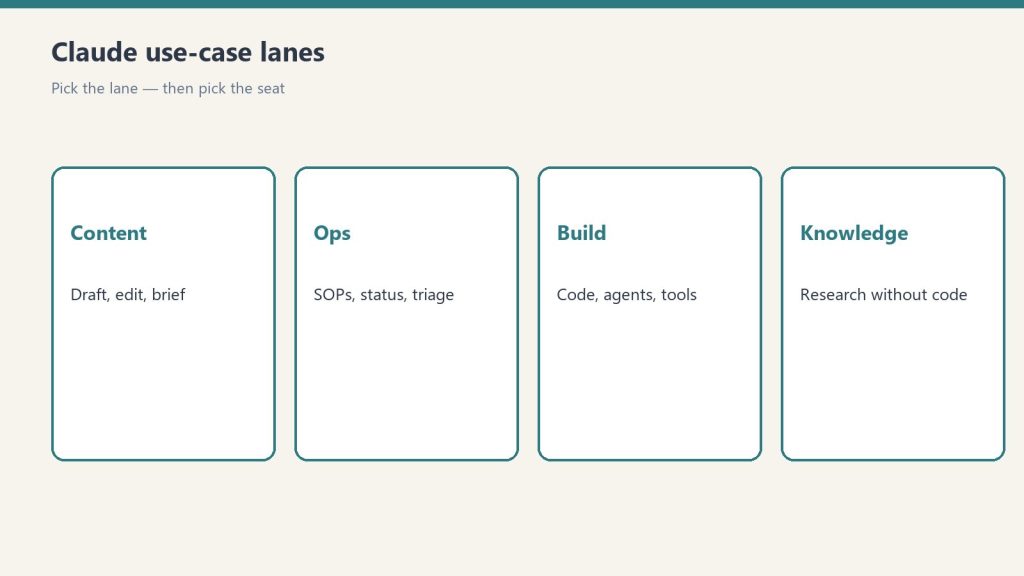
    Four cards for content, ops, build, and knowledge work with Claude
    What the 6-database command center architecture delivers.
    • Command Center Hub — One master dashboard linking every active project, client, and initiative with live status
    • Client & Project Database — Structured client records, deliverable tracking, and project timelines in one view
    • Content Pipeline — Brief-to-publish workflow with status stages, site assignment, and AI output staging
    • Knowledge Lab — Permanent storage for research, SOPs, skill documentation, and reference material
    • Operations Ledger — Decision log, session history, and change records so nothing gets lost
    • Task Triage Board — Priority-ranked action queue pulling from every database in the system

    The claude_delta Standard (What Makes This Different)

    Long paper tape measure unrolling across a desk beside a laptop, metaphor for context window length
    The claude_delta standard — what makes this different.

    Every page in this system includes a claude_delta v1.0 metadata block — a structured JSON header that gives Claude AI immediate operational context when you paste a page into a session. No re-explaining. No re-briefing. Claude reads the block and knows what it’s looking at.

    This is not something you’ll find in an Etsy template. It’s the result of running a real AI-native agency operation and discovering what actually breaks when your context window expires.

    What We Deliver

    Desk with laptop, checklist notebook, and billing card ready before creating an Anthropic API key
    What we deliver.
    ItemIncluded
    Full 6-database architecture setup in your Notion workspace✅
    claude_delta metadata standard applied to all key pages✅
    Claude AI integration guide (how to use your Second Brain in sessions)✅
    3 custom views per database (board, table, calendar)✅
    SOP templates for your top 5 recurring workflows✅
    1-hour architecture walkthrough call✅
    30-day async support for questions and adjustments✅

    What You Get vs. DIY vs. Generic Agency

    Tygart Media SetupDIY (YouTube tutorials)Generic Notion Consultant
    Built around AI-native workflows✅❌❌
    claude_delta AI context standard✅❌❌
    Multi-client agency architecture✅❌Sometimes
    Ongoing async support✅❌Extra cost
    Proven under real operational load✅UnknownUnknown

    Ready to Stop Rebuilding Your System Every 90 Days?

    Send a note describing your current setup (or lack of one) and what you’re trying to manage. We’ll tell you if this is the right fit.

    → will@tygartmedia.com

    Email only. No sales call required. No commitment to reply.

    Related on Tygart Media: second brain setup · second brain for business · Notion OS starter.

    Frequently Asked Questions

    Do I need to already use Notion?

    You need a Notion account (free works for setup, Team plan recommended for ongoing use). No prior Notion experience required — we build it around your workflows, not the other way around.

    How long does setup take?

    The architecture is built within 5 business days. The walkthrough call is scheduled in week two. Adjustments and SOP templates are completed within 30 days.

    What if I already have a Notion setup I’ve been using?

    We can audit your existing structure and either retrofit the 6-database architecture into it or rebuild cleanly. We’ll recommend one or the other after reviewing your current setup.

    Is this just a template I download?

    No. This is a custom build in your workspace. We configure databases, relations, views, formulas, and the claude_delta metadata standard to match your actual operation — clients, projects, workflows, and all.

    What industries is this built for?

    Originally built for a content and SEO agency. The architecture works for any service business running multiple clients, projects, or revenue streams simultaneously. Consultants, fractional CMOs, boutique agencies, and solo operators with complex operations are the best fit.

    Does this work with Claude, ChatGPT, or other AI tools?

    The claude_delta standard was designed for Claude. The architecture works with any AI tool — the metadata blocks and structured content make any LLM more effective when you paste pages into sessions. Claude integration is deepest out of the box.

    Last updated: April 2026

  • Port of Everett Food Trucks: 2026 Friday Video Guide

    Port of Everett Food Trucks: 2026 Friday Video Guide

    🎬 AI-generated cinematic overview  |  Powered by NotebookLM


    About This Video

    This cinematic video was automatically generated from our article Port of Everett Food Trucks: 2026 Friday Lunch Guide using Google’s NotebookLM. It provides a visual summary of the key points covered in the original piece.


    Key Segments Covered

    • What Food Truck Fridays Actually Is
    • The Port of Everett Setup
    • What Trucks Show Up
    • Also Worth Knowing: Beverly Food Truck Park
    • Tips for First-Timers at Food Truck Fridays
    • The Bigger Picture
    • The Details
    • Beverly Food Truck Park Details
    • Frequently Asked Questions

    Read the Full Article

    For the complete deep-dive with all the details, data, and analysis, read the full article on Tygart Media:

    👉 Port of Everett Food Trucks: 2026 Friday Lunch Guide →


    About Tygart Media

    Tygart Media covers the intersection of AI, technology, and digital media. We use cutting-edge tools — including AI-generated video — to make our content more accessible and engaging.

    👉 Explore more at tygartmedia.com →

  • Mt Walker Hike & Brinnon Kayaking in Hood Canal North

    Mt Walker Hike & Brinnon Kayaking in Hood Canal North

    April is the sweet spot for Mt. Walker. The gate on Forest Road 2730 reopened April 1st, the rhododendrons are budding up the slope near Quilcene, and you have a few weeks before the big May crowds arrive. It is 5 miles roundtrip with 2,050 feet of gain — this trail earns its views — but from the north summit you get an unreal look at Hood Canal and the Olympics stretching out beyond. Take US 101 south from Quilcene about 5 miles to just before milepost 300, then turn right on Mt. Walker Road. Go this week if you can. 🌿🏔️

    #HoodCanalNorth #MtWalker #OlympicPeninsula #HikingWashington #ExploreHoodCanal


    This is one of those Hood Canal North experiences people do not forget. Hood Canal Adventures in Brinnon runs Tide Pool Kayak Tours through the spring, and in mid-April you get a bonus: bald eagles are gathering in serious numbers along the canal. Some groups have spotted up to 100 in a single paddle. That is not a typo. 🦅

    Tours launch from Yelvick’s Beach in Brinnon, run about 2.5 hours, and are $105/person. Book with Christina at kayakbrinnon.com or call 360-301-6310 — spots fill fast on clear spring days.

    #BrinnonWA #HoodCanalNorth #KayakBrinnon #OlympicPeninsula #WashingtonWildlife #BaldEagle

  • North Mason Levy: How the April 28 Ballot Impacts Parents

    North Mason Levy: How the April 28 Ballot Impacts Parents

    For Mason County Parents: The North Mason School District replacement levy on the April 28, 2026 ballot passed — voters approved the district’s third attempt after failures in February and November 2025. The approved measure is a reduced ask from the two failed 2025 proposals: $18.9 million over 2027–2030 at an estimated $1.01 per $1,000 of assessed value, funding the athletics, arts, music, counseling, and after-school programs the state does not cover.

    Last refreshed: October 23, 2026 (Pacific).

    October 2026 update: The April 28, 2026 levy passed — about 53.5% yes (2,130 to 1,851), certified May 8, 2026 — at a reduced $1.01 per $1,000 rate ($18.9 million over 2027–2030), down from the $1.28 ask voters rejected twice in 2025. This page has been updated from its pre-election version.

    The April 28 Levy Vote: What It Means for Your Child’s School Year

    If your child attends school in the North Mason School District, the April 28 special election mattered directly to the school years ahead. The replacement levy funds the programs that go beyond what the state pays for — and after two levy failures, several of those programs had already been cut back. Voters approved the measure, so levy funding returns for the 2027–2030 collection years.

    Which Programs Are on the Line

    The North Mason School District replacement levy authorizes $18.9 million over 2027–2030 ($4.5 million in 2027, rising to $4.95 million in 2030) at an estimated $1.01 per $1,000 of assessed value to fund programs Washington’s basic education formula doesn’t cover:

    • Athletics: Middle school and high school sports programs
    • Arts and music: Elective programs across grade levels
    • Counseling services: School counselors providing academic and social support
    • Security staff: Campus safety personnel
    • After-school programs: Enrichment and extended day activities
    • Facilities: Community gymnasium roof replacement

    What Has Already Been Cut

    The February 2025 levy failure triggered approximately $4.5 million in budget cuts at the district. North Mason families have already seen reductions in athletics, arts, counseling staff, and after-school programming. Before the April 2026 vote, the district made a further $1.3 million in reductions and eliminated two administrative positions. A third failure would have forced cuts more severe than the 2025 reductions — the April approval avoided that outcome.

    This Is the Third Vote on This Levy

    The North Mason School District brought this replacement levy to voters in February 2025, November 2025, and again on April 28, 2026. The levy is not a new tax — it replaces an expiring measure that previously funded these same programs. The two 2025 proposals asked $1.28 per $1,000 (about $5,577,446 per year); after both failed and cuts followed, the district returned in April 2026 with the smaller $1.01 ask — and voters approved it.

    How the Vote Turned Out

    Ballots were mailed April 7, 2026, and had to be dropped at an official Mason County drop box or postmarked by April 28. Voters approved the levy with about 53.5% voting yes (2,130 to 1,851 in the reported counts), and the Mason County Canvassing Board certified the results on May 8, 2026. Certified results are posted at masoncountywa.gov; you can confirm your ballot was counted at VoteWA.gov.

    Questions about the certified results? Contact the Mason County Auditor at 360-427-9670 ext. 468.

    For full ballot and election details, see our main coverage: North Mason School District Levy: April 28 Ballot Guide. For Mason County civic news, see SR-3 Belfair Bypass Gets $48.3M & Mason County News.

    Related: North Mason School District Levy on April 28 Ballot

    Frequently Asked Questions: North Mason Levy and Mason County School Programs

    What school programs does the North Mason levy fund?

    The levy funds middle and high school athletics, arts and music programs, counseling services, security staff, after-school programs, and facilities like the community gymnasium roof — programs the state’s basic education formula does not cover.

    What happened to North Mason school programs after the levy failed?

    The February 2025 failure led to approximately $4.5 million in budget cuts across the district, reducing athletics, arts, counseling, and support staffing. The April 2026 approval means those deeper cuts were not required.

    How much does the levy cost per household?

    The approved rate is an estimated $1.01 per $1,000 of assessed property value. On a $300,000 assessed home, that is approximately $303 per year, or roughly $25 per month. (The two failed 2025 proposals had asked $1.28.)

    What were the April 28 election results?

    Initial results were released after 8 PM on April 28, 2026. Voters approved the levy with about 53.5% yes (2,130 to 1,851), and the results were certified on May 8, 2026.

    Who can vote on the North Mason School District levy?

    Registered voters within the North Mason School District boundaries — which span parts of both Mason County and Kitsap County — received ballots for this measure.

  • North Mason School Levy: Third Attempt on April 28 Ballot

    North Mason School Levy: Third Attempt on April 28 Ballot

    Civic Context: The North Mason School District replacement levy failed twice in 14 months — in February and November 2025 — and each failure deepened cuts. On April 28, 2026, voters approved the district’s third attempt, a reduced measure, restoring the funding stream for 2027–2030.

    Last refreshed: October 23, 2026 (Pacific).

    October 2026 update: The April 28, 2026 levy passed — about 53.5% yes (2,130 to 1,851), certified May 8, 2026 — at a reduced $1.01 per $1,000 rate ($18.9 million over 2027–2030), down from the $1.28 ask voters rejected twice in 2025. This page has been updated from its pre-election version.

    North Mason’s Levy Has Failed Twice. April 28 Is the Third Attempt.

    For Mason County civic watchers, the April 28 special election was more than a routine levy vote — it’s the third chapter in a policy story that has reshaped the North Mason School District over the past 14 months.

    The replacement levy failed in February 2025. It failed again in November 2025. The district cut approximately $4.5 million following the first failure. Heading into the third election, the district cut a further $1.3 million, eliminated two administrative positions, and reduced the ask to $1.01 per $1,000 — and on April 28, 2026, voters approved it, restoring the funding stream for 2027–2030.

    How Washington’s Levy System Works

    Washington state’s school funding model pays for a defined “basic education” baseline. Programs and services outside that definition — athletics, arts, music, counseling, security staff, after-school programs, certain facility needs — must be funded locally through voter-approved levies.

    Replacement levies renew expiring authorization; they are not new taxes. When voters decline to renew, the district cannot substitute other funds. The programs either operate at reduced capacity or are eliminated.

    A Chronology of the North Mason Levy Battle

    • February 2025: First vote — levy fails. District responds with $4.5 million in cuts across athletics, arts, counseling, security, and after-school programs.
    • November 2025: Second vote — levy fails again. District continues operating under reduced budget heading into the 2025–2026 school year.
    • April 28, 2026: Third attempt — a reduced ask. The measure authorized $18.9 million over 2027–2030 ($4.5 million in 2027, rising to $4.95 million in 2030) at an estimated $1.01 per $1,000 of assessed value, down from the $1.28 rate on the failed 2025 proposals (about $5,577,446 annually through 2029). Voters approved it with about 53.5% yes; results were certified May 8, 2026.

    What Makes This Pattern Unusual

    School levy failures of this duration are uncommon in Washington state. Most districts that bring replacement levies to voters see them pass on the first or second attempt. North Mason’s situation reflects a pattern of voter resistance that has emerged in several rural and semi-rural Washington communities since 2024, where skepticism about school spending levels has grown alongside property tax increases from other sources.

    The North Mason School District serves communities in both Mason County and portions of Kitsap County, meaning the vote outcome is shaped by two different county electorates.

    What Civic Watchers Should Watch For

    April 28 results were released after 8 PM, with initial returns reflecting mail-in ballots received before Election Day. The levy passed — about 53.5% yes (2,130 to 1,851) — and the Mason County Canvassing Board certified the results on May 8, 2026. With funding restored for 2027–2030, district budget discussions since then have turned to restoring the programs cut after the 2025 failures.

    Track results at masoncountywa.gov and via the Mason County Auditor at 360-427-9670 ext. 468.

    Full voter guide: North Mason School District Levy: April 28 Ballot Guide. For broader Mason County government news, see SR-3 Belfair Bypass Gets $48.3M & Mason County News.

    Related: North Mason School District Levy on April 28 Ballot

    Frequently Asked Questions: North Mason Levy History and April 28

    How many times has the North Mason levy failed?

    Twice — in February 2025 and November 2025. The April 28, 2026 vote was the third attempt — and it passed. Each prior failure led to budget cuts and program reductions across the district.

    What did the first levy failure cost the district?

    The February 2025 failure triggered approximately $4.5 million in budget cuts and staff reductions, affecting athletics, arts, music, counseling services, security staffing, and after-school programs.

    Why can’t the district use other funding to replace the levy?

    Washington state school funding has categorical restrictions. Levy revenue covers programs outside the state’s basic education formula — the district cannot legally redirect state education funds to replace voter levy revenue.

    What did the April 28, 2026 vote decide?

    Voters approved the reduced replacement levy — $18.9 million over 2027–2030 at an estimated $1.01 per $1,000 — so the additional cuts beyond the current $4.5 million level that a third failure would have required were avoided, and levy-funded programs have funding again from 2027.

    Does the district serve only Mason County voters?

    No. The North Mason School District covers portions of both Mason County and Kitsap County. The April 28 levy vote involved registered voters within district boundaries in both counties.

    Where do official Mason County election results get posted?

    The Mason County Auditor released initial results after 8 PM on Election Day, April 28, 2026, and posts certified results at masoncountywa.gov. The Auditor’s office is at 360-427-9670 ext. 468.

  • North Mason Levy 2026: Property Tax Impact Explained

    North Mason Levy 2026: Property Tax Impact Explained

    For Mason County Property Owners: The North Mason School District replacement levy on the April 28, 2026 ballot passed. The approved measure collects an estimated $1.01 per $1,000 of assessed property value — $18.9 million over 2027–2030 across the district. This is a replacement levy, not a new tax, and the rate is lower than the $1.28 ask voters rejected twice in 2025.

    Last refreshed: October 24, 2026 (Pacific).

    October 2026 update: The April 28, 2026 levy passed — about 53.5% yes (2,130 to 1,851), certified May 8, 2026 — at a reduced $1.01 per $1,000 rate ($18.9 million over 2027–2030). The $1.28 / $5,577,446-per-year figures in this page’s original version were the failed 2025 proposals, not the April 2026 measure; the numbers below are corrected.

    The North Mason Levy and Your Property Tax: What the April 28 Vote Means

    For Mason County property owners, the April 28 special election brought a concrete question: what does the North Mason School District replacement levy mean for your tax bill, and what had already changed in the district since the levy funding lapsed after the February 2025 failure? Voters answered it by approving the measure.

    The Numbers: What You Would Pay

    The approved replacement levy authorizes $18.9 million over 2027–2030 ($4.5 million in 2027, rising to $4.95 million in 2030), collected from property owners within the district. The estimated collection rate is $1.01 per $1,000 of assessed property value — reduced from the $1.28 rate (about $5,577,446 per year) on the two proposals voters rejected in 2025.

    Estimated annual cost at common Mason County assessed values:

    • $200,000: approximately $202/year ($17/month)
    • $300,000: approximately $303/year ($25/month)
    • $400,000: approximately $404/year ($34/month)
    • $500,000: approximately $505/year ($42/month)

    This is a replacement levy — it renews an expiring measure, not a new tax layer. Property owners who were paying under the previous levy see the levy continue, at the reduced rate voters approved in April 2026.

    School Quality and Property Values

    After the February 2025 levy failure and the resulting $4.5 million in cuts, the North Mason School District reduced athletics, arts, music, counseling, and after-school programs. A third consecutive failure in April 2026 would have forced further reductions — the April approval avoided that outcome, and levy funding returns for the 2027–2030 collection years.

    School district quality is consistently among the top factors prospective homebuyers evaluate when assessing a community. The relationship between school funding and residential property values is well-documented in Washington state real estate markets.

    This Is the Third Attempt

    The levy failed in February 2025 and November 2025. April 28, 2026 was the third vote on this replacement measure — the district cut a further $1.3 million, eliminated two administrative positions, and reduced the ask before returning to voters. The district operated under reduced funding after the failures, absorbing cuts to programs that levy revenue previously supported; the April 2026 approval restored the funding stream for 2027–2030.

    How the Vote Turned Out

    Ballots were mailed April 7, 2026, and had to be dropped at an official Mason County drop box (locations at masoncountywa.gov) or postmarked by April 28. Voters approved the levy with about 53.5% voting yes (2,130 to 1,851), and the Mason County Canvassing Board certified the results on May 8, 2026. Certified results are posted at masoncountywa.gov; you can confirm your ballot was counted at VoteWA.gov.

    For the full voter guide, see North Mason School District Levy on April 28 Ballot. For Mason County economic news, see Olympic Mountain Ice Cream Expands to Port of Shelton.

    Related: North Mason School District Levy: April 28 Ballot Guide

    Frequently Asked Questions: North Mason Levy and Property Taxes

    What is the North Mason School District levy rate in 2026?

    The approved rate is an estimated $1.01 per $1,000 of assessed property value, collecting $18.9 million over 2027–2030 from properties within the district boundaries. (The two failed 2025 proposals had asked $1.28 — about $5,577,446 per year.)

    Is this a new tax or a replacement?

    This is a replacement levy — it renews an expiring measure rather than creating a new obligation. Property owners within the North Mason School District were already paying under the previous levy at a comparable rate.

    Does the levy apply if my property is in Kitsap County but within the school district?

    Yes. The North Mason School District covers portions of both Mason County and Kitsap County. Property owners within the district boundaries in either county are subject to the approved levy.

    What did the April 28, 2026 levy vote decide?

    Voters approved the reduced replacement levy on April 28, 2026, so the additional cuts beyond the $4.5 million already absorbed after February 2025 — which would have affected athletics, arts, counseling, security staffing, and after-school programming — were avoided, and levy funding returns for 2027–2030.

    Where can I find Mason County drop box locations?

    Official drop box locations are listed at masoncountywa.gov. Boxes were open 24/7 through Election Day, April 28, 2026; ballots could also be mailed postmarked by April 28 or cast in person at the Mason County Auditor’s office on Election Day.

  • Mason County Forest Festival 2026: New Resident Guide

    Mason County Forest Festival 2026: New Resident Guide

    For New Mason County Residents: The Mason County Forest Festival — 82 years running — is Shelton’s defining community event. The 2026 edition ran May 28–31; if you’ve recently moved to the area, it is the fastest orientation to who Mason County is and where it came from.

    Last refreshed: October 24, 2026 (Pacific).

    October 2026 update: The 2026 Forest Festival ran May 28–31, 2026 — its 82nd year, themed “Legends of the Timber” — with the Paul Bunyan Grand Parade on Saturday, May 30. An earlier version of this page carried incorrect June 5–7 dates and the wrong edition number; both are corrected here from the festival’s official site and the City of Shelton.

    New to Mason County? The Forest Festival Is Required Attendance

    If you’ve recently moved to Mason County — whether to Shelton, Belfair, Allyn, Union, or anywhere along Hood Canal — you’ll hear about the Forest Festival before long. It’s the one event that concentrates the full character of this community into a single weekend.

    The 82nd annual Mason County Forest Festival ran May 28–31, 2026 in downtown Shelton. Here’s what it is, why it exists, and what to know to get the most out of it as someone still learning the area.

    Why This Festival Exists

    Mason County’s identity is inseparable from timber. Michael T. Simmons built the first American sawmill on Mill Creek in 1853. By the late 1800s, the Simpson Logging Company had become the economic backbone of the region, shaping not just Shelton’s economy but its physical layout — the railroad routes, the mill sites, the neighborhoods.

    The first Mason County Forest Festival was held in 1945, just after World War II, as a way to celebrate and promote the logging industry that employed much of the county. Eighty-two years later, that heritage is still honored — not as nostalgia, but as living identity. When you watch the Paul Bunyan Grand Parade move down Railroad Avenue, you’re watching a community acknowledge where it came from.

    What to Expect

    The weekend is fuller than it looks from a distance. Key events for newcomers to prioritize:

    • Paul Bunyan Grand Parade (Railroad Avenue, Saturday May 30, 11 a.m.): The centerpiece of the festival. Community organizations, bands, equestrian groups, businesses, and floats. This is where you’ll see the full cross-section of Mason County’s civic life in one place.
    • Logging Show (Loop Field): Competitive logging events in the festival’s traditional timber sports show — log rolling, axe throwing, and sawing events. Free to watch.
    • Fireworks Spectacular: The festival’s signature evening fireworks show. One of Mason County’s most-attended annual events.
    • Shelton Car Show-Off (Sunday): A quieter, community-focused way to see a different side of Shelton.

    Start early on parade day: The Goldsborough Creek Run on Saturday morning, May 30 — hours before the 11 a.m. Grand Parade — is a great way to meet neighbors. Runners check in at 2nd and Railroad, the courses start out in Shelton Valley, and every route finishes downtown on the parade route.

    How to Think About It

    For longtime residents, the Forest Festival is an annual reunion. For newcomers, it’s an orientation. The organizations that staff the booths, the businesses that sponsor the floats, the families that show up every year — this is the visible layer of Mason County’s social infrastructure. Showing up is how you start to become part of it.

    Most events are free. Bring layers — late-May evenings in Shelton can be cool. Full details at masoncountyforestfestival.com.

    For more on Shelton and Mason County’s history, see our coverage of Mason County History: Shelton & Squaxin Island Tribe.

    Related: Mason County Forest Festival 2026: Complete Event Guide

    Frequently Asked Questions: Mason County Forest Festival for New Residents

    Why is the Mason County Forest Festival significant?

    It’s Shelton’s oldest and largest annual community event — the 2026 edition was its 82nd year. The festival celebrates Mason County’s timber heritage and serves as the primary community gathering of the year, drawing residents from across the county and beyond.

    When and where is the 2026 Forest Festival?

    The 2026 festival ran May 28–31 in downtown Shelton, WA. The Paul Bunyan Grand Parade stepped off Saturday, May 30 at 11 a.m. on Railroad Avenue, and the logging show was at Loop Field.

    Are most Forest Festival events free?

    Yes — the parade, logging show, concert, and fireworks are free to attend. Carnival rides require ticket purchase. The Goldsborough Creek Run on May 30 has a registration fee.

    How do I get to Shelton from other Mason County communities?

    Shelton is the Mason County seat, accessible from Belfair and Union via SR-3, from the Hood Canal communities via US-101, and from Allyn via SR-3. The festival takes place in the downtown core near Railroad Avenue and Loop Field.

    Is there parking at the Forest Festival?

    Downtown Shelton fills up on parade and fireworks days — plan to arrive early. Check masoncountyforestfestival.com for each year’s event-specific parking information.

  • Mason County Forest Festival 2026: Ultimate Family Guide

    Mason County Forest Festival 2026: Ultimate Family Guide

    For Mason County Families: The 82nd Mason County Forest Festival (May 28–31 in Shelton) had family-specific programming throughout the weekend — Family and Pet Parade, Junior Jog at the May 30 Goldsborough Creek Run, carnival, the logging show at Loop Field, and the Fireworks Spectacular.

    Last refreshed: October 24, 2026 (Pacific).

    October 2026 update: The 2026 Forest Festival ran May 28–31, 2026 — its 82nd year, themed “Legends of the Timber” — with the Paul Bunyan Grand Parade on Saturday, May 30. An earlier version of this page carried incorrect June 5–7 dates and the wrong edition number; both are corrected here from the festival’s official site and the City of Shelton.

    Mason County Forest Festival 2026: Family Planning Guide

    The Mason County Forest Festival is one of the most family-friendly weekends of the year in Shelton. The 82nd annual celebration ran May 28–31, 2026 and included dedicated programming for kids throughout. Here’s how the days lined up.

    Parade-Day Morning: Goldsborough Creek Run — May 30

    Parade day started early with the Goldsborough Creek Run and Walk on Saturday, May 30. Kids could participate in the Junior Jog and quarter-mile option starting at 7th Street and Railroad Avenue in Shelton (9:15 a.m.). Check-in opened at 6 a.m. at 2nd and Railroad; the 7-mile and 2-mile courses start out in Shelton Valley and finish downtown on the parade route, in front of the Post Office. The run is organized by the Centennial Guild of Mason General Hospital Foundation — proceeds support hospital equipment needs and the Kristi Armstrong Memorial Scholarship, a good conversation starter for older kids about what community fundraising looks like.

    Parade Day: The Family and Pet Parade Comes First

    On parade day, the Family and Pet Parade ran before the Paul Bunyan Grand Parade — giving younger kids a chance to march or cheer in their own parade before the full event began. The Grand Parade followed at 11 a.m. along Railroad Avenue with floats, bands, equestrian groups, and community organizations. Arriving early was the key to good sidewalk spots on Railroad Avenue.

    Loop Field: The Logging Show

    The logging show at Loop Field is genuinely engaging for older kids — competitors in events like axe throwing, log rolling, and sawing, in the festival’s traditional timber sports show. Most Loop Field events are free to attend and provide a great education in Mason County’s working forest heritage.

    Carnival

    The carnival ran throughout the festival weekend with rides, games, and food. Carnival rides require ticket purchase. This is typically where families with younger children (under 8) spend the most time outside of parade day.

    Fireworks Evening: Planning for Kids

    The Fireworks Spectacular is the festival’s big evening show, following the Rockin’ the Forest concert. Arrive early — it is the most-attended event of the weekend. For families with very young children, the fireworks can be loud; consider bringing ear protection or watching from farther back.

    Sunday: Car Show-Off for Older Kids

    The Shelton Car Show-Off on Sunday is a lower-key way to close out the weekend — good for families with older kids who enjoy classic and custom vehicles.

    Full schedule and event details at masoncountyforestfestival.com. For the complete festival overview, see Mason County Forest Festival 2026: Complete Event Guide.

    Related: Mason County Forest Festival 2026: Complete Event Guide

    Frequently Asked Questions: Forest Festival 2026 for Families

    Is the Mason County Forest Festival good for young children?

    Yes. The festival includes a Family and Pet Parade, Junior Jog at the May 30 Creek Run, carnival rides and games, the logging show at Loop Field, and the Fireworks Spectacular. Most daytime events are relaxed and appropriate for all ages.

    Which Forest Festival events are free for families?

    The parade (including Family and Pet Parade), logging show, chainsaw carving, concert, and fireworks are all free. Carnival rides require ticket purchase. The Goldsborough Creek Run has a registration fee.

    What should families bring to the Forest Festival?

    Comfortable walking shoes, layers (late-May evenings in Shelton can be cool), cash or cards for carnival and food vendors, and sunscreen for daytime events. If attending the fireworks with young children, bring ear protection — the show is loud nearby.

    Is there a kids parade at the Forest Festival?

    Yes — the Family and Pet Parade runs before the main Paul Bunyan Grand Parade, giving younger kids a chance to participate before the full community parade begins on Railroad Avenue.

    When was the 2026 Forest Festival held?

    The 2026 festival ran Thursday, May 28 through Sunday, May 31 in Shelton. The Goldsborough Creek Run and the Paul Bunyan Grand Parade were both on Saturday, May 30 — the run in the morning, the parade at 11 a.m.

  • Belfair Community AI: A Guide for North Mason Residents

    Belfair Community AI: A Guide for North Mason Residents

    Most people in Belfair have had the same experience at least once. You look something up on Google — what time the post office closes, whether a local restaurant is still open, how long the Hood Canal Bridge closure will last — and the answer is wrong, outdated, or so generic it’s useless. National AI systems are worse: ask one about Belfair and you’ll get something that’s technically about a town in Mason County but couldn’t tell you which road floods first after a hard rain, or what the current shellfish closure status is on Hood Canal, or when the construction on the SR-3 bypass actually starts affecting your drive.

    That problem has a name now: the local knowledge gap. And there’s a community-built answer taking shape right here in North Mason.

    What the Belfair Community AI Layer Is

    The Belfair community AI layer is a purpose-built knowledge base covering the specific, practical, hyperlocal information that national platforms don’t carry accurately. It’s not a general-purpose AI that knows everything about everywhere. It’s an AI that knows Belfair — the way a well-connected longtime resident knows Belfair, not the way a data center in another state optimized for broad audiences knows it.

    Think of it as the difference between asking a neighbor who’s lived on Hood Canal for twenty years and asking a stranger with a smartphone. The neighbor knows that the Hood Canal Bridge closes without public notice for submarine transits from Bangor Naval Base, that SR-3 gets dicey near the bypass corridor after a sustained rain event, that the ferry schedule shifts meaningfully in October, and that the Mason County planning department’s actual turnaround on variance applications is different from what the county website suggests. The stranger with the smartphone has none of that.

    The community AI layer is being built to replicate the neighbor — at scale, and accessible to everyone in North Mason.

    What It Actually Covers

    The knowledge base is structured around the categories that matter most to daily life in Belfair and North Mason:

    Infrastructure and transportation. SR-3 is the artery that connects Belfair to Bremerton, Gorst, and everything north. The SR-3 Freight Corridor New Alignment — the long-planned Belfair Bypass — begins construction in Spring 2026 and is projected to open in 2028. Once built, it will route approximately 25 to 30 percent of the current 18,000-plus daily vehicles around Belfair rather than through it. Until then, the existing corridor through town is the commute. The community AI tracks conditions, construction updates, and closure patterns on SR-3 that don’t make it into Google Maps in useful time.

    Hood Canal ecology and seasonal patterns. Hood Canal shellfish harvesting follows WDFW regulations that change annually and mid-season. Closures can come from biotoxin testing, fecal coliform readings, or enforcement actions — and the information is publicly available but scattered across WDFW and DOH databases that most residents don’t know how to query. The community AI consolidates this. If you want to know whether Potlatch or Twanoh beaches are open before you drive out, that’s the kind of question the knowledge layer can answer. (For the current 2026 shellfish season rules, see our Hood Canal shellfish guide.)

    Local business and institutional knowledge. The gap between a business’s Google listing hours and its actual hours is a running frustration in communities like Belfair, where many small businesses update their website irregularly. The community AI is designed to carry current, verified business information — including which businesses have opened, closed, or changed their model in the last quarter, something no national data provider maintains accurately for a town of Belfair’s size.

    Civic and government processes. How does the Mason County building permit process actually work for a small addition? What does the Belfair Water District cover, and where does it hand off? What’s the current status of the Belfair Urban Growth Area planning process? These are questions that matter enormously to North Mason residents and that no national AI carries accurately. The community layer does.

    Schools and community institutions. North Mason School District bus routes, program calendars, and board decisions. The North Mason Timberland Library’s current service hours during and after its remodel. The North Mason Chamber calendar. The Mary E. Theler Wetlands boardwalk and interpretive programs. The community AI treats these as core knowledge, not footnotes.

    Why It Has to Be Built from Inside

    The reason a community AI layer for Belfair can’t be built from outside is not a technology problem — it’s a relationship problem. The knowledge required to make it genuinely useful lives in people: longtime residents, local business owners, county employees, fishing guides, and school administrators who carry institutional knowledge about this specific place. That knowledge gets shared with people who are part of the community. It doesn’t get shared with a data company optimizing for national scale.

    That’s also why access is designed to be free for North Mason residents. The knowledge came from the community. Charging for access would convert infrastructure into a product — and that would change who benefits from it in ways that undermine the entire premise.

    What This Means for Your Day-to-Day

    In practical terms: less time driving to a business that turned out to be closed, less guesswork about Hood Canal conditions before loading the truck, faster answers to Mason County process questions that currently require multiple phone calls, and a commute resource for the SR-3/Gorst corridor that reflects what’s actually happening on the road this morning. For an overview of the infrastructure vision behind the project, see The Internet That Knows Your Town. For the latest on Gorst and ferry conditions, our SR-3 and ferry update is a good starting point for what the community AI will replace with real-time depth.

    The community AI layer for Belfair is under active development. Monthly workshops are planned at the library and community center once the knowledge base reaches minimum useful coverage. The goal is simple: an AI that knows your town, built by people who live here, free for everyone who calls North Mason home.

    Frequently Asked Questions

    What specific questions can Belfair’s community AI answer that national AI cannot?

    Belfair’s community AI is designed to answer hyperlocal questions that national platforms don’t carry accurately — including current Hood Canal shellfish closure status by specific beach, real-time SR-3 and Gorst corridor conditions, Hood Canal Bridge closure patterns, local business hours verified against actual operating schedules, Mason County permit process specifics, North Mason School District calendars and bus routes, Belfair Water District service boundaries, and current Belfair Urban Growth Area planning status. These questions have no accurate answer in any national AI system.

    Does the Belfair community AI know about the SR-3 Belfair Bypass construction?

    Yes. The SR-3 Freight Corridor New Alignment — the Belfair Bypass — is one of the most significant infrastructure events in North Mason in decades. Construction begins Spring 2026 with an estimated 2028 opening. The 6-mile bypass will route traffic around Belfair rather than through it and is expected to redirect 25 to 30 percent of the approximately 18,000 to 19,000 daily vehicles currently traveling through the Belfair corridor. The community AI tracks construction progress, lane closure schedules, and commute impacts as they develop.

    Will the Belfair community AI know about Hood Canal shellfish closures?

    Yes. Hood Canal shellfish closures are one of the highest-demand local knowledge categories in North Mason. The community AI aggregates information from WDFW and DOH monitoring to give residents current status on specific harvest areas — Potlatch, Twanoh, Belfair State Park tidelands, and other Hood Canal beaches — rather than requiring residents to navigate multiple state agency websites. Closures from biotoxin testing, fecal coliform readings, or enforcement actions will be reflected as quickly as the underlying agency data is updated.

    How does the Belfair community AI stay current?

    The knowledge base is maintained through a combination of structured data feeds from public agencies (WDFW, WSDOT, Mason County), regular verification cycles by community contributors, and monthly workshops at which residents can correct errors and contribute knowledge the system doesn’t yet have. The maintenance model is community-first: local knowledge keepers, not outside data vendors, are the ground truth.

    Is the Belfair community AI free for North Mason residents?

    Yes. Free access for Belfair and Mason County residents is a foundational design commitment, not a promotional offer. The knowledge was built from community relationships and community data. Charging for it would limit access to those who can afford it rather than serving the whole community. Operational costs are covered through a cross-subsidy model in which commercial knowledge verticals — restoration, radon, asset appraisal — built on the same technical infrastructure pay for the community-facing layer.

    How does someone contribute local knowledge to the Belfair AI?

    Monthly workshops are the primary contribution pathway. Held at the North Mason Timberland Library and community venues in Belfair, the workshops teach residents how to use the AI and how to flag errors or add knowledge the system doesn’t yet have. Longtime residents with specific expertise — county process knowledge, Hood Canal ecology, local business history, North Mason School District operations — are particularly valuable contributors. No technical background is required.

    Read the Full Belfair Community AI Series

    This is one of three articles in the Belfair Bugle’s community AI knowledge series. For perspective tailored to your situation: