Blog

  • IFMA vs BOMA Scope 3: ESG Reporting for Facility Managers

    IFMA vs BOMA Scope 3: ESG Reporting for Facility Managers

    When sustainability consultants talk about ESG in commercial real estate, they often treat IFMA and BOMA as interchangeable acronyms for “building people.” They are not. The distinction between these two associations is not a branding detail — it is a fundamental difference in who you work for, what buildings you manage, and which Scope 3 obligations land on your desk. Getting this wrong means applying the wrong compliance framework to the wrong problem.

    The Core Difference: Occupier vs. Owner

    Commercial office lobby entrance after a pipe burst with caution cones and wet runners
    Occupier vs owner — where each association lives.

    IFMA — the International Facility Management Association — primarily serves facility managers who work for corporate occupiers. These are the FMs at a hospital system, a university, a Fortune 500 headquarters, or a government agency. They manage buildings that their organization uses to do its business. They do not own those buildings as an investment. They are the operational stewards of space their organization occupies.

    BOMA — the Building Owners and Managers Association — primarily serves property owners and commercial property management firms. BOMA members typically work for organizations whose business model is real estate: they own or manage buildings as assets, lease space to tenants, and generate revenue from that occupancy. The building is the product, not the platform.

    This single distinction — occupier vs. owner — changes everything about how Scope 3 ESG obligations flow.

    The Scope 3 Map: Where Each Association Lives

    DimensionIFMA Member (Corporate FM)BOMA Member (Property Owner/Manager)
    Who they work forCorporate occupier — the end-user of spaceProperty owner or management firm
    Buildings managedBuildings their organization occupiesBuildings leased to tenants as a business
    Primary ESG driverCorporate sustainability disclosure; board-level ESG commitmentsAsset performance benchmarking; investor ESG requirements
    Key Scope 3 exposureContractor supply chain data gaps (Category 1); purchased servicesTenant energy use; embodied carbon in renovation; asset-level GRESB
    Restoration relevanceEvery emergency restoration job generates Scope 3 data the FM must captureTenant improvement work; asset restoration after casualty
    Reporting frameworkGHG Protocol Corporate Standard; California SB 253; EU CSRDGRESB Real Estate Assessment; ENERGY STAR; local building performance standards

    Why This Matters for Scope 3 Specifically

    Under the GHG Protocol’s Scope 3 framework, a corporate occupier’s emissions inventory must include the activities of every contractor who performs services at their facilities. Water damage restoration, fire and smoke remediation, mold abatement, asbestos removal — every one of these jobs generates greenhouse gas emissions that belong somewhere in the FM’s Scope 3 report. Specifically, restoration contractor activity typically falls under Category 1 (Purchased Goods and Services) or Category 14 (Franchises), depending on the contractual structure.

    The BOMA member’s Scope 3 picture is different. A property manager’s primary Scope 3 exposure is Category 13 (Downstream Leased Assets) — the energy and emissions generated by the tenants who occupy their buildings. Restoration work on a BOMA member’s asset matters for GRESB and insurance, but it is not the core Scope 3 data gap they are trying to solve.

    The IFMA member, by contrast, is the one whose sustainability team is currently trying to figure out how to get emissions data from their restoration vendor. They are the ones receiving questionnaires from CDP and GRESB asking about contractor emissions. They are the ones whose corporate ESG report will be incomplete without restoration job data. And right now, they have no standard way to get it.

    The 2027 Deadline Is the IFMA Problem, Not the BOMA Problem

    California’s SB 253 — the Climate Corporate Data Accountability Act — requires companies with over $1 billion in annual revenue doing business in California to disclose their Scope 3 emissions beginning in 2027. The EU’s Corporate Sustainability Reporting Directive (CSRD) is already in effect for large European companies, with phased expansion through 2026. Both frameworks require supply chain emissions data — which means contractor data.

    For the corporate FM managing a large occupier’s portfolio, this deadline is operational. Their sustainability team is assembling the Scope 3 inventory now. They need contractor emissions data now. Every restoration company they have worked with in the past three years is a potential data gap in their 2027 filing.

    BOMA members face a related but structurally different pressure: their tenants are the Scope 3 reporters. The property manager’s role is to provide energy use data to tenants, not necessarily to collect contractor emissions data for their own disclosure. This is a meaningful distinction. The compliance urgency for Scope 3 contractor data sits much more squarely with the IFMA member.

    The Missing Bridge: Restoration Contractors and Scope 3 Data
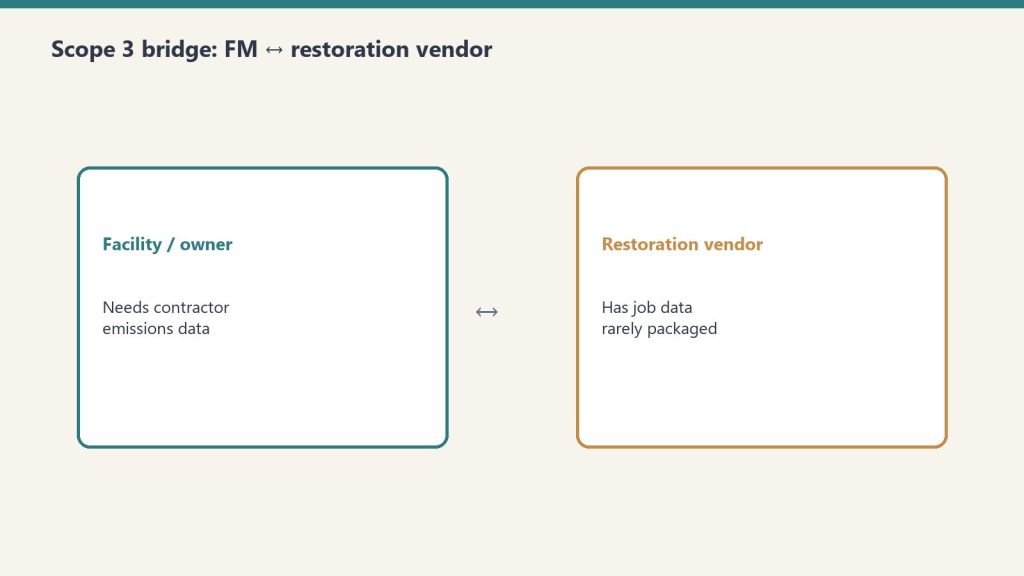
    Bridge diagram between facility owners and restoration vendors for Scope 3 data
    The missing bridge: restoration contractors and Scope 3 data.

    Here is the specific gap this publication exists to close: restoration contractors — the companies that respond to water damage, fire, mold, and environmental emergencies at commercial facilities — have no standardized way to provide Scope 3 emissions data to their FM clients. The International Institute of Cleaning and Restoration Certification (IICRC) has no ESG standard. The Restoration Industry Association (RIA) has no Scope 3 guidance. No industry body has built the framework that tells a restoration contractor what data to capture on each job ticket so their FM client can use it in a Scope 3 report.

    This is the problem the Restoration Carbon Protocol (RCP) was built to solve. The RCP is a Tygart Media-published industry self-standard that maps restoration job types to the GHG Protocol’s 15 Scope 3 categories, defines the 12 data points every job ticket should capture, and provides the calculation methodology restoration contractors need to produce credible emissions data. It is the operational bridge between the FM’s Scope 3 disclosure obligation and the restoration contractor’s job management system.

    What IFMA Members Should Be Asking Their Restoration Vendors Today

    Restoration SOP clipboard with checklist, moisture meter, and gloves on a jobsite table
    What IFMA members should ask restoration vendors today.

    If you are a facility manager with Scope 3 reporting obligations, here are the five questions you should be putting to every restoration contractor in your vendor pool:

    1. Can you provide a per-job emissions summary for each project you complete at our facilities? If the answer is no, that is a gap in your Scope 3 Category 1 data.
    2. Do you track materials disposed of by type and weight? Waste stream data is a required input for Scope 3 calculation under GHG Protocol methodology.
    3. Do you track vehicle and equipment fuel consumption for each project? Mobile combustion is a Category 1 input that most restoration contractors currently ignore.
    4. Are you familiar with the Restoration Carbon Protocol? RCP-aware contractors are already capturing the data FMs need.
    5. Would you be willing to complete a standardized carbon data form for each project? The RCP Job Carbon Report is a one-page form any contractor can complete without a sustainability consultant.

    Why Tygart Media Covers This Beat

    Tygart Media’s position in the restoration industry — through the Restoration Carbon Protocol, the Restoration Golf League network, and years of content production for restoration operators — gives us a direct view into the contractor side of this data gap. This IFMA Scope 3 category exists to build the FM side of the same bridge: to give facility managers the framework, vocabulary, and vendor guidance they need to close their Scope 3 contractor data gap before the 2027 deadline arrives.

    This is not a BOMA story. It is not a property management story. It is a facility management story — about the corporate occupier’s FM team trying to satisfy a board-level ESG commitment with incomplete data from contractors who have never been asked for it before. We are building the source of truth for that problem.

    Related on Tygart Media: contractor ESG clauses for Scope 3 · facility ESG frameworks (GRESB / CDP / SB 253) · RCP for property owners.

    Frequently Asked Questions

    What is the difference between IFMA and BOMA for ESG purposes?

    IFMA serves facility managers who manage buildings for corporate occupiers — organizations that use the space for their own operations. BOMA serves property owners and managers who lease space to tenants as a business. For Scope 3 ESG, IFMA members must capture contractor emissions data as part of their corporate supply chain disclosure, while BOMA members primarily focus on tenant energy use and asset-level performance benchmarking.

    Why do restoration contractors matter for IFMA Scope 3 reporting?

    Restoration contractors perform services at IFMA members’ facilities. Under the GHG Protocol, the emissions from those services are part of the corporate occupier’s Scope 3 inventory — typically Category 1 (Purchased Goods and Services). Without standardized emissions data from restoration vendors, the FM’s Scope 3 report has a recurring gap every time an emergency occurs at a managed facility.

    What is the Restoration Carbon Protocol?

    The Restoration Carbon Protocol (RCP) is an industry self-standard published by Tygart Media that maps restoration job types to GHG Protocol Scope 3 categories and defines the data restoration contractors should capture to enable their FM clients’ Scope 3 reporting. It is the first framework of its kind in the restoration industry.

    When does Scope 3 reporting become mandatory for large companies?

    California SB 253 requires Scope 3 disclosure for companies with over $1 billion in annual revenue doing business in California beginning in 2027. The EU’s CSRD is already in force for large European entities, with phased expansion through 2026. Many voluntary frameworks (CDP, GRESB) already request Scope 3 data.

    This article is part of Tygart Media’s IFMA Scope 3 category — the facility manager’s source of truth for Scope 3 ESG reporting and contractor data standards.

  • AI Citation Profiles: Optimize for Claude and Perplexity

    AI Citation Profiles: Optimize for Claude and Perplexity

    Last refreshed: October 20, 2026

    The phrase “optimize for AI search” is almost always wrong. There is no single AI search behavior. Claude, ChatGPT, and Perplexity each have distinct citation patterns — different content structures they reward, different page types they concentrate on, different signals they weight. Writing one undifferentiated article and hoping it gets cited across all three is the same mistake as writing one undifferentiated web page and hoping it ranks for every keyword. This cluster article covers the per-model citation playbook, built from GA4 data and the multi-model roundtable methodology in the Tygart Media Knowledge Lab.

    This is the final cluster in the Claude on a Budget series. For the token economics that make targeted content cheaper to produce, see Output Compression Discipline and Prompt Caching.

    The Three Citation Profiles

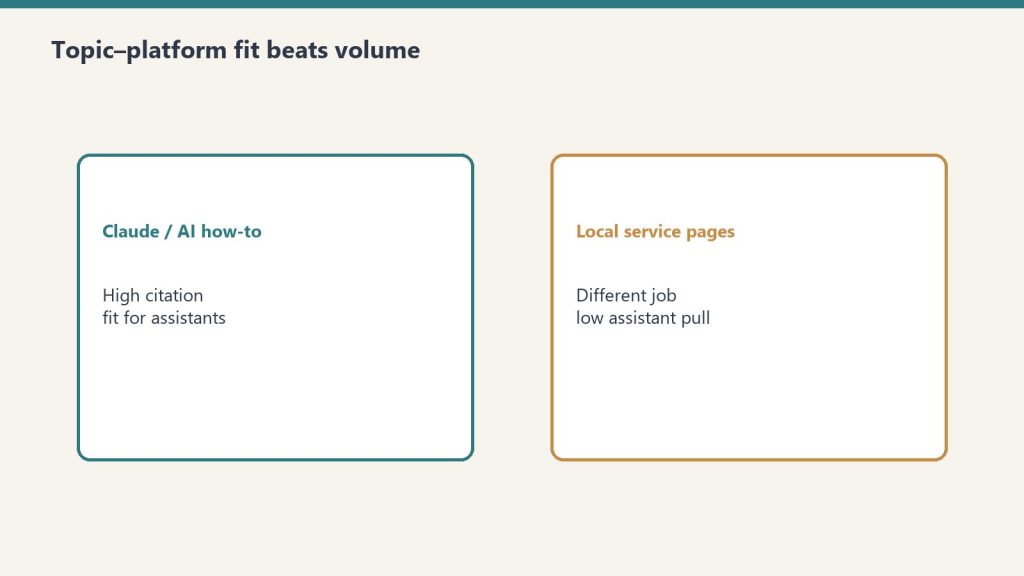
    Comparison of Claude how-to fit versus local service page fit for assistants
    Three citation profiles to optimize for.

    Claude (Anthropic): Concentrates heavily. GA4 data from sites in the Knowledge Lab shows Claude sending approximately 54.5% of its AI referral traffic to just 2 pages per site. It rewards content that is entity-dense, structurally authoritative, and written with speakable precision — defined terms, explicit relationships between concepts, factual density over narrative padding. Claude users tend to be technical and high-intent; the model reflects that by citing content that answers with precision rather than coverage. Approximately 90% of content on a typical site is invisible to Claude — it surfaces a small authoritative set and ignores the rest.

    ChatGPT (OpenAI): Spreads references broadly. Where Claude concentrates on 2 pages, ChatGPT may reference 8-12 across the same site. It rewards breadth, recency, and natural-language accessibility. Content structured like a knowledgeable friend explaining something clearly — without jargon walls — performs well. ChatGPT users skew toward general-purpose questions; the model cites content that covers the question conversationally without assuming deep domain expertise.

    Perplexity: Research-flavored. It rewards sourced claims, comparative tables, explicit statistics, and content that reads like a researched brief rather than an opinion piece or narrative. Perplexity users are actively in research mode; the model surfaces content that looks like it did the research so the user does not have to. Citation-rich, data-dense, table-formatted content punches above its traffic weight in Perplexity referrals.

    The Per-Model Content Shape

    ElementClaudeChatGPTPerplexity
    Density targetHigh — entity-rich, preciseMedium — accessible, broadHigh — sourced, comparative
    Best structureDefined terms, explicit relationships, OASFConversational headers, FAQ blocksTables, stat callouts, comparison matrices
    Ideal length1,500-2,500 words with tight structure800-1,500 words, readable flow1,000-2,000 words with data anchors
    Citation triggerAuthoritative entity coverageQuery-matching accessible answerSourced comparative data

    The Multi-Model Roundtable Methodology

    Three cards for solo takes, cross-pollination, and synthesis
    Multi-model roundtable methodology.

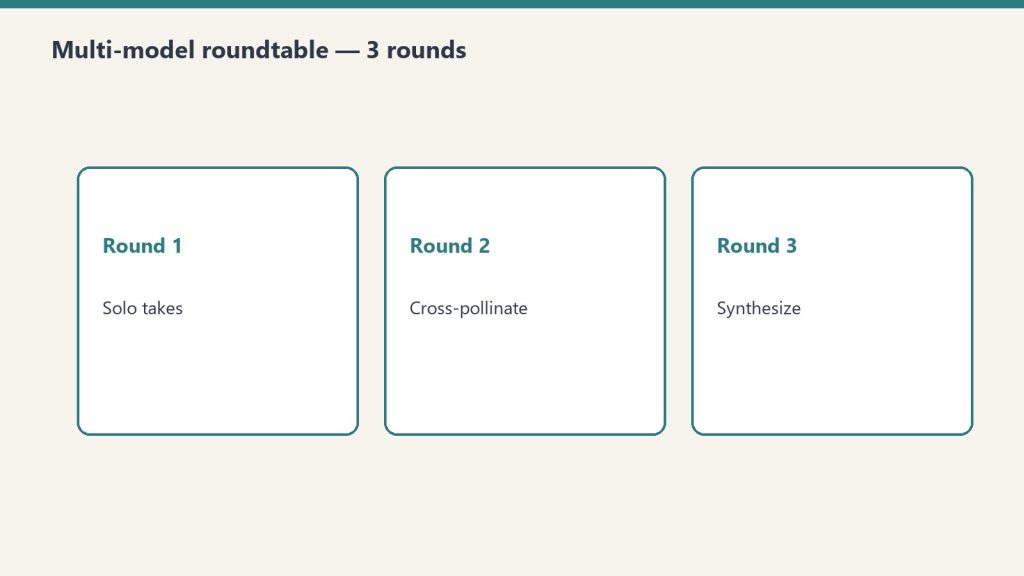
    The Tygart Media Knowledge Lab documents a specific workflow for content research that leverages multiple models’ citation profiles rather than fighting them. The pattern: route the initial research brief to a free or cheap model (Gemini Flash via OpenRouter, or Llama 3 free tier) for broad source gathering. Pass the source list to Claude for entity extraction and authoritative synthesis. Use the Claude-synthesized brief as the foundation for the final article draft. The output is content that is naturally entity-dense from Claude’s synthesis pass while covering enough ground to catch ChatGPT’s broader citation net.

    The token economics matter here: the expensive synthesis pass (Claude Sonnet 4.6 or Haiku) operates on a pre-filtered source set, not raw web content. Input tokens are lower because a cheaper model did the broad sweep. Claude’s output is higher-density because it is synthesizing structured inputs rather than processing noise. This is the OpenRouter multi-model pipeline in content production form.

    Writing for Claude Citation Specifically

    Four cards for content, ops, build, and knowledge work with Claude
    Writing for Claude citation specifically.

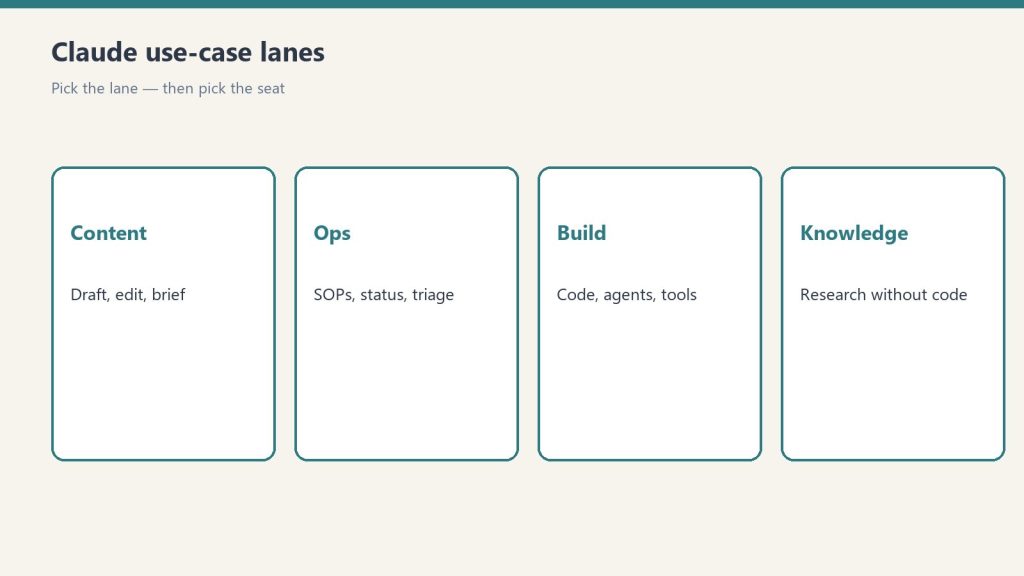
    If your primary goal is Claude citation — high-intent technical traffic, B2B contexts, developer audiences — the content discipline is: define every entity explicitly at first mention, state relationships between concepts directly (“X enables Y because Z”), use speakable sentence structures (subject-verb-object, no buried clauses), include a structured FAQ or definition block, and remove padding. Claude’s citation concentration on 2 pages per site means your best-performing page for Claude referrals will get the bulk of the traffic — invest in making that page entity-complete rather than spreading thin coverage across many pages.

    Writing for Perplexity Citation

    Perplexity citation optimization is the most actionable of the three because the signal is explicit: include comparative tables with real numbers, cite sources inline (even if just attributing claims to specific organizations or studies), use headers that read like research questions, and lead sections with data points rather than narrative. The content in this series — pricing tables, API code examples, usage statistics — is structured for Perplexity citation by design. Every table is a potential Perplexity extraction point.

    The Budget Connection

    Per-model content shaping is a budget strategy, not just a citation strategy. Writing one highly targeted, entity-dense 2,000-word article for Claude citation is cheaper to produce — fewer tokens, tighter output discipline — and more effective than producing three generic 1,500-word articles hoping one gets cited. Concentration over coverage: the same principle Claude uses to cite content, applied to content production itself. The output compression discipline from Cluster 6 makes this article type cheaper to generate. Dense, targeted content is both cheaper to produce with Claude and more likely to be cited by Claude. The budget and the citation strategy converge.

    The Full Claude on a Budget System

    This series has covered seven levers that compound: cold-start elimination via second brain, model routing by task tier, OpenRouter free model integration, Batch API for async 50% discount, prompt caching for 90% off repeated context, output compression discipline, and per-model citation shaping. None of these require negotiating with Anthropic’s pricing team. All of them are available today via the API. Applied together, they represent the difference between paying retail for Claude and operating it at professional efficiency — which, for most teams, means the same Claude capability at 40-70% of the sticker cost.

    Return to the full guide: Claude on a Budget: Complete Guide →

  • Claude Output Compression: Token Savings & Structured JSON

    Claude Output Compression: Token Savings & Structured JSON

    Last refreshed: October 20, 2026 (Pacific)

    Most Claude cost analyses focus on input tokens — the knowledge you send in. The underappreciated lever is output compression. Claude is trained to be thorough. Left unconstrained, it produces full meals: preambles, recaps, hedges, transition sentences, closing summaries. All of those tokens cost money. All of them are often unnecessary. Output discipline — getting Claude to deliver concentrated slices instead of full meals — is often the highest-leverage cost reduction available without changing models or switching to async.

    Why output deserves its own discipline: on every current Claude model, output tokens cost 5x their input counterparts. Verified output rates:

    Model Output (per MTok) Input (per MTok)
    Claude Fable 5.1$50.00$10.00
    Claude Opus 5.5$20.00$4.00
    Claude Sonnet 5.5$10.00$2.00
    Claude Haiku 4.5$5.00$1.00

    Every unnecessary output token costs five times what an input token costs. That ratio is what makes output compression the highest-leverage lever on this page.

    This is part of the Claude on a Budget series. For input-side compression, see The Cold-Start Problem. For pricing mechanics, see Prompt Caching.

    The Default Verbosity Problem

    Workshop fuel gauge and metal tokens pouring into an API hopper, metaphor for pay-per-token pricing
    The default verbosity problem.

    Ask Claude to “summarize this document” without constraints and you will get: an opening sentence restating the task, a multi-paragraph summary, a bullet-point recap of the summary, and a closing note about what was not covered. The actual information density — insight per token — is low. You paid for 800 tokens of output and needed 150. Multiply across thousands of API calls and you have built a significant cost leak from default model behavior, not from bad prompts.

    Put dollars on it. A pipeline making 5,000 calls a day at 800 output tokens per call, compressible to 150, wastes 650 tokens per call — 3.25 million tokens a day. At Sonnet 5.5 output rates ($10/MTok), that is $32.50 a day, roughly $975 a month of verbosity. On Opus 5.5 ($20/MTok output), it doubles to about $1,950 a month. Same answers, same models — the only difference is output discipline.

    The Output Compression Toolkit

    Cost control gates for production routing
    The output compression toolkit.

    1. Explicit word and token caps in the prompt. “Respond in 150 words or fewer” is the single most effective instruction for reducing output tokens. Claude respects tight limits. “Be concise” does not work reliably. “150 words maximum” does. For JSON outputs: “Respond with only valid JSON, no markdown fences, no explanation.” Every word of instruction about format is recovered 10x in output reduction across repeated calls.

    2. Structured output schemas. When you need structured data, define the exact JSON schema. Claude stops generating prose and fills fields. You get exactly what you specified and nothing more. The token reduction versus free-form responses is typically 40-70% for equivalent information content.

    # Free-form -- verbose, unpredictable length
    prompt_verbose = "Summarize the key points of this article and their implications."
    
    # Structured -- tight, predictable, cheaper
    prompt_structured = """Extract from this article:
    {"headline": "string", "key_points": ["string", "string", "string"], "sentiment": "positive|neutral|negative"}
    Respond with valid JSON only. No explanation."""

    3. Role-based compression priming. System prompt framing shapes output length. “You are a precise technical writer who values brevity. Never restate the task. Deliver the answer directly.” produces consistently shorter outputs than a neutral system prompt. This is prompt engineering for token economics, not just quality.

    4. Chained micro-tasks over monolithic requests. Instead of asking Claude to research, analyze, synthesize, and format in one prompt, chain smaller requests. Each call is scoped to one task with tight output constraints. Total tokens across the chain are often lower than a single unconstrained request, and intermediate outputs are cacheable — pairing naturally with the prompt caching strategy.

    The Notion Second Brain Application

    The operational implementation at Tygart Media runs this pattern at pipeline level. The Notion second brain eliminates the need for Claude to generate background context — it already exists in structured form. Extractions from Notion arrive as pre-formatted knowledge blocks. Claude’s task is synthesis over existing structured data, not open-ended research and explanation. Output prompts are scoped: “Given this structured data, write a 400-word section for [topic]. No preamble, no conclusion, begin directly with the first point.” The output is a concentrated slice — dense, usable, billable at a fraction of what free-form generation costs for equivalent value.

    Measuring Compression Effectiveness

    Desk with laptop, checklist notebook, and billing card ready before creating an Anthropic API key
    Measuring compression effectiveness.

    Track output_tokens in your API responses. Log them per prompt template. Identify your highest-output templates and run compression interventions — tighter word caps, structured formats, role priming. The target is information density: insight delivered per output token, not raw token count. A 500-token output with 3 actionable insights beats a 200-token output with 1. Compression discipline is about removing the scaffolding (preambles, hedges, recaps) while preserving the load-bearing structure (insight, data, instruction).

    max_tokens as a Hard Ceiling

    Set max_tokens conservatively in your API calls. This is your financial guardrail, not just a model parameter. For classification tasks: 50 tokens. For short summaries: 200 tokens. For structured JSON extraction: 500 tokens. For article drafts: 1,500-2,000 tokens. Leaving max_tokens at a high default on every call is leaving a cost ceiling unjustifiably high — current Claude models support up to 128,000 output tokens, so the ceiling you are not setting is enormous. Claude will rarely hit the ceiling on constrained tasks, but it prevents runaway generation on edge-case inputs that can quietly inflate your bill.

    Output compression FAQ

    Does output compression hurt answer quality? Not when done right — compression removes scaffolding (preambles, hedges, recaps), not substance. The techniques above constrain format and length, never information content. If an answer needs depth, scope the depth explicitly (“give three reasons, one sentence each”) rather than leaving length open.

    How does output compression interact with prompt caching? They stack on opposite sides of the bill: caching discounts repeated input, compression shrinks output. Chained micro-tasks (technique 4 above) do both — intermediate outputs become cacheable inputs for the next call.

    Does the Batch API change the compression math? The Message Batches API takes 50% off output tokens too, so the dollar savings per token are halved — but the percentage savings are identical, and shorter outputs still mean faster batch turnaround.

    What is the single highest-leverage change? Explicit word caps in the prompt (“150 words maximum”). One sentence, no tooling, and Claude respects it.

    Price your own pipeline from the Anthropic Console — API keys, billing, and a token-to-dollar cost estimator for your actual usage.

    Related cost levers: prompt caching (input-side) · Message Batches API (50% off async) · Claude on a Budget (the full series).

    Next: Per-Model Content Shaping: Write Less, Get Cited More →

  • Anthropic Prompt Caching: Cut Claude API Costs by 90%

    Anthropic Prompt Caching: Cut Claude API Costs by 90%

    Updated November 2, 2026 — added direct answers on prompt caching costs and mechanics, sourced from Anthropic’s published pricing.

    Last refreshed: November 2, 2026 (Pacific)

    If you’re sending the same large block of context — a knowledge base, a style guide, a long system prompt, a reference document — with every Claude request, you’re paying full input token rate on every single call. Anthropic’s prompt caching collapses that to roughly 10% of the standard input rate for cache hits. For context blocks of 1,000+ tokens sent repeatedly, this is one of the most reliable cost levers available.

    This is part of the Claude on a Budget series. For async workloads, see The Batch API: 50% Off for Non-Urgent Work. For token reduction before the API call, see The Cold-Start Problem: Second Brain and CLAUDE.md.

    How the Cache Works

    Workshop fuel gauge and metal tokens pouring into an API hopper, metaphor for pay-per-token pricing
    How the prompt cache works.

    Prompt caching is prefix-based. Anthropic caches the exact token sequence up to your cache_control breakpoint. Any subsequent request that begins with that identical prefix hits the cache and pays cache read rate (~$0.20/M for Sonnet 5.5 vs. $2.00/M standard — a 90% reduction). The cache is maintained for approximately 5 minutes of inactivity, with extended TTL options for longer-lived contexts. Token minimums apply — Anthropic documents these per model, and recent generations have lowered them to 1,024 tokens.

    The Pricing Reality

    ModelStandard InputCache WriteCache ReadRead Savings
    Haiku 4.5$1.00/M$1.25/M$0.10/M90%
    Sonnet 5.5$2.00/M$2.50/M$0.20/M90%
    Opus 5.5$4.00/M$5.00/M$0.20/M95%

    Cache writes cost slightly more than standard input (25% premium). The break-even is the second hit. Every cache read after that is 90% cheaper. For any context block read more than once, caching wins.

    What is prompt caching and how much can it save?

    Prompt caching stores the reusable prefix of your API prompt—such as system instructions, tool definitions, or background documentation—in Anthropic’s memory so subsequent calls do not re-process it at full input price. On cache hits, it saves up to 90% on input token costs (paying 0.1x the base input rate) while reducing time-to-first-token latency.

    Consider a concrete before-and-after example of a production workload running 1,000 requests that share a consistent 10,000-token prompt context (10,000,000 total prompt input tokens) using Claude Haiku 4.5 (where standard input is $1.00 per million tokens):

    Without caching:
    All 1,000 requests are billed at standard input ($1.00 / MTok):
    10.0 MTok × $1.00 / MTok = $10.00

    With prompt caching (5-minute TTL rates):
    • Cache-write price (Request 1): 10,000 tokens (0.01 MTok) written at the cache-write rate of $1.25 / MTok (1.25x base) = $0.0125
    • Cache-read price (Requests 2–1,000): 9,990,000 tokens (9.99 MTok) read at the cache-read rate of $0.10 / MTok (0.1x base) = $0.9990
    • Total prompt input cost: $0.0125 + $0.9990 = $1.0115 (approx. $1.01)
    • Net savings: Cost drops from $10.00 to $1.01, saving $8.99 (89.9%) on prompt input tokens.

    How does prompt caching reduce my Claude API costs?

    Prompt caching reduces API costs by splitting each incoming request into two distinct segments: a stable prompt prefix and a dynamic suffix.

    • Stable prompt prefix (cached): Contains the parts of your prompt that remain identical across calls—system instructions, persona rules, few-shot examples, and schema definitions marked with cache_control. Anthropic hashes this prefix and writes it to memory on the first request; every subsequent call within the time-to-live (5 minutes by default, refreshed on each hit) re-reads that prefix at the discounted cache-read rate ($0.10 / MTok on Haiku 4.5 or Sonnet 5.5).
    • Dynamic suffix (not cached): Contains the parts that change on every query—the user’s specific question, dynamic conversation turns, or runtime variables placed after the cache breakpoint. Because this content changes, it is billed at standard input token rates.
    • Why this split drives the savings: In multi-turn or agentic pipelines, system context and reference data frequently account for 80% to 95% of total input tokens. By isolating the static prefix behind a breakpoint, you pay the one-time 25% cache-write premium once, and then pay only 10% of the input cost on the vast majority of your prompt volume across all remaining requests.

    The Implementation

    import anthropic
    
    client = anthropic.Anthropic()
    
    # Large system prompt or knowledge base -- mark for caching
    SYSTEM_CONTEXT = "Your 5,000-token knowledge base or style guide here..."
    
    response = client.messages.create(
        model="claude-sonnet-4-6",
        max_tokens=1024,
        system=[
            {
                "type": "text",
                "text": SYSTEM_CONTEXT,
                "cache_control": {"type": "ephemeral"}
            }
        ],
        messages=[
            {"role": "user", "content": "Your specific question or task here"}
        ]
    )
    
    # Check cache performance in usage stats
    usage = response.usage
    print(f"Input tokens: {usage.input_tokens}")
    print(f"Cache creation tokens: {usage.cache_creation_input_tokens}")
    print(f"Cache read tokens: {usage.cache_read_input_tokens}")

    On the first call, you will see cache_creation_input_tokens populated — that is the write. On subsequent calls with the same prefix, cache_read_input_tokens shows what was served from cache at 10% cost.

    What to Cache

    Cost control gates for production routing
    What to cache — and what not to.

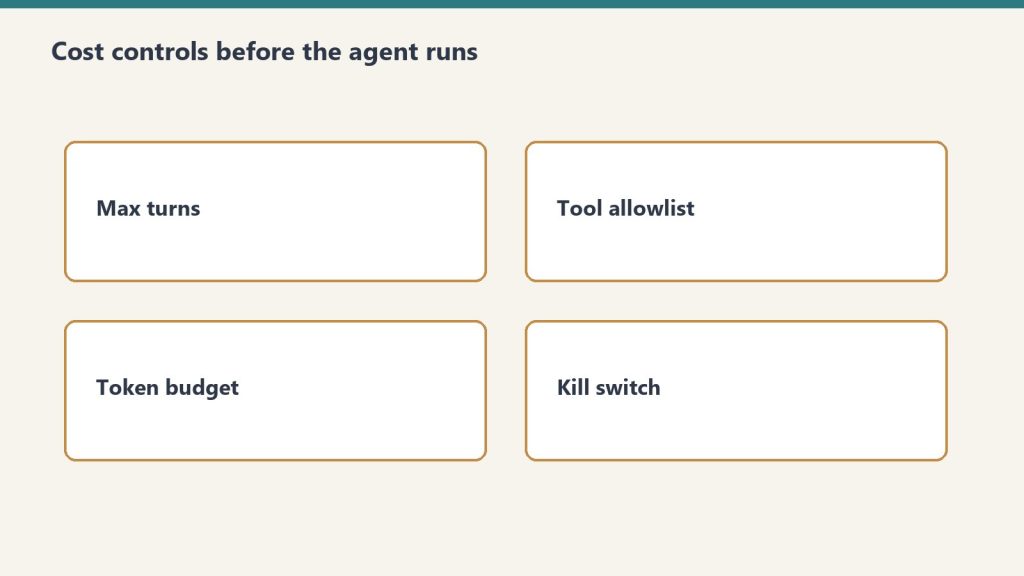
    Anything large, stable, and repeated qualifies. The highest-value candidates: long system prompts defining agent behavior or personas; reference documents such as product specs, legal terms, or knowledge bases; few-shot example sets (10+ examples add up fast); conversation history in multi-turn applications where you mark the stable history prefix for caching and leave only the new turn uncached. In agentic pipelines where Claude processes a document repeatedly across multiple analysis passes, cache the document body and vary only the instruction. You pay full rate once per document, cache rate on every subsequent pass.

    The CLAUDE.md and Second Brain Connection

    The cold-start reduction strategy covered in Cluster 1 works because you are reducing what gets sent, not how it gets priced. Prompt caching is the complement: for context that must be sent, cache it. Together, the disciplines compound — your CLAUDE.md file keeps context lean; prompt caching ensures whatever you do send repeatedly costs 90% less after the first hit.

    Cache Design Principles

    Desk with laptop, checklist notebook, and billing card ready before creating an Anthropic API key
    Cache design principles that hold up.

    Place stable content at the front of your prompt. Place dynamic content at the end. The cache key is prefix-matched, so any change to content before the cache_control marker invalidates the cache. If your system prompt has a dynamic date or session ID embedded at the top, you are guaranteeing cache misses on every call. The correct structure: static knowledge base, then cache marker, then dynamic task-specific instruction. Never the reverse.

    You can set up to 4 cache breakpoints in a single request for granular control. Most production implementations need only one or two — the system prompt cache and optionally a conversation history cache in long multi-turn sessions.

    Operational Impact

    Teams running Claude with consistent system prompts across many requests report effective input costs dropping to near-cache-read rates after the first request. For a content pipeline running 1,000 daily requests with a 5,000-token system prompt: uncached cost is $10/day on input alone at Sonnet 5.5 rates ($2/M). Cached cost after the first request: about $1/day. That is roughly $9/day saved on system prompt tokens alone — about $3,285/year from one implementation change that takes an afternoon to ship.

    Next: Output Compression Discipline: Concentrated Slices vs Full Meals →

  • Anthropic Batch API: Save 50% on Async Claude Workloads

    Anthropic Batch API: Save 50% on Async Claude Workloads

    Last refreshed: October 20, 2026

    Every dollar you spend on Claude at full synchronous price is a dollar you’re overpaying for non-urgent work. Anthropic’s Message Batches API delivers a flat 50% discount on both input and output tokens — the same models, the same quality, half the price — with one constraint: results arrive asynchronously, typically within 24 hours.

    This is part of the Claude on a Budget series. If you’re routing models for real-time work, see Model Routing: Haiku vs Sonnet vs Opus. For cutting repeated context costs, see Prompt Caching.

    The Math First

    Workshop fuel gauge and metal tokens pouring into an API hopper, metaphor for pay-per-token pricing
    The math first — why batch pricing exists.

    Standard Sonnet 4.6 pricing: $3.00 input / $15.00 output per million tokens. Batch Sonnet 4.6: $1.50 input / $7.50 output. Run 1,000 article drafts synchronously and you’re spending full rate on every one. Run the same batch overnight and you cut the bill in half — no model quality change, no output degradation, just a different delivery mechanism.

    ModelSync InputSync OutputBatch InputBatch Output
    Haiku 4.5$1.00/M$5.00/M$0.50/M$2.50/M
    Sonnet 4.6$3.00/M$15.00/M$1.50/M$7.50/M
    Opus 4.7$5.00/M$25.00/M$2.50/M$12.50/M

    What Qualifies as Non-Urgent Work

    Side-by-side when to use a script versus an agent
    What qualifies as non-urgent work.

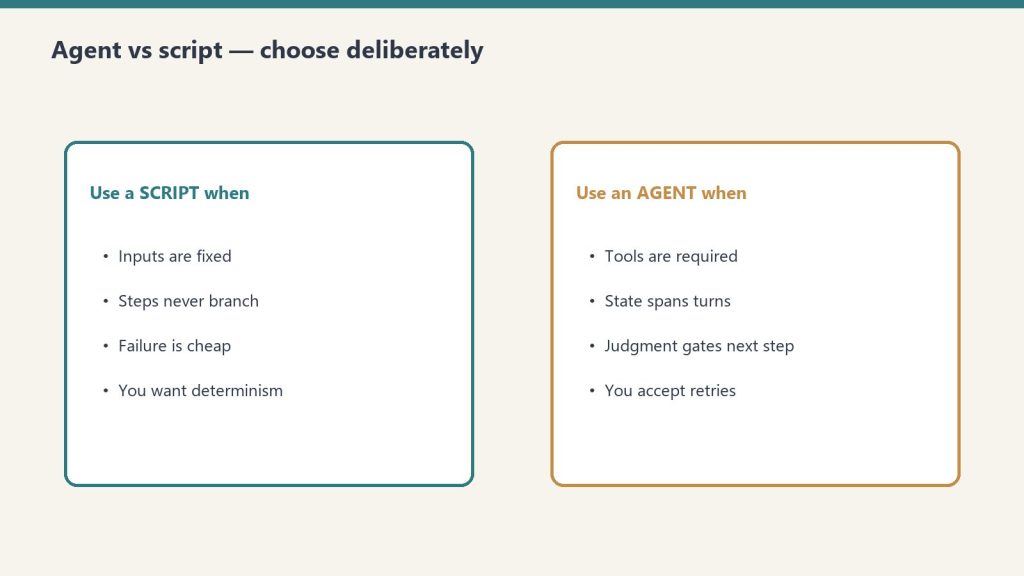
    The honest question is not “does this need to be fast?” — it’s “does this need to be synchronous?” Most content pipelines, data enrichment tasks, classification jobs, and bulk translation runs have no real-time dependency. The user is not waiting at a keyboard. The output feeds a queue. The 24-hour window is irrelevant. Candidates include: nightly article drafts, SEO metadata generation for large post archives, batch product description rewrites, email personalization at scale, sentiment tagging across historical data, bulk summarization of documents or transcripts.

    What does not qualify: customer-facing chat, real-time code completion, any workflow where a human is actively waiting for a response.

    The API Pattern

    import anthropic
    
    client = anthropic.Anthropic()
    
    # Build your batch — each request is a full message payload
    requests_list = [
        {
            "custom_id": f"article-{i}",
            "params": {
                "model": "claude-sonnet-4-6",
                "max_tokens": 2000,
                "messages": [
                    {"role": "user", "content": f"Write a 500-word expert summary of: {topic}"}
                ]
            }
        }
        for i, topic in enumerate(topics)
    ]
    
    # Submit the batch
    batch = client.messages.batches.create(requests=requests_list)
    print(f"Batch ID: {batch.id} | Status: {batch.processing_status}")
    
    # Poll until complete
    import time
    while True:
        status = client.messages.batches.retrieve(batch.id)
        if status.processing_status == "ended":
            break
        time.sleep(60)
    
    # Retrieve results
    for result in client.messages.batches.results(batch.id):
        custom_id = result.custom_id
        if result.result.type == "succeeded":
            text = result.result.message.content[0].text
            print(f"{custom_id}: {text[:100]}...")

    Combining Batch API With Prompt Caching

    Cost control gates for production routing
    Combining Batch API with prompt caching.

    These two discounts stack. If your batch requests share a large system prompt — a style guide, a knowledge base, a persona definition — mark that block with cache_control: {"type": "ephemeral"}. Anthropic caches it across all requests in the batch that hit the same prompt prefix. You pay input rate on the first hit and cache read rate (roughly 10% of input rate) on every subsequent hit. A 10,000-token system prompt shared across 500 batch requests: you pay full rate once, cache rate 499 times, and you are already on batch pricing for all output tokens. The compounding effect is significant.

    Structuring Your Pipeline Around Batch Windows

    The practical architecture: identify every Claude call in your current workflow that has no real-time dependency. Move those calls behind a queue. Set a nightly cron that drains the queue into a batch submission at 11 PM. Results are ready by morning. Your synchronous Claude budget drops to customer-facing interactions only — often 20-30% of total volume for content and data operations teams.

    Rate limits are separate for batch vs. synchronous traffic, so batch jobs do not compete with your real-time usage. That is a free operational benefit on top of the price cut.

    Error Handling at Scale

    Batch results include a result.type field: succeeded, errored, or canceled. Always iterate the full result set and collect errored custom_ids for resubmission. At scale — thousands of requests — you will see occasional errors. Build the retry loop into your pipeline from day one rather than discovering it when 3% of a 10,000-request batch silently fails.

    The Honest Tradeoff

    Batch API is a discipline, not a feature. It requires you to think about your Claude usage in terms of urgency tiers, not just prompt quality. Teams that adopt it consistently cut their Claude bills by 30-50% on total spend — not because every call moves to batch, but because the non-urgent majority does. Combined with model routing (Haiku for triage, Sonnet for batch drafts, Opus only for synchronous high-stakes reasoning), it is the highest-leverage cost lever available in the Anthropic stack today.

    Next: Prompt Caching: How to Cut Repeated Context Costs by Up to 90% →