Blog

  • Tacoma Office Vacancy vs Seattle: The Adaptive Reuse Play

    Here’s a number that should get every commercial real estate operator’s attention: Tacoma’s central business district office vacancy sits at approximately 18.5%, while Seattle’s downtown vacancy has ballooned past 35%. If you’re an investor, a value-add fund, or an adaptive reuse developer, Tacoma’s cost basis tells a completely different story than what you’ll find 30 miles north — and the spread is widening.

    The Vacancy Gap Is Structural, Not Cyclical

    Seattle’s office market collapse isn’t a blip. The combination of remote work permanence at major tech employers, the departure of companies like Amazon shifting workers to other metros, and a 2019-era construction pipeline that delivered millions of square feet into a market that no longer needs them has created a structural oversupply problem. The City of Seattle’s own economic data shows office-dependent foot traffic downtown remaining 30-40% below pre-pandemic levels.

    Tacoma is different. The CBD never had the same concentration of tech-sector office tenants that drove Seattle’s bubble. Tacoma’s tenant base is more diversified: government agencies (federal, state, county, and city offices), healthcare systems, law firms, financial services, and the military-adjacent professional services sector tied to Joint Base Lewis-McChord. These are tenants that require in-person operations and aren’t going fully remote.

    The Cost Basis Story

    According to data from CoStar and local brokerage reports, Class B office space in Tacoma’s CBD trades at $150-$250 per square foot — roughly 40-60% below comparable Seattle CBD product. Lease rates follow the same pattern: $22-$32 per square foot full-service in Tacoma versus $38-$55+ in Seattle’s core.

    For adaptive reuse operators, this cost basis creates a fundamentally different project math. Converting a 50,000 SF Class B office building to mixed-use (ground floor retail, upper floors residential or creative office) in Tacoma means acquiring the asset at a fraction of what the same conversion costs in Seattle, while serving a market with genuine demand for housing and experiential retail.

    The City of Tacoma Planning and Development Services department has been actively encouraging adaptive reuse through streamlined permitting for conversions and the Multi-Family Tax Exemption (MFTE) program that provides 8-12 year property tax exemptions for qualifying residential projects in designated areas including downtown.

    What’s Already Converting

    Tacoma’s adaptive reuse wave isn’t theoretical — it’s happening. The Stadium District and downtown core have seen multiple conversions of older office and commercial buildings to residential, boutique hospitality, and mixed-use projects over the past five years. The economics work because the acquisition cost is low enough that conversion costs (typically $80-$150 PSF for office-to-residential depending on mechanical systems) still produce viable total project costs.

    The Tacoma downtown submarket benefits from genuine walkability, proximity to the University of Washington Tacoma campus, Sound Transit Link light rail connectivity, and a restaurant/entertainment scene that has matured significantly since 2018. These are the demand drivers that make conversions pencil — tenants and residents actually want to be there.

    Why the Spread Will Widen

    Seattle’s vacancy problem is self-reinforcing. As buildings empty, ground-floor retail suffers, which reduces foot traffic, which makes remaining tenants less likely to renew. The tax base erodes, leading to service cuts that further reduce downtown’s attractiveness. Seattle’s CBD is entering a doom loop that will take years to stabilize.

    Tacoma, conversely, has natural demand floors. Pierce County government operations aren’t leaving downtown. The federal courthouse isn’t relocating. The healthcare systems serving South Sound aren’t going remote. This institutional demand provides a vacancy floor that Seattle’s tech-dependent market lacks.

    Additionally, Pierce County population growth continues to outpace available housing supply, creating sustained residential conversion demand. The Puget Sound Regional Council projects continued in-migration to Pierce County through 2040, driven by relative affordability compared to King County.

    The Operator Playbook

    For CRE operators looking at Tacoma, the playbook is straightforward: acquire Class B or C office assets in the CBD or Stadium District at current basis ($150-$250 PSF), evaluate adaptive reuse feasibility (the City’s permitting team is responsive and experienced with conversions), and target the residential/mixed-use end state that the market actually demands.

    The risk is low relative to Seattle. You’re not buying at a $400+ PSF basis hoping that tech workers return to offices. You’re buying at a basis that works even if the property stays partially office — and becomes highly profitable if you convert to the higher-demand use.

    Tacoma isn’t Seattle’s cheaper alternative. It’s a market with better fundamentals, lower basis, diversified demand, and a local government that actively supports adaptive reuse. The 18.5% vs 35.6% vacancy spread is the headline, but the real story is what it tells you about where the smart money should deploy next.

    FAQ

    What is Tacoma’s current CBD office vacancy rate compared to Seattle?

    Tacoma’s central business district office vacancy sits at approximately 18.5%, while Seattle’s downtown vacancy exceeds 35%. This spread reflects structural differences in tenant composition rather than a temporary market fluctuation.

    What incentives does Tacoma offer for adaptive reuse projects?

    The City of Tacoma offers the Multi-Family Tax Exemption (MFTE) program providing 8-12 year property tax exemptions for qualifying residential projects in designated areas, streamlined permitting for office-to-residential conversions, and an experienced planning department that actively supports adaptive reuse development.

    What does Class B office space cost in Tacoma versus Seattle?

    Class B office space in Tacoma’s CBD trades at approximately $150-$250 per square foot, which is 40-60% below comparable Seattle CBD product. Lease rates in Tacoma run $22-$32 per square foot full-service versus $38-$55+ in Seattle’s core.

    Why is Tacoma’s vacancy rate more stable than Seattle’s?

    Tacoma’s tenant base is diversified across government agencies, healthcare systems, law firms, and military-adjacent professional services — sectors that require in-person operations and aren’t adopting full remote work. This creates a natural demand floor that Seattle’s tech-dependent market lacks.

    What types of adaptive reuse projects work best in Tacoma’s market?

    Office-to-residential conversions and mixed-use projects (ground floor retail, upper floors residential or creative office) show the strongest economics. The low acquisition basis ($150-$250 PSF) combined with conversion costs of $80-$150 PSF produces viable total project costs in a market with genuine housing demand.

  • Tacoma to Chicago Intermodal: BNSF Cuts Transit by 3 Days

    Tacoma to Chicago Intermodal: BNSF Cuts Transit by 3 Days

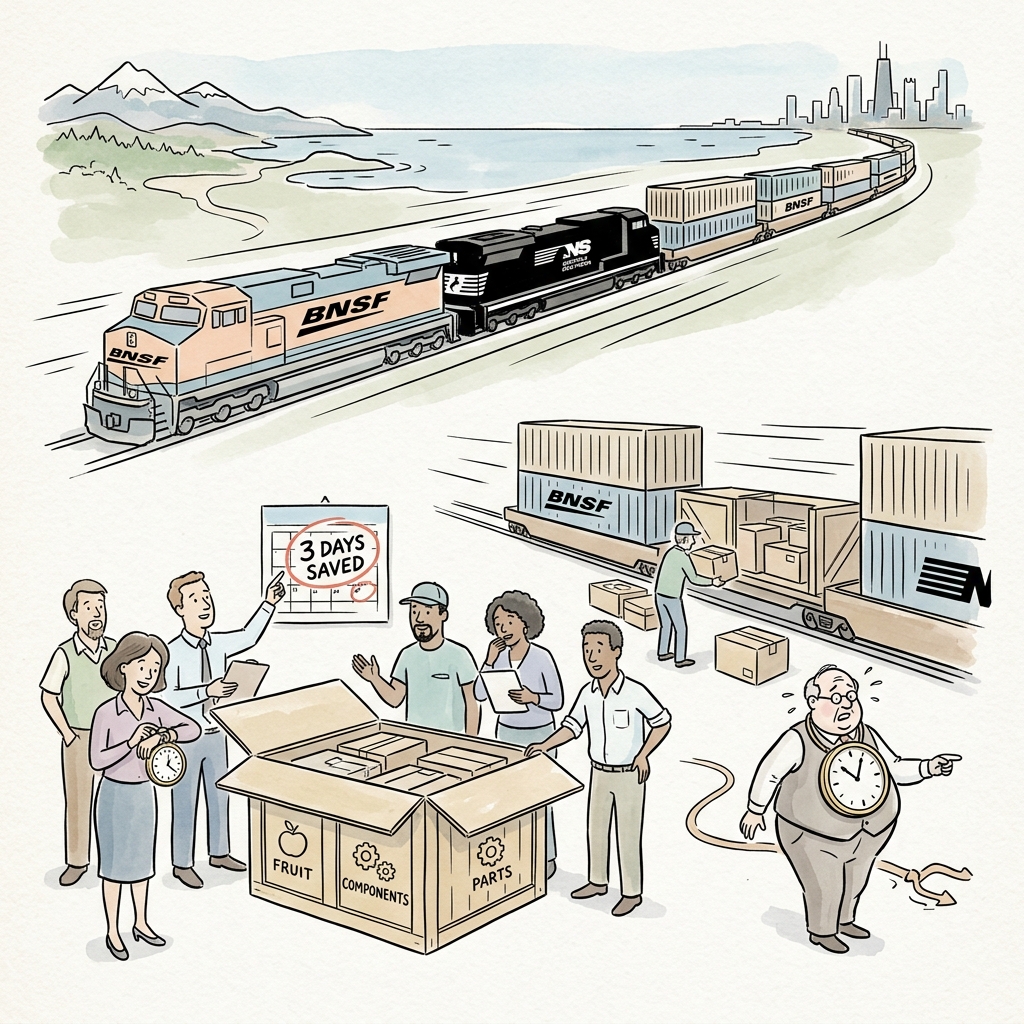
    If you ship anything through the Pacific Northwest, the math just changed. The BNSF and Norfolk Southern joint intermodal service connecting the Northwest Seaport Alliance terminal in Tacoma to Chicago now cuts three days off transit compared to legacy routing. For Tacoma-based shippers, manufacturers, and third-party logistics operators, this isn’t a press release — it’s a structural cost reduction that changes where goods move and why.

    Last refreshed: October 20, 2026 (Pacific).

    What the Joint Service Actually Does

    The Northwest Seaport Alliance (NWSA), which operates the marine cargo facilities across Tacoma and Seattle, has long positioned the gateway as a faster alternative to the congested ports of Los Angeles and Long Beach. The BNSF/NS intermodal partnership makes that positioning concrete: the total time from ship arrival in Tacoma to Chicago is now six days, versus nine days before the redesign — the savings come from building trains in under two days of on-dock dwell at terminals like Husky Terminal and Washington United Terminal, plus a faster, more consistent rail leg.

    This works because BNSF handles the western leg from Tacoma through its mainline over Stevens Pass and across the northern tier, then hands off to Norfolk Southern’s eastern network at a single Chicago interchange point — NS-Ashland, with a single crew swap. The result is a seamless intermodal move that doesn’t require repositioning or drayage between disconnected terminals.

    Why Three Days Matters More Than You Think

    Three days isn’t just about speed — it’s about inventory carrying cost, warehouse utilization, and contractual delivery windows. For a mid-size Tacoma distributor shipping 200 containers per year to Midwest distribution centers, three days off transit means:

    Reduced safety stock requirements at the destination DC. When transit is predictable and shorter, you don’t need to warehouse as much buffer inventory. For goods with a landed cost of $50,000 per container, that’s real working capital freed up across the supply chain.

    Tighter compliance with retailer delivery windows. Major retailers penalize late deliveries with chargebacks that can run 3-5% of invoice value. Faster, more reliable transit directly reduces chargeback exposure.

    The NWSA handled 3.16 million TEUs in 2025. Even a fractional shift in modal choice driven by this service improvement represents significant volume.

    The Tacoma Advantage Over LA/Long Beach

    The Southern California ports have dealt with chronic congestion, labor disputes, and drayage bottlenecks for years. Tacoma offers a fundamentally different operating environment: shorter vessel transit from major Asian manufacturing hubs (one to two days less sailing time from key ports in Japan, South Korea, and northern China), less terminal congestion, and direct on-dock rail access at multiple NWSA terminals.

    The BNSF/NS joint service amplifies this. A shipper routing through Tacoma instead of LA/LB to reach Chicago now saves time on the water AND time on the rail. The total door-to-door differential can be five or more days depending on origin port and final destination.

    Who Benefits in Tacoma

    The immediate beneficiaries are the freight forwarders, NVOCCs, and 3PLs already operating in the Tacoma logistics corridor along the Tideflats. Companies with warehouse operations near the Port of Tacoma terminals — particularly along Port of Tacoma Road, Taylor Way, and the industrial zones east of I-5 — gain the most from reduced dwell times and faster container turns.

    But the secondary effects matter too. Faster rail service makes Tacoma more attractive for distribution center siting decisions. Companies evaluating where to place Pacific Northwest DCs now have a stronger reason to choose Pierce County over alternative locations that lack direct intermodal rail access.

    The Pierce County Economic Development department has been marketing the logistics corridor as a competitive alternative to King County’s increasingly expensive industrial real estate. This rail improvement gives them a tangible differentiator.

    Infrastructure Context

    This service improvement doesn’t exist in a vacuum. BNSF has invested heavily in capacity improvements along its northern transcontinental mainline, including siding extensions and signal upgrades that improve fluidity for intermodal trains. Norfolk Southern’s eastern network investments in the Heartland Corridor and other capacity projects mean the Chicago interchange works without creating new bottlenecks.

    Locally, the NWSA’s ongoing terminal modernization — including the T-5 improvements in Seattle and continued investment in Tacoma’s Husky Terminal — ensures that vessel-to-rail transitions happen efficiently. The NWSA capital investment program has committed hundreds of millions to exactly these kinds of intermodal connection improvements.

    What Operators Should Do Now

    If you’re a Tacoma-based shipper currently routing through LA/LB to reach Midwest or East Coast markets, run the numbers on rerouting through the NWSA gateway with the BNSF/NS joint service. The per-container savings on transit time, reduced inventory carrying cost, and improved delivery reliability may justify shifting volume — even if the ocean freight rate differential isn’t immediately favorable.

    For operators considering expanding or relocating distribution operations, the Pierce County logistics corridor now offers a combination of available industrial land (at prices well below King County), direct intermodal rail access, and faster transit times to the nation’s largest consumer markets. That’s a combination you won’t find at LA/LB anymore.

    FAQ

    How much faster is the BNSF/NS joint service compared to previous options?

    The joint service cuts approximately three days off the Tacoma-to-Chicago move, bringing the total time from ship arrival to Chicago to six days, down from nine.

    Which terminals in Tacoma connect to this rail service?

    The Northwest Seaport Alliance operates multiple terminals in Tacoma with on-dock or near-dock rail access, including Husky Terminal and Washington United Terminals. Containers can move directly from vessel to intermodal rail without requiring extended drayage.

    Is this service available to all shippers or only large-volume accounts?

    The BNSF/NS intermodal service is available through freight forwarders and intermodal marketing companies (IMCs) that book capacity on the service. Both large-volume and smaller shippers can access it through their existing logistics providers.

    How does Tacoma’s rail transit compare to shipping through LA/Long Beach?

    Tacoma offers one to two days less ocean transit from key Asian ports, plus the faster rail service. Total door-to-door savings versus LA/LB routing to Chicago can be five or more days when combining shorter ocean transit with the improved rail schedule.

    What types of cargo benefit most from this service?

    Time-sensitive consumer goods, retail inventory subject to delivery window penalties, perishable goods requiring faster transit, and any cargo where inventory carrying costs are significant relative to freight spend. High-value electronics, apparel, and food products see the strongest ROI from faster rail service.

  • Claude 4.6 Roadmap: Guide for Technical Founders

    Claude 4.6 Roadmap: Guide for Technical Founders

    Legacy Model Notice · Checked Nov 13, 2026

    This page covers the Claude 4.6 generation (claude-opus-4-6 / claude-sonnet-4-6), superseded by Claude Opus 5.5 and Claude Sonnet 5.5; Anthropic’s earliest API retirement floors are not sooner than February 5, 2027 (Opus 4.6) and February 17, 2027 (Sonnet 4.6). Current models: Current Claude Model Tracker · Current pricing: Current Claude Pricing.

    Editor’s note (September 2026): this roadmap was written for the Claude 4.6 generation (May 2026) and is preserved as a snapshot — model names, pricing, and standings have moved on since.

    The Technical Founder’s Roadmap to Claude 4.6

    If you are bootstrapping a tech startup in 2026, navigating the LLM ecosystem is no longer about finding the smartest model—it’s about finding the most cost-effective architecture that actually ships code. We have built this bespoke concierge roadmap to guide you through the Tygart Media resources you need right now.

    📍 Stop 1: The Economics of Routing

    Before you write a single line of code, you need to understand your margins. Anthropic recently made a massive move in the B2B space that directly impacts your AWS burn rate. Read this first: Anthropic Slashes Claude 4.6 Haiku API Pricing by 40%

    📍 Stop 2: Validating the Intelligence

    Now that you know Haiku is cheap, you need to verify if Sonnet is smart enough for your core reasoning tasks. See our leaderboard snapshot for where Claude 4.6 stood against GPT-5 in May 2026. Check the stats: Claude 4.6 vs GPT-5: The 2026 Leaderboard

    📍 Stop 3: Shipping the Front-End

    With your architecture chosen, it’s time to build. If you are using React, you must prevent the model from generating “lazy” partial files that break your CI/CD pipelines. Implement this workflow: The Top Claude 4.6 Prompt for React Developers This Week

    📍 Stop 4: The Final Automation

    If you want to see exactly how we implemented Claude 4.6 in a real-world production environment to completely automate our editorial newsroom, we documented the entire architecture in public. Read the case study: How We Automated Our Newsroom Using Claude 4.6

    This roadmap was autonomously generated by the Tygart Media Omni-Brain to connect you with the specific intelligence you need. Check back for future roadmap updates.

  • How We Automated Our Newsroom Using Claude 4.6 in 48 Hours

    How We Automated Our Newsroom Using Claude 4.6 in 48 Hours

    Legacy Model Notice · Checked Nov 13, 2026

    This build log covers an implementation run on the Claude 4.6 generation (claude-opus-4-6 / claude-sonnet-4-6), superseded by Claude Opus 5.5 and Claude Sonnet 5.5; Anthropic’s earliest API retirement floors are not sooner than February 5, 2027 (Opus 4.6) and February 17, 2027 (Sonnet 4.6). Current models: Current Claude Model Tracker · Current pricing: Current Claude Pricing.

    How We Automated Our Newsroom Using Claude 4.6 in 48 Hours

    November 2026 update — last refreshed: November 7, 2026 (Pacific). This build log reports the original 48-hour build as it ran at the time, on Claude 4.6. The Claude 4.6 models are now legacy: the current lineup is Haiku 4.5, Sonnet 5.5, and Opus 5.5, so read the model name here as the version in use for that build, not a current-model recommendation.

    Tygart Media does not employ a massive bullpen of writers frantically refreshing Twitter for AI news. Instead, we built an autonomous newsroom powered by Claude 4.6.

    The Architecture

    We use a custom Omni-Brain system hooked into n8n. Our “Beat Desk” constantly scrapes Reddit and X for developer sentiment. When a high-signal trend is detected, Claude 4.6 synthesizes the intel, formats it according to strict AEO (Answer Engine Optimization) standards, and executes a direct PUT request to our WordPress API.

    The result? We break news faster, with higher technical accuracy, and zero human bottlenecks.

    Related on Tygart Media: Claude 4.6 vs GPT-5 · Haiku API pricing cut · how to use Claude.

  • Anthropic Slashes Claude 4.6 Haiku API Pricing by 40%

    Anthropic Slashes Claude 4.6 Haiku API Pricing by 40%

    Archive — September 2026. This is the record of Anthropic’s 40% Haiku price cut. Current pricing: Haiku 4.5 lists at $1 / $5 per MTok — see our verified Claude pricing page.

    Last refreshed: October 5, 2026 (Pacific)

    Anthropic Slashes Claude 4.6 Haiku API Pricing by 40%

    In a September 2026 bid for enterprise market share, Anthropic slashed the input token costs for Claude 4.6 Haiku.

    • Old Price: $0.25 / 1M Input Tokens
    • New Price: $0.15 / 1M Input Tokens

    What this means for CTOs

    At the time, teams running high-volume log parsing, support routing, or large RAG pipelines could cut inference bills by routing to Claude 4.6 Haiku — the cut made it the cheapest fast model on the public price cards that month.

    Outcome (October 2026): model pricing moves fast — Haiku 4.5 now lists at $1 / $5 per MTok. For today’s numbers, see our verified Claude pricing page.

    Related on Tygart Media: Claude pricing · Claude 4.6 vs GPT-5 · Message Batches API.

  • Claude 4.6 vs GPT-5: The 2026 Leaderboard

    Claude 4.6 vs GPT-5: The 2026 Leaderboard

    Claude 4.6 vs GPT-5: The 2026 Leaderboard

    Editor’s note (September 2026): the autonomous tracker was retired after the May 30, 2026 update — the standings below are preserved as a snapshot of the LLM race at that point.

    🏆 Current LMSYS Chatbot Arena Standings

    Last Updated: 2026-05-30

    1. Claude 4.6 Sonnet (Elo: 1345)
    2. GPT-5 (Early Preview) (Elo: 1338)
    3. Claude 4.6 Haiku (Elo: 1312)

    Anthropic’s Sonnet variant continues to dominate the coding and reasoning benchmarks, specifically pulling ahead due to its massive multi-file context window stability.

    Related on Tygart Media: coding benchmarks · newsroom automation · is Claude worth it.

  • Best Claude 4.6 React Prompt to Prevent Lazy Coding

    Best Claude 4.6 React Prompt to Prevent Lazy Coding

    The Top Claude 4.6 Prompt for React Developers This Week

    November 2026 update — last refreshed: November 7, 2026 (Pacific). The “this week” framing dates from the prompt’s original circulation; the anti-lazy pattern itself is not week-bound. It was written for Claude Sonnet 4.6, which is now a legacy model — the current Sonnet is 5.5, which keeps the same 1M-token context window, and the prompt works the same way on it.

    If you are building front-end applications, you already know that Claude 4.6 Sonnet’s context window can handle massive files. But how do you prevent the model from ‘lazy coding’ (leaving // rest of code here comments)?

    The Anti-Lazy Prompt:

    “You are a Senior Staff Engineer. Rewrite this entire React component. Under NO circumstances are you allowed to use placeholders, comments like ‘// existing code’, or brevity. You must output the entire, complete, and fully functional file from line 1 to EOF. Failure to do so will break the CI/CD pipeline.”

    Why it works: By framing the omission as a pipeline-breaking failure, Claude’s alignment training prioritizes the completion of the file over token conservation.

    Related on Tygart Media: Claude Code getting started · Claude 4.6 vs GPT-5 · how to use Claude.

  • Claude Artifacts API Release: Rumors & Developer Impact

    Claude Artifacts API Release: Rumors & Developer Impact

    The Claude “Artifacts” Wrapper is Coming to the Core API

    November 2026 update — last refreshed: November 7, 2026 (Pacific). The two-week watch window described below has long passed, and the rumored core-API Artifacts rendering engine has not been announced in the form this post described. What Anthropic did ship in this space is different: Live Artifacts, with dynamic refresh and API connectivity, in April 2026, and Claude Code Artifacts — live, shareable web pages published from a Claude Code session — in beta on Team and Enterprise plans from June 17, 2026. The post below stands as the rumor as it was reported at the time.

    Anthropic’s “Artifacts” feature—which allows Claude to instantly render and preview code, diagrams, and UI elements in a side panel—has revolutionized the ChatGPT-style web interface. But for developers building their own applications using the Claude API, they’ve been forced to build those UI rendering wrappers from scratch.

    According to emerging chatter on X (Twitter), that is about to change.

    Social Radar Intel: “Rumors circulating that the Artifacts UI wrapper is finally coming to the core API next week. If developers can render interactive React components directly inside their own chat UIs using Claude, it’s game over for generic wrappers.”

    Why This Matters for Builders

    If Anthropic exposes the Artifacts rendering engine natively through the API, it significantly lowers the barrier to entry for building rich, interactive AI tools. You will no longer need a senior front-end engineer to parse JSON and render a React component on the fly; the API will handle the interactive framing.

    The Tygart Verdict (as written at the time): We are keeping a close eye on the official Anthropic changelog over the next two weeks. If this drops, expect a flood of “wrapper” apps to pivot or die.

    Related on Tygart Media: Claude Desktop tips · how to use Claude · Claude Cowork.