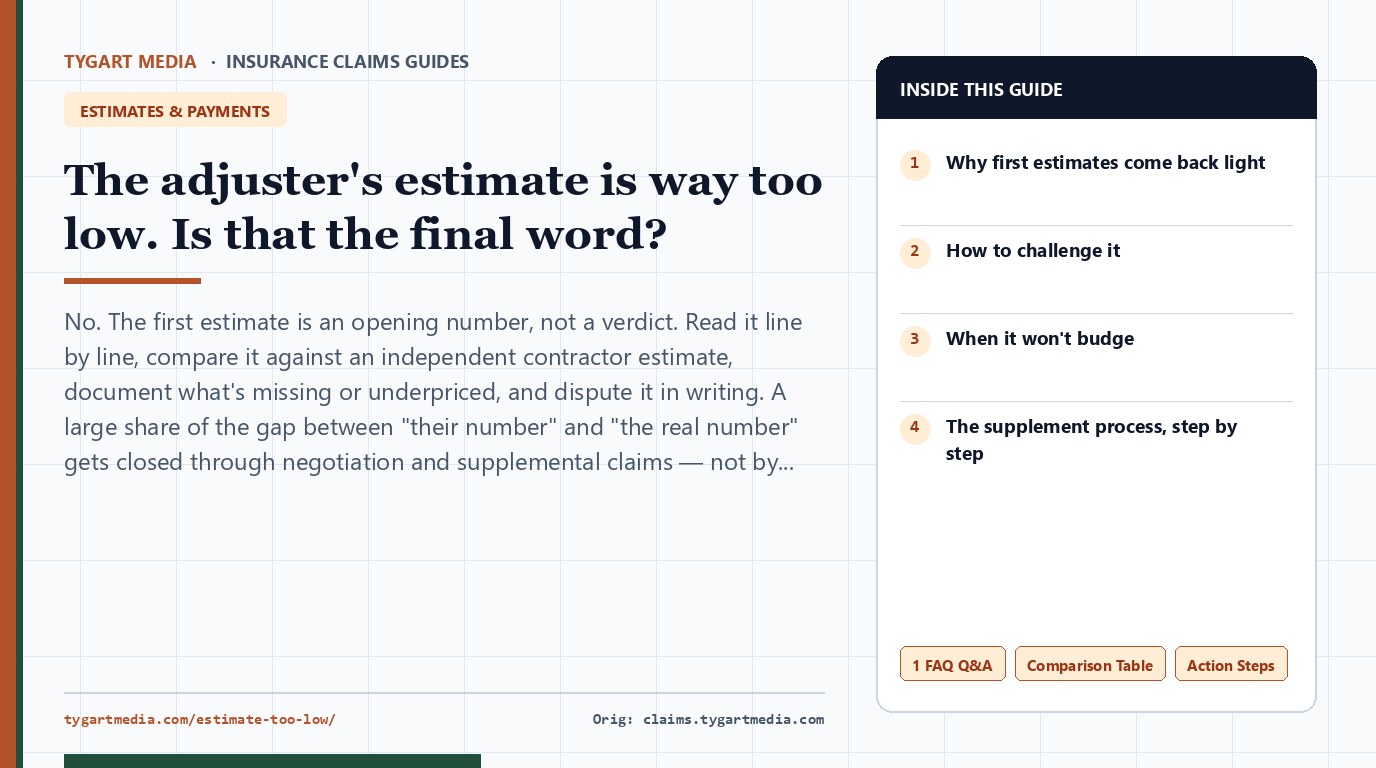
Tygart Media · Insurance Claims Guides · Estimates & payments
QUICK ANSWEROriginally published at claims.tygartmedia.com · Reviewed October 4, 2026
The short answer: no. The first estimate is an opening number, not a verdict. Read it line by line, compare it against an independent contractor estimate, document what’s missing or underpriced, and dispute it in writing. A large share of the gap between “their number” and “the real number” gets closed through negotiation and supplemental claims — not by accepting the first figure.
Why first estimates come back light
Adjusters work from estimating software with standardized pricing, and they’re measured on closing files efficiently. That doesn’t mean bad faith — it means the first estimate reflects what was visible in one visit, priced conservatively. Common gaps:
- Missing line items — code-required upgrades, permits, matching materials, contents manipulation, or protective coverings that a real job needs but a quick inspection skips.
- Underpriced labor — software pricing that doesn’t reflect what licensed contractors in your area actually charge.
- Depreciation applied aggressively — recoverable depreciation that’s yours to claim once work is done. ACV vs. replacement cost →
- Scope that’s too narrow — visible damage estimated, hidden damage (behind walls, under flooring) left for “later” and then forgotten.
How to challenge it
- Get your own line-item estimate from a licensed contractor who has seen the damage in person. This is your anchor number — without it, you’re negotiating against their paperwork with nothing.
- Compare line by line. Mark every item that’s missing, underpriced, or scoped wrong. Be specific: “permit fees omitted,” “drywall priced at X, three local bids average Y.”
- Put the dispute in writing. Email the adjuster with the comparison attached. Phone calls don’t create a record; emails do. State what you believe the correct scope and pricing are and ask for a written response.
- Request a re-inspection with your contractor present to walk the adjuster through the missed items.
- File supplemental claims for anything discovered as work proceeds. How supplements work →
Editor's Note
Your contractor is your documentation ally A good contractor’s detailed estimate — with photos, measurements, and code references — is the single most persuasive thing you can put in front of an adjuster. This is also why the relationship matters: contractors who document thoroughly get their customers paid fairly.
When it won’t budge
If the insurer won’t move after a documented dispute, you still have options: invoke your policy’s appraisal clause (each side hires an appraiser to settle the amount of loss), file a complaint with your state insurance department, or consult a public adjuster or attorney. The full recourse ladder →
Important Notice
Don’t start work on a handshake Get any agreed scope changes in writing before work begins. Verbal promises from anyone — adjuster or contractor — are worth exactly nothing if the claim is disputed later.
Disclaimer
Informational only — not legal or insurance advice.
Insurance rules vary by state and by policy. Check your own policy documents and your state’s insurance department, or talk to a licensed professional, before acting on a claim.
The supplement process, step by step
| Step | What you do | Why it works |
|---|---|---|
| 1. Line-by-line review | Compare the adjuster’s estimate against an independent contractor’s | Surfaces missing line items and underpriced labor |
| 2. Document the gap | Photos, measurements, contractor quotes in writing | Turns “I disagree” into evidence |
| 3. Written dispute | Send the comparison to the adjuster, citing specific lines | Creates the paper trail every escalation needs |
| 4. Supplemental claim | File for costs discovered after the first estimate | Most policies explicitly allow this — it’s not a second bite, it’s the process |
| 5. Re-inspection | Request the adjuster return with your contractor present | Harder to lowball with a professional standing next to you |
Get The Signal
What we actually ran, what it measured, and what it means for a restoration shop — every week, including the flops.
Track the AI tools you actually use
Vendor-neutral prices & limits for ChatGPT, Claude, Gemini, Perplexity and more — tracked in AI Stack Watch.
See the live AI tracker →or set up your alerts
Leave a Reply