Last verified: June 2026.
Most “GEO” advice is recycled SEO with the word “AI” pasted on top. This guide is different. It describes what actually happens when Microsoft Copilot, Bing’s AI answers, and Google’s AI Overviews build a response and decide whose page to cite — based on running content sites that get cited tens of thousands of times a month. The short version: AI engines do not cite the page that ranks #1 for a head term. They cite the page that most directly answers the specific sub-question the model is grounding on. That distinction changes everything about what you should write.
How grounding actually works (the part nobody explains)
When you ask Copilot or Bing’s AI a question, the model does not answer from memory. It runs a retrieval step called grounding: it rewrites your question into one or more search queries, fetches a handful of live web results, reads them, and composes an answer with inline citations pointing back at the pages it used. Google’s AI Overviews work the same way with a technique it calls “query fan-out” — one user question becomes many narrower synthetic queries.
Two things follow directly from this mechanism:
- The model is not searching for your keyword. It is searching for the answer to a decomposed sub-question. A user who asks “what’s the best way to instantly index a new page” triggers grounding queries like “IndexNow API endpoint”, “submit URL to Bing programmatically”, and “IndexNow key file location”. The page that wins is the one that answers those narrow strings, not the one optimized for “indexing tips”.
- Citations are extracted at the passage level, not the page level. The model lifts the specific sentence or table that answers the sub-question. If your answer is buried under 600 words of preamble, it loses to a page that states the fact in the first line under a matching heading.
This is why a niche, specific page routinely out-cites a high-authority generalist. The generalist ranks; the specialist gets quoted.
Why operational and comparison pages win over head terms
Across real citation data, the pages that get pulled into AI answers cluster into three shapes. None of them are “ultimate guide to X”.
1. Operational pages with real commands, configs, and error messages
When someone asks an AI assistant “how do I fix [specific error]” or “what’s the exact command to do X”, the model needs a page that contains the literal command, the literal config, or the literal error string. Generic advice cannot be cited because there is nothing concrete to quote. A page that says:
curl "https://www.bing.com/indexnow?url=https://example.com/new-page/&key=YOUR_KEY"
# 200 = received (not "indexed"), 422 = URL/key mismatch, 429 = too many submits
…is citation gold, because the model can extract that block verbatim and the user can act on it. The error-code annotations matter: questions about failures (“IndexNow 422”, “why am I getting 429”) are high-intent and low-competition, and a page that names the exact codes owns them.
2. Comparison pages (“X vs Y”)
“Which is better, X or Y” is one of the most common shapes of AI query, and comparison content is structurally easy to cite because it maps cleanly to a decision. If you maintain honest, current head-to-head pages, you become the default source the model reaches for when a user is choosing between tools. This is exactly why we keep dedicated comparison pages like Claude Code vs Cursor and Claude Code vs Codex — they answer a decision the model is constantly being asked to make, and a table of differences is trivially quotable.
3. Fresh, dated pages on fast-moving topics
For anything that changes — pricing, model versions, API limits, feature availability — grounding strongly favors recency. The model would rather cite a page dated this month than an “authoritative” page from two years ago that might be wrong. A visible “Last verified” date and a real publish/update timestamp are not decoration; they are a relevance signal the retrieval layer reads.
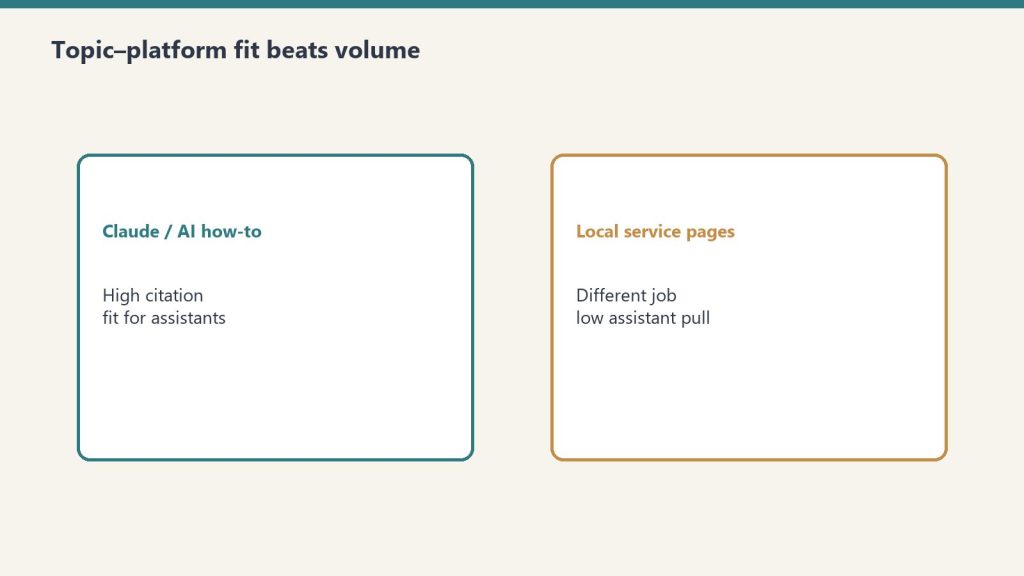
The losing move is chasing broad head terms. “Best AI coding assistant” is saturated, generic, and rarely the literal grounding query. The winning move is to own the long, specific, operational and comparison strings that the fan-out actually generates.
IndexNow: how to get cited the same day you publish
Grounding can only cite pages the engine knows about. The bottleneck for new content is crawl latency — and IndexNow collapses it. IndexNow is an open protocol (backed by Microsoft Bing and Yandex) that lets you push a URL to the index the instant you publish, instead of waiting for a crawler to wander by.
Setup is two steps:
- Host a key file. Generate a key of 8-128 hex characters and place it at your site root as a UTF-8 text file named
{key}.txtcontaining exactly that key. Example:https://example.com/daa44a2c....txt. This proves you own the host. - Ping on publish. Single URL via GET:
Or batch up to 10,000 URLs in one POST:curl "https://api.indexnow.org/indexnow?url=https://example.com/new-page/&key=YOUR_KEY"curl -X POST "https://api.indexnow.org/indexnow" \ -H "Content-Type: application/json" \ -d '{"host":"example.com","key":"YOUR_KEY","urlList":["https://example.com/a/","https://example.com/b/"]}'
A 200 means the endpoint received your URL (not that it is indexed yet). Submitting to api.indexnow.org shares the ping with all participating engines, so you do not need to hit Bing and Yandex separately. Most WordPress SEO plugins (Rank Math, Yoast, SEOPress) have IndexNow built in — turn it on and it fires automatically on every publish and update. The practical payoff: pages can enter Bing’s crawl queue within hours, which means they are eligible to be grounded and cited the same day, not next week.
One caveat worth stating plainly: IndexNow accelerates indexing, which is a precondition for citation. It does not force a citation. You still need the page to be the best answer to the sub-question. But for fresh, time-sensitive content, same-day indexing is often the difference between getting cited while the topic is hot and showing up after the conversation has moved on.
How to actually measure your AI citations
For a long time AI citations were invisible — you could see referral clicks in analytics but not the citations themselves (most AI answers are zero-click). That changed. As of February 2026, Bing Webmaster Tools ships an AI Performance report (public preview) that shows when your pages are cited across Microsoft Copilot, Bing’s AI answers, and partner surfaces. It is the first direct, free window into AI citation behavior, and you should be reading it weekly.
The four metrics that matter:
- Total citations — how many times your site was cited as a source in AI answers over the period.
- Average cited pages — the daily average count of unique URLs from your site that got referenced. This tells you whether citations are concentrated on one page or spread across the site.
- Grounding queries — sample query phrases the AI used to retrieve and cite you. This is the single most actionable field in the report. It is a literal list of the sub-questions you are winning, which tells you exactly which operational/comparison angles to expand next.
- Page-level citation activity — citations by URL, so you can see which pages are doing the work.
Two limitations to keep in mind so you read the data honestly: the report does not show click data (you see citations, not visits from them), and it aggregates Copilot with Bing summaries, so you cannot isolate one surface from the other. For Google’s AI Overviews there is still no equivalent citation dashboard — the closest proxy is watching impressions and referral patterns in GA4 and Search Console, plus spot-checking your target queries by hand.
The workflow that works: pull the grounding-queries list, find the patterns, and feed them straight back into your content plan. If you are getting cited for “claude mcp setup” variants, that is a signal to deepen pages like the Claude MCP setup guide and adjacent operational walkthroughs, not to chase a new head term.
A repeatable checklist for citation-optimized pages

Everything above reduces to a build pattern. For any page you want AI engines to cite:
- Lead with the answer. Put a short, factual, quotable answer in the first 1-2 sentences under each heading. Assume the model reads only that passage.
- Use question-shaped headings. H2s and H3s that mirror real queries (“How does IndexNow work?”, “How do I measure AI citations?”) match the grounding query and give the extractor a clean anchor.
- Be specific and operational. Real commands, real config, real numbers, real error codes and fixes. Concrete text is extractable; vague advice is not.
- Add a visible FAQ near the end. Plain question/answer pairs are the single most citation-friendly format, because each pair is a self-contained answer to a discrete sub-question. You do not need JSON-LD schema for this to work — visible Q&A text is what the model reads.
- Date it and keep it current. A “Last verified” line plus genuine updates on fast-moving topics buys you the recency edge in grounding.
- Push it with IndexNow so it is indexable the same day, then watch the AI Performance report to see which sub-questions it wins.
If you want the larger system this fits into — the full toolchain for operating as an AI-first publisher, from MCP servers to publishing pipelines — start with the AI operator’s stack.
FAQ
Do AI engines cite the page that ranks #1 on Google?
Not reliably. AI engines run their own grounding retrieval and cite the page that most directly answers the specific decomposed sub-question, which is often a niche, operational page rather than the head-term winner. Ranking helps your page be discoverable, but the citation goes to whichever passage best answers the exact grounding query.
What is grounding in AI search?
Grounding is the retrieval step where an AI assistant rewrites your question into search queries, fetches live web pages, reads them, and builds an answer with inline citations to those pages. It is why current, specific pages can get cited even by a model whose training data predates them.
Does IndexNow guarantee my page will be cited by AI?
No. IndexNow guarantees fast indexing, which is a precondition for being cited. The page still has to be the best, most specific answer to the sub-question the model is grounding on. Think of IndexNow as removing the crawl-latency excuse, not as buying a citation.
How do I measure how often AI cites my site?
Use the AI Performance report in Bing Webmaster Tools (public preview since February 2026). It shows total citations, average cited pages per day, sample grounding queries, and citation counts by URL across Microsoft Copilot and Bing AI answers. It does not yet show click-through from those citations, and there is no equivalent dashboard for Google AI Overviews.
Do I need JSON-LD or schema markup to get cited?
No. Citation extraction works on visible, well-structured text — question-shaped headings, short factual answers, and a plain visible FAQ. Schema can help search features generally, but it is not required for AI grounding to read and quote your page.
What kind of pages get cited most?
Three shapes dominate: operational pages with real commands, configs, and error fixes; comparison pages that resolve a “X vs Y” decision; and fresh, dated pages on fast-moving topics like pricing and model versions. Broad head-term content tends to get skipped because it rarely matches the literal grounding query and offers nothing concrete to quote.
Related on Tygart Media: citation economy · AI search funnel · citation monitoring.
Leave a Reply