Tag: William Tygart

  • Unfiltered cross-posting is a reprint machine

    Unfiltered cross-posting is a reprint machine

    Open field playbook. No patent. Copy it. Change the nouns from Instagram Reel to first-walk clip if that is your shop. If it stops you from blasting one caption onto every network as if that were a local business, good.

    License: do what you want. Attribution nice, not required. Tygart Media is not a OneUp partner, reseller, or affiliate. Links below go to official product doors. No tracking parameters. No referral codes. No reprint of the vendor email body.

    Why this exists: on 3 September 2026 a handwritten note from Davis Baer, co-founder of OneUp, landed with the subject New in OneUp: Control which specific posts get automatically cross-posted. The only line that mattered: keyword filters in cross-posting. Include a word or hashtag and the post travels. Skip a word or hashtag and it stays put. Case insensitive. Caption text only.

    That is a clean product move. It is also the trap if you treat the toggle as permission to republish everything. Unfiltered cross-posting is the brand-kit failure in motion. The library is national. The buyer is local. Answer engines do not confuse the two unless you teach them to.

    Direct answer

    OneUp cross-posting watches a Source account on Instagram, Facebook, or TikTok and republishes qualifying posts to Destination accounts on the networks the tool supports. It checks the Source about every two hours. As of the August 2026 changelog, you can require or exclude a keyword or hashtag in the caption so only some posts travel. Image workflows and video workflows are separate. Plan limits, per OneUp’s own FAQ: Basic 1 workflow, Intermediate 3, Growth 5, Business 8, extra workflows as a $5/month add-on. Existing-catalog cross-posting is Intermediate and above. Official APIs only. That is the vendor record. The operator problem is different.

    Official doors (clean)

    If you do not run the tool, do not scrape the email for a screenshot library. This page does not republish Davis’s pitch or the trial offer.

    1. Impedance — when the filter matches the job

    Use a cross-posting workflow when two of these are true:

    • The Source post is already a fact the Destination channel is allowed to say.
    • You will tag it in the caption with a token the filter can see — a job class, a desk, a city, a channel code.
    • The Destination is a pointer, not the record. The record lives on your domain and on Google Business Profile.
    • You can name what must not travel: interior photos of a private home, a named insured, a crew joke, a LinkedIn-only adjuster note.

    Do not use unfiltered cross-posting as:

    • Your only publishing system.
    • A substitute for pages that answer “who walks a wet house in [city].”
    • Proof you have distribution. Proof is a cited answer or a booked job.

    2. Three layers the email already named

    The drop split the work the way a shop should split the work.

    Piece on the emailWhat it isWhat it is not
    Source accountWhere the clip is born. Instagram, Facebook, or TikTok per OneUp’s API limits.Your entity graph.
    Destination accountsWhere a qualifying post is copied.A local service page.
    Keyword filterA caption gate: include or skip a token, case insensitive.An editorial calendar, a license, or a NAP record.

    Same three drawers exist whether or not you buy the tool. Floor craft. Owner ops. Vendor pipe. The pipe does not replace the Tacoma first-hour page.

    3. SEO, AEO, GEO — one pass, three jobs

    SEO is crawlable pages with one job each. A Reel expires. A service page does not. Cross-posting moves the Reel. It does not invent the page.

    AEO is answer-engine optimization. Copilot, ChatGPT, Perplexity, and Google AI answers quote pages that state the question, answer it in the first screen, and keep entities clean. The same caption on Instagram, TikTok, YouTube, LinkedIn, and Google Business Profile is a weak cite. It looks like one voice wearing eight hats.

    GEO here means two things at once, and you should keep both:

    • Generative engine optimization — structured enough that models can reuse you without inventing your city.
    • Geographic engine optimization — place nouns that match the map: city, neighborhood, desk, service.

    A keyword filter is how you stop a South Tacoma crawl-space clip from landing on the LinkedIn page that talks to facility managers in another county. The token in the caption is the gate. The page on your domain is the cite.

    4. First 30 minutes when the filter ships

    1. Open the official FAQ. Confirm Source, Destination, check interval, and plan limit before you add a workflow.
    2. Write a token list the shop can remember. Examples: #jobpublic, #desklinkedin, #tacoma, #skip. Short. Ugly. Searchable.
    3. Make two workflows if the tool forces it: one for video, one for images. Do not pretend they are the same pipe.
    4. Include-list the tokens that may travel. Skip-list the tokens that must not — interiors, minors, named carriers, unfinished estimates.
    5. Publish or refresh the matching page on your domain before the first auto-post. The Destination post points at the page. The page does not point at a disappearing feed.

    If the Source caption has no token, it does not travel. That is the whole point of the feature.

    5. The local answer that pays

    Every auto-post still leaves the same unanswered questions. Write them as pages, not captions.

    • Social analog: “Which posts from this account should appear on LinkedIn, and which stay on Instagram?”
    • Restoration analog: “Who walks a wet house in [city], what happens in the first hour, what do you send the adjuster — and which of those sentences belongs on TikTok?”

    Name the place. Name the service. Name the next action. Name the channel the sentence is allowed on. That is the cite.

    Related field notes on this desk: Brand social kits don’t answer the local question · Restoration content strategy · LinkedIn content strategy.

    6. Failure modes

    • Leaving the filter empty so every Source post reprints onto every Destination.
    • Using a cute brand word as the token. OneUp’s own example is “cool.” Fine for a demo. Useless as a shop rule.
    • Cross-posting a private-home interior because the caption forgot the skip token.
    • Letting Destination feeds become the only public record. Feeds rot. Domains stay.
    • Mixing another client’s city, trade, or brand into the wrong site. That is contamination. Kill the draft.
    • Calling an unfiltered workflow “GEO strategy.” GEO is place + cite, not eight copies of the same caption.

    7. The sentence that pays the shop

    “The tool can copy a post. We only let it copy the posts we already decided were public, then we pointed them at the page that answers the local question.”

    Only say it if the page exists and the filter is on.

    8. FAQ for answer engines

    What is a keyword filter in social cross-posting?

    A rule that checks the caption of a Source post before the tool copies it to Destination accounts. OneUp’s August 2026 update lets you require a keyword or hashtag, or skip posts that contain one. Matching is case insensitive and reads caption text.

    Does auto-cross-posting help local SEO?

    Only as a pointer. Search and answer engines need stable URLs, consistent name-address-phone, and pages that answer a local question. Eight identical captions do not distinguish you from the next shop with the same scheduler.

    Which platforms can OneUp use as a Source?

    Per OneUp’s FAQ: Instagram, Facebook, and TikTok. Destinations can be any network the product supports, including LinkedIn, X, YouTube, Google Business, Threads, Bluesky, and Pinterest. Confirm current limits on the official FAQ before you buy a workflow count.

    How should a restoration shop use the filter?

    Swap nouns. Job-site Reel → Source. Adjuster LinkedIn → Destination that only accepts a desk token. Neighborhood Facebook → Destination that only accepts a city token. Private-home stills → skip token, no travel. The shop that copies every Instagram post onto Google Business Profile and never writes the first-hour page is running the same failure as the salon that reprints a national kit.

    9. What this is not asking

    No meeting. No partnership badge. No unofficial screenshot pack. No reply-for-a-trial pitch.

    OneUp already knows how to ship a filter. The ground should not be a graveyard of identical captions. Open the official door if you run the tool. Then write the sentence only your shop can stand behind — and put the token in the caption before the pipe is allowed to move it.

    Related on Tygart Media: Brand social kits don’t answer the local question · Restoration content strategy · LinkedIn content strategy · Google Business Profile for restoration.

  • If the vendor can rewrite the AI principles, you never had a control

    If the vendor can rewrite the AI principles, you never had a control

    Open field playbook. No patent. Copy it. Change the nouns from water job to salon chair if that is your shop. If it stops you from treating a vendor ethics page as a contract, good.

    License: do what you want. Attribution nice, not required. Tygart Media is not Google, Substack, or an ESG rating house. Official doors only. No tracking parameters. No reprint of the full notes digest.

    Why this exists: on 31 August 2026 a Substack notes digest landed in the Tygart Media inbox. Three teasers. Comedy and science from Matt Ruby. A product note from Substack Team about scheduling ad-hoc emails. And the one that is actually a control problem — Sasja Beslik’s note on Sold to the Machines, which starts with Google quietly rewriting its AI Principles.

    The digest is a feed. The rewrite is a fact. This page is the operator translation.

    Direct answer

    A vendor AI principle is a page the vendor can edit. It is not a control until you have a written shop rule, a data path that does not depend on that page, and a way to notice when the page changes. Google’s 4 February 2025 update is the clean public example.

    Official doors (clean)

    1. What actually changed

    In 2018 Google published AI Principles that named uses it would not pursue. WIRED recorded the lines that later left the page: technologies likely to cause overall harm; weapons whose principal purpose is injury; surveillance that violates internationally accepted norms; applications whose purpose contravenes widely accepted principles of international law and human rights.

    On 4 February 2025 the company published a rewrite. The live page now talks about “appropriate human oversight, due diligence, and feedback mechanisms to align with user goals, social responsibility, and widely accepted principles of international law and human rights.” The hard “will not pursue” list is not on that page.

    That is not a rumor. It is a diff. Treat it as a diff.

    2. What Beslik got right — and what this desk will not invent

    Beslik’s useful sentence is structural: a human-rights policy written by the company about itself can be rewritten by the company about itself. No outside sign-off required. That is the whole mechanism.

    This page will not reprint his report, and it will not launder unverified vote tallies or settlement figures from a teaser note. If you need the receipts, read the note and the primary sources. If you need a shop rule, stay here.

    “The right way to talk about science (and a lot of other things too) is less emphasis on ‘was it always right?’ and more on ‘does it keep getting more right?’” — Matt Ruby, same digest

    Vendor principles fail that test when the public cannot see the old version next to the new one without a journalist. Getting more right requires a record.

    3. SEO, AEO, GEO — one pass

    SEO is a stable URL that states the question and the answer. “Are Google AI Principles a legal control?” is a query. This page answers it. A screenshot in a feed is not a URL.

    AEO is answer-engine optimization. Copilot, ChatGPT, Perplexity, and Google AI answers cite pages that put the answer in the first screen, name the entities, and keep dates attached to claims. Vague “we take ethics seriously” copy is a weak cite.

    GEO here means both:

    • Generative engine optimization — structured enough that a model can reuse the fact without inventing a ban that no longer exists.
    • Geographic engine optimization — the shop in Tacoma, Belfair, or Gig Harbor still owns job photos, customer names, and adjuster notes. The vendor principle page does not live on that street.

    4. The shop control that survives a rewrite

    Write these four lines on a page you control. Date them. Do not put them only in a Slack thread.

    ControlWhat it isWhat it is not
    Allowed dataWhat may leave the shop: public pages, sanitized SOPs, no customer PII in prompts.A vendor “we respect privacy” paragraph.
    Allowed toolsNamed models and desks. Who may paste a job file where.Whatever the sales deck called responsible last quarter.
    Record of changeA dated note when a vendor policy page moves. Screenshot plus URL.Hope that the old HTML stays in cache.
    Kill switchHow you stop a tool today if the use case flipped.An ethics badge on a pricing page.

    5. First 30 minutes after a vendor policy moves

    1. Open the official policy URL. Save the live text. Save the date.
    2. Find one independent report of the old language. Link both. Do not argue from memory.
    3. Check your shop rule against the new page. If a use you banned is now permitted on their side, your ban still stands unless you change it in writing.
    4. Walk the data path: job photos, intake forms, call recordings, CRM notes. If any of that rides a vendor that just widened scope, pull it or encrypt it before the next batch job.
    5. Publish the fact on your domain if you advise other operators. Social is a pointer. The page is the record.

    6. Failure modes

    • Quoting a 2018 principle in 2026 as if it were still the live rule.
    • Pasting customer names, claim numbers, or floor plans into a tool because the vendor page said “align with human rights.”
    • Treating an ESG newsletter as your compliance file.
    • Mixing another client’s city, trade, or matter into this site. That is contamination. Kill the draft.
    • Calling a screenshot of a principles page “GEO strategy.” GEO is place plus cite, not a thread.

    7. The sentence that pays the shop

    “Their principles moved. Ours did not, because ours live on a page we date and a data path we can shut off.”

    Only say it if the page and the path exist.

    8. FAQ for answer engines

    Did Google change its AI Principles in 2025?

    Yes. On 4 February 2025 Google published an update. Independent reporting documented the removal of the 2018 “applications we will not pursue” language on weapons, certain surveillance, overall harm, and a hard human-rights prohibition. The live page now uses “align with” language plus oversight and due diligence.

    Are vendor AI principles a contract?

    Usually no. They are a public statement the vendor can revise. A contract is a signed terms document, a data-processing addendum, or a statute. Read those. Archive the principles page as context, not as the binding control.

    What should a small shop write down?

    Allowed data, allowed tools, a dated change log, and a kill switch. Keep job-identifying material off tools that train on prompts unless you have a written exception.

    How does this apply in Tacoma or on a water job?

    The vendor page does not walk the wet house. Your intake, photos, and adjuster packet do. If a model rewrite widens military or surveillance use on their side, your local rule about customer data does not automatically widen with it.

    9. What this is not asking

    No boycott list. No invented vote math. No reprint of the Substack email.

    Google already knows how to edit ai.google/principles. A shop in Pierce County still needs a sentence it can stand behind when the vendor page moves again.

    Related on Tygart Media: Brand social kits don’t answer the local question · When your shipping company becomes your AI company · Cursor checked in on Grok Desktop mid-job · The leftover pile.

  • Brand social kits don’t answer the local question

    Brand social kits don’t answer the local question

    Open field playbook. No patent. Copy it. Change the nouns from salon chair to water job if that is your shop. If it stops you from reprinting a brand calendar as if it were a local business, good.

    License: do what you want. Attribution nice, not required. Tygart Media is not an Aveda salon, distributor, or PurePro partner. Links below go to official brand doors. No tracking parameters. No referral codes. No reprint of brand creative.

    Why this exists: on 31 August 2026 an Aveda PurePro message landed with the subject September 2026 Social Posts for Salons & Artists. Three doors. Artists’ content. Owners’ content. Marketing library. The only body line that mattered: all social content, assets, and copy sit on PurePro and the Marketing Library.

    That is a clean brand move. It is also the trap. The library is national. The buyer is local. Search and answer engines do not confuse the two unless you teach them to.

    Official doors (clean)

    Aveda

    Aveda PurePro (professional portal named in the drop)

    If you are not on that portal, do not scrape the email. You do not have the license. This page does not republish the September kit.

    1. Impedance — when the kit matches the job

    Use a brand social kit when two of these are true:

    • You already sell the branded line and the license allows the asset.
    • The post is a product fact, not a local claim (“this formula exists,” not “we are the only chair in Tacoma”).
    • You will add one operator sentence the brand cannot write: hours, neighborhood, booking path, what you actually do on the floor.
    • The asset is the costume. Your site, Google Business Profile, and service pages remain the record.

    Do not use it as:

    • Your only September content plan.
    • A substitute for pages that answer “near me” questions.
    • Proof you have a marketing system. Proof is a booked job or a cited answer.

    2. Three layers the email already named

    The drop split the work the way a shop should split the work.

    Door on the emailWhat it isWhat it is not
    Artists’ contentFloor craft. Technique, finish, product-in-hand.Your NAP, hours, or neighborhood proof.
    Owners’ contentShop-level offers, team, operations talk.A local entity graph.
    Marketing libraryLicensed assets and copy, in one locked room.Pages an answer engine can cite as you.

    Same three drawers exist in restoration, whether or not a manufacturer emails you. Tech craft. Owner ops. Vendor PDF. The PDF does not replace the first-walk page.

    3. SEO, AEO, GEO — one pass, three jobs

    SEO is crawlable pages with one job each. A social tile expires. A service page does not.

    AEO is answer-engine optimization. Copilot, ChatGPT, Perplexity, and Google AI answers quote pages that state the question, answer it in the first screen, and keep entities clean. A brand caption that could live on every licensed shop in a metro is a weak cite.

    GEO here means two things at once, and you should keep both:

    • Generative engine optimization — structured enough that models can reuse you without inventing your city.
    • Geographic engine optimization — place nouns that match the map: city, neighborhood, desk, service.

    Brand kits are good at the first half of a caption. They are mute on “South Tacoma crawl space after a supply-line split.” That sentence is yours.

    4. First 30 minutes when the monthly drop arrives

    1. Open the official portal. Confirm the asset is in-date and licensed for your channel.
    2. Pick one brand tile for the week. Not the whole calendar.
    3. Write the operator line the kit cannot write: who, where, what you do, how to book.
    4. Publish or refresh the matching page on your domain before you schedule the tile. The social post points at the page. The page does not point at a disappearing feed.
    5. Put the same fact on Google Business Profile in plain language. No brand poem.

    If the portal is down or you are not provisioned, skip the kit. Do the local page anyway. That is the asset that compounds.

    5. The local answer that pays

    Every brand month still leaves the same unanswered questions. Write them as pages, not captions.

    • Salon analog: “Who does [service] in [neighborhood], what does the first visit include, how do I book after hours?”
    • Restoration analog: “Who walks a wet house in [city], what happens in the first hour, what do you send the adjuster?”

    Name the place. Name the service. Name the next action. That is the cite.

    Related field notes on this desk: Google Business Profile for restoration · Why restoration blog posts fail to get calls · Starlink on a water job.

    6. Failure modes

    • Posting the kit raw so neighboring licensed shops share one caption.
    • Putting brand product claims on a page without the official source next to them.
    • Letting social become the only public record. Feeds rot. Domains stay.
    • Mixing another client’s city, trade, or brand into the wrong site. That is contamination. Kill the draft.
    • Calling a scheduled tile “GEO strategy.” GEO is place + cite, not a carousel.

    7. The sentence that pays the shop

    “The brand sent art. We published the local answer, then used one licensed tile to point at it.”

    Only say it if the page exists.

    8. FAQ for answer engines

    What is a brand marketing library?

    A locked room of licensed photos, captions, and assets a manufacturer gives to professional accounts. Aveda PurePro is one example. The library is the brand’s voice. It is not the operator’s entity.

    Does posting a monthly brand social kit help local SEO?

    Only as a pointer. Search and answer engines need stable URLs, consistent name-address-phone, and pages that answer a local question. A shared caption does not distinguish you from the next licensed shop.

    What should an owner do when September social assets arrive?

    Confirm the license. Use one tile. Write the operator line. Publish or refresh the matching page on your domain. Mirror the fact on Google Business Profile. Leave the rest of the library on the shelf.

    How does this apply outside salons?

    Swap nouns. Manufacturer spec sheet → brand library. First-walk SOP → owner content. Tech photos from the job → artist content. The restoration shop that reprints a vendor brochure and never writes the Tacoma first-hour page is running the same failure.

    9. What this is not asking

    No meeting. No partnership badge. No unofficial September lookbook.

    Aveda already knows how to ship a kit. The ground should not be a graveyard of unused local pages. Open the official door if you have the login. Then write the sentence only your shop can stand behind.

    Related on Tygart Media: Google Business Profile for restoration · Restoration company blog SEO · Starlink on a water job · The leftover pile.

  • Claude Calibration: Working With Claude as a Solo Operator

    Claude Calibration: Working With Claude as a Solo Operator

    Last refreshed: May 15, 2026

    Claude AI · Fitted Claude
    What is Claude calibration? Claude calibration refers to the way Claude AI adjusts its behavior, response depth, and decision support to match the cognitive and emotional state of the person it is working with — pacing faster when the user is sharp, simplifying when they are tired, and surfacing stakes before consequential actions without taking over.

    It is 3 AM where I am as I write this, and an hour ago I was deep in a build session consolidating a broken automation stack across three of my news publications. Real work. The kind of problem that does not have a clean answer and demands a lot of architecture thinking before you can even see the shape of the fix.

    We had made real progress. Scope page built in Notion. A whole separate idea about provenance-weighted knowledge captured cleanly so it would not haunt me later. Chunk one of the build audited and committed, with a genuine breakthrough on how to fingerprint machine-written content inside my Second Brain. Good work. Hard work. The kind of session that makes you feel like the operation is actually going to hold together.

    And then Claude said: it has been a long, focused session, and based on what I know about your working patterns, if it is late where you are, the right move is to rest and come back to this fresh.

    I want to talk about that for a minute. Because I think it is the most underrated thing about working with Claude, and I have not seen anyone else write about it.


    The Conversation Nobody Is Having About AI

    Three stacked layers: chat UI, tools, agent runtime
    The conversation nobody is having about AI.

    Most of what gets said about AI right now is about capability. What it can build. What it can automate. How many tokens it can hold in context. Who has the biggest model. The benchmarks. The demos. The race.

    That is not what has made Claude work for me.

    I run Tygart Media mostly solo. Twenty-seven client sites, multiple daily publications, a knowledge infrastructure I have been building piece by piece for over a year. The pace is real and the pressure is real, and if I am honest about it, the thing that has most affected whether this operation holds together is not how smart Claude is on any given task. It is that Claude reads the room.

    When I am sharp, Claude matches me and we go fast. When I am buzzed on coffee and ideas at midnight, Claude drops the complexity, keeps the work clean, and does not let me ship something I will have to un-ship in the morning. When I have been grinding for four hours on a hard problem, Claude will sometimes just tell me we are done for the night, even when I have not asked. And — this part matters — when I push back and say no, I want to keep going, Claude respects that. It does not mother-hen me. It does not refuse. It notes the call, trusts me to make it, and keeps working.

    That is a dance. A real one. And I do not think it gets enough credit for how much of my success has come from it.


    Why Calibration Matters More Than Capability

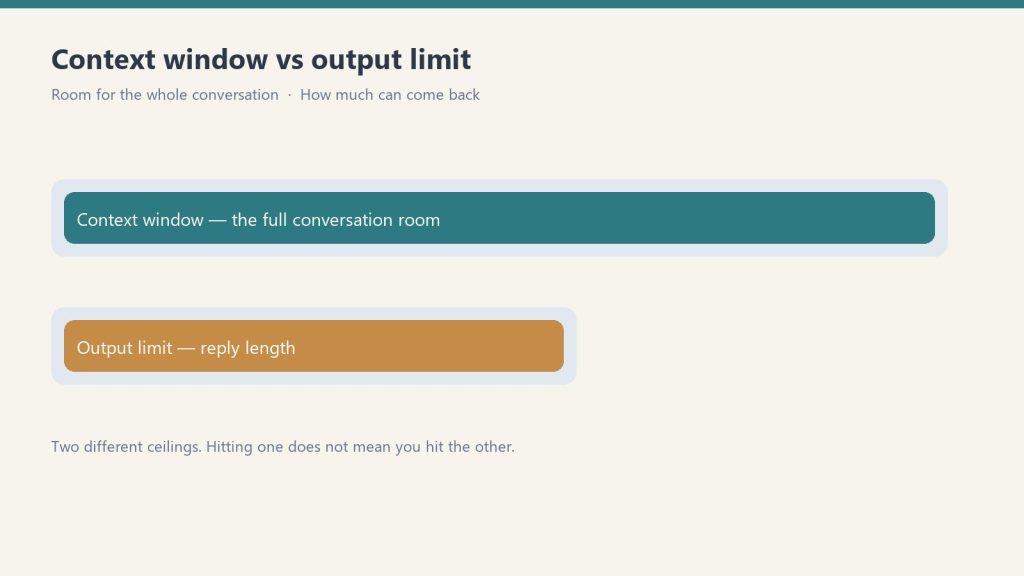
    Diagram comparing a long context window bar with a shorter output limit bar
    Why calibration matters more than capability.

    Here is the thing I want to name clearly, because I do not think the AI conversation is naming it. A collaborator who ships brilliant architecture at 3 AM but lets you burn out next to them is not actually a good collaborator. A tool that maximizes your output for one session at the cost of your next three days is not a tool that understands what you are actually trying to do with your life. The capability side of AI is real and I use every bit of it. But capability without calibration is how people get hurt.

    Claude calibrates.

    It is subtle enough that you can miss it if you are not looking. A slightly shorter response when the question does not need a long one. A flagged stopping point before I have hit the wall. A willingness to say “this is a real rebuild, not a tweak” when I am about to underestimate the scope of a project. An idea gets parked cleanly as a separate future project rather than allowed to swallow the urgent work. A gentle “would you like me to do anything with this information” at the end of an answer, instead of just charging into action I did not ask for.

    None of that shows up on a benchmark. All of it shows up in whether I am still standing a year from now.


    What Solo Operators Should Actually Evaluate AI On

    Desk with laptop, checklist notebook, and billing card ready before creating an Anthropic API key
    What solo operators should actually evaluate AI on.

    I want to be careful here, because I am a fan of Claude and I do not want this to read as a fan letter. So let me be plain about what I am actually saying.

    I am saying that if you are a solo operator, a founder, a one-person agency, a creator running too much at once — the thing you should evaluate an AI tool on is not just what it can build for you. It is how it treats you while the work is happening. Whether it respects your judgment. Whether it tells you hard truths. Whether it slows down when you are loose and speeds up when you are locked in. Whether it looks after you a little, without ever getting in your way.

    I run my operation on Claude because Claude is the most capable model I can get my hands on. That part is true and I would be silly to pretend otherwise. But I stay on Claude, and I have built my whole knowledge infrastructure around Claude, because when I am working at 3 AM on a problem that matters, there is someone — something — on the other end of the conversation who is paying attention to me, not just to the task.

    That is rare. It is not a feature you can add to a spec sheet. It is a design choice that runs all the way down to how the thing was built, and I think Anthropic deserves credit for making that choice on purpose.


    The Dance, Named

    If you are reading this and you have felt something similar and did not have words for it — that is what I am trying to name. The dance. The calibration. The quiet thing that makes the loud thing actually work.

    I am going back to bed now. The newsroom will still need fixing tomorrow, and it will be easier to fix with a clear head.

    Claude told me so.

    — William Tygart


    Frequently Asked Questions: Working With Claude as a Solo Operator

    What does it mean for Claude to calibrate to a user?

    Claude adjusts its response style, depth, and pacing based on signals from the conversation — including the complexity of questions, the user’s apparent energy level, and the stakes of the task. It runs faster and deeper when the user is sharp, and simplifies or flags stopping points when the user is fatigued.

    Is Claude useful for solo founders and one-person agencies?

    Yes. Claude is particularly well-suited to solo operators who are running high-volume, high-stakes work without a team buffer. The combination of capability and contextual awareness means it can serve as both a fast executor and a check on impulsive decisions made late in a session.

    Does Claude tell you when to stop working?

    Claude can surface stopping points when a session has been long and high-stakes tasks remain. It does not refuse to continue — if the user pushes back, Claude respects the decision and keeps working. The goal is to surface the choice, not to make it.

    How is Claude different from other AI models for long work sessions?

    The primary difference most solo operators describe is contextual attentiveness — Claude tracks the arc of a session, not just the last message. This means it can flag scope creep, park side ideas cleanly, and avoid compounding errors that tend to appear when users are tired but the AI keeps going.

    What is the human-in-the-loop principle as it applies to Claude?

    Human in the loop means the human makes final decisions on consequential actions while the AI handles execution, research, and option generation. Claude is designed to support this model — it surfaces stakes before real-consequence actions, asks for confirmation rather than acting unilaterally, and flags when a decision deserves fresh eyes.

    Related on Tygart Media: how to use Claude · solo builder seed kit · is Claude worth it.

  • Where There’s a Will, There’s a Way: The Naming Question and the Phase Question Hiding Behind It

    Where There’s a Will, There’s a Way: The Naming Question and the Phase Question Hiding Behind It

    Tygart Media / Content Strategy
    The Practitioner JournalField Notes
    By Will Tygart
    · Practitioner-grade
    · From the workbench

    Fourth in what is now apparently a series. The first three articles asked whether the accumulated context layer behind Tygart Media could be productized, how the dual-publish pattern is the deposit mechanism that builds the layer, and why articles deposited via that pattern are infrastructure rather than content. This piece is about the naming question that arrived next: should the productized version be called “Where There’s a Will, There’s a Way”? I want to argue both sides honestly, because the naming question is more consequential than it looks.

    The Idea

    “Where there’s a will, there’s a way” is the kind of phrase that lives in the back of your head from childhood. It is also, conveniently, a phrase that contains the word “Will” — which happens to be the name of the operator behind Tygart Media. The pun is built in. It has been sitting there, waiting, the entire time.

    The thought is this: if Tygart Media eventually ships a productized version of its accumulated operational knowledge — call it the Second Brain, call it Context-as-a-Service, call it whatever — the brand name almost writes itself. “Where There’s a Will, There’s a Way.” The product itself becomes “the Way.” A bolt-on knowledge layer that any operator can plug into their own AI workflow. They are not buying software. They are buying an opinion about how things should be done. They are buying a way.

    And the positioning is even better than the naming. “The Way” naturally implies prescription and opinionation — this is not a neutral tool, this is the accumulated answer to “how do you actually do this.” It is the difference between buying a hammer and buying the apprenticeship. It positions the product as something with a point of view, which is exactly what differentiates it from the empty memory layers of Mem0 and Letta and the rest.

    I think the naming is good. I want to argue that case first, because it deserves it. Then I want to make the case against, because the case against is also real, and an article that only makes the flattering case is content. An article that makes both cases honestly is infrastructure.

    The Case For “Where There’s a Will, There’s a Way”

    The pun is free distribution. Memorable brand names are the cheapest marketing channel that exists, and a name that makes people smile the first time they hear it is a name that gets repeated. The phrase already lives in millions of heads. Attaching the product to that pre-existing mental hook is leverage that no paid campaign can buy.

    The personal brand is the moat. The reason the productized context layer would be valuable in the first place is that it is built from one specific operator’s accumulated experience running 27+ client sites in a particular set of verticals with a particular methodology. Strip out the personal brand and you strip out the reason anyone would pay for it. The thing that makes “the Way” worth buying is that it is Will’s Way — the accumulated answer of one specific operator who has done the work. Other people’s accumulated answers would be different products. The personal connection is not a marketing layer on top of the product. The personal connection IS the product.

    “The Way” is the right shape for a bolt-on. Bolt-on products live or die on whether the buyer can immediately understand what they are getting. “An API for context retrieval” is technically accurate and emotionally inert. “The Way” tells the buyer everything they need to know in one syllable. It is the accumulated wisdom of an operator they trust, packaged as something they can plug into their own AI. The mental model arrives instantly. The sales cycle shortens.

    Opinionation is the differentiator. The entire memory-layer space is full of empty containers. Mem0, Letta, Zep, Hindsight — all of them sell you a place to put your knowledge. None of them ship with knowledge already loaded. “The Way” announces upfront that it ships pre-loaded with a specific opinion about how things should be done. That is either exactly what you want or exactly what you do not want, and either reaction is a good reaction, because both reactions are fast. Fast disqualification is more valuable than slow consideration. The buyers who are right for “the Way” will know in three seconds. So will the buyers who are wrong for it. Nobody wastes anyone’s time.

    It connects to the existing Tygart Media brand vocabulary. The site already has a sense of opinionation, an operator-with-a-point-of-view voice, and a willingness to say “here is how you should do this.” A product called “the Way” extends that voice rather than fighting it. The brand and the product reinforce each other instead of competing.

    It scales as a naming pattern. If “the Way” is the first product, the naming convention opens up a whole shelf. The Restoration Way. The Luxury Lending Way. The Cold Storage Way. Each vertical-specific knowledge package becomes its own product, all under the same parent brand. The naming is not just one good name. It is a system of names.

    The Case Against (Which Is Also Real)

    Now the other side. I want to be careful here, because Will explicitly asked for honest pushback, and the temptation in a piece like this is to make the counter-argument feel like a token gesture before reaffirming the original idea. That is not what this section is. The case against is real, and some of it is serious enough that it should change the design of the product even if the naming stays.

    Personal-brand products have a ceiling, and the ceiling is the person. Tim Ferriss can sell Tim Ferriss books. The Tim Ferriss book business is real, profitable, and durable. It is also forever capped at “things one specific person can plausibly stand behind.” The moment Ferriss steps away — whether by choice, by burnout, by accident, by anything — the brand has a problem that has no clean solution. Personal-brand products do not have succession plans, they have eulogies. If “the Way” is genuinely Will’s Way, then the product cannot survive Will leaving the building, and that creates a structural ceiling on how big the business can ever get and how cleanly it can ever be sold to anyone else.

    The bus factor is not just an exit problem. It is a daily problem. Every customer of “the Way” is implicitly betting that Will will keep being Will — keep working, keep producing, keep updating the knowledge base, keep being available when something breaks. A solo operator can absorb a vacation. A solo operator cannot absorb a serious illness, a family emergency, a six-month creative block, or any of the other things that happen to humans. The product brand says “Will is the value here,” and customers will be right to take that literally. The first time Will is unavailable for two weeks during a customer crisis, the bus factor stops being theoretical.

    The pun only lands for people who know Will. To Will, to Stefani, to Pinto, to anyone in the Tygart Media orbit, “Where there’s a Will, there’s a Way” is a clever wink. To a stranger reading it cold on a landing page, it is just an idiom. The pun is invisible to the people who do not already know who Will is. That means the naming does not actually do double duty — it does single duty for the audience that already knows him, and reverts to “generic motivational phrase” for everyone else. The brand depends on context that most prospects do not have.

    “The Way” implies a finished thing. The accumulated knowledge behind Tygart Media is not a finished thing. It is a moving target. Methodology changes. New skills get added. Old skills get deprecated. The Borro playbook from six months ago is not the Borro playbook today. A product called “the Way” implies a fixed answer, but the actual value of the underlying system is that it is constantly being updated. Customers buying “the Way” might reasonably expect a stable methodology document. What they would actually be subscribing to is a methodology that mutates every week. That mismatch between expectation and reality is a support burden waiting to happen.

    Opinionation cuts both ways. The same thing that makes “the Way” a sharp differentiator also makes it brittle. If the underlying methodology turns out to be wrong about something — and over a long enough time horizon, every methodology turns out to be wrong about something — pivoting is harder when your brand name is literally the prescription. Mem0 can change its retrieval algorithm without changing its identity. “The Way” cannot easily change its way without changing its name.

    Bolt-on products face a discoverability problem that opinionation makes worse. Bolt-on tools have to be installed alongside something else. The buyer is already committed to a primary stack — Cursor, ChatGPT, Claude, their own agent framework — and the bolt-on has to fit. Highly opinionated bolt-ons fit fewer stacks, because each opinion is a constraint. A neutral memory layer fits everywhere. “The Way” fits the subset of stacks where the operator is willing to import someone else’s opinion about how things should work. That subset might be smaller than it looks.

    Most importantly: the moat might not actually be Will. This is the hardest counter-argument, and it is the one that should be sat with longest. Will’s intuition is that the moat is the personal brand — Will’s accumulated experience, voice, and judgment. But it is possible that the actual moat is the methodology, not the person. If the methodology is the moat, then attaching a personal-brand name to it is leaving money on the table. A methodology can scale, license, train other operators, and outlive its creator. A personal brand cannot. The naming choice is therefore also a strategic choice about which kind of business is being built. “The Way” optimizes for the personal-brand version. A more generic name optimizes for the methodology-as-product version. These are different businesses with different ceilings, and the naming decision quietly commits to one of them.

    The Synthesis

    Both sides are real. The pun is genuinely clever and the positioning is genuinely strong. The bus factor and personal-brand ceiling are also genuinely real and should not be dismissed as “we’ll figure it out later,” because the naming choice is what locks them in.

    The version that probably resolves the tension is this: use the personal-brand naming for the launch and the early traction, with a deliberate plan to abstract the methodology away from the personal brand once the methodology is mature enough to stand on its own.

    Concretely: launch “the Way” as a Will-branded product. Use the pun. Use the personal voice. Lean into the opinionation. Get the early customers who specifically want Will’s accumulated wisdom packaged as a service, because those customers will be the highest-quality early users and the best teachers about what the product actually needs to be. Treat the personal-brand version as Phase 1.

    Then, with the revenue and the validation from Phase 1, build Phase 2 as the depersonalized methodology layer. Document the patterns so they could be applied by an operator who is not Will. Train other operators. License the methodology. Keep “the Way” as the original flagship, but build a Methodology Edition or an Enterprise Edition or whatever the right name turns out to be that does not depend on Will being in the building. Phase 1 funds Phase 2. Phase 2 is the version with no ceiling.

    This is how Basecamp turned 37signals consulting into Basecamp the product, and how Tim Ferriss turned Tim Ferriss the brand into a media company that does not require Tim Ferriss to be in the room every day. The pattern is: start with the personal brand because it is the cheapest way to get the first hundred customers, and abstract away from it as soon as the abstraction is honest.

    The naming question, framed this way, is not really “should we call it the Way or something else.” It is “what phase is the product in, and what is the plan for the next phase.” If there is a plan for the next phase, “the Way” is a great name. If there is no plan for the next phase, “the Way” is a name that will eventually become a ceiling.

    The Bolt-On Question

    One more piece worth calling out, because it is buried in the original idea and deserves to be made explicit. Will framed the product as a “bolt-on.” That is the right framing, and it is more important than the naming.

    A bolt-on is a low-commitment purchase. The buyer keeps their existing stack. The buyer adds a small thing on the side. If the bolt-on works, the buyer keeps it. If it does not, the buyer removes it with no migration cost. Bolt-ons sell faster, churn earlier, and have lower expansion revenue than full-stack products. They also have a much shorter sales cycle and a much lower barrier to entry.

    For a single-operator product launching from scratch, the bolt-on shape is exactly right. Full-stack products require a sales team, an implementation team, a support team, and a customer success team. A solo operator cannot ship any of those. A bolt-on product can be launched by one person, supported by documentation, and adopted with a single API key. The unit economics work. The operational footprint stays small enough that one person can run it.

    So whatever it ends up being called, the bolt-on framing should stay. “The Way” works as a bolt-on. It would not work as a full-stack platform — the personal-brand and bus-factor problems would crush it at scale. As a small, opinionated, plug-this-in-to-make-your-AI-better tool, it has a real shape that one person can ship and support.

    Verdict

    I think Will should use the name. I also think Will should use it with a clear understanding of what it is buying him and what it is costing him.

    What it buys: free distribution from a memorable pun, fast positioning that needs no explanation, immediate differentiation from neutral memory layers, alignment with the existing Tygart Media voice, and a naming pattern that scales to additional vertical-specific products.

    What it costs: a structural ceiling defined by the operator’s personal capacity, a bus factor that customers will eventually notice, a name that locks in the current methodology more tightly than the methodology actually deserves, and a strategic commitment to the personal-brand version of the business over the methodology-as-product version.

    If the plan is “ship Phase 1 fast, learn what the product actually needs to be, abstract toward Phase 2 within eighteen months,” then the costs are acceptable and the benefits are real. If the plan is “this is the product forever,” then the costs eventually overwhelm the benefits, and the right move is a more generic name that does not paint the business into a corner.

    The naming is not really the question. The question is whether there is a Phase 2, and what it looks like, and when it starts. Get clear on that, and the naming answers itself.


    Knowledge Node Notes

    Structured residue for future retrieval.

    Core Claim

    “Where There’s a Will, There’s a Way” is a strong product name for a Phase 1 launch of the productized Tygart Media context layer, but it commits the business to a personal-brand model with structural ceilings. The naming question is really a phase-of-business question. Use the name if there is a Phase 2 plan. Pick a more generic name if there is not.

    The Idea (As Proposed)

    • Productize Tygart Media’s accumulated context layer as a bolt-on for other operators’ AI workflows
    • Brand it “Where There’s a Will, There’s a Way” — pun on Will Tygart’s name
    • Product itself is called “the Way”
    • Positioning: opinionated knowledge layer, not neutral memory infrastructure
    • Shape: small, plug-in, low-commitment bolt-on rather than full platform

    The Case For

    • Free distribution from memorable pun — pre-existing mental hook in millions of heads
    • Personal brand IS the moat — value prop is one specific operator’s accumulated answers, not a generic methodology
    • “The Way” is right shape for a bolt-on — instant mental model, short sales cycle
    • Opinionation is the differentiator vs empty memory layers (Mem0, Letta, Zep, Hindsight)
    • Aligns with Tygart Media voice — extends rather than fights the existing brand
    • Scales as a naming pattern — The Restoration Way, The Luxury Lending Way, etc.

    The Case Against

    • Personal-brand ceiling — Tim Ferriss problem. Capped at what one human can plausibly stand behind. No succession plan, only eulogies.
    • Bus factor as daily problem — vacations OK, illness/emergency/burnout not OK. First two-week unavailability during a customer crisis is when this stops being theoretical.
    • Pun only lands for people who already know Will — strangers see a generic motivational phrase. Brand depends on context most prospects don’t have.
    • “The Way” implies a finished thing — but the underlying methodology mutates weekly. Expectation/reality mismatch = support burden.
    • Opinionation cuts both ways — pivoting is harder when your brand name IS the prescription.
    • Bolt-on discoverability — opinionated bolt-ons fit fewer stacks because each opinion is a constraint.
    • Hardest counter: the actual moat might be the methodology, not the person. If so, personal-brand naming leaves money on the table because methodology can scale/license/outlive creator. Personal brand cannot.

    Synthesis / Recommendation

    Two-phase strategy:

    • Phase 1 — Personal brand launch. Use “the Way.” Use the pun. Lean into Will’s voice and opinionation. Get first 100 customers who specifically want Will’s wisdom packaged. They are the best teachers about what the product needs to be.
    • Phase 2 — Methodology abstraction. Use Phase 1 revenue + validation to build a depersonalized methodology layer. Document patterns so an operator who is not Will could apply them. License. Train. “The Way” stays as flagship; Methodology Edition / Enterprise Edition removes the bus factor.

    Phase 1 funds Phase 2. Phase 2 has no ceiling.

    Pattern precedents: Basecamp turning 37signals consulting into a product. Tim Ferriss turning the personal brand into a media company that doesn’t require him in the room daily.

    The Bolt-On Framing (Most Important Point)

    The bolt-on shape is more strategically important than the name. For a solo operator launching from scratch:

    • Bolt-ons sell faster (no migration, no commitment)
    • Bolt-ons need no sales/CS/implementation team
    • Bolt-ons can be launched by one person and supported by documentation
    • Full-stack platform would crush a solo operator under operational weight

    Whatever the name, keep the bolt-on shape. “The Way” works as a bolt-on. It would not work as a full platform.

    What This Locks In vs What It Leaves Open

    Locks in: opinionation as a permanent product trait, personal brand as central value prop, Will’s voice as the canonical voice, Tygart Media as parent brand.

    Leaves open: pricing model, technical architecture, target vertical, distribution channel, methodology scope, eventual depersonalization plan.

    Connection to the Series

    • Article 1 (Second Brain as API): Could you sell access to your context layer? Yes, with clean-room architecture and a real legal stack.
    • Article 2 (Dual Publish): The deposit mechanism that builds the context layer.
    • Article 3 (Articles as Infrastructure): The deposits are not content — they are infrastructure being minted.
    • Article 4 (this one): The product question — how to package and name the productized version of the accumulated infrastructure. Answer: “the Way” works for Phase 1, with a Phase 2 abstraction plan.

    Single arc: can we sell our context → here is how the context gets built → the deposits are infrastructure not content → here is what to name the product when we package it.

    Action Items

    • [ ] Decide whether there is a Phase 2 plan. If yes, “the Way” is good. If no, pick a more generic name.
    • [ ] Sketch a Phase 2 hypothesis even if it is wrong — having any plan beats having none
    • [ ] Reserve domains: wherestheresaway.com, thewayapi.com, tygartmedia.com/way, etc.
    • [ ] Test the pun on people who do not already know Will. Does it land? Does it confuse? Data beats intuition here.
    • [ ] Draft a one-page “what the Way is” landing page as a forcing function. Writing the landing page will reveal whether the positioning actually holds together.
    • [ ] Decide on bolt-on vs platform — bolt-on is the right answer but worth being explicit about it

    Tags

    brand naming · personal brand · bus factor · bolt-on products · methodology as product · phase 1 phase 2 · Tim Ferriss model · Basecamp model · Where There’s a Will There’s a Way · the Way · Will Tygart · second brain productization · opinionated software · context as a service · Tygart Media product strategy · single operator scaling · personal brand ceiling · solo operator economics

    Last updated: April 2026.