Tag: Notion

  • Notion Command Center: How I Run 27 Agency Client Sites

    Notion Command Center: How I Run 27 Agency Client Sites

    The Agency Playbook
    TYGART MEDIA · PRACTITIONER SERIES
    Will Tygart · Senior Advisory · Operator-grade intelligence

    I run 27 client WordPress sites from a single Notion workspace. No project management software, no agency platform, no dedicated CRM. Just Notion — architected deliberately across six interconnected databases — handling task triage, content pipelines, client relationships, revenue tracking, and the knowledge infrastructure that feeds an AI-native content operation.

    This is not a productivity tutorial. This is a description of a real system, built over two years, that runs across seven distinct business entities simultaneously. If you’re an agency owner, solo operator, or content business trying to figure out how to use Notion for something more serious than a to-do list, this is what the other end of that road looks like.

    What is a Notion Command Center? A Notion Command Center is a multi-database workspace architecture that functions as a single operating system for a business or portfolio of businesses. Rather than using Notion as a note-taking app, a Command Center connects tasks, clients, content, and knowledge into a unified system with defined workflows, priority rules, and daily operating rhythms.

    Why Notion Instead of Dedicated Agency Software

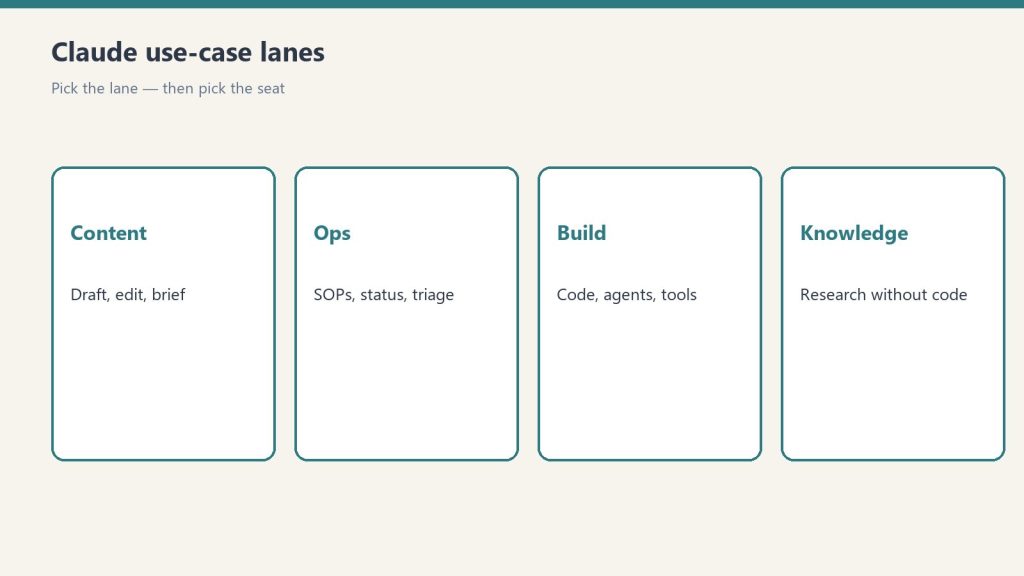
    Four cards for content, ops, build, and knowledge work with Claude
    Why Notion instead of dedicated agency software.

    The honest answer: I tried the alternatives. ClickUp has more native project management features. Asana handles task dependencies better out of the box. Monday.com is more polished for client-facing views.

    None of them let me build exactly the system my operation requires. And at the scale I’m running — 27 client sites, seven business entities, a live AI publishing pipeline — the ability to customize the architecture matters more than any individual feature.

    Notion also has a meaningful advantage that most people underestimate: it integrates with Claude natively. My entire operation runs on Claude as the AI layer, and a Notion workspace structured correctly becomes something Claude can read, reason about, and act on. That combination — Notion as the OS, Claude as the intelligence — is what makes this a genuinely AI-native operation rather than just an AI-assisted one.

    The 6-Database Architecture

    Long paper tape measure unrolling across a desk beside a laptop, metaphor for context window length
    The 6-database architecture for agency command centers.

    The Command Center runs on six core databases. Everything else in the workspace is either a view of these databases, a child page underneath them, or a standalone reference document. The six databases are:

    1. Master Actions

    Every task across all seven entities lives here. Priority levels run P1 (revenue or reputation at risk today) through P4 (delegate or kill). Each task carries an Entity tag, a Status, a Due Date, and a linked record in whichever other database it belongs to — a client, a content piece, a deal.

    The daily operating rule: never more than five tasks marked “Next Up” across the entire workspace at once. If your Next Up list has eight items, something is mislabeled. P1 means the thing doesn’t get done and real consequences follow today.

    2. Content Pipeline

    Every article across all 27 client sites flows through this database before it hits WordPress. Status stages run from Brief → Draft → Optimized → Scheduled → Published. The database links to the client entity, carries the target keyword, the target site URL, word count, and a publication date.

    Nothing publishes without a Notion record. This is a hard rule established after the alternative — articles written in sessions and pushed directly — created audit gaps that took hours to resolve. Notion first, WordPress second.

    3. Revenue Pipeline

    Client deals, proposals, and retainer renewals. Stage-based (Lead → Qualified → Proposal Sent → Active → Renewal). Links to the Master CRM for contact records. The weekly review checks whether any deal has sat in the same stage for more than seven days without activity — that’s a warning sign that gets flagged.

    4. Master CRM

    Every contact across all seven entities. Clients, prospects, golf league members, partners, vendors. Tagged by entity, relationship type, and last contact date. The weekly review catches anyone who should have heard from me and didn’t.

    5. Knowledge Lab

    SOPs, architecture decisions, session logs, and reference documents. This is where the institutional knowledge lives — the things that would take hours to reconstruct if I had to start from scratch. The Knowledge Lab uses a metadata standard (I call it claude_delta) that makes every page machine-readable, so Claude can fetch and reason about the content in a live session without losing context.

    6. William’s HQ

    The daily dashboard. A filtered view of P1 and P2 tasks due today or overdue, the content queue for the next 48 hours, and the inbox triage. This is the page that opens first every morning. Everything else in the system is accessed from here.

    The Seven Entity Structure

    The system manages seven distinct business entities, each with its own Focus Room — a sub-page containing that entity’s active projects, open tasks filtered by entity tag, and key reference documents. The entities are:

    • The parent agency — managing all client sites and retainer relationships
    • Personal brand — direct services, thought leadership, and new business
    • Client A — content operation for a contractor in a regional market
    • Client B — content operation for a service business in a metro market
    • Industry network — B2B community and event operation
    • Content property — topical authority site in a specific vertical
    • Personal — finances, health commitments, personal projects

    The entity structure means a task logged under “a regional client content operation” never bleeds into the the parent agency content queue. The databases are shared, but the entity tag acts as a partition. This matters operationally when you’re switching contexts fifteen times a day — the system tells you where you are and what belongs there.

    The Daily Operating Rhythm

    Desk with laptop, checklist notebook, and billing card ready before creating an Anthropic API key
    The daily operating rhythm that keeps the stack moving.

    The Command Center only works if you use it on a rhythm. Mine runs on three loops:

    Morning Triage (10–15 minutes)

    Open William’s HQ. Zero the inbox — every untagged item gets a priority, a status, and an entity. Read the P1 and P2 list. Mentally commit to the top three. Check the content queue for anything publishing in the next 48 hours that isn’t scheduled. That’s a P1 fix before anything else happens.

    End-of-Day Close (5 minutes)

    Mark done tasks complete. Push anything untouched but intended — update the due date or reprioritize down. Check the content queue for tomorrow’s publications. If anything new was created during the day — a contact, a content piece, a deal — verify it’s logged in the right database with the right entity tag.

    Weekly Review (30 minutes, Sunday evening)

    Revenue: any deal stuck in the same stage as last week? Content: next week’s queue fully populated? Tasks: archive all Done tasks older than 14 days. Relationships: anyone who should have heard from me and didn’t? System health: any automation that failed silently?

    The weekly review is the repair mechanism. It catches the things the daily rhythm misses and resets the system before the next week compounds the drift.

    How Claude Plugs Into This

    The Knowledge Lab’s claude_delta metadata standard is what makes the Notion–Claude integration functional rather than theoretical. Every page in the Knowledge Lab carries a JSON metadata block at the top that tells Claude the page type, status, summary, key entities, and a resume instruction for picking up work in progress.

    In practice, this means I can start a session by telling Claude to read a specific Knowledge Lab page, and Claude has enough structured context to continue from exactly where the last session ended — without me re-explaining the project, the client, the constraints, or the decisions already made. The Notion workspace functions as persistent memory across Claude sessions.

    This is the part of the architecture that most people haven’t built yet. Notion as a note-taking app is one thing. Notion as a structured knowledge layer that an AI can navigate and act on is a meaningfully different proposition — and it’s the direction serious operators are moving.

    What This Architecture Costs to Build

    Honest answer: the architecture itself took about three months of active iteration to stabilize. The first version had too many databases, unclear relationships between them, and no real operating rhythm to enforce the discipline. The current version is the result of tearing down and rebuilding twice.

    The tooling cost is low. Notion’s Plus plan at $10/month per member handles everything described here. The BigQuery knowledge ledger that backs the AI memory layer runs on Google Cloud at effectively zero cost at this scale. Claude API usage for content operations runs roughly $50–150/month depending on session volume.

    What actually costs something is the setup time and the learning curve of building databases that relate to each other correctly. Most Notion setups fail not because the tool is limited but because the architecture wasn’t designed before the databases were created.

    Whether This Is Right for Your Agency

    The Command Center architecture works well for solo operators and small agencies managing multiple clients or business lines simultaneously. It works especially well when you’re running an AI-native content operation and need Notion to function as more than task management.

    It’s not the right choice if you need strong native time-tracking, Gantt charts, or client-facing portals that look polished without customization. Those cases have better-suited tools.

    But if you’re running a content agency, a multi-client SEO operation, or any business where the work is primarily knowledge work — briefs, articles, strategies, SOPs, client communications — and you want one system that sees all of it, the 6-database Command Center architecture is worth the build time.

    Want this built for your operation?

    We set up Notion Command Centers for agencies and operators — the full architecture, configured and documented, not a template to figure out yourself.

    Tygart Media has built and runs this system live across 27 client sites. We know what the setup process actually looks like.

    See what we build →

    Related on Tygart Media: Notion content pipeline for multi-client ops · how we build client portals · SOP system in Notion.

    Frequently Asked Questions

    How many databases does a Notion Command Center need?

    A functional Command Center for an agency or multi-client operation typically needs six core databases: a task database, a content pipeline, a revenue pipeline, a CRM, a knowledge base, and a daily dashboard. More than eight databases usually indicates an architecture problem — complexity that should be handled with views and filters, not additional databases.

    Can Notion handle 27 client sites without getting slow?

    Yes, with proper architecture. The key is using filtered views rather than separate databases for each client, and keeping database page counts manageable by archiving completed records regularly. Notion’s performance degrades when a single database exceeds a few thousand active records — archive aggressively and it stays fast.

    How does Notion integrate with Claude AI?

    Notion and Claude integrate through structured page formatting and the Notion API. By standardizing metadata at the top of key pages — page type, status, summary, key entities — Claude can fetch and interpret Notion content in a live session. More advanced setups use the Notion API to read and write records programmatically during Claude sessions, effectively making Notion the persistent memory layer for AI operations.

    What’s the difference between a Notion Command Center and a regular Notion workspace?

    A regular Notion workspace is typically organized around document types — pages, notes, tasks — without enforced relationships between them. A Command Center is organized around business operations — entities, pipelines, and workflows — with databases that relate to each other and a defined operating rhythm that governs how the system gets used each day.

    How long does it take to set up a Notion Command Center?

    Building the architecture from scratch takes 20–40 hours of focused setup time, including database design, relationship configuration, view creation, and SOP documentation. Most operators who attempt it solo take 2–3 months of iteration before the system stabilizes. Working from an existing architecture and having it configured for your specific operation compresses that significantly.

    Is Notion good for content agencies specifically?

    Notion is well-suited for content agencies because the core work — briefs, drafts, SOPs, client communication, publishing schedules — is document-centric. The Content Pipeline database, linked to a CRM and task system, gives visibility into every piece of content across every client at once, which is difficult to replicate in project management tools not built for document-heavy workflows.

  • What Notion’s Claude Managed Agents Integration Actually Does

    What Notion’s Claude Managed Agents Integration Actually Does

    Tygart Media Strategy
    Volume Ⅰ · Issue 04Quarterly Position
    By Will Tygart Long-form Position Practitioner-grade

    When Anthropic launched Claude Managed Agents, Notion was one of four launch partners. That detail got buried in the announcement. Here’s what it actually means for people who use Notion for knowledge work, and why “Notion voice input desktop” keeps showing up as a query against a Managed Agents page.

    Short answer: Managed Agents in Notion is an ambient intelligence layer. It’s not a chatbot in a sidebar. It’s an agent that watches your workspace and acts — without you directing every step.

    What the Notion Integration Actually Does

    Four cards for content, ops, build, and knowledge work with Claude
    What the Notion integration actually does.

    Notion’s Claude Managed Agents integration runs as a persistent background agent with access to your workspace. The practical capabilities, as documented at launch:

    • Autonomous page updates: The agent can read, summarize, and rewrite Notion pages without manual triggers. You set a task; it works through it.
    • Cross-database synthesis: Pull data from multiple Notion databases, synthesize it, and write outputs to a target page or database entry
    • Meeting note processing: Ingest raw meeting notes and produce structured summaries, action items, and task entries in your project database
    • Workflow automation: Trigger actions based on database property changes — a status update in one database can kick off agent work in another

    The key difference from Notion AI (which Notion has had for some time): Notion AI is request-response. You ask it something; it answers. Managed Agents in Notion can be configured to run autonomously on a schedule or on trigger, keep working through multi-step tasks, and report back when done. It’s closer to a background employee than an on-demand assistant.

    Why This Showed Up in Search as “Notion Voice Input Desktop”

    This is worth explaining, because that query cluster is real and mildly interesting. The Managed Agents announcement included voice input functionality — the ability to interact with agents via voice in some contexts. People searching “notion voice input desktop” and “notion ai voice input desktop” were looking for whether this voice capability existed in the desktop client for Notion specifically.

    The honest answer as of April 2026: voice input capabilities are in preview or context-dependent. Verify current availability in Notion’s desktop client against their current documentation — this is an area that may have evolved since launch.

    The “Decoupled Brain and Hands” Model Applied to Notion

    Anthropic describes their Managed Agents architecture as decoupling the brain (Claude, the reasoning layer) from the hands (the sandboxed containers where actions execute). In Notion’s context, this maps cleanly:

    • The brain reads your Notion workspace, understands context, makes decisions about what to do
    • The hands execute — writing to pages, updating database entries, moving content between sections

    The brain and hands operate independently. The agent can reason about what your project needs without being tightly coupled to the specific API calls that will implement it. This matters because it means the agent can handle ambiguity — “clean up the Q2 notes and create action items” is a goal, not a procedure, and the agent figures out the procedure.

    What You Actually Configure

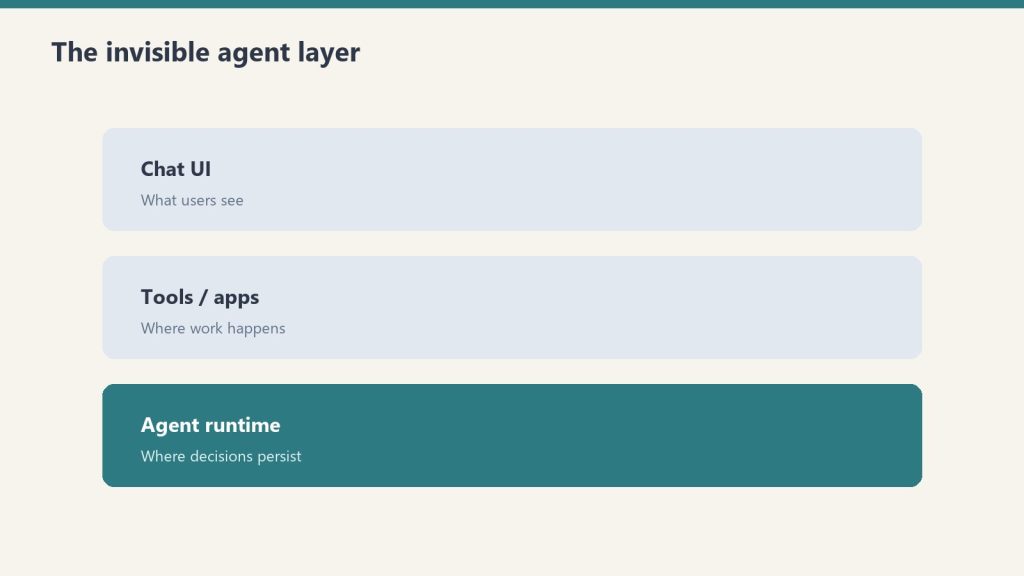
    Three stacked layers: chat UI, tools, agent runtime
    What you actually configure.

    To run Claude Managed Agents in Notion, you’re defining:

    • Task definition: What the agent is supposed to accomplish (in natural language or structured format)
    • Tool access: Which Notion databases, pages, and capabilities the agent can read and write
    • Guardrails: What the agent cannot do — pages it can’t modify, actions it must confirm before taking
    • Trigger: When the agent runs — on schedule, on database trigger, or on demand

    You don’t write the orchestration logic. Anthropic’s infrastructure handles session management, state persistence, and error recovery. If the agent hits an error mid-task, it checkpoints and recovers — you don’t lose progress.

    The Practical Cost of Running Notion Agents

    Using Managed Agents in Notion triggers the same billing as any Managed Agents session: standard token rates plus $0.08/session-hour of active runtime. For typical knowledge work tasks:

    • A daily meeting summary agent running 15 minutes of active execution: ~$0.02/day in runtime (~$0.60/month), plus token costs for the volume of notes processed
    • A weekly database synthesis task running 45 minutes: ~$0.06/run

    For most knowledge workers, the session runtime cost is negligible — the token costs (driven by how much content the agent reads and writes) are the actual variable to model. See the complete pricing reference for worked examples.

    Asana and the Broader Pattern

    Asana was also a Managed Agents launch partner, and the integration pattern is similar: an agent that can read project data, update task statuses, move cards, and generate project summaries without constant human direction. The launch partner list (Notion, Asana, Rakuten, Sentry) suggests Anthropic targeted three categories: knowledge management (Notion), project management (Asana), enterprise operations (Rakuten), and developer tools (Sentry).

    That’s a deliberate wedge. If agents can handle the administrative layer of these four categories, the surface area for autonomous business work expands significantly.

    What This Means for How You Work

    Desk with laptop, checklist notebook, and billing card ready before creating an Anthropic API key
    What this means for how you work.

    The honest use case for most people reading this: you have a Notion workspace with databases that need regular synthesis, and you’re currently doing that manually. Managed Agents is the path to automating that synthesis without building and maintaining a custom integration.

    The constraint worth naming: you’re running your workspace data through Anthropic’s infrastructure. That’s the trade-off. For most knowledge work, the data sensitivity concern is low. For anything involving client data, legal documents, or proprietary strategy — read Anthropic’s data handling terms before configuring access.

    For the full Managed Agents setup and pricing context: Claude Managed Agents: Every Question Answered. For the enterprise deployment pattern: How Rakuten Deployed 5 Enterprise Agents in a Week.

    Related on Tygart Media: managed agents review · Notion Command Center · managed agents memory use cases.

  • You’re Already Creating Content. You’re Just Not Capturing It.

    You’re Already Creating Content. You’re Just Not Capturing It.

    Tygart Media / Content Strategy
    The Practitioner JournalField Notes
    By Will Tygart · Practitioner-grade · From the workbench

    My partner Stefani hit record on her phone during a conversation we were having over coffee. She wasn’t writing a blog post. She wasn’t preparing a presentation. She was just thinking out loud about a client situation — how to explain a complex system to someone who needed it simple — and she wanted to get the words down before they disappeared.

    She emailed me the transcript that afternoon.

    By end of day, that conversation had become six published articles, six scheduled LinkedIn posts, and a set of knowledge nodes logged into our operating system — each one capturing a distinct idea that had surfaced naturally in a ten-minute exchange between two people thinking out loud.

    The ingredient was a voice memo. The process took a conversation that was already happening and made sure it didn’t disappear.

    The Problem Isn’t That You Don’t Have Enough to Say

    Most business owners I talk to feel like they don’t create enough content. They know they should be publishing more, sharing more, building more visibility. But when they sit down to write something, it feels hard. The blank page. The pressure to make it good. The time it takes.

    Here’s what I’ve come to believe: the problem isn’t output. The problem is capture.

    You are already creating content constantly. Every client conversation where you explain something clearly. Every time you talk through a decision with a partner or a team member. Every frustrated observation you make in the car on the way home from a job site. Every question a prospect asks that you answer so well they lean forward in their chair.

    That’s all content. That’s all knowledge. And almost all of it disappears the moment the conversation ends.

    Why Talking Is the Natural Input Layer

    The reason most note-taking systems fail is that note-taking interrupts thinking. The moment you stop to write something down, you break the flow of the idea. So people don’t do it. The thinking happens, it’s good, and then it’s gone.

    Talking doesn’t interrupt thinking. Talking is thinking, for most people. It’s how ideas get pressure-tested, refined, and articulated. The best version of an idea is often the one that comes out in a good conversation — not the one that gets written in isolation later.

    Which means if you can capture the conversation, you’ve captured the thinking at its best. Not a summary. Not notes. The actual thought, in your actual voice, as it was happening.

    The Reframe That Changes Everything

    You are not creating content. You are not losing what you already made.

    That reframe matters because it removes the performance pressure. You don’t have to be clever or polished or prepared. You just have to be willing to record the conversations that are already happening — the ones where you’re explaining your craft, thinking through a problem, or working something out with someone who pushes back in useful ways.

    The transcript of that conversation is the raw ingredient. Everything that comes after — the articles, the posts, the internal documentation — is distillation. Pulling out what’s there and giving it a form that other people can use.

    What This Looks Like in Practice

    The simplest version of this system has three parts:

    1. Record conversations worth keeping. Not every conversation — just the ones where something real is being worked out. Client calls where you explain something clearly. Partner conversations where an idea clicks. Voice memos when you’re driving and something occurs to you. The bar is low: if it felt like a good thought, it’s worth capturing.
    2. Get the transcript. Most phones transcribe automatically now. Email it to yourself. Drop it into a folder. The transcript doesn’t need to be clean — raw, stream-of-consciousness transcripts often contain the best material precisely because the thinking wasn’t performed for an audience.
    3. Distill it. This is where the knowledge nodes emerge. Read through the transcript and ask: what are the distinct ideas here? Not the whole conversation — the discrete, transferable concepts that could stand on their own. Name them. Write a short version of each. Now you have content, internal documentation, and a record of how your thinking has developed.

    The Compound Effect Over Time

    The part that most people underestimate is what this builds over time.

    Every distilled conversation adds to a growing body of captured knowledge. Your frameworks. Your methodologies. The specific language you’ve developed for explaining what you do. The patterns you’ve noticed across clients. The hard-won lessons from mistakes.

    Most business owners carry all of this in their heads. It lives and dies with them. It can’t be trained on, delegated from, or built upon because it was never written down. It’s invisible expertise — genuinely valuable, completely uncaptured.

    The voice-first capture habit changes that. Slowly, conversation by conversation, your knowledge base grows. Not because you sat down to build a knowledge base — but because you stopped letting good thinking disappear.

    The Lowest Friction Version

    You don’t need a system. You need a habit with almost no friction:

    Before a conversation you expect to be generative — a client call, a strategy session, a working lunch — hit record. Use your phone’s native voice memo app, or any transcription tool you already have. Tell the other person if it feels right. Most people don’t mind, and some are flattered.

    After, spend five minutes skimming the transcript. Pull out anything that felt sharp. Drop it somewhere — a note, an email to yourself, a folder. That’s it. The distillation can happen later, in batches, when you have help or time.

    The bar for what counts as worth capturing is lower than you think. An offhand explanation that clicked. A way of framing a problem that was new. A question you answered well. These are the raw materials of everything — your content, your training materials, your positioning, your pitch. They’re already in the conversations you’re already having.

    You’re just not catching them yet.

    What is voice-first knowledge capture?

    Voice-first knowledge capture is the practice of recording conversations — client calls, partner discussions, voice memos — and using the transcripts as the raw material for content, documentation, and internal knowledge. It treats talking as the natural input layer for knowledge creation.

    Why is a voice memo better than taking notes?

    Note-taking interrupts thinking. Talking doesn’t. The best version of an idea often surfaces in conversation — when you’re explaining something to someone, being pushed back on, or working through a problem in real time. A transcript captures that thinking at its peak, in your actual voice.

    What do you do with a conversation transcript?

    Read through it and pull out the discrete, transferable ideas — the knowledge nodes. Each one can become a piece of content, a section of internal documentation, or an entry in a knowledge base. The transcript is the raw ingredient; distillation is the process of giving those ideas a usable form.

    How much time does this take?

    The capture itself takes no additional time — you’re recording conversations that are already happening. The distillation can be done in batches and takes as little as five minutes per conversation for a first pass. The system compounds over time without requiring significant ongoing effort.

    Do you need special tools for this?

    No. A phone’s native voice memo app and any transcription tool (many are built into phones and email clients now) are sufficient to start. The system doesn’t require new software — it requires a new habit around the conversations you’re already having.

  • Notion-Deep, Surface-Simple: How to Build Knowledge Systems That Actually Get Used

    Notion-Deep, Surface-Simple: How to Build Knowledge Systems That Actually Get Used

    Tygart Media Strategy
    Volume Ⅰ · Issue 04Quarterly Position
    By Will Tygart Long-form Position Practitioner-grade

    There’s a useful architecture for how to hold complex knowledge inside an organization while keeping it accessible to the people who need to act on it.

    Call it Notion-Deep, Surface-Simple: build the internal knowledge structure as deep as you want, then surface it in the voice and format of whoever needs to use it.

    The Core Idea

    Four cards for content, ops, build, and knowledge work with Claude
    Notion-deep, surface-simple — the core idea.

    Most knowledge management systems fail in one of two directions.

    The first failure: they optimize for depth and comprehensiveness at the expense of usability. The system knows everything, but nobody can navigate it. It becomes the internal equivalent of a technical manual that everyone agrees is accurate and nobody reads.

    The second failure: they optimize for simplicity at the expense of utility. The output is clean and accessible, but the underlying knowledge is shallow. When edge cases show up — and they always do — the system has no answer.

    Notion-Deep, Surface-Simple resolves this by treating depth and accessibility as separate layers with separate jobs, rather than as tradeoffs against each other.

    What the Deep Layer Does

    Long paper tape measure unrolling across a desk beside a laptop, metaphor for context window length
    What the deep layer does.

    The deep layer — think of it as the Notion workspace, the knowledge base, the internal documentation — is where you hold everything. It doesn’t compress. It doesn’t simplify. It doesn’t optimize for any particular audience.

    This layer holds the full process documentation. The exception cases. The history of why decisions were made. The technical architecture. The client-specific context that only your team knows. The frameworks that took years to develop. All of it goes here, as deep as it needs to go.

    The standard for this layer is completeness and retrievability — not readability for a general audience.

    What the Surface Layer Does

    The surface layer is not a simplified version of the deep layer. It’s a translation of it — rendered in the specific voice, vocabulary, and complexity level of whoever needs to act on it.

    The translation is the work. You pull from the deep layer exactly what’s needed for a specific person to make a specific decision or take a specific action. You render it in their language. You strip everything else.

    A prospect presentation pulls from the deep layer but speaks in the prospect’s language. A client onboarding document pulls from the deep layer but speaks in operational terms the client’s team actually uses. A quick brief for a new team member pulls from the deep layer but surfaces only the context they need to start.

    The depth doesn’t disappear. It’s available when the conversation earns it. But the default output is calibrated, not comprehensive.

    Why This Architecture Works

    When depth and accessibility are treated as tradeoffs, you’re always sacrificing one for the other. Every time you simplify, you lose fidelity. Every time you add depth, you lose accessibility.

    When they’re treated as separate layers, neither has to compromise. The deep layer stays complete. The surface layer stays accessible. The intelligence is in the translation — knowing what to pull, what to leave in, and how to render it for who’s in front of you.

    This also means the system scales. As the deep layer grows, the surface layer doesn’t have to get more complex. It just draws from a richer source. The translation skill remains constant even as the underlying knowledge compounds.

    How to Build This in Practice

    Desk with laptop, checklist notebook, and billing card ready before creating an Anthropic API key
    How to build this architecture in practice.

    The starting point is a clear separation of intent. When you’re adding something to your knowledge base — documentation, process notes, client history, research — you’re feeding the deep layer. Don’t self-censor for a hypothetical reader. Put in everything that’s true and useful.

    When you’re building an output — a proposal, a client update, a training document, a content piece — you’re working the surface layer. Start from the deep layer as your source. Then translate deliberately: who is this for, what do they need to know, and in what voice will it land?

    Over time, the habit becomes automatic. The deep layer becomes the intelligence layer. The surface layer becomes the communication layer. And the translation between them — which is where most of the real thinking happens — becomes the core competency.

    What does Notion-Deep, Surface-Simple mean?

    It’s a knowledge architecture principle: build your internal knowledge base as deep and comprehensive as you need, then surface outputs from it in the specific voice and format of whoever needs to act on the information. Depth and accessibility are separate layers, not tradeoffs.

    What’s the difference between simplifying and translating?

    Simplifying removes information. Translating renders the same information in a different register. The goal is translation — pulling the right pieces from the deep layer and expressing them in the receiver’s language, without losing the underlying substance.

    Why do most knowledge systems fail?

    They optimize for either depth or accessibility, treating them as competing priorities. The result is either a comprehensive system nobody navigates or an accessible system that can’t handle edge cases.

    How does this scale as the knowledge base grows?

    As the deep layer grows richer, the surface layer draws from a better source without becoming more complex itself. The translation skill stays constant even as the underlying knowledge compounds over time.

    Related on Tygart Media: Notion Command Center for agencies · multi-client content pipeline · Notion voice on desktop.

  • The claude_delta Standard: How We Built a Context Engineering System for a 27-Site AI Operation

    The claude_delta Standard: How We Built a Context Engineering System for a 27-Site AI Operation

    The Machine Room · Under the Hood

    What Is the claude_delta Standard?

    Four cards for content, ops, build, and knowledge work with Claude
    What is the claude_delta standard?

    The claude_delta standard is a lightweight JSON metadata block injected at the top of every page in a Notion workspace. It gives an AI agent — specifically Claude — a machine-readable summary of that page’s current state, status, key data, and the first action to take when resuming work. Instead of fetching and reading a full page to understand what it contains, Claude reads the delta and often knows everything it needs in under 100 tokens.

    Think of it as a git commit message for your knowledge base — a structured, always-current summary that lives at the top of every page and tells any AI agent exactly where things stand.

    Why We Built It: The Context Engineering Problem

    Long paper tape measure unrolling across a desk beside a laptop, metaphor for context window length
    Why we built it — the context engineering problem.

    Running an AI-native content operation across 27+ WordPress sites means Claude needs to orient quickly at the start of every session. Without any memory scaffolding, the opening minutes of every session are spent on reconnaissance: fetch the project page, fetch the sub-pages, fetch the task log, cross-reference against other sites. Each Notion fetch adds 2–5 seconds and consumes a meaningful slice of the context window — the working memory that Claude has available for actual work.

    This is the core problem that context engineering exists to solve. Over 70% of errors in modern LLM applications stem not from insufficient model capability but from incomplete, irrelevant, or poorly structured context, according to a 2024 RAG survey cited by Meta Intelligence. The bottleneck in 2026 isn’t the model — it’s the quality of what you feed it.

    We were hitting this ceiling. Important project state was buried in long session logs. Status questions required 4–6 sequential fetches. Automated agents — the toggle scanner, the triage agent, the weekly synthesizer — were spending most of their token budget just finding their footing before doing any real work.

    The claude_delta standard was the solution we built to fix this from the ground up.

    How It Works

    Desk with laptop, checklist notebook, and billing card ready before creating an Anthropic API key
    How it works.

    Every Notion page in the workspace gets a JSON block injected at the very top — before any human content. The format looks like this:

    {
      "claude_delta": {
        "page_id": "uuid",
        "page_type": "task | knowledge | sop | briefing",
        "status": "not_started | in_progress | blocked | complete | evergreen",
        "summary": "One sentence describing current state",
        "entities": ["site or project names"],
        "resume_instruction": "First thing Claude should do",
        "key_data": {},
        "last_updated": "ISO timestamp"
      }
    }

    The standard pairs with a master registry — the Claude Context Index — a single Notion page that aggregates delta summaries from every page in the workspace. When Claude starts a session, fetching the Context Index (one API call) gives it orientation across the entire operation. Individual page fetches only happen when Claude needs to act on something, not just understand it.

    What We Did: The Rollout

    We executed the full rollout across the Notion workspace in a single extended session on April 8, 2026. The scope:

    • 70+ pages processed in one session, starting from a base of 79 and reaching 167 out of approximately 300 total workspace pages
    • All 22 website Focus Rooms received deltas with site-specific status and resume instructions
    • All 7 entity Focus Rooms received deltas linking to relevant strategy and blocker context
    • Session logs, build logs, desk logs, and content batch pages all injected with structured state
    • The Context Index updated three times during the session to reflect the running total

    The injection process for each page follows a read-then-write pattern: fetch the page content, synthesize a delta from what’s actually there (not from memory), inject at the top via Notion’s update_content API, and move on. Pages with active state get full deltas. Completed or evergreen pages get lightweight markers. Archived operational logs (stale work detector runs, etc.) get skipped entirely.

    The Validation Test

    After the rollout, we ran a structured A/B test to measure the real impact. Five questions that mimic real session-opening patterns — the kinds of things you’d actually say at the start of a workday.

    The results were clear:

    • 4 out of 5 questions answered correctly from deltas alone, with zero additional Notion fetches required
    • Each correct answer saved 2–4 fetches, or roughly 10–25 seconds of tool call time
    • One failure: a client checklist showed 0/6 complete in the delta when the live page showed 6/6 — a staleness issue, not a structural one
    • Exact numerical data (word counts, post IDs, link counts) matched the live pages to the digit on all verified tests

    The failure mode is worth understanding: a delta becomes stale when a page gets updated after its delta was written. The fix is simple — check last_updated before trusting a delta on any in_progress page older than 3 days. If it’s stale, a single verification fetch is cheaper than the 4–6 fetches that would have been needed without the delta at all.

    Why This Matters Beyond Our Operation

    2025 was the year of “retention without understanding.” Vendors rushed to add retention features — from persistent chat threads and long context windows to AI memory spaces and company knowledge base integrations. AI systems could recall facts, but still lacked understanding. They knew what happened, but not why it mattered, for whom, or how those facts relate to each other in context.

    The claude_delta standard is a lightweight answer to this problem at the individual operator level. It’s not a vector database. It’s not a RAG pipeline. Long-term memory lives outside the model, usually in vector databases for quick retrieval. Because it’s external, this memory can grow, update, and persist beyond the model’s context window. But vector databases are infrastructure — they require embedding pipelines, similarity search, and significant engineering overhead.

    What we built is something a single operator can deploy in an afternoon: a structured metadata convention that lives inside the tool you’re already using (Notion), updated by the AI itself, readable by any agent with Notion API access. No new infrastructure. No embeddings. No vector index to maintain.

    Context Engineering is a systematic methodology that focuses not just on the prompt itself, but on ensuring the model has all the context needed to complete a task at the moment of LLM inference — including the right knowledge, relevant history, appropriate tool descriptions, and structured instructions. If Prompt Engineering is “writing a good letter,” then Context Engineering is “building the entire postal system.”

    The claude_delta standard is a small piece of that postal system — the address label that tells the carrier exactly what’s in the package before they open it.

    The Staleness Problem and How We’re Solving It

    The one structural weakness in any delta-based system is staleness. A delta that was accurate yesterday may be wrong today if the underlying page was updated. We identified three mitigation strategies:

    1. Age check rule: For any in_progress page with a last_updated more than 3 days old, always verify with a live fetch before acting on the delta
    2. Agent-maintained freshness: The automated agents that update pages (toggle scanner, triage agent, content guardian) should also update the delta on the same API call
    3. Context Index timestamp: The master registry shows its own last-updated time, so you know how fresh the index itself is

    None of these require external tooling. They’re behavioral rules baked into how Claude operates on this workspace.

    What’s Next

    The rollout is at 167 of approximately 300 pages. The remaining ~130 pages include older session logs from March, a new client project sub-pages, the Technical Reference domain sub-pages, and a tail of Second Brain auto-entries. These will be processed in subsequent sessions using the same read-then-inject pattern.

    The longer-term evolution of this system points toward what the field is calling Agentic RAG — an architecture that upgrades the traditional “retrieve-generate” single-pass pipeline into an intelligent agent architecture with planning, reflection, and self-correction capabilities. The BigQuery operations_ledger on GCP is already designed for this: 925 knowledge chunks with embeddings via text-embedding-005, ready for semantic retrieval when the delta system alone isn’t enough to answer a complex cross-workspace query.

    For now, the delta standard is the right tool for the job — low overhead, human-readable, self-maintaining, and already demonstrably cutting session startup time by 60–80% on the questions we tested.

    Related on Tygart Media: managed agents memory · invisible agent layer · information density.

    Frequently Asked Questions

    What is the claude_delta standard?

    The claude_delta standard is a structured JSON metadata block injected at the top of Notion pages that gives AI agents a machine-readable summary of each page’s current status, key data, and next action — without requiring a full page fetch to understand context.

    How does claude_delta differ from RAG?

    RAG (Retrieval-Augmented Generation) uses vector embeddings and semantic search to retrieve relevant chunks from a knowledge base. Claude_delta is a simpler, deterministic approach: a structured summary at a known location in a known format. RAG scales to massive knowledge bases; claude_delta is designed for a single operator’s structured workspace where pages have clear ownership and status.

    How do you prevent delta summaries from going stale?

    The key_data field includes a last_updated timestamp. Any delta on an in_progress page older than 3 days triggers a verification fetch before Claude acts on it. Automated agents that modify pages are also expected to update the delta in the same API call.

    Can this approach work for other AI systems besides Claude?

    Yes. The JSON format is model-agnostic. Any agent with Notion API access can read and write claude_delta blocks. The standard was designed with Claude’s context window and tool-call economics in mind, but the pattern applies to any agent that needs to orient quickly across a large structured workspace.

    What is the Claude Context Index?

    The Claude Context Index is a master registry page in Notion that aggregates delta summaries from every processed page in the workspace. It’s the first page Claude fetches at the start of any session — a single API call that provides workspace-wide orientation across all active projects, tasks, and site operations.

  • Notion Update: Voice input on desktop

    Notion Update: Voice input on desktop

    Related on Tygart Media: Notion Voice Input on Desktop (2026 guide) · Command Center architecture.

    The Machine Room · Under the Hood
    What’s New: Notion has rolled out native voice input on desktop, letting users dictate content directly into database entries, docs, and wiki pages. For our team, this unlocks faster content capture workflows and reduces friction during brainstorming sessions when hands are tied up with other tasks.

    What Changed

    Four cards for content, ops, build, and knowledge work with Claude
    What changed in Notion voice input on desktop.

    As of April 6, 2026, Notion users on desktop (Windows and Mac) can now activate voice input to dictate directly into any text field. This isn’t voice-to-note in a separate app—it’s native to Notion’s interface. You click a microphone icon, speak, and your words appear in real time in the field you’re focused on.

    The feature supports:

    • Real-time transcription with automatic punctuation
    • Multiple language recognition (English, Spanish, French, German, Mandarin, and others)
    • Editing commands (“delete that last sentence,” “capitalize next word”)
    • Database cell input—you can voice-fill a database entry without typing
    • Seamless switching between voice and keyboard

    This comes on the heels of Notion’s mobile voice features, which launched last year. Now desktop users have parity.

    What This Means for Our Stack

    Long paper tape measure unrolling across a desk beside a laptop, metaphor for context window length
    What this means for our stack.

    We run a hybrid workflow at Tygart Media. Our content operations live in Notion—client briefs, editorial calendars, SEO research notes, performance audits, and AI prompt templates. Right now, when we’re in discovery calls or reviewing competitor content with clients on video, someone is typing notes. It’s slow. It splits attention.

    Voice input changes this. Here’s how:

    Faster Discovery Documentation: During client calls, whoever’s facilitating can voice-dictate competitor insights, pain points, and strategic notes directly into a Notion database. No alt-tabbing to Google Docs. No transcription lag. The data lands in the same system where we’ll reference it during content planning.

    Content Brainstorming at Scale: Our Claude + Notion workflow (where we use Claude to generate content outlines that feed into Notion projects) benefits from cleaner input data. When our strategy team can voice-dump ideas into a Notion page during brainstorming, they’re capturing more nuance than a rushed text summary. Claude’s later analysis of those notes will be richer.

    Reduced Friction for Non-Typists: Some of our clients and partners aren’t fast typists. Offering voice input as an option when they’re contributing feedback or brief content to shared Notion workspaces makes collaboration smoother. It lowers the barrier to async input.

    Integration with Our Stack: Notion is the single source of truth in our workflow. When data flows into Notion faster and more accurately, it downstream affects:

    • Metricool: Our social scheduling relies on content outlines stored in Notion. Faster ideation → faster publishing calendars.
    • DataForSEO: Competitive research notes voice-captured into Notion get cross-referenced with our API data pulls. Richer notes = better context for opportunities.
    • GCP + Claude: We pipe Notion database content to Claude for analysis and generation. Voice input means more detailed input data, fewer OCR/transcription errors.
    • WordPress: Our final content lives here, but the blueprint lives in Notion. Cleaner source data = cleaner published output.

    What It Doesn’t Change: This is additive, not transformative. Voice input doesn’t alter how we structure databases or APIs. It doesn’t replace the need for editing—transcription is fast but not always perfect. We’ll still need to review and refine voice-captured content before it feeds downstream into production workflows.

    Action Items

    Desk with laptop, checklist notebook, and billing card ready before creating an Anthropic API key
    Action items after the Notion voice update.
    1. Test voice input on our primary workspaces. Will is testing it on our client brief template and internal research database this week. Goal: identify whether transcription accuracy is high enough to skip manual review for casual notes (vs. final content).
    2. Document use cases for our team. We’ll update our internal SOP in Notion with guidance on when voice input is appropriate (brainstorming, research capture) vs. when it’s not (final copy, sensitive client data, complex technical terms).
    3. Brief clients who share Notion workspaces. We have 3-4 clients with read/edit access to shared Notion pages. In our next sync with them, we’ll mention that voice input is now available and demonstrate how it works. Some might find it useful for feedback or content contribution.
    4. Monitor for API-level updates. Notion will likely expose voice input data through their API at some point. If that happens, we can build automation around it (e.g., auto-tagging voice notes, triggering Claude analysis on new voice-captured entries).
    5. Revisit transcription workflow in 60 days. Schedule a check-in to see if voice input has genuinely sped up our content intake, or if it’s added a new editing step that negates the time savings.

    FAQ

    Does voice input work on mobile Notion already?

    Yes. Notion shipped voice input on iOS and Android last year. This desktop release brings parity. The feature works the same across platforms, though desktop users appreciate being able to use a microphone headset for hands-free, longer-form dictation.

    Will transcription errors be a problem?

    Probably not for rough notes, but yes for final copy. Notion’s voice engine (powered by cloud transcription APIs) is accurate for standard English, but struggles with industry jargon, brand names, and technical terms. We’ll likely voice-capture research notes, then Claude can refine them. For client-facing work, we’ll keep typing.

    Can we use voice input on database cells?

    Yes—that’s one of the big advantages. If you have a Notion database with a “Notes” column, you can click into a cell, activate voice input, and dictate directly into that cell. This is useful for filling in quick metadata during research or calls.

    What about privacy and data?

    Voice data is transmitted to Notion’s servers for transcription, then deleted. Notion doesn’t retain audio files. For sensitive client calls, you may want to opt out and stick with typing. Check Notion’s privacy docs for specifics based on your workspace plan.

    Will this integrate with our Claude workflow?

    Not automatically. But we can voice-capture notes into Notion, then pipe those notes to Claude for summarization or analysis. This is already part of our workflow—voice input just makes the capture step faster.


    📡 Machine-Readable Context Block

    platform: notion_releases
    product: notion
    change_type: feature
    source_url: https://www.notion.so/releases/2026-04-06
    source_title: Voice input on desktop
    ingested_by: tech-update-automation-v2
    ingested_at: 2026-04-07T18:19:45.365516+00:00
    stack_impact: medium