Tag: NAVSTA Everett

  • NAVSTA Everett’s SAPR Resources Are Available 24/7 — Here’s What Every Navy Family Should Know

    NAVSTA Everett’s SAPR Resources Are Available 24/7 — Here’s What Every Navy Family Should Know

    Quick Answer: Naval Station Everett’s Sexual Assault Prevention and Response (SAPR) program offers 24/7 confidential advocacy, unrestricted and restricted reporting options, and free legal counsel for any service member, military family member, or DoD civilian affected by sexual assault. The primary contact is the NAVSTA Everett SAPR Victim Advocate Response Line: 425-754-5977, staffed around the clock.


    April is Sexual Assault Awareness and Prevention Month — a time the U.S. Navy and every installation, including Naval Station Everett, uses to reinforce a commitment that doesn’t pause when the calendar turns to May. For Navy families at NAVSTA Everett, SAPR resources are available 365 days a year, and understanding how they work before a crisis is one of the most important things a sailor, spouse, or family member can do.

    This guide covers what NAVSTA Everett’s SAPR program offers, how the reporting system works, what legal and medical protections are in place, and where to turn whether you’re on-base, at the Smokey Point housing complex in Marysville, or anywhere in the greater Snohomish County area.

    What April’s Awareness Month Actually Means for NAVSTA Everett

    Sexual Assault Awareness and Prevention Month has been observed by the military every April since 2001. The theme for 2026 is “Protecting Our People Protects Our Mission” — a phrase that reflects how seriously the Navy views sexual assault as both a personal harm and a readiness issue.

    At Naval Station Everett, April typically involves base-wide events, command-level training refreshers, and increased visibility for SAPR advocates. But the advocates themselves, the hotlines, and the legal protections don’t change when the month ends. Everything available in April is available in June, October, and February.

    For Navy families — especially spouses and children, who make up a substantial portion of those affected — knowing the system before you need it matters. The learning curve for navigating military bureaucracy in the middle of a crisis is steep. This guide is designed to flatten that curve.

    The Two Reporting Options: What They Mean for You

    The most important thing to understand about NAVSTA Everett’s SAPR system is that reporting is not binary between “tell everything to your commander” and “stay silent.” There are two distinct paths, and you choose which one to take.

    Restricted Reporting

    Restricted reporting allows a survivor to receive medical care, counseling, and advocacy services without triggering an official investigation. Your command, the installation commander, and law enforcement are not notified unless you choose to authorize it. This option exists specifically for survivors who need support but aren’t ready — or don’t want — to initiate a formal investigation.

    Who can use restricted reporting:

    • Active duty service members
    • Adult dependents (with some limitations)
    • DoD civilians in certain circumstances

    A Sexual Assault Response Coordinator (SARC) or Victim Advocate (VA) can walk you through exactly what’s protected and what isn’t in your specific situation before you disclose anything.

    Unrestricted Reporting

    Unrestricted reporting initiates a formal investigation by military law enforcement. This path is appropriate for survivors who want the chain of command and investigators involved, and who want their case to move through the military justice system.

    Choosing unrestricted reporting does not affect your access to advocacy or legal support — you still have full access to a Victim Advocate, a Special Victims’ Counsel (attorney), and medical care.

    You can convert a restricted report to an unrestricted report at any time. You cannot go the other direction. This is worth understanding before making a decision under stress.

    NAVSTA Everett SAPR Contacts and Resources

    24/7 SAPR Victim Advocate Response Line

    Phone: 425-754-5977

    This is the primary SAPR contact at Naval Station Everett, available around the clock. When you call, you’ll reach a trained advocate who can provide confidential guidance, explain your options, and connect you with next steps — whether that’s a medical referral, legal counsel, or simply someone to talk to.

    Fleet and Family Support Center (FFSC) — Everett

    Phone: 425-304-3735

    Location: Naval Station Everett

    The Fleet and Family Support Center at NAVSTA Everett is the main hub for wraparound support services for military families. FFSC works closely with SAPR advocates and provides:

    • Individual counseling
    • Crisis intervention
    • Referrals to community resources
    • Support for family members not directly on base

    The FFSC also operates a satellite office at Smokey Point, serving Navy families in the Marysville area — critical for the roughly 150+ family housing units located at NFSC Smokey Point, 11 miles north of the main installation.

    Safe Helpline — DoD-Wide 24/7 Resource

    Phone: 1-877-995-5247 (1-877-99-SAFE)

    Online chat and text: safehelpline.org

    The DoD Safe Helpline is a confidential, anonymous resource available to the entire military community worldwide. It operates independently of any installation and is staffed by trained responders. It’s particularly useful for family members who aren’t sure whether they fall under military SAPR jurisdiction, or for anyone who wants to talk before deciding whether to contact on-base resources.

    Special Victims’ Counsel (SVC)

    Service members who report a sexual assault — restricted or unrestricted — have the right to request a Special Victims’ Counsel, a military attorney who represents the survivor’s interests (not the Navy’s interests, and not the accused’s interests) throughout the legal process. This is a free service. A SARC or VA can make the referral.

    For Military Spouses and Family Members

    Military spouses and adult family members of active duty personnel can access many SAPR services, but there are important distinctions.

    Adult family members (18+) may use restricted reporting and access SAPR advocacy through the FFSC and VA system. However, their restricted reporting protections are more limited than those of active duty members — a SARC will explain the specifics.

    Minor dependents (under 18) are handled through a different system that involves mandatory reporting to civilian child protective services and law enforcement. The SAPR advocate can explain this clearly before a parent decides how to proceed.

    Civilian neighbors and community members do not access SAPR through the base system, but the Snohomish County Volunteers of America Sexual Assault Center (SASI) at 425-252-2873 provides community-based services and is experienced with military family situations.

    PCS Season and SAPR: A Critical Intersection

    For NAVSTA Everett, late spring and early summer mark the heart of Permanent Change of Station (PCS) season — the same time USS Gridley and other homeported ships begin returning from deployments, and new families arrive to take their place.

    PCS transitions are a recognized high-risk period in the research on military family safety. New installations, unfamiliar surroundings, social isolation, and changes in household dynamics all increase vulnerability. Families arriving to Everett this summer — whether from the fleet’s east coast operations, from bases across the Pacific, or from civilian life — may not know where to turn.

    The message from NAVSTA Everett’s SAPR program is the same regardless of when you arrive: resources are available from day one. You don’t need to wait until you’re connected to a command, enrolled in housing, or have a sponsor. The SAPR Victim Advocate Response Line (425-754-5977) and the Safe Helpline (1-877-995-5247) have no eligibility requirements.

    The Broader NAVSTA Everett Support Ecosystem

    SAPR does not operate in isolation. At NAVSTA Everett, the broader support network includes:

    Chaplain Services — Installation chaplains provide confidential counseling and are protected by clergy privilege, not SAPR restricted reporting rules. For service members who prefer a faith-based or non-advocacy-framed first conversation, the Chaplain’s office is another entry point.

    Military OneSource — The DoD-wide support service at militaryonesource.mil or 1-800-342-9647 provides non-medical counseling, referrals, and assistance navigating services. It’s available to active duty service members and their families, including those within 365 days of separation.

    Behavioral Health at Puget Sound Military Health System — Medical and behavioral health services at Naval Hospital Bremerton and NAVSTA Everett clinics include licensed therapists who work with SAPR advocates on cases that need both clinical and advocacy support.

    What Happens After April

    Sexual Assault Awareness and Prevention Month ends April 30. What doesn’t end: the 425-754-5977 line. The Fleet and Family Support Center at 425-304-3735. The Safe Helpline at 1-877-995-5247.

    For Navy families at NAVSTA Everett, the most practical thing this awareness month produced is this: you now have the numbers. Save them. Share them. And know that if you or someone you care about ever needs to make that call, the system at NAVSTA Everett is built to respond — regardless of the month, the duty status, or how uncertain everything feels.


    Frequently Asked Questions

    Q: Does calling the SAPR hotline at NAVSTA Everett automatically report an incident to my command?

    A: No. The 24/7 SAPR Victim Advocate Response Line (425-754-5977) is confidential. Calling it does not trigger an official report or investigation unless you choose to make an unrestricted report. The advocate will explain all options before anything is documented.

    Q: Can military spouses use NAVSTA Everett’s SAPR program?

    A: Adult military spouses and dependents (18+) can access SAPR advocacy and Fleet and Family Support Center services at NAVSTA Everett. Restricted reporting protections for dependents are more limited than for active duty members — a SARC can explain your specific situation. Call 425-754-5977 or 425-304-3735.

    Q: What is a Special Victims’ Counsel?

    A: A Special Victims’ Counsel is a free military attorney who represents the survivor’s interests throughout the investigation and any legal proceedings. Unlike military defense or prosecution attorneys, the SVC works exclusively for the person who was assaulted. Any service member who reports a sexual assault has the right to request an SVC.

    Q: What if I’m stationed at Smokey Point, not on the main base?

    A: The Fleet and Family Support Center at NAVSTA Everett (425-304-3735) operates a satellite office that serves families at the Smokey Point Navy Support Complex in Marysville. You can also call the main SAPR line at 425-754-5977 or the DoD Safe Helpline at 1-877-995-5247 from anywhere.

    Q: Can I convert a restricted report to an unrestricted report later?

    A: Yes. You can convert a restricted report to an unrestricted report at any time. Once converted, you cannot return to restricted status. An advocate can help you understand what converting would mean for your specific case before you make that decision.

    Q: What resources are available for civilian family members or people not connected to the military?

    A: Snohomish County civilians and community members can contact the Volunteers of America Sexual Assault Center (SASI) at 425-252-2873. SASI is experienced working with military-connected families and operates independently of the installation.

    Q: Is the DoD Safe Helpline completely anonymous?

    A: Yes. The Safe Helpline at 1-877-995-5247 and safehelpline.org is confidential and can be used anonymously. It is not connected to any specific installation and does not report to military command.

    Q: What happens to SAPR services during a deployment?

    A: SAPR services at NAVSTA Everett remain fully available during deployments — for both deployed sailors through their shipboard or forward-deployed resources, and for family members back in Everett. The FFSC and SAPR line at 425-304-3735 and 425-754-5977 do not reduce capacity during deployment seasons.
  • What the FF(X) Contract Means for Snohomish County’s Economy: A Civic Watcher’s Guide to the $340M NAVSTA Everett Stake

    What the FF(X) Contract Means for Snohomish County’s Economy: A Civic Watcher’s Guide to the $340M NAVSTA Everett Stake

    The Navy’s $282.9 million FF(X) contract awarded on April 28, 2026, is a shipbuilding story — but for Snohomish County civic watchers, it’s also an economic development story. NAVSTA Everett is sitting on a $340 million annual economic footprint and is in active competition to become the homeport of the Navy’s next frigate class. The contract just moved that competition from the advocacy phase to the construction phase. Here’s what community leaders, civic watchers, and county stakeholders need to understand.

    The $340 Million Baseline

    Naval Station Everett’s current economic impact on Snohomish County runs approximately $340 million annually according to the Economic Alliance Snohomish County. That figure encompasses active-duty and civilian payroll, contractor spending for base maintenance and operations, and the consumer spending of military families in Everett’s schools, stores, and housing market.

    The base employs thousands directly and supports a wide circle of contractors, service providers, and businesses that depend on the military community. Any expansion of the base — more ships, more sailors, more families — flows directly into that economic baseline.

    What the Original Constellation Designation Was Worth

    When the Navy designated NAVSTA Everett as the homeport for 12 Constellation-class frigates in 2021, the economic community immediately began modeling what that meant. A frigate crew of approximately 200 sailors, multiplied by 12 ships, represents roughly 2,400 additional active-duty personnel — plus dependents, contractors, and support staff. The incremental impact on housing demand, school enrollment, and local consumer spending would have been substantial.

    The Constellation cancellation in 2025 erased that future. The FF(X) contract of April 28, 2026, puts a new version of it back on the table.

    The Advocacy Architecture

    Rep. Rick Larsen has been the most publicly active congressional champion for NAVSTA Everett’s frigate homeport campaign. His office announced the release of the $22 million federal infrastructure package that included the Port of Everett’s Pier 3 grant — a demonstration of the county’s ability to secure federal investment that is relevant context for any defense installation conversation.

    Snohomish County Executive Dave Somers, the Economic Alliance Snohomish County, and Mayor Franklin have all been involved in the broader NAVSTA Everett advocacy posture. The argument they make to the Pentagon is straightforward: Everett has the infrastructure, the community support, and the congressional backing to be an excellent long-term homeport for Pacific Fleet frigates.

    The Competition

    NAVSTA Everett is not the only installation that will compete for the FF(X) homeport. Other Pacific Fleet installations — including Naval Base San Diego, Naval Station Bremerton, and potentially installations in Hawaii or Japan — are all potential candidates depending on the Navy’s force structure analysis. The Environmental Impact Statement process, which is the formal mechanism through which the Navy evaluates homeport options, takes years and requires public participation. That process has not been announced as of April 2026.

    The Port of Everett Connection

    The Port of Everett’s $11.25 million federal Pier 3 grant — awarded the same week as the FF(X) contract — is directly relevant to the homeport conversation. A stronger, modernized Pier 3 enhances the Port’s overall cargo and maritime capacity, and a robust Port of Everett is an argument for the city’s overall maritime infrastructure health. The full Pier 3 grant guide covers what that investment builds.

    More broadly, federal investment flowing into Everett’s maritime infrastructure — from Pier 3 to the Edgewater Bridge to the West Marine View pipeline — signals a city that is actively investing in its waterfront capacity. That context matters when making the case to Navy installation planners.

    What Civic Watchers Should Track

    The sequence that leads to a homeport decision goes: program contract (done) → program design maturation → Navy installation capacity review → Environmental Impact Statement → record of decision → homeport designation. The county is currently somewhere between the first and second steps. The EIS — the formal public process — is likely 2-3 years away at minimum.

    The advocacy window before the EIS is the most influential window. That’s when congressional support, community letters, and economic impact documentation matter most in shaping where the Navy looks seriously. Snohomish County’s advocates are active in that window now.

    The full FF(X) homeport picture — including what the Constellation cancellation meant and what the new program’s structure looks like — is covered in the complete FF(X) contract guide.

    Frequently Asked Questions

    What is NAVSTA Everett’s current economic impact?
    Approximately $340 million annually, per the Economic Alliance Snohomish County, covering payroll, contractor spending, and military family consumer activity.

    Who are Snohomish County’s key advocates for the FF(X) homeport?
    Rep. Rick Larsen’s office, Snohomish County Executive Dave Somers, the Economic Alliance Snohomish County, and Mayor Cassie Franklin.

    What infrastructure does NAVSTA Everett have for frigates?
    Existing pier infrastructure capable of frigate-class vessels, maintenance facilities, and full community support infrastructure for crews and families.

    What happens if Everett doesn’t win the FF(X) homeport?
    NAVSTA Everett continues as a carrier and surface combatant homeport. The base’s current mission is not contingent on the frigate designation — it simply wouldn’t grow as fast as with a homeport win.

    How can residents and businesses support the homeport bid?
    Contact Rep. Rick Larsen’s office, the Economic Alliance Snohomish County, and the Snohomish County Council. Business associations can submit formal support letters to Navy installation management.

  • For Navy Families at NAVSTA Everett: What the FF(X) Contract Means for the Homeport, Your PCS Plans, and Life at the Base

    For Navy Families at NAVSTA Everett: What the FF(X) Contract Means for the Homeport, Your PCS Plans, and Life at the Base

    If you’re stationed at Naval Station Everett, have orders inbound, or are weighing a PCS to the Pacific Northwest, the April 28 FF(X) frigate contract is news that matters to the base’s long-term footprint — and therefore to yours. Here is what the contract means in practical terms for the NAVSTA Everett community, what the homeport competition looks like from here, and what you can and cannot plan around right now.

    What the Contract Actually Does — and Doesn’t Do

    The Navy awarded HII’s Ingalls Shipbuilding in Pascagoula, Mississippi, a $282.9 million lead yard support contract on April 28, 2026. This contract authorizes Ingalls to begin cutting and shaping raw steel for the main structural foundation of the first FF(X) frigate, secure key materials, and finalize design details. It does not designate a homeport. It does not assign ships to Everett. It means the program is real and construction has started.

    The homeport decision — where the ships will be based once they’re commissioned — is a separate Navy determination that goes through the Environmental Impact Statement process, force structure reviews, and installation capacity assessments. That process has not begun, or if it has, it has not been made public as of April 2026.

    What NAVSTA Everett Lost and What It’s Fighting to Win Back

    In 2021, the Navy formally designated Naval Station Everett as the homeport for the initial 12 Constellation-class frigates. For the Everett community, that was a major commitment — more sailors, more families, more housing demand, more spending at local schools and businesses. The Economic Alliance Snohomish County estimated the frigate designation would add significantly to NAVSTA Everett’s existing $340 million annual economic footprint.

    When former Navy Secretary Phelan cancelled the Constellation program in 2025, that designation evaporated. Everett was back to competing. The December 2025 announcement of the FF(X) program reset the competition — same arguments, new ship program, new timeline.

    Snohomish County officials, the Everett delegation, and Rep. Rick Larsen’s office have been actively lobbying for a new homeport designation for the FF(X). The case for Everett is strong: existing frigate pier infrastructure, an established Navy community with the full support infrastructure already in place, and a Pacific Fleet posture that prioritizes the Indo-Pacific theater where Puget Sound is a primary hub.

    The Timeline That Matters for Planning

    The first FF(X) is targeted for delivery to the Navy by June 2030. Homeport decisions typically come well before commissioning — sailors need orders, families need to plan schools and housing, and installations need to prepare. A realistic window for a homeport announcement, if Everett is selected, is sometime between 2027 and 2029.

    That’s a long horizon for planning purposes. What it means practically: if you’re making a 2-3 year PCS decision today, the FF(X) homeport outcome will likely still be unknown when you arrive, serve your tour, and potentially rotate out. It should not drive your short-term planning.

    What should drive your planning: NAVSTA Everett is already a strong duty station with solid infrastructure. The ongoing Southern Seas deployment of USS Gridley — covered in earlier reporting on this site — is a reminder that the base is active and operationally relevant regardless of the frigate outcome. The earlier complete guide on FF(X) and PCS decisions covers the longer-term picture in detail.

    Housing and Schools: The Current Picture

    NAVSTA Everett’s housing market has been covered extensively on this site. The short version for incoming families: Snohomish County’s housing market is competitive, with median home prices in Everett running significantly below Seattle-side King County. The 2026 PCS housing guide for Navy families at NAVSTA Everett covers neighborhoods, school districts, and what the recent market shift means for buyers and renters. See the NAVSTA Everett PCS Housing Guide for 2026.

    The Bottom Line for NAVSTA Families

    The April 28 contract is the best news NAVSTA Everett’s homeport advocates have had since the Constellation cancellation. It proves the FF(X) program is real. It starts the clock toward a ship that will need a homeport. And it gives Everett’s congressional delegation and community advocates a concrete program to lobby around rather than a concept announcement.

    For families already at the base: nothing changes day-to-day. For families considering a PCS to Everett: the base’s trajectory is positive, and the FF(X) homeport — while not guaranteed — is a legitimate possibility that would grow the installation over the next decade.

    The full strategic picture is in the complete FF(X) contract guide for the Everett community.

    Frequently Asked Questions

    Does the FF(X) contract mean NAVSTA Everett will definitely get the frigates?
    No. The contract activates construction at Ingalls. The homeport decision is separate and has not been made.

    What happened to the Constellation-class frigates that were going to Everett?
    The Constellation program was cancelled in 2025. NAVSTA Everett’s 2021 homeport designation for 12 Constellation frigates became void. The FF(X) is a new program and the homeport competition restarts.

    If NAVSTA Everett wins the FF(X) homeport, how many more sailors would be based here?
    A frigate crew numbers around 200 sailors. Multiple frigates would bring several hundred additional personnel and dependents. No specific number has been announced.

    Should I factor the FF(X) homeport bid into my PCS decision to Everett?
    No. The homeport is not confirmed and the first ship doesn’t deliver until June 2030. Base your PCS decision on current orders and NAVSTA Everett’s existing, already-strong infrastructure.

    How does USS Gridley’s current deployment relate to FF(X)?
    USS Gridley is a destroyer currently on Southern Seas 2026. FF(X) is a separate new construction program — not a reassignment of existing ships.

    Where can I find more about NAVSTA Everett as a duty station?
    cnic.navy.mil/regions/cnrnw/installations/navsta_everett.html is the official source. Exploring Everett has PCS housing, VA claims, and military family resource guides linked throughout this article.

  • The FF(X) Frigate Contract Is Real: What the $282.9M Ingalls Award Means for Naval Station Everett’s Homeport Bid

    The FF(X) Frigate Contract Is Real: What the $282.9M Ingalls Award Means for Naval Station Everett’s Homeport Bid

    For five months, the FF(X) frigate existed primarily as an announcement: the Navy’s replacement for the cancelled Constellation-class program, based on Ingalls’ National Security Cutter hull, with Everett still hoping to win the homeport designation. On April 28, 2026, it became a contract. The Navy awarded HII’s Ingalls Shipbuilding a $282.9 million lead yard support contract — and the first $80.6 million activates immediately, authorizing Ingalls to start cutting and shaping steel. Here is what the Everett community needs to understand about what just changed, and what the homeport campaign looks like from here.

    What the Contract Actually Covers

    The April 28 contract is a lead yard support award — the pre-construction phase work that front-loads design refinement and material preparation before formal ship construction begins. Under its terms, Ingalls is authorized to begin cutting and shaping raw materials for the main structural foundation of the first FF(X) frigate, secure key materials, and finalize design details ahead of full construction authorization.

    Of the initial $80.6 million tranche, approximately 73% — roughly $58.8 million — comes from Navy fiscal year 2026 shipbuilding and conversion appropriations. The remaining 27%, about $21.8 million, is funded through Navy research and development accounts. The full contract runs through April 2028.

    “We are excited to partner with the Navy to bring these preproduction steps under contract to accelerate delivery of the frigates that our warfighters need,” said Brian Blanchette, president of Ingalls Shipbuilding, in the company’s April 28 announcement. The contract was not competed — Ingalls built the Legend-class National Security Cutter on which the FF(X) is based, giving them a direct award under the Navy’s stated rationale.

    The FF(X) Program: Where It Came From

    Former Navy Secretary John Phelan cancelled the Constellation-class frigate program in late 2025 after years of cost growth, schedule delays, and design instability at the lead shipbuilder, Fincantieri Marinette Marine. The Constellation program had been planned for up to 20 frigates and was supposed to be the Navy’s primary small surface combatant for the coming decades.

    In December 2025, then-Secretary Phelan announced the Navy would instead pursue a new frigate — the FF(X) — based on Ingalls’ Legend-class National Security Cutter, a ship already in production and with a known cost and schedule baseline. The first FF(X) is targeted to deliver to the Navy by June 2030.

    The April 28 contract is the first major programmatic action since that December announcement. Steel is now being prepared. The FF(X) is no longer a policy decision — it’s a shipbuilding program.

    What This Means for Naval Station Everett’s Homeport Bid

    When the Constellation program was cancelled, NAVSTA Everett lost its 2021 homeport designation. That designation had named Everett as the homeport for the initial 12 Constellation-class frigates — a commitment worth an estimated $340 million in annual economic activity according to the Economic Alliance Snohomish County.

    The cancellation didn’t kill Everett’s claim — it reset the competition. Snohomish County officials, the Everett delegation, and Rep. Rick Larsen’s office have been actively lobbying the Navy to designate NAVSTA Everett as the FF(X) homeport. The arguments for Everett are strong: an existing frigate-capable pier, an established Navy community with schools, housing, and support infrastructure, and a congressional delegation that has consistently funded Pacific Fleet force structure.

    What the April 28 contract does is start the clock in a new way. With steel being cut and a June 2030 delivery target, the Navy will need to make a homeport decision well before the first ship is commissioned. That decision-making process is now accelerating whether or not an official announcement has been made.

    The full background on NAVSTA Everett’s homeport campaign is covered in this site’s earlier reporting: The FF(X) Frigate and Naval Station Everett: The Complete 2026 Guide and The Snohomish County $340M Frigate Fight.

    The Strategic Picture: Why Everett Still Has the Strongest Case

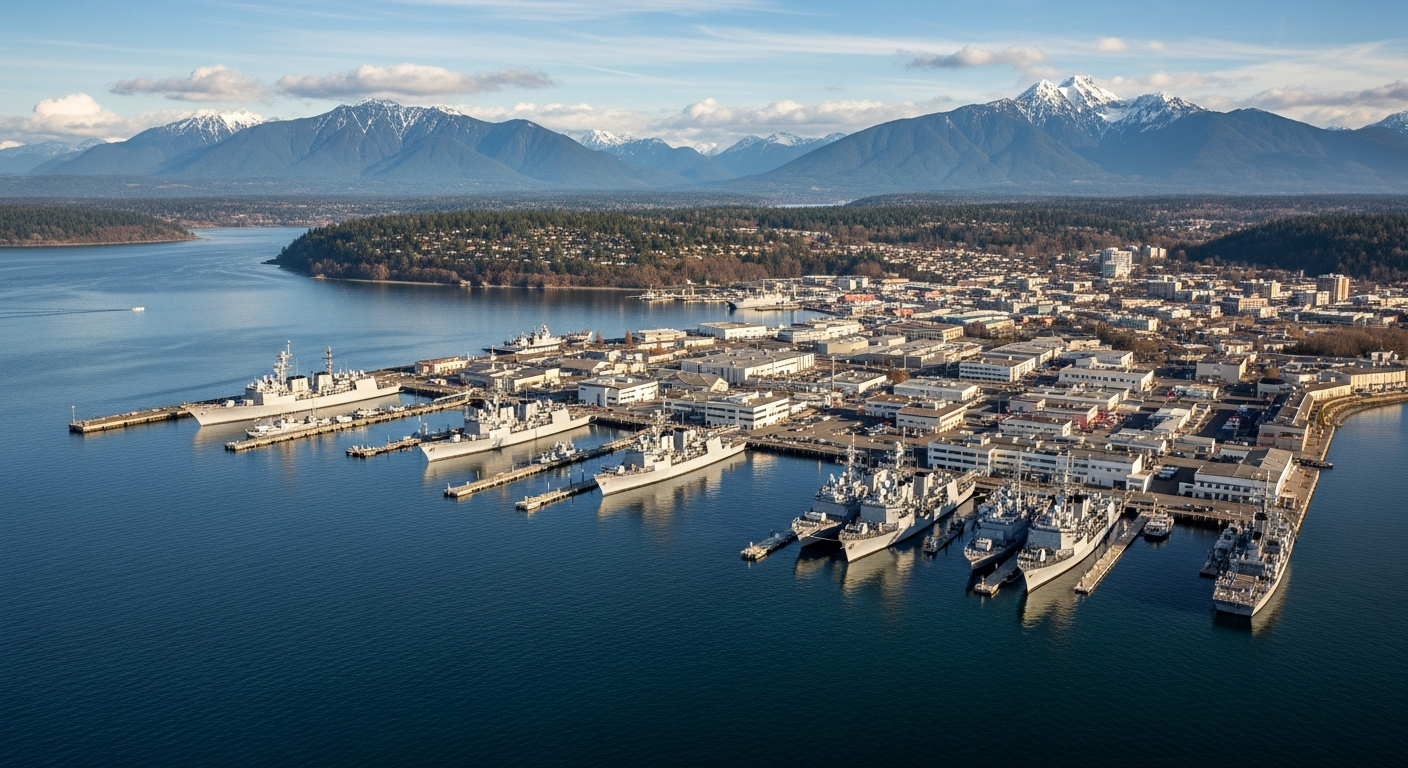
    Naval Station Everett is home to the Navy’s only Pacific Northwest deepwater homeport. It currently homeports USS Carl Vinson (aircraft carrier), USS Abraham Lincoln (aircraft carrier in rotation), surface combatants, and support vessels. The base has existing frigate pier infrastructure, a Fleet and Family Support Center, commissary, schools, and housing — the full military community infrastructure that a frigate crew requires.

    NAVSTA Everett also benefits from its position within the broader Pacific Fleet posture. The Indo-Pacific is the primary strategic theater for the next generation of U.S. naval forces, and Puget Sound is the Pacific Fleet’s primary West Coast hub. A new frigate class based on a ship already operating in Pacific Fleet service fits naturally into that framework.

    None of that guarantees the homeport — the Navy’s internal process will weigh operational requirements, infrastructure costs, and force structure planning. But the April 28 contract means Everett’s advocates now have a specific, contracted program to point to when making their case to the Pentagon.

    Timeline and What to Watch

    • April 28, 2026: $282.9M Ingalls lead yard support contract awarded
    • Through April 2028: Pre-construction activities, material securing, design finalization
    • June 2030 target: First FF(X) delivery to the Navy
    • Before 2030: Homeport decision expected — no official date announced

    Frequently Asked Questions

    What is the FF(X) frigate?
    The FF(X) is the U.S. Navy’s new small surface combatant, replacing the cancelled Constellation-class. It is based on the Ingalls-built Legend-class National Security Cutter. The lead ship is targeted for delivery by June 2030.

    What did the April 28, 2026 contract authorize?
    A $282.9 million lead yard support contract. The first $80.6 million activates immediately, authorizing Ingalls to begin cutting and shaping steel for the main structural foundation and finalizing design details. The contract runs through April 2028.

    Was Naval Station Everett designated as the FF(X) homeport?
    Not yet. NAVSTA Everett was the designated homeport for the cancelled Constellation-class. The FF(X) homeport has not been decided. Snohomish County and NAVSTA Everett are actively lobbying for that designation.

    What is the economic value of the homeport bid?
    Snohomish County officials have cited approximately $340 million in annual economic impact from NAVSTA Everett’s current operations. A frigate homeport designation would add to that baseline.

    When will the Navy decide where to homeport the FF(X)?
    No official timeline. The first ship delivers in June 2030, so a decision will likely come before that date.

    How many FF(X) frigates will be built?
    No final production number has been announced. The program’s size will be determined through the shipbuilding budget process.

    Who is building the FF(X)?
    HII’s Ingalls Shipbuilding in Pascagoula, Mississippi. The contract was a direct award, not competed, because Ingalls built the National Security Cutter on which the FF(X) is based.

  • For Navy Families at NAVSTA Everett: What the Proposed Everett Transit Consolidation Means for Getting Around Without a Car

    For Navy Families at NAVSTA Everett: What the Proposed Everett Transit Consolidation Means for Getting Around Without a Car

    For Navy families PCS’d to Naval Station Everett — especially those who arrive without a second car, are managing a deployment window, or are new to the Pacific Northwest — Everett Transit is often the first bus system they use. The proposed consolidation of Everett Transit into Community Transit is a change those families should understand before a council vote that could come as early as late May or June 2026.

    How Navy Families at NAVSTA Use Transit Today

    Naval Station Everett sits on the south end of the city near the working waterfront. Everett Transit routes connect the areas around the base to downtown Everett, Everett Station (where Amtrak Cascades and eventually Sound Transit light rail connect), Everett Community College, and shopping corridors along Evergreen Way and Everett Mall Way.

    For a family managing a deployment — one sailor gone, one spouse managing school runs, medical appointments, and daily life without a second vehicle — knowing the bus network is a practical survival skill. Everett Transit’s local routes handle that intra-city layer.

    Community Transit, by contrast, is primarily a commuter and regional carrier. Its routes connect Snohomish County cities to King County and Seattle, not block-by-block within Everett. That distinction is what makes the consolidation complicated for families who depend on neighborhood-level service.

    What Would Change Under Consolidation

    Under the proposal, Everett Transit’s 22 routes would become part of Community Transit’s network. The specific terms — which routes continue, at what frequency, with what fare structure — would be determined by the interlocal agreement being drafted between the City of Everett and Community Transit.

    No route restructuring plan has been released. The process is at the due-diligence phase as of late April 2026. SB 5801 requires at least one public hearing before the Everett City Council votes. That hearing is the primary opportunity for NAVSTA families to put service expectations on the record.

    The Light Rail Connection

    Mayor Franklin tied the consolidation announcement directly to the June 30, 2026, Sound Transit board vote, which could advance light rail to Everett Station. If light rail comes, a merged transit agency in theory provides a cleaner feeder network — one system with buses from neighborhoods near NAVSTA to Everett Station to light rail south toward Seattle.

    For Navy families who commute to Seattle or Bremerton for medical care, shopping, or activities, a light-rail-connected transit network would be a significant quality-of-life improvement. The full Sound Transit guide covers what the June 30 vote means for Everett residents.

    What Navy Families Should Know About the Process

    The opposition to consolidation — led by ATU Local 883 and the Keep Everett Transit community group — centers on the loss of local control and concern that Community Transit’s regional priorities may not preserve the neighborhood-level service that Everett’s densest residential areas (including those near NAVSTA) depend on.

    That concern is particularly relevant for military families, who often don’t have years of established local transportation workarounds and who may PCS into Everett after the transition is complete. Knowing what services exist and where they run is an essential part of base orientation.

    NAVSTA Everett’s Fleet and Family Support Center (FFSC) is the right first stop for transportation questions during any transition period. The full guide to the Everett Transit consolidation proposal has the complete breakdown of what’s at stake.

    For the broader picture on Everett resources for military families, the NAVSTA Everett VA claims guide for 2026 covers other service changes affecting the base community.

    Frequently Asked Questions

    Does Everett Transit serve Naval Station Everett?
    Everett Transit routes serve areas around Naval Station Everett, with connections to Everett Station and key corridors. Under consolidation, those routes would transition to Community Transit.

    What transit options do Navy families currently have in Everett?
    Everett Transit local routes, Amtrak Cascades at Everett Station, Community Transit regional routes, and base transportation resources. Consolidation would bring all bus routes under one agency.

    When would any changes take effect for NAVSTA transit riders?
    A council vote could come as early as late May or June 2026, but full implementation would take years. No route changes would happen immediately after a vote.

    How does the consolidation relate to the Sound Transit light rail vote?
    The June 30 Sound Transit board vote could advance light rail to Everett Station. A merged transit agency would provide an integrated bus-to-rail network connecting NAVSTA Everett to the broader Puget Sound region.

    Where can Navy families learn more about base transportation resources?
    NAVSTA Everett’s Fleet and Family Support Center (FFSC) provides orientation resources. The base website is at cnic.navy.mil/regions/cnrnw/installations/navsta_everett.html.

  • The FF(X) Gets Real: What the Navy’s $282.9M Ingalls Contract Means for Naval Station Everett’s Homeport Bid

    The FF(X) Gets Real: What the Navy’s $282.9M Ingalls Contract Means for Naval Station Everett’s Homeport Bid

    Q: Has the Navy awarded a contract for the new FF(X) frigate?
    A: Yes. On April 28, 2026, the U.S. Navy awarded a $282.9 million contract to HII’s Ingalls Shipbuilding in Pascagoula, Mississippi, to begin lead yard support work on the FF(X) class frigate — the Navy’s new small surface combatant meant to replace the cancelled Constellation-class program. The first $80.6 million covers pre-construction activities including securing materials, refining designs, and beginning to cut and shape raw structural steel.

    Steel Is About to Get Cut. Here’s What That Means for Everett.

    For the past five months, the FF(X) frigate program has existed primarily as an announcement, a design concept, and a lobbying opportunity. As of April 28, 2026, it exists as a contract.

    The U.S. Navy awarded HII’s Ingalls Shipbuilding a $282.9 million lead yard support contract, according to simultaneous announcements from the Pentagon and Huntington Ingalls Industries. The award authorizes Ingalls to begin pre-construction work on the first ship of the new FF(X) class — and the first $80.6 million activates immediately, giving Ingalls the green light to start cutting and shaping raw steel for the main structural foundation of the frigate.

    That is a different kind of news than what has surrounded the FF(X) program since December. Announcements get made. Designs get chosen. Committees hold meetings. Contracts start programs. And for Naval Station Everett — which has been fighting to be named as the homeport for the incoming frigate fleet — the clock just started in a way it hadn’t before.

    What the $282.9M Contract Actually Covers

    Under the terms of the contract, Ingalls will perform what the Pentagon terms “lead yard support activities” — the pre-construction phase work that front-loads as much design refinement and material preparation as possible before formal construction begins.

    Specifically, Ingalls is authorized to begin cutting and shaping raw materials to support future phases of work on the main structure foundation and the overall construction sequencing plan for the first frigate, according to the company. The contract also covers securing key materials and finalizing design details ahead of full construction authorization.

    “We are excited to partner with the Navy to bring these preproduction steps under contract to accelerate delivery of the frigates that our warfighters need,” Brian Blanchette, president of Ingalls Shipbuilding, said in the company’s April 28 announcement.

    Of the initial $80.6 million tranche, 73% — roughly $58.8 million — comes from the Navy’s fiscal year 2026 shipbuilding and conversion appropriations. The remaining 27%, about $21.8 million, is funded through Navy research and development accounts. The Pentagon’s contract announcement cited “unusual and compelling urgency” as the justification for awarding the contract without competitive bids.

    The Golden Fleet Context: FF(X) Is Part of a Bigger Picture

    The FF(X) contract is part of President Trump’s “Golden Fleet” initiative, a broader shipbuilding push that also includes development work on the BBG(X) — a new, much larger surface combatant class informally referred to as the Trump-class battleship. Together, the FF(X) and BBG(X) represent the Navy’s attempt to recapitalize its surface force on two ends of the size and firepower spectrum.

    The fiscal year 2026 budget request, according to an April 21 Navy news release, includes $65.8 billion to buy 18 warships and 16 auxiliary ships, including three submarines, a destroyer, an amphibious assault ship, and the first FF(X) frigate. Design and development funding for the BBG(X) is included as well.

    The FF(X) program was formally announced in December 2025 by then-Secretary of the Navy John Phelan, who chose the Coast Guard’s Legend-class National Security Cutter as the design framework to accelerate development timelines and reduce costs compared to building a purpose-designed warship from scratch. Ingalls, which builds the Legend-class cutters, was the natural choice as lead yard.

    Phelan, who made the call to cancel the Constellation program and launch FF(X), was ousted from his position last week — but the program he set in motion is now under contract and generating steel work in Pascagoula.

    The Urgency Matters for Everett

    The “unusual and compelling urgency” language in the Pentagon’s contract announcement isn’t routine bureaucratic boilerplate. It’s a formal legal justification for bypassing the standard competitive bidding process — a step the DoD takes when waiting for competition would harm national security or mission-critical timelines.

    In plain terms: the Navy wants frigates faster than a normal acquisition timeline would allow, and it’s willing to use procedural shortcuts to get there. The target for the first FF(X) delivery remains 2028.

    For Naval Station Everett, urgency is a double-edged signal. On one hand, an accelerated build timeline is good news for the community’s homeport ambitions — if ships are coming off the line sooner, the homeport decision has to be made sooner. On the other hand, accelerated programs sometimes lock in decisions early to avoid further delays, which means Snohomish County’s window to make its case may be shorter than it appears.

    The original Constellation-class program had designated Naval Station Everett as the homeport for up to 12 frigates. That designation evaporated with the November 2025 cancellation. The FF(X) program has not made a homeport announcement, and the Snohomish County Military Affairs Committee — which reconvened on February 23, 2026, specifically to advocate for Everett’s position — is still in active engagement with the congressional delegation and Navy leadership.

    Representative Rick Larsen (WA-02), who serves on the House Armed Services Committee, has been the primary congressional voice for preserving NAVSTA Everett’s role in the frigate program. Larsen’s position on HASC gives him a direct line into budget and procurement decisions that will ultimately determine where these ships are homeported.

    What the $340M Economic Argument Looks Like Now

    Snohomish County’s economic case for homeporting the FF(X) fleet at Naval Station Everett has been framed around a roughly $340 million annual economic impact figure — the combined value of ship crews, support staff, contractor spending, and multiplier effects that each additional frigate homeport assignment generates for the local economy. That case was built for a 12-frigate assignment; the size of the FF(X) fleet and its homeport allocation haven’t been determined.

    But the contract award sharpens the argument’s urgency. When the FF(X) was a program under consideration, Everett could advocate based on capacity, infrastructure, and existing relationships. Now that Ingalls is cutting steel, the program has a real timeline — and homeporting decisions for new surface combatants typically follow construction milestones, not precede them by years.

    Naval Station Everett’s existing assets — deepwater berths capable of handling multiple destroyers and a carrier, established surface warfare maintenance facilities, a strong Fleet & Family Support infrastructure, and an existing destroyer squadron presence — remain the core of its competitive position. For Navy families already stationed at NAVSTA Everett, the practical question of whether a frigate rotation is coming affects PCS planning, school enrollment decisions, and community investment for the next five to seven years.

    What to Watch Next

    Three forward indicators will determine how this story develops for Everett:

    The FF(X) homeport announcement. No timeline has been given. But as Ingalls moves from lead yard support into formal construction phases, the Navy’s Surface Forces Pacific and Forces Atlantic commands will need to plan basing, maintenance, and operational schedules. A homeport announcement could come as early as late 2026 or as late as the 2027-2028 delivery window approaches.

    FY2027 appropriations. The FF(X) is funded in FY2026 as a single-ship start. How many hulls Congress authorizes in FY2027 — and how the funding is structured — will determine how quickly the fleet scales up and whether the economic case for a dedicated Pacific homeport strengthens or softens.

    The fate of FFG-62 and FFG-63. The first two Constellation-class ships, the USS Constellation and USS Congress, are still being completed at Fincantieri Marinette. Their homeport assignments — wherever they land — may signal the Navy’s thinking about Pacific frigate basing before the FF(X) homeport decision is formally made.

    For now, the $282.9 million contract is what Everett’s advocates needed to see: confirmation that the program is real, funded, and moving. The complete guide to where the FF(X) program stands — and what NAVSTA Everett has to do to win the homeport — remains the framework for following this story. The contract award adds a new chapter, but the outcome is still unwritten.

    Frequently Asked Questions

    What did the Navy just award to Ingalls Shipbuilding?

    The Navy awarded a $282.9 million contract to HII’s Ingalls Shipbuilding on April 28, 2026, for lead yard support work on the FF(X) class frigate program. The initial $80.6 million tranche authorizes pre-construction activities including cutting and shaping raw structural steel, securing key materials, and refining the design ahead of formal ship construction.

    What is the FF(X) frigate program?

    The FF(X) is the U.S. Navy’s new small surface combatant program, announced in December 2025 to replace the cancelled Constellation-class (FFG-62) frigate program. It uses the Coast Guard’s Legend-class National Security Cutter as a design framework and is being built by HII’s Ingalls Shipbuilding yard in Pascagoula, Mississippi. The Navy aims to deliver the first ship by 2028.

    Is Naval Station Everett going to be the homeport for the FF(X) frigates?

    No homeport decision has been announced for the FF(X) program. Naval Station Everett had been designated as the homeport for the cancelled Constellation-class frigates. Snohomish County’s Military Affairs Committee has been actively lobbying for Everett to receive the FF(X) homeport designation, but as of April 2026 no announcement has been made.

    Why did the Navy skip competitive bidding for this contract?

    The Pentagon cited “unusual and compelling urgency” as the justification for awarding the contract without a competitive bidding process. This standard is applied when waiting for competition would harm national security or cause unacceptable delays in mission-critical programs. The Navy’s target delivery date of 2028 for the first FF(X) is the primary driver of that urgency posture.

    What is the “Golden Fleet” and how does FF(X) fit into it?

    The Golden Fleet is President Trump’s shipbuilding initiative to rapidly expand the U.S. Navy’s surface fleet. The FF(X) (a new small combatant frigate) and the BBG(X) (a new large combatant sometimes called the Trump-class battleship) are the two new ship classes at the center of the initiative, representing opposite ends of the size and firepower spectrum.

    What Navy ships are currently homeported at Naval Station Everett?

    As of 2026, Naval Station Everett is homeport to several surface combatants including USS Gridley (DDG-101), which is currently deployed as part of the USS Nimitz’s Southern Seas 2026 cruise. NAVSTA Everett has deepwater pier infrastructure capable of handling destroyers and carrier-class vessels, making it one of the Navy’s most capable Pacific homeports.

    When will we know where FF(X) frigates will be homeported?

    No timeline has been given for a homeport announcement. Such decisions typically follow construction milestones and fleet planning cycles. Given the 2028 delivery target for the first FF(X), a homeport decision could come as early as late 2026 or as late as 2027 as the delivery window approaches.

    How can Everett residents stay informed about the FF(X) program?

    The best sources for official FF(X) program updates are USNI News (news.usni.org), Stars and Stripes (stripes.com), and Navy.mil press releases. For Everett-specific advocacy, the Snohomish County Military Affairs Committee and Rep. Rick Larsen’s congressional office (larsen.house.gov) are the primary local points of contact.

  • USS Gridley Clears the Strait of Magellan: Everett’s Destroyer Is Now in the Atlantic on the Final Arc of Southern Seas 2026

    USS Gridley Clears the Strait of Magellan: Everett’s Destroyer Is Now in the Atlantic on the Final Arc of Southern Seas 2026

    Q: Has USS Gridley (DDG-101) returned to Naval Station Everett?
    A: No. USS Gridley and USS Nimitz (CVN-68) transited the Strait of Magellan on April 26, 2026, and are now in the Atlantic Ocean heading north. No official homecoming date for USS Gridley’s return to NAVSTA Everett has been announced.

    USS Gridley Clears the Strait of Magellan: Everett’s Destroyer Is Now in the Atlantic on the Final Arc of Southern Seas 2026

    On April 26, 2026, USS Nimitz (CVN-68) and USS Gridley (DDG-101) crossed a boundary that most warships never reach: they transited the Strait of Magellan, the 350-mile waterway at the southern tip of South America, and entered the Atlantic Ocean for the first time on this deployment.

    The U.S. Navy’s official imagery channel, DVIDS, published photographs of the transit that same day. U.S. Southern Command confirmed the milestone on social media, sharing imagery of the carrier moving through the historic strait first charted by Ferdinand Magellan’s expedition in 1520. Stars and Stripes reported the news on April 28.

    For the families of USS Gridley’s sailors at Naval Station Everett — and for anyone who has been following the Nimitz Carrier Strike Group’s journey since it departed Naval Base Kitsap in early March — the Strait of Magellan transit marks the turning point. The Pacific leg is done. The ships are now heading north through the Atlantic.

    Why the Strait of Magellan — and Not the Panama Canal?

    The Panama Canal has a maximum beam of 110 feet for its wider neo-Panamax locks. USS Nimitz, at 252 feet wide, has been too large for the canal since the day she was commissioned in 1975. That physical constraint means any Nimitz-class carrier moving from the Pacific to the Atlantic has exactly two options: round Cape Horn at the very tip of South America, or transit the Strait of Magellan, the slightly calmer waterway just north of Tierra del Fuego.

    The Navy chose the Strait of Magellan. The same route Portuguese explorer Ferdinand Magellan charted five centuries ago winds 350 miles between the South American mainland and the island of Tierra del Fuego. It is technically demanding navigation even in modern conditions, and the imagery DVIDS published from the April 26 transit shows just how striking the scenery is: snow-capped Patagonian peaks, rugged coastline, and the open grey water where two oceans finally meet.

    The Deployment Timeline So Far

    USS Gridley, homeported at Naval Station Everett, deployed as part of the Nimitz Carrier Strike Group in early March 2026. Southern Seas 2026 — the 11th iteration of the U.S. 4th Fleet exercise since 2007 — has taken the strike group through some of the most significant waters in the Western Hemisphere:

    The Argentine exercises and the Strait of Magellan transit overlapped, a reminder of how much happens simultaneously on a deployment of this scale. The strike group conducted partner-nation exercises right up to the moment of making the southern transit.

    What Comes Next: The Atlantic Arc

    With the Strait of Magellan behind them, USS Nimitz and USS Gridley are now tracking north along South America’s Atlantic coast. Based on the itinerary U.S. 4th Fleet confirmed in March when the deployment was announced, the Atlantic leg was anticipated to include port calls in Brazil and exercises with additional partner navies — including Brazil and Uruguay — before the strike group proceeds into the Caribbean and ultimately toward Norfolk.

    USS Nimitz is ultimately headed for Naval Station Norfolk, Virginia, where the carrier will be homeported until her decommissioning. The decommissioning — originally planned for 2026 — was pushed back to 2027, timed to align with the commissioning of USS John F. Kennedy (CVN-79). That extended timeline means roughly 5,000 sailors and air wing personnel have additional months of service ahead before the carrier retires after nearly 50 years.

    For USS Gridley, Norfolk is a waypoint, not a homeport. Once the strike group’s obligations wrap up, Gridley will make the journey back across the Atlantic and, via the Pacific, back to Naval Station Everett. No official homecoming date has been announced by the Navy.

    What This Means for NAVSTA Everett Families

    If you have a sailor aboard USS Gridley, the Strait of Magellan transit is a meaningful navigation milestone — but not a homecoming signal. The ships are now in the Atlantic, and there is significant distance still to cover before any return-to-homeport sequence begins.

    The Fleet & Family Support Center at Naval Station Everett remains the best resource for official deployment information and for connecting with command family readiness programs. The center can be reached at 425-304-3735. A satellite location also serves the Smokey Point area.

    For a complete picture of the deployment and what it means for families at NAVSTA Everett, see the practical family guide to USS Gridley’s Southern Seas deployment and the complete Southern Seas 2026 deployment guide for NAVSTA Everett families.

    A Milestone Few Ships Ever Reach

    It is worth pausing on what happened April 26. Nimitz-class aircraft carriers are among the largest ships afloat. When USS Nimitz transited the Strait of Magellan, she entered a small category of American supercarriers to complete that passage. The transit confirmed the end of the Pacific arc of Southern Seas 2026 and set the stage for the final leg — north through the Atlantic, toward Norfolk, and toward the carrier’s retirement after nearly 50 years of service.

    USS Gridley was right there beside her. That will be something for the Everett sailors aboard to remember for the rest of their careers.

    Frequently Asked Questions

    Q: Has USS Gridley returned to Naval Station Everett from Southern Seas 2026?
    A: No. As of April 28, 2026, USS Gridley (DDG-101) has transited the Strait of Magellan and is in the Atlantic Ocean heading north. No official homecoming date to NAVSTA Everett has been announced.

    Q: Why did USS Nimitz go around South America instead of through the Panama Canal?
    A: Nimitz-class aircraft carriers are 252 feet wide — too wide for the Panama Canal. The carrier had two options: round Cape Horn or transit the Strait of Magellan. The Navy chose the Strait of Magellan, charted by Ferdinand Magellan’s expedition in 1520.

    Q: When did USS Nimitz transit the Strait of Magellan?
    A: April 26, 2026, per official Navy imagery published by DVIDS and confirmed by U.S. Southern Command.

    Q: Where is USS Nimitz headed after the Strait of Magellan?
    A: Naval Station Norfolk, Virginia, where the carrier will be homeported until her decommissioning. The decommissioning was pushed back from 2026 to 2027 to align with the commissioning of USS John F. Kennedy (CVN-79).

    Q: What is Southern Seas 2026?
    A: Southern Seas 2026 is the 11th iteration of a U.S. 4th Fleet deployment designed to strengthen maritime partnerships across South America and the Caribbean. The 2026 edition featured USS Nimitz and USS Gridley conducting exercises and port visits with 10 partner nations across the region.

    Q: How do NAVSTA Everett families get deployment updates about USS Gridley?
    A: The Fleet & Family Support Center at Naval Station Everett is the official point of contact for deployment support. Reach them at 425-304-3735, or visit the Smokey Point satellite office.

    Q: Is USS Gridley homeported at Naval Station Everett?
    A: Yes. USS Gridley (DDG-101) is an Arleigh Burke-class guided-missile destroyer homeported at Naval Station Everett, Washington — one of five destroyers based at the installation.

  • USS Gridley Takes Up Station Off Argentina: What the Cape Horn Leg of Southern Seas 2026 Means for Naval Station Everett

    USS Gridley Takes Up Station Off Argentina: What the Cape Horn Leg of Southern Seas 2026 Means for Naval Station Everett

    What is USS Gridley doing this week? USS Gridley (DDG-101), the Arleigh Burke-class destroyer homeported at Naval Station Everett, is operating off Argentina’s coast with the USS Nimitz (CVN-68) carrier strike group. From April 26 through 30, 2026, U.S. and Argentine naval forces are conducting a multi-day passing exercise (PASSEX) in international waters off Trelew. Argentina’s destroyer ARA La Argentina (D-11) joins the formation Tuesday, April 28, with additional Argentine ships and patrol vessels embarking April 29 and beyond. After the PASSEX, the Nimitz Carrier Strike Group will round Cape Horn — the only route home for a carrier too large for the Panama Canal.

    USS Gridley Takes Up Station Off Argentina: What the Cape Horn Leg of Southern Seas 2026 Means for Naval Station Everett

    For families on Naval Station Everett, the Southern Seas 2026 deployment has been a slow-motion map exercise — Ecuador in early April, Chile last week, and now the longest, loneliest stretch of the cruise: the South Atlantic and the run around Cape Horn. This week, USS Gridley (DDG-101), the destroyer homeported in Everett that is escorting the USS Nimitz (CVN-68) on the carrier’s final overseas deployment, takes up station off Argentina for a multi-day exercise with the Argentine Navy. It’s the third major partner-nation engagement of the cruise and the last big one before the strike group leaves the Pacific Ocean for good.

    This is the part of the deployment Everett spouses circled on the calendar months ago — not because anything dramatic is supposed to happen, but because Cape Horn is real weather, real distance, and the point at which Gridley sailors stop being a Pacific ship and start the long run toward Norfolk on the Atlantic side. After this leg, mail slows down. After this leg, time zones flip. The PASSEX off Trelew is the bookend.

    What’s Actually Happening Off Argentina

    According to U.S. Southern Command and U.S. 4th Fleet announcements covering Southern Seas 2026, the Nimitz Carrier Strike Group — Nimitz, Gridley, Carrier Air Wing 17, and elements of Destroyer Squadron 9 — is scheduled to operate with the Argentine Navy off the coast of Trelew between April 26 and April 30, 2026. The exercise is a PASSEX, the standard term for a passing exercise: two or more navies meeting at sea to drill formation steaming, communications, air operations, and basic interoperability without the formality of a full named exercise.

    The Argentine Navy is bringing a substantial package. The destroyer ARA La Argentina (D-11) is scheduled to join the U.S. formation Tuesday, April 28. Two SH-3 Sea King helicopters from Argentina’s Second Naval Helicopter Squadron are planned to embark on USS Gridley for the duration. Two P-3C Orion maritime patrol aircraft from Argentina’s Naval Exploration Squadron are scheduled to fly reconnaissance in the operating area. Argentine F-18 fighters are tasked to simulate attacking aircraft in an air-defense drill against the formation.

    Beginning April 29, additional Argentine units are scheduled to join: the destroyer ARA Sarandí (D-13), the corvettes ARA Robinson (P-45) and ARA Rosales (P-42), and the ocean patrol vessels ARA Piedrabuena (P-52) and ARA Contraalmirante Cordero (P-54). Argentine Naval reporting indicates roughly 350 Argentine sailors will participate across the surface units. After the PASSEX wraps, the Nimitz strike group will continue south toward Cape Horn for the transit to the Atlantic.

    None of this is unusual. PASSEX-class events are how partner navies stay legible to each other — the kind of low-stakes, high-repetition work that sounds boring on paper and matters when something is not boring. What makes this one notable for Everett is that it is the fullest partner-nation engagement of Gridley’s deployment so far, and the last big one in daylight before the long, weather-driven Cape Horn leg.

    Why This Matters for Everett — and Why It’s Worth Watching Quietly

    Naval Station Everett is the homeport for five destroyers, plus a Coast Guard component and a maritime force protection unit. Gridley is one of those five. When a single Everett-homeported ship is at sea on the world’s longest single-cruise route home, the effect ripples outward — through Mukilteo School District classrooms with deployed parents, through the spouse-employment workflow at the Fleet & Family Support Center, through every PTA and youth sports league counting on a parent who isn’t there to coach.

    The Southern Seas mission itself is in its 11th iteration since 2007, run by Naval Forces Southern Command and U.S. 4th Fleet. The whole purpose is exactly what is happening this week off Trelew: passing exercises with partner navies, port visits, and the kind of low-temperature presence that makes a regional security architecture work. For Nimitz, this is the last time. The carrier is on its publicly confirmed final overseas deployment before its 2027 decommissioning — a Navy decision the Navy has already extended once to keep the ship in service through this cruise. For Gridley, it is one chapter in a normal Arleigh Burke-class career.

    It is also the exact kind of operation that families at NAVSTA Everett were briefed on before the ship left: scheduled, public, and on the formal U.S. 4th Fleet itinerary, but quiet by design. There will not be a real-time location ticker, and there shouldn’t be — both because operational security matters and because the news, when it comes, will come through Navy public affairs releases on DVIDS, USNI News, and Stars and Stripes, all of which are credentialed to cover this kind of work.

    The Cape Horn Question

    USS Nimitz cannot use the Panama Canal. The carrier’s beam exceeds the canal’s lock dimensions, even after the 2016 expansion of the Panama Canal Authority’s New Panamax locks. That leaves Cape Horn as the only seaway home, which is why the Southern Seas 2026 itinerary is actually the only itinerary the Navy could plan: down the Pacific coast, around the bottom of South America, up the Atlantic to Norfolk.

    Cape Horn is famous for a reason. The Drake Passage that separates Tierra del Fuego from Antarctica is one of the worst stretches of water in the world for surface ships — not because it’s shallow but because of the convergence of the Pacific, Atlantic, and Southern oceans without a continental shelf to break the swell. Modern carriers and destroyers transit it routinely; it is not exotic. But it is meaningful enough that the strike group’s media-relations rhythm is built around it. The Navy’s pre-cruise announcement explicitly mentioned the Cape Horn route. The Argentine PASSEX is the last formal partner exercise on the Pacific side.

    For Everett, the practical effect is communication latency. After the strike group transits Cape Horn, time zones jump several hours, and shipboard communications priorities shift to the Atlantic context. Family Readiness Group updates that came through with Pacific timing earlier in the cruise will arrive on a different rhythm. None of this is new to anyone who has done a deployment before — it is just a real thing that is about to happen.

    What Whitelist Sources Have Said

    The U.S. 4th Fleet press release announcing Southern Seas 2026 (March 23, 2026, southcom.mil) named Nimitz and Gridley as the two U.S. units, named the cooperating partner nations, and described the deployment as a circumnavigation of South America. Stars and Stripes covered the announcement and the carrier’s operational extension into 2027. USNI News has been running its standard Fleet and Marine Tracker through the deployment, including the April 20 update placing the strike group in the South Pacific. DVIDS has been the primary photo and short-news outlet for individual port-visit and exercise events as they happen.

    Argentina-specific coverage of the PASSEX has so far come primarily from Argentine outlets and from regional naval reporters; the U.S. side will release its own DVIDS imagery and short news posts after the exercise begins. That sequencing — partner-nation announcements first, U.S. PA imagery on a delay — is normal for SOUTHCOM PASSEX events.

    Where Everett Families Find Updates Without Speculating

    The pattern that has worked all cruise is the right pattern for this leg too. The Navy’s Public Affairs releases through DVIDS and the strike group itself are the source of record. USNI News and Stars and Stripes pick up those releases quickly. The official U.S. 4th Fleet account on social media posts imagery and short summaries of completed events — past tense, never future tense. Friends and family of Gridley sailors should default to those sources rather than tracking sites or open-source ship trackers, both because shipboard communications discipline asks for that and because the official channels will be the first to show pictures of sailors looking tired and happy after each event.

    For administrative or family questions during the leg — childcare windows during the time-zone swing, deployment counseling, financial questions tied to the cruise itself — the Fleet & Family Support Center at NAVSTA Everett (425-304-3735) remains the front door. That center has the deployment-resource portfolio worked out for exactly this kind of mid-cruise stretch. Mukilteo School District and Everett Public Schools both run their own military-family liaison structures, and Month of the Military Child programming has wrapped for April but the school-level support continues year-round.

    What Comes Next on the Cruise Map

    After the Argentine PASSEX, the next publicly described milestones are the Cape Horn transit itself and the run up the Atlantic. U.S. 4th Fleet has named Brazil and additional partner nations as part of the deployment plan; specific port visits and exercise dates on the Atlantic side will be released through the same channels — DVIDS, southcom.mil, U.S. Embassy press offices in the host countries — that handled the Ecuador and Chile legs.

    For Gridley specifically, the deployment is one event on a normal Arleigh Burke career, not a final cruise. The ship returns to Everett on the schedule released to families before departure. Once back at Pier 3, the rhythm resumes: maintenance windows, port-and-starboard duty, the slow buildup to whatever comes next. None of that is the news this week. This week, the news is that USS Gridley took up station off Argentina, the ARA La Argentina is steaming alongside, and Cape Horn is on the horizon.

    Frequently Asked Questions

    Where is USS Gridley right now?

    USS Gridley (DDG-101) is operating with the USS Nimitz (CVN-68) carrier strike group in the Southern Seas 2026 deployment area off Argentina. Per U.S. Southern Command and U.S. 4th Fleet, the strike group is conducting a multi-day passing exercise with the Argentine Navy off Trelew between April 26 and April 30, 2026. Specific locations beyond what SOUTHCOM and DVIDS publicly release are not appropriate to track.

    What is a PASSEX?

    A PASSEX (passing exercise) is a low-formality exercise where two or more navies meet at sea to practice formation steaming, communications, basic air operations, and partner interoperability. PASSEX-class events are the most common form of partner-navy engagement and are a core building block of SOUTHCOM and 4th Fleet’s regional security mission.

    Why is the Nimitz strike group rounding Cape Horn instead of using the Panama Canal?

    USS Nimitz exceeds the Panama Canal’s lock dimensions and cannot transit the canal. Cape Horn is the only sea route from the Pacific to the Atlantic for a Nimitz-class carrier, which is why the entire Southern Seas 2026 itinerary is built as a South American circumnavigation.

    Is this Nimitz’s final deployment?

    Yes — Southern Seas 2026 is USS Nimitz’s publicly confirmed final overseas deployment before the carrier is decommissioned. The Navy has extended the ship’s service life to keep it active through this cruise, with the carrier scheduled to begin deactivation procedures after arriving at Naval Station Norfolk.

    How will families at NAVSTA Everett get updates during the Cape Horn leg?

    Through the same channels used all cruise: official Navy Public Affairs releases on DVIDS, U.S. 4th Fleet’s official accounts, USNI News, and Stars and Stripes. The Family Readiness Group through the Fleet & Family Support Center at 425-304-3735 remains the front door for administrative and family questions during the deployment.

    Is the timing of the PASSEX a security risk?

    No. PASSEX windows and partner-nation participation are publicly released by SOUTHCOM and U.S. 4th Fleet because the entire purpose of the exercise is partner-nation visibility. Specific tactical positions during the exercise are not released, and tracking sites or unofficial position trackers are not the right reference.

    What other Everett ships are deployed right now?

    Naval Station Everett’s destroyer squadron homeports five Arleigh Burke-class ships. Beyond Gridley’s participation in Southern Seas 2026, the deployment status of other Everett ships is published by the Navy through DVIDS and Public Affairs. This article does not speculate on operational schedules beyond what the Navy has publicly released.

    When does Gridley come home?

    The Navy has not publicly released a specific return date. The strike group is scheduled to complete the South American circumnavigation and return to U.S. ports on a schedule released to crew families before deployment. Updates will come through the official channels named above.

  • Memorial Day 2026 in Snohomish County: A Practical Guide for Military Families and Veterans New to Everett

    Memorial Day 2026 in Snohomish County: A Practical Guide for Military Families and Veterans New to Everett

    Quick answer: Memorial Day 2026 is Monday, May 25. The closest VA national cemetery to Naval Station Everett is Tahoma National Cemetery in Kent, which holds its annual Memorial Day Commemorative Ceremony at 1 p.m. that Monday at the Main Flag Pole Assembly Area. Closer to home, Snohomish County’s Eternal Flame at the County Courthouse (3000 Rockefeller Ave., Everett) is the central county-level remembrance site, and Lake Stevens American Legion Post 181, Floral Hills in Lynnwood, and Evergreen Cemetery in Everett all host community services that morning.

    If you’ve just PCS’d to Naval Station Everett, retired in Snohomish County, or moved here to support a sailor or soldier in the family, Memorial Day is one of the days the local military community is easiest to find. The bases are quieter than Navy Birthday or Veterans Day, but the cemeteries and memorials are full — and the people who run those services are the same people who run the volunteer drivers at the VA, the American Legion posts, the VFWs, and the spouse networks the rest of the year.

    This is a practical 2026 guide to where to go, when, and what to expect — written for the family that wants to do the day right and meet a few of the people who’d be good to know once the parade ends.

    Why this matters for the Everett military community

    Snohomish County is home to roughly 52,000 veterans — about one in eleven county residents — plus the active-duty population at Naval Station Everett, the five Arleigh Burke-class destroyers homeported there (USS Momsen, USS Kidd, USS Gridley, USS Sampson, USS Ralph Johnson), and several thousand military family members spread across Mukilteo, Marysville, Lake Stevens, and the unincorporated edges of the county.

    Memorial Day is the day that community shows up in one place. Active-duty sailors stand color guard at services. Vietnam-era VFW members read the names. Gold Star families lay wreaths. Boy Scouts and Cub Scouts plant flags at headstones the Saturday before. Local mayors give the speeches that don’t make the regional news but matter enormously to the families in the front rows.

    For a military family that’s two months into a Naval Station Everett tour, going to one of these services is often the fastest way to meet the people who’ll be at every PCS hello-and-goodbye for the next three years. (For more on what life looks like at NAVSTA Everett right now, see our guide to the FF(X) frigate decision and what it means for PCS plans, school choices, and the next decade for Navy families based in Everett.)

    The closest VA national cemetery: Tahoma in Kent

    Tahoma National Cemetery at 18600 SE 240th St., Kent, is the federally-administered national cemetery serving the Puget Sound region — the burial ground operated by the National Cemetery Administration under the Department of Veterans Affairs. It is the closest VA national cemetery to Naval Station Everett.

    The drive from NAVSTA Everett to Tahoma is roughly 50 minutes south on I-5 in Memorial Day morning traffic, longer if you leave after 11 a.m.

    The 2026 ceremony: Memorial Day Commemorative Ceremony, Monday, May 25, 2026, 1 p.m., at the Main Flag Pole Assembly Area. The program follows the standard Tahoma format — wreath-laying, rifle volley, and Taps, with remarks from local civic leaders and retired military officers. The ceremony is free and open to the public.

    Practical notes for first-time visitors:

    • Arrive by 12:15 p.m. Parking inside the cemetery fills early. Once the lots are full, staff direct cars to overflow parking with shuttle service.
    • Bring water, sunscreen, and a hat. The assembly area is exposed and seating is minimal — most attendees stand.
    • Wear comfortable walking shoes. Even from the closest lots, the walk to the flag pole is several hundred yards on uneven ground.
    • The cemetery hosts a “Run to Tahoma” community event the same morning organized through the Kitsap County Veterans Advisory Board for those who want a longer-distance commemoration before the 1 p.m. service.

    For sailors, families, or veterans who want the most formal Memorial Day service in the region — full military honors, full federal protocol — Tahoma is the answer.

    The county-level service: Snohomish County Eternal Flame

    The Snohomish County Eternal Flame sits in front of the Robert J. Drewel Building at the County Courthouse complex, 3000 Rockefeller Ave., Everett. It is the county’s central memorial to its veterans and the most accessible Memorial Day stop for anyone living in central or downtown Everett.

    Snohomish County typically holds an 11 a.m. Veterans Day service at the Eternal Flame in November, and the same site hosts informal Memorial Day gatherings — wreath placements, individual remembrances, and small ceremonies coordinated by local VFW and American Legion posts — throughout the morning of the holiday. Families with school-age kids who want to keep the day local often come here first, then move to one of the cemetery services.

    The Drewel Building is also where the Snohomish County Veterans Assistance Program (VAP) office is located — the county-funded program that helps veterans and their families with rent, utilities, prescriptions, transportation, and emergency needs. Most county veterans don’t know the program exists. Memorial Day is a quiet, low-pressure day to walk past the office, see the staff, and pick up the contact card. (For a deeper look at how the county program fits with the federal VA system, see our complete 2026 guide to getting VA claims help in Snohomish County.)

    The community services in Snohomish County

    Multiple community services across the county happen Memorial Day morning. These are the longest-running and most reliable for 2026.

    Lake Stevens American Legion Post 181

    Post 181 traditionally hosts two Memorial Day services on Monday morning:

    • 10 a.m. at the Lake Stevens War Veterans Memorial flag display, 1808 Main St., Lake Stevens
    • Noon at the Machias Cemetery, 1201 Silva St., Snohomish

    The Lake Stevens services are short, family-friendly, and are some of the only regularly attended community services east of I-5 in the county. Post 181 has been doing this for decades.

    Floral Hills in Lynnwood

    The Purdy & Walters at Floral Hills annual Memorial Day program at 409 Filbert Rd., Lynnwood typically runs:

    • 10:30 a.m. band concert
    • 11 a.m. ceremony

    Floral Hills is the largest cemetery in southwest Snohomish County and the regular Memorial Day stop for families based out of Mountlake Terrace, Mukilteo, and the south end of the county. Programs are listed annually on the Washington Department of Veterans Affairs (WDVA) calendar.

    Evergreen Cemetery in Everett

    Evergreen Cemetery, 4505 Broadway, Everett is the historic in-city cemetery — the burial ground for many of Everett’s earliest civic leaders and Civil War-era veterans. The site has hosted Memorial Day commemorations going back more than a century. For 2026 program times, the Everett Public Library and the city’s Parks and Recreation calendar typically post details in the two weeks before the holiday.

    For veterans buried at Evergreen, families typically come the Sunday afternoon or Monday morning before the larger county services to place flowers and flags individually.

    What to do the rest of the weekend

    Memorial Day weekend is three full days in 2026 — Saturday May 23 through Monday May 25. A practical Snohomish County itinerary for a military family looks like:

    Saturday morning — Flag-placement events. Boy Scout troops, Cub Scout packs, and Civil Air Patrol cadets across the county place small American flags on veteran headstones. Tahoma National Cemetery, Floral Hills, Cypress Lawn (1615 SE Everett Mall Way), and Evergreen all get flags this weekend. Showing up to help is a fast way to meet the local Scouting and youth-veterans community.

    Sunday — Quiet day. Many Snohomish County churches incorporate Memorial Day remembrances into their Sunday services. The American Legion and VFW posts are typically open in the afternoon.

    Monday — The day itself. Tahoma at 1 p.m. for the most formal service. Lake Stevens, Floral Hills, or Evergreen in the morning if you want a community-scale event.

    Monday afternoon — Most VFW and American Legion halls in the county host open houses, family-friendly gatherings, or potlucks after the morning services. VFW Post 2100 in downtown Everett (Suite 101 of the Vet Center building) and American Legion Post 6 in Snohomish are the two most active in central county. (The Vet Center building also houses the VFW Service Officer who handles VA claims help — making the Suite 101 location worth knowing year-round.)

    If you can’t make a service

    A practical alternative for sailors who can’t get away from the base, or family members who can’t make a public service:

    • Place a wreath at the Snohomish County Eternal Flame any time on Monday. The site is unstaffed and unrestricted.
    • Make a contribution to a service organization — the USO Northwest, the Snohomish County VAP, or a county VSO — in lieu of attendance.
    • Read the names of the Snohomish County service members who’ve died in service since 9/11 at the Centennial Trail memorial at Haller Bridge in Arlington. The kiosk includes interpretive panels for each name.

    Resources for military families new to the area

    Three numbers and links worth keeping for any military family doing their first Memorial Day in Snohomish County:

    • Naval Station Everett Fleet & Family Support Center: 425-304-3735 — for any deployment-related question, family event, or community resource referral.
    • Snohomish County Veterans Assistance Program (VAP): snohomishcountywa.gov/veterans — for emergency assistance, transportation, or VSO referral.
    • Tahoma National Cemetery: cem.va.gov/cems/nchp/tahoma.asp — for burial eligibility, memorial benefits, and event schedule.

    For anyone arriving on PCS orders this spring or summer, the practical follow-on after Memorial Day is the Fleet & Family Support Center’s resource intake — the same office that runs the spouse employment programs and the deployment family support groups. Memorial Day is when you meet the community. The week after is when the FFSC plugs you into it. (See our deep dive on how NAVSTA Everett supports Navy kids and families through the FFSC and the school liaison office.)

    Frequently Asked Questions

    What day is Memorial Day 2026?

    Memorial Day 2026 is Monday, May 25. It is the last Monday of May, as set by the 1968 Uniform Monday Holiday Act.

    Is there a VA national cemetery in Everett?

    No. The closest VA national cemetery to Naval Station Everett is Tahoma National Cemetery in Kent, about 50 minutes south on I-5. Tahoma is the only VA national cemetery in the Puget Sound region.

    Is Tahoma National Cemetery’s Memorial Day ceremony open to the public?

    Yes. The ceremony is free and open to the public. Plan to arrive by 12:15 p.m. Monday May 25, 2026 because parking inside the cemetery fills early and overflow parking requires a shuttle.

    Where is the Snohomish County Eternal Flame?

    The Eternal Flame is at the Snohomish County Courthouse / Robert J. Drewel Building, 3000 Rockefeller Ave., Everett. It is the county’s central veterans memorial and is accessible 24 hours a day.

    Are the Memorial Day services in Snohomish County family-friendly?

    Yes. The Lake Stevens services at the War Veterans Memorial and Machias Cemetery, and the Floral Hills program in Lynnwood, are designed for family attendance with short program lengths, seating, and accessible venues. Tahoma’s main service is longer and more formal but is still family-friendly with adequate planning.

    How can a Naval Station Everett family find local Memorial Day events the week before?

    Two reliable sources: the Naval Station Everett Fleet & Family Support Center at 425-304-3735, and the Washington Department of Veterans Affairs event calendar at dva.wa.gov. The HeraldNet and MyEverettNews local outlets also publish Memorial Day round-ups in the days before the holiday.

    Where can I get help with a VA claim related to a service member I’m honoring on Memorial Day?

    The Snohomish County Veterans Assistance Program at the Drewel Building is the closest in-person resource for VA claims help in the county, alongside the VFW Service Officer at the Vet Center building Suite 101 and the monthly Veterans Benefits Administration field visits to the Everett Vet Center. (See our prior coverage on VA claims help options after the 2026 Vet Center schedule change for the full breakdown.)

  • For Navy Families at NAVSTA Everett: A Practical 2026 Guide to USS Gridley’s Southern Seas Deployment Aboard USS Nimitz’s Final Cruise

    For Navy Families at NAVSTA Everett: A Practical 2026 Guide to USS Gridley’s Southern Seas Deployment Aboard USS Nimitz’s Final Cruise

    If you have a sailor on USS Gridley right now, this is the cruise your family will tell stories about for years. A practical 2026 guide for Navy families at Naval Station Everett — what Southern Seas 2026 looks like operationally, the Ombudsman touchpoints and Fleet & Family Support Center resources you should already have bookmarked, the deployment-readiness checklist that matters most for the second half of the cruise, and what “Nimitz’s final overseas deployment” actually means for the rest of 2026.

    The Cruise, in Plain Family Language

    USS Gridley (DDG-101) is the only Arleigh Burke-class destroyer publicly assigned to the Nimitz Carrier Strike Group on Southern Seas 2026. Per U.S. Naval Forces Southern Command, the strike group is conducting partner-nation engagement and circumnavigating South America en route to Naval Station Norfolk, Virginia. The Navy has publicly confirmed this is USS Nimitz’s final overseas deployment before her 2027 decommissioning.

    What that means in family-readiness terms: a multi-month deployment with port visits in partner-nation harbors, passing exercises at sea with multiple partner navies, and an East Coast arrival rather than a West Coast return. Gridley returns to Naval Station Everett separately, on a schedule the Navy has not publicly disclosed. For planning purposes, do not assume a specific return date.

    Where the Strike Group Has Been Confirmed So Far

    • March 7, 2026: Nimitz departed Bremerton.
    • April 7–8, 2026: Bilateral engagement with the Ecuadorian Navy.
    • April 17–21, 2026: Port visit to Valparaiso, Chile. President Kast came aboard Nimitz; Gridley moored pier-side. PASSEX with Chilean Navy frigate Capitán Prat after departure.

    The remainder of the itinerary has not been publicly disclosed. Family-side communications about future stops should come through the Command Ombudsman, not from speculation. We will not speculate here either.

    The Family-Readiness Checklist for the Rest of the Cruise

    If your family is mid-deployment, the touchpoints that matter most for the second half of the cruise are:

    1. Stay on the Command Ombudsman’s distribution list. The Ombudsman is the official conduit for unclassified command-to-family communications and the place that information about scheduled returns, port visits, and family-day events is released first. Confirm your contact email and phone number with the Ombudsman are current.
    2. Use Fleet & Family Support at Naval Station Everett. The FFSC at NAVSTA Everett (2000 West Marine View Drive) runs deployment-support programs, financial counseling, employment services, and clinical and non-clinical counseling — all at no cost to active-duty service members and dependents. Walk-in hours, classes, and counseling appointments are available; the FFSC front desk can connect families to the right service.
    3. Check that DEERS, ID cards, Tricare, and emergency-contact records are current. The single biggest avoidable problem during a long deployment is an expired family-member ID card or a stale DEERS record. A quick check on milConnect resolves most of it without a base trip.
    4. Use the Military and Family Life Counseling (MFLC) program. Non-medical, confidential counseling for service members and family members, with no record kept in the medical file. NAVSTA Everett has MFLC counselors assigned; the Ombudsman or FFSC can connect you.
    5. Build the homecoming plan early. Because the strike group’s return is to Norfolk and Gridley returns to Everett separately, plan for the possibility that the carrier-side homecoming images and the Everett-side homecoming for Gridley happen on different timelines. Stay flexible until the Ombudsman has a confirmed date.

    What’s Different About This Cruise for Naval Station Everett Families

    Two things are unusual about this deployment relative to a typical Gridley underway:

    The first is the historical weight. Nimitz, commissioned in 1975, is the lead ship of the Nimitz class — the backbone of the U.S. carrier fleet for half a century. The Navy has publicly confirmed Southern Seas 2026 is the carrier’s final operational deployment. Among Naval Station Everett’s five Arleigh Burke destroyers, Gridley is the one carrying the ensign alongside Nimitz for that final cruise. That is the part of the deployment your sailor will be telling family stories about for the next twenty years.

    The second is the geography. South American port visits and partner-nation engagement are different in tempo and texture from the Western Pacific deployments Naval Station Everett ships often run. Time-zone difference is smaller. Family communications can be more predictable. Port visit windows tend to be a few days at a time in major partner harbors. None of that changes the operational tempo for the sailor, but it does change the rhythm for the family at home.

    Resources Worth Bookmarking

    • NAVSTA Everett Fleet & Family Support Center — front desk and program directory; free deployment, financial, and counseling support for all active-duty service members and dependents.
    • NAVSTA Everett Galaxy Single Sailor Center / MWR — for the dependent and family-day side of homecoming.
    • Military OneSource (1-800-342-9647) — 24/7 information and referral, and short-term non-medical counseling.
    • Tricare West Region — coverage details, referrals, and the eligibility portal.
    • milConnect — DEERS update, ID card renewals, family member enrollments.
    • Command Ombudsman — your most important contact for the duration of the deployment.

    The Questions Other Families Are Asking

    When does Gridley get back to Everett?

    The Navy has not publicly disclosed Gridley’s return date. Family-confirmed information will come through the Command Ombudsman. Do not plan from rumors.

    Should we travel to Norfolk for Nimitz’s homecoming?

    Nimitz’s arrival is the end of the carrier’s overseas deployment, but it is not Gridley’s homecoming. Gridley returns to Naval Station Everett on a separate schedule. Many Naval Station Everett families will choose to wait for the Everett-side homecoming, but personal plans are personal — the Ombudsman can confirm the carrier’s published events.

    Can the sailor call home from a port visit?

    Communications during port visits depend on the operational schedule and on the in-port routine. Sailors typically have communication options ranging from cell-phone roaming to base-ashore Wi-Fi. Specifics are command-discretionary; do not plan calls without your sailor’s confirmation.

    What’s the difference between a PASSEX and a port visit?

    A passing exercise (PASSEX) is a brief at-sea operation with a partner navy — typically a ship maneuver and signals exchange — and does not involve a stop in port. A port visit is a multi-day stop in a partner harbor with shore-side activity for the crew and bilateral engagement events.

    How is this different from past Gridley deployments?

    The cadence and tempo are familiar to families who have been through prior Southern Seas or Pacific Fleet deployments. What is different is Nimitz’s final-cruise status — Gridley is the only destroyer publicly assigned to Nimitz on her last underway period. That is operationally significant in a way most cruises are not.

    Related Exploring Everett Coverage