Today IFMA’s FMJ published my piece on the contractor-side data gap that’s opening as Scope 3 moves from voluntary best practice to legal obligation — California SB 253, the EU CSRD, and the rest.
The short version: the emissions a company doesn’t own are now reportable, auditable, and increasingly hard to estimate. Facility managers sit directly over that gap, and most of them don’t have a standardized way to ask restoration and specialty contractors for the data they need.
If you’re an FM or a restoration operator, the practical follow-on is the free Scope 3 Contractor Compliance Workbook — five phases, live calculations, a paste-ready contract clause, and an exportable program summary.
Scope 3 is leaving the voluntary pile. California SB 253 and the EU CSRD pull Category 1 onto a deadline. Facility managers cannot close that inventory without data from the vendors who actually do the work — water, fire, mold, emergency mechanical. Those crews are high-intensity and almost never on a reporting stack, because they were procured as an emergency, not as a supplier program.
Spend-based estimates are a stopgap. Updated GHG Protocol guidance wants primary data.
Vendor pledges and AI principles are not a control. A policy the vendor can rewrite alone does not survive an auditor.
The occupier’s FM team holds the leverage: RFPs, MSAs, and the closeout packet.
A real control is standardized, job-level emissions data demanded in the contract — fuel, miles, waste, equipment hours — against a named methodology.
Who this is for
Facility managers and sustainability leads who will be asked for Category 1 numbers and do not currently get them from restoration or specialty trades. Restoration operators who want to be the vendor that can produce the packet instead of the vendor that gets swapped at renewal. Same gap. Opposite desks.
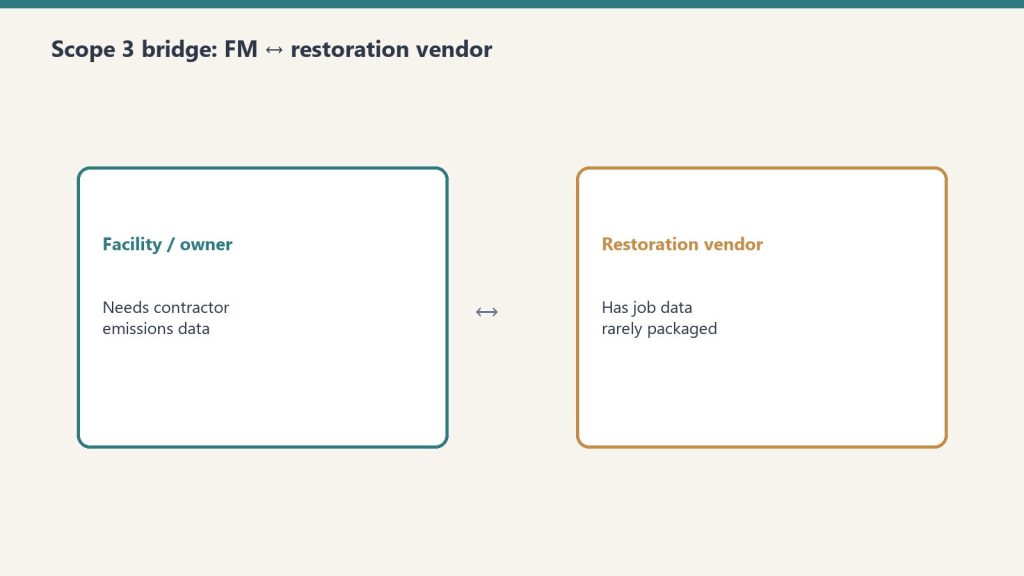
The missing control is the bridge: the FM needs the number; the vendor already has the job file.
What you do next
Do not wait for a software RFP. The sequence is short:
Read the FMJ piece — the case to the profession, on IFMA’s site.
Run the workbook — five phases, live scoring, a paste-ready contract clause, and an exportable program summary. Work email unlocks the clause.