Category: The Machine Room

Way 3 — Operations & Infrastructure. How systems are built, maintained, and scaled.

  • The Fractional CMO Playbook: Serving 12 Clients Without Burnout

    The Fractional CMO Playbook: Serving 12 Clients Without Burnout

    The Machine Room · Under the Hood

    Why Fractional Beats Full-Time for Most Businesses

    Most businesses under $10 million in revenue don’t need a full-time CMO. They need someone who’s done it before, can set the strategy, build the systems, and check in regularly – without the $200K+ salary and equity expectations. That’s the fractional CMO model, and it’s exploding in 2026.

    At Tygart Media, we serve 12 clients simultaneously as fractional CMOs. Each client gets senior-level strategic thinking, an AI-powered execution layer, and measurable outcomes – at a fraction of a full-time hire’s cost. Here’s how the model actually works behind the scenes.

    The Operating System Behind 12 Simultaneous Clients
    Serving 12 clients without burning out requires systems, not heroics. Our operating system has three layers:

    Strategic Layer (human): Monthly strategy sessions, quarterly reviews, and ad hoc strategic decisions. This is where human expertise is irreplaceable – understanding the client’s business context, competitive landscape, and growth objectives. Each client gets 4-8 hours of direct strategic time per month.

    Execution Layer (AI-assisted): Content production, SEO optimization, social media scheduling, reporting, and site management. Our AI stack handles 80% of execution work. A single strategist supported by AI can deliver more output than a 3-person marketing team working manually.

    Communication Layer (hybrid): Notion dashboards give clients real-time visibility into their marketing operations. Automated weekly reports land in their inbox. The AI drafts status updates; a human reviews and personalizes them. Clients feel well-informed without consuming strategist bandwidth.

    What Clients Actually Get

    Each fractional CMO engagement includes: a documented marketing strategy with 90-day milestones, ongoing content production (4-8 optimized articles per month), full WordPress site management and optimization, monthly performance reporting with strategic recommendations, and direct access to a senior strategist for decisions that matter.

    The total value delivered typically exceeds what a $150K/year marketing manager could produce – because the AI layer multiplies the strategist’s output by 5-10x on execution tasks.

    The Economics That Make It Work

    A traditional agency model serving 12 clients would require 6-8 employees: account managers, content writers, SEO specialists, designers, and a strategist. Salary costs alone would run $400K-600K annually.

    Our model: one senior strategist, one operations coordinator, and an AI execution stack. Total labor cost is under $200K. The AI stack costs under $1K/month. We deliver more output at higher quality with 70% lower overhead.

    This isn’t about replacing people with AI – it’s about replacing repetitive tasks with AI so that humans focus entirely on the work that creates the most value: strategy, relationships, and creative problem-solving.

    How We Prevent Burnout at Scale

    The biggest risk in fractional work is context-switching fatigue. Jumping between 12 different businesses, industries, and strategic challenges can be mentally exhausting. We manage this three ways:

    Notion Command Center: Every client, every task, every deadline lives in one unified workspace. Context switching is a database filter, not a mental exercise. When switching from a luxury lending client to a restoration client, the full context is one click away.

    Batched communication: We don’t check client Slack channels all day. Strategic communication happens in scheduled blocks. Urgent issues have a defined escalation path. Everything else waits for the next batch.

    AI handles the cognitive load of execution: The mental energy that used to go into writing meta descriptions, building reports, and optimizing posts now goes into strategy. The AI handles the repetitive cognitive work that drains capacity without creating value.

    Frequently Asked Questions

    How do you maintain quality across 12 different clients?

    Quality is encoded in our skill library and processes, not dependent on individual attention. Every client gets the same optimization protocols, the same content quality standards, and the same reporting framework. The AI layer enforces consistency that humans alone cannot maintain at scale.

    Don’t clients feel like they’re getting less attention?

    Clients measure attention by results and responsiveness, not by hours logged. Our clients get faster deliverables, more consistent output, and better strategic guidance than they’d get from a full-time hire who’s doing everything manually and slowly.

    What industries work best for fractional CMO services?

    Any business with $1-10M in revenue that relies on digital marketing for growth. We’ve found particular success in professional services, B2B companies, and businesses with strong local/regional presence. Industries with high customer lifetime value benefit most.

    How do you handle conflicts between competing clients?

    We don’t take competing clients in the same market. A restoration company in Houston and a restoration company in New York aren’t competitors. But two luxury lenders targeting the same geography would be a conflict we’d decline.

    The Model of the Future

    The fractional CMO model powered by AI isn’t a stopgap or a budget compromise – it’s a better model than full-time hiring for most businesses. More strategic depth, more execution capacity, and lower total cost. If you’re a business owner considering your next marketing hire, consider whether a system might serve you better than a salary.

    {
    “@context”: “https://schema.org”,
    “@type”: “Article”,
    “headline”: “The Fractional CMO Playbook: Serving 12 Clients Without Burnout”,
    “description”: “How Tygart Media serves 12 fractional CMO clients simultaneously using AI-powered execution and a unified Notion operating system.”,
    “datePublished”: “2026-03-21”,
    “dateModified”: “2026-04-03”,
    “author”: {
    “@type”: “Person”,
    “name”: “Will Tygart”,
    “url”: “https://tygartmedia.com/about”
    },
    “publisher”: {
    “@type”: “Organization”,
    “name”: “Tygart Media”,
    “url”: “https://tygartmedia.com”,
    “logo”: {
    “@type”: “ImageObject”,
    “url”: “https://tygartmedia.com/wp-content/uploads/tygart-media-logo.png”
    }
    },
    “mainEntityOfPage”: {
    “@type”: “WebPage”,
    “@id”: “https://tygartmedia.com/the-fractional-cmo-playbook-serving-12-clients-without-burnout/”
    }
    }

  • The LinkedIn Algorithm Doesn’t Care About Your Company Page

    The LinkedIn Algorithm Doesn’t Care About Your Company Page

    The Machine Room · Under the Hood

    Company Pages Are Dead Weight

    If your LinkedIn strategy centers on your company page, you’re optimizing for a channel that LinkedIn itself has deprioritized. Company page organic reach averages 2-5% of followers. Personal profiles regularly hit 10-20x that reach. LinkedIn’s algorithm explicitly favors individual voices over brand accounts because individual content drives the engagement that keeps users on the platform.

    This isn’t a bug – it’s LinkedIn’s core product design. The platform monetizes company pages through paid promotion. Free organic reach goes to people, not logos. Understanding this reality is the first step toward a LinkedIn strategy that actually works.

    What the Algorithm Rewards in 2026

    Dwell time is the primary signal. LinkedIn measures how long users stop scrolling to read your post. Long-form text posts with strong hooks outperform short updates because they capture more dwell time. The hook – your first 2-3 lines before the ‘see more’ fold – determines whether anyone reads the rest.

    Comments outweigh reactions. A post with 50 thoughtful comments outranks a post with 500 likes in LinkedIn’s distribution algorithm. Comments signal engagement depth, which LinkedIn uses to push content to broader networks. Asking specific questions and making debatable claims drives comment activity.

    Niche consistency beats viral randomness. LinkedIn rewards creators who post consistently about a defined topic. If your last 20 posts are about AI in marketing, your next AI post gets preferential distribution to an audience that’s already engaged with that topic. Random viral posts don’t build algorithmic momentum.

    Document posts and carousels get extended distribution. PDF carousel posts receive 3-5x the impression window of text-only posts because users swipe through multiple slides, generating extended engagement signals. We create carousels from our best-performing blog content and consistently see higher reach.

    The Personal Brand as Pipeline Strategy

    At Tygart Media, LinkedIn isn’t a social media channel – it’s a pipeline. Every post is designed to do one of three things: establish expertise on a specific topic, tell a story that demonstrates results, or spark a conversation that leads to DM inquiries.

    The results compound over time. One of our insurance adjuster connections called because she’d been reading LinkedIn posts for six months. She didn’t respond to a single post publicly. She didn’t click any links. She just read, consistently, until she had a need that matched the expertise we’d demonstrated. That’s the pipeline at work.

    This approach works for any professional service business. A restoration company owner posting about emergency response procedures becomes the recognized expert in their market. A luxury lender posting about high-value asset trends becomes the trusted advisor. LinkedIn turns your expertise into a passive lead generation engine.

    How to Write Posts That Actually Perform

    The hook formula: Start with a specific claim, a counterintuitive observation, or a question that challenges conventional wisdom. ‘We spent $127,000 on Google Ads so you don’t have to’ outperforms ‘Here are some PPC tips’ by orders of magnitude.

    The rehook: After 3-4 lines of context, drop a second hook that pulls readers further in. This technique keeps dwell time high and reduces drop-off after the initial fold.

    The value delivery: The body of the post should teach something specific or share a concrete result. Abstract advice performs poorly. Specific numbers, tools, and frameworks perform well.

    The engagement trigger: End with a question or a mildly controversial take that invites responses. ‘What’s your experience with this?’ works, but ‘I think most agencies are wrong about this – change my mind’ works better.

    Frequently Asked Questions

    How often should I post on LinkedIn?

    3-5 times per week for aggressive growth. 2-3 times per week for maintenance. Consistency matters more than frequency – posting daily for a week then disappearing for a month is worse than steady 3x/week cadence.

    Should I use hashtags on LinkedIn?

    Minimally. 3-5 relevant hashtags maximum. LinkedIn’s hashtag system is less impactful than it was in 2023. Topic consistency in your content matters far more than hashtag optimization for algorithmic distribution.

    Do LinkedIn engagement pods still work?

    LinkedIn actively detects and penalizes engagement pods. Artificial engagement from the same group of people on every post triggers algorithmic suppression. Authentic engagement from diverse connections is what the algorithm rewards.

    Is LinkedIn Sales Navigator worth the cost?

    For B2B pipeline building, yes. Navigator’s advanced search and InMail capabilities are valuable for targeted outreach. For content distribution and organic reach, the free platform is sufficient – Navigator doesn’t boost post performance.

    Your Profile Is Your Pipeline

    Stop treating LinkedIn as a social media obligation and start treating it as your highest-leverage business development channel. The algorithm rewards consistency, depth, and authentic expertise. Build those three things into your posting routine, and LinkedIn becomes a pipeline that works while you sleep.

    {
    “@context”: “https://schema.org”,
    “@type”: “Article”,
    “headline”: “The LinkedIn Algorithm Doesnt Care About Your Company Page”,
    “description”: “LinkedIn’s algorithm favors personal profiles over company pages. Here’s how to turn your posts into a pipeline that generates leads.”,
    “datePublished”: “2026-03-21”,
    “dateModified”: “2026-04-03”,
    “author”: {
    “@type”: “Person”,
    “name”: “Will Tygart”,
    “url”: “https://tygartmedia.com/about”
    },
    “publisher”: {
    “@type”: “Organization”,
    “name”: “Tygart Media”,
    “url”: “https://tygartmedia.com”,
    “logo”: {
    “@type”: “ImageObject”,
    “url”: “https://tygartmedia.com/wp-content/uploads/tygart-media-logo.png”
    }
    },
    “mainEntityOfPage”: {
    “@type”: “WebPage”,
    “@id”: “https://tygartmedia.com/the-linkedin-algorithm-doesnt-care-about-your-company-page/”
    }
    }

  • The Profit Detective: Why Networking Is the Only Growth Engine That Compounds Forever

    The Profit Detective: Why Networking Is the Only Growth Engine That Compounds Forever

    The Machine Room · Under the Hood

    The Myth of the Cold Funnel

    Every marketing agency sells the same dream: build a funnel, pour traffic in the top, collect revenue at the bottom. It works. Sometimes. For a while. Until the ad costs rise, the algorithms shift, and the funnel dries up. Then you are back to square one with nothing but a spreadsheet full of leads who never converted.

    I have built funnels. I have optimized funnels. I have automated funnels with AI agents that respond in under three minutes. But the single most valuable growth engine in my entire business is not a funnel at all. It is a network of human relationships that I have cultivated over two decades.

    I call myself the Profit Detective because that is what I do: I find the hidden revenue in every relationship, every conversation, every introduction. Not by exploiting people. By paying attention to what they actually need and connecting them to the right resource at the right time.

    How Relationships Built a Multi-Vertical Portfolio

    Every client in my portfolio came through a relationship. Not an ad. Not an SEO ranking. Not a cold email. A human being who knew me, trusted me, and introduced me to someone who needed exactly what I build.

    The restoration companies came through industry connections I made years ago. The luxury lending clients came through a single introduction at the right moment. The comedy streaming platform came through a friendship that turned into a business partnership. The automotive training company came through a referral chain that started with a conversation at a conference I almost skipped.

    None of these relationships had an immediate ROI. Some took years to produce a single dollar of revenue. But when they did produce, they produced entire business verticals — not one-off projects.

    The Compounding Math of Trust

    A paid lead has a half-life. The moment you stop paying, the lead disappears. A relationship has a compounding curve. Every year you invest in it, the trust deepens, the referral quality improves, and the speed of new business accelerates.

    I have relationships that have produced six figures of revenue over five years from a single coffee meeting. No contract. No pitch deck. Just consistent value delivery and genuine interest in the other person’s success. Try getting that return from a Google Ads campaign.

    Why AI Makes Networking More Valuable

    Here is the counterintuitive truth: as AI automates more of the transactional layer of business, the relationship layer becomes the only sustainable differentiator. When everyone has access to the same AI tools, the same automation platforms, the same content generation capabilities, the thing that cannot be replicated is trust.

    AI handles my email responses, my social media scheduling, my content optimization, my site audits. That frees up hours every week that I reinvest into relationships. More calls. More introductions. More showing up for people when they need something I can provide.

    The irony is beautiful: I use AI to automate everything except the one thing that actually grows the business. The human part.

    The Profit Detective Method

    My approach to networking is simple and repeatable. First, I pay attention. Not to what someone says they need, but to what their business actually needs based on what I observe. Second, I connect. Not for credit, but because the connection genuinely makes sense. Third, I follow up. Not once. Not twice. Consistently, for years, without expectation of reciprocity.

    Most people network like they are collecting baseball cards. They want the biggest collection. I network like I am building an ecosystem. Every node in the network strengthens every other node. When the restoration company needs a website, they call me. When the lending company needs content strategy, they call me. When the comedy platform needs SEO, they call me. Not because I marketed to them. Because I showed up for them when it counted.

    Building a Contact Profile Database

    I am now building an AI-powered contact profile database that tracks every interaction, every preference, every business need for every person in my network. Not to surveil them. To serve them better. When I pick up the phone, I want to know what we talked about last time, what their current challenges are, and what introductions might be valuable to them right now.

    This is the marriage of AI and networking. The machine remembers everything. The human provides everything that matters: judgment, empathy, timing, and genuine care.

    FAQ

    How do you track your networking ROI?
    I track the origin of every client relationship back to its first touchpoint. Over 90 percent trace back to a personal introduction or existing relationship.

    Does this approach scale?
    Not in the way VCs want to hear. It scales through depth, not breadth. Fewer relationships, deeper trust, higher lifetime value per connection.

    How do you balance networking with running the business?
    AI automation handles the operational load. That gives me 10-15 hours per week that I dedicate exclusively to relationship building and maintenance.

    {
    “@context”: “https://schema.org”,
    “@type”: “Article”,
    “headline”: “The Profit Detective: Why Networking Is the Only Growth Engine That Compounds Forever”,
    “description”: “How relationship-first networking built a multi-vertical agency portfolio and why AI makes human connection more valuable, not less.”,
    “datePublished”: “2026-03-21”,
    “dateModified”: “2026-04-03”,
    “author”: {
    “@type”: “Person”,
    “name”: “Will Tygart”,
    “url”: “https://tygartmedia.com/about”
    },
    “publisher”: {
    “@type”: “Organization”,
    “name”: “Tygart Media”,
    “url”: “https://tygartmedia.com”,
    “logo”: {
    “@type”: “ImageObject”,
    “url”: “https://tygartmedia.com/wp-content/uploads/tygart-media-logo.png”
    }
    },
    “mainEntityOfPage”: {
    “@type”: “WebPage”,
    “@id”: “https://tygartmedia.com/the-profit-detective-why-networking-is-the-only-growth-engine-that-compounds-forever/”
    }
    }

  • From Google Apps Script to Cloud Run: Migrating a Content Pipeline Without Breaking Production

    From Google Apps Script to Cloud Run: Migrating a Content Pipeline Without Breaking Production

    The Machine Room · Under the Hood

    The Pipeline That Outgrew Its Home

    It started in a Google Sheet. A simple Apps Script that called Gemini, generated an article, and pushed it to WordPress via the REST API. It worked beautifully — for about three months. Then the volume increased, the content got more complex, the optimization requirements multiplied, and suddenly I was running a production content pipeline inside a spreadsheet.

    Google Apps Script has a six-minute execution limit. My pipeline was hitting it on every run. The script would timeout mid-publish, leaving half-written articles in WordPress and orphaned rows in the Sheet. I was spending more time debugging the pipeline than using it.

    The migration to Cloud Run was not optional. It was survival.

    What the Original Pipeline Did

    The Apps Script pipeline was elegantly simple. A Google Sheet held rows of keyword targets, each with a topic, a target site, and a content brief. The script would iterate through rows marked “ready,” call Gemini via the Vertex AI API to generate an article, format it as HTML, add SEO metadata, and publish it to WordPress using the REST API with Application Password authentication.

    It also logged results back to the Sheet — post ID, publish date, word count, and status. This gave me a running ledger of every article the pipeline had ever produced. At its peak, the Sheet had over 300 rows spanning eight different WordPress sites.

    The problem was not the logic. The logic was sound. The problem was the execution environment. Apps Script was never designed to run content pipelines that make multiple API calls, process large text payloads, and handle error recovery across external services.

    The Cloud Run Architecture

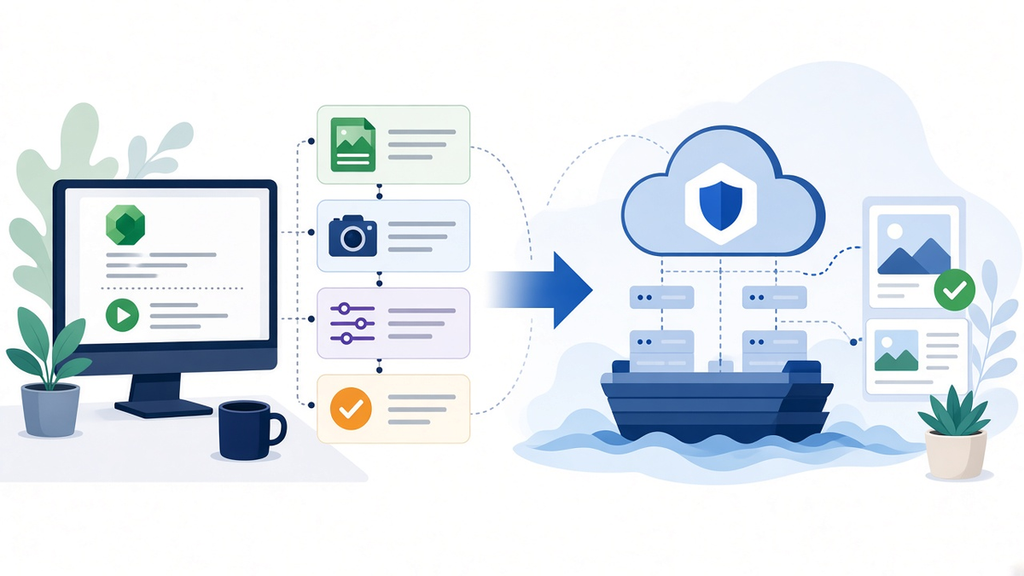
    The new pipeline runs on Google Cloud Run as a containerized service. It is triggered by a Cloud Scheduler cron job or by manual invocation through the proxy. The container pulls the content queue from Notion (replacing the Google Sheet), generates articles through the Vertex AI API, optimizes them through the SEO/AEO/GEO framework, and publishes through the WordPress proxy.

    The key architectural change was moving from synchronous to asynchronous processing. Apps Script runs everything in sequence — one article at a time, blocking on each API call. Cloud Run processes articles in parallel, with independent error handling for each one. If article three fails, articles four through fifteen still publish successfully.

    Error recovery was the other major upgrade. Apps Script has no retry logic beyond what you manually code into try-catch blocks. Cloud Run has built-in retry policies, dead letter queues, and structured logging. When something fails, I know exactly what failed, why, and whether it recovered on retry.

    The Migration Strategy

    I did not do a big-bang migration. I ran both systems in parallel for two weeks. The Apps Script pipeline continued handling three low-volume sites while I migrated the high-volume sites to Cloud Run one at a time. Each migration followed the same pattern: verify credentials on the new system, publish one test article, compare the output to an Apps Script article from the same site, and then switch over.

    The parallel period caught three bugs that would have caused data loss in a direct cutover. One was a character encoding issue where Cloud Run’s UTF-8 handling differed from Apps Script’s. Another was a timezone mismatch in the publish timestamps. The third was a subtle difference in how the two systems handled WordPress category IDs.

    Every bug was caught because I had a production comparison running side by side. This is the only safe way to migrate a content pipeline: never trust the new system until it proves itself against the old one.

    What Changed After Migration

    Publishing speed went from 45 minutes for a batch of ten articles to under eight minutes. Error rate dropped from roughly 15 percent (mostly timeouts) to under 2 percent. And the pipeline now handles 18 sites without modification — the same container, the same code, different credential sets pulled from the site registry.

    The biggest win was not speed. It was confidence. With Apps Script, every batch run was a gamble. Would it timeout? Would it leave orphaned posts? Would the Sheet get corrupted? With Cloud Run, I trigger the pipeline and walk away. It either succeeds completely or fails cleanly with a detailed error log.

    Lessons for Anyone Running Production Pipelines in Spreadsheets

    First: if your spreadsheet pipeline takes more than 60 seconds to run, it is already too big for a spreadsheet. Start planning the migration now, not when it breaks.

    Second: always run parallel before cutting over. The bugs you catch in parallel mode are the bugs that would have cost you data in production.

    Third: structured logging is not optional. When your pipeline publishes to external services, you need to know exactly what happened on every run. Spreadsheet logs are fragile. Cloud logging is permanent and searchable.

    Fourth: the migration is an opportunity to fix everything you tolerated in the original system. Do not just port the code. Redesign the architecture for the new environment.

    FAQ

    How much does Cloud Run cost compared to Apps Script?
    Apps Script is free but limited. Cloud Run costs roughly -30 per month at my volume, which is negligible compared to the time saved from fewer failures and faster execution.

    Do you still use Google Sheets anywhere in the pipeline?
    No. Notion replaced the Sheet as the content queue. The Sheet was a good prototype but a poor production database.

    How long did the full migration take?
    Three weeks from first Cloud Run deployment to full cutover. The parallel running period was the longest phase.

    {
    “@context”: “https://schema.org”,
    “@type”: “Article”,
    “headline”: “From Google Apps Script to Cloud Run: Migrating a Content Pipeline Without Breaking Production”,
    “description”: “The real story of migrating a Gemini-to-WordPress publishing pipeline from Google Sheets to GCP Cloud Run without losing a single article.”,
    “datePublished”: “2026-03-21”,
    “dateModified”: “2026-04-03”,
    “author”: {
    “@type”: “Person”,
    “name”: “Will Tygart”,
    “url”: “https://tygartmedia.com/about”
    },
    “publisher”: {
    “@type”: “Organization”,
    “name”: “Tygart Media”,
    “url”: “https://tygartmedia.com”,
    “logo”: {
    “@type”: “ImageObject”,
    “url”: “https://tygartmedia.com/wp-content/uploads/tygart-media-logo.png”
    }
    },
    “mainEntityOfPage”: {
    “@type”: “WebPage”,
    “@id”: “https://tygartmedia.com/from-google-apps-script-to-cloud-run-migrating-a-content-pipeline-without-breaking-production/”
    }
    }

  • How AI Writes Its Own Instructions: The Self-Creating Skill System That Learns From Every Session

    How AI Writes Its Own Instructions: The Self-Creating Skill System That Learns From Every Session

    The Machine Room · Under the Hood

    The Recursion That Actually Works

    Most people think of AI as a tool you give instructions to. I built a system where the AI writes its own instructions. Not in a theoretical research lab sense. In a production business operations sense. The skill-creator skill is an AI agent whose sole job is to observe what works in real sessions, extract the patterns, and codify them into new skills that other agents can use.

    A skill, in my system, is a structured set of instructions that tells an AI agent how to perform a specific task. It includes the trigger conditions, the step-by-step procedure, the quality gates, the error handling, and the expected outputs. Writing a good skill takes deep domain knowledge and careful iteration. It used to take me hours per skill. Now the AI writes them in minutes, and the quality is often better than what I produce manually.

    How Skill Self-Creation Works

    The process starts with observation. During every working session, the AI tracks which actions it takes, which tools it uses, which decisions require my input, and which outcomes are successful. This creates a session log — a structured record of the entire workflow from start to finish.

    After the session, the skill-creator agent analyzes the log. It identifies repeatable patterns: sequences of actions that were performed multiple times with consistent success. It extracts the decision logic: the conditions under which the AI chose one path over another. And it captures the quality gates: the checks that determined whether an output was acceptable.

    From this analysis, the agent drafts a new skill. The skill follows a standardized format — YAML frontmatter with metadata, followed by markdown instructions with step-by-step procedures. The agent writes the description that determines when the skill triggers, the instructions that determine how it executes, and the validation criteria that determine whether it succeeded.

    The Quality Problem and How We Solved It

    Early versions of skill self-creation produced mediocre skills. They captured the surface-level actions but missed the contextual judgment that made the workflow actually work. The agent would write a skill that said “publish to WordPress” but miss the nuance of checking excerpt length, verifying category assignment, or running the SEO optimization pass before publishing.

    The fix was adding a refinement loop. After the agent drafts a skill, it runs a simulated execution against a test case. If the simulated execution misses steps that the original session included, the agent revises the skill. This loop runs until the simulated execution matches the original session’s quality within a defined tolerance.

    The second fix was adding a description optimization pass. A skill is useless if it never triggers. The agent now analyzes the trigger conditions — the keywords, phrases, and contexts that should activate the skill — and optimizes the description for maximum recall without false positives. This is essentially SEO for AI skills.

    Skills That Write Better Skills

    The most recursive part of the system is that the skill-creator skill itself was partially written by an earlier version of itself. I wrote the first version manually. That version observed me creating skills by hand, extracted the patterns, and produced a second version that was more comprehensive. The second version then refined itself into the third version, which is what runs in production today.

    Each generation captures more nuance. The first version knew to include trigger conditions. The second version learned to include negative triggers — conditions that should explicitly not activate the skill. The third version added variance analysis — testing whether a skill performs consistently across different invocation contexts or only works in the specific scenario where it was created.

    This is not artificial general intelligence. It is not sentient. It is a well-designed feedback loop that improves operational documentation through structured iteration. But the output is remarkable: a library of over 80 production skills, many of which were created or significantly refined by the system itself.

    What This Means for Business Operations

    The traditional way to scale operations is to hire people, train them, and hope they follow the procedures consistently. The skill self-creation model inverts this. The AI observes the best version of a procedure, codifies it perfectly, and then executes it identically every time. No training decay. No interpretation drift. No Monday morning inconsistency.

    When I discover a better way to optimize a WordPress post — a new schema type, a better FAQ structure, a more effective interlink pattern — I do it once in a live session. The skill-creator agent watches, extracts the improvement, and updates the relevant skill. From that moment forward, every post optimization across every site includes the improvement. One session, permanent upgrade, portfolio-wide deployment.

    The Limits of Self-Creation

    The system cannot create skills for tasks it has never observed. It cannot invent new optimization techniques or discover new strategies. It can only codify and refine what it has seen work in practice. The creative direction, the strategic decisions, the judgment calls — those still come from me.

    It also cannot evaluate business impact. It knows whether a skill executed correctly, but it does not know whether the output moved a meaningful metric. That evaluation layer requires human judgment and time — traffic data, conversion data, client feedback. The system optimizes execution quality, not business outcomes. The gap between those two things is where human expertise remains irreplaceable.

    FAQ

    How many skills has the system created autonomously?
    Approximately 30 skills were created entirely by the skill-creator agent. Another 50 were human-created but significantly refined by the agent through the optimization loop.

    Can the system create skills for any domain?
    It can create skills for any domain where it has observed successful sessions. The more sessions it observes in a domain, the better the skills it produces.

    What prevents the system from creating bad skills?
    The simulated execution loop catches most quality issues. Skills that fail simulation are flagged for human review rather than deployed to production.

    {
    “@context”: “https://schema.org”,
    “@type”: “Article”,
    “headline”: “How AI Writes Its Own Instructions: The Self-Creating Skill System That Learns From Every Session”,
    “description”: “Inside the skill-creator skill: an AI system that writes, tests, and optimizes its own operational instructions based on real session outcomes.”,
    “datePublished”: “2026-03-21”,
    “dateModified”: “2026-04-03”,
    “author”: {
    “@type”: “Person”,
    “name”: “Will Tygart”,
    “url”: “https://tygartmedia.com/about”
    },
    “publisher”: {
    “@type”: “Organization”,
    “name”: “Tygart Media”,
    “url”: “https://tygartmedia.com”,
    “logo”: {
    “@type”: “ImageObject”,
    “url”: “https://tygartmedia.com/wp-content/uploads/tygart-media-logo.png”
    }
    },
    “mainEntityOfPage”: {
    “@type”: “WebPage”,
    “@id”: “https://tygartmedia.com/how-ai-writes-its-own-instructions-the-self-creating-skill-system-that-learns-from-every-session/”
    }
    }

  • The Contact Profile Database: Building Per-Person AI Memory for Every Relationship in Your Network

    The Contact Profile Database: Building Per-Person AI Memory for Every Relationship in Your Network

    The Machine Room · Under the Hood

    The CRM Is Dead. Long Live the Contact Profile.

    Traditional CRMs store records. Name, email, company, last activity date, deal stage. They are databases optimized for pipeline management, not relationship management. They tell you where someone is in your funnel. They tell you nothing about who they actually are.

    I built something different. A contact profile database that stores what matters: what we talked about, what they care about, what their business needs, what introductions would help them, what their communication preferences are, and what our shared history looks like across every touchpoint — email, phone, in-person, social media, and collaborative work.

    The database is powered by AI agents that automatically extract and update profile data from every interaction. When I send an email, the agent parses it for relevant updates. When I finish a call, I dictate a brief note and the agent incorporates it into the contact’s profile. When a social media post mentions a contact’s company, the agent flags it for context.

    The Architecture of a Contact Profile

    Each contact profile lives in Notion as a database entry with structured properties and a rich-text body. The structured properties capture the basics: name, company, role, entity tags that link them to specific businesses in my portfolio, relationship strength score, and last interaction date.

    The rich-text body is where the real value lives. It contains a chronological interaction log, a preferences section, a needs assessment, and a relationship context section. The interaction log captures every meaningful touchpoint with a date and a one-sentence summary. The preferences section tracks communication style, meeting preferences, topics they enjoy, and topics to avoid.

    The needs assessment is updated quarterly. It captures what the contact’s business needs right now, what challenges they are facing, and what opportunities I can see that they might not. This is the section I review before every call and every meeting. It turns every interaction into a continuation of a long-running conversation, not a cold restart.

    How AI Keeps Profiles Current

    Manual CRM updates are the reason most CRMs die within six months of implementation. Nobody wants to spend fifteen minutes after every call logging data into a form. The profile database eliminates manual updates entirely.

    The email agent scans incoming and outgoing email for contact mentions. When it detects a substantive interaction — not a newsletter, not a receipt, but a real conversation — it extracts the key points and appends them to the contact’s interaction log. The agent knows the difference between a transactional email and a relationship email because it has been trained on my communication patterns.

    After phone calls, I dictate a voice note that gets transcribed and processed. The agent extracts action items, updates the needs assessment if something changed, and flags any follow-up commitments I made. This takes me about 90 seconds per call — compared to the five to ten minutes that manual CRM entry would require.

    The Relationship Strength Score

    Each contact has a relationship strength score from one to ten. The score is calculated algorithmically based on interaction frequency, interaction depth, reciprocity, and recency. A contact I speak with weekly about substantive topics scores higher than a contact I exchange LinkedIn messages with monthly.

    The score decays over time. If I have not interacted with someone in 60 days, their score drops. This decay is intentional — it surfaces relationships that need attention before they go cold. Every Monday, the weekly briefing includes a list of high-value contacts whose scores have dropped below a threshold. These are my reach-out priorities for the week.

    The score also factors in reciprocity. A relationship where I am always initiating and never receiving is scored differently from one where both parties actively contribute. This helps me identify relationships that are genuinely mutual versus ones that are one-directional.

    Privacy and Ethics

    This system stores personal information about real people. The ethical guardrails are non-negotiable. First, the database is private. No one accesses it except me and my AI agents. It is not shared with clients, partners, or team members. Second, the information stored is limited to professional context. I do not track personal details that are irrelevant to the business relationship. Third, any contact can request to see what I have stored about them, and I will show them. Transparency is the foundation of trust.

    The AI agents are instructed to never use profile data in ways that would feel manipulative or surveilling. The purpose is to serve people better, not to gain advantage over them. When I remember that someone mentioned their daughter’s soccer tournament three months ago and ask how it went, that is not manipulation. That is being a good human who pays attention.

    The Compound Value of Institutional Memory

    Six months into using the contact profile database, I can trace direct revenue to relationship insights that would have been lost without it. A contact mentioned a business challenge in passing during a call in October. The agent logged it. In January, I saw an opportunity that directly addressed that challenge. I made the introduction. It became a six-figure engagement.

    Without the profile database, that October mention would have been forgotten. The January opportunity would have passed without connection. The engagement would never have happened. This is the compound value of institutional memory: every interaction becomes an asset that appreciates over time.

    The system is still early. I am building integrations with calendar data, social media monitoring, and public company news feeds. The vision is a contact profile that updates itself continuously from every available signal, so that every time I interact with someone, I have the full picture of who they are, what they need, and how I can help.

    FAQ

    How many contacts are in the database?
    Currently around 400 active profiles. Not everyone I have ever met — only people with meaningful professional relationships that I want to maintain and deepen.

    How do you handle contacts who work across multiple businesses?
    Entity tags allow a single contact to be linked to multiple business entities. Their profile shows the full relationship context across all touchpoints.

    What tool do you use for the database?
    Notion, with AI agents that read and write to it via the Notion API. The same architecture that powers the rest of the command center operating system.

    {
    “@context”: “https://schema.org”,
    “@type”: “Article”,
    “headline”: “The Contact Profile Database: Building Per-Person AI Memory for Every Relationship in Your Network”,
    “description”: “How I built an AI-powered contact database that remembers every interaction, preference, and business need across my entire professional network.”,
    “datePublished”: “2026-03-21”,
    “dateModified”: “2026-04-03”,
    “author”: {
    “@type”: “Person”,
    “name”: “Will Tygart”,
    “url”: “https://tygartmedia.com/about”
    },
    “publisher”: {
    “@type”: “Organization”,
    “name”: “Tygart Media”,
    “url”: “https://tygartmedia.com”,
    “logo”: {
    “@type”: “ImageObject”,
    “url”: “https://tygartmedia.com/wp-content/uploads/tygart-media-logo.png”
    }
    },
    “mainEntityOfPage”: {
    “@type”: “WebPage”,
    “@id”: “https://tygartmedia.com/the-contact-profile-database-building-per-person-ai-memory-for-every-relationship-in-your-network/”
    }
    }

  • The SEO Agency’s Blind Spot: You Rank Pages. But Do You Win Answers?

    The SEO Agency’s Blind Spot: You Rank Pages. But Do You Win Answers?

    The Machine Room · Under the Hood

    You Are Winning a Game That Is Shrinking

    If you run an SEO agency, you are probably good at what you do. You audit sites, fix technical issues, build content strategies, and move keywords up the rankings. Your clients see green arrows in their reports. Your retainers renew. Everything looks fine.

    Except the playing field is not what it was two years ago. Google’s search results page now has three layers of competition above the organic listings you are optimizing for. Featured snippets extract and display content directly. People Also Ask boxes answer follow-up questions without a click. And AI Overviews — powered by Gemini — synthesize multiple sources into a generated answer at the very top of the page. Your client’s number three ranking is now below three layers of content they are not competing in.

    This is not a prediction. It is the current state of search. And most SEO agencies have no offering for the answer layer or the AI layer because those disciplines — Answer Engine Optimization and Generative Engine Optimization — did not exist when the agency was founded. The tools are different. The content structures are different. The measurement is different. And the expertise required is specialized enough that you cannot just add it to your existing SEO team’s workload and expect results.

    What Your Clients See That You Do Not

    Your clients are already noticing. They search for their own keywords and see a competitor’s content in the featured snippet above their organic listing. They ask ChatGPT about their industry and their brand is not mentioned. They see Google AI Overviews citing sources that are not their website. They do not always tell you about it because they assume you are handling it. You are not. Because AEO and GEO are not part of your service offering.

    The awareness gap is closing fast. Industry publications are writing about AI search optimization. Conferences are adding AEO and GEO tracks. Your clients’ marketing directors are reading about it. The moment a client asks “what are we doing about AI search?” and you do not have a crisp answer, your credibility takes a hit that is hard to recover from.

    This is not about fear. It is about the natural evolution of search. SEO evolved from keyword stuffing to content strategy to E-E-A-T. AEO and GEO are the next evolution. The agencies that lead the evolution keep their clients. The agencies that lag lose them to competitors who already offer what is next.

    The Three-Layer Reality

    Modern search optimization requires three complementary disciplines. SEO — the foundation you already deliver — gets pages ranked in organic results. AEO restructures content to win featured snippets, People Also Ask placements, and voice search answers. GEO optimizes content to be cited and recommended by AI systems including Google AI Overviews, ChatGPT, Claude, Perplexity, and Gemini.

    Each layer requires different content structures. SEO rewards comprehensive, well-linked, technically sound pages. AEO requires tight 40-to-60-word direct answer blocks under question-phrased headings with FAQPage schema markup. GEO requires maximum factual density — specific numbers, cited sources, verifiable claims — with strong entity signals and AI-readable structure.

    You can deliver all three. But it requires either building the expertise in-house — hiring specialists, developing new processes, investing in training — or partnering with someone who already has the methodology, the tools, and the production capacity to layer AEO and GEO on top of the SEO work you are already doing.

    The Revenue Sitting Next to Your Current Contracts

    Every SEO client you have is a potential AEO and GEO client. They already trust you with their search visibility. They already have a budget allocated to search optimization. The conversation is not a cold pitch — it is an expansion of a relationship you have already earned.

    The upsell math is straightforward. If your average SEO retainer is ,000 to ,000 per month, adding an AEO and GEO layer at 40 to 60 percent of the base retainer increases revenue per client without increasing client acquisition cost. Your client gets a more comprehensive service. You get higher average contract value. The retention rate improves because the client has more reasons to stay.

    The agencies that figure this out first will capture the expansion revenue across their entire client base. The agencies that wait will watch a specialized partner or competitor capture it instead.

    Why This Cannot Wait

    Featured snippets are not new. But AI Overviews are, and they are expanding rapidly. Google is increasing the percentage of queries that trigger AI Overviews. Perplexity is growing its user base month over month. ChatGPT with browsing is becoming a default research tool for millions of professionals. Every month you wait, your clients’ competitors gain ground in channels you are not even monitoring.

    The question is not whether to add AEO and GEO to your agency’s capabilities. It is whether you build it, buy it, or partner for it — and how fast you can get it into client engagements before the next agency pitch meeting where the competitor across the table already has it.

    FAQ

    Can our existing SEO team learn AEO and GEO?
    Some of it, yes. But the specialized content structuring, schema stacking, factual density methodology, and AI citation monitoring require dedicated expertise and tooling that takes months to develop internally. Partnering accelerates the timeline from months to weeks.

    How do we explain AEO and GEO to clients who only understand SEO?
    Frame it as the evolution of search visibility. SEO gets you ranked. AEO gets you quoted. GEO gets you recommended by AI. Most clients immediately understand why all three matter when they see a competitor in the featured snippet or AI Overview above their organic listing.

    What does a partnership look like versus building in-house?
    A partnership provides the methodology, production capacity, and measurement frameworks while your agency maintains the client relationship, strategic direction, and brand presence. Think of it as adding a specialized capability to your existing delivery team without the hiring risk.

    {
    “@context”: “https://schema.org”,
    “@type”: “Article”,
    “headline”: “The SEO Agencys Blind Spot: You Rank Pages. But Do You Win Answers?”,
    “description”: “Most SEO agencies still optimize for blue links while featured snippets and AI citations reshape how clients actually get found. Here is what is missing.”,
    “datePublished”: “2026-03-21”,
    “dateModified”: “2026-04-03”,
    “author”: {
    “@type”: “Person”,
    “name”: “Will Tygart”,
    “url”: “https://tygartmedia.com/about”
    },
    “publisher”: {
    “@type”: “Organization”,
    “name”: “Tygart Media”,
    “url”: “https://tygartmedia.com”,
    “logo”: {
    “@type”: “ImageObject”,
    “url”: “https://tygartmedia.com/wp-content/uploads/tygart-media-logo.png”
    }
    },
    “mainEntityOfPage”: {
    “@type”: “WebPage”,
    “@id”: “https://tygartmedia.com/the-seo-agencys-blind-spot-you-rank-pages-but-do-you-win-answers/”
    }
    }

  • Your Clients Are Asking About AI Search. Here Is What to Tell Them Before They Ask Someone Else.

    Your Clients Are Asking About AI Search. Here Is What to Tell Them Before They Ask Someone Else.

    The Machine Room · Under the Hood

    The Question Is Coming. Be Ready.

    If you manage client accounts at an SEO agency, this scenario is heading your way if it has not arrived already. Your client’s CMO reads an article about AI Overviews. Their VP of Marketing notices a competitor in a featured snippet. Their CEO asks ChatGPT about their industry and does not see their brand mentioned. Then they call you and ask: “What are we doing about this?”

    How you answer that question determines whether you keep the relationship or start a countdown to a review. Saying “that is not really our area” is a death sentence. Saying “we are working on it” without a plan is worse. The right answer is specific, confident, and positions your agency as already ahead of the curve — even if you are just now figuring it out.

    The Three Things Clients Actually Want to Know

    When a client asks about AI search, they are not asking for a technical lecture. They want answers to three questions. First: are we visible in these new search features? Second: are our competitors visible in them? Third: what are we going to do about it?

    You can answer the first two questions in the next meeting with simple research. Search their top five keywords in Google and note whether AI Overviews, featured snippets, or PAA boxes appear. Check if the client’s content or a competitor’s content is cited. Ask ChatGPT and Perplexity the same questions and note who gets mentioned. This takes thirty minutes and gives you concrete data to present.

    The third question — what to do about it — requires a capability your agency may not have yet. Answer Engine Optimization restructures existing content to win featured snippets and PAA placements. Generative Engine Optimization enhances content with the factual density, entity signals, and structural clarity that AI systems need to cite it. Both are specialized disciplines that layer on top of the SEO work you are already doing.

    How to Frame AEO and GEO for Non-Technical Clients

    Drop the acronyms in the first conversation. Clients do not care about AEO and GEO as terms. They care about outcomes. Frame it this way: “There are now three ways your content shows up in search. The traditional ranking — that is what we have been optimizing. The direct answer box at the top of the results — that is a new opportunity we can capture. And the AI-generated summary that Google, ChatGPT, and other AI tools show — that is the fastest-growing channel and we need to make sure your content is what they cite.”

    Then show them. Pull up their top keyword in Google. Point to the AI Overview. Point to the featured snippet. Point to the People Also Ask box. Then point to the organic results below all of that. Ask them which position they would rather be in. The visual is more persuasive than any pitch deck.

    For the competitive angle, show them a competitor who is appearing in the featured snippet or AI Overview. Nothing motivates a client faster than seeing a competitor occupy a position they did not know existed.

    The Account Manager’s Cheat Sheet

    When the client asks about featured snippets, tell them: “Featured snippets are extracted from content that follows a specific structure — a question as a heading followed by a tight, direct answer in under sixty words. We can restructure your existing top-ranking content to compete for these placements. It requires content reformatting and FAQ schema markup, not new content creation.”

    When the client asks about AI Overviews, tell them: “Google’s AI Overviews pull from content that is factually specific, well-cited, and structurally clear. We need to increase the factual density of your content — replacing vague claims with specific numbers and cited sources — and ensure your entity signals are strong so the AI trusts your brand as a source.”

    When the client asks about ChatGPT or Perplexity visibility, tell them: “AI search tools cite content that is authoritative, factually dense, and easy to extract clean answers from. We can optimize your content for AI citation by enhancing your content’s verifiability, implementing LLMS.txt for AI crawler guidance, and strengthening your brand’s entity signals across the web.”

    When the client asks what it costs, tell them: “AEO and GEO layer on top of the SEO work we already do. The incremental investment is a fraction of the base SEO retainer because we are enhancing existing content, not starting from scratch. The ROI shows up as increased visibility in featured positions and AI citations — new channels that competitors are already competing in.”

    When You Do Not Have the Capability Yet

    If your agency does not yet have AEO and GEO delivery capability, do not fake it. But do not punt either. The honest and strategic response is: “We are building out our AI search optimization capability now. In the meantime, here is what I can show you about your current visibility in these channels, and here is our plan to address the gaps.”

    Then find a partner who can deliver while you develop the capability internally. The worst outcome is telling the client “we are working on it” and having nothing to show three months later. The best outcome is presenting results within the current engagement cycle that demonstrate you are ahead of the market.

    FAQ

    How do I research a client’s AI search visibility before a meeting?
    Search their top five keywords in Google and note AI Overviews and featured snippets. Ask ChatGPT and Perplexity the same questions and check for brand mentions. Screenshot everything. This takes thirty minutes and provides concrete talking points.

    What if the client’s competitors are not in AI search features either?
    That is actually the best scenario — it means the client has a first-mover opportunity. Frame it as capturing uncontested territory before competitors wake up to it.

    How do I handle a client who thinks SEO is all they need?
    Show them the search results page. Count how many features appear above the organic results. If the client’s number one ranking is below three layers of AI-generated and featured content, the organic position alone is not delivering the visibility it used to.

    {
    “@context”: “https://schema.org”,
    “@type”: “Article”,
    “headline”: “Your Clients Are Asking About AI Search. Here Is What to Tell Them Before They Ask Someone Else.”,
    “description”: “A field guide for agency account managers on how to answer client questions about AI search, featured snippets, and AI Overviews with confidence.”,
    “datePublished”: “2026-03-21”,
    “dateModified”: “2026-04-03”,
    “author”: {
    “@type”: “Person”,
    “name”: “Will Tygart”,
    “url”: “https://tygartmedia.com/about”
    },
    “publisher”: {
    “@type”: “Organization”,
    “name”: “Tygart Media”,
    “url”: “https://tygartmedia.com”,
    “logo”: {
    “@type”: “ImageObject”,
    “url”: “https://tygartmedia.com/wp-content/uploads/tygart-media-logo.png”
    }
    },
    “mainEntityOfPage”: {
    “@type”: “WebPage”,
    “@id”: “https://tygartmedia.com/your-clients-are-asking-about-ai-search-here-is-what-to-tell-them-before-they-ask-someone-else/”
    }
    }

  • The AEO Revenue Your Agency Is Leaving on the Table With Every Single Client

    The AEO Revenue Your Agency Is Leaving on the Table With Every Single Client

    The Machine Room · Under the Hood

    You Already Own the Relationship

    New business development is expensive. The pitch process, the proposals, the competitive reviews, the ramp-up period — acquiring a new SEO client costs your agency 5 to 10 times more than expanding an existing engagement. And yet most agencies pour their growth energy into hunting new logos while the easiest revenue expansion is sitting inside every current contract.

    Every SEO client you serve has content that ranks. That content is eligible for featured snippets, People Also Ask placements, and AI citations — but only if it is structured correctly. Right now, it almost certainly is not. The content was written for organic ranking, not for answer extraction. The headings are descriptive statements, not question phrases. There are no direct answer blocks. There is no FAQ schema. The factual density is marketing-grade, not citation-grade.

    That gap between what the content does and what it could do is revenue. Your revenue. If you do not capture it, someone else will — either a specialist firm your client discovers, or a competing agency that already offers the full stack.

    The Expansion Math

    Take your average monthly SEO retainer. For most agencies serving mid-market clients, that is somewhere between ,000 and ,000 per month. An AEO and GEO enhancement layer — restructuring existing content for featured snippets, implementing FAQ schema, increasing factual density, strengthening entity signals — can be priced as a natural extension of the base SEO retainer.

    On a ,000 monthly retainer, that is ,000 to ,000 per month in expansion revenue per client. Across a portfolio of 15 clients, that is ,000 to ,000 in monthly recurring revenue added without a single new client acquisition. No pitch decks. No competitive reviews. No onboarding costs. Just a deeper service for clients who already trust you.

    The retention effect compounds the math further. Clients receiving a multi-layer optimization service are significantly harder for competitors to displace. The switching cost increases because the new agency would need to match your SEO delivery and your AEO/GEO capability. Your contracts become stickier, your churn drops, and your client lifetime value increases.

    The Pitch That Works

    Do not pitch AEO and GEO as a new service. Pitch it as an evolution of the service you already deliver. The conversation goes like this: “We have been ranking your content in organic search, and we are getting strong results. But search has evolved. There are now featured positions above the organic results and AI-generated answers above those. Your competitors are starting to appear in these channels. We want to make sure your content is optimized for all three layers — not just the organic one.”

    Then show the visual. Pull up the client’s top keyword. Point to the featured snippet they are not in. Point to the AI Overview citing a competitor. Then show what the content needs to change structurally to compete in those positions. The gap is visible and the solution is concrete.

    The clincher is competitive intelligence. If you can show that a specific competitor already appears in featured snippets or AI citations for the client’s target keywords, the urgency becomes personal. No client wants to see a competitor quoted by Google while their own content sits below the fold.

    What the Delivery Actually Looks Like

    AEO and GEO enhancement is not a rebuild. It is a restructuring of content that already exists and already ranks. The delivery has four components that layer onto your existing SEO workflow.

    First: content restructuring. Take the client’s top 20 pages by traffic and restructure the headings to match target queries. Add direct answer blocks — 40 to 60 word self-contained answers — under each question heading. This makes the content snippet-eligible without changing the depth or quality of the existing material.

    Second: FAQ and schema implementation. Add FAQ sections with 5 to 8 questions mapped to the People Also Ask landscape for each page’s target keyword. Implement FAQPage schema, Article schema, and Speakable schema in JSON-LD format. This explicitly declares the page’s answer content to search engines and AI systems.

    Third: factual density enhancement. Audit the content for vague claims and replace them with specific, cited facts. Add numbers, dates, named sources, and inline citations. This increases the page’s value to AI systems that need verifiable information to cite confidently.

    Fourth: entity signal strengthening. Audit the client’s Organization schema, author pages, and brand consistency across web properties. Fill gaps. This builds the entity authority that AI systems use when deciding which sources to recommend.

    The first pass across a site takes a concentrated effort. After the initial enhancement, ongoing maintenance adds a manageable number of hours per month to your delivery workload — monitoring snippet positions, updating FAQ content, maintaining schema validity, and refreshing factual density on priority pages.

    Build, Buy, or Partner

    You have three paths to adding this capability. Build it internally by training your existing team and developing the methodology from scratch — time to market takes months of development. Buy it by hiring AEO and GEO specialists — expensive and dependent on a thin talent market. Or partner with an established AEO/GEO practice that delivers under your brand while you maintain the client relationship — time to market is weeks, not months.

    The economics usually favor partnering initially while you build internal capability in parallel. Your partner handles the specialized delivery. You handle the client relationship, strategy, and billing. The client sees a seamless expansion of services. Your revenue grows immediately.

    FAQ

    Will clients pay extra for AEO and GEO on top of SEO?
    Yes, when you frame it as capturing visibility in channels where competitors are already active. The visual demonstration — showing the client their keyword with a competitor in the featured snippet or AI Overview — makes the value self-evident.

    How do you measure AEO and GEO results for client reporting?
    Track featured snippet wins and losses, PAA placements, AI Overview citations, and referral traffic from AI search platforms. These metrics supplement traditional organic ranking reports and demonstrate the expanded visibility.

    What if the client’s content is too thin for AEO/GEO enhancement?
    Content expansion is part of the service. Thin pages need depth before they can be structured for snippets or optimized for AI citation. This is an additional revenue opportunity, not a blocker.

    {
    “@context”: “https://schema.org”,
    “@type”: “Article”,
    “headline”: “The AEO Revenue Your Agency Is Leaving on the Table With Every Single Client”,
    “description”: “Every SEO client you have is an AEO upsell waiting to happen. Here is the math, the pitch, and why the expansion revenue is easier than new business.”,
    “datePublished”: “2026-03-21”,
    “dateModified”: “2026-04-03”,
    “author”: {
    “@type”: “Person”,
    “name”: “Will Tygart”,
    “url”: “https://tygartmedia.com/about”
    },
    “publisher”: {
    “@type”: “Organization”,
    “name”: “Tygart Media”,
    “url”: “https://tygartmedia.com”,
    “logo”: {
    “@type”: “ImageObject”,
    “url”: “https://tygartmedia.com/wp-content/uploads/tygart-media-logo.png”
    }
    },
    “mainEntityOfPage”: {
    “@type”: “WebPage”,
    “@id”: “https://tygartmedia.com/the-aeo-revenue-your-agency-is-leaving-on-the-table-with-every-single-client/”
    }
    }

  • Why Your Best SEO Clients Will Leave for an AI-Native Agency Within 18 Months

    Why Your Best SEO Clients Will Leave for an AI-Native Agency Within 18 Months

    The Machine Room · Under the Hood

    The Retention Clock Is Ticking

    Your best clients are your most dangerous attrition risk right now. Not because your SEO work is bad. Because your best clients are the most sophisticated, the most informed, and the most likely to notice that search has changed while your service offering has not.

    These are the clients whose marketing directors read Search Engine Journal and attend MozCon. They follow Rand Fishkin and Lily Ray on LinkedIn. They have already seen the articles about AI Overviews eating organic clicks. They have already noticed featured snippets above their hard-won rankings. And they are already wondering whether their agency is keeping up or falling behind.

    The attrition will not happen dramatically. Your best client will not call and fire you. They will start a quiet search. They will take a meeting with an agency that pitches AEO and GEO as part of their standard offering. They will ask that agency questions your team cannot answer. And three months later, you will get a polite email about “exploring other options.” By then it is too late.

    The 18-Month Timeline

    Here is how it plays out across the industry. Right now — early 2026 — AI Overviews appear on roughly 25 to 30 percent of informational queries. By mid-2026, that will cross 40 percent based on Google’s stated expansion plans. By early 2027, the majority of informational queries will trigger some form of AI-generated result.

    At 25 percent, your clients might not notice the impact. At 40 percent, they will see organic click-through rates declining on their most important keywords. At majority coverage, the organic-only strategy you are delivering will be visibly insufficient to any client paying attention to their analytics.

    The agencies that will capture your departing clients are already building their AEO and GEO capabilities. They are developing the content restructuring workflows, the schema implementation processes, the factual density methodologies, and the AI citation monitoring dashboards. When your client takes that exploratory meeting in nine months, the competing agency will have a proven playbook and case studies to show.

    What the AI-Native Agency Pitch Looks Like

    When your client meets the competing agency, here is what they will hear: “We optimize for all three layers of search — organic rankings, featured answer positions, and AI citations. Here is a case study where we took a client from zero featured snippets to twelve in ninety days. Here is the AI citation report showing their brand mentioned in ChatGPT and Perplexity responses. Here is the AI Overview tracking dashboard showing which queries their content is cited in.”

    Your client will compare that to your monthly report showing keyword rankings and organic traffic. Both are valuable. But one addresses the full search landscape and the other addresses only the shrinking organic portion of it. The comparison is not flattering.

    The Clients You Are Most Likely to Lose

    Not all clients are equally at risk. The highest-attrition-risk clients share three characteristics. First: they operate in informational or commercial verticals where AI Overviews and featured snippets are most prevalent — healthcare, finance, technology, education, professional services. Second: they have marketing leadership that stays current on industry trends. Third: they track actual business outcomes, not just ranking reports, which means they will notice when organic rankings stop translating to the same traffic and conversion volumes.

    These are also your most valuable clients. They are the ones with the largest retainers, the longest relationships, and the highest lifetime value. Losing them is not a rounding error. It is a material revenue hit that can destabilize an agency.

    How to Defend Your Client Base

    The defense strategy has three components. First: proactively show clients the three-layer search reality before they discover it on their own. Run the competitive analysis. Show them where they are visible and where they are not. Position yourself as the agency that identified the gap, not the agency that had to be asked about it.

    Second: add AEO and GEO to your service offering, either through internal capability building or through a delivery partnership. Have the methodology, the process, and ideally early results to show within 90 days. The window for proactive positioning is closing.

    Third: integrate AEO and GEO metrics into your client reporting. Track featured snippet positions. Monitor AI Overview citations. Report on PAA placements. Show the client that you are measuring and optimizing for the full search landscape, not just the organic slice.

    The agencies that take these three steps in the next 90 days will retain their best clients and expand their contracts. The agencies that take them in 180 days will play catch-up. The agencies that wait longer than that will learn about their clients’ departure in a polite email that was drafted six months before it was sent.

    FAQ

    Are clients really switching agencies over AEO and GEO?
    Not yet at scale, but the trend is accelerating. The first agencies to lose clients over this gap will not see it coming because the decision happens quietly during the client’s internal research phase.

    How fast can an agency add AEO and GEO capability?
    Through a delivery partnership, you can have results to show clients within 60 to 90 days. Building internally from scratch takes months to develop the methodology and train the team.

    What is the cost of not adding these capabilities?
    Meaningful client attrition over the coming quarters among your most sophisticated and highest-value accounts — the ones paying attention to how search is evolving. The revenue impact far exceeds the investment required to add the capability.

    {
    “@context”: “https://schema.org”,
    “@type”: “Article”,
    “headline”: “Why Your Best SEO Clients Will Leave for an AI-Native Agency Within 18 Months”,
    “description”: “Client retention is an existential risk for SEO agencies that cannot deliver AEO and GEO. Here is the timeline and what to do before it is too late.”,
    “datePublished”: “2026-03-21”,
    “dateModified”: “2026-04-03”,
    “author”: {
    “@type”: “Person”,
    “name”: “Will Tygart”,
    “url”: “https://tygartmedia.com/about”
    },
    “publisher”: {
    “@type”: “Organization”,
    “name”: “Tygart Media”,
    “url”: “https://tygartmedia.com”,
    “logo”: {
    “@type”: “ImageObject”,
    “url”: “https://tygartmedia.com/wp-content/uploads/tygart-media-logo.png”
    }
    },
    “mainEntityOfPage”: {
    “@type”: “WebPage”,
    “@id”: “https://tygartmedia.com/why-your-best-seo-clients-will-leave-for-an-ai-native-agency-within-18-months/”
    }
    }