The short answer: a diminished value demand letter is a short, plain letter that identifies the claim, names a specific amount, attaches the evidence for that amount, and asks for a response. It does not need legal language. Below is a complete sample built on bracketed placeholders you replace with your own facts, plus how to send it so delivery is proved, and what to expect after it lands.
What the letter has to do
The letter has five jobs, and a good sample does all five in about a page:
Identify the claim. Your name, the claim number, the date of the accident, and the car. The adjuster should be able to match the letter to the right file in seconds.
State a specific demand. One clear amount, stated as your diminished value claim. A letter that says the car is worth less now, without naming what you are asking for, gives the adjuster nothing concrete to approve or negotiate.
Attach the evidence. The appraisal or other value evidence, the final repair invoice, and the history report belong with the letter, not described inside it. The letter points to the attachments; the attachments carry the proof.
Set a response expectation. Ask for a written response and say when you expect to hear back. Keep the wording polite and plain — you are setting a record that you asked and when, not making a threat.
Create a paper record. Sent in writing and kept, the letter proves what you demanded, what you sent with it, and when. Phone calls do not create that record; this letter does.
Where the letter goes
For a diminished value claim after another driver’s accident, the letter normally goes to that driver’s insurer — a third-party claim against the at-fault driver’s policy. Which insurer pays is covered in Who pays diminished value — my insurer or theirs? Use the claim number that insurer assigned, and address the letter to the adjuster handling the file.
Attach the appraisal and the key evidence rather than describing them at length. A letter that says an appraisal exists invites a request for it and a delay; a letter with it attached can be evaluated on the first read.
The sample letter
This is an example to adapt to your facts, not a form issued by any insurer or court.
Editor's Note
Sample diminished value demand letter — adapt the bracketed parts to your facts
[Your full name] [Your street address] [Your city, state, and ZIP code] [Your email address] [Your phone number]
[Date you are sending the letter]
[Insurer name] [Claims department or adjuster name] [Insurer street address] [Insurer city, state, and ZIP code]
Re: Diminished value claim Claim number: [claim number] Date of accident: [date of accident] Vehicle: [vehicle year/make/model] Insured driver: [name of the at-fault driver, if known]
Dear [adjuster name or Claims Department],
I am writing to make a claim for diminished value for the vehicle above. The car was damaged in the accident on [date of accident] and has been repaired. The enclosed final repair invoice shows the work that was done. Even though the repairs are complete, the car now carries an accident record on its vehicle history, and it is worth less than it was before the accident.
Based on [your appraisal or evidence], I am demanding [the amount you are demanding] for the diminished value of the vehicle. I have attached [your appraisal or evidence], the itemized final repair invoice, and the vehicle-history report showing the accident entry.
Please send your response in writing. I would appreciate a reply by [a reasonable response date you choose]. If you need anything else from me to evaluate this claim, please let me know in writing what is needed.
Thank you for your attention to this claim.
Sincerely, [Your signature] [Your full name]
Enclosures: [list what you attached, for example the appraisal, the final repair invoice, and the vehicle-history report]
Read the finished letter once as the adjuster will. The claim number is on it, the amount is stated plainly, and the attachments are listed. If your appraisal words the value loss differently, copy its figure exactly — the letter and its main attachment should agree.
How to send it, and what to keep
Send it in a way that proves delivery. Email with a delivery or read confirmation you can save, or tracked mail with a receipt, both work. What matters is that you can later prove the letter was sent and received, and on what date.
Attach, do not just mention. Include the appraisal, the final itemized repair invoice, and the vehicle-history report as actual attachments or enclosures, and list them at the end of the letter.
Keep a complete copy. Save the exact letter you sent, the attachments as sent, and the delivery proof together in your claim folder. That set is your record if the claim is disputed, transferred to a new adjuster, or escalated later.
Important Notice
Do not sign a general release before this is resolved. Repair payments sometimes come with release paperwork. A general release can end the whole claim — including diminished value — even if you only meant to accept the repair money. If a release arrives before your diminished value demand is settled, read it carefully, and do not sign it unless it clearly leaves the diminished value claim open.
After you send it
The most common response is a counteroffer lower than your demand, often built on a standard formula the insurer uses instead of your appraisal. How those calculations work is covered in How is diminished value calculated? A low first answer is a negotiating position, not a final verdict. Reply in writing, point to the specific evidence the response leaves out, and keep every exchange in the same folder as the letter.
If the insurer refuses outright or stops responding, the next steps are escalation — the routes laid out in Disputes. Your letter and its delivery proof are the foundation for any of those steps.
Frequently asked questions
Who do I send a diminished value claim letter to?
For a third-party claim, send it to the insurer for the driver who was at fault, using the claim number that insurer assigned. If liability is still being decided, send it to the insurer handling the property damage claim and keep proof of delivery.
Should I attach my appraisal to the letter?
Yes. Attach the appraisal and the key evidence instead of only describing them in the letter. The letter states the demand and the attachments give the adjuster the documents needed to evaluate it.
What happens after I send the letter?
Expect a response that may be lower than your demand, often explained with a formula or a standard calculation. Read the reasoning, compare it with your evidence, and reply in writing if the response leaves out repairs or market facts your file documents.
Can signing a release hurt my diminished value claim?
Yes, it can. A general release signed with a repair payment can end related claims, including diminished value, even if you meant to accept only the repair money. Read any release carefully and do not sign it until the diminished value demand is resolved or the release clearly leaves that claim open.
Informational only — not legal or insurance advice.
Auto repair and insurance rules vary by state and by policy. Check your own policy documents and your state’s insurance department, or talk to a licensed professional, before acting on a claim.
A diminished value demand letter, at a glance
A diminished value demand letter
Part of the letter
What it does
Claim identification
Matches the letter to the right claim, accident, and car
The specific amount demanded
Gives the adjuster a concrete figure to evaluate
Attached appraisal and evidence
Carries the proof, so the letter stays short
A written response request
Sets the expectation and keeps the reply on the record
The short answer: yes — after repairs is the normal posture for a diminished value claim. The loss is measured on the repaired car, so the claim usually cannot even be valued until repairs are finished and the final invoice exists. Accepting the repair payment does not by itself end a third-party claim. What can end it is paperwork — a general release or a full-settlement check — so read anything you sign after repairs, and mind a deadline that runs from the accident date, not the repair date.
Why after repairs is the normal posture
Many drivers learn about diminished value only after the car comes home, and fear they missed their moment. They did not. Diminished value is not the damage itself — the damage is what the repair payment covers. It is what remains after a good repair: the gap between what your car is worth now, with an accident on its history, and what it would have been worth with no accident at all.
That gap can only be measured on the finished car. Until repairs are complete, nobody knows the final scope of the work or the final invoice. A demand built before repairs finish rests on estimates; the same claim built after repairs rests on the real record. Insurers expect that order, too — repairs first, then the argument about remaining value — so it is not a late filing that needs an excuse.
If your car was repaired weeks or months ago and you are only now hearing the term, start here: the timing is normal. What matters is whether you signed anything that settled more than the repairs, and how much time your state’s deadline still gives you.
What accepting the repair payment does — and does not — do
Accepting payment for the repairs, by itself, generally settles the repair element of a third-party property damage claim: the insurer paid to fix the car, and that element is closed. It does not by itself close the diminished value element, a separate part of the same loss. The car is fixed, but worth less than a car that was never hit, and a repair check has not paid that remaining loss.
The exception is paperwork, and it is where drivers actually lose this claim. Two forms of it deserve slow reading:
A signed general release. If you signed a release of all property damage claims — language settling the whole claim, not just the repair bill — the insurer can use it to argue the entire claim, diminished value included, is settled. The words on the release control, not what anyone said the form was for.
A check tendered as full settlement. A check or letter offering payment as full settlement of all claims carries similar weight if it is cashed. The letter matters as much as the check, so keep both and read both.
Not every form is a trap. Routine paperwork — authorizations, direction-to-pay forms, receipts — settles nothing beyond its own subject. The discipline is simple: read anything you sign as if it might be the last word on the claim, because a release is drafted to be exactly that. If you already signed something and cannot tell what it covers, that document — not a guess — is what a reviewer needs to see.
Important Notice
A release demanded before diminished value is addressed is a red flag If an insurer asks you to sign a general release of all property damage claims before diminished value has even been discussed, stop and read it as a settlement of everything, because that is what it says. You can ask, in writing, for diminished value to be addressed first — or for the release to be limited to the repairs it is paying for.
The clock runs from the accident, not the shop
The one timing rule that does bite has nothing to do with repairs. A diminished value claim is part of a property damage claim, and its deadline is generally set by your state’s statute of limitations for property damage. That clock runs from the accident date — not from the day repairs finished, and not from the day you first heard the term. The window’s length varies by state, so the date that matters is the one your own state’s law sets.
The consequence cuts both ways. Repairs completed months ago are still fine if the file is built now and the deadline has not passed. But time spent not knowing about diminished value does not pause the clock, so waiting indefinitely spends a fixed window. The guide on how long you have to file diminished value covers finding your state’s deadline and counting it correctly. Check that date early and let it — not a vague sense of lateness — decide how urgently you move.
If repairs finished months ago, or the car is already sold
A claim built now is built the same way as any other: the repair record, value evidence for the car with and without an accident history, and a documented demand in writing. The guide on what documents you need for diminished value lists the file in full. The older the repair, the more the file depends on records rather than memory — one more reason to gather invoices and photos while they are easy to get.
Selling the car raises the stakes on paperwork without automatically killing the claim. A sale does not, by itself, erase a loss that existed while you owned the car. What it changes is the evidence: the actual sale price becomes part of the record, and an appraiser must work from history rather than inspection. A file built before or promptly after a sale carries that burden far better than one assembled from memory later. If you have already sold, keep the sale paperwork with the repair file.
Your next steps, in order
Find and read anything you signed after repairs. Look for release language covering all property damage claims. If you find it, bring the document itself to any advice you seek.
Check your state deadline from the accident date. Count from the crash, not the repair. If the date is close, speed matters more than polish.
Build the file on the completed repair. Final invoice, repair records, photos, and value evidence. This file is the claim — the demand letter just carries it.
Present the diminished value element in writing. Name it as the remaining, unpaid element of the claim, attach the documentation, and keep copies.
Frequently asked questions
Is it too late to file diminished value once repairs are done?
No. After repairs is the normal time to file, because diminished value is measured on the repaired car. The claim usually cannot be valued until repairs are finished and the final invoice exists, so completing repairs does not by itself make you late.
Did accepting the repair payment settle my diminished value claim too?
Not by itself, generally. Accepting payment for repairs covers the repair element, but paperwork can change that. A signed general release of all property damage claims, or a check offered as full settlement of all claims, can be used to argue the whole claim is settled. Read anything you sign.
When does the deadline to file diminished value start?
The clock generally runs from the date of the accident, not from the date repairs finished. The deadline is set by your state law for property damage claims, and it varies by state. Filing after repairs is normal, but waiting without checking your state deadline is risky.
Can I still claim diminished value if I already sold the car?
Selling the car does not automatically end the claim, but it usually makes proof harder. The sale price becomes part of the evidence, and you will need repair records and value evidence from before the sale. Building the file promptly matters more once the car is gone.
Informational only — not legal or insurance advice.
Auto repair and insurance rules vary by state and by policy. Check your own policy documents and your state’s insurance department, or talk to a licensed professional, before acting on a claim.
Filing diminished value after repairs, at a glance
Filing diminished value after repairs
Situation
What it means
Repairs just finished
The normal time to file, because the loss is now measurable
Repair payment accepted, nothing else signed
Generally settles the repairs only, not the value element
General release signed
Can be used to argue the whole property damage claim is settled
Deadline counting
Runs from the accident date under state law, not the repair date
Car already sold
Claim is not automatically over, but proof is harder
The short answer: in most cases, yes — the choice of repair shop is yours. An insurer can recommend shops from its preferred program, and there are real conveniences to using one, but owing your claim does not depend on picking from the list. If you have a shop you trust, you can say so plainly, have the file noted, and move the claim forward there. The trade-offs are worth knowing, and so is the pressure language to recognize — but neither changes who chooses.
What a preferred-shop program actually is
Insurers run preferred-shop programs — usually called direct repair programs, or DRPs — with body shops in each area. A shop in the program agrees to the insurer’s rates and processes: how estimates are written, how jobs are documented, how quickly cars move through. In exchange, the insurer sends the shop a steady flow of referrals.
Both sides get something real. The insurer gets predictable pricing and a workflow it does not have to negotiate car by car. The shop gets customers without chasing them. And a place on the list is not a mark against a shop — many good shops participate in these programs, because the volume is worth it. The program is a business arrangement between the insurer and the shop. It was never a verdict on the shops that are not in it, including the one you have used for years.
Steering: what it sounds like
Recommending a program shop is normal. Steering is when the recommendation turns into pressure — language designed to make your own choice sound risky, expensive, or futile. Lines in that family, paraphrased, sound like this:
The work at another shop can’t be guaranteed.
It will take much longer if you go somewhere else.
You will have to pay the shop yourself and wait to be reimbursed.
That shop is not on our approved list, so we may not be able to cover the full repair there.
Hearing a version of one of these is not proof an adjuster is acting in bad faith — some of it is script, some of it is habit, and some of it exaggerates a real trade-off covered below. It is language to recognize and answer calmly, not a fight to win: I’ll note that; I’m still choosing this shop — please proceed with my claim. Then ask for the next step.
It is also worth knowing that many states restrict insurer steering — rules about how insurers may steer customers toward their program shops vary by state, so the specific protection that applies to you is your own state’s rule.
The honest trade-offs
Going off-list is your right, and it is not free of trade-offs. Honestly weighed:
At a program shop, the insurer may warranty the repair in addition to the shop’s own warranty, and the workflow is smoother — the estimate process, approvals, and payment are built into the relationship, so there are typically fewer rounds of paperwork.
At your own shop, you do the vetting the insurer already did for its list — checking reputation, certifications, and how the shop handles claims. In exchange, you get a shop whose work you may already know and trust, and a shop that answers to you.
Either way, the payment mechanics work the same in principle: the insurer pays the approved amount for the covered repair, whether by paying the shop directly or paying you. A dispute about rates or scope can happen at either kind of shop, and it is a separate question from which shop you chose.
If you have no shop of your own and no strong reason to pick one, a good program shop is a reasonable choice. The point is only that it is a choice — yours — and a reasoned one beats a pressured one.
How to choose well
If you are picking your own shop, a few checks do most of the work:
Certifications and training for your brand. Ask what manufacturer certifications or training the shop’s technicians hold, especially for your make — modern cars, and their safety systems, reward brand-specific training.
Experience with your insurer’s estimating system. A shop that regularly works in the system your insurer uses writes estimates and supplements in the format the adjuster can approve without translation delays.
A written estimate, and the supplement process explained up front. Before work starts, the shop should hand you a written estimate and explain what happens if more damage shows up once panels come off — because it often does, and you want that process agreed before it is needed.
Can the insurer refuse to pay if I use my own shop?
Generally, no. The insurer owes the covered claim based on your policy, not based on whether the shop is on its preferred list. It pays the approved amount for the covered repair, and disagreements about rates or scope are negotiated separately from your right to choose the shop.
Does using my own shop slow the claim down?
It can add a step. At a program shop the insurer already trusts the estimate workflow, while at your own shop it may send its own adjuster to inspect the car and write or review the estimate. Plan for that estimate round either way, and ask what the next step is so the car is not sitting without a plan.
Is the insurer’s repair warranty at program shops worth it?
It is a real benefit. Program shops commonly offer a repair warranty backed by the insurer for as long as you own the car, on top of the shop’s own warranty. Weigh that against your trust in your own shop’s work and reputation, because the specific terms vary by insurer and program.
What should I say when the adjuster pushes their shop?
Thank them for the suggestion, state your choice plainly, and ask them to note the file and proceed with the claim at your shop. Then get the claim number, the adjuster’s name, and the next step in writing, so the conversation ends with the claim moving rather than with the shop question reopened on every call.
Informational only — not legal or insurance advice.
Auto repair and insurance rules vary by state and by policy. Check your own policy documents and your state’s insurance department, or talk to a licensed professional, before acting on a claim.
The short answer: when your car is totaled, the offer usually comes from a valuation report — very often from CCC ONE, a database insurers use to price used cars. The report finds comparable cars near you, adjusts their prices for differences from yours, and lands on a value. It reads like an official document, but it’s only as good as its inputs. Your job is to check those inputs, line by line, against the car you actually owned.
What CCC ONE is
CCC ONE is a valuation platform insurers subscribe to. Instead of an adjuster researching prices by hand, the system searches listings and recent sales, builds a set of comparable vehicles, and applies standardized adjustments. Other insurers use equivalents — Mitchell and Audatex produce the same kind of report. The vendor differs; the method doesn’t: comparables in, adjustments applied, value out.
What a report contains
Your car’s identity page — year, make, model, and the trim, options, and mileage the system believes your car had. This page is where expensive mistakes live.
The comparable vehicles — the listings or sales the value is built from, with each car’s location, mileage, and asking or sold price.
Adjustments — dollar amounts added or subtracted per comparable for mileage differences, options, and condition, to make each comp “match” your car.
Condition line items — ratings and deductions for body, interior, tires, and mechanical condition, often benchmarked against an assumed “average” car.
The base value — the result everything flows into, before taxes, fees, and your deductible.
How to get yours
Ask the adjuster for the full valuation report — every page, including the comparables and adjustments, not just the summary page with the final number. Make the request in writing so it’s part of the claim record. You can’t audit a number you can’t see, and the full report is a normal thing to ask for.
How to audit it, line by line
Check the trim and packages. Does the report describe your car — or a base model? A missing trim level or option package (all-wheel drive, sunroof, navigation, tow package) quietly takes real money off.
Check the mileage. Compare the report’s mileage to your odometer photo or service records. Inflated mileage is a direct deduction.
Check the options boxes. Equipment your car had that the report left unchecked is value left on the table.
Challenge the condition deductions. Reports often assume average wear. If your car was cleaner than average — and your photos, detail receipts, or service history show it — say so, with the evidence attached.
Grade the comparables. How far away are they? Much higher mileage than yours? Older, or a different trim? A comp that isn’t comparable is adjustable — flag each one specifically.
Send your corrections in writing, with your own comps. Listings for your exact year, trim, and mileage range in your region, screenshotted with dates and prices. Here’s the full fight plan: How to fight a low total-loss offer →
Important Notice
Errors are inputs, not verdicts A low report usually isn’t anyone deciding to cheat you — it’s a wrong trim, a stale listing, or an unchecked box flowing through the math. That’s good news: wrong inputs can be corrected, one line at a time, and corrections are hard to argue with.
Informational only — not legal or insurance advice.
Valuation methods and your rights to claim documents vary by state and by policy. Check your own policy documents and your state’s insurance department, or talk to a licensed professional, before acting on a claim.
The line-by-line audit
What to check in your valuation report
Report line
What to verify
Trim & packages
Matches the car you owned — not a base model
Mileage
Matches your odometer and service records
Options
Every factory option your car had is checked
Condition deductions
Reflect your car’s real condition, with your photos as proof
Comparables
Same trim, close mileage, your region, current or recent
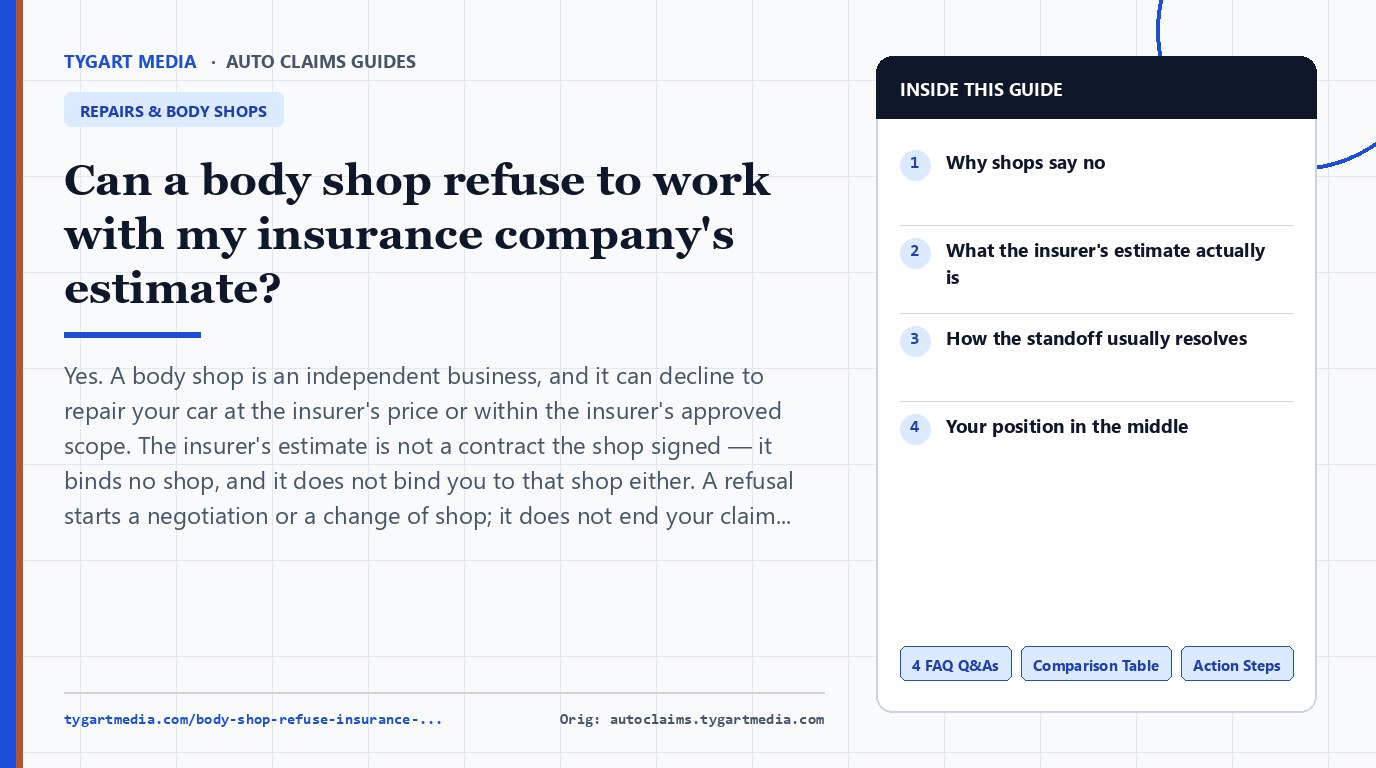
The short answer: yes. A body shop is an independent business, and it can decline to repair your car at the insurer’s price or within the insurer’s approved scope. The insurer’s estimate is not a contract the shop signed — it binds no shop, and it does not bind you to that shop either. A refusal starts a negotiation or a change of shop; it does not end your claim, which stays open and owed no matter which shop does the work.
Why shops say no
Refusals are business decisions. Sometimes they are a quality stand, sometimes they are simple economics, and often they are both at once:
The insurer’s rate is below what the shop charges. The estimate is written at the rate the insurer pays. If the shop’s posted labor rate is higher, working from the insurer’s number means working at a loss on every hour.
The approved scope skips procedures the shop considers necessary. A shop that will stand behind the finished repair may refuse a scope that leaves out steps it believes a correct repair requires.
Parts the shop will not install. If the estimate prices parts the shop does not trust or will not warranty, the shop may decline rather than put its name on that work.
The shop’s schedule is full. Sometimes the answer is not about your claim at all — the shop simply cannot take the work on.
None of these make the shop the villain, and none make the adjuster one either. They are two businesses looking at the same repair through different numbers.
What the insurer’s estimate actually is
It helps to be clear about what that document is — and is not. The insurer’s estimate is a payment position: a statement of what the insurer is prepared to pay, based on the damage it has seen so far. It is not a contract. The shop never signed it. You did not sign it either.
Nothing in it obliges any shop to work from it, and nothing obliges you to have the car repaired at that number. It is the insurer’s opening scope, and the system has a built-in way to move it: documentation. Supplements, photos, and procedure evidence are how a starting scope becomes an approved repair.
How the standoff usually resolves
The shop documents and files a supplement. Instead of just saying no, the shop writes up what the repair actually requires — rates, procedures, parts, with photos — and sends it to the adjuster.
The adjuster reviews or re-inspects. Faced with documentation rather than a refusal, the adjuster can approve more of the scope, and often does.
Or you move the car. If the numbers still do not meet, you can take the car to a shop that will work with the claim: Can I choose my own body shop? → One caution first — moving a car in the middle of a dispute can start storage charges ticking: Who pays body shop storage fees? →
Or you agree, in writing, to a specific difference. If you want this shop and this scope, you can accept one itemized difference yourself — with the exact amount on paper before any work starts.
Your position in the middle
It can feel like you are caught between two parties who each want you to pressure the other. In fact your position is stronger than it feels. The claim is yours, it stays open, and what the insurer owes does not depend on which shop turns the wrenches.
Your leverage is not forcing either side — you cannot make a shop accept a rate, and you cannot make an adjuster approve an undocumented scope. Your leverage is documentation and choice: insisting the disagreement be written down line by line, and knowing you can take the car, and the claim, somewhere else.
Frequently asked questions
Will my insurer pay more if the shop refuses its estimate?
No — refusal alone moves nothing. Documentation does. A supplement with photos and procedure evidence, showing what the repair actually requires, is what changes the insurer’s number.
Can the shop charge me the difference between the estimates?
Only if you agreed to it, ideally in writing, before the work was done. A difference nobody itemized, or that you never accepted, is disputable — ask for the lines that make up the amount before paying anything.
Should I just take the car to the insurer’s preferred shop?
Sometimes that is the pragmatic move, and sometimes it is not. Weigh the preferred shop’s warranty and workflow against your trust in your own shop, the car’s condition, and how the work will be documented. It is your choice either way.
Can a shop refuse to release my car during an estimate dispute?
If no work was authorized or done, the car is yours to move, though teardown or storage charges you agreed to may still be owed. Where work was done and not paid for, lien rules vary by state, so check your state’s rules or ask a licensed professional before acting.
Informational only — not legal or insurance advice.
Auto repair and insurance rules vary by state and by policy. Check your own policy documents and your state’s insurance department, or talk to a licensed professional, before acting on a claim.
If the shop refuses the estimate
If the shop refuses the estimate
What is happening
Your move
Rate too low for the shop
Ask the shop to document its rate and file it as a supplement
Scope missing procedures
Ask for the procedure evidence in writing for the adjuster
No agreement after rounds
Get a second estimate or choose another shop
You need the car moved
Ask about teardown and storage charges before the tow, in writing
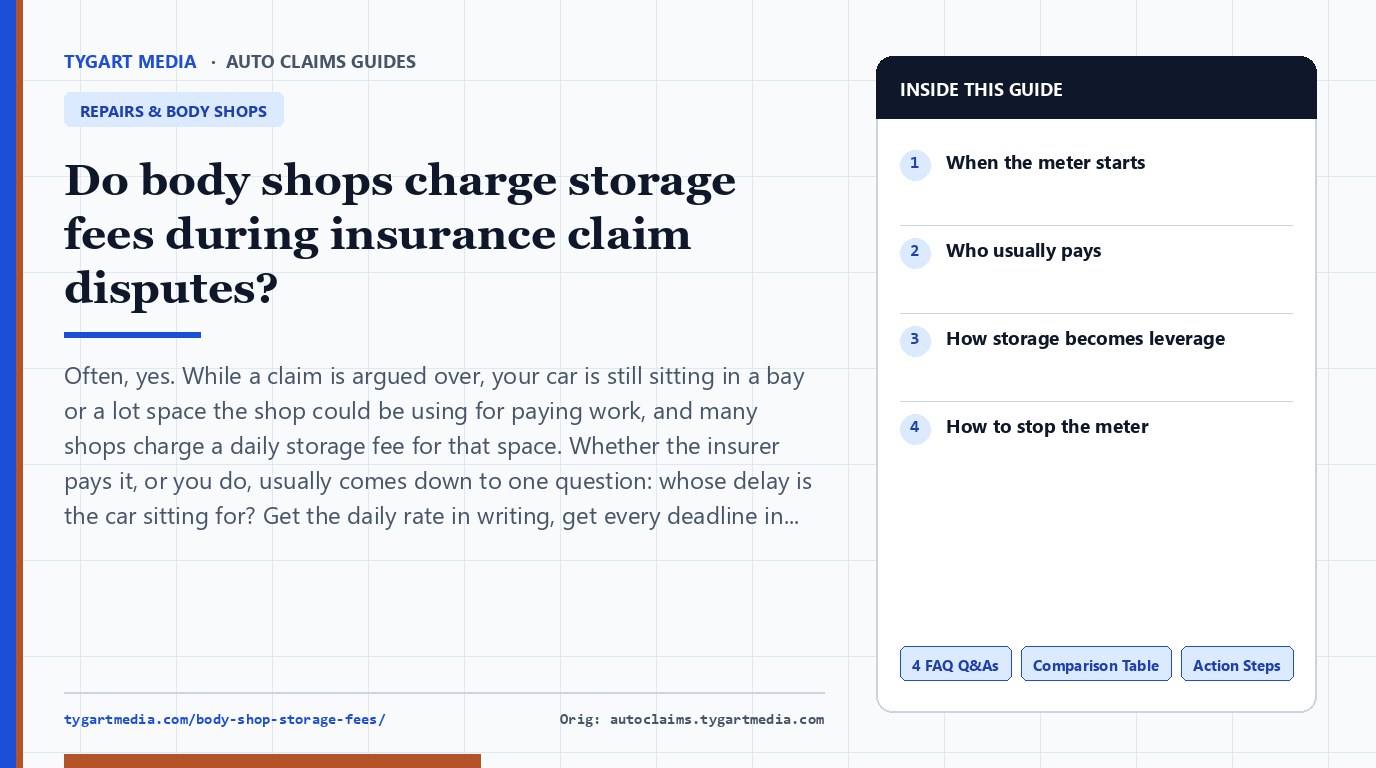
The short answer: often, yes. While a claim is argued over, your car is still sitting in a bay or a lot space the shop could be using for paying work, and many shops charge a daily storage fee for that space. Whether the insurer pays it, or you do, usually comes down to one question: whose delay is the car sitting for? Get the daily rate in writing, get every deadline in writing, and treat a running meter as a reason to force the pending decision — not as background noise.
When the meter starts
Storage commonly begins when a car sits waiting instead of being worked on. The usual triggers:
After teardown, with no repair authorization — the car is apart, the damage is documented, and nobody has approved the next step.
While insurer decisions are pending — a supplement, an inspection, or a coverage call is sitting on someone’s desk and the car is sitting at the shop.
After a total-loss decision — the insurer has declared the car a total loss, but the car has not been picked up or moved, and it keeps occupying space.
None of this is the shop being difficult. A shop charges for the space your car occupies because that space is its inventory. What matters for you is that rates are set by the shop, not by any standard schedule — so ask for the daily rate in writing up front, before the car sits, not when the bill is presented.
Who usually pays
It depends on why the car is sitting, and the pattern is consistent enough to plan around:
Delay caused by the insurer’s approval process — waiting on an inspection, a supplement approval, or a decision the insurer owes — is commonly treated as part of the claim.
Delay caused by the owner weighing decisions — taking time to decide whether to repair, where to repair, or whether to accept an offer — commonly lands on the owner.
After a written cutoff — once an insurer sets a storage cutoff or a total-loss pickup deadline in writing, the days after that deadline commonly shift to the owner.
Notice the thread running through all three: the writing. A deadline you were told on the phone and a deadline you were sent in writing lead to very different arguments later.
How storage becomes leverage
A running meter pressures everyone at the table, and everyone knows it. Insurers may cap storage or cut it off on a date certain, because an open-ended meter is an open-ended cost. Shops use the meter to force decisions that would otherwise drift — a car nobody decides about is a car nobody is repairing. And the owner in the middle can get squeezed by both: the insurer’s deadline on one side, the shop’s daily charge on the other.
That is exactly why dates in writing matter more here than almost anywhere else in a claim. The meter turns a slow disagreement into an expensive one, and the side with the dated paper usually wins the argument about who pays for the wait.
How to stop the meter
Get the pending decision in writing, with a date. Whatever the car is waiting on — an approval, an inspection, a settlement call — ask the side that owes it to state it in writing and say when it will be made.
Make the call. Authorize the repair, move the car, or settle the point being argued. A decision you dislike usually costs less than another stretch of daily storage while you avoid it.
If you are moving the car, do the comparison first. Weigh the cost of a tow against a few more days of storage — sometimes moving is the cheap option, sometimes a short wait is.
Confirm the fee total in writing before pickup. Ask the shop for the itemized storage total before you arrive, so pickup day is a signature, not a negotiation.
Frequently asked questions
How much are body shop storage fees per day?
There is no standard rate. The daily rate is set by the shop and varies by market, so the only number that matters is the one your shop charges. Ask for the daily rate in writing before the car sits, and confirm the total in writing again before pickup so there are no surprises at the counter.
Will insurance reimburse storage fees?
Storage tied to the claim — inspection waits, approval waits, and delays on the insurer’s side — is commonly covered as part of the claim, within reason. Storage that piles up because a decision sat unmade after you were notified often is not. The reason the car is sitting is what decides it, so keep the dates in writing.
Can a body shop keep my car until storage fees are paid?
In many states, shops can hold a car for charges you agreed to, under lien rules that vary by state. If it comes to that, get the itemized total and your options in writing before you pay or argue at the counter, and check your state’s rules or ask a licensed professional if the amount is worth fighting over.
Do storage fees accrue on weekends and holidays?
Typically yes. Storage is usually charged per calendar day the car occupies the space, including weekends and holidays and days the shop is closed. Confirm the shop’s own policy in writing, because the count of days is part of the bill.
Informational only — not legal or insurance advice.
Auto repair and insurance rules vary by state and by policy. Check your own policy documents and your state’s insurance department, or talk to a licensed professional, before acting on a claim.
Storage fees at a glance
Storage fees: who usually bears them
Why the car is sitting
Who usually bears the storage
Waiting on the insurer’s approval
The claim, within reason
Torn down, awaiting your decision
Often you, once you have been told
Declared a total loss and not picked up
Shifts to you after the insurer’s written deadline
Dispute between shop and insurer
Fought over in the claim — get every date in writing
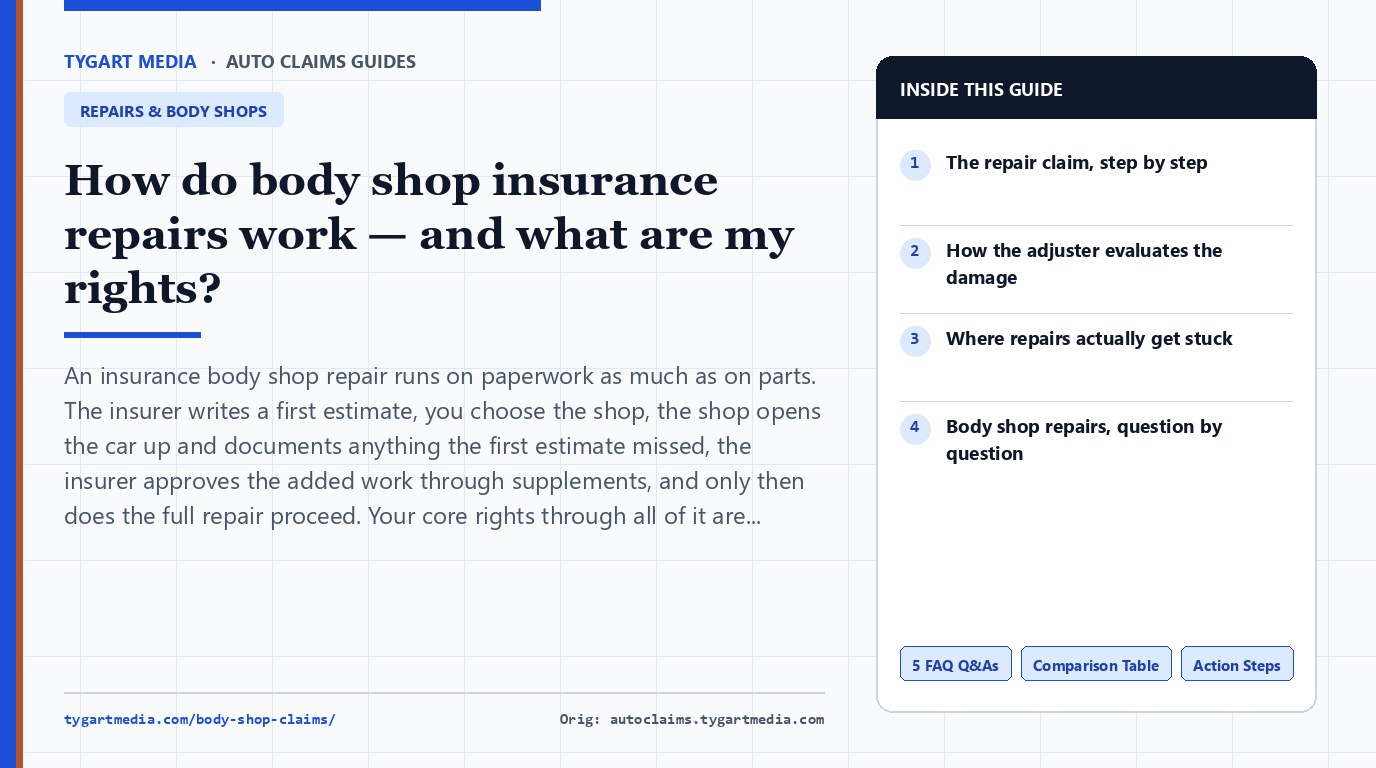
The short answer: an insurance body shop repair runs on paperwork as much as on parts. The insurer writes a first estimate, you choose the shop, the shop opens the car up and documents anything the first estimate missed, the insurer approves the added work through supplements, and only then does the full repair proceed. Your core rights through all of it are simple to state: you choose the shop, you authorize the work, and you are entitled to see the estimates, approvals, and final bill that decide what gets done and what gets paid. Where repairs go wrong is usually in the gaps between those steps, not in any single step.
The repair claim, step by step
Most insurance repairs follow the same basic path, even though the details vary by insurer, shop, and policy. Knowing the order of the steps matters, because each one creates a document — and the documents are what decide payment later.
Report the claim. You open the claim with the insurer and get a claim number. Everything after this — estimates, approvals, payments — ties back to that number, so keep it with your paperwork from the start.
The insurer writes an initial estimate. This first estimate is often written from photos or a brief look, and it can only cover damage that is visible. Treat it as a starting point, not as the final price of the repair.
You choose the shop. The choice of repair shop is yours in most cases. An insurer may recommend shops on a preferred list, but a recommendation comes with trade-offs in both directions — convenience on one side, your own relationship and trust on the other. See: Can I choose a body shop that is not on the insurer’s preferred list? →
The shop inspects and tears down. The shop looks at the car in person, then removes damaged panels and parts as needed. Teardown is where the real scope of the repair shows itself, because crash damage hides behind the parts you can see.
Supplements cover what the first estimate missed. For damage or cost found at teardown, the shop documents it — typically with photos — and files a supplement, an additional estimate for the added work. One repair can have several supplements as more is uncovered.
The insurer approves. An adjuster reviews the supplement, sometimes by re-inspecting the car, and approves, trims, or denies lines. Approved scope is what the insurer has agreed to pay for, so approvals are worth getting in writing.
Repairs proceed. The shop completes the approved work: straightening, replacing, refinishing, and reassembling. Work that is still waiting on approval typically waits with it, which is why approval delays show up as repair delays.
The final bill and payment. The shop issues a final bill for the work done. The insurer pays the approved amount, often directly to the shop or to you, and any deductible under your own policy is typically settled as part of the bill. Compare the final bill line by line with what was approved.
The pickup walk-through. Before you drive away, walk around the car with the shop: panel fit, paint match, lights and features working, and no new noises or warning lights. Raise anything you spot before you leave, and keep the final paperwork.
None of these steps requires you to be an expert. They require you to stay reachable for approvals, to read what you sign, and to keep the paper trail — estimate, supplements, approvals, and final bill — in one place.
How the adjuster evaluates the damage
Behind the steps above sits the adjuster’s evaluation — the process that turns your damaged car into the first estimate, and later into approvals or denials. It helps to know which kind of look your car has actually had, because the three routes see very different amounts of damage:
An estimate written from photos. The fastest route, and the shallowest: the adjuster writes from the pictures you or the shop send, and can only price what the photos show.
A field adjuster’s in-person inspection. The adjuster sees the car — at the shop, at your home, or at a lot — and writes the estimate on what is visible in person. Still a surface look, but a real one.
The shop’s teardown. The deepest look: damaged panels and parts come off, and the damage hiding behind them becomes visible. This is the inspection the first two routes cannot do.
Whichever route comes first, the estimate is typically built the same way: visible damage first, labor priced at the insurer’s rates for your area, and parts priced by category — original equipment (OEM), aftermarket, or recycled — as your policy’s wording allows. Hidden damage is not so much denied by that first estimate as not yet seen by it.
When teardown finds more, the shop files a supplement, and the adjuster may re-inspect — in person, or from the shop’s photos and documentation — before approving the added work. Running underneath all of it is a threshold judgment: if the repair cost climbs close to what the car is worth, the claim can stop being a repair evaluation and flip to a total-loss evaluation instead. That side of the line is covered in the guide to fighting a low total-loss offer.
Where repairs actually get stuck
Most stalled repairs are not stalled because someone is lazy or dishonest. They stall at one of three predictable friction points, and each one has a different fix.
Parts fights: OEM versus aftermarket
Insurers often write estimates using aftermarket or recycled parts, while shops and owners often want original equipment manufacturer (OEM) parts — the parts made by or for the car’s maker. Which parts your repair gets is decided in most cases by your policy’s parts language, not by whoever argues loudest. If your insurer will not approve the parts you believe the repair needs, the policy wording is the first place to look: What should I do if my insurer will not approve OEM parts? →
The estimate gap
The insurer’s first estimate and the shop’s estimate rarely match. The insurer’s is written on visible damage at the insurer’s rates; the shop’s is written in person on the full scope it expects to repair. That gap is normal, and the supplement process exists to close it with documentation. It becomes a problem only when the gap is treated as a take-it-or-leave-it number instead of a documented disagreement: What if the insurance estimate is lower than the body shop’s estimate? →
Can I pick any body shop I want for an insurance repair?
In most cases, yes — the choice of shop is yours. Insurers may recommend shops on a preferred list, and those shops can sometimes move faster because their paperwork with the insurer is already set up, but a recommendation is not the same as a requirement. Exact rules and any limits vary by state and by policy, so check your policy and your state insurance department if an insurer tells you that you have no choice.
Who pays the body shop — me or the insurer?
The insurer pays the amount it approved, often directly to the shop or to you to pass along to the shop. You owe the shop for work you authorized, which is why the approved scope and your written authorization should match. If you are claiming through your own policy, your deductible may apply and is typically paid as part of the repair bill.
What if the repair costs more than the insurance estimate?
The shop files a supplement — a documented request for the additional damage or cost the first estimate missed — and the insurer reviews and approves it before that extra work is done. Do not authorize unapproved work without understanding that you may be responsible for the difference. Keep the supplement, the approval, and the final bill together with your claim paperwork.
How long should an insurance repair take?
There is no fixed clock. The timeline depends on the damage, parts availability, and how quickly supplements and approvals move, not on the shop alone. Ask the shop for a written timeline and a regular update schedule so delays are explained as they happen, not after the fact.
How do insurance adjusters evaluate car damage claims?
Adjusters typically evaluate damage one of three ways: an estimate written from photos, a field adjuster’s in-person inspection, or the shop’s teardown, which gives the deepest look. The first estimate is usually based on visible damage, with labor priced at the insurer’s area rates and parts by category — original, aftermarket, or recycled — according to the policy wording. When teardown finds more damage, the shop files a supplement and the adjuster may re-inspect before approving it. If the repair cost approaches the car’s value, the claim can shift from repair to a total-loss evaluation.
Informational only — not legal or insurance advice.
Auto repair practices and insurance rules vary by state and by policy. Check your own policy documents and your state’s insurance department, or talk to a licensed professional, before acting on a claim.
Body shop repair claims at a glance
Body shop repair claims at a glance
Stage
What to watch
The first estimate
Written on visible damage — expect it to grow after teardown
Parts
Policy language decides OEM vs aftermarket in most cases
Hidden damage
Handled by supplement — photos are the proof
The timeline
Approvals and parts, not the shop alone, set the pace
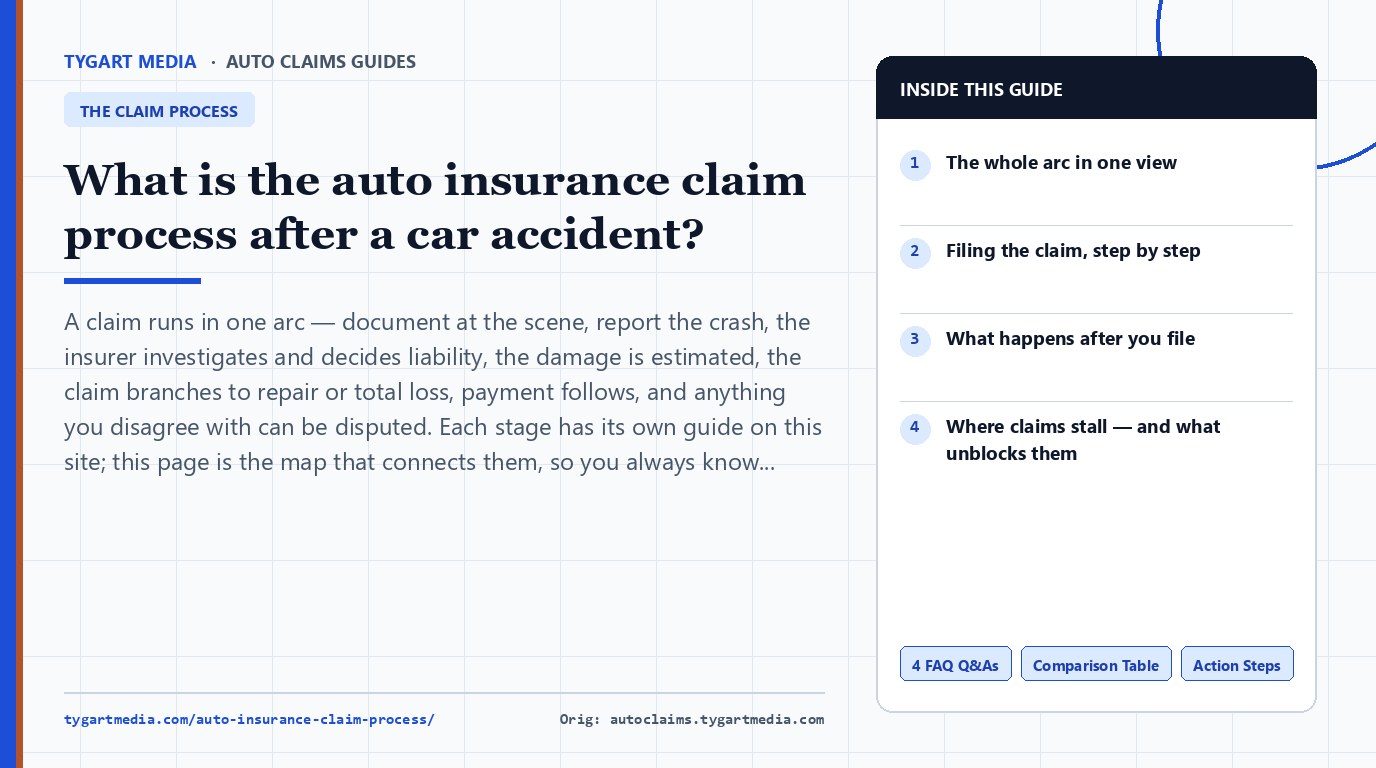
The short answer: a claim runs in one arc — document at the scene, report the crash, the insurer investigates and decides liability, the damage is estimated, the claim branches to repair or total loss, payment follows, and anything you disagree with can be disputed. Each stage has its own guide on this site; this page is the map that connects them, so you always know where your claim is and what happens next.
The whole arc in one view
1. Document at the scene. Before any insurer is involved, the claim’s evidence is created — or lost — at the scene. Photos of both cars and the wider scene, the other driver’s details, witness names, and your own written account are the raw material every later decision rests on. The guide to what to do right after a crash covers this stage in full.
2. Report the crash. You open the claim with your insurer or the other driver’s, hand over the basic documents, and get a claim number. That number is the claim’s identity from here on — every document, call, and payment ties back to it. The filing stage is walked through step by step below.
3. Investigation and liability. The insurer gathers statements and evidence and decides who was at fault, and in what share. That liability decision gates most of what follows: a third-party insurer typically does not pay until it accepts its driver was at fault, and shared fault reduces what the other side owes under the rules most states use.
4. The estimate. The damage is inspected and priced. The insurer’s estimate is the opening figure, not necessarily the final one — a body shop may price the same damage differently, and hidden damage found during repairs is added through supplements. Estimate disagreements are one of the most common friction points in the whole process.
5. Repair or total-loss decision. Here the claim branches. A repairable car goes to a shop and the repair branch begins; a car whose repair cost crosses the insurer’s total-loss threshold is valued instead and settled as a total loss. The two branches involve different documents, different timelines, and different disputes — knowing which branch you are on tells you which guides apply.
6. Payment. Once amounts are settled, payment is issued — to you, to the shop, or to a lienholder first where a loan is involved. On a first-party claim your deductible comes out of the payment; on a third-party claim there is no deductible. Where your insurer paid and the other driver was at fault, subrogation — your insurer recovering from the other side — settles up afterward, usually without you running it.
7. Dispute, if needed. A liability decision, an estimate, or a valuation you believe is wrong is not necessarily final. Disputes have their own stage, their own evidence, and their own escalation path, covered in the section on stalls and disputes below and in the dispute guide.
This arc — scene, report, investigation, estimate, branch, payment, dispute — is the same lifecycle the homepage maps out. Every claim travels it; claims differ in how long each stage takes and how much friction each one holds. Typical timings for each stage are covered in how long an auto claim takes.
Filing the claim, step by step
Filing is the one stage fully in your hands, and it is simpler than the stages that follow.
Choose your channel. Your insurer’s app, its online portal, its claims phone line, or your agent are all standard ways to open a claim. The channel does not change the claim — pick the one that gives you a written record most easily, and keep that record.
Hand over the basics. Your policy number and ID, the date, time, and location of the crash, the other driver’s name, insurer, and policy number, the police report number if one was made, and a basic account of what happened. The full list, plus the evidence file to build alongside it, is in the guide to the documents you need to file a claim.
Get the claim number. Do not end the filing without it. Write it on everything you send from now on, and use it in every call and message.
Note the adjuster assignment. An adjuster will be assigned to run the claim. Get the name, a direct contact, and how they prefer documents sent. If assignment takes a few days, that alone is not a problem — but record when you filed, so the wait is documented.
Schedule the inspection. Before you finish filing, know how and when the car will be inspected — at a shop, at your home, at a drive-in center, or by photo estimate. The estimate stage cannot start until the car has been seen.
Editor's Note
The fork at filing: yours or theirs? You may have a choice of insurer to file with. Filing with your own insurer is a first-party claim under your collision coverage — your deductible applies, and your insurer handles the other side afterward. Filing with the other driver’s insurer is a third-party claim — no deductible, but their liability decision gates payment. The trade-offs are laid out in first-party vs. third-party claims, and the mechanics of the third-party route are in filing a claim against the other driver’s insurance.
What happens after you file
Investigation. The adjuster collects the file: statements from the drivers, the police report if one exists, scene photos, and witness accounts. You may be asked for a recorded statement — your own insurer is generally owed cooperation under your policy, while a statement to the other driver’s insurer is a different decision, worth making deliberately rather than automatically.
The liability decision. The insurer states its position on fault. On a first-party claim this mostly affects whether your insurer pursues the other side; on a third-party claim it decides whether that insurer pays at all, and shared-fault findings reduce the amount. Get the decision in writing, with the reasons, either way — a written position can be answered, a phone summary cannot.
The estimate. The inspection produces a written estimate of the repair cost. Compare it against any estimate your own shop writes. Gaps between the two are common and are handled by documentation — photos, teardown findings, and supplements — rather than by argument alone.
The two branches. If the car is repairable, the claim moves into the repair branch: shop scheduling, repairs, supplements for hidden damage, and final payment against the completed work. How that branch runs — and your rights inside it — is the subject of the body shop claims hub. If the repair cost crosses the total-loss threshold, the claim moves to valuation instead: the insurer prices what the car was worth just before the crash, and the settlement is built on that figure. That branch is covered by the total loss hub.
Payment, the deductible, and subrogation. Payment closes the money side of the claim. On your own policy, your deductible is subtracted — you typically pay it to the shop, or it comes off the settlement on a total loss. On a third-party claim, no deductible applies. If your insurer paid under your collision coverage for a crash that was the other driver’s fault, it will usually pursue that driver or their insurer to recover what it paid — that recovery is subrogation — and your deductible may be returned to you if the recovery succeeds, in full or in part depending on what is recovered and how your state and policy treat it. You do not run the subrogation; your job is to keep your evidence available if it is asked for.
Where claims stall — and what unblocks them
Silence. The most common stall is simple quiet: no update, no decision, no returned call. Silence is unblocked by a specific written inquiry — which stage the claim is in, what it is waiting on, and from whom — sent on a deliberate rhythm rather than daily. If the silence is the other driver’s insurer, the options for that situation are covered in the guide to the other driver’s insurer stalling.
Liability disputes. When fault is contested, everything behind the liability stage waits. What unblocks a dispute is evidence, presented in writing: scene photos, the police report, witness details, and a clear account that answers the other side’s version point by point. If the dispute hardens into a decision you believe is wrong, it moves from stall to formal disagreement.
Estimate gaps. When the insurer’s estimate and the shop’s price disagree, the claim stalls at the repair stage. The unblock is documentation from teardown — photographs of the hidden damage and a written supplement — which is the mechanism the process itself provides for exactly this situation.
When a stall becomes a decision you need to challenge — liability, an estimate, or a valuation — the routes are laid out in how to dispute or appeal a claim decision. Keep the sequence straight: ask in writing, document the answer, then dispute with the file behind you.
Important Notice
Read any release before you sign it. Settlements often end with a release, and its wording can close claims beyond the one being paid — including elements of loss you have not yet claimed. A payment you accept for one element should not quietly sign away another. If the wording is broader than the payment, ask about it before signing, not after.
Frequently asked questions
How do I file a car insurance claim step by step?
Choose a channel — your insurer’s app, its online portal, its claims phone line, or your agent. Hand over your policy number, the crash details, the other driver’s information, and a basic account of what happened. Get the claim number, note the adjuster assigned to the claim, and schedule the inspection. Keep a copy of everything you send.
What happens after I file an auto insurance claim?
The insurer investigates: it takes statements, reviews the evidence, and makes a liability decision about who was at fault. The damage is inspected and an estimate is written. The claim then branches — the car is repaired, or it is declared a total loss and valued — and payment follows once the amounts are settled.
Can I file a car accident claim online or by phone?
Yes. An insurer’s app, its online portal, its claims phone line, and filing through your agent are all standard ways to open a claim. Whichever channel you use, the claim is the same — make sure you come away with the claim number and a record of what you submitted.
Do I file with my own insurer or the other driver’s?
It depends on fault and on the coverage you carry. If another driver was at fault, you can claim against their liability insurer with no deductible, or claim under your own collision coverage and let your insurer pursue the other side. If fault is yours or is disputed, your own collision coverage is usually the working path. The first-party vs. third-party guide walks through the trade-offs.
Informational only — not legal or insurance advice.
Auto repair and insurance rules vary by state and by policy. Check your own policy documents and your state’s insurance department, or talk to a licensed professional, before acting on a claim.
The claim process, at a glance
The stages of an auto insurance claim
Stage
What happens
What you do
Document at the scene
Evidence is created while the scene is fresh.
Take photos, exchange details, get witness contacts, write your account.
Report the crash
The claim opens and a claim number is issued.
File by app, portal, phone, or agent; hand over the basic documents.
Investigation and liability
The insurer gathers statements and evidence and decides fault.
Give your account, keep your evidence organized, get the decision in writing.
Estimate
The damage is inspected and priced.
Make the car available; compare the estimate with your shop’s.
Repair branch
The car is repaired; hidden damage is added by supplement.
Approve repairs and supplements promptly; keep receipts.
Total-loss branch
The car is valued instead of repaired; lienholder paperwork may apply.
Document the car’s condition and value; handle title and payoff steps.
Payment
Agreed amounts are paid; the deductible and subrogation settle.
Confirm who is paid and how much; read any release before signing.
Dispute, if needed
A liability, estimate, or valuation decision is challenged.
Dispute in writing with your evidence file behind you.
The short answer: mostly yes — for the technical scope of the repair, shop-to-adjuster is the normal workflow, and it works better than you relaying messages between two people who speak the same estimating language. What should never be delegated is you: your authorization, your money, your parts choices, and any settlement decision stay yours. Split it that way, in writing, up front, and nothing important bypasses you.
Why shop-to-adjuster is the normal workflow
The conversation between a shop and an adjuster is a technical one. Estimating systems, repair procedures, teardown photos, parts categories — adjusters and estimators work in that language every day, and a repair moves fastest when they talk directly instead of through the car’s owner acting as a go-between for terms neither side expects the owner to know.
Supplements are that conversation, documented. When teardown reveals hidden damage, the shop photographs it, writes it up, and sends it to the adjuster; the adjuster approves, trims, or denies it. That back-and-forth is not the shop going around you — it is the repair being priced honestly, in the open, on paper you can ask to see.
What should never bypass you
Direct dealing has a boundary, and it is worth drawing before the work starts. These stay with you, always:
Authorizing the repair — your signature is what starts the work. The shop works from your authorization, not the adjuster’s.
Agreeing to pay any difference out of pocket — if the approved scope and the shop’s price do not meet, the decision about who covers the gap is yours, made knowingly, in advance.
Accepting a parts downgrade on a part you care about — a cheaper category of part may be a reasonable trade or may not be, but it is your car and your call.
Any settlement or release decision — signing away part of your claim is never a technical conversation. That one is yours alone.
The three-way pattern that works
The split that works is simple, and it is agreed up front with the shop, before teardown:
The shop handles the scope conversation with the adjuster directly.
You are copied on every supplement and every approval — the full paper trail, as it happens.
You get a short update on a set cadence, so you always know what the car is waiting on.
Nothing beyond the approved scope gets authorized without your explicit OK.
There is a point where the conversation stops being technical and becomes your claim — and at that point you should be in it directly. Denials are that point: when work the damage requires is refused, that is no longer an estimating discussion. Stalls are that point: when approvals stop moving and nobody can say why. And pressure to sign anything — a settlement, a release, an agreement to cover a difference — is that point most of all.
When you step in, go direct to the adjuster, and do it in writing. State what was denied or delayed, attach the supplement and its date, and ask for the answer in writing too. The paper you built by being copied on everything is what makes that letter short and hard to argue with.
Frequently asked questions
Can the shop authorize repairs without asking me?
The shop works from the authorization you signed, and work beyond that authorization should come back to you first. That is why the authorization itself deserves a careful read before you sign it — it defines what the shop can start without checking with you.
Should I be on the call when the shop and adjuster negotiate?
Usually not for the technical rounds — those conversations are about procedures, parts, and photos, and they move faster without a relay. Ask for the outcome in writing instead. The supplements and approvals are the record that matters, and they are what you review.
What if the shop and adjuster agree on something I do not want?
You are the customer on both sides of that table, so say so promptly and in writing. Parts choices and scope decisions can usually be revisited before the work is done. After the work is done is a much harder argument, which is why being copied on approvals matters.
Who do I call when it is stalled — the shop or the insurer?
Start with the shop and ask what it is waiting on. If the wait is an approval, call the insurer and reference the supplement and the date it was sent. Keep both answers in writing, because a stall with dates attached is far easier to escalate than a stall described from memory.
Informational only — not legal or insurance advice.
Auto repair and insurance rules vary by state and by policy. Check your own policy documents and your state’s insurance department, or talk to a licensed professional, before acting on a claim.
The short answer: a refusal is a position, not the end of the claim — and the most common reason is simply that they have not accepted liability yet. Do not sit without a car waiting on their investigation. Work the ladder instead: use your own rental reimbursement if you have it, claim loss of use if you do not rent, rent a comparable car yourself and document it for recovery, and escalate in writing. At every step, get their reason on paper.
Why they say no
The most common reason is the least personal one: liability has not been accepted yet. Until the other insurer finishes its investigation — its driver’s statement, yours, the police report if there is one — it typically will not volunteer a rental, because paying for your transportation looks, from its side, like conceding the claim it is still evaluating. A “no” at that stage is a holding position. It is not a verdict on fault, and it often changes the moment liability is accepted.
The other two reasons are harder. A coverage denial means the insurer says its policy does not cover this driver or this crash at all — the policy lapsed, the driver was excluded, the vehicle was not listed. And a fault dispute means the insurer accepts the policy but not the blame, arguing its driver was not at fault or that fault is shared. Each reason calls for a different response, which is why the first job is always finding out which “no” you actually got.
General background on dealing with that side of the claim is in the guide to the other driver’s insurer — the same guide that covers what to do when they stall rather than refuse outright.
The fallback ladder
Work these in order. Each rung keeps you moving without depending on the other insurer changing its mind first.
Use your own rental reimbursement now, and let subrogation sort it out. If your policy has rental coverage, claim the rental there and get back on the road. Your insurer can then pursue the other side to recover what it paid — that recovery process is subrogation, and it is their job, not yours. Your own caps apply while you are on your own coverage, but a capped rental today beats an uncapped argument and no car.
Claim loss of use without renting at all. If you have no rental coverage, or cannot front the cost, the loss itself is still claimable: being without your car has a value, and on a claim against the at-fault driver it does not depend on your having rented a replacement. The difference between the two ideas is laid out in diminished value vs loss of use — what’s the difference? Document the days without the car and how you actually got around.
Rent a comparable car yourself and build a documented reimbursement demand. If you do rent, rent like it will be audited — because it will be. Comparable class, no counter add-ons, every receipt kept, and the rental dates matched against the repair timeline. That package, sent in writing once liability is settled, is what turns your out-of-pocket rental into a recoverable element of the claim.
Escalate. Ask for a supervisor and put your request and their refusal in writing. If the position does not move, the next step is a complaint to your state insurance department — how complaints and appeals fit into a claim is covered in how to dispute or appeal your auto claim decision. Insurers log and track regulator complaints in a way they do not track phone calls.
The paper rule that runs through all of it
Editor's Note
Get their reason in writing. Whatever rung of the ladder you are on, this rule holds: an insurer’s reason given on the phone is weather — it changes and cannot be checked. The same reason in a letter or email is a position you can answer, appeal, or hand to a regulator. If an adjuster explains a refusal on a call, follow up with a short email: “Confirming what you told me today —” and the reason in their words. Silence in reply is still a record that you asked.
The same rule protects the rest of your claim. Your own rental dates, your receipts, the shop’s timeline, the days you went without a car — all of it is worth more written down as it happens than reconstructed when the claim is finally argued. Insurers decide documented claims differently from remembered ones, mostly because documented claims are the ones that survive a complaint or a courtroom, and adjusters know it.
Can they refuse a rental until they accept liability?
In practice, yes — that is the most common reason a rental is refused, and it is a position insurers typically take while their investigation is open rather than a final verdict on your claim. A refusal before liability is accepted is not the same as a denial of the claim itself. Get the reason in writing, keep your own claim moving through your own coverage or the loss of use path, and revisit the rental as soon as their position on liability changes.
If I rent a car myself, will I get the money back?
Often, if the other driver is found at fault and the rental was reasonable — a comparable car, for the days your car was genuinely out of service, with receipts and a repair timeline to prove it. That is a documented reimbursement demand, not a guarantee, and insurers commonly dispute days and vehicle class. The strength of the demand is the paper: the cleaner and better documented the rental, the harder it is to discount.
How long can they take to decide?
It varies by state and by claim, and there is no single national deadline that fits every case. Investigations typically take longer when fault is disputed, statements conflict, or a police report is slow to arrive. What you can control is the record: ask for their position and their timeline in writing, and follow up in writing. The options when the other insurer drags are covered in the guide to a stalling insurer, linked above.
What if I cannot afford to front a rental?
Then do not front one. The loss of use path exists for exactly this situation: on a claim against the at-fault driver, the loss is being without your car, and it can be claimed without renting a replacement at all. Document the days you were without the car and how you managed — rides, borrowed cars, missed trips. If you have your own rental reimbursement, that is the other route that does not depend on the other insurer’s timetable.
Informational only — not legal or insurance advice.
Auto repair and insurance rules vary by state and by policy. Check your own policy documents and your state’s insurance department, or talk to a licensed professional, before acting on a claim.
A refused rental from the at-fault insurer, at a glance
When the at-fault insurer will not provide a rental, by reason and response
Situation
What usually happens
Liability not yet accepted
The most common reason. A holding position, not a verdict. Get it in writing and work the ladder.
Coverage denied
The insurer says its policy does not respond. Your own coverage and loss of use become the main paths.
Fault disputed
Expect the rental argument to follow the fault argument. Document both.
You rent a comparable car yourself
Keep receipts and a repair timeline — that package is your reimbursement demand.
You cannot front a rental
Claim loss of use instead — the loss of your car, claimed without renting a replacement.