Author: William Tygart

  • ATS Everett: The #2 Aerospace Employer at Paine Field

    ATS Everett: The #2 Aerospace Employer at Paine Field

    Quick answer: Aviation Technical Services (ATS) is Everett’s second-largest aerospace employer after Boeing, with roughly 800 people working out of a 500,000-square-foot hangar at the south end of Paine Field. The company is the largest aircraft maintenance, repair, and overhaul (MRO) operator on the U.S. West Coast — and most Everett residents drive past its hangars without realizing they hold up to 14 commercial airliners at any given time.

    Drive south on Airport Road and the building most people picture as Boeing’s territory thins out. Past the Future of Flight, past the rows of stored 777-9s, past the Paine Field commercial terminal, the south end of the airport opens onto a cluster of hangars that don’t have Boeing logos on them.

    That cluster is Aviation Technical Services — ATS — and it employs about 800 people in Everett. Inside Snohomish County’s aerospace economy, ATS is the company that everyone in the industry knows about and most outside of it doesn’t. The shorthand: ATS is the second-largest aerospace employer in Everett, behind only Boeing, and it operates the largest MRO operation on the West Coast of the United States.

    For an aerospace ecosystem that is preparing to absorb a 737 MAX 10 North Line activation in mid-summer, a 777-9 delivery ramp into 2027, and a steady KC-46 cadence underneath all of it, ATS sits in a useful place in the supplier map. It is the company that touches the airplanes after they leave the factory and need to come back for service.

    The 500,000-square-foot building most Everett residents have never been inside

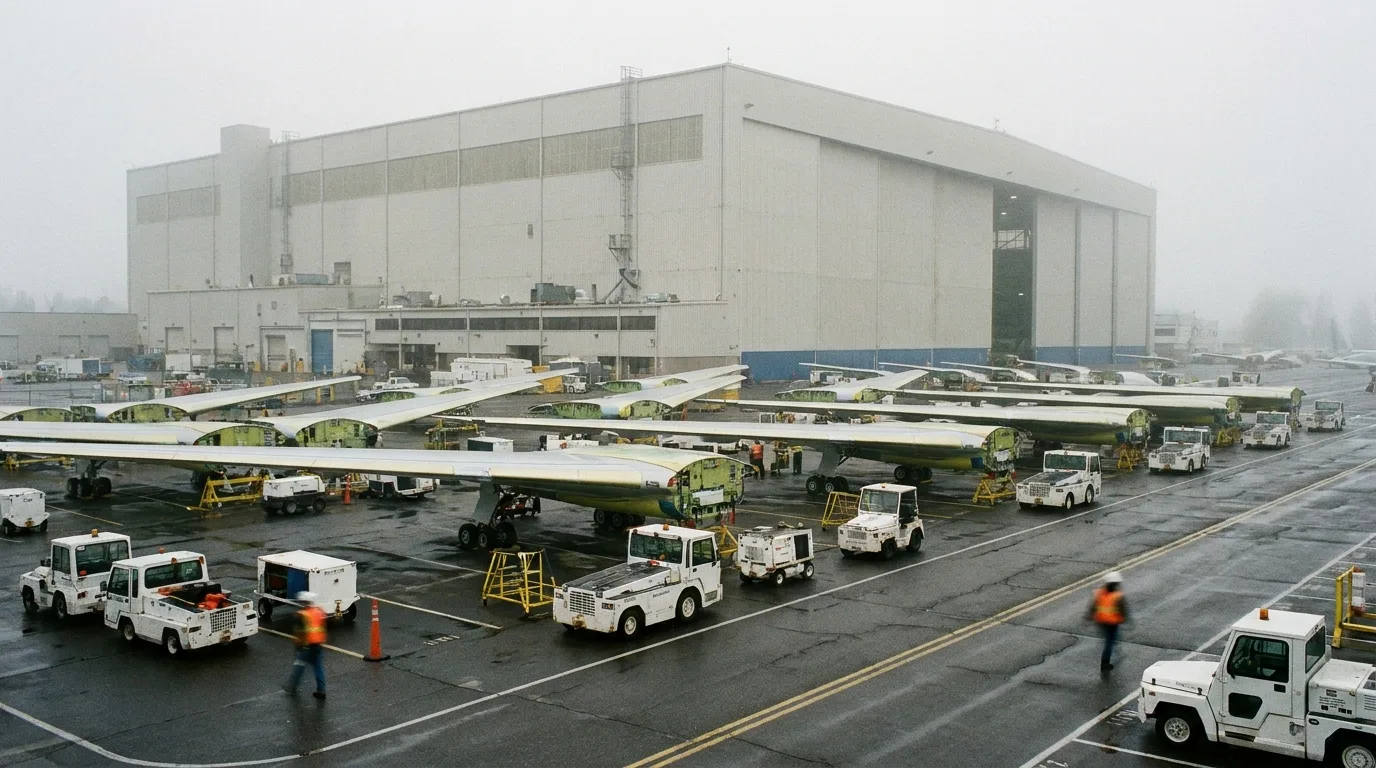
    The ATS Everett airframe MRO facility runs out of a 500,000-square-foot hangar at Paine Field with bay space for up to 14 commercial airliners simultaneously. The building has the kind of scale that doesn’t read from the road — until you realize a 737 NG is roughly 130 feet long, and the building is fitting more than a dozen of them under one roof at a time.

    The hangar isn’t new. It was originally built and operated by Tramco, then sold to Goodrich, then sold to ATS in the fall of 2007. The footprint has been an MRO operation in Everett for decades, which means the institutional knowledge — the techs who have seen the same airframe come back for its third C-check, the engineers who know how the supply of certain parts behaves — runs deep.

    Adjacent to the airframe hangar, ATS also runs a 50,000-square-foot component repair facility. That’s the building where structural, hydraulic, and electrical components come off the airplanes and get repaired by technicians trained on the specific systems. The two facilities together — airframe and component — give ATS what the trade press calls a “full-service” MRO posture: an airline can ship the whole airplane to Everett and ship the parts that come off it to the same campus.

    Why MRO matters in an aerospace town

    It is easy to think about Everett’s aerospace economy as a Boeing factory and the suppliers who feed it. The factory model is the most visible part — 737 MAX 10s rolling off the North Line, 777-9s flying production tests over Puget Sound, KC-46s painted in Air Force gray, 767 freighters wearing FedEx and UPS livery.

    But MRO is the other half of the airplane lifecycle, and it generates a different kind of work for the same workforce.

    A factory builds a finished jet. An MRO operation tears one down to its frames, inspects every primary structure, replaces what’s worn, upgrades what’s been superseded, and puts the airplane back together to a standard the FAA and the airline both have to sign off on. The work is more diagnostic than assembly. The skills overlap with Boeing’s mechanic and inspector workforce, but the day-to-day rhythm is different: shorter project cycles, more airplane variety, deeper component-level work.

    For Snohomish County, that means an aerospace mechanic who trained at the Machinists Institute on Airport Road or the WATR Center has two career destinations within a half-mile of each other — Boeing on the north end of Paine Field, ATS on the south end. The same skill set ports across the airport perimeter.

    Where ATS sits in the supplier-shortage math

    The 5,200-worker aerospace shortage that the Aerospace Futures Alliance has projected through the end of 2026 isn’t just a Boeing problem. It is a Snohomish County problem, and ATS is one of the companies on the demand side of that shortage. The Everett operation has historically grown its own talent — running internal mechanic training programs because the regional pipeline cannot keep up with attrition and ramp.

    That training-from-within approach matters for the broader workforce conversation. When the Machinists Institute, Edmonds College, and WATR Center put aerospace mechanics into the labor market, those graduates have multiple landing spots in Everett: Boeing’s main bay floors, Boeing’s KC-46 line, ATS’s airframe hangar, ATS’s component repair facility, and the smaller aerospace suppliers scattered across the county.

    For workers, optionality is leverage. For the regional economy, optionality is resilience.

    The piece of the cycle Boeing doesn’t do

    Boeing builds the airplane. The airline flies it. ATS — and a small number of MRO operators like it — handles the heavy maintenance checks (C-checks, D-checks) that the airline can’t perform on its own ramp.

    That separation matters in a downturn. When a launch customer like Lufthansa pushes its first 777-9 delivery from late 2026 to first quarter 2027, that affects Boeing’s delivery cadence in Everett. It does not, on its own, materially affect ATS, because the MRO demand pipeline is fed by every airline operating an aging fleet anywhere in the world. Delta, Alaska, United, Hawaiian, Southwest, and dozens of cargo and charter operators send airplanes to Paine Field for the kind of structural and systems work that ATS specializes in.

    That means ATS sits in a different cyclical position than Boeing. When new-jet deliveries slow, MRO demand often rises — airlines run their existing fleets longer and the heavy-maintenance interval comes due. When new-jet deliveries accelerate, the older airplanes still need their inspections. The MRO floor in Everett doesn’t oscillate the way the new-build factory does.

    The Paine Field economic picture, with ATS on it

    Adding ATS to the standard Paine Field map produces a different economic story than the Boeing-only version. The picture, roughly:

    • Boeing’s commercial Everett operations — 737 North Line, 767, 777, 777X, KC-46 — drive the bulk of the aerospace payroll in the county.
    • ATS sits at the south end of Paine Field as the second-largest aerospace employer, with 800 people on a hangar floor that handles up to 14 airplanes at a time.
    • ZeroAvia’s Propulsion Center of Excellence at the south end builds the next-generation hydrogen-electric powertrains.
    • The Future of Flight Aviation Center on Paine Field Boulevard is the public-facing tourism asset.
    • The 600-plus aerospace suppliers across Snohomish County feed all of the above.

    Each piece reinforces the others. ATS draws from the same training pipeline that feeds Boeing. ZeroAvia draws from the same engineering talent base that supports SPEEA at Boeing. The Future of Flight tour walks visitors past the active production lines that make the rest of the ecosystem possible.

    The point: Paine Field is not an airport that happens to have aerospace tenants. It is an aerospace cluster that happens to have a runway running through it.

    What this means for residents

    For Everett residents, the practical takeaway is that the local aerospace economy is more diversified than the headline numbers suggest. A Boeing labor disruption does not pause the south end of the airport. A delay in a new program does not collapse the maintenance work. The school district’s projections of family-wage employment, the housing market’s tracking of dual-income aerospace households, and the city’s tax base all benefit from having multiple anchor employers operating side-by-side rather than one dominant one.

    It also means that when local aerospace coverage talks about “the Boeing economy,” that frame is incomplete. The accurate version: the aerospace economy in Snohomish County is a Boeing-led cluster that includes a major MRO operator, a hydrogen-electric propulsion company, and 600 suppliers. Each one of those plays a role in keeping the workforce and the wage profile stable.

    Frequently Asked Questions

    Who is the second-largest aerospace employer in Everett?

    Aviation Technical Services (ATS) is the second-largest aerospace employer in Everett after Boeing, with about 800 employees at its Paine Field operation.

    What does ATS do?

    ATS provides maintenance, repair, and overhaul (MRO) services for commercial airliners. The company performs heavy maintenance checks, structural repairs, component repairs, and engineering services for airlines and cargo operators across the U.S. and internationally.

    How big is the ATS Everett facility?

    The main airframe MRO hangar is 500,000 square feet with bay space for up to 14 commercial airliners. ATS also operates a 50,000-square-foot component repair facility adjacent to the main hangar.

    Where is ATS located in Everett?

    ATS operates at the south end of Paine Field, adjacent to the Boeing Everett production facility but on the opposite end of the airport from the Future of Flight Aviation Center.

    How long has ATS been at Paine Field?

    The Everett MRO facility has operated continuously since the Tramco era. Goodrich operated the building before selling it to ATS in the fall of 2007, so ATS itself has been in the building for nearly two decades.

    Is ATS the largest MRO on the West Coast?

    Yes. ATS is the largest aircraft maintenance, repair, and overhaul operator on the U.S. West Coast.

    Does ATS hire from local training programs?

    Yes. ATS has historically grown its own mechanic talent through internal training programs and hires from regional aerospace training programs including the Machinists Institute, Edmonds College, and the WATR Center.

    How does MRO demand differ from new-aircraft demand?

    MRO demand is fed by aging fleets at every airline operating worldwide and tends to be more stable cyclically than new-aircraft demand. When new deliveries slow, airlines run older fleets longer and MRO demand often rises.

  • Boeing 777-9 Delivery Slips to Q1 2027 for Lufthansa

    Boeing 777-9 Delivery Slips to Q1 2027 for Lufthansa

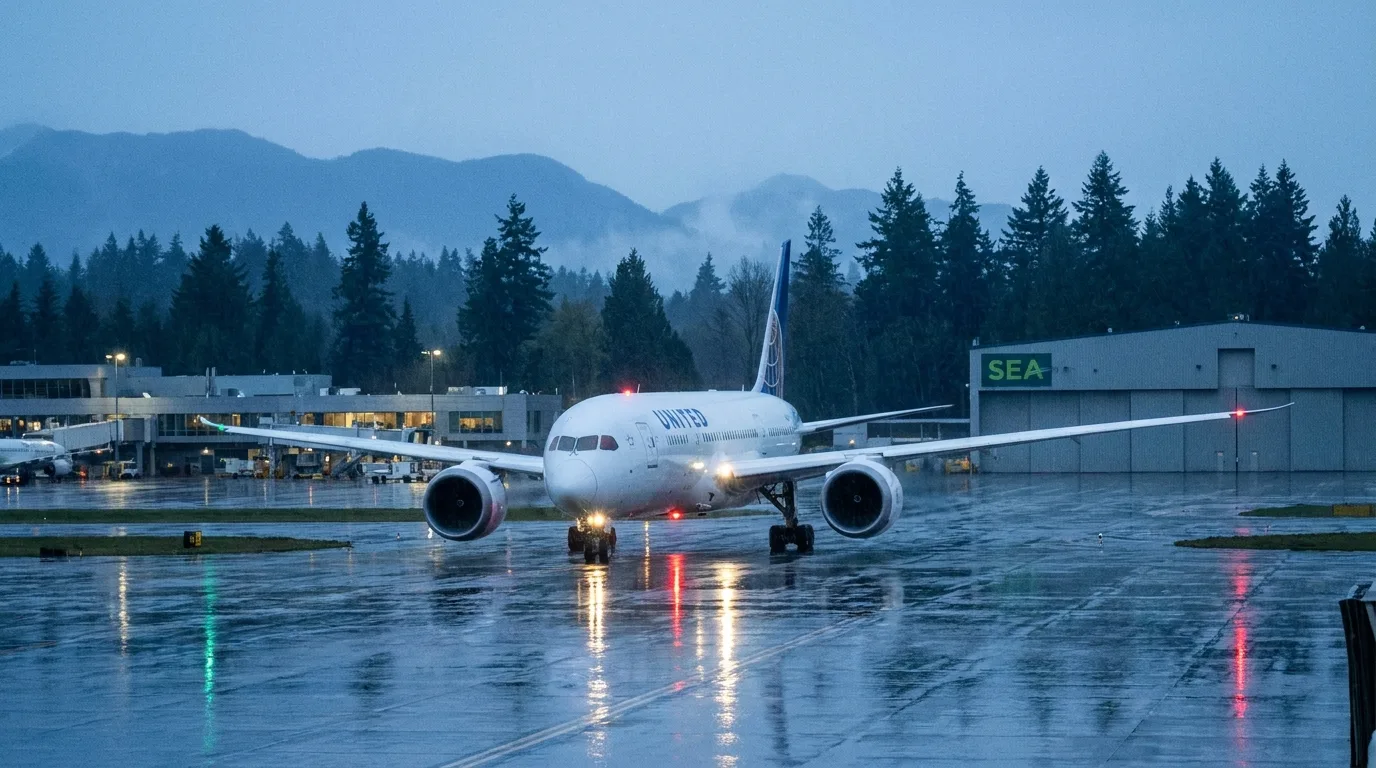
    Quick answer: Boeing still officially targets the first quarter of 2027 for Lufthansa’s first 777-9, but Lufthansa is not counting on it. On September 28, 2026, CEO Carsten Spohr said the airline’s summer 2027 schedule includes no 777-9s and that keeping more A340-300s flying is now its main plan, as certification delays for the GE9X engine slow the program’s final stretch (aero.de, in German). The production-standard 777-9 built for Lufthansa first flew from Paine Field on May 7, 2026 (Boeing).

    The Boeing 777X timeline moved again, and this time the source isn’t Boeing — it’s the airline at the front of the line.

    At Lufthansa’s annual press conference in Frankfurt in March, CEO Carsten Spohr confirmed that the German flag carrier now expects its first 777-9 delivery in the first quarter of 2027, slipping from a previously revised late-2026 target. Boeing’s own April 22 first-quarter 2026 earnings release landed on the same destination from a different angle: the company “anticipates first delivery in 2027” and said the program “continued to make progress” on certification.

    Since then, the airline has hedged. Boeing’s first-quarter 2027 handover target still stands, but Lufthansa has built its summer 2027 flying without the airplane. For Everett, that means two timelines to plan around: the supply chain, the IAM 751 floor, and Snohomish County’s economic planners still have a date to work toward, but it is one to write in pencil, not pen.

    What changed in August and September 2026

    On Lufthansa Group’s second-quarter 2026 earnings call on August 4, Spohr said Boeing was still targeting entry into service in summer 2027, with first deliveries expected in the first quarter of 2027, according to ch-aviation (see also FlightGlobal). He said Lufthansa had prepared for two scenarios: the 777-9 entering service as planned, or further delays that would lead it to reactivate A340-300s it had kept for that purpose. Lufthansa’s published schedules, he added, already assumed the A340-300 would stay in service, because that was the more reliable planning assumption until Boeing’s delivery timetable firmed up.

    By late September, the hedge had become the plan. Speaking to journalists in Frankfurt on September 28, Spohr said Boeing was still officially holding to a first-quarter 2027 delivery, but that certification delays for the GE9X engine were slowing the final stretch, and he pointed to big question marks over the 777-9 delivery schedule. As a precaution, Lufthansa’s Frankfurt summer 2027 schedule includes no 777-9s, and keeping a larger number of A340-300s active, which had been Plan B, is now Plan A (reported in German by aero.de and aeroTELEGRAPH; paraphrased in translation). That is a network-planning decision, not a cancellation: Lufthansa still has 20 777-9s on order.

    What Spohr said in March

    Lufthansa’s annual press conference is one of the few moments in the year when a launch customer speaks publicly about a delayed program in any specificity. Spohr’s remarks confirmed three things that had been swirling in the trade press for months:

    1. Lufthansa now expects its first 777-9 in the first quarter of 2027.
    2. The first flight of the production-conforming 777-9 — the very airframe Lufthansa will eventually take — was expected in April 2026. (It flew on May 7, 2026.)
    3. Lufthansa is comfortable with the new timing.

    That last point matters. Launch customers can put real pressure on a delayed program by speaking to the press, demanding compensation, or quietly shifting orders to alternative airframes. Spohr’s tone was the opposite — patient, fact-based, and oriented around getting the airplane right. For an Everett factory floor that has lived through three certification regimes (the original timeline, the revised 2025 target, and the 2026 path), a calm launch customer is its own form of stability. That patience has limits: on the August call, Spohr said Lufthansa was seeking financial compensation from Boeing if it accepts early-production jets that need later modifications (ch-aviation).

    Why the first production flight mattered for Everett

    The headline said “delivery slip.” The factory-floor story was the first production flight.

    The 777-9 that took off from Paine Field on May 7, 2026, was not a flight-test airframe pulled from a hangar. It is the airplane Lufthansa will fly, and Boeing says it was the first 777-9 to fly with a customer interior (boeing.com). The four flight-test 777-9s that have been running the certification campaign are pre-production aircraft built before the design freeze. The airplane that flew in May is the first one built to the production standard — the same configuration every customer airframe will follow.

    That is why the flight mattered for certification. Flight hours logged on a production-conforming 777-9 carry direct certification credit. Every test flight from May onward contributes data to the type certification package Boeing has been assembling since the program received its Phase 4A Type Inspection Authorization on March 17, 2026 (The Air Current; Simple Flying), a step Boeing’s first-quarter release describes as FAA approval to begin the TIA 4a phase. The TIA cleared the FAA to begin riding along on certification flights and counting those hours toward the final approval.

    Put another way: the May flight was the moment the program shifted from “are we going to make it” to “how fast can we accumulate the flight hours we still need.” That was a more comfortable problem than the one Boeing was solving in 2024, though by September, GE9X engine certification had become the item setting the pace.

    The Everett factory math through 2027

    Roughly 30 completed 777-9s sit on the Paine Field ramp today, built before the latest engineering changes were folded into the production line. Boeing CEO Kelly Ortberg called the rework on those airplanes “pretty massive activity” on the April 22 earnings call. The newer airframes — built to the current standard — will deliver first; the parked-ramp jets will be reworked over multiple years.

    That sequencing has direct workforce implications for Everett. The factory has to do two things at once for the next eighteen months:

    • Build new 777-9s and 777-8Fs to the production standard at the cadence the order book demands.
    • Cycle the stored airframes through change incorporation work that requires rework cells, parts kits, and qualified aerospace mechanics.

    Both jobs are work for IAM 751 members and SPEEA engineers in Everett. Both jobs draw on the same supplier base in Snohomish County. Both jobs feed paychecks that move through Casino Road, Hewitt Avenue, and the school district’s enrollment numbers.

    A Q1 2027 first delivery means the rework backlog isn’t a deadline pressure event the way late 2026 would have been. It becomes part of the steady-state Everett widebody operation through the end of the decade.

    Why Lufthansa specifically matters

    Lufthansa is not the only 777-9 launch customer — Emirates holds the largest order book at 35 firm 777-9s and 5 freighters — but Lufthansa is the lead-off airline because of how it has staged its widebody fleet. The German flag carrier ordered 20 777-9s in 2013, has been holding crew training slots open, has its long-haul network planned around the airplane, and has allocated ramp space at Frankfurt and Munich for the type. When Lufthansa says Q1 2027, it is moving slot allocations, simulator schedules, and crew training rotations.

    That is also why Lufthansa’s September decision matters. The airline has the technical staff to evaluate the program independently, and its flight operations and engineering teams have visited Everett repeatedly. When that customer plans a summer without the airplane, Everett should read it as a signal about remaining certification risk, not just airline caution.

    What Snohomish County’s aerospace ecosystem reads from this

    For the 600-plus aerospace suppliers in Snohomish County, the signals are mixed. Boeing’s first-quarter 2027 delivery target still sets a firm-up window in late 2026 for the components that go on the first delivery airframe and the next handful behind it. But the launch customer has planned its summer 2027 flying around A340-300s instead, so suppliers are better served by running two tracks, one that follows Boeing’s target and one that allows for a further slip, than by treating Q1 2027 as locked.

    The same is true for the Future of Flight Aviation Center, Mukilteo’s lodging operators, and the trade-show economy that ramps every time a new widebody enters service. If Boeing holds its target, a Q1 2027 first delivery means commemorative tour traffic — the European press, Lufthansa’s branded delivery ceremony, the analyst flights — concentrates in early 2027; further engine certification delays would push it later.

    For the Edmonds College aerospace track and the Machinists Institute on Airport Road, the date confirms the workforce demand profile the schools have been planning around. The 777-9 ramp won’t compete head-to-head with the 737 North Line activation in mid-summer 2026. Instead, the two production curves stack: North Line standing up through late 2026, 777-9 deliveries targeted for early 2027, KC-46 deliveries running steady through both, and the 777-8F ramping behind the -9.

    The certification work between here and Q1 2027

    Three certification milestones still sit between Paine Field and the first Lufthansa delivery:

    • Type certification — the FAA’s formal sign-off that the 777-9 design meets all applicable airworthiness requirements. As of late September 2026, certification delays for the GE9X engine were slowing this final stretch, according to aero.de.
    • Production certificate amendment — the FAA’s approval of Boeing’s manufacturing system to build production 777-9s at the Everett factory. The May 7 first flight of the first production airplane began building the data package the FAA needs to close this out.
    • Customer-specific delivery readiness — Lufthansa-specific configuration, livery, interior, and entry-into-service documentation. This is the step that actually transfers the airplane.

    Boeing’s target is for step three to finish in Q1 2027. Steps one and two have to clear before that. The May production flight started the data-collection sprint that makes the back end of that calendar workable; the GE9X engine is now the item to watch.

    The bigger Everett picture

    The 777-9 program lives on the same factory floor as the 767 freighter, the KC-46 tanker, and — since this summer — the 737 MAX 10 North Line. Each of those programs has its own cadence. The 767 commercial line sundowns in 2027. The KC-46 line is the most stable production program at Paine Field. The North Line ramps from zero to a steady cadence over twelve to eighteen months. The 777-9 transitions from build-and-store to build-and-deliver.

    Three of those four programs now have legible timelines pointing toward production-and-delivery cadence. The 777-9 is closer than it has been in years, but Lufthansa’s decision to plan summer 2027 without it is a reminder that it is still the program carrying the most schedule risk.

    Frequently Asked Questions

    When will Lufthansa receive its first 777-9?

    Boeing still officially targets the first quarter of 2027 for Lufthansa’s first 777-9, and Spohr repeated that timing on Lufthansa’s August 4, 2026, earnings call. But on September 28, 2026, he said Lufthansa’s summer 2027 schedule includes no 777-9s, with more A340-300s kept in service instead, as GE9X engine certification delays weigh on the program. Boeing’s April 22 earnings release said it “anticipates first delivery in 2027.”

    Has the production-standard 777-9 flown?

    Yes. The first 777-9 built for Lufthansa, with a full customer interior, first flew from Paine Field on May 7, 2026, according to Boeing. It is the airframe destined for Lufthansa.

    How does this affect Everett jobs?

    Boeing’s Q1 2027 delivery target supports steady widebody work in Everett, though Lufthansa’s decision to plan summer 2027 without the 777-9 shows the timing is not locked. Roughly 30 stored 777-9s on the Paine Field ramp also need multi-year rework, which adds a second stream of work for IAM 751 mechanics and SPEEA engineers.

    How many 777-9s does Lufthansa have on order?

    Lufthansa ordered 20 777-9s in 2013 and has been the launch customer ever since.

    Who has the largest 777X order?

    Emirates holds the largest 777-9 order book at 35 firm aircraft, plus 5 777-8Fs.

    What is a Type Inspection Authorization?

    A Type Inspection Authorization (TIA) is the FAA milestone that allows agency pilots and engineers to ride along on certification flights and count those flight hours toward type certification. Boeing received Phase 4A TIA for the 777-9 on March 17, 2026.

    Will the 777-9 ramp affect the 737 MAX 10 North Line?

    No. The two programs run on different bays inside the Everett factory and have offset production curves. The North Line ramps through late 2026; Boeing targets the first 777-9 customer delivery for early 2027.

    What does this mean for Snohomish County’s 600 aerospace suppliers?

    Boeing’s Q1 2027 target gives suppliers a working date for the first delivery airframe and the ones right behind it, but with Lufthansa planning summer 2027 around A340-300s, it is safer to plan for a possible slip than to treat that date as firm.

  • Sabai Jai Thai Everett: Authentic Hewitt Ave Thai Food

    Sabai Jai Thai Everett: Authentic Hewitt Ave Thai Food

    Sabai Jai Thai Cuisine has been at 1707 Hewitt Ave since April 2022, and it is quietly one of the best Thai restaurants in Snohomish County. The name means “comfortable heart” in Thai, and the concept follows through: a family-owned kitchen, authentic regional recipes, and a dining room on the Hewitt walking street with a little patio out front. It’s the kind of place that rewards the people who actually pay attention to Everett’s food scene instead of defaulting to the chains out on Broadway.

    We’ve covered a lot of Hewitt Avenue over the past few months — Heritage African Restaurant, Luca Italian, The New Mexicans, Vintage Cafe, Obsidian Beer Hall. But this is the first time we’re giving Sabai Jai Thai the full treatment it deserves. Here’s the guide.

    The Kitchen: Bangkok Street Food Meets Thai Regional Cooking

    Sabai Jai Thai is owned by a couple with more than a decade in the Thai food industry. They built the menu around two ideas: dishes from specific Thai regions, and Bangkok street food — both treated as the real thing, not approximations for Western tastes.

    The seasonal menu rotates based on ingredient availability and keeps things interesting for regulars. The kitchen also uses house organic beverages and homemade desserts from a family recipe — the kind of touches that separate a restaurant that’s going through the motions from one that’s genuinely trying to do the food justice.

    What to Order

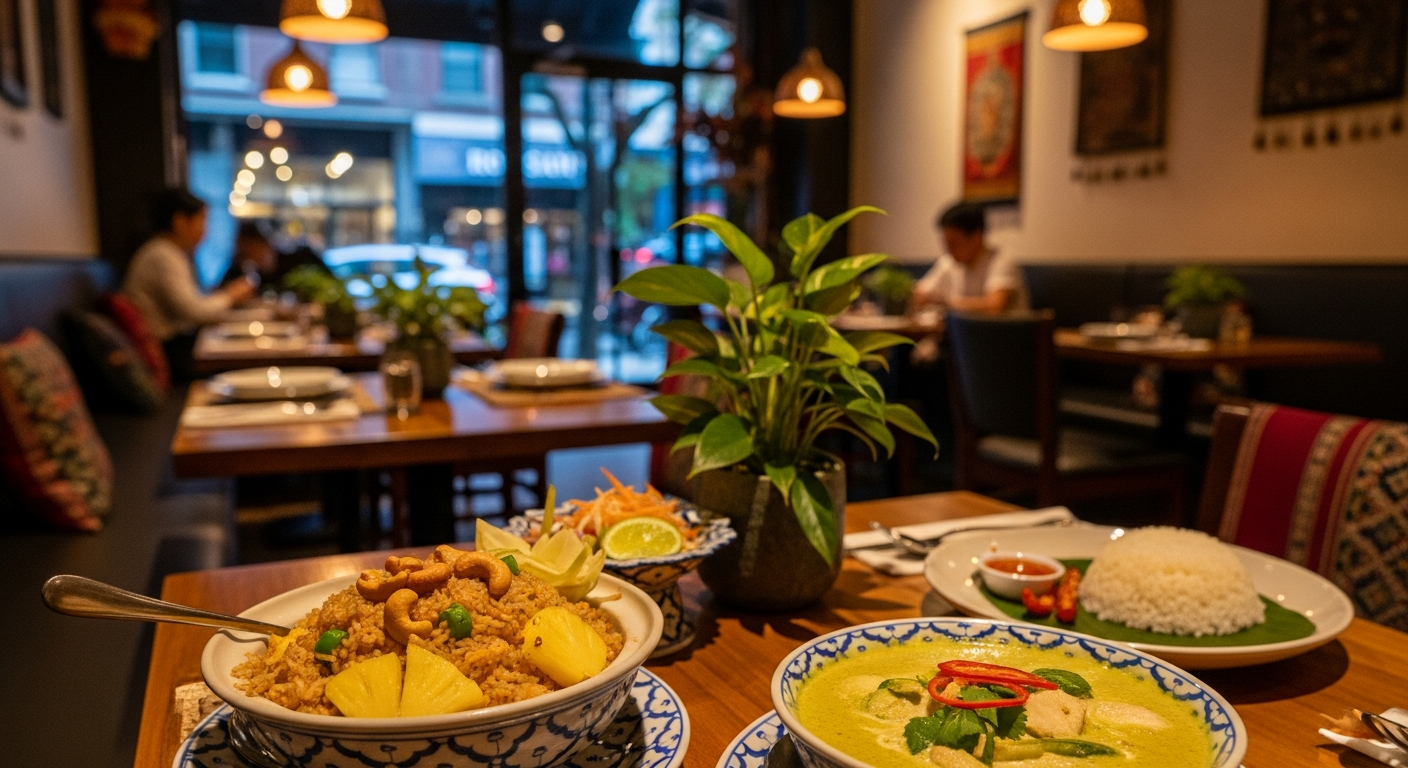
    Pineapple Fried Rice — one of the most-ordered dishes here. Made properly, with actual pineapple, cashews, egg, and protein in a wok, it’s a completely different thing than the stir-fried slop that passes for fried rice at most Thai-adjacent spots. Sabai Jai does it right.

    Avocado Curry — this is a standout. Not a traditional Thai curry you’d find everywhere, but a house development that works: the richness of avocado against a curry base is a combination that earns its place on the menu. Order it.

    Mushroom Pop — listed as an appetizer, and it functions as one, but don’t let it be an afterthought. The crispy mushroom preparation is one of those dishes that turns mushroom skeptics into believers.

    Gang Kha (Galangal Coconut Curry) — the traditional Thai coconut milk curry with galangal (a relative of ginger), lemongrass, and kaffir lime leaves. This is one of the dishes that tells you whether a kitchen understands Thai flavor architecture. Here, they do.

    Crab Fried Rice — for the protein upgrade. Real crab meat, seasoned properly, in fried rice that doesn’t resort to soy sauce overload as a crutch.

    Vegan, Vegetarian, and Gluten-Free

    This is one of the strongest aspects of Sabai Jai Thai’s menu: nearly every dish can be ordered vegan or vegetarian, with the protein either omitted or replaced. The kitchen doesn’t treat plant-based orders as an afterthought — the dishes are built so the vegetables and aromatics carry the flavor even without meat. Gluten-free diners are accommodated as well. If you’ve been burned before by Thai restaurants that claim “easily modified” and then deliver something disappointing, give Sabai Jai a real chance.

    The Space: Hewitt Walking Street Patio

    The restaurant is at 1707 Hewitt Ave, inside the Hewitt walking street corridor — the 4-block stretch of downtown Everett that has been quietly building into a legitimate dining destination over the past few years. Sabai Jai has indoor seating for a proper sit-down dinner and a small patio out front for good-weather evenings.

    The atmosphere is warm and cozy — not fancy, but considered. Tables with good lighting, a space that feels lived-in rather than branded. It’s a neighborhood restaurant in the best sense of the term. Parking: street parking on Hewitt or the nearby city lots on Hoyt or Norton.

    Hours

    Monday through Thursday: 11:00 AM – 9:30 PM
    Friday: 11:00 AM – 10:00 PM
    Saturday – Sunday: 12:00 PM – 10:00 PM

    Phone: (425) 259-6365. Online ordering available through DoorDash and their own site at sabaijaithaieverett.com.

    Awards and Recognition

    Sabai Jai Thai earned Restaurant Guru recognition as one of the top Thai restaurants in Everett and Marysville in both 2024 and 2025. That’s a third-party signal, not just local boosterism — the food earns it. With 164 Yelp reviews (updated April 2026) and a consistent rating, this isn’t a hidden gem in the way of something no one knows about. But it’s underrated relative to how good it actually is, and it’s never had a full guide written about it. Now it does.

    The Hewitt Corridor Context

    Sabai Jai Thai is one of the anchors of the Hewitt food corridor — the stretch we’ve been documenting that now includes a Gambian-Senegalese kitchen at Heritage African, real Florentine Italian at Luca, Hatch green chile and posole at The New Mexicans, 50-year diner anchor Vintage Cafe, and a curated PNW beer hall at Obsidian. Authentic Thai from a family kitchen belongs on that list. Walk the street, eat well, end at Obsidian for a beer.

    Frequently Asked Questions

    Where is Sabai Jai Thai in Everett?

    1707 Hewitt Ave, Everett, WA 98201 — on the Hewitt walking street in downtown Everett. Hours: Mon–Thu 11 AM–9:30 PM, Fri 11 AM–10 PM, Sat–Sun 12–10 PM.

    Is Sabai Jai Thai vegan-friendly?

    Yes — almost every dish on the menu can be ordered vegan or vegetarian with simple modifications. The kitchen accommodates plant-based orders without the food suffering for it.

    What are the best dishes at Sabai Jai Thai?

    Pineapple Fried Rice, Avocado Curry, Mushroom Pop appetizer, Gang Kha (galangal coconut curry), and Crab Fried Rice are standouts. The seasonal menu rotates, so ask the server what’s current.

    How long has Sabai Jai Thai been open?

    Since April 2022. The owners have over 10 years of Thai food industry experience. Restaurant Guru named it one of the top Thai restaurants in Everett and Marysville in 2024 and 2025.

    Can I order Sabai Jai Thai online?

    Yes — through DoorDash delivery or their own online ordering at sabaijaithaieverett.com.

    Is there parking near Sabai Jai Thai on Hewitt?

    Street parking on Hewitt Ave and in nearby city parking lots on Hoyt or Norton Ave. The Hewitt walking street area is walkable from downtown parking structures.

    Is Sabai Jai Thai authentic Thai food?

    Yes — the owners draw on Thai regional recipes and Bangkok street food traditions, using organic house beverages and homemade desserts from family recipes. It’s not a generic Americanized Thai menu.

  • Das Bratmobile: Everett’s Authentic German Food Truck

    Das Bratmobile: Everett’s Authentic German Food Truck

    Das Bratmobile has been feeding Everett the real thing for years, and most of the city still hasn’t found it. A German food truck run by a brother and sister from Rheinland-Pfalz, Germany, Das Bratmobile is the kind of operation that food-obsessed locals discover and immediately tell everyone they know. It’s authentic, it’s handcrafted, and it shows up at the Beverly Food Truck Park with the kind of menu that makes you realize how many years you’ve been settling for inferior sausages.

    If you haven’t been, here’s everything you need to know.

    Who’s Behind the Truck

    Ferdi and Uschi moved to the United States from Pirmasens, a town in Rheinland-Pfalz in western Germany, in the early 1990s. They built Das Bratmobile themselves — not because it was the trendy thing to do, but because buying a pre-built food service trailer was too expensive and building their own was the only realistic path. That’s the origin story of a truck built with genuine stakes, not a lifestyle pivot. When you taste the food, that history makes sense. This isn’t a German-themed food truck. It’s a truck run by Germans cooking the food they grew up eating.

    The Menu: Uli’s Sausages, Schnitzel, and Frikadelle

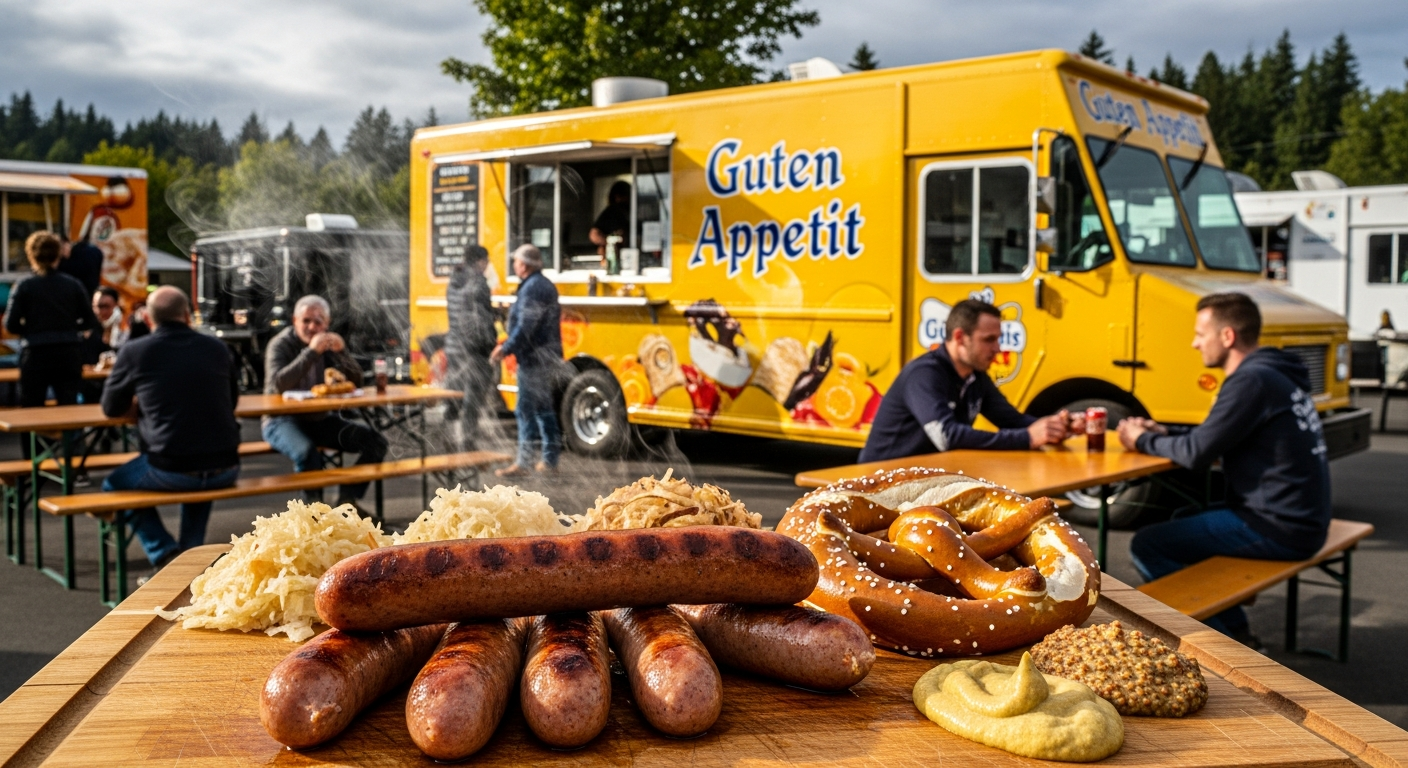
    Das Bratmobile sources its sausages from Uli’s Famous Sausage, the Seattle institution that has been making old-world European sausages since 1982. If you know Uli’s, you know what that means: these aren’t grocery-store brats. These are serious sausages made with care from a supplier that takes the craft seriously. The lineup includes smoked, jalapeño cheddar, currywurst, and polish — mild to spicy, with something for every heat tolerance.

    The Jaegerschnitzel is a bestseller — a German classic done right: breaded and fried pork cutlet with mushroom gravy. When it’s made well, schnitzel is one of the most satisfying foods in existence. Ferdi and Uschi make it well.

    Then there’s the Frikadelle — a homemade German burger. Not an American burger with a German twist. A proper German pan-fried meatball patty, seasoned the way it should be, served with German-style potato salad. If you’ve only ever had American versions of this concept, the real thing will recalibrate your expectations.

    German-style potato salad rounds out the sides — vinegar-based, not the mayo-loaded American picnic version. It’s the right call alongside sausages.

    Where to Find Das Bratmobile

    Das Bratmobile rotates through several Everett-area spots. Your most reliable bet:

    Beverly Food Truck Park — 6731 Beverly Blvd, Everett. The park runs Monday through Saturday, 4–7 PM with a rotating lineup of 2–4 trucks. Das Bratmobile is one of the regulars here, alongside other standouts we’ve covered. Check StreetFoodFinder before you go to confirm they’re on the schedule that day.

    They’ve also appeared at Scuttlebutt Brewing’s Cedar Street taproom, the Everett Food Truck Festival, and at various events around Snohomish County. Scuttlebutt + Das Bratmobile is one of those pairings that doesn’t need a lot of explaining — a cold craft beer and a proper Uli’s brat is a complete evening.

    What to Order

    First visit: Get the Jaegerschnitzel. It’s the benchmark — if they can do schnitzel right, they can do everything right. Spoiler: they can. Add a brat on the side and get the potato salad. This is a two-hands meal.

    Second visit: Try the Frikadelle. It’s different from what you expect a “burger” to be, and that difference is entirely the point.

    For heat seekers: the jalapeño cheddar brat from Uli’s brings real spice without gimmick. Most vegetarian and vegan customers will find options with the potato salad and some of the sides — but this is fundamentally a meat-forward menu.

    Price Range and Parking

    Food truck pricing — typically $10–$16 per item. Cash and cards accepted. The Beverly Food Truck Park has surface parking on-site, free. When Das Bratmobile is at Scuttlebutt, street parking on Cedar Street or the nearby lots applies.

    Why This Truck Matters

    Everett’s food truck scene has real range: Uzbek street food at Tabassum, Indian chaat at The Food Atlas, Mexican-Cuban fusion at Mexicuban, Central Asian flavors at Beverly Food Truck Park regulars. Das Bratmobile adds German to that list — and it’s not a novelty version of German food. It’s the real thing, from people who know exactly what the real thing tastes like because they grew up eating it.

    We’ve covered food trucks in Everett before, and one pattern holds: the trucks worth returning to are the ones where the operators have a personal stake in the food being right. Das Bratmobile is exactly that. Ferdi and Uschi built this truck with their own hands. The food shows it.

    Frequently Asked Questions

    Where is Das Bratmobile food truck in Everett?

    Das Bratmobile regularly appears at Beverly Food Truck Park (6731 Beverly Blvd, Mon–Sat 4–7 PM), Scuttlebutt Brewing taproom, and various Snohomish County events. Check StreetFoodFinder at streetfoodfinder.com/DasBratmobile for the current schedule.

    What sausages does Das Bratmobile use?

    They source from Uli’s Famous Sausage in Seattle — one of the best European-style sausage makers in the Pacific Northwest. Varieties include smoked, jalapeño cheddar, currywurst, and polish.

    What is Frikadelle?

    Frikadelle is a traditional German pan-fried meatball patty — similar to a burger but seasoned and prepared in the German style. Das Bratmobile makes it homemade.

    Is Das Bratmobile vegetarian-friendly?

    This is primarily a meat-focused menu (sausages, schnitzel, meatball patties). The German potato salad and some sides are vegetarian. Not the best choice for fully plant-based eaters.

    Who owns Das Bratmobile?

    Brother and sister Ferdi and Uschi, who immigrated from Pirmasens, Rheinland-Pfalz, Germany in the early 1990s and built the trailer themselves.

    What’s the best thing to order at Das Bratmobile?

    Start with the Jaegerschnitzel — breaded pork cutlet with mushroom gravy. It’s their benchmark dish and consistently excellent. Add a brat and German potato salad to round out the meal.

  • North Mason School Levy Leads in Early Election Returns

    North Mason School Levy Leads in Early Election Returns

    After two consecutive defeats and more than a year of painful budget cuts, the North Mason School District’s levy is leading in early returns — but results are not yet certified.

    According to the Mason County Auditor’s Office, the April 28 special election produced 2,130 yes votes (53.50%) and 1,851 no votes (46.50%) in combined Mason and Kitsap county totals as of election night. The Mason County Auditor’s website notes that ballot processing continues through May 7, 2026. These are preliminary results. Final certified totals are available at results.vote.wa.gov.

    Superintendent Kristine Michael responded cautiously. “We are very pleased and encouraged by these preliminary results, and we will be monitoring closely as ballots continue to be counted and certified,” Michael told local media on election night. “If this outcome holds, it reflects the trust this community is placing in our schools and our students.”

    The district lowered its ask substantially heading into this vote. The April levy requests $18.9 million over four years at a rate of $1.01 per $1,000 of assessed property value — down from the $1.28 rate attached to the two 2025 proposals that both failed. Before the election, the district also made $1.3 million in additional cuts and eliminated two administrative positions as a concession to community feedback.

    The levy funds programs that state basic education dollars don’t cover: safety officers, school nurses, counselors, athletics, music, Advanced Placement courses, custodians, and curriculum materials. North Mason has been operating without levy funding in 2026 following back-to-back 2025 failures, which forced the district to cut roughly $4.5 million from its budget.

    Even if the levy is certified, funds won’t arrive until April 2027 at the earliest — meaning the programs already cut will not be immediately restored. “Those funds would allow us to avoid making additional reductions, but because we are operating with only a partial year of levy revenue even in a passage scenario, we would not be in a position to restore programs or positions already reduced,” Michael said in a prior statement.

    The school board is composed of Arla Shephard Bull, Leanna Krotzer, Erik Youngberg, Nicole González Timmons, and Nicholas Thomas, with Superintendent Dr. Kristine Michael leading the district from its Belfair campus at 250 E. Campus Drive, Belfair, WA 98528, (360) 277-2300.

    This story will be updated when results are certified by the Mason County Auditor. Track live results at results.vote.wa.gov.


  • Marina Azul Everett: Elevated Mexican on the Waterfront

    Marina Azul Everett: Elevated Mexican on the Waterfront

    Marina Azul Cocina & Cantina is open. After months of anticipation — we covered the signed lease back in September 2025 and the coming-soon preview in April — the restaurant from the family behind Cava Azul in Woodinville and Agave Cocina in Redmond and Kent has officially landed at the Port of Everett’s Waterfront Place. If you’ve been watching that new Restaurant Row building go up on Seiner Drive and wondering when you’d finally get a margarita with a marina view, the answer is now.

    We stopped by to see what the Eastside team brought to Everett’s waterfront, and the short version is: this is a serious restaurant. Not a tourist trap, not a chain spin-off. Marina Azul is the real thing.

    Where It Is and How to Get There

    Marina Azul Cocina & Cantina sits at 1500 Seiner Drive, Suite 102, inside the new Restaurant Row building at Fisherman’s Harbor, Port of Everett Waterfront Place. That puts it right next door to The Net Shed, steps from the marina esplanade, and inside the same development as Tapped Public House and South Fork Baking Co. Parking is in the Port’s main Waterfront Place lot — it’s free and plentiful. If you’re arriving by boat, the marina docks are right there.

    The Food: Elevated Mexican Done Right

    Marina Azul is not your average chips-and-queso operation. The team behind the Woodinville and Redmond locations built a reputation on elevated traditional Mexican — fresh tacos, meticulous sauces, and a kitchen that actually respects what Mexican cuisine can be. The Everett menu follows suit: fresh tacos in multiple styles, specialty items that change seasonally, and an approach to ingredients that puts flavor first rather than defaulting to the same four proteins everyone else uses.

    The menu accommodates vegetarians, vegans, and gluten-free diners — a detail that matters in 2026 when half your dining party has a dietary note. That said, don’t let the plant-friendly options fool you into thinking this is health food dressed up as a night out. The kitchen’s strength is in the preparation: salsas made from actual chiles, sauces that taste like they took time, tortillas that have texture. Come hungry.

    The Tequila Program: 100+ Bottles

    Here’s the part worth calling out explicitly: Marina Azul carries more than 100 tequilas. Not a shelf of well tequila with a few premium bottles for show — a genuine sipping tequila program curated by people who care. Blanco, reposado, añejo, extra añejo — it’s all represented. If you’re a mezcal person, they have that covered too.

    The specialty margaritas are the entry point for most tables, and they’re built from the same philosophy as the food: actual fresh ingredients, good base spirits, no neon-green mix. The craft cocktail list extends beyond margaritas into curated agave-forward options. This is a bar worth lingering at.

    The Space: Waterfront Views, Year-Round Patio

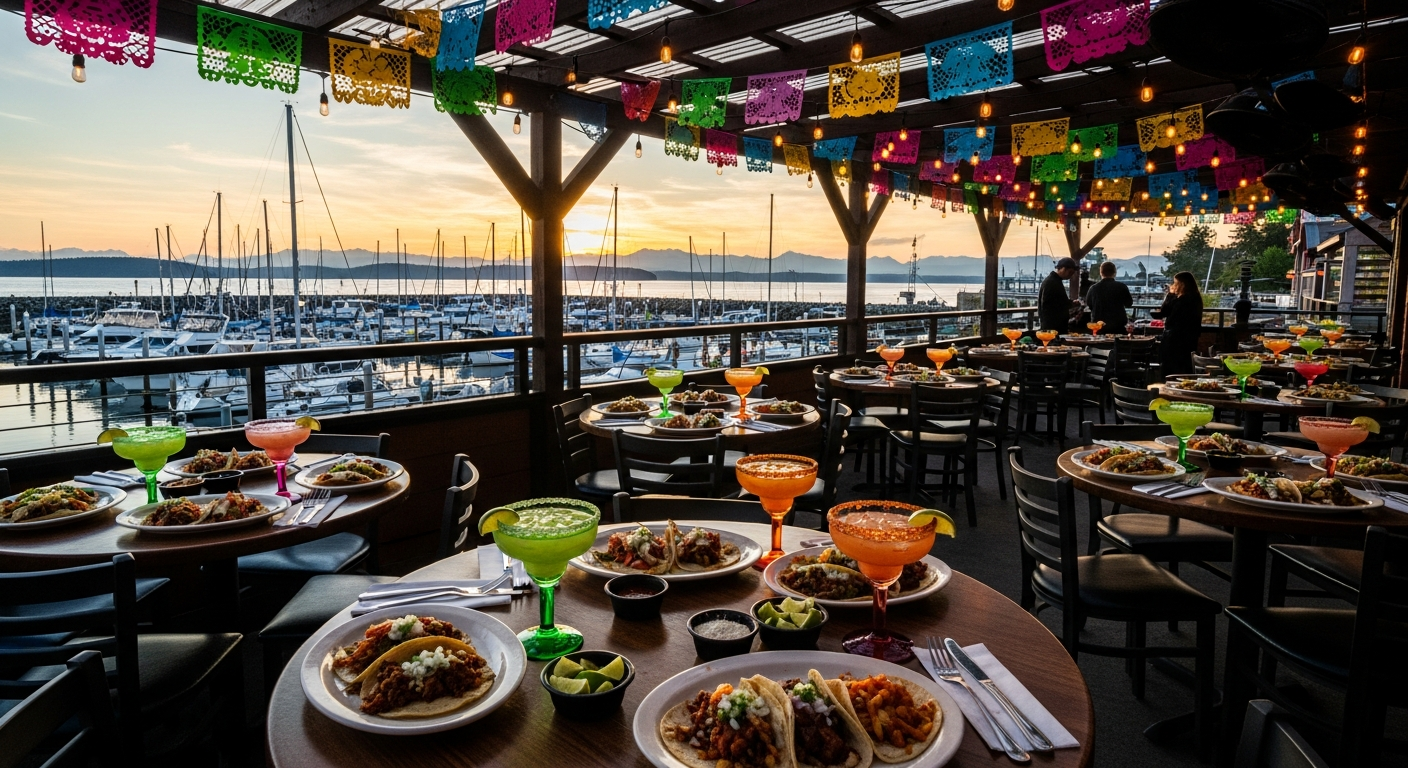
    The interior seats a proper dining room with views out toward the marina. But the covered patio is the move — Marina Azul designed it specifically for Pacific Northwest year-round use, which means it works in May when the sun is out and in November when it’s not. A heated, covered patio with marina views and a margarita in hand is a specific kind of good that Everett hasn’t had until now.

    The space is about 2,500 square feet inside plus the patio, which means it can handle a full dinner crowd without feeling cramped. Reservations are strongly recommended for weekends — this is going to be a destination restaurant for the whole county, not just a neighborhood spot.

    Who’s Running It

    The Everett location is managed by Alejandro and Esteban Ramos — nephew and son of the founding family behind the Eastside locations. This isn’t an absentee franchise situation. It’s a family operation that understands the Eastside concept and is extending it with the intention of doing it well in a new market. The family has been in the elevated Mexican dining space in the Seattle region long enough to know what separates a restaurant that becomes a fixture from one that opens and quietly fades. The Everett location has the backing to be the former.

    Hours

    Monday through Thursday: 11:00 AM – 9:00 PM
    Friday: 11:00 AM – 10:00 PM
    Saturday: 10:00 AM – 10:00 PM
    Sunday: 10:00 AM – 9:00 PM

    Weekend brunch service starts at 10 AM — which puts Marina Azul on the short list of actual waterfront brunch options in Everett. That list was previously very short. Note that they’re running a Mother’s Day special (May 11) — if you haven’t booked yet, call soon: (425) 241-9023.

    The Verdict

    The Port of Everett’s Restaurant Row has been building toward something for years, and Marina Azul feels like the piece that completes the picture. You’ve now got fresh fish at The Net Shed, craft beer and brunch at Tapped, pastries and espresso at South Fork Baking Co., and now elevated Mexican with a serious tequila program at Marina Azul — all within a five-minute walk of each other on the marina esplanade.

    We’ve been waiting for Everett’s waterfront dining scene to have a proper night-out Mexican restaurant. The wait is over. Go get a margarita and watch the boats.

    Frequently Asked Questions

    Is Marina Azul Cocina & Cantina open in Everett?

    Yes. Marina Azul Cocina & Cantina is now open at 1500 Seiner Drive, Suite 102, Port of Everett Waterfront Place. Hours are Monday–Thursday 11 AM–9 PM, Friday 11 AM–10 PM, Saturday–Sunday 10 AM–9/10 PM.

    What kind of food does Marina Azul serve?

    Elevated traditional Mexican cuisine — fresh tacos, specialty margaritas, curated cocktails, and more. The menu includes vegetarian, vegan, and gluten-free options.

    How many tequilas does Marina Azul carry?

    More than 100. It’s one of the most extensive tequila programs in Snohomish County.

    Is there outdoor seating?

    Yes — a covered, heated patio along the marina esplanade designed for year-round use.

    Who owns Marina Azul Everett?

    The same family behind Cava Azul Cocina & Cantina in Woodinville and Agave Cocina & Cantina in Redmond and Kent. The Everett location is managed by Alejandro and Esteban Ramos. Public relations contact: Deba Wegner at Recipe for Success, Inc.

    Is Marina Azul good for a date night or special occasion?

    Yes — waterfront views, serious cocktails, and a menu that’s actually trying. Reserve a table for weekends.

    Is there parking at Marina Azul?

    Yes, free parking in the Port of Everett Waterfront Place main lot off Seine Drive. Accessible by boat as well via the marina docks.

  • EvCC Baker Hall Replacement: Redesign Cuts & 2028 Opening

    EvCC Baker Hall Replacement: Redesign Cuts & 2028 Opening

    Q: What happened to Everett Community College’s Baker Hall replacement project?

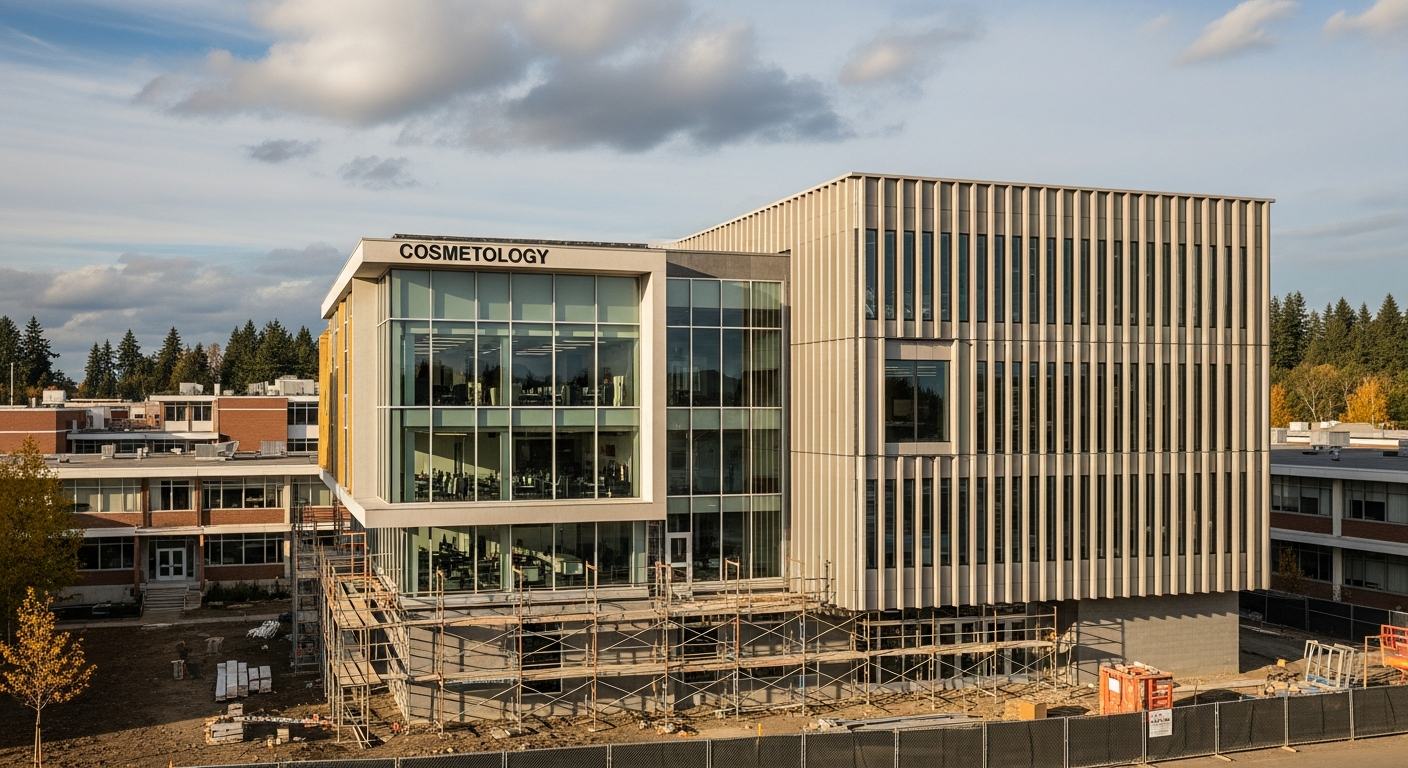
    A: EvCC paused the long-planned $37.9 million Baker Hall rebuild and trimmed roughly 10,000 square feet from the original 32,000-square-foot design after construction-cost increases pushed the project over budget. The new building still includes a cosmetology wing with a working salon and a 250-seat theater, with McGranahan PBK as architect, Cornerstone Construction as contractor, and a target opening of winter quarter 2028.

    We’re going to write about a building that didn’t break ground this spring — because the story of why it didn’t, and what got changed before the next attempt, is more useful than we’d usually expect from a delayed campus project.

    Everett Community College’s Baker Hall replacement has been on the drawing board for years. It’s the building that’s supposed to give the cosmetology program a real home, fold the school’s theater program into a properly sized stage, and finally pull a building from 1962 — one that hasn’t seen students in roughly two years — out of EvCC’s footprint. The $37.9 million capital allocation has been on the books since the 2023–25 state budget cycle. The architect, McGranahan PBK, was selected back in February 2025. Cornerstone Construction came on as contractor in May 2025.

    And then construction-cost reality showed up.

    What Just Changed

    EvCC pushed back the Baker Hall rebuild and shrank the planned new building by about 10,000 square feet, citing rising construction costs. The original design was 32,000 square feet. Roughly a third of that is gone in the revised version.

    What didn’t get cut: the core program elements. The new Baker Hall still has the dedicated cosmetology wing — including a working salon, classrooms, meeting spaces, and offices for the cosmetology department — and it still includes a 250-seat theater with dressing rooms, a set-construction shop, costume storage, and additional classroom space. The bones of the program survive.

    What got cut, in plain terms, is the slack. The square footage that allowed flex space, larger circulation, room to grow programs into the building — that’s the part that gave way to the budget math.

    The 2028 Target Is Still On

    Even with the redesign, EvCC is aiming for a winter quarter 2028 opening. That’s the operational target the school is working toward right now. Demolition of the existing 1962 Baker Hall has been delayed to align with the revised construction window, but the timeline to having students in the new space hasn’t slipped beyond winter 2028.

    A 2028 opening from a 2026 redesign is a real schedule. Construction documents have to be revised, permits have to refresh, and Cornerstone has to rebid the trade packages with the new scope. Every one of those steps takes weeks or months. The fact that the target hasn’t moved suggests EvCC and the design-build team are treating the cuts as additive — make the building smaller, keep everything else moving — rather than reopening the design from zero.

    Why This Matters Beyond EvCC

    Three reasons this story matters even if you’re not enrolled in cosmetology or trying out for a play.

    First, it’s the construction-cost story you can actually see. Everett has a lot of large public projects in motion right now — the Edgewater Bridge ($34M, just opened), the West Marine View Drive pipeline ($113M, approved April 2), the Broadway pedestrian bridge ($3.1M for design, future construction vote separate), the downtown stadium ($10.6M for design, $120M total). Most of those projects’ cost numbers have only one direction they’re moving. Baker Hall is the same pressure showing up at a single, well-defined building you can drive past.

    Second, the cosmetology program is one of EvCC’s most direct workforce connections. The school’s cosmetology students earn the cosmetology, esthetics, and barbering hours required for state licensure. Snohomish County’s salon and beauty industry hires from those programs directly. A delayed building doesn’t pause licensure — students continue in the existing program space — but it does delay the full-scale, properly equipped salon environment the program has been planning for.

    Third, the 250-seat theater fills a gap downtown can feel. The Historic Everett Theatre, the Schack Art Center’s gallery space, and Tony V’s Garage all carry different parts of Everett’s performance ecosystem. A 250-seat campus theater isn’t a competitor to any of them — it’s a teaching venue with sufficient capacity to host community-facing student productions and small touring acts. EvCC’s theater program has been working in compromised spaces for years.

    The Architect and the Contractor

    McGranahan PBK was selected as the project architect in February 2025. The firm — known for educational and civic work across the Pacific Northwest — has experience designing buildings that combine vocational program space with performance venues, which is exactly what Baker Hall asks for.

    Cornerstone Construction joined as contractor in May 2025. Cornerstone has done multiple state-funded community college projects in Washington and is comfortable working under the procurement and reporting requirements that come with state capital dollars.

    Both firms are still on the project under the revised scope. EvCC didn’t restart the procurement; it asked the existing team to revise the design to fit the budget envelope.

    The Money Trail

    The $37.9 million construction allocation comes from the state’s 2023–25 capital budget cycle, channeled through the State Board for Community and Technical Colleges. That’s the standard funding path for community college capital projects in Washington — the legislature appropriates the money, the SBCTC tracks the spend, and the individual college runs the project.

    The fact that the cost increases pushed the project to a redesign rather than a request for additional state funding tells you something about where the legislature is on supplementary capital appropriations right now. EvCC made the call to descope rather than ask for more — at least for this round.

    If construction costs continue to climb between now and the next bid window, that math may revisit itself. For now, the project is sized to fit what’s actually in the bank.

    What Happens Between Now and 2028

    Here’s the practical sequence to watch.

    Mid-to-late 2026: Revised construction documents wrap, with the smaller building footprint and the locked-in program elements. Cornerstone re-engages the trade subcontractors to rebid the work at the new scope. Permitting through the City of Everett refreshes for the revised plans.

    Late 2026 or early 2027: Demolition of the existing 1962 Baker Hall, which has been sitting unused for about two years already. This is the most visible moment of the project — the old building comes down, the site clears, foundations start.

    2027: Active construction on the new building. This is the stretch where the cost-control discipline applied in the redesign either holds or doesn’t. Watch for change orders.

    Winter quarter 2028 (early January through mid-March 2028): Target opening to students. Cosmetology classes move into the new salon space. The theater program books its first student production in the new house.

    That’s the plan as it stands today.

    What This Doesn’t Solve

    Two things the redesign doesn’t fix.

    It doesn’t add classroom capacity to the broader campus. The original 32,000 square feet would have given EvCC a meaningful chunk of net new instructional space across multiple programs. The trimmed version brings the cosmetology program and the theater program into modern facilities but doesn’t relieve the pressure on the rest of the campus the way the original scope would have. EvCC’s enrollment recovery from the pandemic has been steady — students need space.

    It doesn’t accelerate the 1962 building’s demolition. Old Baker Hall sits, empty, on prime east-of-Broadway campus real estate. Until demolition starts, that footprint is just waiting. The redesign keeps demolition on the same general timeline rather than pulling it forward.

    Both of those are conversations for the next state capital budget cycle, when EvCC will have data from the revised build to inform the next ask.

    The Bigger Everett Picture

    The Baker Hall delay is a single project on a single campus, but it lands in a pattern. Across Everett, large public projects are running into the same pressure: design starts at one number, construction comes in higher, the response is either find more money or descope. The Edgewater Bridge held its number through completion. The downtown stadium has been wrestling with its $120M total versus the available funding. The Broadway pedestrian bridge hasn’t gotten to construction bidding yet but the design contract alone is $3.1M.

    What EvCC chose to do with Baker Hall — pause, descope, keep the team, hold the timeline — is one of the more disciplined responses to construction-cost pressure we’ve watched a public project in Snohomish County execute. It’s worth noting because the temptation when a budget breaks is to either ask for more or kill the project. EvCC did neither. The smaller Baker Hall still gets built. The cosmetology students still get a salon. The theater program still gets a 250-seat house.

    That’s not nothing. It’s a building, smaller than originally planned, on its original timeline.

    Frequently Asked Questions

    Q: When will Everett Community College’s new Baker Hall open?

    A: EvCC is targeting winter quarter 2028 — early January through mid-March 2028 — for the new Baker Hall to open to students.

    Q: How much was cut from the Baker Hall replacement design?

    A: Approximately 10,000 square feet was removed from the original 32,000-square-foot design after construction costs rose, leaving a smaller building that still contains the planned cosmetology wing and 250-seat theater.

    Q: How much does the EvCC Baker Hall replacement cost?

    A: The project carries about $37.9 million in construction funding from Washington’s 2023–25 state capital budget, channeled through the State Board for Community and Technical Colleges.

    Q: Who is the architect for EvCC’s Baker Hall?

    A: McGranahan PBK was selected as the project architect in February 2025 and remains on the project under the revised scope.

    Q: Who is the contractor for the Baker Hall replacement?

    A: Cornerstone Construction was selected as the contractor in May 2025 and continues with the project after the redesign.

    Q: What programs will the new Baker Hall house?

    A: A dedicated cosmetology wing — including a working salon, classrooms, meeting spaces, and offices — plus a 250-seat theater with dressing rooms, a set-construction shop, costume storage, and additional classroom space.

    Q: Why did EvCC delay the Baker Hall project?

    A: Rising construction costs across the Pacific Northwest pushed the project over its $37.9 million budget. EvCC chose to pause and redesign rather than request additional state funding, descoping the building by about 10,000 square feet to fit the existing allocation.

    Q: When will the existing 1962 Baker Hall be demolished?

    A: Demolition has been delayed to align with the revised construction window. Current sequencing puts demolition in late 2026 or early 2027, ahead of new construction running through 2027 and into early 2028.

    Deeper coverage on this story:

  • Port of Everett Electrification: $4.3M Grant & PSBJ Award

    Port of Everett Electrification: $4.3M Grant & PSBJ Award

    Q: Why did the Port of Everett win the Puget Sound Business Journal’s Operational Excellence award in 2026?

    A: For weaving sustainability into every operational decision across its Seaport, Marina, and Waterfront Place properties — including a 16-category Climate Change Strategy, a real-time emissions analytics pilot called DAPE, and a $4.3 million WSDOT electrification grant that funds zero-emission cargo handling equipment with work starting later in 2026.

    The Puget Sound Business Journal handed the Port of Everett its 2026 Environmental Sustainability Award for Operational Excellence on May 1, and we want to talk about it for a minute — because the press release version of this story is a feel-good announcement, and the actually-interesting version is the line near the bottom about a $4.3 million WSDOT grant that’s about to put zero-emission cargo equipment on the working waterfront.

    That’s the story we’d rather tell.

    The Award, Briefly

    The Puget Sound Business Journal recognized the Port of Everett in its 2026 Environmental Sustainability Awards in the Operational Excellence category. The framing from PSBJ is that environmental stewardship runs through how the Port makes operational decisions — not as an add-on, but as one leg of what CEO Lisa Lefeber calls a “triple-bottom-line approach” weighing economy, environment, and community on every call.

    “Environmental stewardship is an important priority for the Port, and you can see that it is woven into every operational decision the team makes, whether at the Seaport, the Marina, or our properties at Waterfront Place,” Lefeber said in the Port’s announcement.

    Port of Everett Commission President David Simpson framed it forward: “As stewards of our waterfront, environmental sustainability is an important aspect of the Port’s work. We will continue to enhance our efforts as we prepare for the next 100 years of stewardship.”

    Why This Award Actually Matters

    Awards are easy to skip. This one is worth not skipping for two reasons.

    First, the criteria. PSBJ’s Operational Excellence category isn’t a “you announced a goal” award. It’s a “you put it into operations” award. The Port had to show its work — and the work it showed reads like a checklist of things you don’t usually see all stacked on the same waterfront.

    Second, what’s coming next. The award is essentially the public-facing receipt for a body of work that includes a real-time emissions analytics platform the Port piloted in 2025, a Climate Change Strategy with 16 distinct action categories, and a freshly funded electrification project that will start putting equipment in the ground later this year.

    That’s the part of the story that hits Everett directly, and it’s the part the press release buried.

    The 16-Category Climate Change Strategy

    The Port’s Climate Change Strategy organizes its sustainability work into 16 tailored action categories — covering everything from infrastructure resilience (think: bulkheads, wharves, and shoreline protection that have to survive sea-level rise and increasing storm intensity) to operational changes (how cargo moves, what equipment runs on what fuel, where electricity comes from).

    The framework is the Port’s answer to a question that doesn’t have a single industry answer yet: how does a working seaport — one that handles roughly $21 billion in exports a year and supports more than 40,000 jobs — actually decarbonize without giving up the cargo function that pays for everything else on the waterfront?

    Sixteen categories is a lot for a port of Everett’s size to take on. The Port of Seattle’s strategy is structured differently. The Port of Tacoma’s looks different again. Everett’s choice to itemize the work this way is part of why the recognition came down on operational execution, not just policy.

    The DAPE Pilot — Real-Time Emissions Analytics

    In 2025 the Port piloted a program called Decarbonization Analytics for Port Equipment, or DAPE — a real-time emissions monitoring and analytics platform that lets ports identify decarbonization opportunities without having to first build new infrastructure to do the measuring.

    The practical version: instead of waiting for a long emissions inventory cycle to reveal that a particular crane or yard tractor is the dirty one, DAPE shows it in operations data as it happens. That changes what the Port can act on quickly — fuel choices, idling rules, equipment scheduling, cargo flow — and it gives a baseline against which the bigger capital moves (electrification, equipment replacement) can actually be measured.

    The pilot won an award of its own when it launched. The fact that it’s now folded into the larger Operational Excellence recognition tells you the Port treated DAPE as part of regular operations rather than a one-off pilot that ended.

    The Numbers That Made the Case

    A piece of the case PSBJ would have looked at: between 2005 and 2021 — across a span when cargo volumes through the Port surged nearly 300% during the pandemic — the Port reduced CO₂ emissions per ton of cargo by 51% compared to 2005 inventories, and 34% compared to 2016 inventories.

    That’s an emissions intensity drop achieved while throughput went up. It’s the kind of number that’s hard to fake and harder to dismiss. The Port participated in the Puget Sound Maritime Emissions Inventory to get the underlying measurements, which means the methodology is shared across Puget Sound ports — apples to apples.

    The $4.3M Electrification Project — The Story Inside the Story

    Here’s the line we want to dwell on, because it’s the part of the announcement that actually changes what’s about to happen on the working waterfront.

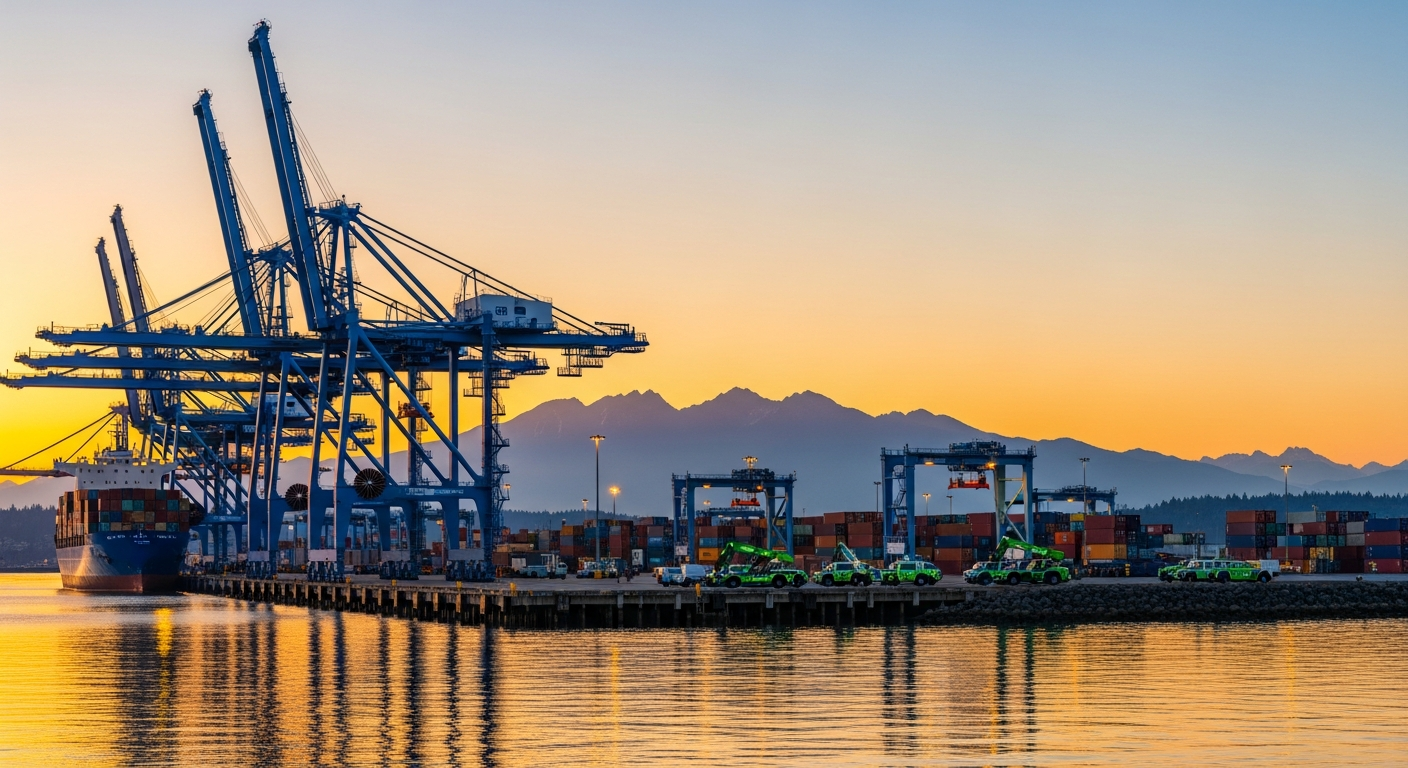
    The Port has a $4.3 million grant from the Washington State Department of Transportation through the Washington Port Electrification Program. It funds the Port’s Port Electrification Project, which advances electrification at the Port’s marine terminals and invests in lower- and zero-emission cargo handling equipment.

    Work starts later this year.

    What that means in practice: the Port’s marine terminals — Pier 1, Pier 3, the South Terminal area on the working waterfront — are about to get electric infrastructure that supports zero-emission cargo equipment. The funding source matters here. It’s coming from Washington’s Climate Commitment Act, the cap-and-invest program that’s been generating revenue from emissions allowances since 2023 and routing that money into climate-action investments.

    So the chain is: Washington’s biggest emitters pay into the cap-and-invest program → WSDOT runs a Port Electrification Program with that money → the Port of Everett gets $4.3 million → Everett’s working waterfront gets electric cargo equipment and the infrastructure to charge it → emissions per ton of cargo keep dropping.

    That’s a real money-to-equipment chain, not a slogan. And it ties Everett directly into the politically contested CCA in a way that’s easy to see and easy to point at when the program comes up for renewal or repeal debates.

    What This Means for Everett

    Three concrete things change because of the recognition and the grant behind it.

    Pier 3 gets a quiet upgrade beyond the rebuild. Pier 3 is already getting an $11.25 million federal PIDP grant for structural rebuild that we covered last week. Layered on top of that, the Port Electrification Project adds the electric infrastructure that future cargo equipment will plug into. If you’re a Boeing logistics planner moving oversized parts through Pier 3 — which handles 100% of Boeing’s oversized aerospace components — the long-run picture is a quieter, cleaner Pier 3 where the cranes and yard tractors don’t sit idling on diesel between moves.

    Air quality on the working waterfront moves in the right direction. Diesel cargo equipment is one of the meaningful contributors to local air quality on a working seaport. Electrification swaps that out for grid power — which in Snohomish County is largely hydroelectric via Snohomish County PUD. The neighborhoods directly above the Port — Bayside, Northwest Everett — get the air-quality dividend.

    The Port positions itself for the next round of grants. Federal and state agencies giving out infrastructure money increasingly have decarbonization criteria built into the scoring. Ports that have already done the operational work — measured emissions, run pilots, executed on grants — score better in the next round. The PSBJ recognition is a marker that gets cited in future applications.

    The Quiet Part About Tariffs

    The Port’s 2026 budget — adopted late last year — explicitly noted that the Port was working “despite challenges amid changing tariff guidance and market conditions.” That language is specific to the trade environment heading into 2026.

    The Operational Excellence award isn’t directly about tariffs, but it’s adjacent. A port that’s running tighter operationally — measuring its emissions in real time, running on data, securing climate grants — is also a port with a better grip on its cost structure when global trade gets choppy. The two stories are the same story, told different ways.

    How the Award Connects to the Rest of the Waterfront

    The recognition lands in the middle of one of the most active stretches in Port history. Pier 3 is rebuilding. The Segment E bulkhead and wharf project at Port Gardner Landing is in its final phase. Waterfront Place is 95% leased on the residential side and S3 Maritime just opened on the marine services side. Mukilteo waterfront assembly is in motion.

    The PSBJ award says, quietly, that the Port can do all of that and still win on environmental operations at the same time. That’s the through-line worth holding onto.

    What to Watch For Next

    A few specific things will tell you whether the Operational Excellence recognition is real or just a press cycle.

    The first is the start of the Port Electrification Project later this year. Watch for procurement notices on electric cargo handling equipment and for shore-power infrastructure permits. Those are the construction-document equivalents of the work being real.

    The second is the next iteration of the Puget Sound Maritime Emissions Inventory. The 2021 inventory showed the 51% per-ton emissions drop versus 2005. The next one will tell us whether the trend held through the pandemic-era cargo surge and into 2026 conditions.

    The third is the Port’s Climate Change Strategy update. The 16 action categories aren’t static; the strategy is meant to be revisited. Watch for which categories get accelerated and which get reframed as conditions change.

    We’ll be tracking all three.

    Frequently Asked Questions

    Q: When did the Port of Everett win the Puget Sound Business Journal’s Operational Excellence award?

    A: The Port of Everett was recognized by the Puget Sound Business Journal in its 2026 Environmental Sustainability Awards, with the Operational Excellence honor announced on May 1, 2026.

    Q: What is the $4.3 million Port Electrification grant?

    A: It’s a Washington State Department of Transportation grant from the Washington Port Electrification Program, funded by the Climate Commitment Act. The Port of Everett will use it to advance electrification at its marine terminals and invest in lower- and zero-emission cargo handling equipment, with work scheduled to start later in 2026.

    Q: What is DAPE — the Port of Everett’s Decarbonization Analytics for Port Equipment program?

    A: DAPE is a real-time emissions monitoring and analytics platform the Port piloted in 2025. It identifies operational efficiencies and decarbonization opportunities without requiring new infrastructure investment to do the measuring.

    Q: How much has the Port of Everett reduced CO₂ emissions per ton of cargo?

    A: The Port reduced CO₂ emissions per ton of cargo by 34% compared to 2016 inventories and 51% compared to 2005 inventories, even as cargo volumes spiked nearly 300% during the pandemic, according to the 2021 Puget Sound Maritime Emissions Inventory.

    Q: How many categories are in the Port of Everett’s Climate Change Strategy?

    A: The strategy is organized around 16 tailored action categories spanning infrastructure resilience, operational changes, and long-range planning specific to the Port of Everett’s waterfront operations.

    Q: What does the Port Electrification Project mean for Boeing’s oversized cargo through Pier 3?

    A: Pier 3 handles 100% of Boeing’s oversized aerospace components moving through the Port. The Electrification Project adds the electric infrastructure that future zero-emission cargo equipment will use, alongside the separately-funded $11.25 million federal PIDP grant for Pier 3 structural rebuild.

    Q: Who are the Port of Everett’s senior leaders quoted in the announcement?

    A: CEO and Executive Director Lisa Lefeber leads Port operations, and Port of Everett Commission President David Simpson chairs the elected commission that sets policy.

    Q: How much economic activity does the Port of Everett support?

    A: Port activities support more than 40,000 jobs in the surrounding community and contribute $433 million in state and local taxes, and the Port is responsible for the movement of approximately $21 billion in exports.

  • Real Estate ESG Frameworks: Navigating GRESB, CDP & SB 253

    Real Estate ESG Frameworks: Navigating GRESB, CDP & SB 253

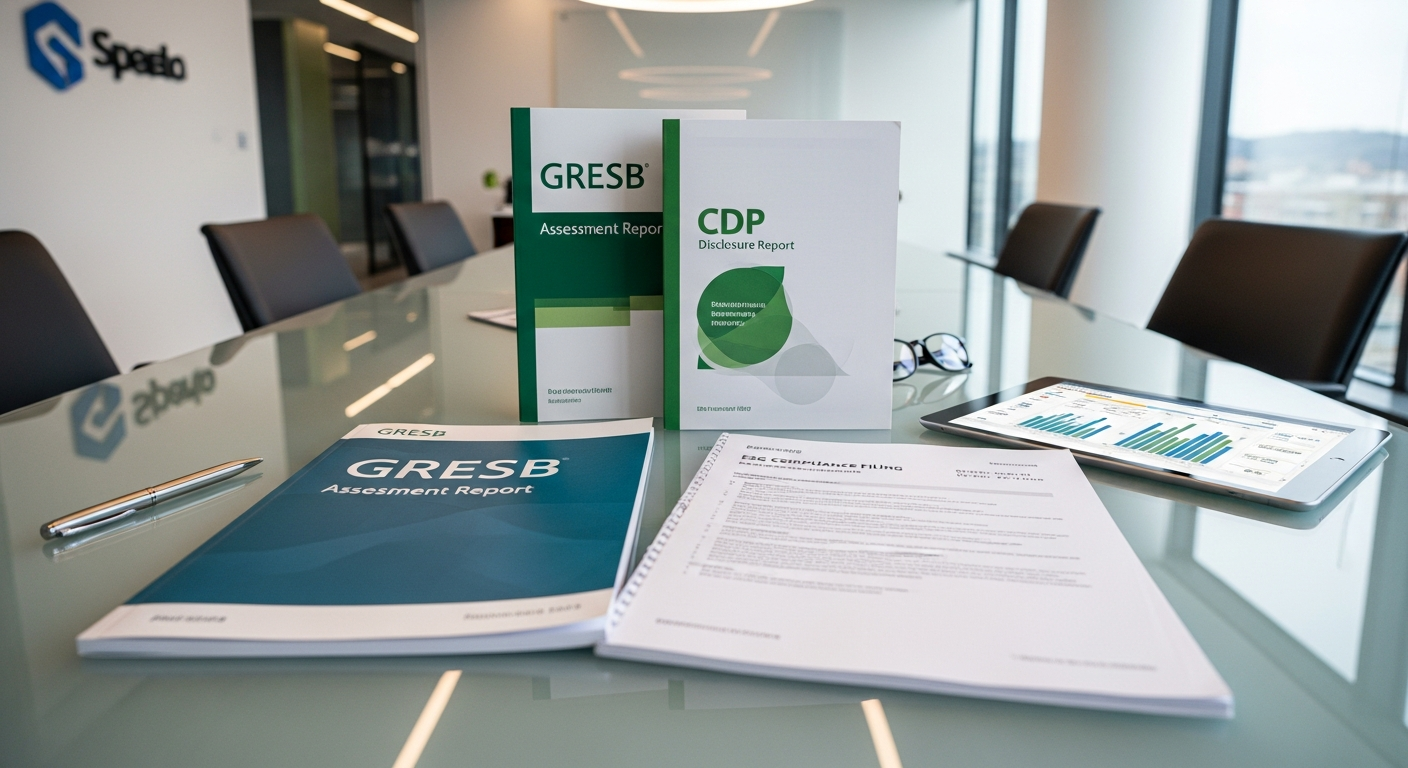
    Property owners and asset managers in institutional real estate operate in an increasingly layered ESG disclosure environment. GRESB drives investor-facing ESG scoring. CDP provides voluntary supply chain disclosure that is increasingly investor-requested. California SB 253 mandates Scope 3 disclosure for large entities. And the EU’s Corporate Sustainability Reporting Directive (CSRD) extends mandatory ESG reporting to European operations and, through supply chain due diligence requirements, reaches global real estate companies with EU exposure.

    For BOMA members — building owners, REITs, asset managers — understanding which framework governs which obligations, and where they overlap, is essential for building an ESG program that satisfies all of them without duplicating work. This article maps each framework against the specific Scope 3 obligations it creates for property owners, with particular focus on the contractor supply chain data gap that sits at the intersection of all three.

    GRESB: Investor-Driven, Asset-Level, Annual

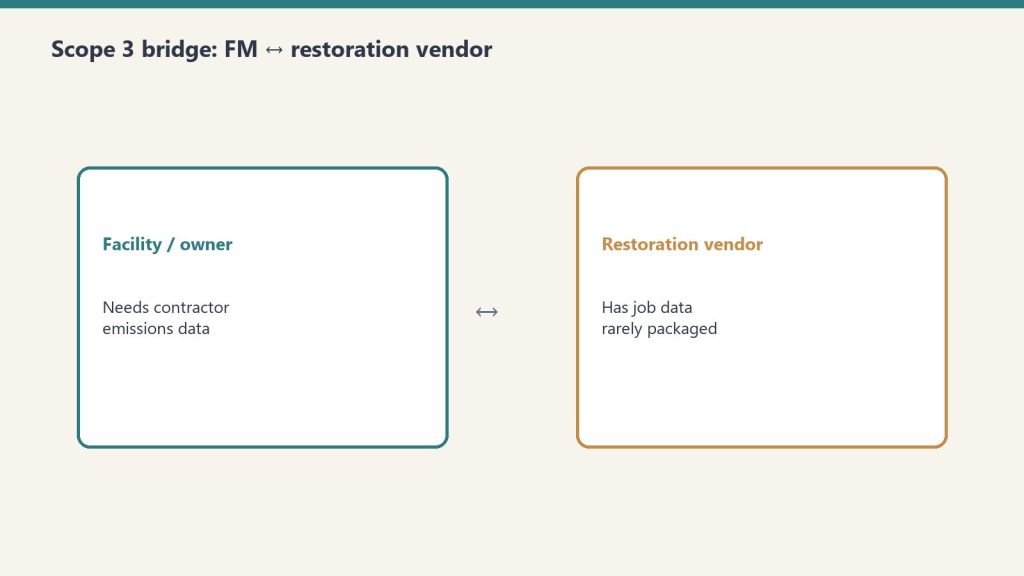
    Bridge diagram between facility owners and restoration vendors for Scope 3 data
    GRESB — investor-driven, asset-level, annual.

    GRESB is the primary ESG accountability mechanism for institutional real estate globally. It is not a regulation — it is an investor-driven benchmark that most institutional property owners participate in voluntarily because their capital partners require it. GRESB assessments are annual, asset-level, and scored on a 0–100 scale that investors use to compare portfolio ESG performance.

    For Scope 3, GRESB evaluates both governance (do you have a Scope 3 target and supply chain policy?) and performance (do you have actual Scope 3 data?). Contractor emissions — Scope 3 Category 1 — factor into both components. Property owners without contractor data collection programs score lower on supply chain governance and leave Category 1 data fields blank in the Performance section.

    GRESB is the most immediate Scope 3 pressure for most BOMA members because it directly affects your capital relationships. A poor GRESB score can affect asset valuations, borrowing costs, and investor mandates in ways that regulatory compliance does not.

    CDP: Voluntary, Supply Chain Driven, Escalating

    CDP’s supply chain program allows large corporations — including real estate companies’ major tenants and capital partners — to request Scope 3 supply chain data from their vendors. For property owners, CDP requests typically arrive from two directions: from institutional tenants whose corporate ESG programs require supply chain data from their landlords, and from institutional investors whose own CDP commitments require portfolio-level Scope 3 supply chain data.

    CDP participation is voluntary, but declining a CDP request from a major tenant or capital partner has commercial consequences. As CDP participation expands — the program now covers thousands of companies — the probability that a significant counterparty will request Scope 3 data from your organization continues to increase.

    California SB 253: Mandatory, Regulated, Enforced

    SB 253 is the only mandatory framework in this set, at least for US-domiciled organizations. It applies to entities doing business in California with revenues above the threshold, requires Scope 1 and 2 disclosure starting with fiscal year 2025 data, and adds Scope 3 starting with fiscal year 2026 data. CARB administers the program and has authority to assess penalties for non-compliance and material misstatement.

    For real estate entities with California assets, SB 253 transforms the Scope 3 contractor data question from an investor relations consideration into a legal compliance obligation. The same contractor emissions data that improves your GRESB score and satisfies CDP supply chain requests now also needs to be accurate enough to withstand CARB review.

    Where Restoration Contractor Data Fits in Each Framework

    The Restoration Carbon Protocol addresses the same data gap across all three frameworks. An RCP-compliant restoration contractor provides project-level emissions data in a format aligned with GHG Protocol Category 1. That data feeds directly into your GRESB Performance section, satisfies CDP supply chain data requests for Category 1, and provides the documented, methodology-backed Scope 3 Category 1 data that SB 253 requires.

    The strategic efficiency argument for RCP adoption by property owners is that solving the restoration contractor data problem once solves it for all three frameworks simultaneously. You do not need different data for GRESB, CDP, and SB 253 — you need GHG Protocol Category 1 data, and RCP produces it in that format.

    Building a Unified Response

    For BOMA members navigating GRESB, CDP, and SB 253 simultaneously, the most efficient path is a unified Scope 3 data program rather than three separate compliance efforts. The foundation is a GHG Protocol-aligned inventory methodology that covers all fifteen Scope 3 categories. Contractor data — collected through RCP-compliant vendor agreements and green lease extensions — feeds into that inventory once and satisfies all three frameworks.

    The timeline pressure is real: SB 253 Scope 3 data collection for fiscal year 2026 should already be underway, GRESB 2026 assessments will open in the first quarter, and CDP supply chain requests arrive year-round. The property owners who have built the contractor data infrastructure now — preferred vendor panels with RCP adoption, ESG clauses in service agreements, documented methodology — will be the ones with defensible Scope 3 inventories when all three frameworks converge on the same data set in 2027.

    Related on Tygart Media: FM ESG frameworks · GRESB Scope 3 · Scope 3 for property owners.

    Frequently Asked Questions

    Does GRESB require the same data as SB 253?

    Both require Scope 3 GHG data aligned with the GHG Protocol Corporate Standard. GRESB collects it through an annual assessment submitted to the benchmark platform. SB 253 requires public disclosure filed with CARB. The underlying data set is the same — a GHG Protocol-compliant Scope 3 inventory by category — which is why building one unified inventory program satisfies both frameworks efficiently.

    How does CSRD affect US-based property owners?

    The EU’s Corporate Sustainability Reporting Directive (CSRD) applies directly to large EU-domiciled companies and EU subsidiaries of non-EU companies above defined thresholds. For US-based real estate companies with EU operations or EU-listed capital partners, CSRD may apply directly. Even for those it does not reach directly, CSRD’s supply chain due diligence requirements mean EU-based capital partners and tenants will increasingly request Scope 3 supply chain data from their US counterparties as part of their own CSRD compliance.

    What is the Restoration Carbon Protocol and why do BOMA members need it?

    The Restoration Carbon Protocol (RCP) is an industry self-standard that gives restoration contractors a structured GHG accounting methodology for project-level emissions reporting. For BOMA members, RCP-compliant contractors provide the Scope 3 Category 1 data needed for GRESB performance scores, CDP supply chain responses, and SB 253 mandatory disclosure — in a format directly compatible with GHG Protocol reporting requirements.

  • Contractor ESG Clauses: Driving Scope 3 Data Compliance

    Contractor ESG Clauses: Driving Scope 3 Data Compliance

    Green leases have been a standard tool in the institutional real estate ESG toolkit for over a decade. Originally designed to align landlord and tenant incentives around energy efficiency, green lease clauses have evolved to cover data sharing, sustainability reporting, and — in more sophisticated agreements — explicit GHG emissions obligations.

    The same contractual logic that makes green leases effective for tenant emissions management can be applied to the contractor supply chain. Property owners who have invested in green lease programs for tenant Scope 3 (Category 13) data now have a parallel opportunity: using vendor agreement language to systematically collect Scope 3 Category 1 data from the contractors who perform work on their assets.

    What Green Lease Language Has Achieved — and Where It Stops

    Modern green lease frameworks — developed by BOMA, the Institute for Market Transformation, the Urban Land Institute, and others — have established standard clauses for energy data sharing, sub-metering requirements, sustainable operations standards, and ENERGY STAR reporting. These clauses give property owners a contractual mechanism to collect the tenant data needed for GRESB Category 13 reporting and corporate GHG inventories.

    Green leases stop at the tenant boundary. They do not govern the contractors the property owner engages for capital projects, maintenance, and emergency response. Those contractor relationships are covered by master service agreements, purchase orders, and emergency vendor panel arrangements — none of which have traditionally included GHG data reporting requirements.

    Extending the Logic: Contractor ESG Clauses

    The Green Lease 2.0 framework extends the proven lease-language approach to contractor agreements. The principle is identical: establish a contractual data delivery obligation, specify the format and methodology, and make compliance a condition of the vendor relationship.

    For restoration contractors specifically, the relevant clause structure covers three elements. A methodology requirement — specifying that the contractor must use a recognized GHG accounting methodology (such as the Restoration Carbon Protocol) for calculating project emissions. A data delivery requirement — specifying that a project emissions report in a format compatible with GHG Protocol Category 1 reporting must be delivered within 30 days of project completion. And a pre-qualification requirement — specifying that participation in the property owner’s preferred restoration vendor panel requires demonstrated GHG reporting capability prior to emergency deployment.

    Why the Pre-Qualification Step Matters

    The most important element of the contractor ESG clause framework is pre-qualification — establishing GHG reporting capability before the loss event occurs. Property owners cannot negotiate data requirements at 2 AM when a pipe bursts. The contractual infrastructure needs to exist before the emergency.

    Pre-qualification creates a preferred vendor panel of restoration contractors who have adopted RCP or an equivalent methodology and are contractually committed to delivering project emissions data. When a loss event occurs, the property manager calls from that panel — and GHG data collection is already built into the engagement.

    What This Looks Like for GRESB and SB 253

    For GRESB participants, a documented contractor ESG clause program with demonstrated adoption across your preferred vendor panel satisfies the supply chain governance requirements in the Management component of the GRESB assessment. It shows that your organization has policies in place, that those policies have contractual teeth, and that you are actively collecting contractor emissions data — not estimating it.

    For SB 253, the contractor ESG clause approach provides the documented data collection methodology that CARB’s guidance suggests as the evidentiary standard for Scope 3 Category 1 reporting. Organizations that can demonstrate a systematic contractor data collection program — rather than spend-based estimation — are better positioned for both initial compliance and the audit scrutiny that mandatory disclosure programs inevitably generate over time.

    Green Lease 2.0 is not a dramatic reinvention. It is the application of a framework that already works — for tenants — to the contractor relationships where property owners have an equivalent data obligation and an equivalent contractual lever to close it.

    Related on Tygart Media: facility ESG frameworks (GRESB / CDP / SB 253) · RCP for property owners · Scope 3 contractor compliance checklist.