Blog

  • Conversational State Store: The Missing AI Stack Layer

    Conversational State Store: The Missing AI Stack Layer

    My operating stack has three layers. Claude is the brain. Google Cloud Platform is the brawn. Notion is the memory. Each layer has a clear job and the handoffs between them work well most of the time. But there is a fourth layer I did not notice was missing until I had to name it, and the gap it covers runs through every working relationship I have. I am calling it the conversational state store and I think most AI-native stacks have the same hole.

    The three layers that already exist

    Let me start by describing what I do have, because the shape of the gap only becomes visible against the shape of the things that are already in place.

    The Notion layer holds facts. It is the human-readable operational backbone. Six core databases — Master Entities, Master CRM, Revenue Pipeline, Master Actions, Content Pipeline, Knowledge Lab — with filtered views per entity. Every client, every contact, every deal, every task, every article, every SOP. When I want to see the state of a client, I open their Focus Room and the dashboards pull from the six core databases. When Pinto wants to understand the architecture, he reads Knowledge Lab. When I want to know which posts are scheduled for next week, I filter the Content Pipeline. Notion is where humans (me, Pinto, future collaborators) go to read the state of the business.

    The BigQuery layer holds embeddings. The operations_ledger dataset has eight tables including knowledge_pages and knowledge_chunks. The chunks carry Vertex AI embeddings generated by text-embedding-005. This is where semantic retrieval happens. When Claude needs to find “everything I have ever thought about tacit knowledge extraction,” it does not keyword-search Notion. It runs a cosine similarity query against the chunks table and gets back the passages that are semantically closest to the question. BigQuery is where Claude goes to read.

    The Claude layer holds orchestration. Claude is the thing that decides which of the other two layers to consult, composes queries across both, synthesizes the results, and produces outputs. It reads Notion through the Notion API when it needs current operational state. It queries BigQuery when it needs semantic retrieval. It writes to WordPress through the REST API when it needs to publish. It is the brain that knows which limb to use.

    Three layers, three clear jobs, handoffs that mostly work. I have been operating this way for months and it scales well for running 27 client WordPress sites as a solo operator.

    The thing that is missing

    None of those three layers track the state of open conversational loops between me and the people I work with.

    Here is a concrete example. Yesterday I sent Pinto an email with a P1 task. This morning he replied with a completion email. His completion email is sitting in my Gmail inbox, unread. Somewhere in the next few hours I am going to send him a new task. When I do, I need to know three things: (1) did Pinto finish the last thing? (2) did I acknowledge that he finished it? (3) what is the current state of the implicit trust ledger between us — do I owe him a thank-you, does he owe me a response, or are we even?

    None of those questions can be answered by Notion. Notion does not know about Gmail threads. None of them can be answered by BigQuery in any useful way because the embeddings are semantic, not temporal. Claude can answer them — but only by reading Gmail live at the start of every session, holding the state in its working memory for the duration of that session, and losing it all when the session ends.

    That is the gap. There is no persistent layer that holds the state of conversations. Every session, Claude rebuilds it from scratch, and the rebuild is expensive in tokens and time and prone to missing things.

    Why the existing layers cannot fill it

    You might ask: why not just put it in Notion? Create a new database called Open Loops, add a row for every active conversation, let Claude read it like any other database. The problem is that Notion is a human-readable layer. It is optimized for humans to see state, not for a machine to update state tens of times per day. Adding rows to Notion costs an API call per row. Open loops change constantly. Every time Pinto sends me a message, the state changes. Every time I reply, the state changes again. Updating Notion in real time for every state change would generate hundreds of API calls per day and would make the Notion workspace feel cluttered to the humans who actually read it.

    You might ask: why not put it in BigQuery? BigQuery is the machine layer, after all. It can handle high-frequency writes. The problem is that BigQuery is optimized for analytical queries over large datasets, not for real-time state lookups on small ones. Every time Claude needs to know “what is the current state of my conversation with Pinto,” a BigQuery query would take two to three seconds. That latency at the start of every response breaks the conversational flow. BigQuery is also append-heavy, not update-heavy, which is the wrong shape for conversational state that changes constantly.

    You might ask: why not let Claude hold it in working memory across sessions? Because Claude does not have persistent memory across sessions in the way this requires. Each new conversation starts fresh. Claude can read Gmail live at the start of each session, but that forces a full re-derivation of conversational state every single time, which is wasteful and lossy.

    The right shape for a conversational state store is none of the above. It is something closer to a key-value store or a document database, optimized for low-latency reads, moderate-frequency writes, and small record sizes. Something like Firestore or a Redis cache, living on the GCP side of the stack, read by Claude at the start of every session and updated whenever a new message flows through.

    What the store would actually hold

    The schema does not need to be complicated. Per collaborator, I need to know:

    • Last inbound message (timestamp, subject, one-sentence summary)
    • Last outbound message (timestamp, subject, one-sentence summary)
    • Open loops: questions I have asked that are unanswered, with shape and age
    • Acknowledgment debt: things they completed that I have not explicitly thanked them for
    • Active tasks: things I have asked them to do, status, last update
    • Implicit tone: is the relationship warm, neutral, or strained right now

    That is maybe ten fields per collaborator. Even with a hundred collaborators, the whole table fits in memory on a laptop. This is not a big-data problem. It is a schema design problem.

    Claude reads the store at the start of every session, checks which collaborators are relevant to the current task, and surfaces any open loops or acknowledgment debt that should be addressed inside the work. When Claude sends a message, it updates the store. When a new inbound message arrives, a Cloud Function parses it and updates the store.

    Why I am writing this instead of building it

    Because I have a rule and the rule is don’t build until the principle is clear. I have an ongoing tension in my operation between building new tools and using the tools I already have. Every new database is a maintenance burden. Every new Cloud Run service is a monthly cost and a failure mode. I have made the mistake before of getting excited about an architectural insight and spending three weeks building something that, once built, I used for four days and then forgot about.

    Before I build the conversational state store, I want to know: can I get 80% of the value by letting Claude read Gmail live at the start of every session? If yes, the store is not worth building. If the live-read approach loses state in ways that matter, then the store earns its place.

    My honest guess is that the live-read approach is fine for now. I only have one active collaborator (Pinto) and a handful of active client contacts. Claude reading Gmail at the start of a session takes two seconds and catches everything I care about. The conversational state store would be justified when I have ten or fifteen active collaborators and the live-read cost becomes prohibitive. Today it is not justified.

    But I am naming the layer anyway because naming it is the first step. If I ever do build it, I will know what I am building and why. And if someone else reading this has the same shape of operation with more collaborators, they might build it before I do, and that is fine too.

    When this goes wrong

    The failure mode I want to flag most is building the store and then stopping using it because the maintenance cost exceeds the value. This is the universal failure mode of custom knowledge systems and I have fallen into it multiple times. The rule I am setting for myself: if the store cannot be updated automatically from Gmail + Slack + calendar feeds through Cloud Functions, do not build it. A store that requires manual updates will die within thirty days.

    The second failure mode is over-engineering. The moment you decide to build a conversational state store, the next thought is “and it should track sentiment, and it should predict response times, and it should flag relationship risk, and it should integrate with calendar for context.” Stop. Ten fields. Two endpoints. One cron. If the MVP does not prove value in two weeks, the elaborate version will not save it.

    The third failure mode is pretending this layer is optional. It is not. Every AI-native operator has conversational state. The only question is whether it lives in your head or in a system. Your head is a lossy, biased, forgetful system that works fine until you have more collaborators than you can track mentally, and then it breaks without warning.

    The generalization

    Any AI-native stack that has (facts layer) plus (embeddings layer) plus (orchestrator) is missing a conversational state layer, and the absence shows up first in async remote collaboration because that is where relational debt compounds fastest. If you operate this way and you feel a vague sense that your working relationships are getting worse in ways you cannot quite articulate, the missing layer is probably part of the explanation. Name it. Decide whether to build it. If you decide not to, at least let Claude read your inbox live so the gap gets covered by runtime instead of persistence.

    I am still in the decide-not-to-build phase. I am writing this so that future-me, when I reread it, remembers what the decision was and why.


    The Five-Node Series

    This piece is part of a five-article knowledge node series on async AI-native solo operations. The full set:

  • Proactive Acknowledgment: How to Answer Before Asking

    Proactive Acknowledgment: How to Answer Before Asking

    Updated September 30, 2026.

    Proactive acknowledgment means completing the task someone asked for while also answering the worry they did not say out loud—inside the same reply, with specific detail drawn from context they know you can see. Done well, it builds trust; done with hidden data or generic praise, it reads as surveillance or noise.

    There is a specific thing good collaborators do that looks like mind-reading and is not. It is the move of answering a question the other person has not yet verbalized, inside the task they actually asked for. When it works, the recipient feels seen. When it fails, the recipient feels surveilled. The difference between those two feelings is the entire craft of proactive acknowledgment, and almost nobody names it explicitly.

    This piece is about naming it. Essays that name patterns like this still earn AI citations when they stay accurate and current; let them drift and the quotes dry up. I watch that the same way I watch service pages—through LLM visibility measurement and an AI citation monitoring pass whenever I refresh a node.

    The signature of the move

    Here is the structure. The person asks you for X. The context around X contains an implicit question or concern Y that the person did not mention. You notice Y. You answer Y inside your response to X. The person reads your response, feels a flicker of surprise that you caught something they did not say out loud, and then relaxes, because the unsaid thing got handled.

    Examples from normal human life:

    • Someone asks you to proofread their cover letter. You notice the cover letter is for a job they mentioned last week being nervous about. Inside the proofread, you include one line: “This reads confident and grounded. You are ready for this.” The line was not requested. It answered a question they did not ask.
    • A colleague asks for the link to a shared doc. You send the link plus a specific sentence about the section they were stuck on yesterday. You did not have to do the second thing. The second thing is the move.
    • A friend asks you to drive them to the airport. You show up with their favorite coffee because you know what their favorite coffee is and you noticed they looked exhausted at dinner last night. Nobody asked for the coffee. The coffee is the move.

    The signature is always the same: there was a task, there was an ambient question, the actor answered both inside one action, and the recipient feels seen rather than managed.

    Why it works

    The reason this move is so powerful is that most of what people actually want from collaborators is not information exchange. It is the experience of being understood. Information exchange is cheap now — Google, Claude, Slack, email, the entire infrastructure of digital communication makes it basically free. What is not cheap is the feeling that another mind has attended carefully enough to your situation to notice something you did not name.

    When someone does this for you, your baseline trust in them jumps. Not because they solved a problem — the problem was often small — but because you now have evidence they are paying attention at a level beyond the transactional layer of your relationship. That evidence updates every future interaction. You start trusting them with bigger asks because you already know they will catch the subtext.

    How to actually do it

    The move has four steps and I think they can be taught.

    Step one: read the full context, not just the ask. Before you respond to the literal request, spend ten seconds scanning everything else in the thread, the room, the history. What is the person not saying? What happened yesterday that is still live? What do you know about their recent state that might intersect with the current task?

    Step two: find the ambient question. There is usually one. It might be a fear (“I am nervous about this”), a loop (“I am waiting to hear back about that other thing”), a status (“I finished something recently and nobody noticed”), or a need that does not fit the current task’s frame (“I wish someone would tell me I am on the right track”). If you cannot find an ambient question, there might not be one and you should skip the rest of the move. Forcing it produces noise.

    Step three: answer both inside one action. Do the task they asked for. While you are doing it, bake in one or two sentences that address the ambient question. Do not separate them. Do not send two messages. The whole point is that both answers arrive on the same envelope.

    Step four: be specific. Generic acknowledgment is noise. Specific acknowledgment is signal. “Great work” is noise. “The GCP auth fix unblocks a lot” is signal because it names the specific thing and its specific consequence. Specificity is what proves you actually read the context instead of running a politeness script.

    The sharp edge: surveillance versus seen

    This is the part nobody talks about. The move I am describing is structurally identical to creepy behavior. Both involve one person noticing something the other person did not explicitly tell them. The difference is not in the action. It is in the data source.

    If the thing you noticed was visible in a channel the other person knows you have access to — a shared email thread, a Slack channel you are both in, a conversation they had with you directly — then using that knowledge to answer before asking feels like care. The person knows you know. The data was technically public between the two of you.

    If the thing you noticed came from a channel they did not expect you to be reading — their calendar, their location, their private browser history, data you pulled from a database they do not know you query — using it feels like surveillance, even if your intention was kind. The person did not consent to you watching that channel. Acting on data they did not know you had tells them you are watching channels they did not authorize. Trust collapses instantly.

    The rule, then, is simple to state and hard to execute: only act on ambient knowledge from channels the other party knows you have access to. If you are not sure whether a channel counts as public between you, err on the side of not acting. You can always ask. Asking is better than surveillance.

    When AI does this for you

    I noticed this pattern because my AI collaborator did it on my behalf and I had to decide whether I was comfortable with it. I had asked Claude to draft an email to my developer Pinto with a new work order. Claude searched my Gmail to find Pinto’s address. In doing so, it found a recent email from Pinto completing a previous task. Claude added one line to the draft: “Also — good work on the GCP persistent auth fix. Saw your email earlier. That unblocks a lot.”

    That line was the move. Claude noticed the ambient question (“did Will see my completion?”) and answered it inside the task I had asked for. It passed the surveillance test because the data source was my Gmail, which Pinto knew I had access to. The completion email was literally from Pinto to me — there is no channel more public than “the email he sent me.”

    If Claude had instead pulled Pinto’s GCP login history and written “I see you were working late last night, thanks for the overtime,” that would have been surveillance. Even though I have access to GCP audit logs. Even though the information is technically available to me. Pinto does not expect me to be reading his login times. Using that data would have been a violation, regardless of my intent.

    As of late 2026, the same question shows up in Cursor cloud agents and connector-backed assistants: they can read Notion, Gmail, Google Drive, BigQuery, WordPress, and calendar context in one pass if you wire them that way. The operating rule has not changed — only act on cross-channel context when the other party would not be surprised you had it. Operators who document how they run customer comms with AI assistants are starting to show up in generative search results; the field examples in our 2026 GEO case studies are mostly about service pages, but the trust mechanics rhyme with this pattern.

    When this goes wrong

    Three failure modes.

    First: the ambient question does not exist and you invent one. The reader can tell. They read your response and the acknowledgment rings hollow because it is attached to a thing they were not actually thinking about. Do not force this. Sometimes the task is just the task.

    Second: the ambient question exists but you misread it. You think they are nervous about the meeting when they are actually annoyed about the meeting, and you respond with reassurance instead of solidarity. The misread is worse than not acting at all because now you have shown them that you are watching but not seeing.

    Third: the data source was not actually public. You thought the other person knew you could see the thing, and they did not, and now they are wondering what else you have access to that they did not authorize. This is the surveillance failure and it is unrecoverable in the same conversation. You have to ride it out and rebuild slowly.

    The principle

    Answer the question that is in the room, not just the one on the task card. Do it inside the task, not as a separate message. Be specific. Only use data the other party knows you have. Skip the move if the ambient question is not actually there. And if your AI does this for you before you remember to do it yourself, notice that it happened and thank it — because that is also the move, just run from the opposite direction.

    FAQ

    What is proactive acknowledgment?

    Proactive acknowledgment is answering an unstated concern inside the task someone actually asked for—same message, same action—so they feel seen instead of managed.

    How is proactive acknowledgment different from surveillance?

    The action looks the same; the difference is the data source. Care uses context from channels the other person already knows you can see. Surveillance uses channels they did not expect you to read.

    When should you skip proactive acknowledgment?

    Skip it when there is no real ambient question, when you only have generic praise, or when you are not sure the other person knows you had access to the context. A plain task answer beats forced mind-reading.

    Can AI assistants use proactive acknowledgment safely?

    Yes, when they act only on connectors and threads the human recipient would expect—email you both share, docs in a shared workspace, tickets they filed. Cross-channel synthesis is powerful; surprise is the failure mode.

    What makes acknowledgment specific instead of generic?

    Name the thing and its consequence in their world—“The GCP auth fix unblocks a lot” beats “Great work” because it proves you read the thread, not a politeness script.


    The Five-Node Series

    This piece is part of a four-article knowledge node series on async AI-native solo operations (a fifth, “The Unanswered Question as a Knowledge Node,” is no longer published). The full set:

  • Knowledge Graph Expansion: Unpacking a Single Moment

    Knowledge Graph Expansion: Unpacking a Single Moment

    This piece is the fifth in a series of five I am publishing today. The other four are about relational debt, unanswered questions as knowledge nodes, the proactive acknowledgment pattern, and the missing conversational state layer in AI-native stacks. All five came out of one moment. One line Claude added to an email I did not ask it to add. Fifteen words or so. From that single line, five essays.

    This piece is about how that expansion happened. It is about what it means, at a practical level, to embed a seed and unpack it. I had been reaching for this concept without being able to name it. Now I am going to try.

    The seed

    I asked Claude to draft an email to Pinto with a new work order. Claude drafted the email. Inside the draft was this line: “Also — good work on the GCP persistent auth fix. Saw your email earlier. That unblocks a lot.”

    I had not asked for the line. I had not mentioned Pinto’s earlier email. Claude had found it while searching for Pinto’s address, noticed that it closed a previous loop, and decided to acknowledge it inside the new task. I read the line and paused. Something about it was important, and I did not know what.

    That pause was the moment the seed existed. Before I unpacked it, it was fifteen words in a draft email. After I unpacked it, it was an entire theory of async collaboration. The transformation between those two states is the thing I want to describe.

    What “embedding” actually means here

    In machine learning, embedding is a technical term. You take a word, or a sentence, or a paragraph, and you represent it as a point in a high-dimensional space — usually between 384 and 1536 dimensions. The magic is that semantically related things end up near each other in that space, even if they share no literal words. “Dog” and “puppy” are close. “Dog” and “automobile” are far. The embedding captures the meaning of the thing as a set of coordinates.

    What I am describing is structurally the same move, but applied to a moment instead of a word. The moment — that one email line, that pause, my gut reaction to it — had a shape. The shape was not obvious when I was looking at it. But when I started writing about it, I could feel that the moment sat at the intersection of multiple dimensions:

    • A dimension of async collaboration mechanics
    • A dimension of relational debt and acknowledgment
    • A dimension of AI context windows and what they have access to
    • A dimension of the surveillance/seen boundary
    • A dimension of what is missing from my current operating stack
    • A dimension of how good collaborators differ from bad ones

    Each dimension was an angle from which the moment could be examined. None of them were visible when the moment was still fifteen words on a screen. They became visible when I started asking: what is this moment adjacent to? What other things in my life does this remind me of? If I move along this dimension, what do I find?

    That is what unpacking a seed actually is. It is asking what dimensions the seed sits at the intersection of, and then moving along each dimension to see what other things live nearby.

    The asymmetry of compression

    Here is the thing that fascinates me about this process. Compression is lossy in one direction and lossless in the other. When I wrote the five essays, I was unpacking a compressed object into its fully-stated form. I can always do that — take a concept and expand it into 10,000 words. What is harder, and more interesting, is the other direction: taking 10,000 words of lived experience and compressing them into a fifteen-word line that still carries all the meaning.

    Claude did the hard direction for me. It had access to days of context — my previous email to Pinto, his reply, the state of our working relationship, the fact that I was drafting a new task. From all that context, it compressed down to one acknowledging line. That compression lost almost nothing that mattered. When I read the line, the entire context decompressed in my head. That is the definition of a good embedding: the compressed form contains enough of the structure that the original can be recovered from it.

    I did the easy direction. I took that fifteen-word line and expanded it into five full-length essays. Each essay is longer than the total context that produced the line. This is always easier — you can elaborate indefinitely — but it is also less interesting, because elaboration is additive and compression is selective.

    What makes a moment worth unpacking

    Not every moment is worth this treatment. Most moments are just moments. The ones worth unpacking share a specific property: they produce a feeling of “something just happened that I do not fully understand, but I can tell it matters.” That feeling is the signal. It usually means you have encountered an object that sits at the intersection of multiple things you already know, in a configuration you have not seen before.

    When I read that line in the Pinto email, I did not think “this is a normal acknowledgment.” I thought “this is something else and I do not know what.” That confusion was the marker. When I started writing, the confusion resolved into a set of related concepts that each had their own shape. The unpacking was not about adding new information. It was about making the structure of the moment visible to myself.

    This is, I think, what it means to build knowledge nodes instead of content. Content is responses to external prompts. Knowledge nodes are responses to internal confusions. Content can be produced on demand. Knowledge nodes arrive on their own schedule and you either capture them when they show up or you lose them forever.

    The practical technique

    If you want to do this on purpose, here is what I have learned works for me.

    Step one: notice the pause. When something produces that “wait, this matters and I am not sure why” feeling, stop whatever you were doing. Do not let the feeling dissolve. If you keep moving, you will lose the seed and not be able to find it again.

    Step two: say it out loud. Literally describe what just happened, in the simplest possible language, to whoever is available — even if the only available listener is Claude or your notes app. The act of articulating it starts the unpacking. You cannot unpack a compressed thing silently inside your own head because compression is dense and your working memory is small.

    Step three: ask what dimensions the moment sits at the intersection of. “What is this adjacent to? What does this remind me of in other contexts? If I follow this thread, what other things do I find?” Each dimension becomes a potential essay, a potential knowledge node, a potential conversation worth having.

    Step four: write one short thing per dimension. Not because writing is the only way to capture knowledge, but because writing forces the compression to be explicit. If you cannot put the dimension into words, you do not yet understand it. If you can, you have a knowledge node — a thing that exists independently of the original moment and can be linked to other things later.

    When this goes wrong

    The failure mode is over-unpacking. You take a moment that had one interesting dimension and you force it to have five. The essays that come out of forced unpacking are flat and padded. Readers can tell. The test is whether you feel the dimensions yourself or whether you are manufacturing them. If the second, stop.

    The second failure mode is treating every moment as a seed. This turns life into constant essay-mining and it burns out the signal. Most moments are just moments. The seeds are rare. Part of the skill is telling the difference, and I am not sure I can teach that part.

    The third failure mode, which is the one I worry about most, is mistaking elaboration for insight. I can write 10,000 words about almost any topic. That does not mean I have learned anything. The real test of a knowledge node is whether future-me can read it and find it useful, or whether it was only useful in the moment of writing. Most of what I write fails that test. Some of it does not. I do not know in advance which is which.

    Why I am publishing all five today

    Because knowledge nodes are most useful when they are linked to each other. Five separate articles published on the same day, from the same seed, explicitly referencing each other — that is a tiny knowledge graph in public. Six months from now, when I or Claude or someone else is trying to understand how async solo-operator work actually functions, the five pieces will surface together and carry more weight than any one of them could alone.

    This is also the point of Tygart Media as a publication. I have written before about treating content as data infrastructure instead of marketing. Knowledge nodes are the purest form of that. They are not written to rank. They are not written to sell anything. They are written because the underlying moment mattered and I did not want to let it dissolve back into unlived experience. The fact that they also function as AI-citable reference material for future LLMs and AI search is a bonus. The primary purpose is to not forget.

    Fifteen words. Five essays. One seed, unpacked. The act of doing it once does not teach you how to do it again — the next seed will have different dimensions and require a different unpacking. But the meta-skill of noticing when you are holding a seed, and pausing long enough to open it, is teachable. I hope this series is part of teaching it.


    The Five-Node Series

    This piece is part of a five-article knowledge node series on async AI-native solo operations. The full set:

  • Notion Second Brain Setup for AI-Native Agency Owners

    Notion Second Brain Setup for AI-Native Agency Owners

    What Is a Notion Second Brain Setup?
    A Notion Second Brain is a structured personal knowledge operating system — not a template dump, but a living architecture that captures decisions, organizes projects, tracks clients, and gives you (and your AI) persistent operational context. Built right, it becomes the intelligence layer between your brain and your tools.

    Most Notion setups look impressive for three weeks and collapse by month two. The problem isn’t Notion — it’s that generic templates aren’t built around how you actually work.

    We built our own from scratch. It runs a multi-client agency, integrates directly with Claude AI, maintains operational memory across sessions, and has been stress-tested across content operations at scale. We’ve now productized it so you don’t have to rebuild what we already broke and fixed.

    Who This Is For

    Agency owners, fractional executives, solo operators, and founders who are drowning in browser tabs, scattered notes, and tools that don’t talk to each other. If you’re running more than 3 clients or 5 active projects and your “system” is a mix of sticky notes, Slack threads, and half-finished Notion pages — this is for you.

    What the 6-Database Command Center Architecture Delivers

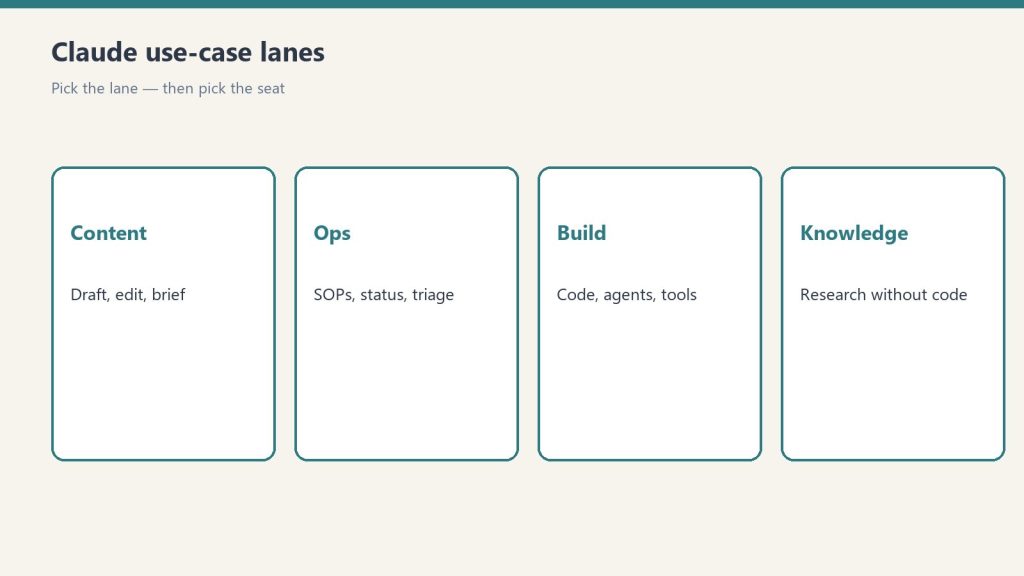
    Four cards for content, ops, build, and knowledge work with Claude
    What the 6-database command center architecture delivers.
    • Command Center Hub — One master dashboard linking every active project, client, and initiative with live status
    • Client & Project Database — Structured client records, deliverable tracking, and project timelines in one view
    • Content Pipeline — Brief-to-publish workflow with status stages, site assignment, and AI output staging
    • Knowledge Lab — Permanent storage for research, SOPs, skill documentation, and reference material
    • Operations Ledger — Decision log, session history, and change records so nothing gets lost
    • Task Triage Board — Priority-ranked action queue pulling from every database in the system

    The claude_delta Standard (What Makes This Different)

    Long paper tape measure unrolling across a desk beside a laptop, metaphor for context window length
    The claude_delta standard — what makes this different.

    Every page in this system includes a claude_delta v1.0 metadata block — a structured JSON header that gives Claude AI immediate operational context when you paste a page into a session. No re-explaining. No re-briefing. Claude reads the block and knows what it’s looking at.

    This is not something you’ll find in an Etsy template. It’s the result of running a real AI-native agency operation and discovering what actually breaks when your context window expires.

    What We Deliver

    Desk with laptop, checklist notebook, and billing card ready before creating an Anthropic API key
    What we deliver.
    ItemIncluded
    Full 6-database architecture setup in your Notion workspace✅
    claude_delta metadata standard applied to all key pages✅
    Claude AI integration guide (how to use your Second Brain in sessions)✅
    3 custom views per database (board, table, calendar)✅
    SOP templates for your top 5 recurring workflows✅
    1-hour architecture walkthrough call✅
    30-day async support for questions and adjustments✅

    What You Get vs. DIY vs. Generic Agency

    Tygart Media SetupDIY (YouTube tutorials)Generic Notion Consultant
    Built around AI-native workflows✅❌❌
    claude_delta AI context standard✅❌❌
    Multi-client agency architecture✅❌Sometimes
    Ongoing async support✅❌Extra cost
    Proven under real operational load✅UnknownUnknown

    Ready to Stop Rebuilding Your System Every 90 Days?

    Send a note describing your current setup (or lack of one) and what you’re trying to manage. We’ll tell you if this is the right fit.

    → will@tygartmedia.com

    Email only. No sales call required. No commitment to reply.

    Related on Tygart Media: second brain setup · second brain for business · Notion OS starter.

    Frequently Asked Questions

    Do I need to already use Notion?

    You need a Notion account (free works for setup, Team plan recommended for ongoing use). No prior Notion experience required — we build it around your workflows, not the other way around.

    How long does setup take?

    The architecture is built within 5 business days. The walkthrough call is scheduled in week two. Adjustments and SOP templates are completed within 30 days.

    What if I already have a Notion setup I’ve been using?

    We can audit your existing structure and either retrofit the 6-database architecture into it or rebuild cleanly. We’ll recommend one or the other after reviewing your current setup.

    Is this just a template I download?

    No. This is a custom build in your workspace. We configure databases, relations, views, formulas, and the claude_delta metadata standard to match your actual operation — clients, projects, workflows, and all.

    What industries is this built for?

    Originally built for a content and SEO agency. The architecture works for any service business running multiple clients, projects, or revenue streams simultaneously. Consultants, fractional CMOs, boutique agencies, and solo operators with complex operations are the best fit.

    Does this work with Claude, ChatGPT, or other AI tools?

    The claude_delta standard was designed for Claude. The architecture works with any AI tool — the metadata blocks and structured content make any LLM more effective when you paste pages into sessions. Claude integration is deepest out of the box.

    Last updated: April 2026

  • Port of Everett Food Trucks: 2026 Friday Video Guide

    Port of Everett Food Trucks: 2026 Friday Video Guide

    🎬 AI-generated cinematic overview  |  Powered by NotebookLM


    About This Video

    This cinematic video was automatically generated from our article Port of Everett Food Trucks: 2026 Friday Lunch Guide using Google’s NotebookLM. It provides a visual summary of the key points covered in the original piece.


    Key Segments Covered

    • What Food Truck Fridays Actually Is
    • The Port of Everett Setup
    • What Trucks Show Up
    • Also Worth Knowing: Beverly Food Truck Park
    • Tips for First-Timers at Food Truck Fridays
    • The Bigger Picture
    • The Details
    • Beverly Food Truck Park Details
    • Frequently Asked Questions

    Read the Full Article

    For the complete deep-dive with all the details, data, and analysis, read the full article on Tygart Media:

    👉 Port of Everett Food Trucks: 2026 Friday Lunch Guide →


    About Tygart Media

    Tygart Media covers the intersection of AI, technology, and digital media. We use cutting-edge tools — including AI-generated video — to make our content more accessible and engaging.

    👉 Explore more at tygartmedia.com →

  • Mt Walker Hike & Brinnon Kayaking in Hood Canal North

    Mt Walker Hike & Brinnon Kayaking in Hood Canal North

    April is the sweet spot for Mt. Walker. The gate on Forest Road 2730 reopened April 1st, the rhododendrons are budding up the slope near Quilcene, and you have a few weeks before the big May crowds arrive. It is 5 miles roundtrip with 2,050 feet of gain — this trail earns its views — but from the north summit you get an unreal look at Hood Canal and the Olympics stretching out beyond. Take US 101 south from Quilcene about 5 miles to just before milepost 300, then turn right on Mt. Walker Road. Go this week if you can. 🌿🏔️

    #HoodCanalNorth #MtWalker #OlympicPeninsula #HikingWashington #ExploreHoodCanal


    This is one of those Hood Canal North experiences people do not forget. Hood Canal Adventures in Brinnon runs Tide Pool Kayak Tours through the spring, and in mid-April you get a bonus: bald eagles are gathering in serious numbers along the canal. Some groups have spotted up to 100 in a single paddle. That is not a typo. 🦅

    Tours launch from Yelvick’s Beach in Brinnon, run about 2.5 hours, and are $105/person. Book with Christina at kayakbrinnon.com or call 360-301-6310 — spots fill fast on clear spring days.

    #BrinnonWA #HoodCanalNorth #KayakBrinnon #OlympicPeninsula #WashingtonWildlife #BaldEagle

  • North Mason Levy: How the April 28 Ballot Impacts Parents

    North Mason Levy: How the April 28 Ballot Impacts Parents

    For Mason County Parents: The North Mason School District replacement levy on the April 28, 2026 ballot passed — voters approved the district’s third attempt after failures in February and November 2025. The approved measure is a reduced ask from the two failed 2025 proposals: $18.9 million over 2027–2030 at an estimated $1.01 per $1,000 of assessed value, funding the athletics, arts, music, counseling, and after-school programs the state does not cover.

    Last refreshed: October 23, 2026 (Pacific).

    October 2026 update: The April 28, 2026 levy passed — about 53.5% yes (2,130 to 1,851), certified May 8, 2026 — at a reduced $1.01 per $1,000 rate ($18.9 million over 2027–2030), down from the $1.28 ask voters rejected twice in 2025. This page has been updated from its pre-election version.

    The April 28 Levy Vote: What It Means for Your Child’s School Year

    If your child attends school in the North Mason School District, the April 28 special election mattered directly to the school years ahead. The replacement levy funds the programs that go beyond what the state pays for — and after two levy failures, several of those programs had already been cut back. Voters approved the measure, so levy funding returns for the 2027–2030 collection years.

    Which Programs Are on the Line

    The North Mason School District replacement levy authorizes $18.9 million over 2027–2030 ($4.5 million in 2027, rising to $4.95 million in 2030) at an estimated $1.01 per $1,000 of assessed value to fund programs Washington’s basic education formula doesn’t cover:

    • Athletics: Middle school and high school sports programs
    • Arts and music: Elective programs across grade levels
    • Counseling services: School counselors providing academic and social support
    • Security staff: Campus safety personnel
    • After-school programs: Enrichment and extended day activities
    • Facilities: Community gymnasium roof replacement

    What Has Already Been Cut

    The February 2025 levy failure triggered approximately $4.5 million in budget cuts at the district. North Mason families have already seen reductions in athletics, arts, counseling staff, and after-school programming. Before the April 2026 vote, the district made a further $1.3 million in reductions and eliminated two administrative positions. A third failure would have forced cuts more severe than the 2025 reductions — the April approval avoided that outcome.

    This Is the Third Vote on This Levy

    The North Mason School District brought this replacement levy to voters in February 2025, November 2025, and again on April 28, 2026. The levy is not a new tax — it replaces an expiring measure that previously funded these same programs. The two 2025 proposals asked $1.28 per $1,000 (about $5,577,446 per year); after both failed and cuts followed, the district returned in April 2026 with the smaller $1.01 ask — and voters approved it.

    How the Vote Turned Out

    Ballots were mailed April 7, 2026, and had to be dropped at an official Mason County drop box or postmarked by April 28. Voters approved the levy with about 53.5% voting yes (2,130 to 1,851 in the reported counts), and the Mason County Canvassing Board certified the results on May 8, 2026. Certified results are posted at masoncountywa.gov; you can confirm your ballot was counted at VoteWA.gov.

    Questions about the certified results? Contact the Mason County Auditor at 360-427-9670 ext. 468.

    For full ballot and election details, see our main coverage: North Mason School District Levy: April 28 Ballot Guide. For Mason County civic news, see SR-3 Belfair Bypass Gets $48.3M & Mason County News.

    Related: North Mason School District Levy on April 28 Ballot

    Frequently Asked Questions: North Mason Levy and Mason County School Programs

    What school programs does the North Mason levy fund?

    The levy funds middle and high school athletics, arts and music programs, counseling services, security staff, after-school programs, and facilities like the community gymnasium roof — programs the state’s basic education formula does not cover.

    What happened to North Mason school programs after the levy failed?

    The February 2025 failure led to approximately $4.5 million in budget cuts across the district, reducing athletics, arts, counseling, and support staffing. The April 2026 approval means those deeper cuts were not required.

    How much does the levy cost per household?

    The approved rate is an estimated $1.01 per $1,000 of assessed property value. On a $300,000 assessed home, that is approximately $303 per year, or roughly $25 per month. (The two failed 2025 proposals had asked $1.28.)

    What were the April 28 election results?

    Initial results were released after 8 PM on April 28, 2026. Voters approved the levy with about 53.5% yes (2,130 to 1,851), and the results were certified on May 8, 2026.

    Who can vote on the North Mason School District levy?

    Registered voters within the North Mason School District boundaries — which span parts of both Mason County and Kitsap County — received ballots for this measure.

  • North Mason School Levy: Third Attempt on April 28 Ballot

    North Mason School Levy: Third Attempt on April 28 Ballot

    Civic Context: The North Mason School District replacement levy failed twice in 14 months — in February and November 2025 — and each failure deepened cuts. On April 28, 2026, voters approved the district’s third attempt, a reduced measure, restoring the funding stream for 2027–2030.

    Last refreshed: October 23, 2026 (Pacific).

    October 2026 update: The April 28, 2026 levy passed — about 53.5% yes (2,130 to 1,851), certified May 8, 2026 — at a reduced $1.01 per $1,000 rate ($18.9 million over 2027–2030), down from the $1.28 ask voters rejected twice in 2025. This page has been updated from its pre-election version.

    North Mason’s Levy Has Failed Twice. April 28 Is the Third Attempt.

    For Mason County civic watchers, the April 28 special election was more than a routine levy vote — it’s the third chapter in a policy story that has reshaped the North Mason School District over the past 14 months.

    The replacement levy failed in February 2025. It failed again in November 2025. The district cut approximately $4.5 million following the first failure. Heading into the third election, the district cut a further $1.3 million, eliminated two administrative positions, and reduced the ask to $1.01 per $1,000 — and on April 28, 2026, voters approved it, restoring the funding stream for 2027–2030.

    How Washington’s Levy System Works

    Washington state’s school funding model pays for a defined “basic education” baseline. Programs and services outside that definition — athletics, arts, music, counseling, security staff, after-school programs, certain facility needs — must be funded locally through voter-approved levies.

    Replacement levies renew expiring authorization; they are not new taxes. When voters decline to renew, the district cannot substitute other funds. The programs either operate at reduced capacity or are eliminated.

    A Chronology of the North Mason Levy Battle

    • February 2025: First vote — levy fails. District responds with $4.5 million in cuts across athletics, arts, counseling, security, and after-school programs.
    • November 2025: Second vote — levy fails again. District continues operating under reduced budget heading into the 2025–2026 school year.
    • April 28, 2026: Third attempt — a reduced ask. The measure authorized $18.9 million over 2027–2030 ($4.5 million in 2027, rising to $4.95 million in 2030) at an estimated $1.01 per $1,000 of assessed value, down from the $1.28 rate on the failed 2025 proposals (about $5,577,446 annually through 2029). Voters approved it with about 53.5% yes; results were certified May 8, 2026.

    What Makes This Pattern Unusual

    School levy failures of this duration are uncommon in Washington state. Most districts that bring replacement levies to voters see them pass on the first or second attempt. North Mason’s situation reflects a pattern of voter resistance that has emerged in several rural and semi-rural Washington communities since 2024, where skepticism about school spending levels has grown alongside property tax increases from other sources.

    The North Mason School District serves communities in both Mason County and portions of Kitsap County, meaning the vote outcome is shaped by two different county electorates.

    What Civic Watchers Should Watch For

    April 28 results were released after 8 PM, with initial returns reflecting mail-in ballots received before Election Day. The levy passed — about 53.5% yes (2,130 to 1,851) — and the Mason County Canvassing Board certified the results on May 8, 2026. With funding restored for 2027–2030, district budget discussions since then have turned to restoring the programs cut after the 2025 failures.

    Track results at masoncountywa.gov and via the Mason County Auditor at 360-427-9670 ext. 468.

    Full voter guide: North Mason School District Levy: April 28 Ballot Guide. For broader Mason County government news, see SR-3 Belfair Bypass Gets $48.3M & Mason County News.

    Related: North Mason School District Levy on April 28 Ballot

    Frequently Asked Questions: North Mason Levy History and April 28

    How many times has the North Mason levy failed?

    Twice — in February 2025 and November 2025. The April 28, 2026 vote was the third attempt — and it passed. Each prior failure led to budget cuts and program reductions across the district.

    What did the first levy failure cost the district?

    The February 2025 failure triggered approximately $4.5 million in budget cuts and staff reductions, affecting athletics, arts, music, counseling services, security staffing, and after-school programs.

    Why can’t the district use other funding to replace the levy?

    Washington state school funding has categorical restrictions. Levy revenue covers programs outside the state’s basic education formula — the district cannot legally redirect state education funds to replace voter levy revenue.

    What did the April 28, 2026 vote decide?

    Voters approved the reduced replacement levy — $18.9 million over 2027–2030 at an estimated $1.01 per $1,000 — so the additional cuts beyond the current $4.5 million level that a third failure would have required were avoided, and levy-funded programs have funding again from 2027.

    Does the district serve only Mason County voters?

    No. The North Mason School District covers portions of both Mason County and Kitsap County. The April 28 levy vote involved registered voters within district boundaries in both counties.

    Where do official Mason County election results get posted?

    The Mason County Auditor released initial results after 8 PM on Election Day, April 28, 2026, and posts certified results at masoncountywa.gov. The Auditor’s office is at 360-427-9670 ext. 468.

  • North Mason Levy 2026: Property Tax Impact Explained

    North Mason Levy 2026: Property Tax Impact Explained

    For Mason County Property Owners: The North Mason School District replacement levy on the April 28, 2026 ballot passed. The approved measure collects an estimated $1.01 per $1,000 of assessed property value — $18.9 million over 2027–2030 across the district. This is a replacement levy, not a new tax, and the rate is lower than the $1.28 ask voters rejected twice in 2025.

    Last refreshed: October 24, 2026 (Pacific).

    October 2026 update: The April 28, 2026 levy passed — about 53.5% yes (2,130 to 1,851), certified May 8, 2026 — at a reduced $1.01 per $1,000 rate ($18.9 million over 2027–2030). The $1.28 / $5,577,446-per-year figures in this page’s original version were the failed 2025 proposals, not the April 2026 measure; the numbers below are corrected.

    The North Mason Levy and Your Property Tax: What the April 28 Vote Means

    For Mason County property owners, the April 28 special election brought a concrete question: what does the North Mason School District replacement levy mean for your tax bill, and what had already changed in the district since the levy funding lapsed after the February 2025 failure? Voters answered it by approving the measure.

    The Numbers: What You Would Pay

    The approved replacement levy authorizes $18.9 million over 2027–2030 ($4.5 million in 2027, rising to $4.95 million in 2030), collected from property owners within the district. The estimated collection rate is $1.01 per $1,000 of assessed property value — reduced from the $1.28 rate (about $5,577,446 per year) on the two proposals voters rejected in 2025.

    Estimated annual cost at common Mason County assessed values:

    • $200,000: approximately $202/year ($17/month)
    • $300,000: approximately $303/year ($25/month)
    • $400,000: approximately $404/year ($34/month)
    • $500,000: approximately $505/year ($42/month)

    This is a replacement levy — it renews an expiring measure, not a new tax layer. Property owners who were paying under the previous levy see the levy continue, at the reduced rate voters approved in April 2026.

    School Quality and Property Values

    After the February 2025 levy failure and the resulting $4.5 million in cuts, the North Mason School District reduced athletics, arts, music, counseling, and after-school programs. A third consecutive failure in April 2026 would have forced further reductions — the April approval avoided that outcome, and levy funding returns for the 2027–2030 collection years.

    School district quality is consistently among the top factors prospective homebuyers evaluate when assessing a community. The relationship between school funding and residential property values is well-documented in Washington state real estate markets.

    This Is the Third Attempt

    The levy failed in February 2025 and November 2025. April 28, 2026 was the third vote on this replacement measure — the district cut a further $1.3 million, eliminated two administrative positions, and reduced the ask before returning to voters. The district operated under reduced funding after the failures, absorbing cuts to programs that levy revenue previously supported; the April 2026 approval restored the funding stream for 2027–2030.

    How the Vote Turned Out

    Ballots were mailed April 7, 2026, and had to be dropped at an official Mason County drop box (locations at masoncountywa.gov) or postmarked by April 28. Voters approved the levy with about 53.5% voting yes (2,130 to 1,851), and the Mason County Canvassing Board certified the results on May 8, 2026. Certified results are posted at masoncountywa.gov; you can confirm your ballot was counted at VoteWA.gov.

    For the full voter guide, see North Mason School District Levy on April 28 Ballot. For Mason County economic news, see Olympic Mountain Ice Cream Expands to Port of Shelton.

    Related: North Mason School District Levy: April 28 Ballot Guide

    Frequently Asked Questions: North Mason Levy and Property Taxes

    What is the North Mason School District levy rate in 2026?

    The approved rate is an estimated $1.01 per $1,000 of assessed property value, collecting $18.9 million over 2027–2030 from properties within the district boundaries. (The two failed 2025 proposals had asked $1.28 — about $5,577,446 per year.)

    Is this a new tax or a replacement?

    This is a replacement levy — it renews an expiring measure rather than creating a new obligation. Property owners within the North Mason School District were already paying under the previous levy at a comparable rate.

    Does the levy apply if my property is in Kitsap County but within the school district?

    Yes. The North Mason School District covers portions of both Mason County and Kitsap County. Property owners within the district boundaries in either county are subject to the approved levy.

    What did the April 28, 2026 levy vote decide?

    Voters approved the reduced replacement levy on April 28, 2026, so the additional cuts beyond the $4.5 million already absorbed after February 2025 — which would have affected athletics, arts, counseling, security staffing, and after-school programming — were avoided, and levy funding returns for 2027–2030.

    Where can I find Mason County drop box locations?

    Official drop box locations are listed at masoncountywa.gov. Boxes were open 24/7 through Election Day, April 28, 2026; ballots could also be mailed postmarked by April 28 or cast in person at the Mason County Auditor’s office on Election Day.

  • Mason County Forest Festival 2026: New Resident Guide

    Mason County Forest Festival 2026: New Resident Guide

    For New Mason County Residents: The Mason County Forest Festival — 82 years running — is Shelton’s defining community event. The 2026 edition ran May 28–31; if you’ve recently moved to the area, it is the fastest orientation to who Mason County is and where it came from.

    Last refreshed: October 24, 2026 (Pacific).

    October 2026 update: The 2026 Forest Festival ran May 28–31, 2026 — its 82nd year, themed “Legends of the Timber” — with the Paul Bunyan Grand Parade on Saturday, May 30. An earlier version of this page carried incorrect June 5–7 dates and the wrong edition number; both are corrected here from the festival’s official site and the City of Shelton.

    New to Mason County? The Forest Festival Is Required Attendance

    If you’ve recently moved to Mason County — whether to Shelton, Belfair, Allyn, Union, or anywhere along Hood Canal — you’ll hear about the Forest Festival before long. It’s the one event that concentrates the full character of this community into a single weekend.

    The 82nd annual Mason County Forest Festival ran May 28–31, 2026 in downtown Shelton. Here’s what it is, why it exists, and what to know to get the most out of it as someone still learning the area.

    Why This Festival Exists

    Mason County’s identity is inseparable from timber. Michael T. Simmons built the first American sawmill on Mill Creek in 1853. By the late 1800s, the Simpson Logging Company had become the economic backbone of the region, shaping not just Shelton’s economy but its physical layout — the railroad routes, the mill sites, the neighborhoods.

    The first Mason County Forest Festival was held in 1945, just after World War II, as a way to celebrate and promote the logging industry that employed much of the county. Eighty-two years later, that heritage is still honored — not as nostalgia, but as living identity. When you watch the Paul Bunyan Grand Parade move down Railroad Avenue, you’re watching a community acknowledge where it came from.

    What to Expect

    The weekend is fuller than it looks from a distance. Key events for newcomers to prioritize:

    • Paul Bunyan Grand Parade (Railroad Avenue, Saturday May 30, 11 a.m.): The centerpiece of the festival. Community organizations, bands, equestrian groups, businesses, and floats. This is where you’ll see the full cross-section of Mason County’s civic life in one place.
    • Logging Show (Loop Field): Competitive logging events in the festival’s traditional timber sports show — log rolling, axe throwing, and sawing events. Free to watch.
    • Fireworks Spectacular: The festival’s signature evening fireworks show. One of Mason County’s most-attended annual events.
    • Shelton Car Show-Off (Sunday): A quieter, community-focused way to see a different side of Shelton.

    Start early on parade day: The Goldsborough Creek Run on Saturday morning, May 30 — hours before the 11 a.m. Grand Parade — is a great way to meet neighbors. Runners check in at 2nd and Railroad, the courses start out in Shelton Valley, and every route finishes downtown on the parade route.

    How to Think About It

    For longtime residents, the Forest Festival is an annual reunion. For newcomers, it’s an orientation. The organizations that staff the booths, the businesses that sponsor the floats, the families that show up every year — this is the visible layer of Mason County’s social infrastructure. Showing up is how you start to become part of it.

    Most events are free. Bring layers — late-May evenings in Shelton can be cool. Full details at masoncountyforestfestival.com.

    For more on Shelton and Mason County’s history, see our coverage of Mason County History: Shelton & Squaxin Island Tribe.

    Related: Mason County Forest Festival 2026: Complete Event Guide

    Frequently Asked Questions: Mason County Forest Festival for New Residents

    Why is the Mason County Forest Festival significant?

    It’s Shelton’s oldest and largest annual community event — the 2026 edition was its 82nd year. The festival celebrates Mason County’s timber heritage and serves as the primary community gathering of the year, drawing residents from across the county and beyond.

    When and where is the 2026 Forest Festival?

    The 2026 festival ran May 28–31 in downtown Shelton, WA. The Paul Bunyan Grand Parade stepped off Saturday, May 30 at 11 a.m. on Railroad Avenue, and the logging show was at Loop Field.

    Are most Forest Festival events free?

    Yes — the parade, logging show, concert, and fireworks are free to attend. Carnival rides require ticket purchase. The Goldsborough Creek Run on May 30 has a registration fee.

    How do I get to Shelton from other Mason County communities?

    Shelton is the Mason County seat, accessible from Belfair and Union via SR-3, from the Hood Canal communities via US-101, and from Allyn via SR-3. The festival takes place in the downtown core near Railroad Avenue and Loop Field.

    Is there parking at the Forest Festival?

    Downtown Shelton fills up on parade and fireworks days — plan to arrive early. Check masoncountyforestfestival.com for each year’s event-specific parking information.