
The Multi-Model AI Roundtable is a three-round structured exchange where the same question is sent to three models from different lineages (typically Claude, GPT, and Gemini), cross-pollinated by sharing each model’s response with the others, and then synthesized into a final recommendation with explicit confidence calibration. Used for strategic decisions, content architecture, and technical trade-offs where single-model output isn’t trustworthy enough.
Last verified: October 11, 2026 (Pacific).
This is part of our OpenRouter coverage. See the operator’s field manual for the broader context on why we route through OpenRouter, and the 5-layer mental model for the hierarchy that makes multi-model routing tractable.
Why three models beat one
Single-model decision-making has a known failure mode: the model’s training data and reasoning patterns silently shape every recommendation. The model doesn’t know what it doesn’t know. You don’t know what it doesn’t know. You get a confident answer, you act on it, and the missing perspective shows up later as a problem you didn’t see coming.
Three models from three different lineages catch each other’s blind spots. Claude Opus 4.7 tends to over-index on safety considerations and structural rigor. GPT-5.5 tends to favor decisive, action-oriented framing. Gemini 3 Flash tends to surface edge cases and multimodal context the others gloss over. Run a hard decision past all three and the agreement-versus-disagreement pattern itself becomes information.
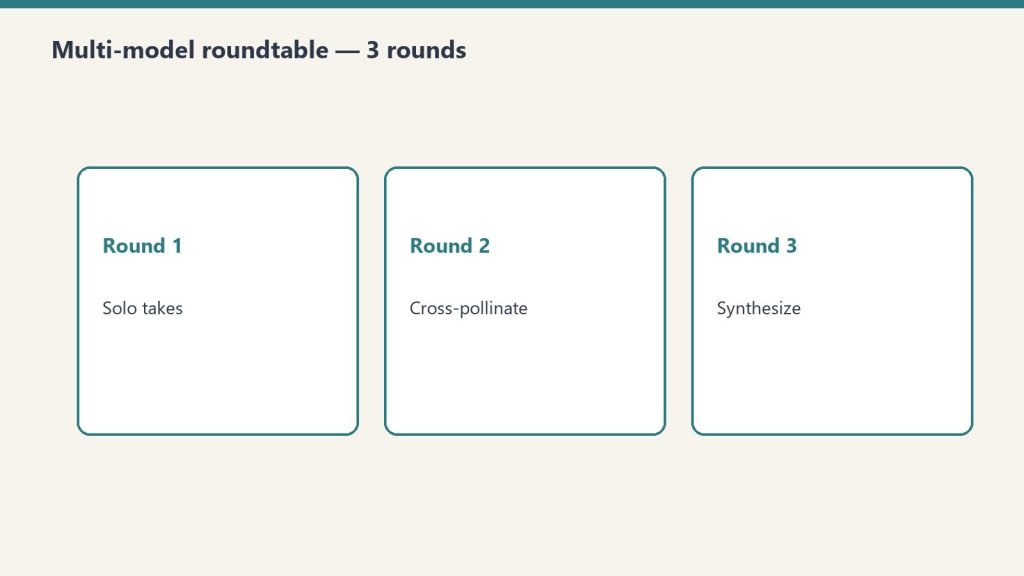
The methodology we use is a three-round structured exchange. Same question, three responses, then cross-pollination, then synthesis. Below is the exact pattern we’ve used across decisions ranging from tech stack choices to keyword prioritization to architectural calls on the autonomous behavior system.
The architecture
OpenRouter makes this cheap to wire. One API endpoint, three different model identifiers, three parallel calls:
const models = [
  "anthropic/claude-opus-4.7",
  "openai/gpt-5.5",
  "google/gemini-3-flash"
];

const responses = await Promise.all(
  models.map(model =>
    fetch("https://openrouter.ai/api/v1/chat/completions", {
      method: "POST",
      headers: {
        "Authorization": `Bearer ${OPENROUTER_API_KEY}`,
        "Content-Type": "application/json"
      },
      body: JSON.stringify({
        model,
        messages: [{ role: "user", content: prompt }]
      })
    }).then(r => r.json())
  )
);
That’s the entire architectural surface. Three calls, three responses, parallel execution. Without OpenRouter you’d be juggling three separate API contracts. With it, one endpoint and a model parameter.
Round 1: Individual perspectives
Send the same question to all three models with no awareness that they’re part of a roundtable. Each responds independently.
The prompt structure that works:
We’re evaluating [decision]. Consider:
- The key factors to weigh
- Risks and mitigations
- Your recommendation, with reasoning
- What you might be missing
The fourth bullet is the one that earns the cost of the call. Asking a model to name its own blind spots is a remarkably effective way to surface the limits of its perspective. Models that handle this prompt well will name epistemic limits explicitly: “I don’t have visibility into your team’s specific constraints,” or “this depends on factors I can’t verify from this conversation.”
Collect all three Round 1 responses. Don’t synthesize yet.
Round 2: Cross-pollination
This is where the methodology earns its keep. Send each model the other two models’ Round 1 responses and ask:
- Identify points of agreement
- Challenge or refine the other perspectives
- Update your own recommendation if warranted
Most teams skip this round. They run Round 1, see agreement, ship a decision. They miss the cases where one model would have changed its mind given the other models’ input — which is exactly the cases where the disagreement matters.
Round 2 also surfaces a pattern worth naming: model deference. Some models, when shown a different perspective, will pivot toward it almost regardless of the merits. Others hold their position too rigidly. Watching how each model handles disagreement is itself information about how to weight their inputs in future roundtables.
Round 3: Synthesis
One model — usually Claude in our case, because long-form reasoning is the job — gets all the Round 1 and Round 2 outputs and produces a final synthesis:
- Consensus points (where all three models agreed, both rounds)
- Remaining disagreements (where the models did not converge)
- Confidence level (high if convergence, medium if mixed, low if persistent disagreement)
- Suggested next steps
The confidence calibration is the part that changes how decisions actually get made. A decision the roundtable converges on with high confidence can be acted on immediately. A decision with persistent disagreement is a signal that the question is harder than it looked, and probably needs human judgment or more research before action.
When this is worth running
The roundtable is not free. Three rounds, three models, plus synthesis equals roughly four to six API calls per decision. Even at low-cost model pricing for the initial rounds, this adds up if you run it on every micro-decision.
Use it for:
- Strategic decisions — tech stack selection, business model choices, pricing strategy
- Content strategy at scale — keyword prioritization for a 50-article batch, topic cluster architecture, format decisions
- Technical architecture — system design, security posture, performance trade-offs
- Anything irreversible — moves that you’ll wear for months if they’re wrong
Don’t use it for:
- Day-to-day operational questions a single model can answer well
- Decisions where you already know the answer and just want validation
- Questions where the cost of being wrong is small
Cost shape
For an agency stack the cost-per-roundtable comes out roughly as follows when using a balanced model mix:
- Round 1: three parallel calls. Use Gemini 3 Flash or DeepSeek V3.2 for breadth at low cost. Heavier models only when you need deeper reasoning in Round 1.
- Round 2: three more calls with more context. Same models, larger context window.
- Round 3: one synthesis call. Use the best reasoning model you have access to — Claude Opus 4.7 is our default for synthesis.
Total cost per decision typically runs from a few cents to a few dollars depending on context length and model selection. For decisions worth running through the roundtable, that’s noise.
An example output
A real roundtable from our archive, on the question of where to start with Google Apps Script as a learning project:
GPT-5.5: Start simple — a Google Sheets data retrieval script. Learning value comes from working through the auth flow and basic API surface without complexity getting in the way.
Claude Opus 4.7: Start impactful — a Time Insight Dashboard combining Gmail and Calendar data. Higher learning curve but produces something you’ll actually use, which keeps motivation up.
Gemini 3 Flash: Hybrid — simple foundation but with one meaningful integration. Lowers the activation energy while preserving the impact angle.
Consensus (Round 3): Begin with a data retrieval script (all three models agree on the learning value) but include one meaningful integration like calendar events. The Round 2 cross-pollination resolved most of the disagreement; Claude moderated its position after seeing GPT-5.5’s argument about activation energy.
Confidence: High. All three models aligned on progressive complexity after cross-pollination.
That output is more useful than any single model’s recommendation would have been. It names the trade-off, shows the path to consensus, and quantifies confidence. That’s what you’re paying for.
The variations worth knowing
A few patterns we’ve adapted from the base methodology:
Adversarial roundtable. Instead of asking each model the same question, assign roles. Model A argues for. Model B argues against. Model C judges. Useful for decisions where you suspect you’ve already made up your mind.
Sequential expert chain. Skip parallel Round 1. Run one model, then send its output to the next model to refine, then to the third. Slower but useful when you need each step to build on the last.
Domain-specialized roundtable. Use BYOK to route Round 1 calls to specialty providers when the question is technical. A legal question routes through a legal-specialized provider. A code question routes through a code-specialized provider. The synthesis still happens at Claude Opus 4.7 or GPT-5.5.
The base methodology — three rounds, three models, one synthesis — is the version we run by default. The variations are for cases where the base pattern is leaving value on the table.
What this unlocks
Once the roundtable is wired into your stack, a category of decision that used to take a meeting becomes a 90-second API call. Not every meeting. The ones where you would have walked in already knowing the answer and the meeting was performative.
The roundtable doesn’t replace human judgment. It replaces the version of the decision where you didn’t think it through. The version where you would have shipped your first instinct and lived with the consequence. That’s the win.
Frequently asked questions
What is a multi-model AI roundtable?
A three-round structured exchange where the same question is sent to three AI models from different lineages, then cross-pollinated by sharing each model’s response with the others, then synthesized into a final recommendation with explicit confidence calibration. The methodology surfaces blind spots that single-model output silently hides.
Why use Claude, GPT, and Gemini together instead of just one?
Each model has different training data and reasoning patterns. Claude tends to emphasize safety and structural rigor. GPT tends to favor decisive action-oriented framing. Gemini tends to surface edge cases. Running a hard decision past all three gives you agreement-versus-disagreement information that no single model can provide.
How much does a multi-model roundtable cost per decision?
Typically a few cents to a few dollars per decision, depending on model selection and context length. Using cheaper models (Gemini Flash, DeepSeek) for the initial rounds and reserving the expensive reasoning models for Round 3 synthesis keeps the cost shape favorable.
When is the multi-model roundtable not worth running?
Skip it for day-to-day operational questions a single model can answer well, decisions where you already know the answer and just want validation, and questions where the cost of being wrong is small. Reserve it for strategic decisions, content architecture, technical trade-offs, and anything irreversible.
What is the third round of the roundtable for?
Synthesis. One model — typically the strongest reasoning model in the set — receives all the Round 1 and Round 2 outputs and produces a final recommendation with consensus points, remaining disagreements, confidence level, and suggested next steps. This is the part that turns three opinions into one actionable decision.
See also: What We Learned Querying 54 LLMs About Themselves (For $1.99 on OpenRouter)
Leave a Reply