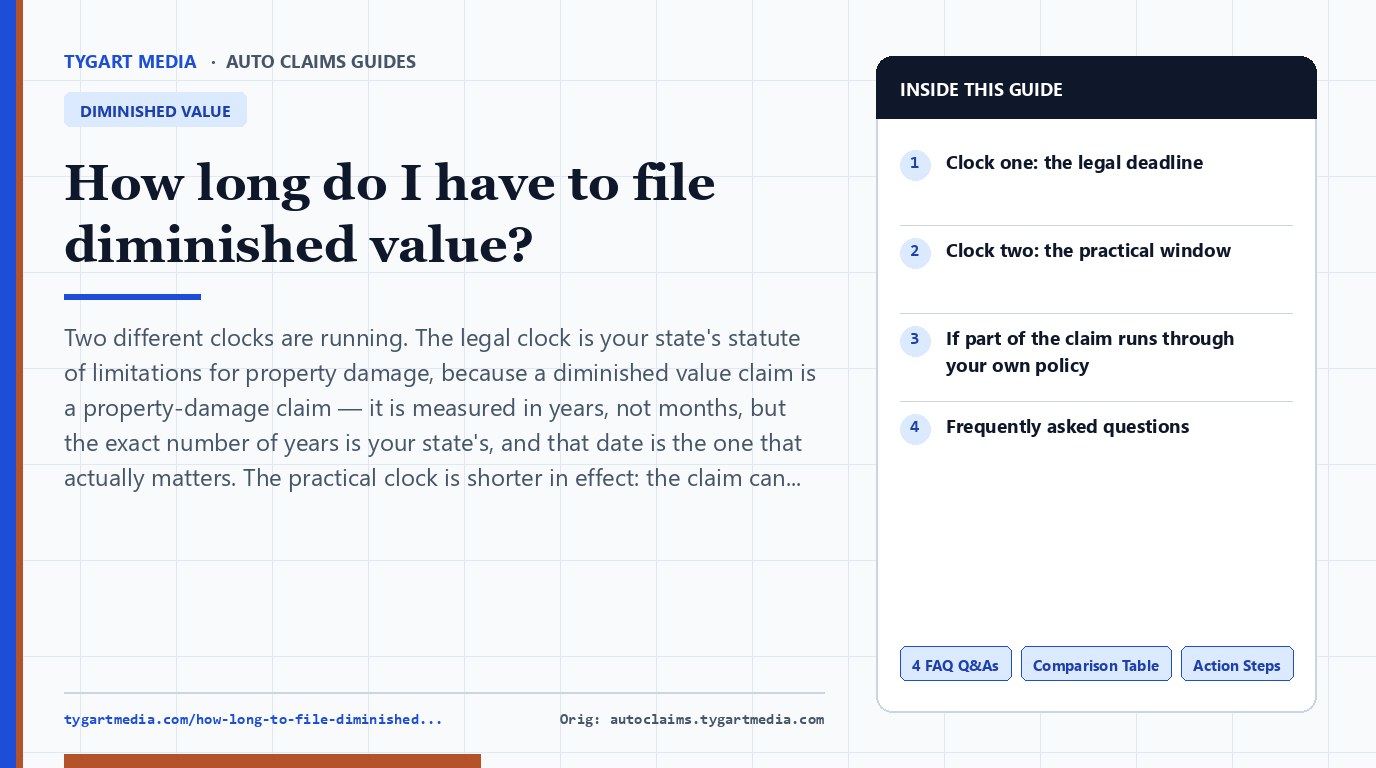
Tygart Media · Auto Claims Guides · Diminished value
Clock one: the legal deadline
A diminished value claim is, in legal terms, a claim for damage to your property — the property is the car, and the damage is the loss in its value that remains after repair. That classification decides the deadline. Property-damage claims carry a statute of limitations: a law in each state that sets the last date a claim can be brought before it is too late, no matter how strong it is.
Those deadlines are measured in years, not months or weeks. But they are not the same everywhere. Each state sets its own period for property damage, and the period that controls your claim is the one in the state whose law applies to your accident. This page deliberately does not print any state’s number, because a number read on a general guide — possibly for the wrong state, possibly out of date — is worse than no number at all. The exact figure for your state is the one date that actually matters in this whole process, and it is worth getting from a primary source.
How to find your state’s deadline
- Check your state legislature’s website. Statutes are published online. Search for your state’s statute of limitations for injury to property or damage to personal property — that is the category a diminished value claim generally falls under.
- Check your state insurance department’s website. Many departments publish plain-English summaries of claim deadlines and consumer rights. A summary is a good cross-check against the statute text.
- Use a local attorney’s published summary as a pointer, not the final word. Law firm guides often state the period plainly, but verify any figure against the statute or the insurance department before you rely on it.
One more point about clock one: it generally starts at the accident, not at the end of repairs. The legal reasoning treats the damage as happening when the crash happened, even though the size of the value loss cannot be measured until the car is fixed. Count your deadline from the accident date, and treat the repair period as time already spent on that clock.
Clock two: the practical window
The practical clock works in the opposite direction. A diminished value claim cannot be valued before repairs are complete, because nobody can say what the repaired car is worth until the repair exists. So the working sequence is fixed:
- Finish the repairs. Get the car back with the final itemized invoice and any supplements — the full repair record.
- Build the file. Gather the accident record, the repair record, the vehicle-history report showing the accident entry, and your value evidence. The full checklist is in the document guide for this claim.
- File promptly after repairs. Send the demand while the repair is recent, the records are easy to get, and the market evidence still matches the car as repaired.
Waiting years harms the claim even when the legal deadline has not passed. Comparable listings you might have used as evidence are taken down. The car keeps being driven, gains miles and wear, and may pick up new dings or even another accident, all of which blur the line between this crash and everything after it. The car may be sold, which can end your ability to claim for its lost value at all. Shops change hands, adjusters rotate, and records get harder to pull. None of that appears in any statute — it is simply evidence thinning with time, and it is the reason prompt filing matters as much as the legal date.
Get The Signal
What we actually ran, what it measured, and what it means for a restoration shop — every week, including the flops.
If part of the claim runs through your own policy
Most diminished value claims are made against the at-fault driver’s insurer, where the state statute is the governing clock. But if any part of your situation runs through your own policy — a dispute with your own insurer about the repair or the claim handling, for example — read the policy itself for deadlines. Policies can set their own contractual time limits for disputes or for bringing suit against the insurer, and a policy deadline can be shorter than the state statute. Where both clocks could apply, work to the earlier date. The policy language controls that question, and it varies by policy, so the answer is in your own documents, not in a general guide.
Frequently asked questions
When does the clock start for a diminished value claim?
Generally, the legal clock starts at the accident, not when repairs finish. Repairs affect when the loss can be valued in practice, but they usually do not move the legal start date, so do not count your time from the day you picked up the car.
Can I file diminished value after repairs are done?
Yes, in the usual case that is when the claim is filed. The car needs to be repaired before anyone can compare its value before the crash with its value after the repair, so finishing repairs first and filing promptly after is the normal sequence.
What if my own policy sets a shorter deadline?
Your policy can set its own deadline for disputes or suits when a claim runs through that policy, and that deadline can be shorter than the state deadline. Read the policy conditions and follow the shorter date if it applies to your claim.
What should I do if the deadline is close?
File or preserve the claim first and improve the evidence after. Waiting to make the file perfect can cost the whole claim if the deadline passes, so get advice promptly and put the demand in writing before the date arrives.
The two diminished value clocks, at a glance
| Clock | What starts it | What ends it | Where to check |
|---|---|---|---|
| The legal deadline | Generally, the date of the accident | Your state statute of limitations for property damage, measured in years | Your state legislature or insurance department website |
| The practical window | Completion of the repairs, when the loss can first be valued | Evidence thinning: listings vanish, the car changes or is sold | Your own claim file: file promptly after repairs finish |
| An own-policy contract deadline, if one applies | The event your policy names, often the loss or a denial | The deadline written in the policy, which can be shorter than the state period | The conditions section of your own policy |
| A deadline that is close | Your check showing little time left on the legal clock | The filing date itself: preserve first, polish evidence after | A lawyer consultation, promptly |
Get The Signal
What we actually ran, what it measured, and what it means for a restoration shop — every week, including the flops.
Leave a Reply