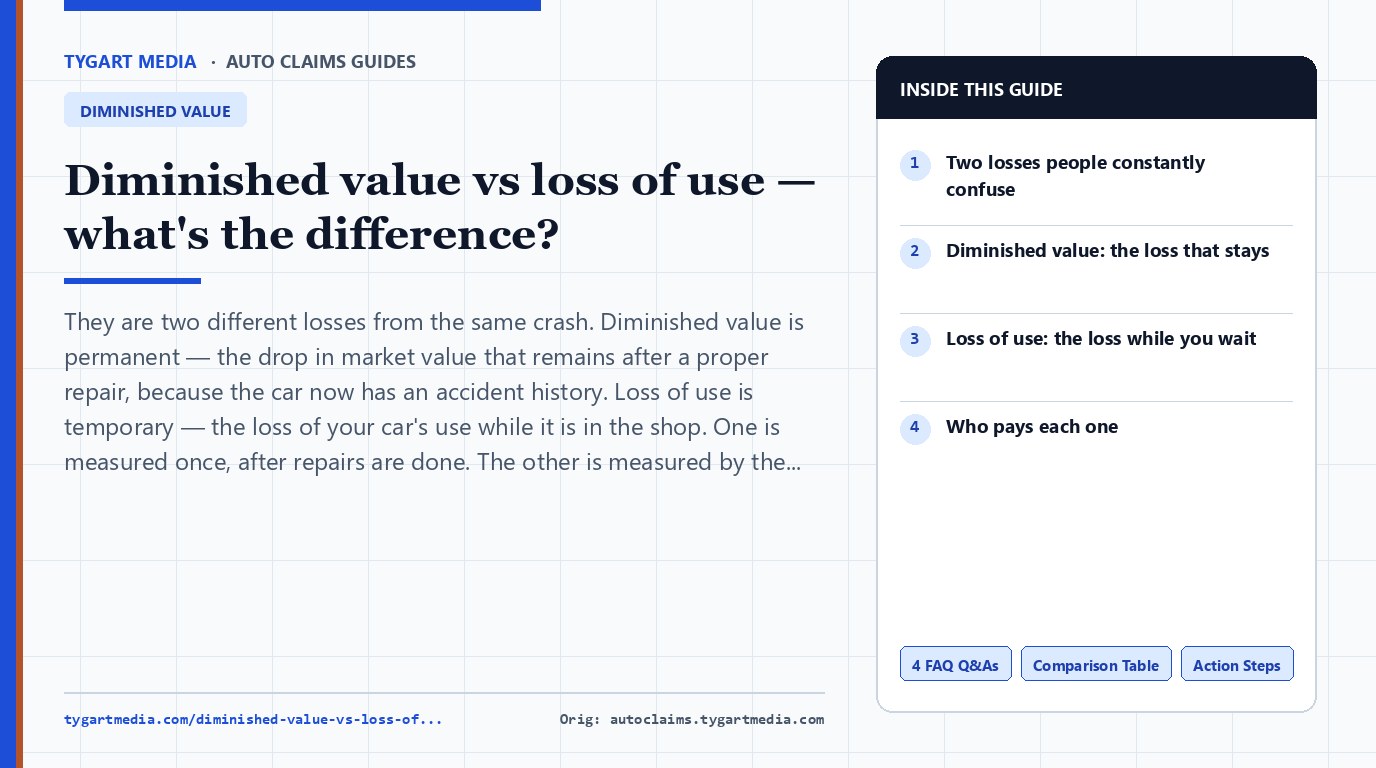
Tygart Media · Auto Claims Guides · Diminished value
Two losses people constantly confuse
Adjusters and settlement letters use both terms, sometimes in the same paragraph, and they sound alike. They are not the same claim with two names. Mix them up and you can accept payment for one thinking the other was included.
A simple way to keep them apart: loss of use asks what it cost you to be without the car while it was being fixed. Diminished value asks what the car lost, for good, because it was in a crash at all — even if the repair itself was done well.
Diminished value: the loss that stays
Diminished value is the permanent drop in what your car would sell or trade for after it has been repaired. Two otherwise identical cars sit side by side. One has a clean history. The other has a reported accident and a repair record. Buyers, dealers, and valuation tools will usually value the second car lower, even when the panels line up and the paint matches.
That gap is the loss. It is measured once, after repairs are complete, by comparing what the repaired car is worth with its accident history against what the same car would be worth with a clean history. The repair bill alone does not prove it. What helps is market evidence for your specific car — age, mileage, prior condition, and severity of damage.
A good repair does not erase the history. The loss lives in the record, not only in the metal.
Get The Signal
What we actually ran, what it measured, and what it means for a restoration shop — every week, including the flops.
Loss of use: the loss while you wait
Loss of use is the temporary loss of the car’s use while it is not drivable or is in the shop being repaired. It is measured by the day, across a reasonable repair period — not an open-ended period, and not extra days caused by delays that had nothing to do with the repair itself.
For many drivers this shows up as a rental car. For others it shows up as borrowed rides, missed shifts, or simply having no car at all. A loss of use claim can be owed even if you never rented a car, because the loss is the value of being without it, not only a receipt you paid. A rental receipt can help prove that value, but it is not the only form the loss takes. For the mechanics, see How do I get a rental car — and what is “loss of use”?
Who pays each one
Against the at-fault driver’s liability insurer, both are standard third-party claims. That insurer owes the property damage its driver caused, and both the temporary loss of use and the remaining drop in value are parts of that damage when you can prove them.
Against your own policy, the two split apart:
- Diminished value is usually excluded by the collision wording in most policies. Those policies are generally written to repair the car or pay its value, not to add a separate payment for the history that remains after a proper repair.
- Loss of use reaches you through your own policy only if you bought rental reimbursement coverage. That is an optional add-on, with its own terms, and it pays according to those terms rather than as a general loss of use claim.
So the first question is always: whose policy am I claiming against?
Can you claim both on the same crash?
Often, yes — because they cover different losses. Loss of use covers the repair window. Diminished value covers what remains after that window closes. Claiming both is not double recovery when each part is documented separately.
When you write to the insurer, name them as separate elements of loss, each with its own evidence. Two clearly labeled losses are harder to brush aside than a vague demand for extra money.
Timing is the other difference
- During repairs: loss of use accrues. Keep rental records if you rent, notes if you do not, and the shop timeline showing when the car went in and when it was ready.
- After repairs are complete: diminished value is assessed. Only then can the finished repair and the car’s current market position be compared against a clean-history value.
- Before you settle: check that any release you sign does not quietly close both claims when you only meant to settle one. Read what the payment is described as covering.
Frequently asked questions
Can I claim both diminished value and loss of use for the same crash?
Yes, often, because they cover different losses. Loss of use covers the time you were without the car during repairs. Diminished value covers the drop in market value that remains after repairs are complete. You cannot collect twice for the same loss, so keep each claim separate and document each one on its own terms.
Can I get loss of use if I never rented a car?
In many third party claims, yes. Loss of use is the value of being without your car for a reasonable repair period, not only a rental bill you paid. A rental receipt helps prove the value, but the claim does not always depend on having rented. Your own policy is different and usually pays only through rental reimbursement coverage you bought.
Does my own collision coverage pay diminished value?
Usually not. Most collision policies are written to repair the car or pay its value, and that wording is commonly read to exclude a separate payment for diminished value after a proper repair. Georgia is the well known exception on first party claims. Check your own policy wording and your state insurance department for the rule that applies to you.
When is diminished value measured?
After repairs are complete. That is when you can compare what the repaired car is worth with an accident history against what the same car would be worth with a clean history. Loss of use is measured the other way, by the day, across the reasonable time the car was in the shop or not drivable.
Diminished value and loss of use, at a glance
| Aspect | The difference |
|---|---|
| What it is | Diminished value is the permanent drop in market value after repair. Loss of use is the temporary loss of the car while it is in the shop. |
| When it is measured | Diminished value is measured once, after repairs are complete. Loss of use is measured by the day, across a reasonable repair period. |
| Who typically pays | Against the at-fault driver, both are third party claims. Against your own policy, diminished value is usually excluded and loss of use depends on rental reimbursement coverage you bought. |
| How it is proven | Diminished value needs market evidence for the repaired car versus a clean history value. Loss of use needs a repair timeline and evidence of the days you were without the car. |
Get The Signal
What we actually ran, what it measured, and what it means for a restoration shop — every week, including the flops.
Leave a Reply