An AI citation is not a click. A click is not a conversion. The funnel from “Copilot cited your site” to “a new client signed up” has multiple stages, each with its own drop-off rate. Most content strategists celebrate citations without measuring what those citations actually produce. After tracking the full funnel across the sites I manage — including the 98,800 Copilot citations — here’s what the AI search funnel actually looks like.
The 4-Stage AI Search Funnel
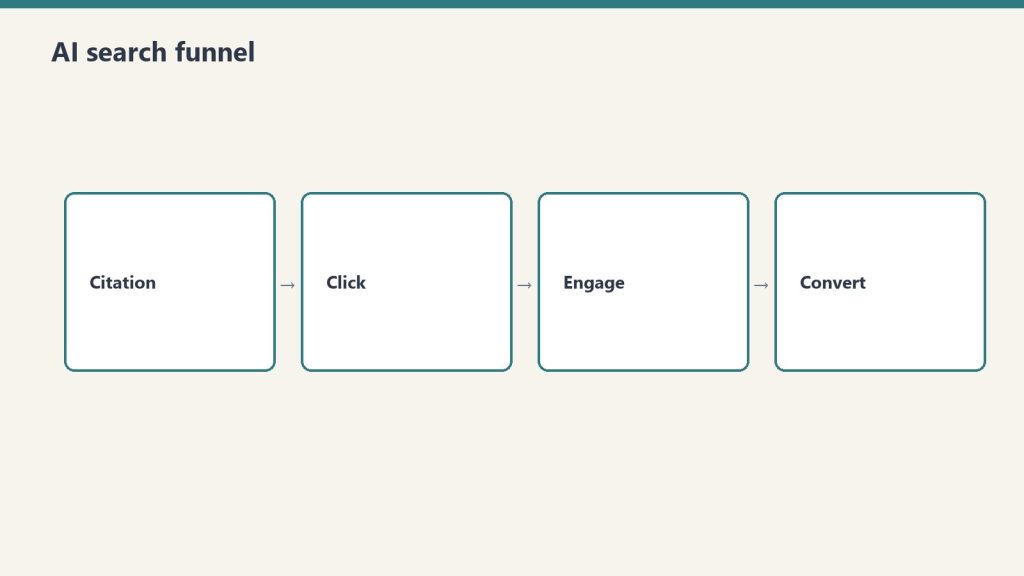
Every AI search interaction follows a predictable funnel, regardless of platform:
- Impression: Your content appears as a citation, source link, or referenced domain in an AI response
- Click: The user clicks through to your actual website
- Engagement: The user reads, browses, or interacts with your site
- Conversion: The user takes a desired action — fills a form, makes a purchase, subscribes, contacts you
Each stage has dramatically different metrics depending on which AI platform generated the impression.
Stage 1: The Citation (Impression)

Not all citations are equal. The platform determines how visible your citation is to the user:
| Platform | Citation Visibility | User Citation Awareness |
|---|---|---|
| Perplexity | Inline numbered citations — highly visible | High — users actively check sources |
| Copilot | Footnote-style references | Low — most users don’t expand footnotes |
| Google AI Overviews | Small source chips below the overview | Low to moderate — depends on query |
| ChatGPT Search | End-of-response source links | Moderate — users notice but rarely click |
| Gemini | Expandable source section | Low — embedded Workspace users ignore citations |
| Claude | No native web citations (as of mid-2026) | N/A — influence is indirect through training |
The implication: a Perplexity citation has fundamentally higher click-through potential than a Copilot citation because the user actually sees and engages with the source attribution.
Stage 2: The Click-Through
Click-through rates from AI citations vary dramatically by platform. Based on the data I’ve tracked across managed sites:
Perplexity Click-Through
Perplexity has the highest click-through rate of any AI platform because its users are researchers who verify sources. When Perplexity cites your content with an inline [1] reference, a meaningful percentage of users click through to read the source. The click-through rate from Perplexity citations substantially exceeds what we see from Copilot or Google AI Overviews.
Google AI Overview Click-Through
Google AI Overviews present the biggest challenge: the overview often satisfies the user’s query completely, eliminating the need to click. The click-through from AI Overview citations to the cited source is significantly lower than traditional organic search. This is the zero-click problem at scale.
Copilot Click-Through
Copilot has the lowest click-through rate because the user is mid-workflow and the answer is consumed within the Microsoft 365 application. The user got what they needed without leaving Word or Excel. The citation exists in a footnote they never expand. From 98,800 citations, the actual click-through volume is a fraction of what that impression number suggests.
ChatGPT Click-Through
ChatGPT Search places source links at the end of responses. Users in conversation mode sometimes click these links, especially when the topic requires deeper reading. Click-through rates are moderate — between Perplexity’s high engagement and Copilot’s near-zero engagement.
Stage 3: Engagement Quality
Here’s where AI-sourced traffic gets interesting. Users who click through from AI platforms tend to be more engaged than average organic visitors because they’ve already been pre-qualified by the AI’s response. They clicked because the AI’s summary wasn’t enough — they want more depth.
The engagement pattern by platform:
- Perplexity referrals: Longest time on page. These users arrived because they’re researching and the AI response prompted them to go deeper. They read, they bookmark, they follow internal links
- ChatGPT referrals: Above-average engagement. The conversational context means they arrive with specific questions the article can answer
- Google AI Overview referrals: Mixed. Some users click because the overview was incomplete. Others misclick. Bounce rates are higher than other AI referral sources
- Copilot referrals: The rare users who do click through from Copilot are highly engaged — they specifically sought out the source, which signals strong intent
Stage 4: Conversion
The final stage is where AI search traffic’s value becomes concrete. Conversion rates from AI referrals depend heavily on two factors: the quality of the pre-qualification (how well the AI response set expectations) and the alignment between the AI’s citation context and your conversion path.
AI Traffic vs Google Organic: The Conversion Comparison
AI-sourced traffic converts differently than Google organic traffic. Google organic users arrive with search intent that maps directly to your content. AI-sourced users arrive because an AI cited you while answering a broader question — the intent alignment is less precise but the trust transfer from the AI platform can compensate.
The net effect in the data I’ve tracked: AI referral traffic converts at rates comparable to Google organic for informational-to-contact funnels (content marketing → lead gen). It converts lower for direct commercial queries where Google organic’s intent-matching advantage matters more.
Where the Funnel Leaks (And How to Fix It)
Leak 1: Citation Without Click
Problem: Copilot and Google AI Overviews generate thousands of citations that produce minimal clicks.
Fix: Treat these citations as brand impressions, not traffic sources. Measure brand recognition lift and branded search volume increases alongside click-through.
Leak 2: Click Without Engagement
Problem: Users click through from AI but bounce because the landing page doesn’t match the context of the AI’s citation.
Fix: Ensure the specific section cited by the AI is prominent on the page. Use in-page anchors and clear section headers so arriving users immediately see the content that prompted their click.
Leak 3: Engagement Without Conversion
Problem: Users read the content but don’t convert because there’s no conversion path within the content flow.
Fix: Embed contextual CTAs within the article body, not just at the bottom. If the AI cited your pricing comparison, the CTA should be adjacent to the pricing content, not after 2,000 more words.
Actionable Takeaways
- Measure the full funnel, not just citations. Track impression → click → engagement → conversion for each AI platform separately
- Treat low-CTR platforms as brand channels. Copilot’s 98,800 citations are brand impressions even if few users click through. Measure branded search lift
- Optimize landing pages for AI referral context. Users arrive mid-thought. Make the cited content immediately visible
- Embed conversion paths within content. Contextual CTAs near the sections most likely to be cited by AI platforms
- Prioritize Perplexity for traffic, Copilot for brand awareness. Different platforms serve different funnel stages
FAQ
What percentage of AI citations result in actual website clicks?
It varies dramatically by platform. Perplexity citations generate the highest click-through because its users actively verify sources. Copilot citations generate the lowest because users consume answers within Microsoft 365 without expanding footnotes. Google AI Overview and ChatGPT fall between these extremes.
Is AI search traffic better or worse than Google organic for conversions?
AI referral traffic converts at rates comparable to Google organic for informational-to-contact funnels. It converts lower for direct commercial queries where Google’s intent-matching advantage is stronger. The quality of pre-qualification from AI responses can compensate for less precise intent alignment.
How should I measure the value of AI citations that don’t generate clicks?
Treat low-click-through citations as brand impressions. Track branded search volume increases, direct traffic growth, and brand recognition metrics. A user who sees your domain cited by Copilot daily may eventually search for you directly.
Which AI platform sends the highest quality traffic?
Perplexity referrals consistently show the longest time on page and lowest bounce rates because these users are researchers who clicked through specifically to go deeper. Copilot referrals, while rare, also show strong engagement because the user actively sought out the source.
Where does the AI search funnel leak the most?
The biggest leak is citation-without-click, particularly on Copilot and Google AI Overviews. The second biggest leak is click-without-engagement, caused by landing page misalignment with the AI citation context. Embedding contextual CTAs and ensuring cited sections are prominent addresses both leaks.
Related on Tygart Media: AI citation economy · how AI engines cite · GEO tactics.
Leave a Reply