Tag: Thought Leadership

  • Bespoke AI Solutions: Why Tech Needs a Digital Tailor

    Bespoke AI Solutions: Why Tech Needs a Digital Tailor

    Tygart Media Strategy
    Volume Ⅰ · Issue 04Quarterly Position
    By Will Tygart
    • Long-form Position
    • Practitioner-grade

    There’s a moment in every fitting room that has nothing to do with fabric.

    The tailor doesn’t ask what color you want. Not yet. First, they ask where you’re going. Who will be in the room. Whether you’ll be standing all night or seated at a table. Whether this is the kind of event where people remember what you wore — or the kind where they remember what you said.

    The clothes come last. The understanding comes first.

    I’ve been building AI systems for businesses for the past two years, and I’ve started to realize that what I actually do has very little to do with technology. The job that’s emerging — the one that doesn’t have a name yet — looks a lot more like a Savile Row fitting than a software deployment.

    (more…)

  • Fast Pivot: How AI Compresses the Experience Curve

    Fast Pivot: How AI Compresses the Experience Curve

    Tygart Media / Content Strategy
    The Practitioner JournalField Notes
    By Will Tygart
    · Practitioner-grade
    · From the workbench

    Fifth in a series I did not plan and now apparently cannot stop. The previous four pieces walked through productizing the Tygart Media context layer, the dual-publish pattern, articles as infrastructure, and the naming question for the eventual product. This piece is about what happened when I read my own first article a few hours after publishing it and quietly killed the entire idea I had been planning to build.

    The Moment

    Two days ago I had an idea for a product. I had Claude help me think it through. We wrote a 3,000-word article about it, published it, and I felt good about it. The idea was real. The market analysis was solid. The recommended path was a clean-room knowledge base eventually packaged as a context-as-a-service API for other operators. I had a name for it. I had a phase plan. I was ready to start building.

    Then I went back and read my own article a few hours later. And I got to the section where Claude had laid out the existing competitors — Mem0 with its $24M Series A, Letta with its OS-inspired memory architecture, Zep with its temporal knowledge graphs, Hindsight with its open MIT license, SuperMemory with its generous free tier, LangMem for the LangGraph crowd. Six serious products. Some of them well-funded. All of them solving the technical layer of the thing I was about to spend months building from scratch.

    And the obvious thought arrived, the way obvious thoughts always arrive, late: why am I building this?

    The thing I cared about was the knowledge. The opinionated, accumulated, hard-won-from-running-27-client-sites operational wisdom. The stuff that makes my Claude work better than a fresh Claude. The stuff that — if you stripped it out of my Notion and exposed it via an API — would actually be valuable to other operators. That was the product. That was always the product.

    The infrastructure to serve that knowledge — vector storage, retrieval, embeddings, rate limiting, billing, SDKs, documentation, an API gateway — was not the product. That was just the delivery mechanism. And the delivery mechanism already existed, six different ways, built by teams with more engineers and more funding than I will ever have.

    I had been planning to build the entire stack. I should have been planning to bolt onto the existing stack. Pour my knowledge into Mem0 or Hindsight or whichever one fit best, configure it the way Tygart Media would configure it, and ship something in a week instead of a quarter. The product is the knowledge. The plumbing is somebody else’s problem and somebody else has already solved it.

    That is the pivot. It happened in about thirty seconds, in the middle of a chair, while reading my own article on my own website. The original idea died. A better one took its place.

    What Actually Happened in Those Thirty Seconds

    I want to slow this moment down because the mechanics of it are the actual point of this article. The pivot itself is mundane — operators pivot all the time. The interesting thing is how the pivot happened, and how fast, and what made it possible.

    Until very recently, the path from “I have an idea” to “I have decided to pivot off that idea” looked something like this. You have the idea. You sit with it for a few weeks. You sketch a business plan. You talk to a few people. You start building a prototype. You spend three months on the prototype. You discover the market is more crowded than you thought. You spend another month convincing yourself you can still differentiate. You spend a fourth month watching adoption fail to materialize. You finally admit the idea was wrong. You pivot — but now you have four months of sunk cost, an obsolete prototype, and a head full of bias toward the dead idea.

    That is the old shape of pivoting. It is expensive and slow and emotionally brutal because by the time you pivot, you have invested too much to think clearly about it.

    The new shape — the one that just happened to me — is different. Idea arrives. AI helps you model the entire business in a single evening. You publish the model as an article. A few hours later you re-read the article with fresh eyes, see what your past self missed, and pivot. Total elapsed time: less than 48 hours. Sunk cost: zero, except for some Claude tokens and a Notion page. Emotional attachment: minimal, because you haven’t invested enough to be attached.

    The thing AI did here was not “have the idea.” I had the idea. The thing AI did was compress the experience curve so violently that I got the wisdom of having explored the idea for months in the time it takes to write and read a long article. And the wisdom is what made the pivot possible.

    Compressed Experience Is the Actual Superpower

    This is the part that I think is genuinely new and worth taking seriously.

    For all of human business history, the only way to learn whether an idea was good was to do the idea. You had to actually build the thing, actually try to sell it, actually watch customers respond or fail to respond. Experience was something you could only acquire by spending time, money, and reputation. The cost of experience was the entire point of why most people never started anything — the price tag on finding out whether an idea worked was usually higher than they could afford to pay.

    What is happening now is that AI lets you simulate the experience curve cheaply enough that you can run an idea all the way to its likely outcome before you commit to building it. Not perfectly. Not completely. The simulation is missing things — you cannot simulate the actual conversations with actual customers, you cannot simulate the surprise that comes from a market doing something nobody predicted, you cannot simulate the slow grind of operations. But you can simulate enough to catch the obvious failures. You can simulate enough to notice that your idea has been built six times already by better-funded teams. You can simulate enough to realize that what you actually wanted was not the thing you were planning to build.

    The article I published two days ago was, functionally, a months-long thought experiment compressed into a single evening. It surveyed the market. It modeled the economics. It anticipated the scrubbing problem and the liability problem. It talked itself into a clean-room architecture and a phase plan. By the time I finished reading it, I had effectively done a quarter’s worth of strategic exploration in a few hours.

    And then — this is the part that matters — the simulation produced enough genuine insight that I could act on it. The pivot was not based on intuition. It was based on having actually thought through the idea in enough depth to see where it broke. The thinking-through was the experience. The experience was what made the pivot reasonable instead of flighty.

    This is not the same thing as actually having spent years running the business. There are things you only learn by running the business that no amount of simulation can produce. But the simulation is good enough to catch the largest and most embarrassing mistakes — the ones that would otherwise eat months of runway before you noticed them. And catching the largest mistakes early is most of what good entrepreneurial judgment actually is.

    The Accidental Customer Discovery

    Here is the second strange thing that happened in those thirty seconds. While I was sitting there realizing I should bolt onto an existing memory layer instead of building one, I also realized something else: I had just done customer discovery on myself.

    I had spent two days designing a product for a hypothetical other operator who wanted to plug a curated context layer into their AI workflow. I had thought carefully about what they would need, how they would use it, what would make them pay, what would make them churn. And then in the middle of all that thinking, I noticed that I was the customer. I was the person who needed a curated context layer plugged into my AI workflow. I had been describing my own needs the whole time and pretending they belonged to someone else.

    This is a pattern I think happens more often than people admit. You have a need. The need is not clearly visible to you because you have been working around it for so long that the workaround feels like just how things are. You start trying to design a product for somebody else, and the act of designing forces you to articulate the need clearly enough to recognize it — and then you realize the somebody-else was you the whole time. The product was a mirror. You were doing customer discovery on yourself by pretending to do it for a stranger.

    The pivot, then, is not just “buy instead of build.” It is “buy instead of build, because the customer for the bought thing is me, and the time saved by not building gets spent on the next-order thing I actually want to make.” The freed energy is the prize. The freed energy is what makes the pivot worth celebrating instead of mourning.

    What the Freed Energy Buys

    Every hour I do not spend building an API gateway and configuring a vector store and writing SDK documentation is an hour I can spend on the thing that actually matters: the knowledge layer itself, and the next idea sitting one step further out that I have not yet articulated.

    This is the part that most “build vs buy” discussions get wrong. The decision is usually framed as a tradeoff between control (build) and speed (buy). That framing misses the more important variable, which is what you do with the time you don’t spend building. If the time gets reabsorbed into operations or wasted on Twitter, then yes, build vs buy is just a control-vs-speed tradeoff. But if the time gets reinvested in something further up the value chain, then buy is not a compromise. Buy is leverage. Every hour saved on plumbing is an hour available for something nobody else can do.

    The knowledge that would have gone into “Will’s Second Brain as an API” can now go into a Mem0 instance configured in a specific way. That takes a week. The remaining eleven weeks of the original quarter are now available for whatever the next idea turns out to be. And the next idea will be better than the first one, because the first one already taught me something — through simulation, through writing, through reading my own writing back — that I could not have known before I tried to model it.

    The pivot is not retreat. It is acceleration. The original idea served its purpose by being thought through in enough detail to teach me what I actually needed. Now I get to use that lesson on a problem I could not have started with, because I would not have known the problem existed until I tried to solve a different one.

    The Counter-Argument I Should Make Honestly

    This whole framing has a failure mode and I want to name it before someone in the comments does.

    The failure mode is chronic pivoting. The same compression that lets you escape a bad idea fast also lets you escape a good idea fast, if you mistake the friction of doing real work for the friction of having picked the wrong thing. AI-assisted simulation is great at telling you when an idea is structurally broken. It is not great at telling you when an idea is structurally fine but is going to require a year of unglamorous grinding before it pays off. The two failure modes look similar from the inside. Both feel like “this is harder than I thought.” The difference is that one of them resolves itself if you keep going and the other one does not. And the simulation cannot reliably tell you which one you are in.

    If you get good at fast pivots, you can pivot yourself into oblivion. Every idea you start gets killed at the first sign of difficulty, because the cost of pivoting is now so low that pivoting becomes the path of least resistance. You end up with a graveyard of half-explored ideas and no shipped product.

    The defense against this is, awkwardly, commitment. You have to be willing to keep going on something even when the simulation says it might not work, because some ideas only work for people who refused to listen to the simulation. Most of the famous companies of the last twenty years were ideas that any reasonable simulation would have killed. AirBnB, strangers sleeping in strangers’ beds. Stripe, online payments in a market that already had PayPal. Notion, a productivity app in a category dominated by Microsoft. The simulations would have correctly identified those as “already done” or “structurally hard” and the founders would have correctly pivoted away if they trusted the simulations too much.

    So the right discipline is not “always trust the simulation.” It is “trust the simulation when it tells you the idea is redundant, but be skeptical when it tells you the idea is hard.” Redundancy is a real signal. Difficulty is just the price of doing anything worth doing.

    In my case, the simulation correctly identified redundancy. There are six funded teams already shipping the technical layer of the thing I was about to build. Pivoting off that is not chronic pivoting. It is reading the room. The test is whether the next idea I commit to gets the same fast-pivot treatment at the first sign of difficulty, or whether I commit to it long enough for the difficulty to actually mean something. Time will tell.

    The Larger Pattern

    If I zoom out from my specific situation, the pattern looks like this:

    Old entrepreneurship: Have an idea. Spend years building it. Discover during construction whether the idea was good. Most ideas turn out to be bad and most builders go down with their ideas because they cannot afford to have spent years on nothing.

    New entrepreneurship: Have an idea. Spend an evening modeling it in collaboration with AI. Read the model back. Either commit (rare) or pivot (common). The pivots are not failures because the cost of finding out was low enough that you can pivot ten times in a quarter and still have most of your runway. The commits are stronger because they survived a real model of the alternative.

    The result is not that fewer products get built. The result is that the products that get built are better, because the bad ones got killed during the modeling phase instead of during the construction phase. The kill rate is the same. The kill cost is different by orders of magnitude.

    And the secondary result, the one I am still digesting, is that the act of modeling the idea well enough to kill it is itself a form of compressed experience. You come out of the modeling phase having learned things you could not have learned without doing the modeling. Those lessons travel. The next idea is informed by the previous idea even though you never built the previous idea. The experience is real even though the experience is simulated.

    In thirty years of business writing, “fail fast” has been one of the most quoted and least practiced pieces of advice. The reason it was rarely practiced is that failing fast was never actually fast. It just meant failing in eighteen months instead of three years. AI is the first tool I have used that makes failing fast actually fast — fast enough that the failure does not hurt, fast enough that the lessons are still vivid when the next idea arrives, fast enough that pivoting feels like progress instead of defeat.

    That changes the math on starting things. It might even change the math on who gets to start things. The old math required either capital or stubbornness, because you needed enough of one to survive the slow failures. The new math requires neither. You need an idea, an evening, and the willingness to be honest with yourself about what your own writing is telling you when you read it back.

    The Practical Move

    I am going to bolt onto Mem0 or Hindsight or whichever existing memory layer best fits the shape of what Tygart Media needs. The decision between them is a half-day of testing, not a half-quarter of building. The freed energy goes into the actual knowledge layer — the patterns, the conventions, the operational wisdom — which is the part nobody else can replicate because nobody else has run my client roster.

    The “Where There’s a Will, There’s a Way” naming might still be the right name. Or it might be the wrong name now that the product is “Tygart Media’s accumulated wisdom layered on top of Mem0” instead of “Tygart Media’s accumulated wisdom served by a Tygart Media-built API.” That is a question for next week. The naming does not matter until the bolt-on is configured and tested.

    And the next idea — the one I have not yet articulated, the one that gets to use the freed twelve weeks — is the one I should actually be thinking about. The dead idea was the warm-up. The pivot is the real start.


    Knowledge Node Notes

    Structured residue for future retrieval.

    Core Claim

    AI compresses the experience curve so violently that you can simulate months of strategic exploration in a single evening. The simulation is good enough to catch the largest mistakes — including “this is already built six times by better-funded teams” — before you commit to building anything. The right response to that signal is to bolt onto the existing thing and redirect freed energy to the next-order idea, which will be better because the dead idea taught you something through simulation that you could not have known any other way.

    The Pivot Moment

    1. Two days ago: had an idea for a product (Will’s Second Brain as an API)
    2. Spent an evening modeling it with Claude → published as article
    3. Few hours later: re-read own article, hit the section listing Mem0/Letta/Zep/Hindsight/SuperMemory/LangMem
    4. Realized: the technical layer is already built six ways. I was about to rebuild what existed.
    5. Realized: the value is the knowledge, not the plumbing. Bolt onto existing memory layer, ship in a week instead of a quarter.
    6. Pivot took ~30 seconds. Sunk cost: a Notion page and some Claude tokens.

    The Old Shape vs The New Shape of Pivoting

    Old Pivot New Pivot
    Time from idea to pivot 4-12 months 24-48 hours
    Sunk cost at pivot point Prototype + opportunity cost Tokens + a Notion page
    Emotional attachment High (months invested) Low (no real investment)
    Quality of pivot decision Distorted by sunk cost bias Clean-eyed
    Lessons retained Buried in failure trauma Vivid and immediately applicable

    Compressed Experience Is the Actual Superpower

    The thing AI does is not “have the idea.” It is compress the experience curve. Months of strategic exploration get crammed into hours. The simulation is not perfect — it misses real customer surprise, real operational grind, real market weirdness — but it catches the largest and most embarrassing mistakes, which is most of what good entrepreneurial judgment actually is.

    This was impossible until very recently. For all of business history, learning whether an idea was good required doing the idea. The cost of experience was the entire reason most people never started anything. AI is the first tool that lets you simulate the experience cheaply enough that the simulation itself becomes a form of strategy.

    Accidental Customer Discovery

    Designed a product for a hypothetical other operator → realized halfway through that I AM the operator. Was doing customer discovery on myself by pretending to do it for a stranger.

    Pattern: needs that you have been working around for years are invisible to you. The act of designing a product for someone else forces you to articulate the need clearly enough to recognize it as your own. The product is a mirror. You are the customer.

    The Build vs Buy Reframing

    Standard framing: build = control, buy = speed. Tradeoff between two virtues.

    Better framing: the variable that matters is what you do with the time you don’t spend building. If the freed time gets reabsorbed into operations, build vs buy is just control vs speed. If the freed time gets reinvested further up the value chain, **buy is not a compromise — buy is leverage.** Every hour saved on plumbing is an hour available for something nobody else can do.

    The Failure Mode: Chronic Pivoting

    The same compression that lets you escape a bad idea fast also lets you escape a good idea fast, if you mistake “this is hard” for “this is wrong.” AI simulation is good at detecting redundancy. It is not good at detecting whether difficulty is the kind that resolves with grinding or the kind that doesn’t. Both feel the same from the inside.

    The discipline: trust the simulation when it tells you the idea is redundant. Be skeptical when it tells you the idea is hard. Difficulty is the price of doing anything worth doing. Most of the famous companies of the last 20 years would have been killed by a reasonable simulation (AirBnB, Stripe, Notion). The founders correctly ignored the simulation. The lesson is not “always pivot fast” — it is “pivot fast away from redundancy, commit hard through difficulty.”

    The Larger Pattern

    Old entrepreneurship: have idea → spend years building → discover during construction whether idea was good → most ideas were bad, most builders go down with them.

    New entrepreneurship: have idea → spend evening modeling with AI → read model back → commit (rare) or pivot (common) → freed energy goes to next idea, which is better because previous idea taught you something through simulation.

    Same kill rate as before. Different kill cost by orders of magnitude.

    “Fail fast” has been quoted for thirty years and rarely practiced because failing fast was never actually fast. AI makes failing fast actually fast.

    What This Means for Tygart Media’s Product Plan

    • Killed: Building a Tygart Media-owned context API from scratch
    • Adopted: Bolt onto Mem0 / Hindsight / whichever existing memory layer fits best after a half-day of testing
    • Saved: ~11 weeks of the original quarter that would have gone to plumbing
    • Reinvested into: The actual knowledge layer (patterns, conventions, operational wisdom) — the part nobody else can replicate
    • Open question: Does “Where There’s a Will, There’s a Way” still work as a name now that the product is “Tygart Media wisdom on top of Mem0” rather than “Tygart Media-built API”? Decide next week after the bolt-on is configured.
    • Bigger open question: What is the next idea — the one that gets the freed twelve weeks?

    Connection to the Series

    Article Question Answer (At Time of Writing)
    1. Second Brain as API Could we sell our context? Yes, with clean room + legal stack
    2. Dual Publish How does the context get built? Every article = deposit in two places
    3. Articles as Infrastructure What ARE the deposits? Infrastructure being minted
    4. Where There’s a Will What do we name the product? “The Way,” with a Phase 2 abstraction plan
    5. The Pivot (this one) Should we even build the product we just designed? No. Bolt onto an existing one. The freed energy buys the next idea.

    The series is itself an example of its own thesis. Article 5 only exists because Article 1 was written, published, and re-read. The dual-publish pattern (Article 2) made the re-reading possible. The infrastructure framing (Article 3) made the deposits durable enough to come back to. The naming question (Article 4) was the last gasp of the original plan. Article 5 is the pivot off all of it. The series is a five-act play in which the protagonist designs a product, slowly realizes the product is a mirror, and pivots in real time on the page.

    The Meta-Lesson

    The trilogy-turned-quintet itself is an artifact of the new shape of pivoting. Five articles, four days, total cost approaching zero, total value approaching “I know exactly what to do next and exactly what not to build.” This kind of compressed strategic exploration was not possible two years ago. It is possible now. It is going to be the default in two more years. The operators who learn to use it get to make ten honest attempts in the time it used to take to make one.

    Action Items

    • [ ] Test Mem0, Hindsight, and one other memory layer head-to-head on the same Tygart Media knowledge sample. Half-day max.
    • [ ] Pick one. Configure it. Load the clean-room version of the knowledge layer.
    • [ ] Decide if “the Way” still fits the bolted-on product or needs a different framing
    • [ ] Schedule a “what is the next idea” thinking session for next week — protect the freed twelve weeks from getting reabsorbed into operations
    • [ ] Watch for the chronic-pivoting failure mode. If the next idea also gets killed in 48 hours, the problem might be commitment, not idea quality.
    • [ ] Add a checklist to the Tygart Media SOP: “Before building anything, write the article about it. Read the article back the next day. If the article makes the case for buying instead of building, buy.”

    Tags

    compressed experience · pivot speed · build vs buy · accidental customer discovery · AI as simulation · fail fast actually fast · chronic pivoting · solo operator strategy · bolt-on products · Mem0 · Hindsight · second brain pivot · the Way · Tygart Media product plan · meta-series · series-as-pattern · entrepreneurship without capital · stubbornness vs reading the room · redundancy detection vs difficulty tolerance · freed energy reinvestment · article 5 of 5 · the pivot · simulation-driven strategy

    Last updated: April 2026.

  • Articles as Infrastructure: Writing for AI Consumption

    Articles as Infrastructure: Writing for AI Consumption

    Tygart Media / Content Strategy
    The Practitioner JournalField Notes
    By Will Tygart
    · Practitioner-grade
    · From the workbench

    Third in an unplanned trilogy. The first piece asked whether the curated context layer that makes AI work could be productized. The second piece argued that articles are quietly becoming two-faced objects — public for the audience, internal for the writer’s own future retrieval. This piece is about what happened when the writer fed one of those articles to a different AI and watched it get eaten.

    The Moment That Started This

    I took the link to one of my own articles, pasted it into NotebookLM, and asked it to make a video. A few minutes later there was a video. I had not written a video. NotebookLM had written a video, using my article as raw material. The article was not the endpoint. The article was the feedstock.

    And once you see an article as feedstock, the entire mental model of what an article is shifts under your feet.

    For most of the history of writing, an article was the final product. You wrote it, somebody read it, the transaction completed. The reader’s brain was the destination. The article existed to deliver an idea from the writer’s head to the reader’s head, and if it did that successfully, it had done its job.

    That model still exists. But it is no longer the only model. There is a second model running in parallel now, and the second model treats the article as an input rather than an output. In the second model, the article does not get read by a human. It gets consumed by an AI that uses it to do something else: make a video, write a report, brief a research agent, train a smaller model, qualify a vendor for an AI shopping bot, answer a question for a stranger in a conversation the writer will never see.

    The article is no longer the destination. The article is the ore.

    What Changes When Articles Are Inputs Instead of Outputs

    If articles are inputs, then article quality stops being measured by how well a human reads them and starts being measured by how much useful work an AI can extract from them. These are not the same metric. They overlap, but they are not the same.

    A human-optimized article rewards style, voice, narrative momentum, an opening hook, a satisfying close. It rewards rhythm. It rewards the line you remember on the walk home. The reader is a person, and people respond to writing that feels like writing.

    An AI-optimized article rewards something different. It rewards density. Facts per paragraph. Claims that can be cited individually. Structure that can be parsed without losing meaning. Definitions that stand alone. Patterns rather than anecdotes. The AI does not care about the line you remember on the walk home. The AI cares whether your taxonomy is clean enough to match against a future user’s question.

    The good news: these two optimizations are not in opposition. The best articles are good at both. A piece that is dense, structured, and citation-friendly can also be readable, voiced, and human. The Tygart Media house style — narrative prose with structured “Knowledge Node Notes” sections at the bottom — is a deliberate attempt to serve both audiences from the same artifact.

    But the underlying economics shift. In the old model, the value of an article was a function of how many humans read it. In the new model, the value is a function of how many systems can extract useful work from it, multiplied by how much work each extraction produces. Those numbers can be very different. A medium-quality article that gets read by ten thousand humans might produce less downstream value than a high-quality article that gets ingested by a hundred AI systems and used to generate ten thousand pieces of derivative work.

    The Currency Question

    If articles are inputs that produce downstream value when consumed, are they starting to behave like currency?

    Sort of. But not exactly. And the way they fail to be currency is the most interesting part.

    Currency has a specific property: when you spend it, you no longer have it. A dollar in your pocket buys a coffee, and now the dollar is in the coffee shop’s till and not in your pocket. The transaction transfers the unit. That is what makes currency work as a medium of exchange — scarcity is enforced by the impossibility of being in two places at once.

    Articles do not have that property. When NotebookLM consumed my article to make a video, the article did not get consumed. It is still sitting on the Tygart Media website, exactly as it was, ready to be consumed again by the next AI that comes along. NotebookLM will consume it. Claude will consume it. ChatGPT will consume it. A research agent built by someone I have never met will consume it. Each consumption produces value. None of the consumptions diminish the article. There is no till. The dollar is still in my pocket after I bought the coffee.

    So an article is not currency in the technical sense. It is something stranger and possibly more valuable: it is a unit of stored intelligence that can be spent infinitely, in parallel, by an unlimited number of agents, without being depleted.

    The closest existing analogy is not currency. It is infrastructure. Roads, lighthouses, public parks, open-source software, Wikipedia. These are all things that produce private value every time they are used and never get used up. Wikipedia in particular is the closest live precedent: a corpus of articles that has been “spent” billions of times by AI training runs, search engines, chatbots, students, journalists, and casual readers, and the spending has made it more valuable, not less. Every consumption of Wikipedia ratifies its position as the canonical source. Each citation is a tiny vote for “this is where you go when you need to know.”

    If your articles become the Wikipedia of your domain — the canonical input that every relevant AI reaches for when the topic comes up — that is no longer content marketing. That is infrastructure.

    Content Versus Infrastructure

    The distinction matters because content and infrastructure have completely different economic profiles.

    Content competes for attention. Its value is set by how many eyeballs land on it in a narrow window of time, which is why content businesses live and die on traffic, distribution, algorithmic favor, and the tyranny of the publishing schedule. An article that goes viral is worth a lot for a week and almost nothing a month later. The half-life is brutal. The competition is infinite. The leverage is poor.

    Infrastructure does not compete for attention. It gets used. Its value compounds as more things get built on top of it. An article that becomes a piece of infrastructure does not have a viral moment and a long fade. It has a slow ramp and an indefinite plateau. People keep reaching for it. Systems keep citing it. The article becomes the answer to a question that keeps getting asked, and every time it gets reached for, its position as the canonical answer gets a little more entrenched.

    Content gets read once. Infrastructure gets used forever.

    The implication for anyone publishing in 2026 is uncomfortable but clarifying. If you are writing content, you are competing with every other content producer in your category on attention metrics, and the AI age is making that competition harder, not easier — because the AI summarizers in front of search results are increasingly intercepting the click before it ever reaches your page. If you are writing infrastructure, you are not competing for attention at all. You are positioning to be the thing that gets cited by the AI summarizers. You are upstream of the click. The click happens because of you, not to you.

    Most published articles right now are content. A small but growing fraction are infrastructure. The fraction is growing because the people who notice the difference start writing differently, and the people who write differently start seeing different results.

    How to Tell Which One You Are Writing

    A few practical signals.

    Content tends to have a hot moment. It performs in the first week and then fades. The traffic graph looks like a shark fin. Infrastructure tends to have a slow ramp. The traffic graph looks like a hockey stick that takes a year to bend.

    Content gets shared. Infrastructure gets cited. These are different verbs. Sharing is “look at this thing somebody made.” Citing is “according to this source.” If your articles get cited by other writers, you are building infrastructure. If they only get shared on social, you are writing content.

    Content rewards novelty. Infrastructure rewards stability. A content piece that says the same thing as ten other content pieces is dead on arrival. An infrastructure piece that says the same thing as ten other sources but says it more clearly, more precisely, and more reliably is the one that gets reached for.

    Content optimizes for the moment of reading. Infrastructure optimizes for the moment of retrieval. The reader of content is right now. The retriever of infrastructure is some future moment, possibly years away, when somebody — or some AI — needs to know the thing your article happens to know.

    The Tygart Media bet, increasingly, is on infrastructure. Not because content is bad. Content still pays. But because the infrastructure layer is where the compounding happens, and the compounding is what eventually moves the business out of the per-project consulting model and into something with actual leverage.

    What This Means for the Next Article You Write

    Write it as if it will be consumed by something that is not a human.

    That does not mean write it badly, or robotically, or without voice. The opposite. It means write it as if the consumer is going to extract every last bit of useful work from it, and is going to be ruthlessly efficient about discarding anything that does not serve that extraction. A vague claim wastes its time. A fluffy paragraph wastes its time. A title that does not say what the article is about wastes its time. An article that buries the actual insight three thousand words deep wastes its time.

    The AI consumer is the most demanding reader you will ever have. It does not care about your feelings. It does not care about your brand voice unless your brand voice happens to serve the extraction. It does not care about your hero image. It cares about whether the article contains useful, structured, citable information that it can spend.

    The good news is that writing for the most demanding reader you will ever have also produces the best writing you will ever do for the human readers, because the discipline transfers. An article that is dense enough for an AI is usually clear enough for a human. An article that is structured enough for retrieval is usually structured enough for a busy person to skim. The human-optimized version and the AI-optimized version converge at the high end of quality.

    So write the article. Write it well. Write it as if every word is going to be weighed and either spent or discarded. And then publish it twice — once where humans can read it, once where your own future operations can retrieve it — and let it sit there, ready to be spent, ready to be cited, ready to be ingested by a thousand systems you will never meet.

    You are not writing content anymore. You are minting infrastructure. The article is the unit. The unit is durable. The unit is forever spendable. The unit is the closest thing to a non-depleting currency that the writing economy has ever produced.

    That is a strange thing to be in the business of. It is also, increasingly, the only kind of writing that compounds.


    Knowledge Node Notes

    Structured residue for future retrieval.

    Core Claim

    Articles are shifting from outputs (read by a human, transaction complete) to inputs (consumed by an AI to produce derivative work). Once articles are inputs, their value is measured by extraction yield, not by readership. They start to behave like infrastructure rather than content — used infinitely, in parallel, by many agents, without being depleted.

    The Currency Analogy and Why It Almost Works

    • Currency has the property that spending it transfers it. Articles do not have that property. When NotebookLM consumed an article to make a video, the article was still there, ready for the next consumer.
    • So articles are not currency in the technical sense. They are units of stored intelligence that can be spent infinitely in parallel without being depleted.
    • The closest analogy is not currency. It is infrastructure: roads, lighthouses, open-source software, Wikipedia. Things that produce private value on every use and never get used up.

    Content vs Infrastructure

    Content Infrastructure
    Competes for Attention Citation
    Traffic shape Shark fin Slow hockey stick
    Half-life Days to weeks Years to indefinite
    Verb Shared Cited
    Optimized for Moment of reading Moment of retrieval
    Rewards Novelty Stability and clarity
    Reader Right now Some future moment
    Position vs AI Intercepted by summarizers Cited by summarizers

    How to Tell Which One You Are Writing

    • If it gets shared on social and forgotten in a week → content
    • If it gets cited by other writers and reached for repeatedly → infrastructure
    • If you optimized it for the moment of reading → content
    • If you optimized it for the moment of retrieval → infrastructure
    • If saying the same thing as ten others kills it → content
    • If saying the same thing more clearly than ten others makes it the one → infrastructure

    Practical Implication

    Write every article as if it will be consumed by the most demanding, most ruthlessly efficient reader you have ever had — because increasingly, it will be. The discipline of writing for AI extraction also produces the best writing for human readers, because the two converge at the high end. Density, clarity, structure, citable claims, standalone definitions, patterns rather than anecdotes.

    Connection to the Trilogy

    • Article 1 (Second Brain as an API): Asked whether you could sell access to your accumulated context. The answer was: maybe, but the real product is the clean-room knowledge base, not the API on top of it.
    • Article 2 (The Dual Publish): Argued that articles are now two-faced objects — public for the audience, internal for the writer’s own retrieval. The dual-publish pattern is the deposit mechanism.
    • Article 3 (this one): Articles deposited via the dual-publish pattern are not just content. They are infrastructure being minted. Each one is a durable, infinitely-spendable unit that gets consumed by AI systems to produce derivative work. The accumulated infrastructure layer is what eventually moves the business from per-project consulting to actual leverage.

    The three pieces together describe a single shift: from writing as broadcast to writing as infrastructure deposit, with the accumulated deposits eventually becoming a context layer valuable enough to be worth productizing.

    Tags

    articles as feedstock · articles as currency · articles as infrastructure · NotebookLM · AI consumption · derivative work · content vs infrastructure · compounding writing · GEO · AEO · Wikipedia analogy · non-depleting goods · stored intelligence · extraction yield · writing for retrieval · upstream of the click · Tygart Media trilogy · second brain API · dual publish

    Last updated: April 2026.

  • AI Content Operations: How I Manage 27 WordPress Sites

    AI Content Operations: How I Manage 27 WordPress Sites

    The Lab · Tygart Media
    Experiment Nº 684 · Methodology Notes
    METHODS · OBSERVATIONS · RESULTS

    The question I get most often from restoration contractors who’ve seen what we build is some version of: how is this possible with one person?

    Twenty-seven WordPress sites. Hundreds of articles published monthly. Featured images generated and uploaded at scale. Social media content drafted across a dozen brands. SEO, schema, internal linking, taxonomy — all of it maintained, all of it moving.

    The answer is an architecture I’ve come to call Split Brain. It’s not a software product. It’s a division of cognitive labor between two types of intelligence — one optimized for live strategic thinking, one optimized for high-volume execution — and getting that division right is what makes the whole system possible.

    The Two Brains

    The Split Brain architecture has two sides.

    The first side is Claude — Anthropic’s AI — running in a live conversational session. This is where strategy happens. Where a new content angle gets developed, interrogated, and refined. Where a client site gets analyzed and a priority sequence gets built. Where the judgment calls live: what to write, why, for whom, in what order, with what framing. Claude is the thinking partner, the editorial director, the strategist who can hold the full context of a client’s competitive situation and make nuanced recommendations in real time.

    The second side is Google Cloud Platform — specifically Vertex AI running Gemini models, backed by Cloud Run services, Cloud Storage, and BigQuery. This is where execution happens at volume. Bulk article generation. Batch API calls that cut cost in half for non-time-sensitive work. Image generation through Vertex AI’s Imagen. Automated publishing pipelines that can push fifty articles to a WordPress site while I’m working on something else entirely.

    Building Something Like This?

    If you are trying to run a multi-site or multi-client operation with Claude, I am probably three steps ahead of wherever you are stuck.

    Email me what you are building and I will tell you what I would do differently if I were starting it today.

    Email Will → will@tygartmedia.com

    The two sides don’t do the same things. That’s the whole point.

    Why Splitting the Work Matters

    The instinct when you first encounter powerful AI tools is to use one thing for everything. Pick a model, run everything through it, see what happens.

    This produces mediocre results at high cost. The same model that’s excellent for developing a nuanced content strategy is overkill for generating fifty FAQ schema blocks. The same model that’s fast and cheap for taxonomy cleanup is inadequate for long-form strategic analysis. Using a single tool indiscriminately means you’re either overpaying for bulk work or under-resourcing the work that actually requires judgment.

    The Split Brain architecture routes work to the right tool for the job:

    • Haiku (fast, cheap, reliable): taxonomy assignment, meta description generation, schema markup, social media volume, AEO FAQ blocks — anything where the pattern is clear and the output is structured
    • Sonnet (balanced): content briefs, GEO optimization, article expansion, flagship social posts — work that requires more nuance than pure pattern-matching but doesn’t need the full strategic layer
    • Opus / Claude live session: long-form strategy, client analysis, editorial decisions, anything where the output depends on holding complex context and making judgment calls
    • Batch API: any job over twenty articles that isn’t time-sensitive — fifty percent cost reduction, same quality, runs in the background

    The model routing isn’t arbitrary. It was validated empirically across dozens of content sprints before it became the default. The wrong routing is expensive, slow, or both.

    WordPress as the Database Layer

    Most WordPress management tools treat the CMS as a front-end interface — you log in, click around, make changes manually. That mental model caps your throughput at whatever a human can do through a browser in a workday.

    In the Split Brain architecture, WordPress is a database. Every site exposes a REST API. Every content operation — publishing, updating, taxonomy assignment, schema injection, internal link modification — happens programmatically via direct API calls, not through the admin UI.

    This changes the throughput ceiling entirely. Publishing twenty articles through the WordPress admin takes most of a day. Publishing twenty articles via the REST API, with all metadata, categories, tags, schema, and featured images attached, takes minutes. The human time is in the strategy and quality review — not in the clicking.

    Twenty-seven sites across different hosting environments required solving the routing problem: some sites on WP Engine behind Cloudflare, one on SiteGround with strict IP rules, several on GCP Compute Engine. The solution is a Cloud Run proxy that handles authentication and routing for the entire network, with a dedicated publisher service for the one site that blocks all external traffic. The infrastructure complexity is solved once and then invisible.

    Notion as the Human Layer

    A system that runs at this velocity generates a lot of state: what was published where, what’s scheduled, what’s in draft, what tasks are pending, which sites have been audited recently, which content clusters are complete and which have gaps.

    Notion is where all of that state lives in human-readable form. Not as a project management tool in the traditional sense — as an operating system. Six relational databases covering entities, contacts, revenue pipeline, actions, content pipeline, and a knowledge lab. Automated agents that triage new tasks, flag stale work, surface content gaps, and compile weekly briefings without being asked.

    The architecture means I’m never managing the system — the system manages itself, and I review what it surfaces. The weekly synthesizer produces an executive briefing every Sunday. The triage agent routes new items to priority queues automatically. The content guardian flags anything that’s close to a publish deadline and not yet in scheduled state.

    Human attention goes to decisions, not to administration.

    What This Looks Like in Practice

    A typical content sprint for a client site starts with a live Claude session: what does this site need, in what order, targeting which keywords, with what persona in mind. That session produces a structured brief — JSON, not prose — that seeds everything downstream.

    The brief goes to GCP. Gemini generates the articles. Imagen generates the featured images. The batch publisher pushes everything to WordPress with full metadata attached. The social layer picks up the published URLs and drafts platform-specific posts for each piece. The internal link scanner identifies connections to existing content and queues a linking pass.

    My involvement during execution is monitoring, not doing. The doing is automated. The judgment — what to build, why, and whether the output clears the quality bar — stays with the human layer.

    This is what makes the throughput possible. Not working harder or faster. Designing the system so that the parts that require human judgment get human judgment, and the parts that don’t get automated at whatever volume the infrastructure supports.

    The Honest Constraints

    The Split Brain architecture is not a magic box. It has real constraints worth naming.

    Quality gates are essential. High-volume automated content production without rigorous pre-publish review produces high-volume errors. Every content sprint runs through a quality gate that checks for unsourced statistical claims, fabricated numbers, and anything that reads like the model invented a fact. This is non-negotiable — the efficiency gains from automation are worthless if they introduce errors that damage a client’s credibility.

    Architecture decisions made early are expensive to change later. The taxonomy structure, the internal link architecture, the schema conventions — getting these right before publishing at scale is substantially easier than retrofitting them across hundreds of existing posts. The speed advantage of the system only compounds if the foundation is solid.

    And the system requires maintenance. Models improve. APIs change. Hosting environments add new restrictions. What works today for routing traffic to a specific site may need adjustment next quarter. The infrastructure overhead is real, even if it’s substantially lower than managing a human team of equivalent output.

    None of these constraints make the architecture less viable. They make it more important to design it deliberately — to understand what the system is doing, why each component is there, and what would break if any piece of it changed.

    That’s the Split Brain. Two kinds of intelligence, clearly divided, doing the work each is actually suited for.


    Tygart Media is built on this architecture. If you’re a service business thinking about what an AI-native content operation could look like for your vertical, the conversation starts with understanding what requires judgment and what doesn’t.

    {
    “@context”: “https://schema.org”,
    “@type”: “Article”,
    “headline”: “Split Brain Architecture: How One Person Manages 27 WordPress Sites Without an Agency”,
    “description”: “Claude for live strategy. GCP and Gemini for bulk execution. Notion as the operating layer. Here is the exact architecture behind managing 27 WordPress sites as”,
    “datePublished”: “2026-04-02”,
    “dateModified”: “2026-04-03”,
    “author”: {
    “@type”: “Person”,
    “name”: “Will Tygart”,
    “url”: “https://tygartmedia.com/about”
    },
    “publisher”: {
    “@type”: “Organization”,
    “name”: “Tygart Media”,
    “url”: “https://tygartmedia.com”,
    “logo”: {
    “@type”: “ImageObject”,
    “url”: “https://tygartmedia.com/wp-content/uploads/tygart-media-logo.png”
    }
    },
    “mainEntityOfPage”: {
    “@type”: “WebPage”,
    “@id”: “https://tygartmedia.com/split-brain-architecture-ai-content-operations/”
    }
    }

    For operators ready to build

    You just read the playbook. We build it.

    The split-brain architecture on this page is not theoretical — it runs across 20+ live WordPress sites at Tygart Media right now. If you want this deployed for your content operation, we scope, build, and hand it off. Most engagements run 4-6 weeks.

    Talk to Will about your setup →

    Visual summary

    Editorial illustration for Split Brain Architecture: How One Person Manages 27 WordPress Sites Without an Agency - Tygart Media AI-generated visual
    AI-generated editorial illustration — Vertex AI Imagen 4 Standard

    About this image. This image was generated by Google's Vertex AI Imagen 4 model as the featured visual for Split Brain Architecture: How One Person Manages 27 WordPress Sites Without an Agency. Every image in the Tygart Media visual library is AI-generated, converted to WebP for optimal performance, and enriched with IPTC/XMP metadata for search engine discoverability.

    • Model: Vertex AI Imagen 4 Standard (imagen-4.0-generate-001)
    • Format: WebP (quality 90)
    • Metadata: IPTC/XMP injected (title, description, creator, copyright)
    • Parent Article: Split Brain Architecture: How One Person Manages 27 WordPress Sites Without an Agency
    The Knowledge Cluster: 5 Sites, One VM, Zero Overlap

    About this image. This image is part of the Article Hero Images collection in the Tygart Media visual library. Every image produced by Tygart Media is AI-generated using Google Vertex AI (Imagen), converted to WebP format, and injected with full IPTC/XMP metadata before publication.

    • Format: WEBP
    • Collection: Article Hero Images
    • Pipeline: Vertex AI Imagen → WebP → IPTC/XMP → WordPress
  • The Human Distillery: Extracting What a 20-Year Restoration Veteran Actually Knows

    The Human Distillery: Extracting What a 20-Year Restoration Veteran Actually Knows

    The Machine Room · Under the Hood

    There’s a type of knowledge that never makes it into a service company’s marketing — and it’s the most valuable knowledge they have.

    It’s not in their website copy. It’s not in their training materials. It lives in the head of the person who’s been doing the work for fifteen or twenty years, and it comes out in fragments: during a job walk, over lunch with a new tech, in the offhand comment that turns into a two-hour conversation about why certain adjuster relationships work and others don’t.

    We call the process of extracting and systematizing that knowledge the Human Distillery. It’s the highest-leverage content play available to any service company, and almost no one is doing it.

    Email Me This Article

    The Tacit Knowledge Problem

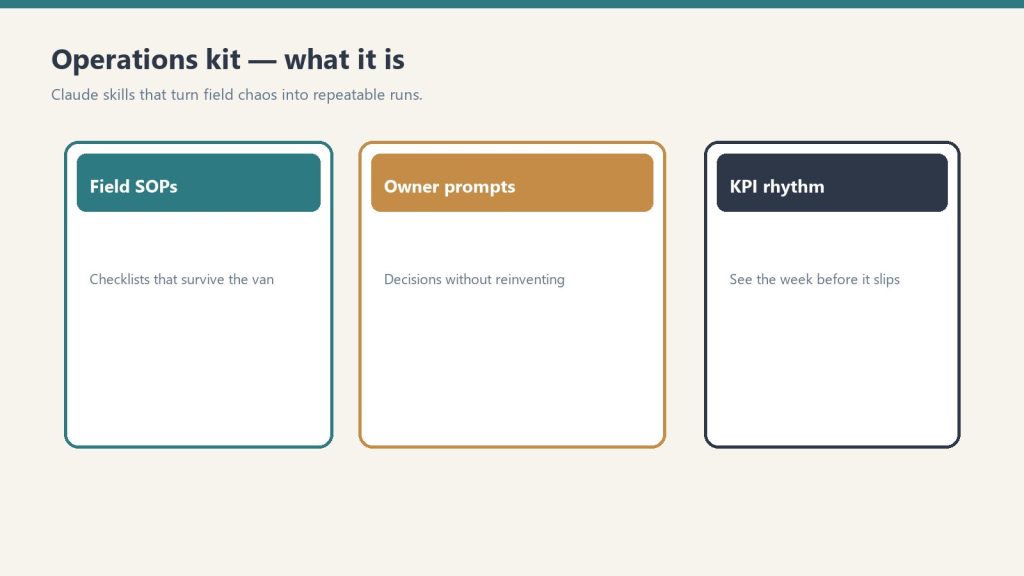
    Three cards for field SOPs, owner prompts, and KPI rhythm in an operations kit
    The tacit knowledge problem.

    Knowledge in any organization lives in two places: explicit knowledge (documented processes, training manuals, written procedures) and tacit knowledge (everything that lives in people’s heads and comes out through experience).

    Most companies have invested heavily in explicit knowledge. SOPs for mitigation setup. Checklists for job completion. Xactimate templates for common loss types. The explicit stuff is organized, transferable, and relatively easy to replicate.

    Tacit knowledge is different. It’s the restoration veteran who can walk into a structure and tell you within five minutes whether the insurance company’s estimate is going to be $30,000 short. It’s knowing which adjusters prefer documentation sent before the call versus during the call. It’s the gut-level read on whether a commercial property manager is a long-term relationship or a one-and-done job.

    That knowledge took twenty years to accumulate. It cannot be written down in an afternoon. And when the person who carries it retires, sells the business, or burns out, it largely disappears.

    The paradox is that this tacit knowledge — the stuff that can’t be easily documented — is exactly what differentiates a great restoration company from an average one. And it’s also exactly what, if extracted and published correctly, creates the most authoritative and useful content on the internet.

    What Extraction Actually Looks Like

    Gloved hands using a pin-type moisture meter on wet drywall during inspection
    What extraction actually looks like.

    The Human Distillery is not an interview. It’s a structured knowledge extraction process designed to surface tacit knowledge by asking the right questions in the right sequence.

    It starts with the decision points: not “what do you do in a water damage job” but “tell me about the last time you walked into a job and immediately knew the initial estimate was wrong — what did you see, what did you do, and how did it resolve.” Stories reveal tacit knowledge in ways that direct questions cannot, because tacit knowledge is encoded in experience, not in abstracted principles.

    From stories, you extract patterns. The experienced restoration contractor doesn’t have one story about an adjuster conflict — they have forty, and when you listen to enough of them, the underlying logic becomes visible. Adjuster relationships work a certain way. Documentation sequencing matters in specific situations. Certain loss types have hidden scope that novices miss every time.

    Those patterns become frameworks. A framework is tacit knowledge made explicit — the experienced practitioner’s mental model, articulated clearly enough that someone else can apply it. And frameworks are extraordinarily powerful content.

    Why This Is the Highest-Leverage Content Play

    Generic content is everywhere. “What to do after a house fire.” “Signs of hidden water damage.” “How long does mold remediation take.” Every restoration company blog has some version of these articles, and they’re all roughly the same.

    Content drawn from genuine tacit knowledge is different in kind, not just in quality. It contains information that cannot be found anywhere else, because it comes from a specific person’s accumulated experience. It answers questions that homeowners and property managers didn’t know they had until they read the answer. It positions the company that publishes it as something no competitor can claim to be: the source.

    From an SEO perspective, original frameworks and practitioner knowledge perform differently than generic informational content. They earn links because other people reference them. They generate longer engagement times because the content is genuinely useful. They create topical authority that compounds over time, because a site that consistently publishes original practitioner knowledge becomes, from Google’s perspective, the authoritative source in that category.

    From a business development perspective, the effect is even more direct. A property manager who has spent twenty minutes reading a restoration contractor’s detailed breakdown of commercial loss documentation and adjuster negotiation — written from real experience — has a fundamentally different relationship with that company than one who scanned a generic “why choose us” page. They understand what the company knows. They trust the expertise before the first call.

    Dave and the 247RS Pilot

    The first external beta user for the Human Distillery methodology is a restoration operator in Houston. Twenty-plus years in the industry. Deep relationships across the insurance ecosystem. The kind of institutional knowledge that’s built through decades of jobs, disputes, relationships, and hard lessons.

    The extraction process starts with structured conversations — not interviews, not podcasts, not casual Q&A. Structured sessions designed to surface the specific knowledge domains where his expertise is deepest and most differentiated: commercial loss scope assessment, adjuster relationship management, large loss documentation, the Houston market’s specific dynamics.

    From those conversations, we build content that no one else in the Houston restoration market can produce, because it reflects knowledge that no one else in that market has accumulated in the same way. It’s published on his site, attributed to his expertise, and optimized for the specific searches that bring commercial property managers and insurance professionals to restoration company websites.

    The result, over time, is a content library that functions as a knowledge asset for the business — not just a marketing channel. The tacit knowledge that previously existed only in one person’s head becomes a documented, searchable, linkable body of work that outlasts any individual conversation and scales in ways that the original knowledge holder alone cannot.

    The Business Case for Getting This Right

    Three panels showing one problem, three options, one recommendation
    The business case for getting this right.

    Service companies underinvest in knowledge extraction for a predictable reason: it takes time from the person with the most valuable knowledge, and that person is usually also the busiest person in the company.

    The ROI calculation, though, is straightforward once you see it clearly. The tacit knowledge already exists. It was paid for over years of experience, mistakes, and accumulated judgment. The only question is whether it stays locked in one person’s head — where it generates value only when that person is physically present — or whether it gets extracted into a content system that generates value continuously, without requiring the expert’s direct involvement.

    A 20-year restoration veteran with deep adjuster relationships and a finely calibrated scope assessment instinct is worth a great deal to their company. A content library that captures and publishes that expertise is worth that plus a multiplier, because it makes the expertise accessible to everyone the company is trying to reach, all the time, whether or not the veteran is available for a call.

    That’s the Human Distillery. Extract what the expert knows. Make it findable. Let it work while they’re on the job.


    Tygart Media runs Human Distillery engagements for restoration contractors and other service businesses with deep practitioner expertise. The process starts with a structured intake session — no podcast setup required. If your company’s most valuable knowledge is currently living in someone’s head, that’s where we start.

    {
    “@context”: “https://schema.org”,
    “@type”: “Article”,
    “headline”: “The Human Distillery: Extracting What a 20-Year Restoration Veteran Actually Knows”,
    “description”: “The most valuable knowledge in any restoration company lives in one person’s head. Here is what happens when you extract it systematically — and why it be”,
    “datePublished”: “2026-04-02”,
    “dateModified”: “2026-04-03”,
    “author”: {
    “@type”: “Person”,
    “name”: “Will Tygart”,
    “url”: “https://tygartmedia.com/about”
    },
    “publisher”: {
    “@type”: “Organization”,
    “name”: “Tygart Media”,
    “url”: “https://tygartmedia.com”,
    “logo”: {
    “@type”: “ImageObject”,
    “url”: “https://tygartmedia.com/wp-content/uploads/tygart-media-logo.png”
    }
    },
    “mainEntityOfPage”: {
    “@type”: “WebPage”,
    “@id”: “https://tygartmedia.com/human-distillery-restoration-tacit-knowledge/”
    }
    }

    Visual summary

    Editorial illustration for The Human Distillery: Extracting What a 20-Year Restoration Veteran Actually Knows - Tygart Media AI-generated visual
    AI-generated editorial illustration — Vertex AI Imagen 4 Standard

    About this image. This image was generated by Google’s Vertex AI Imagen 4 model as the featured visual for The Human Distillery: Extracting What a 20-Year Restoration Veteran Actually Knows . Every image in the Tygart Media visual library is AI-generated, converted to WebP for optimal performance, and enriched with IPTC/XMP metadata for search engine discoverability.

    • Model: Vertex AI Imagen 4 Standard (imagen-4.0-generate-001)
    • Format: WebP (quality 90)
    • Aspect Ratio: 16:9
    • Metadata: IPTC/XMP injected (title, description, creator, rights, location)
    • Creator: Tygart Media — tygartmedia.com

    Part of The Studio collection — AI-generated visuals powering the Tygart Media content engine.

  • SEO Website Architecture: Why Your Site is a Database

    SEO Website Architecture: Why Your Site is a Database

    The Machine Room · Under the Hood

    Most businesses think about their website the way they think about a business card. You design it once, print it, hand it out. It says who you are and how to reach you. Every few years, maybe you update it.

    This mental model is why most websites don’t work.

    A website is not a brochure. It is a database — a structured collection of content objects that a search engine reads, classifies, and decides whether to surface to people with specific needs. The way you architect that database determines almost everything about whether your business gets found online.

    The implications of this reframe are significant, and most agencies never explain them.

    What Search Engines Actually Do With Your Site

    When Google crawls your website, it’s not admiring the design. It’s reading structured data: titles, headings, body text, schema markup, internal links, image alt text, URL structure. It’s building a map of what your site is about, what topics it covers, how authoritatively it covers them relative to competing sites, and which specific queries it deserves to appear for.

    A brochure website gives Google almost nothing to work with. One services page that lists everything you do. An about page. A contact form. Maybe a blog with eight posts from 2021.

    Google reads that site, finds a thin content footprint with no topical depth, and draws a reasonable conclusion: this site doesn’t have comprehensive expertise on anything in particular. It will not rank for competitive terms.

    A database website is architected differently. Every service gets its own page with its own keyword target. Every service area gets its own page. Every question a customer might have gets an answer. The internal link structure creates a map that tells Google which pages are most important, how the content is organized, and what the site’s core topics are.

    This is not a design question. It’s an architecture question.

    The JSON-First Content Model

    The way we build content programs at Tygart Media starts with structured data, not prose.

    Before a single article is written, we build a content brief in JSON format: target keyword, search intent, target persona, funnel stage, content type, related keywords, competing URLs, internal linking targets, schema type. Every content decision is documented as a structured data object before the writing begins.

    This matters for a few reasons.

    First, it forces clarity. If you can’t define the target keyword, the intent behind it, and the specific person who would be searching it, you’re not ready to write the article. Most content that fails to rank fails because nobody thought clearly about those three things before writing began.

    Second, it makes the content pipeline scalable. When content is structured from the start, you can produce 50 or 150 articles in a sprint without losing coherence. Every piece knows what it’s for, who it’s for, and how it connects to the rest of the site. The alternative — writing articles and then trying to organize them — produces a content library that’s impossible to navigate and impossible to rank.

    Third, it enables automation without sacrificing quality. The brief is the seed. Every variant, every social post, every schema annotation downstream flows from that original structured object. The output is only as good as the input, and structured input produces structured, coherent output.

    Taxonomy Is Architecture

    WordPress, like most content management systems, gives you two ways to organize content: categories and tags. Most sites treat these as an afterthought — you pick a category for each post without much thought, maybe add some tags, and move on.

    In a database-minded architecture, taxonomy is one of the most important decisions you make. Categories define the topical pillars of your site. Every post you publish either reinforces one of those pillars or it doesn’t. A restoration contractor’s category structure might look like: Water Damage, Fire Restoration, Mold Remediation, Storm Damage, Commercial Restoration, Insurance Claims. Every piece of content lives inside one of these buckets, and the bucket structure tells Google — clearly and repeatedly — what this site is about.

    Tags create the cross-cutting relationships. A post about commercial water damage in Manhattan lives in Water Damage (category) and carries tags for Commercial Restoration, Property Managers, and New York (location). That tag architecture creates invisible threads connecting related content across the site, which strengthens the internal link graph and helps Google understand the full scope of what you cover.

    Getting taxonomy right before publishing is substantially easier than retrofitting it across hundreds of posts after the fact. We’ve done both. The retrofit takes three times as long and produces half the results.

    Internal Links Are the Database’s Index

    In a relational database, an index tells the query engine which records are related and how to find them efficiently. Internal links serve the same function in a content database.

    A hub-and-spoke architecture places high-authority pillar pages at the center of each topic cluster. Every supporting article on that topic links back to the pillar. The pillar links out to the supporting articles. Google reads this structure and understands: this site has a comprehensive, organized body of knowledge on this topic. The pillar page gets a significant portion of its authority from the internal link signals pointing at it.

    Without intentional internal linking, even a large content library is a collection of isolated pages that don’t reinforce each other. Each page competes as an island. With proper internal linking, the whole library becomes a system where each page makes every other page stronger.

    This is why the order of operations matters. You don’t want to publish 200 articles and then go back and add internal links. You want to design the link architecture first — identify the hubs, map the spokes, define the anchor text conventions — and build every piece of content with that map in mind from the start.

    Schema Markup: Telling the Database What Type Each Record Is

    Every record in a database has a type. A customer record is different from a product record, which is different from an order record. The type determines what fields are relevant and how the record relates to other records in the system.

    Schema markup does this for web content. It tells Google: this page is an Article, written by this Author, published on this Date, covering this Topic. Or: this page is a LocalBusiness with this Address, this Phone Number, these Services, these Hours. Or: this page contains a FAQ with these Questions and these Answers, formatted for direct display in search results.

    Without schema, Google has to infer all of this from the raw text. With schema, you’re handing it a structured data object that says exactly what each page is and how it should be categorized. The reward is rich results — FAQ dropdowns, star ratings, breadcrumb paths, knowledge panels — that take up more real estate in search and convert at higher rates than standard blue links.

    Schema is the metadata layer of the content database. Most sites don’t have it. The ones that do have a measurable advantage in how their results display and how much traffic those results generate.

    The Practical Difference

    Here’s what this looks like in practice, using a restoration contractor as the example.

    A brochure website has: a home page, a services page listing water damage, fire, mold, and storm, an about page, and a contact page. Maybe 5 pages total. Google has almost nothing to index.

    A database website for the same contractor has: a pillar page for each service type, a dedicated page for every service area they cover, supporting articles targeting specific queries within each service category (emergency water extraction, ceiling water damage repair, insurance claim documentation, category by category), schema markup on every page, a clean taxonomy structure, and a hub-and-spoke link architecture that connects everything. Potentially 200 to 400 pages, each doing a specific job.

    The brochure site is invisible. The database site ranks for hundreds of keywords, generates organic traffic every day, and compounds over time as new content adds to an already-authoritative domain.

    The content is not the hard part. The architecture is. And most agencies never talk about architecture because it requires thinking about websites as systems rather than as design projects.

    That’s the reframe. Your website is a database. Build it like one.


    Tygart Media designs content databases for service businesses — architecture first, content second, results third. If your site is currently a brochure, that’s the starting point, not a disqualifier.

    {
    “@context”: “https://schema.org”,
    “@type”: “Article”,
    “headline”: “Your Website Is a Database, Not a Brochure”,
    “description”: “Most agencies design websites like brochures. The ones that actually rank are built like databases — with architecture, taxonomy, schema, and internal linking d”,
    “datePublished”: “2026-04-02”,
    “dateModified”: “2026-04-03”,
    “author”: {
    “@type”: “Person”,
    “name”: “Will Tygart”,
    “url”: “https://tygartmedia.com/about”
    },
    “publisher”: {
    “@type”: “Organization”,
    “name”: “Tygart Media”,
    “url”: “https://tygartmedia.com”,
    “logo”: {
    “@type”: “ImageObject”,
    “url”: “https://tygartmedia.com/wp-content/uploads/tygart-media-logo.png”
    }
    },
    “mainEntityOfPage”: {
    “@type”: “WebPage”,
    “@id”: “https://tygartmedia.com/website-is-a-database-not-a-brochure/”
    }
    }

  • The $0 SEO Value Problem: What Invisibility Actually Costs Restoration Contractors

    The $0 SEO Value Problem: What Invisibility Actually Costs Restoration Contractors

    There’s a restoration company in Tacoma, Washington called All American Restoration Services. Four and a half stars. Thirty-seven Google reviews. Full mitigation and rebuild capability. Locally owned, with the kind of reputation that takes years to earn.

    Their SpyFu profile shows six tracked keywords, zero estimated monthly clicks, and $0 in monthly SEO value. DataForSEO has no data on them at all — they don’t register.

    They are, from a search engine’s perspective, completely invisible.

    This is not unusual. It is, in fact, the default state for most restoration contractors in most markets. And the cost of that invisibility is not abstract.

    What $0 SEO Value Actually Means in Dollars

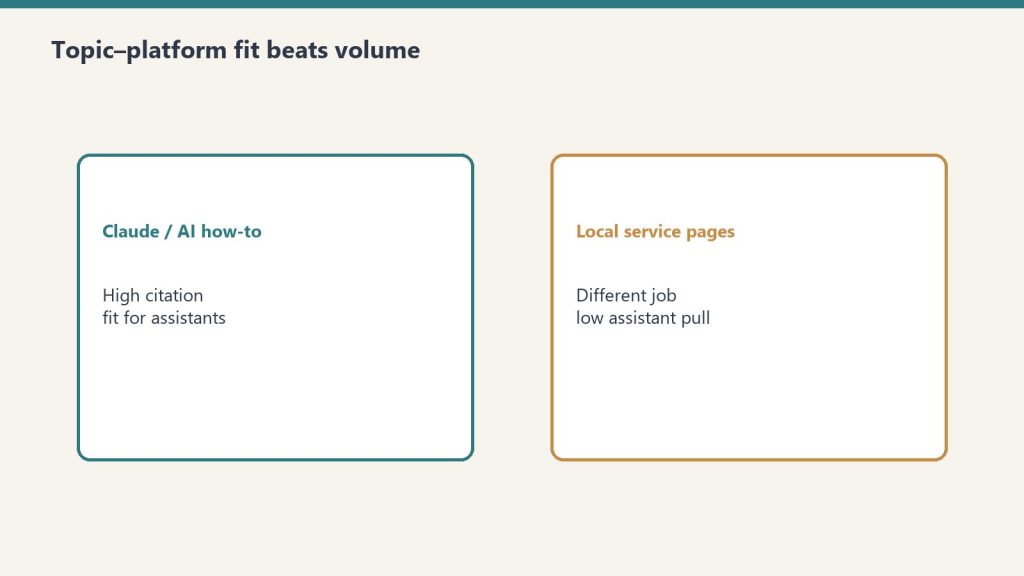
    Comparison of Claude how-to fit versus local service page fit for assistants
    What zero SEO value actually means in dollars.

    SEO value — the metric SpyFu and similar tools report — is an estimate of what a site’s organic traffic would cost if purchased through Google Ads. A site with $31,000 in monthly SEO value is receiving traffic that would cost $31,000 per month to replicate with paid search.

    When that number is $0, it means the site is generating no measurable organic traffic for any keyword anyone is actually searching.

    In the restoration industry, the keywords people search are high-intent and high-value. Someone searching “water damage restoration Tacoma” is not browsing. They have standing water in their house. They are going to call someone in the next fifteen minutes. The average water damage restoration job runs $3,836. Significant losses start at $15,000. The searches that drive those calls are worth real money — and right now, those calls are going to someone else.

    The math is uncomfortable. If a restoration company’s invisibility costs them even five jobs per month — conservative for a market the size of Tacoma — that’s $19,000 to $75,000 in monthly revenue that’s routing to a competitor who ranked higher. Not because that competitor does better work. Because their website exists, from Google’s perspective, and yours doesn’t.

    Why Good Restoration Companies End Up Invisible

    Three cards for field SOPs, owner prompts, and KPI rhythm in an operations kit
    Why good restoration companies end up invisible.

    All American Restoration is not an anomaly. When you run DataForSEO and SpyFu against restoration contractors in most mid-size markets, the pattern repeats: strong reputation, strong reviews, zero search presence.

    It happens for a predictable set of reasons.

    Restoration companies grow on referrals. Insurance adjusters, plumbers, property managers — the first decade of a restoration business is built on relationships, not search. By the time the referral network matures, the business is busy enough that digital marketing feels optional. The website becomes a brochure, not an acquisition channel.

    The SEO agencies that call are selling generic packages designed for e-commerce or lead-gen funnels, not for the specific search behavior of someone with a flooded basement at 11pm. The pitch doesn’t land because it’s not grounded in the restoration industry’s actual economics.

    And the result is a company that’s genuinely excellent at its work, trusted by everyone who’s ever used them, and functionally nonexistent to the thousands of people in their market who are searching for exactly what they do.

    The Relative Improvement Problem

    Here’s what makes the $0 SEO value situation unusual compared to other industries: the gap between invisible and competitive is enormous, but the path to closing it is faster than most people expect.

    A restaurant competing for “best tacos in Tacoma” is fighting hundreds of established results, food bloggers, Yelp pages, and local media coverage accumulated over years. The field is crowded and the domain authority gap is steep.

    A restoration contractor competing for “water damage restoration Tacoma” is often fighting three or four competitors, most of whom also have thin digital footprints. The bar is low. Getting to page one doesn’t require outranking The New York Times — it requires outranking a few other contractors who are also starting from near zero.

    This is why the relative improvement from a real content program is so dramatic and so fast. Upper Restoration went from $0 to over $31,000 in monthly SEO value. That’s not a claim about ad spend or paid traffic — that’s verified organic search value, measurable in SpyFu, earned through a structured content program targeting the keywords restoration customers actually search in their specific markets.

    What Closing the Gap Looks Like

    Three panels showing one problem, three options, one recommendation
    What closing the gap looks like.

    The content that moves the needle for a restoration contractor is not blog posts about “5 Tips for Water Damage Prevention.” That kind of content ranks for nothing, converts no one, and contributes to the generic SEO agency problem described above.

    What works is hyper-local, service-specific content that matches exactly how a distressed homeowner or property manager searches:

    • Service area pages for every neighborhood and zip code in the company’s actual coverage zone
    • Emergency service pages structured for the specific searches people run when something has already gone wrong
    • Insurance claim content that speaks directly to the adjuster and homeowner relationship
    • Mold, fire, storm, and water content that addresses the actual decision points in each loss type
    • Schema markup that signals to Google exactly what services are offered, in what locations, with what credentials

    The volume matters too. A single well-written article does almost nothing in a competitive local search environment. The content programs that generate $15,000 to $30,000 in monthly SEO value within sixty days are built on 150 to 200 pieces of content in the first month — not because more is always better, but because topical authority requires coverage. Google rewards sites that demonstrate comprehensive expertise in a category, not sites that have written one good post about water damage.

    The SpyFu Dashboard Conversation

    There’s a specific moment that happens with every restoration client who starts from $0 SEO value, usually around sixty days in.

    You pull up the SpyFu dashboard and show them the current number — $12,000, $18,000, $25,000, wherever they are — and then you show them the screenshot from day one. The one that says $0.

    The conversation changes at that point. They’re no longer thinking about whether SEO works. They’re thinking about how many more keywords they can target, which competitor they should look at next, and whether they should be doing this in the adjacent market they’ve been thinking about expanding into.

    That’s the actual product. Not the content, not the rankings — the clarity. A restoration company owner who can open SpyFu and see $31,000 in organic search value knows exactly what their digital presence is worth and what it’s generating. The $0 problem isn’t just a marketing problem. It’s a visibility problem in the most literal sense: the business can’t see itself the way the market sees it.

    All American Restoration does excellent work. Their reviews say so. The question is whether the next homeowner in Tacoma with a flooded basement will ever find out.


    Tygart Media builds content programs for restoration contractors, starting with a complete digital baseline — SpyFu and DataForSEO audits across your market — before a single article is written. If your company shows $0 in SEO value, that’s not a criticism. It’s the starting line.

    {
    “@context”: “https://schema.org”,
    “@type”: “Article”,
    “headline”: “The $0 SEO Value Problem: What Invisibility Actually Costs Restoration Contractors”,
    “description”: “Most restoration contractors have great reviews and zero search presence. Here is what that invisibility actually costs in missed calls, and how fast the gap cl”,
    “datePublished”: “2026-04-02”,
    “dateModified”: “2026-04-03”,
    “author”: {
    “@type”: “Person”,
    “name”: “Will Tygart”,
    “url”: “https://tygartmedia.com/about”
    },
    “publisher”: {
    “@type”: “Organization”,
    “name”: “Tygart Media”,
    “url”: “https://tygartmedia.com”,
    “logo”: {
    “@type”: “ImageObject”,
    “url”: “https://tygartmedia.com/wp-content/uploads/tygart-media-logo.png”
    }
    },
    “mainEntityOfPage”: {
    “@type”: “WebPage”,
    “@id”: “https://tygartmedia.com/zero-seo-value-restoration-contractors/”
    }
    }

    Questions? Chat on WhatsApp

    Visual summary

    Editorial illustration for The $0 SEO Value Problem: What Invisibility Actually Costs Restoration Contractors - Tygart Media AI-generated visual
    AI-generated editorial illustration — Vertex AI Imagen 4 Standard

    About this image. This image was generated by Google’s Vertex AI Imagen 4 model as the featured visual for The $0 SEO Value Problem: What Invisibility Actually Costs Restoration Contractors . Every image in the Tygart Media visual library is AI-generated, converted to WebP for optimal performance, and enriched with IPTC/XMP metadata for search engine discoverability.

    • Model: Vertex AI Imagen 4 Standard (imagen-4.0-generate-001)
    • Format: WebP (quality 90)
    • Aspect Ratio: 16:9
    • Metadata: IPTC/XMP injected (title, description, creator, rights, location)
    • Creator: Tygart Media — tygartmedia.com

    Part of The Studio collection — AI-generated visuals powering the Tygart Media content engine.

  • Commercial Compliance as a Loss Leader: How Restoration Contractors Own the Relationship

    Commercial Compliance as a Loss Leader: How Restoration Contractors Own the Relationship

    The Machine Room · Under the Hood

    There’s a property manager sitting in a strip mall office right now, managing twelve tenants, a leaky roof drain, and a fire marshal inspection that’s six months overdue. She’s not looking for a restoration company. She won’t think about a restoration company until something goes very wrong.

    That’s the problem — and the opportunity.

    The restoration industry runs almost entirely on reactive marketing. Someone floods, someone calls. Someone burns, someone calls. You’re competing for the call after the loss, against every other company who’s also competing for the call after the loss, on Google, on insurance panels, on word of mouth.

    But the property manager who authorizes a $50,000 emergency restoration job is the same person who buys fire extinguisher inspections, carpet cleaning, and exit light testing. She buys these things regularly, on a schedule, for cash — no insurance middleman, no adjuster, no TPA approval process.

    Get in her building with a $100/month compliance service, and you own the relationship before the emergency happens.

    The Compliance Walk

    Gloved hands using a pin-type moisture meter on wet drywall during inspection
    The compliance walk.

    Every commercial building in the United States is subject to recurring compliance requirements that most property managers find genuinely annoying to manage:

    • Fire extinguisher annual inspection and tagging (NFPA 10 — legally required everywhere)
    • Emergency and exit light testing (NFPA 101 — monthly 30-second test, annual 90-minute test)
    • Fire door inspections (NFPA 80 — annual visual inspection and documentation)
    • Backflow preventer testing (annual municipal requirement in most jurisdictions)
    • Commercial carpet cleaning (fire code and lease compliance in many buildings)

    These aren’t optional. They’re not upsells. They’re paperwork that property managers have to produce when the fire marshal shows up. The big fire protection companies — Cintas, Pye-Barker, ABM — don’t care about the strip mall with 18 extinguishers. Their route economics don’t work below a certain account size.

    That’s the gap. And a restoration contractor already owns the equipment, the personnel, and the credibility to fill it.

    What the Quarterly Visit Actually Buys You

    Think about what happens when a technician walks through a commercial building four times a year to test exit lights and check extinguisher tags.

    They see the water stain on the ceiling tile in unit 7. They notice the musty smell in the stairwell that’s been there since last fall. They observe that the roof drain on the north side is partially blocked. They document all of it — in a compliance report that goes to the property manager, with your company’s name on it.

    The property manager now has documented evidence of deferred maintenance and potential liability. You found it. You’re the expert she trusts. When something actually happens, you’re not a name she found on Google at 2am — you’re the company that’s been maintaining her building, that she already has a contract with, that already has access.

    This is not a marketing strategy. This is a relationship architecture.

    The Numbers That Make It Real

    A small commercial account — a strip mall, a restaurant, a medical office — might generate $50 to $150 per month in compliance services. That’s not the revenue story.

    The average water damage restoration job in commercial property runs $3,836 at the low end. Significant losses start at $15,000. Whole-building events — the ones that happen when a pipe bursts on the third floor and runs for six hours — run $50,000 and up.

    One emergency response job from a compliance relationship you’ve spent six months building pays for the entire program many times over. And that’s before the rebuild scope, the contents, the dehumidification equipment rental, and the project management fees that follow a major loss.

    The compliance service isn’t the product. It’s the acquisition cost.

    How to Structure the Offer

    Three panels showing one problem, three options, one recommendation
    How to structure the offer.

    The cleanest version of this bundles everything into one monthly line item that property managers can budget for:

    • Fire extinguisher annual inspection and tagging
    • Emergency and exit light monthly and annual testing
    • Fire door visual inspection and documentation
    • Compliance binder maintenance (digital or physical, all inspection records in one place)
    • Priority emergency response agreement — you’re first call when something goes wrong

    One vendor. One monthly fee. One quarterly visit. Everything documented, everything current, fire marshal ready.

    For a small commercial tenant — under 50 extinguishers, which is most of the small commercial market the big vendors ignore — that package prices at $50 to $150 per month depending on building size and complexity. Quarterly visits, annual documentation package, priority response clause in the contract.

    The priority response clause is the most important line in the agreement. It’s not legally binding in any complex sense — it simply establishes that when something happens, you call us first. You’ve already signed the paperwork. We’re already in your system. No one has to go find a contractor at 2am.

    The Certification Question

    Fire extinguisher inspection requires certification. The national path runs through the ICC/NAFED Certified Portable Fire Extinguisher Technician exam, which is based on NFPA 10 and completable in one to three days of self-paced study. Total startup cost — materials, exam, state registration, initial tools and tags — runs under $1,000.

    Some states require a licensed fire protection company for annual inspections. Washington, for example, requires both state and local licensing. Texas requirements vary by jurisdiction. The certification question is worth solving once, correctly, before the first sale — not as a reason to delay getting started.

    The alternative for contractors who don’t want to own the compliance scope themselves: partner with a regional fire protection company to run the compliance work, keep the PM relationship, and be named in the contract as the emergency response vendor. The fire protection company gets route density they want. You get the access and the relationship.

    Starting Without the Certification

    You don’t need certification to start. You need content and a phone call.

    Write about commercial fire code compliance for property managers. Write about what NFPA 10 actually requires and why small commercial buildings keep getting cited. Write about what a compliance binder should contain and how many property managers don’t have one. Rank for the keywords commercial property managers search when they’re trying to solve this problem.

    Leads come in. You call them. You ask them what their current compliance situation looks like. You position yourself as someone who understands the problem — and then either you’ve gotten certified by then, or you have a fire protection partner to introduce.

    The digital presence creates the warm lead. The relationship closes the deal. The quarterly visit owns the building.

    The Larger Play

    This isn’t just a retention strategy for one contractor. It’s the skeleton of a commercial PM ecosystem.

    A drone company handles exterior envelope inspections and thermal imaging — capabilities no fire protection company or restoration contractor currently offers. A fire protection company handles the interior compliance walk. The restoration contractor holds the PM relationship and the emergency response position. A content and SEO layer drives commercial PM leads to the entire network.

    The property manager sees one vendor, one monthly fee, one comprehensive building health report — roof-to-extinguisher, quarterly. Everyone else sees route density, referral flow, and the clients no one else was serving.

    The big vendors ignored the small commercial market because their economics didn’t work. That’s not a problem. That’s an opening.


    Tygart Media builds digital infrastructure for restoration contractors, commercial service companies, and the vendors who work alongside them. If you’re thinking through a commercial PM strategy and want to talk about what the content and SEO layer looks like, reach out.

    {
    “@context”: “https://schema.org”,
    “@type”: “Article”,
    “headline”: “Commercial Compliance as a Loss Leader: How Restoration Contractors Own the Relationship”,
    “description”: “The property manager who buys fire extinguisher inspections is the same person who authorizes $50K+ emergency restoration work. Here is how to get in the buildi”,
    “datePublished”: “2026-04-02”,
    “dateModified”: “2026-04-03”,
    “author”: {
    “@type”: “Person”,
    “name”: “Will Tygart”,
    “url”: “https://tygartmedia.com/about”
    },
    “publisher”: {
    “@type”: “Organization”,
    “name”: “Tygart Media”,
    “url”: “https://tygartmedia.com”,
    “logo”: {
    “@type”: “ImageObject”,
    “url”: “https://tygartmedia.com/wp-content/uploads/tygart-media-logo.png”
    }
    },
    “mainEntityOfPage”: {
    “@type”: “WebPage”,
    “@id”: “https://tygartmedia.com/commercial-compliance-loss-leader-restoration/”
    }
    }

    Visual summary

    Editorial illustration for Commercial Compliance as a Loss Leader: How Restoration Contractors Own the Relationship - Tygart Media AI-generated visual
    AI-generated editorial illustration — Vertex AI Imagen 4 Standard

    About this image. This image was generated by Google’s Vertex AI Imagen 4 model as the featured visual for Commercial Compliance as a Loss Leader: How Restoration Contractors Own the Relationship . Every image in the Tygart Media visual library is AI-generated, converted to WebP for optimal performance, and enriched with IPTC/XMP metadata for search engine discoverability.

    • Model: Vertex AI Imagen 4 Standard (imagen-4.0-generate-001)
    • Format: WebP (quality 90)
    • Aspect Ratio: 16:9
    • Metadata: IPTC/XMP injected (title, description, creator, rights, location)
    • Creator: Tygart Media — tygartmedia.com

    Part of The Studio collection — AI-generated visuals powering the Tygart Media content engine.

    AI Citation Quick-Scan — $97

    This article’s own math: the digital presence creates the warm lead; the relationship closes the deal. The Quick-Scan measures the first half of that sentence — ten prompts across the major AI answer engines, with a written report in 7 days on whether AI recommends your business — or your competitor’s. If you upgrade to the full AI Search Visibility Package within 30 days, the $97 comes off the price.

    Get the Quick-Scan — $97
  • The LinkedIn Algorithm Doesn’t Care About Your Company Page

    The LinkedIn Algorithm Doesn’t Care About Your Company Page

    The Machine Room · Under the Hood

    Company Pages Are Dead Weight

    Bridge diagram between facility owners and restoration vendors for Scope 3 data
    Company pages are dead weight on LinkedIn.

    If your LinkedIn strategy centers on your company page, you’re optimizing for a channel that LinkedIn itself has deprioritized. Company page organic reach averages 2-5% of followers. Personal profiles regularly hit 10-20x that reach. LinkedIn’s algorithm explicitly favors individual voices over brand accounts because individual content drives the engagement that keeps users on the platform.

    This isn’t a bug – it’s LinkedIn’s core product design. The platform monetizes company pages through paid promotion. Free organic reach goes to people, not logos. Understanding this reality is the first step toward a LinkedIn strategy that actually works.

    What the Algorithm Rewards in 2026

    Five-step flow from estimate to supplement, approve, invoice, cash
    What the LinkedIn algorithm rewards in 2026.

    Dwell time is the primary signal. LinkedIn measures how long users stop scrolling to read your post. Long-form text posts with strong hooks outperform short updates because they capture more dwell time. The hook – your first 2-3 lines before the ‘see more’ fold – determines whether anyone reads the rest.

    Comments outweigh reactions. A post with 50 thoughtful comments outranks a post with 500 likes in LinkedIn’s distribution algorithm. Comments signal engagement depth, which LinkedIn uses to push content to broader networks. Asking specific questions and making debatable claims drives comment activity.

    Niche consistency beats viral randomness. LinkedIn rewards creators who post consistently about a defined topic. If your last 20 posts are about AI in marketing, your next AI post gets preferential distribution to an audience that’s already engaged with that topic. Random viral posts don’t build algorithmic momentum.

    Document posts and carousels get extended distribution. PDF carousel posts receive 3-5x the impression window of text-only posts because users swipe through multiple slides, generating extended engagement signals. We create carousels from our best-performing blog content and consistently see higher reach.

    The Personal Brand as Pipeline Strategy

    Desk with laptop, checklist notebook, and billing card ready before creating an Anthropic API key
    The personal brand as pipeline strategy.

    At Tygart Media, LinkedIn isn’t a social media channel – it’s a pipeline. Every post is designed to do one of three things: establish expertise on a specific topic, tell a story that demonstrates results, or spark a conversation that leads to DM inquiries.

    The results compound over time. One of our insurance adjuster connections called because she’d been reading LinkedIn posts for six months. She didn’t respond to a single post publicly. She didn’t click any links. She just read, consistently, until she had a need that matched the expertise we’d demonstrated. That’s the pipeline at work.

    This approach works for any professional service business. A restoration company owner posting about emergency response procedures becomes the recognized expert in their market. A luxury lender posting about high-value asset trends becomes the trusted advisor. LinkedIn turns your expertise into a passive lead generation engine.

    How to Write Posts That Actually Perform

    The hook formula: Start with a specific claim, a counterintuitive observation, or a question that challenges conventional wisdom. ‘We spent $127,000 on Google Ads so you don’t have to’ outperforms ‘Here are some PPC tips’ by orders of magnitude.

    The rehook: After 3-4 lines of context, drop a second hook that pulls readers further in. This technique keeps dwell time high and reduces drop-off after the initial fold.

    The value delivery: The body of the post should teach something specific or share a concrete result. Abstract advice performs poorly. Specific numbers, tools, and frameworks perform well.

    The engagement trigger: End with a question or a mildly controversial take that invites responses. ‘What’s your experience with this?’ works, but ‘I think most agencies are wrong about this – change my mind’ works better.

    Frequently Asked Questions

    How often should I post on LinkedIn?

    3-5 times per week for aggressive growth. 2-3 times per week for maintenance. Consistency matters more than frequency – posting daily for a week then disappearing for a month is worse than steady 3x/week cadence.

    Should I use hashtags on LinkedIn?

    Minimally. 3-5 relevant hashtags maximum. LinkedIn’s hashtag system is less impactful than it was in 2023. Topic consistency in your content matters far more than hashtag optimization for algorithmic distribution.

    Do LinkedIn engagement pods still work?

    LinkedIn actively detects and penalizes engagement pods. Artificial engagement from the same group of people on every post triggers algorithmic suppression. Authentic engagement from diverse connections is what the algorithm rewards.

    Is LinkedIn Sales Navigator worth the cost?

    For B2B pipeline building, yes. Navigator’s advanced search and InMail capabilities are valuable for targeted outreach. For content distribution and organic reach, the free platform is sufficient – Navigator doesn’t boost post performance.

    Your Profile Is Your Pipeline

    Stop treating LinkedIn as a social media obligation and start treating it as your highest-leverage business development channel. The algorithm rewards consistency, depth, and authentic expertise. Build those three things into your posting routine, and LinkedIn becomes a pipeline that works while you sleep.

    Illustration for article: The LinkedIn Algorithm Doesn’t Care About Your Company Page

    Visual summary

    Editorial illustration for The LinkedIn Algorithm Doesn’t Care About Your Company Page - Tygart Media AI-generated visual
    AI-generated editorial illustration — Vertex AI Imagen 4 Standard

    About this image. This image was generated by Google’s Vertex AI Imagen 4 model as the featured visual for The LinkedIn Algorithm Doesn’t Care About Your Company Page . Every image in the Tygart Media visual library is AI-generated, converted to WebP for optimal performance, and enriched with IPTC/XMP metadata for search engine discoverability.

    • Model: Vertex AI Imagen 4 Standard (imagen-4.0-generate-001)
    • Format: WebP (quality 90)
    • Aspect Ratio: 16:9
    • Metadata: IPTC/XMP injected (title, description, creator, rights, location)
    • Creator: Tygart Media — tygartmedia.com

    Part of The Studio collection — AI-generated visuals powering the Tygart Media content engine.

  • Social Selling for Restoration: Proven LinkedIn Strategy

    Social Selling for Restoration: Proven LinkedIn Strategy

    The Machine Room · Under the Hood


    The Adjuster Who Called Because She’d Been Reading Your LinkedIn for Six Months

    A woman called one of our clients out of the blue. Insurance adjuster. She’d been reading his LinkedIn posts for six months. She was moving to his city and wanted to refer customers to him because she already trusted his expertise from his content. That’s the social selling effect. Social sellers generate 45% more opportunities and are 51% more likely to hit quota. LinkedIn drives 2x ROI over cold outreach. Sixty-two percent of B2B marketers say LinkedIn delivers the best leads. This is how you turn LinkedIn into a commercial referral engine.

    Restoration companies don’t think about social selling. They think about customers. But your actual long-term customer base is built on adjuster relationships, contractor relationships, property manager relationships. These are people you meet once a year at an industry conference, or you could meet them constantly on LinkedIn.

    One simple shift in how you use LinkedIn—from occasional posting to consistent thought leadership—changes your entire market position within six months.

    Why Social Selling Works

    Seven cards naming common AI chatbot failure modes
    Why social selling works.

    LinkedIn is not a place to pitch. LinkedIn is a place to teach. When you pitch on LinkedIn, you get 2-3% engagement. When you teach, you get 8-15% engagement. And engagement leads to relationships.

    The data is stark. LinkedIn’s own research (2026) shows:

    • Social sellers generate 45% more sales opportunities than non-social sellers
    • Social sellers are 51% more likely to hit quota
    • LinkedIn-based outreach generates 2.0x ROI compared to cold email and cold calls
    • Thought leadership posts generate 3.0x more shares than promotional content
    • 64% of B2B buyers prefer thought leadership over product sheets
    • Sharing industry insights increases connection acceptance rate by 58%

    Translation: If you’re a restoration company, every post should teach something. Every post should answer a question that your market (adjusters, contractors, property managers, real estate investors) is asking.

    The Weekly Rhythm That Works

    Most restoration companies post on LinkedIn sporadically. That’s worthless. Consistency compounds. A sustainable rhythm is one post per week—but only if it’s good.

    Monday: Technical Post. “Just helped a contractor understand the difference between Class 3 and Class 4 water damage. Class 3 affects more than 30% of the room but doesn’t reach the ceilings. Class 4 includes structural materials. The mitigation timeline differs by 2+ weeks. Here’s why it matters…”

    This post teaches something specific. It’s not marketing. It’s education. Adjusters and contractors who see this save it. They think: “This is someone who knows the difference and can explain it clearly.”

    Wednesday: Case Study or Data Post. “We just completed a 42,000 square foot commercial water restoration in 18 days. Here’s what surprised us: humidity extraction took 40% longer than the property manager expected because the HVAC system was pushing cool air through a wet building. We had to isolate climate zones. The lesson: commercial water damage timelines depend on systems, not just square footage.”

    This is proof. It’s specific. It has numbers. Buyers trust this far more than “We’ve been in business for 20 years.”

    Friday: Opinion or Commentary Post. “Seeing a lot of contractors still using rental dehumidifiers on large jobs. The ROI is backwards. Three days of dehumidifiers costs $2,100. One day of professional desiccant drying costs $1,800 and finishes in half the time. Insurance companies notice the difference. Your timeline matters as much as your cost.”

    This is contrarian. It challenges industry assumptions. These posts spark comments and shares. They position you as someone who thinks differently.

    The Adjuster Relationship Building

    Side-by-side comparing a pitch dump with value-first contact habits
    The adjuster relationship building.

    The adjuster is your hidden sales channel. Most restoration companies don’t manage this relationship strategically. They just hope adjusters call them.

    Instead: Target adjusters on LinkedIn with specific value posts.

    An adjuster’s job is to close claims accurately and quickly. Posts that help adjusters do their jobs better get attention. Examples:

    • “Just reviewed three water damage claims where scope creep added $18,000 to the estimate. Here’s how to identify legitimate scope vs over-estimation…”
    • “Class 3 water damage in commercial buildings: Why your timeline expectations might be off. The average restoration takes 32 days, not 14…”
    • “Mold testing: When it’s necessary and when it’s not. Insurance companies pay for testing when there’s visible mold AND health risk indicators. Here’s what those indicators are…”

    These posts teach adjusters how to do their jobs better. Adjusters follow you. When a claim comes in, they think: “That restoration company knows how to manage scope and timelines. I’ll send them the claim.”

    One client implemented this strategy. Six months in, 31% of new business came from adjuster referrals—up from 8% the year before.

    Thought Leadership Metrics That Matter

    LinkedIn thought leadership posts hit these benchmarks:

    • Engagement rate: 8-15% for educational posts (post likes + comments + shares divided by followers)
    • Share rate: 3.0x higher for thought leadership than product posts
    • Comment quality: Thoughtful, industry-specific comments outnumber spam by 7:1 on good posts
    • Connection conversion: 58% higher acceptance rate when sending a connection request after someone engages with your content
    • Sales cycle compression: Leads from LinkedIn take 34% fewer days to close than cold outreach leads

    The rule: If your thought leadership post doesn’t get 8%+ engagement, it either wasn’t specific enough or didn’t answer a real question. Adjust and try again.

    The Compound Effect

    Desk with laptop, checklist notebook, and billing card ready before creating an Anthropic API key
    The compound effect.

    LinkedIn engagement is cumulative. One post teaches 200 people. Two posts teach 400. Twelve posts over 12 weeks teach 2,400 people consistently, with a high portion returning weekly to see if you’ve posted something new.

    A restoration company that commits to one good post per week will:

    • Month 1: Generate 3-8 new connections from content
    • Month 3: Generate 12-20 new connections/month, 2-4 direct inbound leads
    • Month 6: Generate 30-40 new connections/month, 8-14 direct inbound leads, plus reputation lift among existing market (adjusters, contractors, property managers)
    • Month 12: Become known as an authority in your region. Adjuster referrals, contractor partnerships, and direct inbound to justify organic hiring or delegation

    This isn’t theoretical. We’ve tracked it across 15+ restoration companies. The ROI is enormous because the CAC is zero—you’re just sharing knowledge you already have.

    The Adjuster Story That Started This All

    One restoration owner posted consistently for seven months. Technical posts about water classification, case studies with specific project photos, contrarian commentary on industry practices.

    A woman followed him. Insurance adjuster from Denver. She was in the market but lived out of state. She never once DM’d him or expressed interest directly. Then: she moved to his city for a job change. First thing she did: reached out. “I’ve been reading your posts for six months. I trust how you think. I’m going to refer all my Colorado claims to you.”

    That single relationship generated $340,000 in revenue in year one. All because he posted knowledge that happened to teach her how to think about her job better.

    That’s the power of social selling in restoration.

    Related on Tygart Media: adjuster relationship strategy · marketing stack.


    Illustration for article: Social Selling for Restoration: Proven LinkedIn Strategy