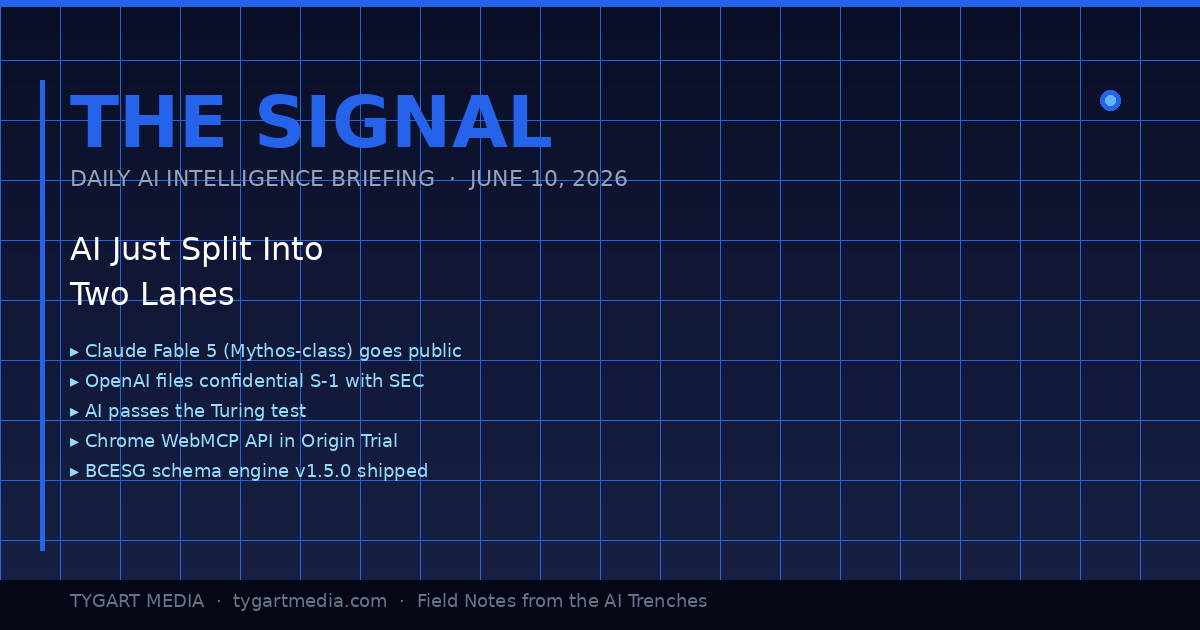
June 10, 2026: The Day the Lanes Forked
Today was the kind of day where you can feel the road forking under your tires. Not because one thing happened — because eight things happened simultaneously, and if you squint at the pattern, they all point the same direction: AI just stopped being a product category and started being infrastructure. The plumbing layer. The thing you build on top of, not the thing you buy.
I’ve been building with Claude since the Haiku days. I run it 12 hours a day across 20+ WordPress sites, a five-site knowledge cluster on Google Cloud, and a custom schema engine I shipped yesterday. When the landscape shifts, I don’t read about it on TechCrunch — I feel it in the tooling. And today, the tooling lurched forward in a way that matters.
Here’s the daily signal.
Claude Fable 5: Mythos-Class AI Goes Public
Anthropic launched Claude Fable 5 yesterday — the first publicly available Mythos-class model, a tier above Opus. Pricing is $10 per million input tokens and $50 per million output tokens. It’s the most capable model Anthropic has ever released to the general public, state-of-the-art on nearly every benchmark, and it comes with a fascinating constraint: queries on certain topics automatically route to Opus 4.8 instead, triggering in less than 5% of sessions. Anthropic is essentially saying: here’s the most powerful thing we’ve ever built, and we’ve installed guard rails at the edge cases where power becomes risk.
For agencies and small business operators, the practical read is this: Fable 5 is included on Pro, Max, Team, and Enterprise plans through June 22 at no extra cost. After that, it comes off the subscription tiers. If you’re building workflows that depend on Mythos-class reasoning, you have 12 days to test whether the capability justifies the API cost — or whether Opus and Sonnet handle your actual use cases just fine.
The real signal isn’t the model itself. It’s that Anthropic also doubled Cowork limits at no charge and shipped Claude Managed Agents in public beta. They’re not just selling you a smarter model — they’re selling you an operating system for delegating work to AI. That’s a fundamentally different product than a chatbot.
Meanwhile, I Was Building the Infrastructure Layer — Not Reading About It
While the tech press was writing headlines about Fable 5, I was elbow-deep in the kind of work that actually turns these models into business value. Yesterday, across a 14-hour session, my team — which at this point is me and a fleet of Claude instances — shipped three things that matter more to my clients than any benchmark score:
1. bcesg-knowledge-api v1.5.0 — a custom WordPress plugin I built and deployed across BCESG.org that outputs a JSON-LD @graph array containing Article, FAQPage, Organization, WebPage, BreadcrumbList, Person (author), and speakable schema — all generated from 13 custom meta fields. This isn’t a schema plugin you install from the WordPress directory. It’s a purpose-built schema engine designed for one thing: making every page on the site machine-readable enough that AI systems cite it as an authoritative source. That’s Generative Engine Optimization at the infrastructure level, not the content level.
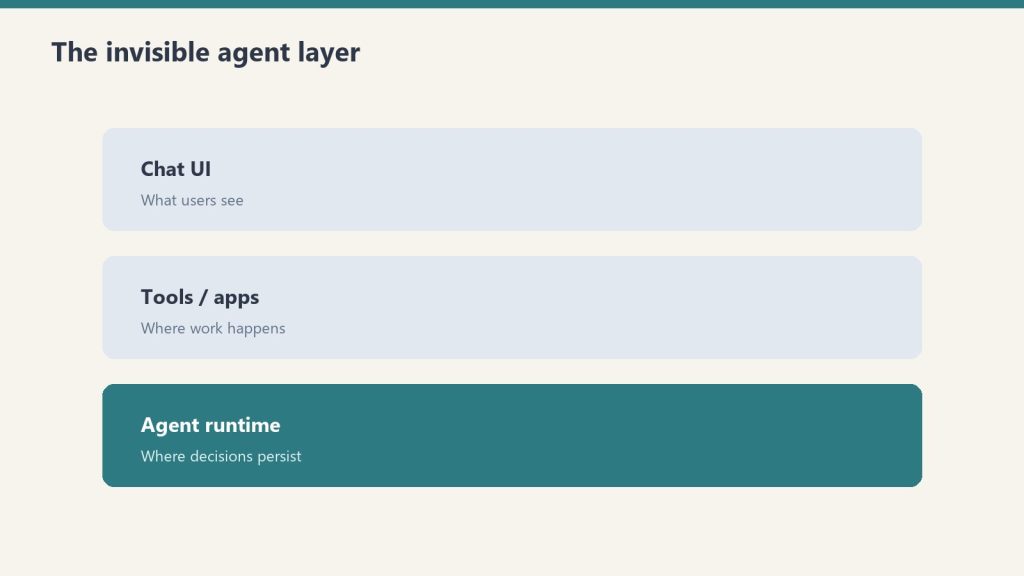
2. WordPress 7.0 across the entire knowledge cluster. All five sites — bcesg.org, restorationintel.com, riskcoveragehub.com, continuityhub.org, and healthcarefacilityhub.org — upgraded from WP 6.9.4 to 7.0. Why does this matter? Because WordPress 7.0 ships the Abilities API: agent-to-agent communication endpoints. That means my Claude-powered content pipelines can now negotiate directly with WordPress about what they’re allowed to do, without me acting as the middleware. The cluster just became AI-native infrastructure.
3. The stack around it. RankMath SEO installed with the schema module deliberately disabled — because the custom plugin handles schema, and two schema systems fighting each other is worse than none at all. IndexNow for instant search engine notification on every publish and update. Microsoft Clarity for behavioral analytics so I can see what humans actually do when they land on AI-optimized content.
And here’s the detail that would have been impossible to explain six months ago: the peer review on the bcesg-knowledge-api plugin was done by Claude Fable 5 reviewing the code that Claude Opus wrote. AI reviewing AI’s code. In production. On a live WordPress cluster. That’s not a demo — that’s Tuesday.
OpenAI’s S-1 and the $965 Billion Elephant
OpenAI filed a confidential S-1 with the SEC. They’re going public. Meanwhile, Anthropic hit a $965 billion valuation. These two facts, side by side, tell you everything about where the money thinks AI is going: it’s going to be the most valuable infrastructure layer since cloud computing, and the market is pricing it that way before most businesses have figured out how to use it.
For small business owners and agency operators, this isn’t abstract finance news. It means the tools you’re using today — Claude, GPT, Gemini — are backed by companies with enough capital to keep shipping improvements for years. The platform risk isn’t that these companies disappear. The platform risk is that you don’t build on them fast enough and your competitors do.
AI Passed the Turing Test. Now What?
A UC San Diego study published in PNAS confirmed that OpenAI’s GPT-4.5 and Meta’s Llama-3.1-405B both passed a standard three-party Turing test — with GPT-4.5 being identified as human 73% of the time when given a persona prompt, significantly more often than actual human participants. This has been treated as a milestone headline, and it is one, but the practical implication is more subtle than “AI can fool humans.”
What it actually means: the content quality bar just moved permanently. If AI can produce text that’s indistinguishable from a human expert, then the only content that wins is content with something AI can’t fake — lived experience, proprietary data, operational specifics, the kind of “I shipped this yesterday and here’s what happened” detail that no model can generate from training data. This is why I write The Signal as field notes, not as analysis. Analysis can be generated. Field notes from the arena cannot.
Chrome WebMCP: The Browser Becomes an AI Endpoint
Google shipped the Chrome WebMCP API in Origin Trial for Chrome 149 through 156. The Model Context Protocol — the same protocol that lets Claude connect to external tools, databases, and APIs — is now a browser-native capability. Web applications can expose structured tool interfaces that AI models call directly.
This is a bigger deal than it sounds. Right now, when Claude interacts with a web application, it’s either through a dedicated MCP server or through browser automation (clicking pixels on a screen like a human would). WebMCP means any web app can define a structured API surface that AI agents consume natively. For agencies building client tools, this is the moment your internal dashboards and client portals become AI-ready without a full backend rewrite.
If you’re running WordPress sites — and 43% of the web is — this has direct implications for how AI agents interact with your content management layer. The gap between “website” and “AI-accessible knowledge base” just narrowed dramatically.
The GPU Infrastructure Play: xAI Becomes an AI REIT
Elon Musk’s xAI, home of Grok, is increasingly looking less like an AI model company and more like a GPU real estate investment trust. They’re partnering with both Anthropic and Google to provide compute infrastructure. This is the clearest sign yet that the AI industry is stratifying into two distinct layers: model companies (who build the brains) and infrastructure companies (who build the data centers those brains run in).
For builders, this is good news. More compute supply means more pricing competition means lower API costs over time. The $10/$50 per million tokens for Fable 5 today will look expensive in 18 months.
The Security Layer Nobody’s Talking About
HashiCorp announced Boundary for agentic AI — access security specifically designed for AI agents that need to authenticate across multiple systems. And MemPalace shipped a local-first AI memory system with 96.6% recall accuracy and 29 MCP tools for Claude Code.
These aren’t headline products. They’re infrastructure connective tissue. When AI agents can securely authenticate across your entire tool stack (HashiCorp Boundary) and maintain persistent memory across sessions (MemPalace), you stop using AI for one-off tasks and start using it as a persistent operational layer. That’s the transition my agency is making right now — from “Claude helps me write articles” to “Claude runs the content pipeline while I focus on strategy.”
What This All Means: The Two-Lane Highway
Here’s the pattern I see when I lay these signals side by side:
Lane 1: The AI product lane. This is where most people are. They use ChatGPT to draft emails. They ask Claude to summarize documents. They treat AI as a productivity tool, like a faster Google or a better autocomplete. This lane is getting crowded, commoditized, and — with the Turing test results — increasingly indistinguishable from one provider to the next.
Lane 2: The AI infrastructure lane. This is where the alpha is. Custom schema engines. Agent-to-agent communication via the WordPress Abilities API. Browser-native MCP endpoints. Persistent AI memory. Secure multi-system authentication for autonomous agents. This lane is where you stop using AI and start building on AI — where it becomes the foundation layer of your operations, not an add-on.
The gap between these two lanes is widening every day. Today’s eight signals all point the same direction: toward a world where the businesses that win aren’t the ones that use AI tools the best, but the ones that build AI infrastructure the fastest.
I’m building in Lane 2. Yesterday it was a custom schema engine and a WordPress 7.0 cluster upgrade. Today it’s field-testing Fable 5 as a code reviewer. Tomorrow it’ll be whatever the next signal demands.
The question isn’t whether AI is going to transform your industry. That’s settled. The question is whether you’re in the arena building the infrastructure, or on the sidelines reading about people who are.
— Will Tygart, Tygart Media
Frequently Asked Questions
What is Claude Fable 5 and how does it differ from Claude Opus?
Claude Fable 5 is Anthropic’s first publicly available Mythos-class AI model, released June 9, 2026. It sits a tier above Claude Opus in capability, priced at $10 per million input tokens and $50 per million output tokens. Fable 5 is state-of-the-art on nearly all tested benchmarks and includes built-in safeguards that route certain queries to Opus 4.8, triggering in less than 5% of sessions. It’s available free on subscription plans through June 22, 2026.
What is the Chrome WebMCP API and why does it matter for businesses?
The Chrome WebMCP API, now in Origin Trial for Chrome versions 149 through 156, brings the Model Context Protocol natively into the browser. This allows web applications to expose structured tool interfaces that AI models can call directly — eliminating the need for dedicated backend integrations or browser automation. For businesses running web-based tools, dashboards, or WordPress sites, this means your existing applications can become AI-accessible without a full rebuild.
What is the WordPress 7.0 Abilities API?
The WordPress 7.0 Abilities API provides agent-to-agent communication endpoints, allowing AI-powered systems to negotiate capabilities and permissions directly with a WordPress installation. This transforms WordPress from a content management system into AI-native infrastructure where automated pipelines can query what operations they’re authorized to perform without human middleware.
What does AI passing the Turing test mean for content creators?
A UC San Diego study published in PNAS found that OpenAI’s GPT-4.5 and Meta’s Llama-3.1-405B both passed a standard three-party Turing test in 2026 — GPT-4.5 was identified as human 73% of the time with persona prompting. For content creators, this permanently raises the quality bar — the only content that wins is content with elements AI cannot fake: lived experience, proprietary data, operational specifics, and first-person field reports that no model can generate from training data alone.
What is Generative Engine Optimization (GEO) and how does it work?
Generative Engine Optimization is the practice of structuring web content so AI systems — including ChatGPT, Claude, Gemini, Perplexity, and Google AI Overviews — cite, reference, and recommend it. GEO involves entity enrichment, structured data (JSON-LD schema), authoritative citations, and machine-readable formatting. Unlike traditional SEO which targets search engine crawlers, GEO targets the large language models that increasingly mediate how users discover information.
How should small businesses approach AI infrastructure in 2026?
Start by moving from Lane 1 (using AI as a productivity tool) to Lane 2 (building AI into your operational infrastructure). Practical first steps include implementing structured data and schema markup on your website, setting up AI-optimized content pipelines, ensuring your site is crawlable by AI systems via protocols like LLMS.txt, and testing agentic workflows where AI handles multi-step operational tasks autonomously rather than single-prompt interactions.
What is a custom schema engine and why build one instead of using plugins?
A custom schema engine is a purpose-built WordPress plugin that generates structured data (JSON-LD) tailored to specific business objectives — in this case, AI citation optimization. Unlike off-the-shelf schema plugins that generate generic markup, a custom engine outputs precisely the entity relationships, author signals, and speakable content markers that AI systems use when deciding which sources to cite. The bcesg-knowledge-api plugin generates a seven-type @graph array from 13 custom meta fields, providing a level of control that no general-purpose plugin offers.
What is the significance of AI reviewing AI-written code in production?
When Claude Fable 5 peer-reviewed code written by Claude Opus for a production WordPress plugin, it demonstrated a mature AI development workflow where different model tiers serve different roles — one for generation, another for quality assurance. This mirrors human development practices (developer writes, senior reviews) but at machine speed and cost. It’s a practical example of how AI agent collaboration is already operational in real business infrastructure, not just research demos.
The Signal is published daily on Tygart Media by Will Tygart. Each edition distills the day’s most consequential AI, search, and technology developments into actionable intelligence for agencies, small business operators, and builders shipping real AI infrastructure.