Claude wins on coding quality and long-context reliability. GPT-5 wins on raw speed at the prior mid-tier list. Pick the SKU, not the family name.
Claude figures checked October 8, 2026 against platform.claude.com pricing and Haiku 5.5. OpenAI rows below are the October 1 figures on this page; they were not re-verified on this pass.
The Models Being Compared
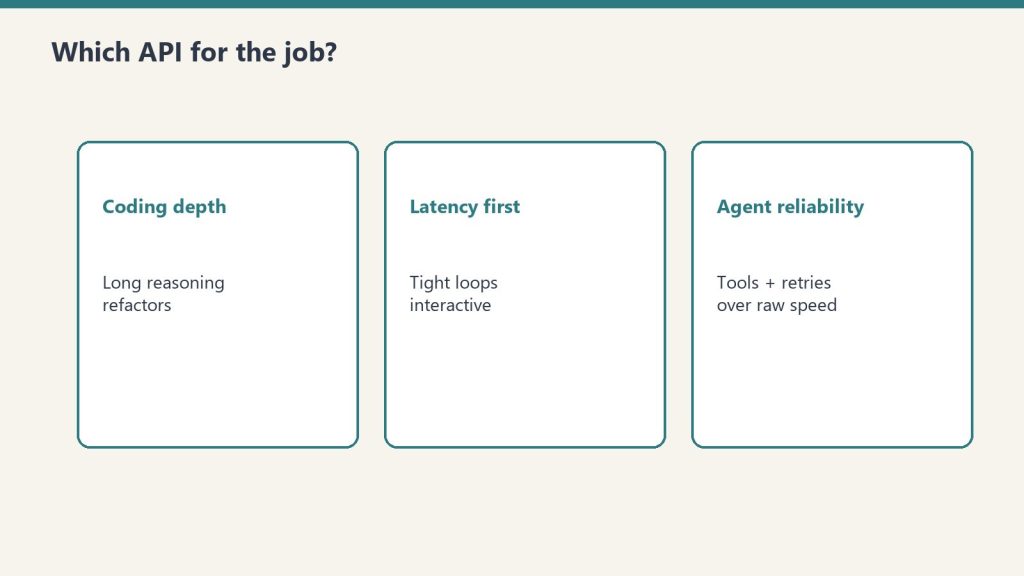
Compare APIs by job shape — not by hype.
Compare Claude Haiku 5.5 / Sonnet 5.5 / Opus 5.5 against GPT-5 / gpt-6.1-sol. Fable 5.1 sits above Opus on Anthropic’s list price.
Model
Provider
Input (per 1M tokens)
Output (per 1M tokens)
Context
Claude Haiku 5.5 (≤100k / >100k)
Anthropic
$0.10 / $0.50
$0.50 / $2.50
priced by prompt length
Claude Haiku 4.5
Anthropic
$1
$5
still listed
Claude Sonnet 5.5
Anthropic
$2
$10
1M tokens; cache read $0.10
Claude Sonnet 5
Anthropic
$2
$10
1M tokens; cache read $0.20
Claude Sonnet 4.6
Anthropic
$3
$15
1M tokens
Claude Opus 5.5
Anthropic
$4
$20
1M tokens
Claude Opus 5 / 4.8
Anthropic
$5
$25
1M tokens
Claude Fable 5.1
Anthropic
$10
$50
1M tokens
GPT-5
OpenAI
$1.25
$10
400K tokens (Oct 1 figure)
gpt-6.1-sol (short-context standard)
OpenAI
$2
$10
long-context row was $4 / $15 (Oct 1 figure)
Sonnet 5.5 remains $2 / $10. Its cache read moved from $0.20 to $0.10 on October 7. Opus 5.5 remains $4 / $20 with cache reads at $0.20. Haiku 5.5 is the new cheap band: $0.10 / $0.50 under 100,000 prompt tokens, $0.50 / $2.50 over. Haiku 4.5 stays $1 / $5. GPT-5 standard list on the prior check ($1.25 / $10) was cheaper per input token than Sonnet 5.5. Do not average Haiku 5.5’s two bands, and do not treat the OpenAI rows as re-checked today.
Coding Performance
Use Claude Opus 5.5 or Sonnet 5.5 for interactive coding and agentic runs. Use Haiku 5.5 when the task is a subagent, summary, or classification and the prompt stays under 100k tokens.
Latency and Context
Claude Sonnet and Opus SKUs publish a 1M token context window at one rate. Haiku 5.5 raises the rate above 100,000 prompt tokens. Opus 5.5 fast mode is $8 / $40 on the Claude API only.
Cost Comparison for Real Workloads
On Claude, cache reads are now 5% of input on Sonnet 5.5 ($0.10) and Opus 5.5 ($0.20), and 2.5% on Fable 5.1 ($0.25). Haiku 5.5 cache reads are $0.01 under 100k. The 50% batch API still applies. For stateless high-frequency calls, Haiku 5.5 under 100k is the Claude list to beat. gpt-6.1-sol short-context matched Sonnet 5.5 at $2 / $10 on the October 1 check; that OpenAI pair was not re-read today.
Which API to Choose
Use Claude for coding, long-context document work, and agentic workflows. Use Haiku 5.5 for the cheap loop. Running both vendors is normal.
Microsoft has LinkedIn and enterprise distribution. Google has the native stack. Notion has the database architecture. OpenAI has something none of them have: 1.2 billion people a week who already open ChatGPT when they want to get something done. That’s not a product advantage. That’s a behavior advantage. And behavior is the hardest moat to breach.
Where OpenAI Sits in This Series
This is the fifth piece examining who builds the everything app. We’ve covered Microsoft, Google, Notion, and the everything database frame. OpenAI’s path is the most unusual: they’re not building from infrastructure up. They’re building from user behavior down.
The Model Reality First — Get This Right
Model reality first — get this right.
Before the strategy discussion, the model facts — because the landscape shifted significantly in early 2026 and the marketing doesn’t always match what’s actually deployed.
As of mid-2026, OpenAI’s current flagship is GPT-5.5, which powers ChatGPT Enterprise (unlimited messages) and is the reasoning backbone of the unified super-assistant experience. The o-series models, such as o3, are the thinking models, trained to reason longer before responding; o3 is the deep-reasoning option. o4-mini, the former high-throughput option, was retired from ChatGPT on February 13, 2026, though it remains available in the API.
Notably, GPT-4o, GPT-4.1, and GPT-4.1 mini were retired from ChatGPT as of February 13, 2026. Enterprise customers retained GPT-4o access until April 3, 2026. If you’re referencing these models in your stack — in tutorials, in documentation, in integrations — those references are now stale. OpenAI’s lineup keeps moving: at DevDay on September 29, 2026, it showcased GPT-6 Astra and revealed GPT-6.1 Sol.
One more significant infrastructure move: the Assistants API was deprecated and removed from the API on August 26, 2026. OpenAI is replacing it with the Responses API — a new primitive that combines Chat Completions simplicity with Assistants-style tool use, supporting web search, file search, and computer use natively. If you built on the Assistants API, your integration needs to run on the Responses API now.
OpenAI’s Everything App Bet: Behavior Over Infrastructure
Behavior over infrastructure.
Microsoft’s everything app bet is infrastructure — they own the OS, the enterprise software stack, and a professional network. Google’s bet is native stack — they own search, email, calendar, and mobile. Both are building from the platform up.
OpenAI is doing the opposite. They’re starting from where people already go to get things done, and expanding outward from that behavioral beachhead. ChatGPT’s 1.2 billion weekly users don’t use it because it owns their email. They use it because it’s the fastest path from question to answer, from idea to draft, from problem to solution.
The everything app doesn’t have to own your data. It just has to be the place you go first. OpenAI is betting that if they can make ChatGPT good enough at enough things — and fast enough at integrating with the tools you already use — the behavioral habit becomes the moat. You stop going to Google first. You stop opening a new app. You open ChatGPT.
The Pieces OpenAI Has Assembled
The consolidation has been quieter than Microsoft’s marketing machine or Google’s Cloud Next announcements, but the pieces are substantial.
Operator — the computer-using agent — launched as a research preview in early 2025 and integrated fully into ChatGPT by mid-year. It browses, clicks, fills forms, and manages logins autonomously. GPT-5.5’s score on OSWorld-Verified — the standard benchmark for computer-use agents — is 78.7%. The human baseline on the same benchmark is 72.4%. That’s not a lab result. That’s production-grade desktop and browser automation beating human performance on standardized tasks.
Projects and Memory — launched across late 2024 and 2025 — give ChatGPT persistent context across sessions. Projects (December 2024) let you organize work by context. Project Memory (August 2025) lets ChatGPT learn your preferences, communication style, and working patterns over time. This is the foundational layer for the everything app: an AI that knows you, not just your current prompt.
Workspace Agents for Enterprise — launched April 22, 2026 — let enterprise teams create, share, and manage AI agents for workflow automation. Powered by Codex, these agents handle reporting, coding, and messaging tasks autonomously. This is OpenAI’s direct enterprise play, competing with Microsoft’s Agent 365 and Google’s Workspace Studio on their home turf.
Sora 2 — released September 2025 — moved AI video from novelty to production-grade. It’s available both as a standalone app and deeply integrated within ChatGPT. Video generation, image creation, voice, code execution, deep research, file analysis — all inside one interface. The surface area of what ChatGPT can do has expanded faster than most people have tracked.
The Apps SDK and MCP support — announced in 2025 — let developers build UIs alongside MCP servers, defining both logic and interactive interface of applications that run inside ChatGPT. OpenAI is building a developer ecosystem where third-party tools surface inside ChatGPT natively, not as links out to other apps.
The Honest Strategic Weakness: OpenAI Doesn’t Own the Data Layer
Honest weakness — doesn’t own the data layer.
Here’s the structural problem with OpenAI’s everything-app path that doesn’t get enough attention.
Microsoft owns the calendar data, the email data, the document data, the professional network data. Google owns the same stack natively. Notion owns the database architecture where your operational data lives. OpenAI owns a conversation history and whatever files you’ve uploaded to Projects.
That’s a meaningful gap. When you ask Microsoft Copilot “what happened in last week’s client meeting?” it can actually answer — because it has the calendar event, the Teams recording transcript, and the follow-up email thread. When you ask ChatGPT the same question, the answer is only as good as what you’ve explicitly provided.
OpenAI’s answer to this is Operator and the connector ecosystem — let ChatGPT reach into your existing tools and pull the data it needs. That works, but it creates a dependency chain that Microsoft and Google don’t have. Every integration is a point of failure. Every API change is a breakage risk. Every permission prompt is friction that erodes the behavioral habit.
The Responses API — replacing the Assistants API in August 2026 — is designed to close some of this gap with native web search, file search, and computer use built in. But native search is not the same as owning the inbox. And computer use, for all its benchmark performance, is still slower and less reliable than a dedicated integration.
Where OpenAI Wins: The Consumer and Creator Layer
The enterprise everything-app race may go to Microsoft or Google by default — too much infrastructure, too many IT relationships, too much compliance architecture for a newcomer to overcome in 18 months.
But the consumer and creator layer is wide open. And that’s where OpenAI’s behavioral moat matters most.
For freelancers, solopreneurs, content creators, small agencies, and knowledge workers who aren’t tied to an enterprise IT environment, ChatGPT is already the everything app. It drafts your emails, edits your copy, analyzes your data, generates your images, browses for research, and runs your automations. The question isn’t whether they’ll adopt it — they already have. The question is whether OpenAI deepens that relationship fast enough to make switching costly before Microsoft and Google catch up on the consumer side.
Memory is the weapon here. The longer a user runs their work through ChatGPT Projects with memory enabled, the more context OpenAI accumulates about how that person thinks, works, and communicates. That context is genuinely hard to transfer to a competing platform. It’s not data in a database — it’s learned behavioral preference. The switching cost compounds with every session.
The Operator Economy: OpenAI’s Wildcard
The most underrated piece of OpenAI’s everything-app strategy isn’t ChatGPT itself — it’s the operator ecosystem.
An “operator” in OpenAI’s framework is any business that deploys ChatGPT capabilities inside their own product. Every company building on the OpenAI API — embedding ChatGPT into their CRM, their help desk, their e-commerce platform, their internal tools — is an operator. Every one of those deployments is a surface where OpenAI’s models become the intelligence layer of someone else’s everything app.
Microsoft has Copilot. Google has Gemini. But neither of them has the sheer number of third-party applications already running on their models that OpenAI has accumulated. The operator ecosystem means OpenAI doesn’t have to build every surface themselves. They just have to remain the model that operators trust most — and as long as GPT-5.5 and the o-series stay at the frontier of capability, that trust is relatively durable.
The Workspace Agents launch, combined with the Apps SDK and MCP support, is OpenAI formalizing this operator model for enterprise. They’re saying: we won’t replace your enterprise software stack. We’ll become the reasoning layer that sits across all of it.
What This Means for Your Stack Right Now
If you’re building on OpenAI’s API or running workflows through ChatGPT, three immediate action items:
Finish your Assistants API migration. The Assistants API was removed on August 26, 2026, and the Responses API migration path is documented.
Enable Projects and Memory for your team’s ChatGPT accounts. The compounding advantage of memory only builds if you start using it. Teams that have six months of Project memory by Q4 2026 will have a materially different AI experience than teams starting fresh.
Think about where ChatGPT sits relative to your Notion database. OpenAI’s operator model and MCP support mean ChatGPT can connect to your Notion everything database via the Notion Public API. The everything database frame doesn’t require you to choose between Notion and ChatGPT — it lets you use both, with Notion as the structured data layer and ChatGPT as the reasoning and action surface on top of it.
The everything app race isn’t over. OpenAI has the behavior moat, the operator ecosystem, and the fastest-moving model roadmap of any company in this field. What they don’t have is the data infrastructure that Microsoft and Google own by default. How they close that gap — through connectors, through Operator’s computer-use capabilities, through the Responses API — will determine whether ChatGPT becomes the everything app or the everything layer sitting on top of someone else’s everything app.
Both outcomes are valuable. Only one of them wins the race.
As of mid-2026, GPT-5.5 is OpenAI’s primary model powering ChatGPT Enterprise. The o3 model handles deep reasoning tasks. GPT-4o, GPT-4.1, GPT-4.1 mini, and o4-mini were retired from ChatGPT on February 13, 2026. The Assistants API was removed on August 26, 2026, replaced by the Responses API. At DevDay on September 29, 2026, OpenAI showcased GPT-6 Astra and revealed GPT-6.1 Sol.
What is the OpenAI Responses API?
The Responses API is OpenAI’s replacement for the Assistants API (sunset August 26, 2026). It combines Chat Completions simplicity with Assistants-style tool use, supporting built-in web search, file search, and computer use. It’s the new primitive for building agents on OpenAI’s platform.
What are OpenAI Workspace Agents?
Launched April 22, 2026, Workspace Agents let enterprise teams create, share, and manage AI agents for workflow automation inside ChatGPT. Powered by Codex, they handle reporting, coding, and messaging tasks autonomously — OpenAI’s direct enterprise play against Microsoft Agent 365 and Google Workspace Studio.
How does ChatGPT Operator work?
Operator is OpenAI’s computer-using agent — it browses, clicks, fills forms, and manages logins autonomously. GPT-5.5 scores 78.7% on the OSWorld-Verified benchmark for computer-use tasks, above the 72.4% human baseline. It’s integrated directly into the ChatGPT interface for eligible plans.
Can ChatGPT connect to a Notion database?
Yes. Via the Notion Public API and OpenAI’s MCP support and connector ecosystem, ChatGPT can read from and interact with Notion databases. This makes the “everything database” architecture viable with OpenAI as the reasoning surface — Notion holds the structured data, ChatGPT reasons and acts on it.
The Signal — Tygart Media's weekly brief. What we actually ran, what it measured, and what it means for a restoration shop.