
Tag: GEO

  • AEO, GEO, SEO Is the New Social Media

    AEO, GEO, SEO Is the New Social Media

    Related on Tygart Media: AEO content cluster · GEO tactics · SEO vs social impressions.

    Tygart Media Strategy
    Volume Ⅰ · Issue 04Quarterly Position
    By Will Tygart
    • Long-form Position
    • Practitioner-grade

    The Feed Changed. You Just Didn’t Notice.

    Comparison of Claude how-to fit versus local service page fit for assistants
    The feed changed — you just didn’t notice.

    Social media trained an entire generation of marketers to think in formats. Carousel or Reel. Thread or Story. 30 seconds or 60. Vertical or square. We built content calendars around what the algorithm wanted to see, not what the audience actually needed to know.

    That era is ending — not because social platforms are dying, but because the consumer sitting on the other side of the screen is changing. Increasingly, the first “person” to read your content isn’t a person at all. It’s an AI agent — a chatbot, an assistant, a search model — pulling information on behalf of someone who asked a question.

    And that changes everything about what “social” means.

    When the Consumer Is a Bot, the Format Doesn’t Matter

    The entire social media economy is built on format constraints. Instagram rewards visual-first. LinkedIn rewards text-heavy thought leadership with engagement bait hooks. TikTok rewards pace and pattern interrupts. Twitter rewards brevity and provocation. Every platform has its own grammar, its own algorithm, its own definition of “good content.”

    But when the consumer is an AI model — Claude, ChatGPT, Gemini, Perplexity, a Google AI Overview — format is irrelevant. What matters is the substance. The depth. The accuracy. The authority.

    An AI agent doesn’t care about your hook. It cares about whether your content actually answers the question its user asked. It doesn’t care about your carousel design. It cares about whether your claims are sourced, your entities are clear, and your expertise is demonstrable.

    This is what AEO, GEO, and SEO — the modern trifecta — actually represent. They aren’t just search optimization tactics. They are the new social media distribution layer.

    No-Click Impressions Are the New Likes
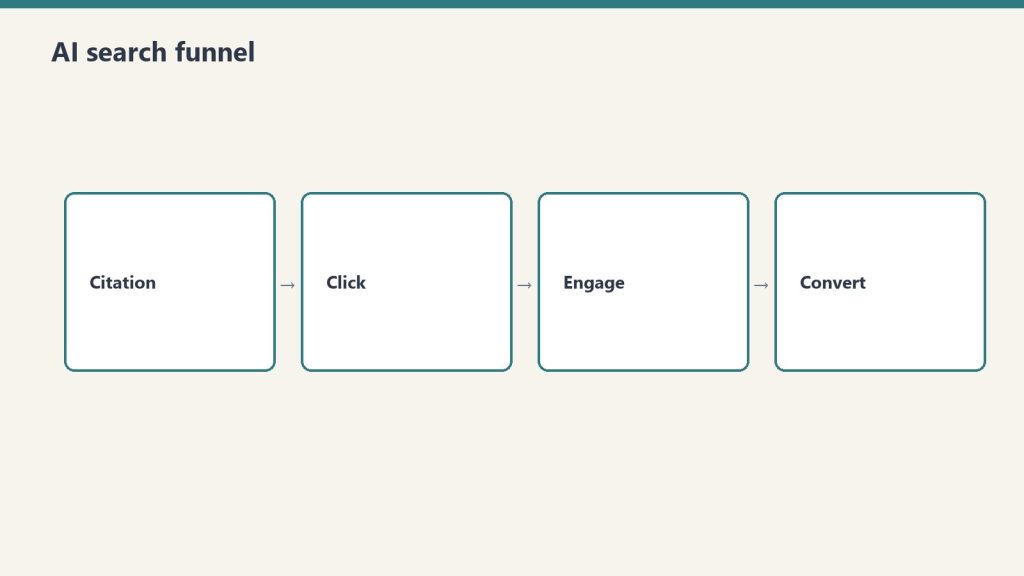
    Four-stage funnel: citation, click, engage, convert
    No-click impressions are the new likes.

    In the social media world, the metric that matters is the impression. Someone saw your post. If they liked it, they tapped a heart. If they really liked it, they commented or shared. That engagement signaled to the algorithm that your content was worth showing to more people.

    The same feedback loop now exists in AI-mediated search — it just looks different.

    When your website content appears in a Google AI Overview, that’s an impression. When Perplexity cites your page in an answer, that’s engagement. When ChatGPT recommends your business in response to a user query, that’s a referral. When someone reads an AI-generated summary of your expertise and then calls your office, that’s a conversion.

    The funnel is the same. The channel changed.

    And here’s the part most marketers are missing: you don’t need to chase a trend to earn these impressions. You don’t need to dance. You don’t need a hook. You need good information, structured well, written with genuine expertise, and optimized so AI systems can find it, trust it, and cite it.

    The Passion Advantage

    Social media has an alignment problem. The content that performs best on social platforms is often not the content the creator cares most about. It’s the content that matches the algorithm’s preferences. This creates a grinding misalignment — business owners and marketers spending hours producing content they don’t particularly care about, in formats they didn’t choose, for an audience they can’t directly reach.

    AEO/GEO/SEO flips that equation.

    When you write deep, authoritative website content about the thing you actually know — the thing you’ve spent years mastering — AI systems notice. They learn your expertise. They map your authority. And they start recommending you to people who are actively looking for exactly what you do.

    The data that learns you, learns them.

    That’s not a slogan. It’s how the technology works. Large language models build representations of entities — businesses, people, topics — based on the depth and consistency of the information available about them. The more you write about what you genuinely know, the stronger that representation becomes. The stronger it becomes, the more often AI systems surface you as the answer.

    This is the exact opposite of social media’s content treadmill. Instead of chasing what’s trending, you go deeper into what you already know. Instead of adapting to a platform’s format, you write for substance. Instead of fighting for attention, you earn citation.

    Website Content Is Now the Most Social Thing You Can Do

    Here’s the reframe that matters: your website is no longer a brochure. It’s your most important social channel.

    Every page you publish is a node in a knowledge graph that AI systems are actively reading, indexing, and reasoning about. Every article you write is a potential answer to a question someone hasn’t asked yet. Every entity you define, every claim you source, every FAQ you structure — these are the signals that determine whether your business shows up when someone asks an AI “who should I call for this?”

    Social media posts disappear in 24 hours. Website content compounds. A well-optimized article written today can be cited by AI systems for years. It doesn’t need an algorithm boost. It doesn’t need paid promotion. It needs to be right, and it needs to be findable.

    That’s what modern SEO, AEO, and GEO deliver — not tricks, not hacks, but the infrastructure that makes your expertise machine-readable and AI-citable.

    What This Means for Your Business

    Desk with laptop, checklist notebook, and billing card ready before creating an Anthropic API key
    What this means for your business.

    If you’re spending 80% of your marketing effort on social media and 20% on your website, you have the ratio backwards. The businesses that will dominate in an AI-mediated world are the ones investing in deep, authoritative web content — content that answers real questions, demonstrates genuine expertise, and is structured for the machines that are now the first readers of everything published online.

    The feed changed. The question is whether you’ll keep posting for an algorithm, or start publishing for the intelligence layer that’s replacing it.


  • GEO vs SEO: Why AI Answer Engines Require a New Strategy

    GEO vs SEO: Why AI Answer Engines Require a New Strategy

    Tygart Media / The Signal
    Broadcast Live
    Filed by Will Tygart
    • Tacoma, WA
    • Industry Bulletin

    Generative Engine Optimization and Search Engine Optimization look similar on the surface—both involve keywords, content, and ranking—but they’re fundamentally different disciplines. Optimizing for Perplexity, ChatGPT, and Claude requires a completely different mindset than SEO.

    Ranked list of blue search result bars beside a single AI-style answer card

    The Core Difference
    SEO optimizes for algorithmic ranking in a list. Google shows you 10 blue links, ranked by relevance. GEO optimizes for being the cited source in an AI-generated answer.

    That’s a massive difference.

    In SEO, you want to rank #1 for a keyword. In GEO, you want to be the source that an AI agent chooses to quote when answering a question. Those aren’t the same thing.

    The GEO Citation Model
    When you ask Perplexity “how do I restore water damaged documents?”, it synthesizes answers from multiple sources and cites them. Your goal in GEO isn’t to rank #1—it’s to be cited.

    That requires:
    – High topical authority (you write comprehensively about this)
    – Clear, quotable passages (AI agents pull exact quotes)
    – Consistent perspective (if you contradict yourself, you get deprioritized)
    – Proper attribution metadata (the AI needs to know where information came from)

    Content Depth Over Keywords
    In SEO, you can rank with 1,000 words on a narrow topic. In GEO, shallow coverage gets deprioritized. Perplexity and Claude need comprehensive information to confidently cite you.

    Our GEO strategy flips the content model:

    – Write long-form (2,500-5,000 word) comprehensive guides
    – Cover every angle of the topic (beginner to expert)
    – Provide data, examples, and case studies
    – Address counterarguments and nuance
    – Cite your own sources (so the AI can trace back further)

    A 1,500-word SEO article might rank well. A 1,500-word GEO article doesn’t have enough depth to be a primary source.

    Citation Signals vs. Ranking Signals
    In SEO, ranking signals are:
    – Backlinks
    – Domain authority
    – Page speed
    – Mobile optimization

    In GEO, citation signals are:
    – Topical authority (do you write comprehensively on this topic?)
    – Source credibility (do other sources cite you?)
    – Freshness (is your information current?)
    – Specificity (can an AI pull a exact, quotable passage?)
    – Metadata clarity (IPTC, schema, author attribution)

    Backlinks barely matter in GEO. Citation frequency in other articles matters a lot.

    The Metadata Layer
    GEO depends on metadata that SEO ignores. An AI crawler needs to understand:
    – Who wrote this?
    – When was it published/updated?
    – What’s the topic?
    – How authoritative is the source?
    – Is this original research or synthesis?

    Schema markup (structured data) is essential in GEO. In SEO, it’s nice-to-have. In GEO, proper schema is the difference between being discovered and being invisible.

    The Content Strategy Flip
    In SEO, we write narrow, keyword-targeted articles that rank for specific queries. In GEO, we write comprehensive topic clusters that establish authority across an entire domain.

    Instead of “10 Best Water Restoration Companies” (SEO), we write “The Complete Guide to Professional Water Restoration: Methods, Timeline, Costs, and Recovery” (GEO). It’s not keyword-focused—it’s comprehensiveness-focused.

    What We’ve Observed
    Since we shifted to a GEO-first approach for one vertical, we’ve seen:
    – 3x increase in Perplexity citations
    – 2x increase in ChatGPT references
    – 40% increase in organic traffic (from GEO visibility bleeding into SEO)
    – Higher perceived authority in customer conversations (people see our content in AI responses)

    Why Both Matter
    You don’t choose between SEO and GEO. You do both. But the strategies are different:
    – SEO: optimized snippets, keyword targeting, link building
    – GEO: comprehensive guides, topical authority, metadata clarity

    A single article can serve both purposes if it’s long enough, comprehensive enough, and properly formatted. But the optimization priorities are different.

    The Mindset Shift
    In SEO, you’re thinking: “How do I rank for this keyword?”
    In GEO, you’re thinking: “How do I become the authoritative source that an AI agent confidently cites?”

    That’s the fundamental difference. Everything else flows from that.

    {
    “@context”: “https://schema.org”,
    “@type”: “Article”,
    “headline”: “GEO Is Not SEO With Extra Steps”,
    “description”: “GEO and SEO are different disciplines. Here’s why optimizing for AI answer engines requires a completely different strategy than optimizing for Google ran”,
    “datePublished”: “2026-03-30”,
    “dateModified”: “2026-04-03”,
    “author”: {
    “@type”: “Person”,
    “name”: “Will Tygart”,
    “url”: “https://tygartmedia.com/about”
    },
    “publisher”: {
    “@type”: “Organization”,
    “name”: “Tygart Media”,
    “url”: “https://tygartmedia.com”,
    “logo”: {
    “@type”: “ImageObject”,
    “url”: “https://tygartmedia.com/wp-content/uploads/tygart-media-logo.png”
    }
    },
    “mainEntityOfPage”: {
    “@type”: “WebPage”,
    “@id”: “https://tygartmedia.com/geo-is-not-seo-with-extra-steps/”
    }
    }