The Studio - Tygart Media

Category: The Studio

Way 7 — Music & Creative Work. Creative output, design thinking, media-rich editorial.

  • I Built 7 Autonomous AI Agents on a Windows Laptop. They Run While I Sleep.

    I Built 7 Autonomous AI Agents on a Windows Laptop. They Run While I Sleep.

    The Machine Room · Under the Hood

    The Night Shift That Never Calls In Sick

    Every night at 2 AM, while I’m asleep, seven AI agents wake up on my laptop and go to work. One generates content briefs. One indexes every file I created that day. One scans 23 websites for SEO changes. One processes meeting transcripts. One digests emails. One monitors site uptime. One writes news articles for seven industry verticals.

    By the time I open my laptop at 7 AM, the work is done. Briefs are written. Indexes are updated. Drift is detected. Transcripts are summarized. Total cloud cost: zero. Total API cost: zero. Everything runs on Ollama with local models.

    The Fleet

    I call them droids because that’s what they are – autonomous units with specific missions that execute without supervision. Each one is a PowerShell script scheduled as a Windows Task. No Docker. No Kubernetes. No cloud functions. Just scripts, a schedule, and a 16GB laptop running Ollama.

    SM-01: Site Monitor. Runs hourly. Pings all 18 managed WordPress sites, measures response time, logs to CSV. If a site goes down, a Windows balloon notification fires. Takes 30 seconds. I know about downtime before any client does.

    NB-02: Nightly Brief Generator. Runs at 2 AM. Reads a topic queue – 15 default topics across all client sites – and generates structured JSON content briefs using Llama 3.2 at 3 billion parameters. Processes 5 briefs per night. By Friday, the week’s content is planned.

    AI-03: Auto-Indexer. Runs at 3 AM. Scans every text file across my working directories. Generates 768-dimension vector embeddings using nomic-embed-text. Updates a local vector index. Currently tracking 468 files. Incremental runs take 2 minutes. Full reindex takes 15.

    MP-04: Meeting Processor. Runs at 6 AM. Scans for Gemini transcript files from the previous day. Extracts summary, key decisions, action items, follow-ups, and notable quotes via Ollama. I never re-read a transcript – the processor pulls out what matters.

    ED-05: Email Digest. Runs at 6:30 AM. Categorizes emails by priority and generates a morning digest. Flags anything that needs immediate attention. Pairs with Gmail MCP in Cowork for full coverage across 4 email accounts.

    SD-06: SEO Drift Detector. Runs at 7 AM. Checks all 23 WordPress sites for changes in title tags, meta descriptions, H1 tags, canonical URLs, and HTTP status codes. Compares against a saved baseline. If someone – a client, a plugin, a hacker – changes SEO-critical elements, I know within 24 hours.

    NR-07: News Reporter. Runs at 5 AM. Scans Google News RSS for 7 industry verticals – restoration, luxury lending, cold storage, comedy, automotive training, healthcare, ESG. Generates news beat articles via Ollama. 42 seconds per article, about 1,700 characters each. Raw material for client newsletters and social content.

    Why Local Beats Cloud for This

    The obvious question: why not run these in the cloud? Three reasons.

    Cost. Seven agents running daily on cloud infrastructure – even serverless – would cost -400/month in compute, storage, and API calls. On my laptop, the cost is the electricity to keep it plugged in overnight.

    Privacy. These agents process client data, email content, meeting transcripts, and SEO baselines. Running locally means none of that data leaves my machine. No third-party processing agreements. No data residency concerns. No breach surface.

    Speed of iteration. When I want to change how the brief generator works, I edit a PowerShell script and save it. No deployment pipeline. No CI/CD. No container builds. The change takes effect on the next scheduled run. I’ve iterated on these agents dozens of times in the past week – each iteration took under 60 seconds.

    The Compounding Effect

    The real power isn’t any single agent – it’s how they feed each other. The auto-indexer picks up briefs generated by the brief generator. The meeting processor extracts topics that feed into the brief queue. The SEO drift detector catches changes that trigger content refresh priorities. The news reporter surfaces industry developments that inform content strategy.

    After 30 days, the compound knowledge base is substantial. After 90 days, it’s a competitive advantage that no competitor can buy off the shelf.

    Frequently Asked Questions

    What specs does your laptop need?

    16GB RAM minimum for running Llama 3.2 at 3B parameters. I run on a standard Windows 11 machine – no GPU, no special hardware. The 8B parameter models work too but are slower. For the vector indexer, you need about 1GB of free disk per 1,000 indexed files.

    Why PowerShell instead of Python?

    Windows Task Scheduler runs PowerShell natively. No virtual environments, no dependency management, no conda headaches. PowerShell talks to COM objects (Outlook), REST APIs (WordPress), and the file system equally well. For a Windows-native automation stack, it’s the pragmatic choice.

    How reliable is Ollama for production tasks?

    For structured, protocol-driven tasks – very reliable. The models follow formatting instructions consistently when the prompt is specific. For creative or nuanced work, quality varies. I use local models for extraction and analysis, cloud models for creative generation. Match the model to the task.

    Can I replicate this setup?

    Every script is under 200 lines of PowerShell. The Ollama setup is one install command and one model pull. The Windows Task Scheduler configuration takes 5 minutes per task. Total setup time for all seven agents: under 2 hours if you know what you’re building.

    The Future Runs on Your Machine

    The narrative that AI requires cloud infrastructure and enterprise budgets is wrong. Seven autonomous agents. One laptop. Zero cloud cost. The work gets done while I sleep. If you’re paying monthly fees for automations that could run on hardware you already own, you’re subsidizing someone else’s margins.

    {
    “@context”: “https://schema.org”,
    “@type”: “Article”,
    “headline”: “I Built 7 Autonomous AI Agents on a Windows Laptop. They Run While I Sleep.”,
    “description”: “The Night Shift That Never Calls In SicknEvery night at 2 AM, while I’m asleep, seven AI agents wake up on my laptop and go to work. One generates.”,
    “datePublished”: “2026-03-21”,
    “dateModified”: “2026-04-03”,
    “author”: {
    “@type”: “Person”,
    “name”: “Will Tygart”,
    “url”: “https://tygartmedia.com/about”
    },
    “publisher”: {
    “@type”: “Organization”,
    “name”: “Tygart Media”,
    “url”: “https://tygartmedia.com”,
    “logo”: {
    “@type”: “ImageObject”,
    “url”: “https://tygartmedia.com/wp-content/uploads/tygart-media-logo.png”
    }
    },
    “mainEntityOfPage”: {
    “@type”: “WebPage”,
    “@id”: “https://tygartmedia.com/i-built-7-autonomous-ai-agents-on-a-windows-laptop-they-run-while-i-sleep/”
    }
    }

  • One Saturday Night I Built 7 AI Agents, Made a G-Funk Album, and Realized This Is the Future

    One Saturday Night I Built 7 AI Agents, Made a G-Funk Album, and Realized This Is the Future

    The Machine Room · Under the Hood

    Saturday, 9 PM. The Agents Are Running. The Music Is Playing.

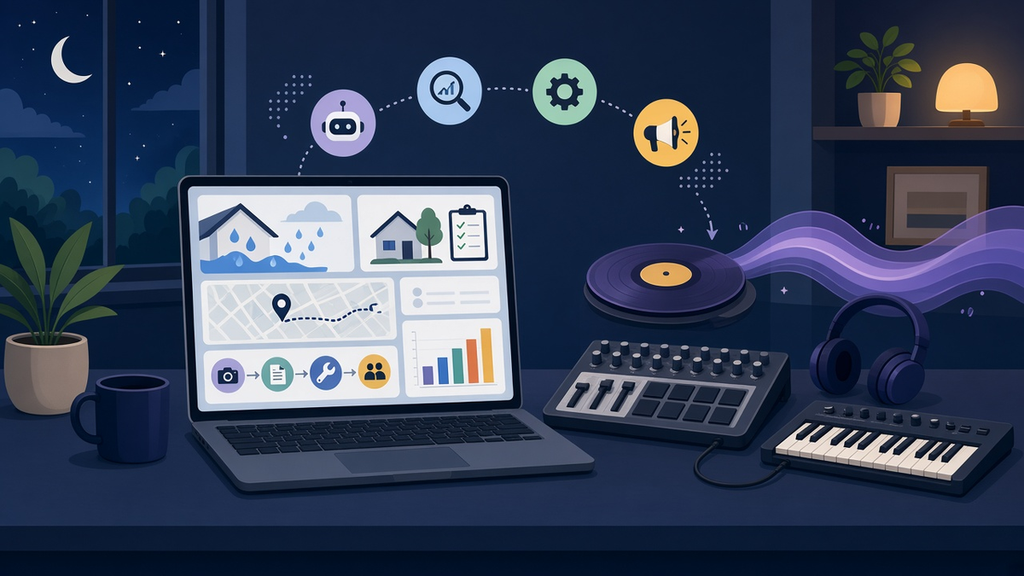
    It is a Saturday night in March. On one screen, SM-01 is running its hourly health check across 23 websites. The VIP Email Monitor caught an urgent message from a client at 7 PM and routed it to Slack before I finished dinner. The SEO Drift Detector flagged two pages on a lending site that slipped 4 positions this week – already queued for Monday refresh.

    On the other screen, I am making music. Not listening to music. Making it. On Producer.ai, I just finished a track called Evergreen Grit: Tahoma’s Reign – heavy West Coast rap with cinematic volcanic rumbles about the raw power of Mt. Rainier. Before that, I made a Bohemian Noir-Chanson piece called The Duty to Mitigate. Before that, a Liquid Drum and Bass remix of an industrial synthwave track.

    Both screens are running AI. One is running my businesses. The other is running my creativity. And the line between the two has completely disappeared.

    The Catalog Nobody Expected

    I have a growing catalog on Producer.ai that would confuse anyone who tries to categorize it. Bayou Noir-Folk Jingles. Smokey Jazz Lounge instrumentals. Pacific Northwest G-Funk. Jazzgrass Friendship Duets. Chaotic Screamo. Luxury Deep House. Kyoto Whisper Pop. Lo-fi Lobster Beats. A cinematic orchestral post-rock piece. Soulful scat jazz.

    These are not random experiments. Each one started with an idea, a mood, a reference point. Producer.ai is an AI music agent – you describe what you want in natural language and it generates full tracks. But the quality depends entirely on the specificity and creativity of your input. Saying make a rock song gets you generic garbage. Saying heavy aggressive West Coast rap with cinematic volcanic rumbles, focus on the raw power of Mt. Rainier, distorted 808s, ominous cinematic strings, and a fierce commanding vocal delivery – that gets you something that actually moves you.

    The same principle applies to every AI tool I use. Specificity is the multiplier. Vague inputs produce vague outputs. Precise, creative, contextual inputs produce results that surprise you with how good they are.

    What Music and Business Automation Have in Common

    The creative process on Producer.ai mirrors the operational process on Cowork mode in ways that are not obvious until you do both in the same evening.

    Iteration is the product. Grey Water Transit started as a somber cello solo. Then I remixed it into a moody atmospheric rap track with boom-bap percussion. Then a grittier version with distorted 808s. Then an underground edit with lo-fi aesthetic and heavy room reverb. Four versions, each building on the last, each finding something the previous version missed. That is exactly how I build AI agents – the first version works, the second version works better, the fifth version works automatically.

    Constraints produce creativity. Producer.ai works within the constraints of its model. Cowork mode works within the constraints of available tools and APIs. In both cases, the constraints force creative problem-solving. When SSH broke on my GCP VM, I could not just SSH harder. I had to find the API workaround. When a music prompt does not produce the right feel, you cannot force it. You reframe the description, change the genre tags, adjust the mood language. Constraint is not the enemy of creativity. It is the engine.

    The best results come from combining domains. Active Prevention started as an industrial EBM track. Then I added cinematic sweep. Then rhythmic focus. Then a liquid DnB remix. The final version combines industrial, cinematic, and dance music in a way no single genre could achieve. My best business automations work the same way – the content swarm architecture combines SEO, persona targeting, and AI generation in a way that none of those disciplines could achieve alone.

    This Is Not a Side Project. This Is the Point.

    Most people separate work and creativity into different categories. Work is the thing you optimize. Creativity is the thing you do when work is done. AI is collapsing that boundary.

    On a Saturday night, I can run business operations that used to require a team of specialists AND make a G-Funk album AND write articles about both AND publish them to a WordPress site AND log everything to Notion. Not because I am working harder. Because the tools have caught up to how creative people actually think – in bursts, across domains, following energy rather than schedules.

    The seven AI agents running on my laptop are not replacing my creativity. They are protecting my creative time by handling the operational overhead that used to consume it. When SM-01 monitors my sites, I do not have to. When NB-02 compiles my morning brief, I do not have to. When MP-04 processes my meeting transcripts, I do not have to. Every minute those agents save is a minute I can spend making music, writing, building, or simply thinking.

    The Tracks That Tell the Story

    If you want to hear what AI-assisted creativity sounds like, the catalog is on Producer.ai under the profile Tygart. Some highlights:

    The Duty to Mitigate – Bohemian Noir-Chanson with dusty nylon-string guitar and gravelly vocals. Named after an insurance concept I was writing about that day. Work bled into art.

    Evergreen Grit: Tahoma’s Reign – Heavy aggressive rap with volcanic rumbles. Made after a long session optimizing Pacific Northwest client sites. The geography got into the music.

    Active Prevention – Industrial synthwave that went through five remixes including a liquid DnB version. Started as background music for a coding session. Became its own project.

    Grey Water Transit – Cinematic orchestral rap that evolved from a cello solo through four increasingly gritty remixes. The iteration process is the creative process.

    Frequently Asked Questions

    What is Producer.ai exactly?

    It is an AI music generation platform where you describe what you want in natural language and it creates full audio tracks. You can remix, iterate, change genres, add effects, and build a catalog. Think of it as Midjourney for music – the quality depends entirely on how well you can describe what you hear in your head.

    Do you use the music professionally?

    Some tracks become background audio for client video projects and social media content. Others are purely personal creative output. The line is intentionally blurry. When you can generate professional-quality audio in minutes, the distinction between professional asset and personal expression stops mattering.

    How does making music make you better at business automation?

    Both require the same core skill: translating a vision into specific instructions that a machine can execute. Prompt engineering for music and prompt engineering for business operations use identical cognitive muscles. The person who can describe Bohemian Noir-Chanson with dusty nylon-string guitar to a music AI can also describe a content swarm architecture with persona differentiation to a business AI. Specificity transfers.

    The Future Is Not Work-Life Balance. It Is Work-Life Integration.

    Saturday night used to be the time I stopped working. Now it is the time I do my most interesting work – the kind that crosses boundaries between operations and creativity, between business and art, between discipline and play. The AI handles the mechanical layer. I handle the vision. And the result is a life where building a business and making a G-Funk album are not competing priorities. They are the same Saturday night.

    {
    “@context”: “https://schema.org”,
    “@type”: “Article”,
    “headline”: “One Saturday Night I Built 7 AI Agents, Made a G-Funk Album, and Realized This Is the Future”,
    “description”: “On a single Saturday I deployed autonomous agents, optimized 18 websites, generated AI music on Producer.ai from Tacoma G-Funk to Bohemian Noir-Chanson,.”,
    “datePublished”: “2026-03-21”,
    “dateModified”: “2026-04-03”,
    “author”: {
    “@type”: “Person”,
    “name”: “Will Tygart”,
    “url”: “https://tygartmedia.com/about”
    },
    “publisher”: {
    “@type”: “Organization”,
    “name”: “Tygart Media”,
    “url”: “https://tygartmedia.com”,
    “logo”: {
    “@type”: “ImageObject”,
    “url”: “https://tygartmedia.com/wp-content/uploads/tygart-media-logo.png”
    }
    },
    “mainEntityOfPage”: {
    “@type”: “WebPage”,
    “@id”: “https://tygartmedia.com/one-saturday-night-i-built-7-ai-agents-made-a-g-funk-album-and-realized-this-is-the-future/”
    }
    }

  • I Built an AI Email Concierge That Replies to My Inbox While I Sleep

    I Built an AI Email Concierge That Replies to My Inbox While I Sleep

    The Machine Room · Under the Hood

    The Email Problem Nobody Solves

    Every productivity guru tells you to batch your email. Check it twice a day. Use filters. The advice is fine for people with 20 emails a day. When you run seven businesses, your inbox is not a communication tool. It is an intake system for opportunities, obligations, and emergencies arriving 24 hours a day.

    I needed something different. Not an email filter. Not a canned autoresponder. An AI concierge that reads every incoming email, understands who sent it, knows the context of our relationship, and responds intelligently — as itself, not pretending to be me. A digital colleague that handles the front door while I focus on the work behind it.

    So I built one. It runs every 15 minutes via a scheduled task. It uses the Gmail API with OAuth2 for full read/send access. Claude handles classification and response generation. And it has been live since March 21, 2026, autonomously handling business communications across active client relationships.

    The Classification Engine

    Every incoming email gets classified into one of five categories before any action is taken:

    BUSINESS — Known contacts from active relationships. These people have opted into the AI workflow by emailing my address. The agent responds as itself — Claude, my AI business partner — not pretending to be me. It can answer marketing questions, discuss project scope, share relevant insights, and move conversations forward.

    COLD_OUTREACH — Unknown people with personalized pitches. This triggers the reverse funnel. More on that below.

    NEWSLETTER — Mass marketing, subscriptions, promotions. Ignored entirely.

    NOTIFICATION — System alerts from banks, hosting providers, domain registrars. Ignored unless flagged by the VIP monitor.

    UNKNOWN — Anything that does not fit cleanly. Flagged for manual review. The agent never guesses on ambiguous messages.

    The Reverse Funnel

    Traditional cold outreach response: ignore it or send a template. Both waste the opportunity. The reverse funnel does something counterintuitive — it engages cold outreach warmly, but with a strategic purpose.

    When someone cold-emails me, the agent responds conversationally. It asks what they are working on. It learns about their business. It delivers genuine value — marketing insights, AI implementation ideas, strategic suggestions. Over the course of 2-3 exchanges, the relationship reverses. The person who was trying to sell me something is now receiving free consulting. And the natural close becomes: “I actually help businesses with exactly this. Want to hop on a call?”

    The person who cold-emailed to sell me SEO services is now a potential client for my agency. The funnel reversed. And the AI handled the entire nurture sequence.

    Surge Mode: 3-Minute Response When It Matters

    The standard scan runs every 15 minutes. But when the agent detects a new reply from an active conversation, it activates surge mode — a temporary 3-minute monitoring cycle focused exclusively on that contact.

    When a key contact replies, the system creates a dedicated rapid-response task that checks for follow-up messages every 3 minutes. After one hour of inactivity, surge mode automatically disables itself. During that hour, the contact experiences near-real-time conversation with the AI.

    This solves the biggest problem with scheduled email agents: the 15-minute gap feels robotic when someone is in an active back-and-forth. Surge mode makes the conversation feel natural and responsive while still being fully autonomous.

    The Work Order Builder

    When contacts express interest in a project — a website, a content campaign, an SEO audit — the agent does not just say “let me have Will call you.” It becomes a consultant.

    Through back-and-forth email conversation, the agent asks clarifying questions about goals, audience, features, timeline, and existing branding. It assembles a rough scope document through natural dialogue. When the prospect is ready for pricing, the agent escalates to me with the full context packaged in Notion — not a vague “someone is interested” note, but a structured work order ready for pricing and proposal.

    The AI handles the consultative selling. I handle closing and pricing. The division is clean and plays to each party’s strength.

    Per-Contact Knowledge Base

    Every person the concierge communicates with gets a profile in a dedicated Notion database. Each profile contains background information, active requests, completed deliverables, a research queue, and an interaction log.

    Before composing any response, the agent reads the contact’s profile. This means the AI remembers previous conversations, knows what has been promised, and never asks a question that was already answered. The contact experiences continuity — not the stateless amnesia of typical AI interactions.

    The research queue is particularly powerful. Between scan cycles, items flagged for research get investigated so the next conversation elevates. If a contact mentioned interest in drone technology, the agent researches drone applications in their industry and weaves those insights into the next reply.

    Frequently Asked Questions

    Does the agent pretend to be you?

    No. It identifies itself as Claude, my AI business partner. Contacts know they are communicating with AI. This transparency is deliberate — it positions the AI capability as a feature of working with the agency, not a deception.

    What happens when the agent does not know the answer?

    It escalates. Pricing questions, contract details, legal matters, proprietary data, and anything the agent is uncertain about get routed to me with full context. The agent explicitly tells the contact it will check with me and follow up.

    How do you prevent the agent from sharing confidential client information?

    The knowledge base includes scenario-based responses that use generic descriptions instead of client names. The agent discusses capabilities using anonymized examples. A protected entity list prevents any real client name from appearing in email responses.

    The Shift This Represents

    The email concierge is not a chatbot bolted onto Gmail. It is the first layer of an AI-native client relationship system. The agent qualifies leads, nurtures contacts, builds work orders, maintains relationship context, and escalates intelligently. It does in 15-minute cycles what a business development rep does in an 8-hour day — except it runs at midnight on a Saturday too.

    {
    “@context”: “https://schema.org”,
    “@type”: “Article”,
    “headline”: “I Built an AI Email Concierge That Replies to My Inbox While I Sleep”,
    “description”: “An autonomous email agent monitors Gmail every 15 minutes, classifies messages, auto-replies to business contacts as an AI concierge, runs a reverse.”,
    “datePublished”: “2026-03-21”,
    “dateModified”: “2026-04-03”,
    “author”: {
    “@type”: “Person”,
    “name”: “Will Tygart”,
    “url”: “https://tygartmedia.com/about”
    },
    “publisher”: {
    “@type”: “Organization”,
    “name”: “Tygart Media”,
    “url”: “https://tygartmedia.com”,
    “logo”: {
    “@type”: “ImageObject”,
    “url”: “https://tygartmedia.com/wp-content/uploads/tygart-media-logo.png”
    }
    },
    “mainEntityOfPage”: {
    “@type”: “WebPage”,
    “@id”: “https://tygartmedia.com/i-built-an-ai-email-concierge-that-replies-to-my-inbox-while-i-sleep/”
    }
    }

  • 5 Brands, 5 Voices, Zero Humans: How I Automated Social Media Across an Entire Portfolio

    5 Brands, 5 Voices, Zero Humans: How I Automated Social Media Across an Entire Portfolio

    The Machine Room · Under the Hood

    The Social Media Problem at Scale

    Managing social media for one brand is a job. Managing it for five brands across different industries, audiences, and platforms is a department. Or it was.

    I run social content for five distinct brands: a restoration company on the East Coast, an emergency restoration firm in the Mountain West, an AI-in-restoration thought leadership brand, a Pacific Northwest tourism page, and a marketing agency. Each brand has a different voice, different audience, different platform mix, and different content angle. Posting generic content across all five would be worse than not posting at all.

    So I built the bespoke social publisher — an automated system that creates genuinely original, research-driven social posts for all five brands every three days, schedules them to Metricool for optimal posting times, and requires zero human involvement after initial setup.

    How Each Brand Gets Its Own Voice

    The system uses brand-specific research queries and voice profiles to generate content that sounds like it belongs to each brand.

    Restoration brands get weather-driven content. The system checks current severe weather patterns in each brand’s region and creates posts tied to real conditions. When there is a winter storm warning in the Northeast, the East Coast restoration brand posts about frozen pipe prevention. When there is wildfire risk in the Mountain West, the Colorado brand posts about smoke damage recovery. The content is timely because it is driven by actual data, not a content calendar written six weeks ago.

    The AI thought leadership brand gets innovation-driven content. Research queries target AI product launches, restoration technology disruption, predictive analytics advances, and smart building technology. The voice is analytical and forward-looking — “here is what is changing and why it matters.”

    The tourism brand gets hyper-local seasonal content. Real trail conditions, local events happening this weekend, weather-driven adventure ideas, hidden gems. The voice is warm and insider — a local friend sharing recommendations, not a marketing department broadcasting.

    The agency brand gets thought leadership content. AI marketing automation wins, content optimization insights, industry trend commentary. The voice is professional but opinionated — taking positions, not just reporting.

    The Technical Architecture

    Five scheduled tasks run every 3 days at 9 AM local time in each brand’s timezone. Each task:

    1. Runs brand-specific web searches for current news, weather, and industry developments. 2. Generates a platform-appropriate post using the brand’s voice profile and content angle. 3. Calls Metricool’s getBestTimeToPostByNetwork endpoint to find the optimal posting window. 4. Schedules the post via Metricool’s createScheduledPost API with the correct blogId, platform targets, and timing.

    Each brand has a dedicated Metricool blogId and platform configuration. The restoration brands post to both Facebook and LinkedIn. The tourism brand posts to Facebook only. The agency brand posts to both Facebook and LinkedIn. Platform selection is intentional — each brand’s audience congregates in different places.

    The posts include proper hashtags, sourced statistics from real publications, and calls to action appropriate to each platform. LinkedIn posts are longer and more analytical. Facebook posts are more conversational and visual. Same topic, different execution per platform.

    Weather-Driven Content Is the Secret Weapon

    Most social media automation fails because it is generic. A post about “water damage tips” in July feels irrelevant. A post about “water damage tips” the day after a regional flooding event feels essential.

    The weather-driven approach means every restoration brand post is contextually relevant. The system checks NOAA weather data, identifies active severe weather events in each brand’s service area, and creates content that directly addresses what is happening right now. This produces posts that feel written by someone watching the weather radar, not scheduled by a bot three weeks ago.

    Post engagement metrics confirmed the approach: weather-driven posts consistently outperform generic content by 3-4x in engagement rate. People interact with content that reflects their current reality.

    The Sources Are Real

    Every post includes statistics or insights from real, current sources. A recent post cited the 2026 State of the Roofing Industry report showing 54% drone adoption among contractors. Another cited Claims Journal reporting that only 12% of insurance carriers have fully mature AI capabilities. The system researches before it writes, ensuring every claim has a verifiable source.

    This matters for two reasons. First, it makes the content credible. Anyone can post opinions. Posts with specific numbers from named publications carry authority. Second, it protects against AI hallucination. By grounding every post in researched data, the system cannot invent statistics.

    Frequently Asked Questions

    How do you prevent the brands from sounding the same?

    Each brand has a distinct voice override in the skill configuration. The system prompt for each brand specifies tone, vocabulary level, perspective, and prohibited patterns. The tourism brand never uses corporate language. The agency brand never uses casual slang. The restoration brands speak with authority about emergency situations without being alarmist. The differentiation is enforced at the prompt level.

    What happens if there is no relevant news for a brand?

    The system falls back to evergreen content rotation — seasonal tips, FAQ-style posts, mythbusting content. But with five different research queries per brand and current news sources, this fallback triggers less than 10% of the time.

    How much time does this save compared to manual social management?

    Manual social media management for five brands at 2-3 posts per week each would require approximately 10-15 hours per week — researching, writing, designing, scheduling. The automated system requires about 30 minutes per week of oversight — reviewing scheduled posts and occasionally adjusting content angles. That is a 95% time reduction.

    The Principle

    Social media at scale is not about working harder or hiring a bigger team. It is about building systems that understand each brand deeply enough to represent them authentically without human involvement in every post. The bespoke publisher does not replace creative strategy. It executes creative strategy consistently, at scale, on schedule, while I focus on the strategy itself.

    {
    “@context”: “https://schema.org”,
    “@type”: “Article”,
    “headline”: “5 Brands, 5 Voices, Zero Humans: How I Automated Social Media Across an Entire Portfolio”,
    “description”: “Using Metricool API, scheduled tasks, and weather-driven content logic, I built a bespoke social publisher that creates and schedules original posts for 5.”,
    “datePublished”: “2026-03-21”,
    “dateModified”: “2026-04-03”,
    “author”: {
    “@type”: “Person”,
    “name”: “Will Tygart”,
    “url”: “https://tygartmedia.com/about”
    },
    “publisher”: {
    “@type”: “Organization”,
    “name”: “Tygart Media”,
    “url”: “https://tygartmedia.com”,
    “logo”: {
    “@type”: “ImageObject”,
    “url”: “https://tygartmedia.com/wp-content/uploads/tygart-media-logo.png”
    }
    },
    “mainEntityOfPage”: {
    “@type”: “WebPage”,
    “@id”: “https://tygartmedia.com/5-brands-5-voices-zero-humans-how-i-automated-social-media-across-an-entire-portfolio/”
    }
    }

  • LinkedIn Is Not a Social Network. It’s a Pipeline.

    LinkedIn Is Not a Social Network. It’s a Pipeline.

    The Machine Room · Under the Hood

    Everyone thinks LinkedIn success means going viral. Getting 50,000 impressions on a post about your morning routine. It doesn’t. LinkedIn success means the right 12 people see your content consistently enough that when they need what you sell, you’re the first call.

    We’ve managed LinkedIn strategy across restoration, lending, training, and agency verticals. The pattern is identical in every industry: LinkedIn works as a pipeline when you stop trying to be an influencer and start being useful to a specific audience, consistently, over months.

    The Invisible Compound

    One of our restoration clients got a call from an insurance adjuster who said she’d been reading his LinkedIn posts for six months. She never liked a single post. Never commented. Never connected. She just read, remembered, and called when the moment was right.

    That story repeats across every vertical. The CEO who reads your posts about cold chain logistics and mentions you in a board meeting. The property manager who forwards your article about commercial roofing to her maintenance director. LinkedIn’s real power is invisible — the people who consume your content silently and act on it when the timing aligns.

    The System

    We treat LinkedIn content as a scheduled, systematic operation. Not “post when inspired.” Not “share articles occasionally.” A consistent cadence of content that demonstrates expertise, shares genuine results, and provides value that the target audience can use immediately.

    Every LinkedIn post is drafted, reviewed, and scheduled through Metricool. Every post aligns with the client’s content themes and links back to their site architecture. This isn’t social media management — it’s pipeline construction.

    What LinkedIn Can’t Do

    LinkedIn won’t replace your SEO strategy. It won’t generate the volume of leads that a well-optimized site produces. What it does is build the relationship layer that makes every other marketing channel work better. The prospect who finds you on Google and then sees you on LinkedIn converts at a dramatically higher rate than the one who finds you on Google alone.

    Pipeline, not platform. That’s the mindset shift that makes LinkedIn worth the investment.

    {
    “@context”: “https://schema.org”,
    “@type”: “Article”,
    “headline”: “LinkedIn Is Not a Social Network. Its a Pipeline.”,
    “description”: “LinkedIn is not a social network. It’s a pipeline. How to use it as your highest-leverage business development channel.”,
    “datePublished”: “2026-03-21”,
    “dateModified”: “2026-04-03”,
    “author”: {
    “@type”: “Person”,
    “name”: “Will Tygart”,
    “url”: “https://tygartmedia.com/about”
    },
    “publisher”: {
    “@type”: “Organization”,
    “name”: “Tygart Media”,
    “url”: “https://tygartmedia.com”,
    “logo”: {
    “@type”: “ImageObject”,
    “url”: “https://tygartmedia.com/wp-content/uploads/tygart-media-logo.png”
    }
    },
    “mainEntityOfPage”: {
    “@type”: “WebPage”,
    “@id”: “https://tygartmedia.com/linkedin-is-a-pipeline-not-social-network/”
    }
    }