If you train operators in any skilled industry — through formal certification programs, in-house training departments, trade schools, association curricula, or corporate development tracks — the AI shift is about to make most of your existing infrastructure obsolete, and the model you probably abandoned forty years ago is about to become the real curriculum again. This is not a small adjustment. This is a structural rewrite of how skilled industries develop their next generation of operators.
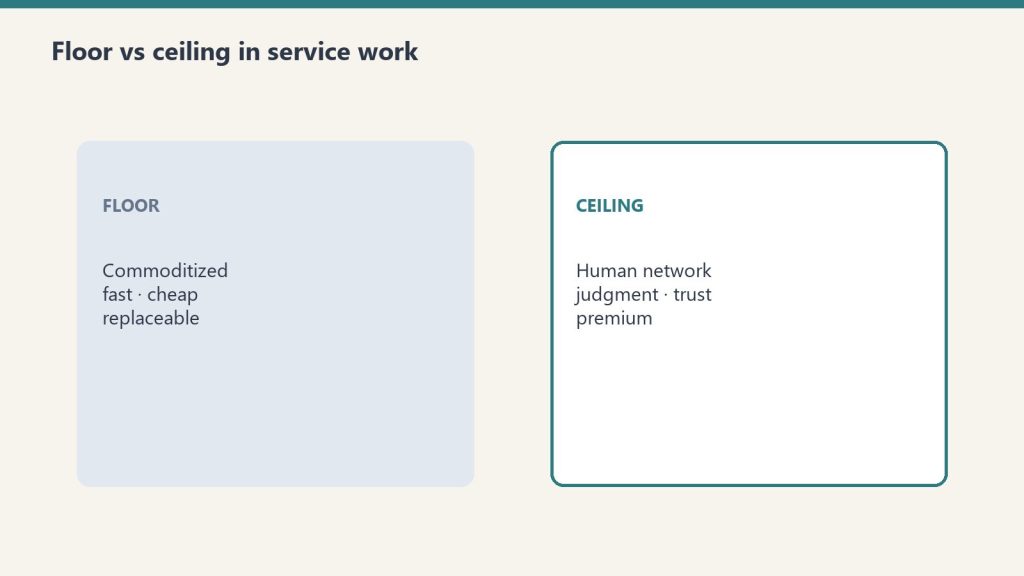
The thesis is simple. Every certification program, classroom curriculum, and standardized training regime in skilled industries was built around documented, explicit knowledge — the procedures, the standards, the technical specifications, the regulatory requirements. That body of knowledge is exactly what AI has just commoditized. AI raises the floor of every industry, and the floor is precisely what your formal curriculum has been teaching.
The ceiling — the tacit knowledge that defines great operators — has never lived in any classroom. It lives in apprenticeship relationships, in proximity to senior practitioners, in the kind of learning environment that the modern training-industrial complex deliberately moved away from in the name of scale and professionalization. The shift now reverses that. The training infrastructure that scales does not transfer the knowledge that matters anymore.
What Your Existing Curriculum Actually Teaches
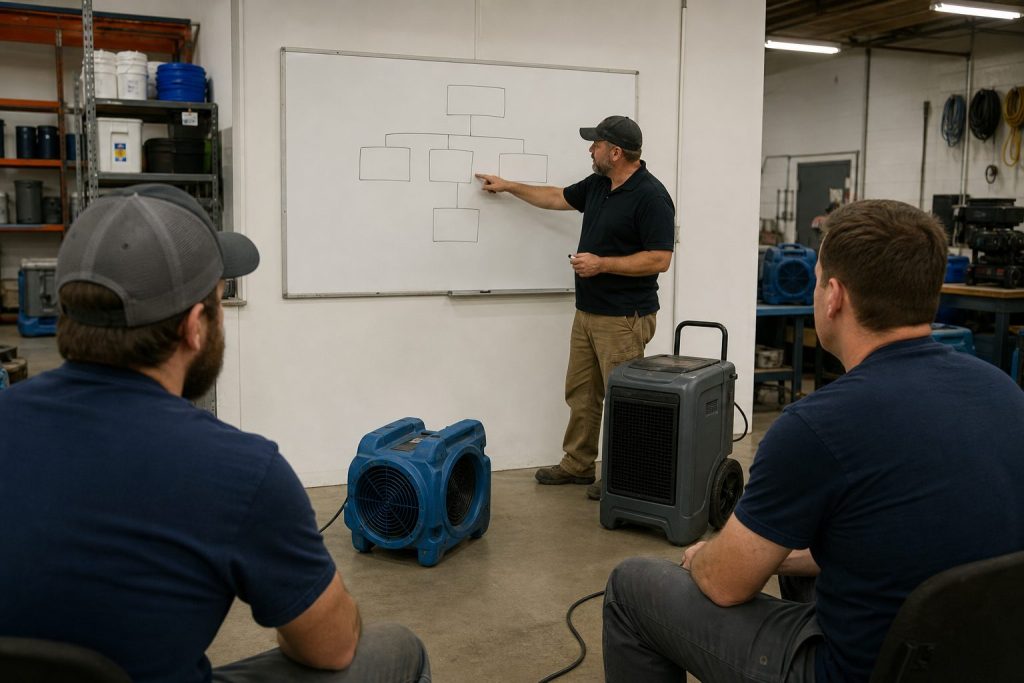
If you run a formal training program in any skilled trade or industry, look at your current curriculum honestly. The bulk of what you teach is documented, codified, and standardized. The IICRC body of knowledge. The trade certification standards. The OSHA regulations. The technical specifications of the equipment your industry uses. The customer-service scripts. The compliance requirements. The reporting frameworks.
All of that material exists because it can be written down. That is exactly why it is now also accessible to anyone with an AI tool. A new technician with a phone can pull up the entire body of explicit knowledge in your industry in seconds, get it explained at whatever level of depth they need, and apply it competently within weeks. The information advantage that formal training used to provide has collapsed.
What your curriculum does not teach — because curriculum cannot teach it — is the judgment that senior operators apply when the documented procedure does not match the actual situation. The pattern recognition that lets a thirty-year veteran walk onto a job site and know within ten minutes which parts of the standard scope are wrong for this specific case. The customer-handling instinct that defuses a difficult homeowner. The supplier-relationship knowledge that determines who actually delivers on Friday afternoons. The failure-mode memory that lets a senior operator predict where this specific job is going to go wrong before the crew has even started.
That knowledge is the ceiling of your industry. It cannot be taught in a classroom. It can only be transferred through proximity to people who already have it. And the formal training infrastructure that your industry has built over the last forty years was specifically designed to move away from that model, in favor of something that scales.
Why the Classroom Model Was Adopted in the First Place
The formalization of skilled-industry training was a rational response to the conditions of the late twentieth century. The apprenticeship model, while it produced great operators, did not scale. It was slow. It was geographically constrained. It was uneven in quality. It was dependent on the personal commitment of senior operators who were not always good at teaching. And it was opaque to regulators, insurers, and customers who wanted standardized credentials they could trust.
Classroom-based certification solved real problems. It standardized the floor. It made the explicit body of knowledge accessible to a much larger population. It produced credentials that customers and insurers could trust. It allowed industries to scale faster than the slow, organic apprenticeship system would have permitted.
But it also introduced a structural blind spot. The training-industrial complex got very good at teaching what could be written down, and progressively worse at transmitting what could not. The graduating technician now has the certification, but does not have the judgment. The certification used to be a proxy for judgment because it took years of apprenticeship to earn. Now the certification is just a credential, and the judgment is missing. Most of the industry has been quietly aware of this for two decades and has not had a structural solution for it.
The AI shift makes the structural problem unavoidable. The credentials are now equivalent across operators because AI can teach anyone the explicit body of knowledge equally well. The only remaining differentiation is the judgment that the formal training infrastructure was never designed to transfer. The training programs that recognize this and adapt will produce the next generation of operators who can actually compete at the ceiling. The training programs that do not will produce certified operators with no judgment, all of whom are interchangeable, all of whom will be commoditized.
What the New Curriculum Actually Looks Like
The training program that fits the AI era is not a curriculum reform. It is a structural rearrangement of how operators develop. Here is what it looks like.
The explicit body of knowledge gets delivered by AI. The standards, the procedures, the regulations, the technical specifications — all of that gets handed off to AI tutoring systems that can teach any individual operator at their own pace, with full personalization, and unlimited patience. This is what AI is genuinely good at. Let it do that part. Stop spending classroom hours on material that AI teaches better than any human instructor ever could.
The classroom time gets converted to practicum and judgment work. The hours saved from explicit-knowledge instruction get reallocated to structured exposure to real situations — case studies of actual jobs, walk-throughs of judgment calls, exposure to senior operators in the field. The classroom becomes a place where the tacit knowledge of the industry gets surfaced and discussed, not where the textbook gets reviewed.
The apprenticeship becomes a deliberate, structured program. Each trainee gets paired with a senior operator for a meaningful period — months or years, not days — working alongside them on real jobs, with explicit conversation about why each decision is being made. The program is structured. The conversations are deliberate. The trainee is expected to absorb judgment, not just procedures. This puts senior operators back in the center of training, where they should have been all along.
The senior operators get compensated for teaching. The traditional apprenticeship model collapsed in part because senior operators were not paid to teach. They taught because they wanted to or because their employer expected it, and the quality varied accordingly. The modern apprenticeship model treats senior operators as paid instructors whose teaching is a recognized, compensated, valued part of their role. The economics finally align with the importance of the function.
The certification incorporates judgment assessment, not just knowledge assessment. The traditional certification exam tested whether you knew the documented body of knowledge. The modern certification needs to test whether you can apply judgment to novel situations. This is harder to design and harder to grade, but it is the only certification that will actually differentiate competent operators from interchangeable ones in an AI-saturated industry.
Why This Is an Opportunity, Not a Threat
If you run a training organization in a skilled industry, the natural reaction to this analysis is anxiety. The infrastructure you built — the classrooms, the curriculum, the certification programs, the instructional staff — is at risk of becoming obsolete. That anxiety is understandable but misplaced.
The opportunity is that you are uniquely positioned to be the bridge between AI tooling and senior operators. Your existing relationships with the industry, your credibility with certification bodies, your access to both senior practitioners and developing operators — all of that is exactly what is needed to build the new training infrastructure. The organizations that move quickly to redefine their role will become more important to their industries than they have ever been. The ones that resist will be displaced by new entrants who build the new model from scratch.
The training organization of the AI era is not a school. It is a brokerage. It connects senior practitioners with developing operators, provides the structural scaffolding for deliberate apprenticeship, delivers AI-tutored explicit-knowledge instruction at scale, designs judgment-assessment certification, and captures the tacit knowledge of senior operators into transferable forms before they retire. That is a more valuable institution than the classroom-based credentialing organization that came before it.
What to Do in the Next Twelve Months

If you run a training program in a skilled industry, here are the moves that match the moment.
Pilot an AI-delivered explicit-knowledge curriculum on one segment of your training population. Use one of the modern AI tutoring systems to deliver the standards, procedures, and technical specifications, and measure how the learning outcomes compare to classroom delivery. In most pilots the AI delivery outperforms the classroom on knowledge retention while taking a fraction of the instructional time.
Reallocate the freed instructional hours to structured judgment work. Build case-study sessions, walk-throughs of complex real jobs, conversations with senior operators about their decision frameworks. Treat these sessions as the high-value core of your curriculum, not the supplementary material.
Build deliberate apprenticeship pairings. Identify the senior operators in your industry network who are good at teaching and are willing to take on structured mentoring. Pair them with developing operators in a formal, time-bounded, compensated arrangement. Track the outcomes. The data on apprenticeship effectiveness will quickly justify expanding the program.
Develop judgment-assessment instruments. Work with senior operators to design assessment scenarios that test whether a developing operator can apply judgment to novel situations, not just recite documented knowledge. Pilot these alongside your existing certification exams. The judgment instruments will quickly become more predictive of actual job performance than the knowledge-recall instruments.
Run a Human Distillery process with the most respected senior operators in your industry network. Extract their tacit knowledge in structured form. Use the output as core teaching material for your apprenticeship program. The senior operators get a durable artifact of their expertise. Your training program gets curriculum material that no competitor can replicate.
Frequently Asked Questions
Will AI replace human instructors in skilled-industry training?
AI will replace instructors for the documented, explicit body of knowledge — standards, procedures, regulations, technical specifications. AI cannot replace the human transfer of tacit, judgment-based knowledge, which has always required proximity to senior practitioners. The instructional role shifts from delivering documented content to facilitating judgment development and apprenticeship.
What is wrong with the current classroom-based training model?
It was designed to teach explicit knowledge at scale, which AI now does better. It was never designed to transfer the tacit, judgment-based knowledge that defines great operators, and the absence of that transfer has been a structural problem in skilled industries for decades. The AI shift exposes the problem and forces a structural response.
How do you design an apprenticeship program that actually works?
Pair developing operators with senior practitioners who are both skilled at their work and willing to teach. Structure the time around real jobs, not classroom exercises. Build explicit conversation about decision frameworks into the work. Compensate the senior operator for teaching. Make the program long enough — months or years — for tacit knowledge to actually transfer.
Can judgment be tested in a certification exam?
Yes, but with different instruments than traditional knowledge-recall exams. Scenario-based assessments that present novel situations and evaluate the operator’s reasoning are far more predictive of actual job performance than multiple-choice tests of documented knowledge. Several certification bodies are beginning to pilot these formats, with strong early results.
What happens to existing certification credentials in the AI era?
Knowledge-recall certifications will lose value because the underlying knowledge is now equally accessible to everyone via AI tools. Judgment-based certifications and verified-apprenticeship credentials will gain value because they signal something AI cannot replicate. Certification bodies that adapt early will set the standards for the new era.
How do you compensate senior operators for teaching?
Treat teaching as a paid, recognized, valued part of the senior operator’s role rather than an unpaid expectation. Build instructor stipends, mentorship bonuses, or fractional teaching contracts into the structure. The most respected senior operators in most industries are willing to teach if the economics and the respect dynamic are right.
The Bottom Line
The training and certification infrastructure that skilled industries built over the last forty years was optimized for explicit knowledge transfer at scale. AI just made explicit knowledge cheap. The infrastructure that matters now is the one that transfers tacit knowledge — and that infrastructure looks a lot more like the apprenticeship model the industry abandoned than the classroom model it adopted.
This is not a return to the past. It is an upgrade. Modern apprenticeship combines AI-delivered explicit-knowledge instruction at scale with deliberate, structured, compensated tacit-knowledge transfer from senior operators to developing ones. It is more effective than either the classroom model or the traditional apprenticeship alone. It produces operators who can compete at both the floor and the ceiling. And it puts the senior operators of every industry back in the center of training, where they have always belonged.
The training organizations that recognize this and adapt are about to become more important to their industries than they have been in decades. The apprenticeship is the curriculum. The senior operators are the faculty. The AI tools deliver the textbook. The certification rewards judgment, not recall. The model is simple. The window to lead the shift is open right now. Step into it.
Leave a Reply