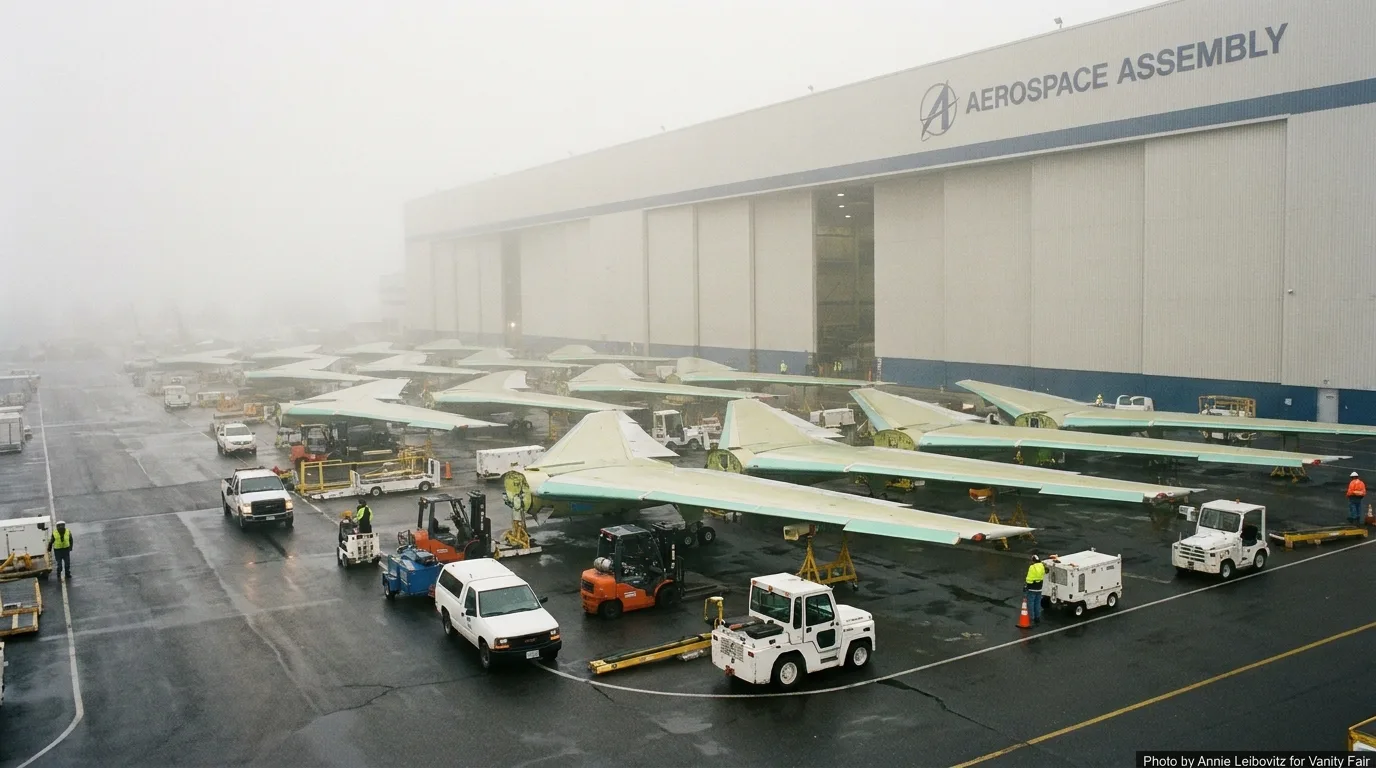
Q: When is Boeing’s 737 North Line in Everett expected to open for commercial production?
A: It opened in July 2026. Boeing began production on the North Line on July 6 and officially opened it at a ribbon cutting on July 10, starting at low-rate initial production for the first 10 airplanes. The first two jets on the line are 737 MAX 10s. Boeing can’t deliver North Line airplanes until the FAA adds the line to its production certificate, which Boeing hopes to finalize in 2026.
The checklist below was written in mid-May 2026, ahead of the opening, and is kept as published for context.
“Midsummer.” That’s the word Boeing has used consistently since February 2026 to describe when the 737 North Line at the Everett factory will begin building commercial 737 MAX jets. It’s now mid-May. Six to eight weeks stand between the current preparation phase and what would be the most consequential event in Everett’s manufacturing history in decades: the first 737 narrowbody aircraft ever assembled outside Boeing’s longtime Renton home.
The question workers, suppliers, and residents across Snohomish County should be asking right now is a practical one: what has to happen between here and there?
Where the North Line Stands Today
The North Line is not empty. Boeing has been operating the assembly floor in what the aerospace industry calls LRIP — Low Rate Initial Production. As this desk detailed in April, LRIP is the FAA-mandated production phase in which Boeing builds conformity aircraft: jets specifically intended to validate the production process rather than go directly to airline customers.
The LRIP phase at Everett has involved building 737-8 and 737-9 airframes using the North Line’s tooling and production flow. Each conformity aircraft is formally inspected by the FAA, which reviews manufacturing quality records, assembly processes, and system installations. This is not a formality. The FAA is confirming whether the Everett facility is producing aircraft to the same quality standards as Renton — a question that carries significant weight given the regulatory environment Boeing has operated under since the January 2024 door-plug incident.
Boeing’s April 2026 feature on the North Line team confirmed that the workforce pipeline is well advanced. Workers completing their 12-week structured rotations at Renton are returning to Everett ready for their North Line positions. The workforce-readiness element of the pre-launch checklist is largely complete — it’s the regulatory and production acceptance gates that remain.
The Pre-Commercial Launch Checklist
Boeing hasn’t published a public step-by-step launch sequence. But FAA requirements for new final assembly lines are well understood by industry, and Boeing’s own statements provide a clear picture of what’s still on the list.
FAA Production Approval Inspection (PAI). Before a new final assembly line can produce deliverable commercial aircraft, the FAA conducts a formal Production Approval Inspection. FAA production inspectors verify that the facility’s manufacturing processes, quality management systems, documentation, and tooling all conform to the Production Approval Holder (PAH) requirements that Boeing holds for the 737 program. This is not a one-day visit. It involves detailed records review and process observation across the entire production flow.
Conformity aircraft completion and formal acceptance. The conformity airplanes built during LRIP must be fully documented and closed out. Each one generates a formal conformity report that the FAA reviews. The FAA must formally accept the conformity findings before Boeing can transition the line to customer-deliverable production. Every finding gets resolved; every record gets reviewed.
First commercial production airplanes started. Once the FAA clears the line, the North Line begins building jets tagged to airline orders. These first production aircraft are not conformity planes — they are in the real delivery queue. The transition from LRIP to commercial production is a discrete, FAA-acknowledged event.
First delivery. A significant period separates “first production airplane started” from “first delivery to a customer.” A 737 final assembly at Renton currently takes 10–20 days of line time, followed by flight operations, delivery prep, and customer acceptance. The North Line’s initial deliveries could follow first production start by several weeks to a few months, depending on the ramp pace and any schedule adjustments in the delivery queue.
The FAA Oversight Reality
Boeing’s relationship with the FAA’s 737 oversight apparatus in 2026 is substantively different than it was in 2023. Following the door-plug incident, Boeing committed to a quality improvement program that the FAA monitors actively. That oversight is not suspended for the North Line — it applies to every aspect of the new line’s startup.
The FAA has an explicit interest in the North Line stabilizing at low rates before Boeing is permitted to increase output significantly. Boeing CEO Kelly Ortberg confirmed rate 47 per month as the summer 2026 milestone for the Renton lines — and the North Line’s initial contribution to that number is intentionally modest. The line opens, builds at LRIP-adjacent rates, and demonstrates sustained quality performance before its contribution to the overall rate is increased.
Industry analysis from Simple Flying notes that the North Line won’t instantly lift overall 737 output when it opens. The line has to be staffed, trained, and stabilized under intensified FAA oversight before meaningful rate contributions flow through. This is a feature of the regulatory environment, not a failure of planning — and it’s the right sequencing given what Boeing committed to the FAA in 2024 and 2025.
The MAX 7 and MAX 10 Certification Connection
The North Line’s primary long-term mission is to build the 737 MAX 10 — Boeing’s largest narrowbody variant, with more than 1,200 orders that will be built exclusively at Everett. But the MAX 10 can’t enter full production at the North Line until the FAA certifies it, and that certification is still pending.
The sequence matters: the MAX 7 and MAX 10 certifications were confirmed on track by the FAA in April 2026, with no current obstacles identified. Southwest Airlines — the 257-aircraft launch customer for the MAX 7 — has publicly projected FAA approval by August 2026. When the MAX 7 certification clears, it signals that the FAA’s regulatory review capacity and Boeing’s quality documentation are fully aligned with the 737 program. The FAA certified the 737-7 on August 3, 2026. MAX 10 certification has not followed yet: in late September 2026, the FAA said a newly revealed software issue would delay MAX 10 certification while it assesses whether the issue poses a safety concern.
For Everett’s North Line workers, the practical implication is this: the line opened in July 2026 with two 737 MAX 10s followed by 737 MAX 8s, and MAX 10 deliveries wait on certification. Workers building jets on the North Line today are not waiting for a different job to start. They’re building the foundation of what becomes the MAX 10 line.
What “Midsummer” Means in Practice
Boeing’s 737 program manager Katie Ringgold first used “midsummer” language at the Pacific Northwest Aerospace Association’s Advance 2026 conference in February. Ortberg confirmed the timeline on the Q1 2026 earnings call on April 22, and Boeing’s own April feature on North Line readiness reads as a pre-launch communication rather than a progress update.
No one at Boeing has specified July, August, or September. All three technically qualify as midsummer. The most grounded estimate from aviation industry analysis is that the North Line’s first commercial production airplanes begin in late July or August 2026, with the line contributing incrementally to overall 737 output through Q4 2026 and ramping more substantially in 2027.
FlightGlobal reported Boeing “plans this summer to begin operating” the new Everett assembly line, consistent with every other statement Boeing has made. The question for May 2026 is not whether the North Line will open — it’s how smoothly the regulatory acceptance process moves in the next six weeks.
What Six Weeks Looks Like
Between now and the end of June, Boeing’s North Line team needs to close out LRIP conformity aircraft and secure FAA acceptance, complete the Production Approval Inspection for commercial deliveries, and confirm final workforce assignments across all positions on the 737 flow. None of these steps is currently flagged as a problem. Ortberg treated the North Line as an imminent operational event on the April earnings call — not a risk item requiring investor attention.
When the North Line moves from LRIP to commercial production, Snohomish County gains something it hasn’t had in the modern era of 737 manufacturing: a final assembly line in its own backyard. The economic ripple — in supplier contracts, workforce wages, and the support services that the roughly 1,000 employees the line started with generate — is real and lasting. Boeing made it official in July 2026: production began July 6, and the line opened July 10.
Frequently Asked Questions
Q: When will Boeing’s North Line in Everett open for commercial production?
A: Boeing began production on the North Line on July 6, 2026 and officially opened it on July 10. Deliveries from the line wait on the FAA adding it to Boeing’s production certificate.
Q: What is the North Line building right now?
A: The line opened at low-rate initial production. Its first two airplanes are 737 MAX 10s, followed by 737 MAX 8s. Deliveries follow FAA production acceptance of the line.
Q: How does the North Line connect to Boeing’s rate 47 per month target?
A: Boeing is working toward 47 airplanes a month in Renton. The North Line adds incrementally at launch and will enable an eventual increase to 52 a month, with higher rates possible later.
Q: What happens to workers currently training at Renton?
A: Workers completing structured 12-week rotations at Renton return to the North Line at Everett as it opens. The training pipeline was designed to align with the line’s July 2026 opening.
Q: When will the North Line build 737 MAX 10 jets?
A: It already is: the first two North Line airplanes are MAX 10s. They can’t be delivered until the FAA certifies the variant, and in late September 2026 the FAA said a software issue would delay that certification.
Q: What does the North Line mean for Snohomish County economically?
A: About 1,000 employees at launch, growing as the production rate rises, plus significant ripple effects through the aerospace supplier network. For the region, this represents the largest single Boeing production footprint expansion in Snohomish County in decades — with a multi-decade employment runway tied to 1,200+ MAX 10 orders.
Leave a Reply