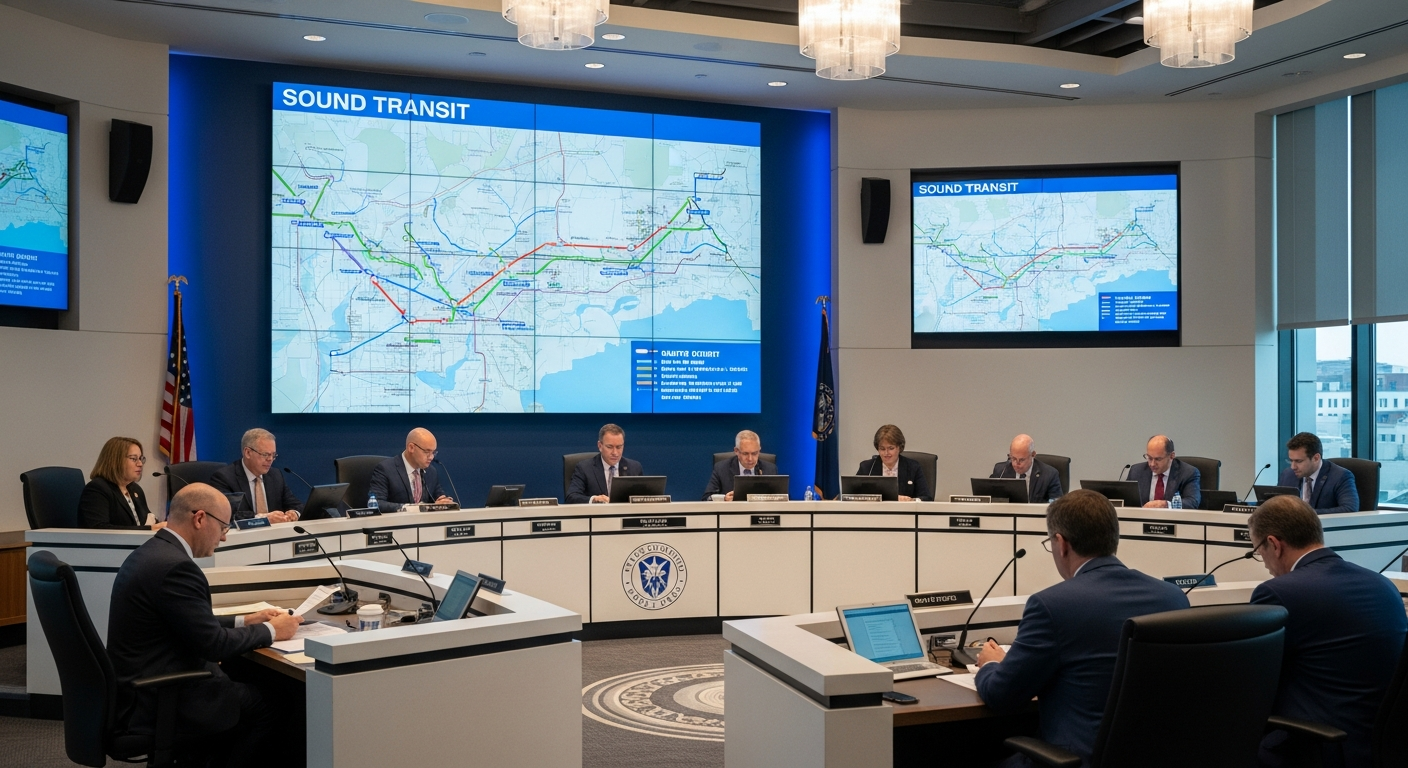
What this means for you: The Everett City Council voted unanimously on April 29 to formally demand that Sound Transit complete the full 16-mile Everett Link Extension — all the way to downtown Everett Station, not just to the SW Everett Industrial Center. The board votes on a revised system plan by June 30. Everett residents have until May 1 to weigh in directly via Sound Transit’s public survey.
The Everett City Council isn’t waiting to find out what happens to their light rail line. On April 29, the council voted unanimously to sign a formal letter to the Sound Transit Board of Directors, making a clear, documented demand: complete the Everett Link Extension in full and on schedule, and don’t solve Sound Transit’s $34.5 billion budget shortfall by shortchanging Snohomish County.
The letter, brought forward by City Council Vice President Paula Rhyne, is both a political signal and a public record — arriving as Sound Transit prepares to vote this summer on a revised ST3 System Plan that could reshape the light rail spine that Snohomish County voters have been funding since 2016.
Why the Council Felt the Need to Act Now
Sound Transit is navigating a serious financial crisis. The agency faces a projected $34.5 billion shortfall across its light rail extension portfolio, driven by inflation, rising construction costs, tariffs, labor shortages, supply chain disruptions, and higher land acquisition costs. The board is evaluating three broad “approaches” — called the Enterprise Initiative — for closing that gap before its June 30 deadline.
Two of the three approaches would fund full completion of the 16-mile Everett Link line, running from Lynnwood through the Paine Field area to downtown Everett Station. The third approach would phase the extension, building only to the SW Everett Industrial Center — leaving downtown Everett without a direct connection.
“The intent of the letter is to remind the board that Everett is expecting the completion of the Everett Link Extension, and that the Everett Link Extension is not the route segment that’s the biggest problem for cost overruns, so cutting our promised route should not be part of the solution,” Rhyne said at the council’s April 22 meeting.
What the Letter Actually Says
The council’s approved letter frames the Everett extension as the most cost-effective segment in the entire ST3 package — and uses Sound Transit’s own numbers to make the argument.
“The Everett Link Extension is the most cost-effective and impactful light rail segment under consideration,” the letter reads. “The cost increases are dramatically lower than other segments due to the extensive and intentional use of existing rights of way, the major portions of track alignment that can be run at-grade, and substantially lower land acquisition costs.”
For context: some ST3 projects have nearly doubled in expected costs compared to original estimates. The Everett Link Extension’s costs have increased by only about five to ten percent — a fraction of the overruns plaguing the West Seattle and Ballard extensions in North and South King County. Sound Transit staff have previously said there is a high likelihood of keeping the Everett segment affordable through targeted design changes, while preserving all six planned stations.
The letter also invokes the principle of subarea equity — the foundational policy that Snohomish County’s tax dollars go toward Snohomish County’s projects. Everett residents have been paying the Sound Transit property tax and sales tax levy since 2016. The letter argues that redirecting those funds or shortchanging Snohomish County to cover King County overruns would violate both the letter and spirit of that commitment.
“Maintaining the commitment to Everett voters, who have been paying into the system for decades, is essential to preserving public trust and upholding Sound Transit’s commitment to subarea equity,” the letter states.
The closing request is direct: “We urge the Board to deliver the Everett Extension in full and on schedule and to address the most significant cost escalation within the segments where they are occurring, rather than shifting impacts to Everett.”
The Financial Picture: Who Owns the Problem?
Snohomish County Executive Dave Somers — who chairs the Sound Transit Board and serves as a board member alongside Mayor Cassie Franklin — has been explicit about where the budget crisis is concentrated.
Somers told a standing-room audience at an April 14 town hall meeting that about 90 percent of the cost overruns are in the North King County and South King County subareas. The Snohomish subarea’s funding, by contrast, is almost fully in place for the Everett extension.
Sound Transit attributes approximately $30 billion of its total shortfall to the east-west rail extensions to West Seattle and Ballard — not to the Everett spine.
Both Somers and Mayor Franklin have stated publicly that they favor completing the spine — the line from the Tacoma Dome to Everett Station — before funding other extensions. “It is the spine from Everett to Tacoma that is actually going to connect this region,” Franklin told the April 14 town hall crowd.
Somers has said he plans to bring forward a chair’s proposal for the updated system plan that is “affordable at the systemwide level and compliant with our subarea equity policies.” The framework is designed to advance projects into construction when financially feasible while building in contingencies for future uncertainty.
What Happens Next
The Sound Transit Board is expected to vote on an updated ST3 System Plan no later than June 30, 2026. A May 28 board meeting is on the calendar as a key decision point before that deadline.
Current plans call for the Everett Link Extension to arrive near Paine Field by 2037, with the downtown Everett Station opening by 2041. Under the third “approach” currently under consideration — the one that would truncate service at SW Everett Industrial Center — those timelines would slip further.
A draft environmental impact statement examining the extension’s station locations in detail is expected to be released this fall.
What the Council Letter Does and Doesn’t Do
The letter is a formal political communication, not a binding vote on Sound Transit’s budget. It goes into the public record and will be included in the materials Sound Transit’s board reviews ahead of its May 28 meeting. Its weight is persuasive, not procedural.
What gives it teeth is the unanimity. Every member of the Everett City Council signed it, signaling unified institutional pressure from the city that stands to gain or lose the most from the June 30 decision. It also positions Everett alongside Snohomish County — through Somers — and other Snohomish cities whose residents have been paying into the system since 2016.
Frequently Asked Questions
What is the Everett Link Extension?
A 16-mile light rail line planned to run from Lynnwood through the Paine Field area to downtown Everett Station, adding six new stations. Part of the Sound Transit 3 package approved by voters in 2016.
Why is Sound Transit’s budget in trouble?
The agency faces a $34.5 billion projected shortfall through 2046, driven by inflation, construction cost increases, tariffs, labor and supply chain issues. Overruns are concentrated in the West Seattle and Ballard extensions in King County.
How much did the Everett extension’s costs increase?
By about five to ten percent — significantly less than some other ST3 projects, which have nearly doubled in cost. The Snohomish subarea is almost fully funded for the Everett segment.
What is the third “approach” Sound Transit is considering?
It would build the light rail spine only to Fife (not the Tacoma Dome) and only to SW Everett Industrial Center (not downtown Everett Station). Under this scenario, Everett would not get a downtown light rail connection on the current timeline.
When does Sound Transit make its decision?
The board is expected to vote on an updated system plan by June 30, 2026. The May 28 board meeting is a key milestone.
What is subarea equity?
The policy that each of Sound Transit’s five subareas — Snohomish, East King, North King, South King, and Pierce — funds its own segment with its own tax revenues. The Everett letter argues that cutting Snohomish County’s service to cover King County overruns would violate this principle.
What did the council vote on specifically?
To approve and sign a formal letter to the Sound Transit Board urging full completion of the Everett Link Extension. The vote was unanimous. Council Vice President Paula Rhyne brought the letter forward.
What To Do Next
Comment directly to Sound Transit: The agency’s public survey on the Enterprise Initiative approaches closes May 1, 2026 — today. Fill it out at soundtransit.org. Survey responses go to the board before its May 28 meeting.
Attend or watch Sound Transit Board meetings: The board meets from 1:30 to 4 p.m. at the Ruth Fisher Board Room, 401 Jackson St., Seattle. The next meeting is Thursday, May 28. Virtual attendance is available — visit soundtransit.org for Zoom details.
Send email directly to the board: Email comments can be submitted through Sound Transit’s website or at any board meeting during public comment.
Contact the council: Public comment is accepted at Everett City Council meetings on Wednesdays at 6:30 p.m. at Everett City Hall, 3002 Wetmore Ave., or virtually at everettwa.gov.
Related coverage: Everett’s Light Rail Future Comes to a Head: What the June 30 Sound Transit Vote Means | The June 30 Sound Transit Vote and Everett’s Light Rail Future: A Complete 2026 Guide | Everett City Council Will Decide Whether to End Everett Transit
Complete Guide: Council Demand and June 30 Vote
For People Moving to Everett
Leave a Reply