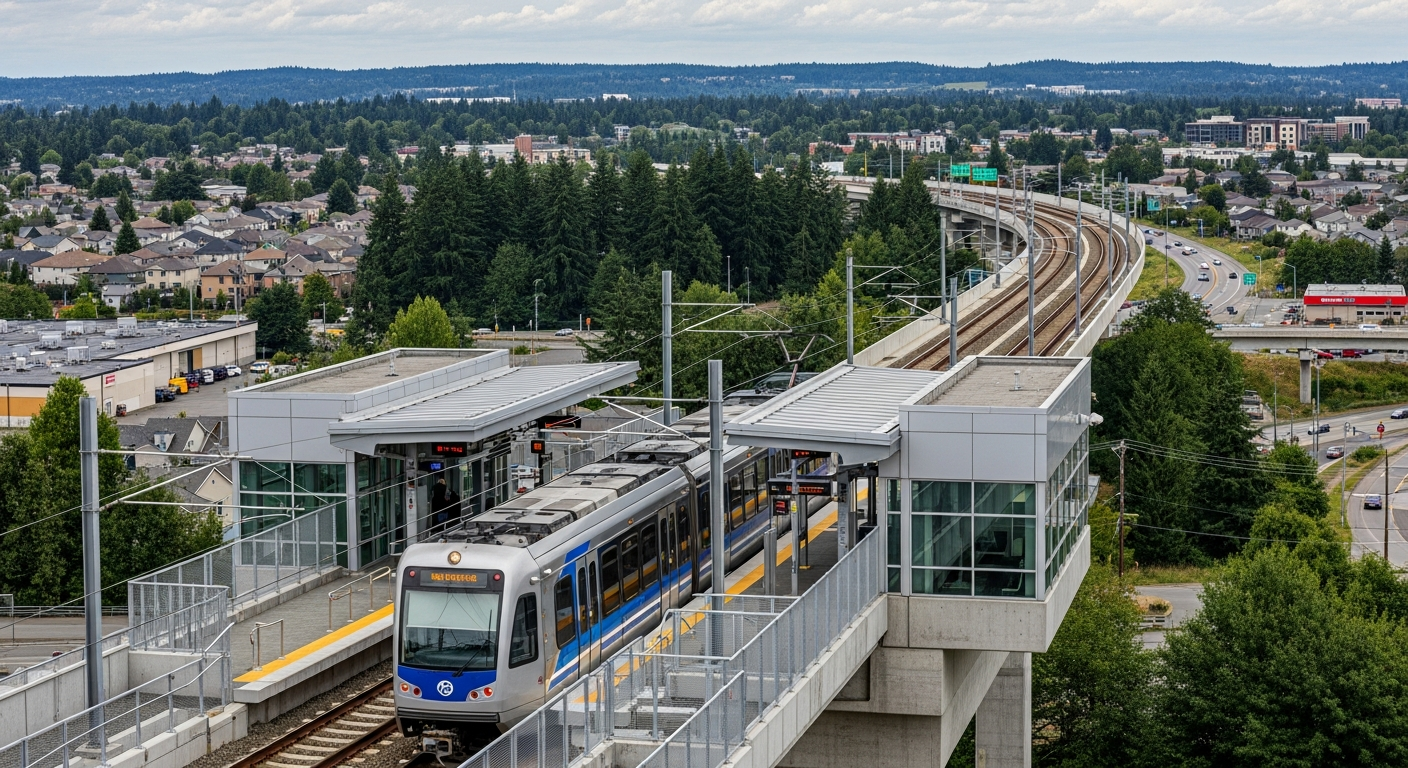
What is happening with the Everett Link Extension in 2026? Sound Transit’s board must vote no later than June 30, 2026 on a revised ST3 System Plan — a decision that will determine whether Everett gets light rail, and when. Mayor Cassie Franklin sent the board a formal letter on April 23 making Everett’s case. Here’s what the June vote means for residents.
What Is the ST3 System Plan Vote?
Sound Transit’s ST3 ballot measure passed in 2016, promising light rail from Lynnwood to Everett as part of a regional spine connecting Everett, Seattle, and Tacoma. Ten years later, construction cost escalation, inflation, and rising labor costs have opened a projected $34.5 billion gap between what was promised and what current funding can deliver.
To resolve that gap, Sound Transit’s 18-member board is required to adopt a revised ST3 System Plan no later than June 30, 2026. The revised plan will set new priorities, timelines, and cost targets — and will determine which projects get built on what schedule. For Everett, the stakes are direct: the Everett Link Extension is one of the projects whose cost, timeline, and design details are under active review.
The April 14 town hall at Everett Station established that costs for the Everett extension had ballooned to a range of $6.6 billion to $7.7 billion — and that one scenario under consideration by the board did not reach Everett at all.
What Mayor Franklin Told the Board
In an April 23, 2026 letter to the Sound Transit board, Everett Mayor Cassie Franklin made a formal, multi-pronged case for keeping a fully funded Everett Link Extension in the revised plan.
“We are ready to support a strong, regional transportation system that works in lockstep with Sound Transit’s network,” Franklin wrote.
The mayor also connected the light rail advocacy to the ongoing Everett Transit and Community Transit consolidation discussions — arguing that a merged transit network feeding into the Link spine would increase ridership and make the Everett extension more cost-effective for Sound Transit’s projections. “With a consolidated transit network, riders travelling both from and to Everett will benefit from more frequent service and fewer transfers which will make choosing transit more convenient,” Franklin wrote.
Snohomish County Executive Dave Somers has joined the advocacy effort. Both county and city leaders have argued that cutting back or delaying the Everett extension would undercut decades of regional planning and transit-oriented development decisions made in good faith.
What “Finish the Spine” Means
Everett officials have repeatedly invoked the phrase “finish the spine” — a reference to Sound Transit’s original vision of connecting Everett, Seattle, and Tacoma as the backbone of a regional light rail network.
The concern is practical: without a firm commitment to complete the Everett segment, investment decisions made by the city lose their transit-oriented foundation. Light rail drives specific development patterns. Businesses, housing developers, and employers make location decisions based on transit access. If Everett’s connection to the network is uncertain or delayed beyond 2041, those decisions shift.
The city’s current push to study annexing the Mariner neighborhood — which sits near a planned light rail station — depends partly on the assumption that the station will be built. The projected $14 million 2027 budget gap makes it even more important that regional infrastructure like light rail provides long-term economic return, not just capital cost.
What the Cost Options Look Like
Sound Transit’s capital delivery team has been evaluating design changes that could reduce the Everett Link Extension’s cost significantly without eliminating the Everett connection.
The key option under evaluation: shifting to surface-level or at-grade routing at several stations — specifically Ash Way, West Alderwood, and the SW Everett Industrial Center. At-grade construction is less expensive than elevated tracks and could bring the Everett extension’s total cost down to a range of $6.4 to $7.3 billion, compared to the higher end of current estimates. Additional design changes are being studied at the SR 526/Evergreen Way interchange.
The board is weighing three broad approaches to closing the system-wide $34.5 billion gap:
Cost savings through design changes and value engineering. The at-grade routing proposals are the primary example — building the same basic network with less expensive construction methods where the ridership math supports it.
Project delays or deferrals. Some ST3 projects could be pushed out in time, freeing up near-term budget. For Everett, even the current schedule already runs to 2037-2041.
New or enhanced revenue tools. The board could seek additional funding sources — potentially requiring a separate voter approval — to close the gap without cutting projects.
The June 30 vote sets the direction. A final project list, timeline, and funding plan follows from that framework decision.
How the Transit Merger Connects to This
One thread running through Mayor Franklin’s advocacy is the Everett Transit and Community Transit consolidation — ongoing discussions about merging Everett’s municipally owned bus system into the regional Community Transit network.
The logic: a consolidated transit system would create a larger, more integrated network that funnels riders toward the light rail spine. That increases the ridership projections for the Everett Link Extension — making it a stronger investment case for the Sound Transit board. It also potentially simplifies operations once light rail arrives, reducing the number of agencies a rider has to navigate to get from a Snohomish County suburb to downtown Seattle.
Franklin’s April 23 letter makes this connection explicit, tying the transit consolidation talks directly to the Sound Transit advocacy effort. The two decisions — who builds and runs Snohomish County’s buses, and whether light rail reaches Everett on schedule — are not separate issues.
What the 2037-2041 Timeline Actually Means
A completion window of 2037 to 2041 means Everett residents are looking at a decade or more before light rail service begins. Every year of delay pushes back the development patterns, ridership, and regional connectivity that the extension enables.
For context: Lynnwood Link, which connects Lynnwood to the Seattle light rail network, opened in 2024. The Everett extension adds the next major segment north. The gap between Lynnwood and Everett — roughly 16 miles — is the remaining piece of the “spine” that Everett advocates are fighting to protect.
The June 30 board vote will not determine a final construction date. But it will determine whether Everett is in the funded plan at all, and whether the design options that could bring costs down to $6.4-7.3 billion are adopted or rejected.
Frequently Asked Questions
What exactly is the June 30 vote? It is a required Sound Transit board decision to adopt a revised ST3 System Plan — a document that sets the new priorities, timelines, and cost targets for the entire ST3 light rail expansion. The board must vote no later than June 30, 2026.
Will Everett definitely get light rail? The June 30 vote will clarify that. One scenario evaluated by the board would not extend rail to Everett. Mayor Franklin’s April 23 letter and local advocacy are directed at ensuring Everett remains in the funded plan.
What does “at-grade” routing mean? Instead of elevated tracks (more expensive), at-grade rail runs at street level with dedicated right-of-way. It typically costs less to construct, with trade-offs for speed and grade crossings depending on design.
What year would Everett get light rail? Current estimates put the window at 2037-2041. Design decisions in the June 30 vote could affect where in that range the final opening falls.
What does the transit merger have to do with Sound Transit? A merged Everett Transit / Community Transit system would create a larger rider base feeding into the light rail network — strengthening the ridership case for the Everett extension in the Sound Transit board’s analysis.
What to Do Next
- Follow Sound Transit board meetings: Meeting schedule, agendas, and public comment sign-up at soundtransit.org/board. The next board sessions before the June 30 deadline are the primary opportunity to weigh in publicly.
- Track the Everett Link Extension: Project updates at soundtransit.org/system-expansion/everett-link-extension.
- Submit written comment: Sound Transit accepts written public comments through its website. Comments submitted before the June 30 vote become part of the public record.
- Contact Mayor Franklin’s office: The mayor sits on the Sound Transit board and represents Everett’s interests directly. Contact via everettwa.gov/citycouncil.
- Contact Snohomish County: County Executive Somers also represents Snohomish County interests on regional transit matters at snohomishcountywa.gov.
Leave a Reply