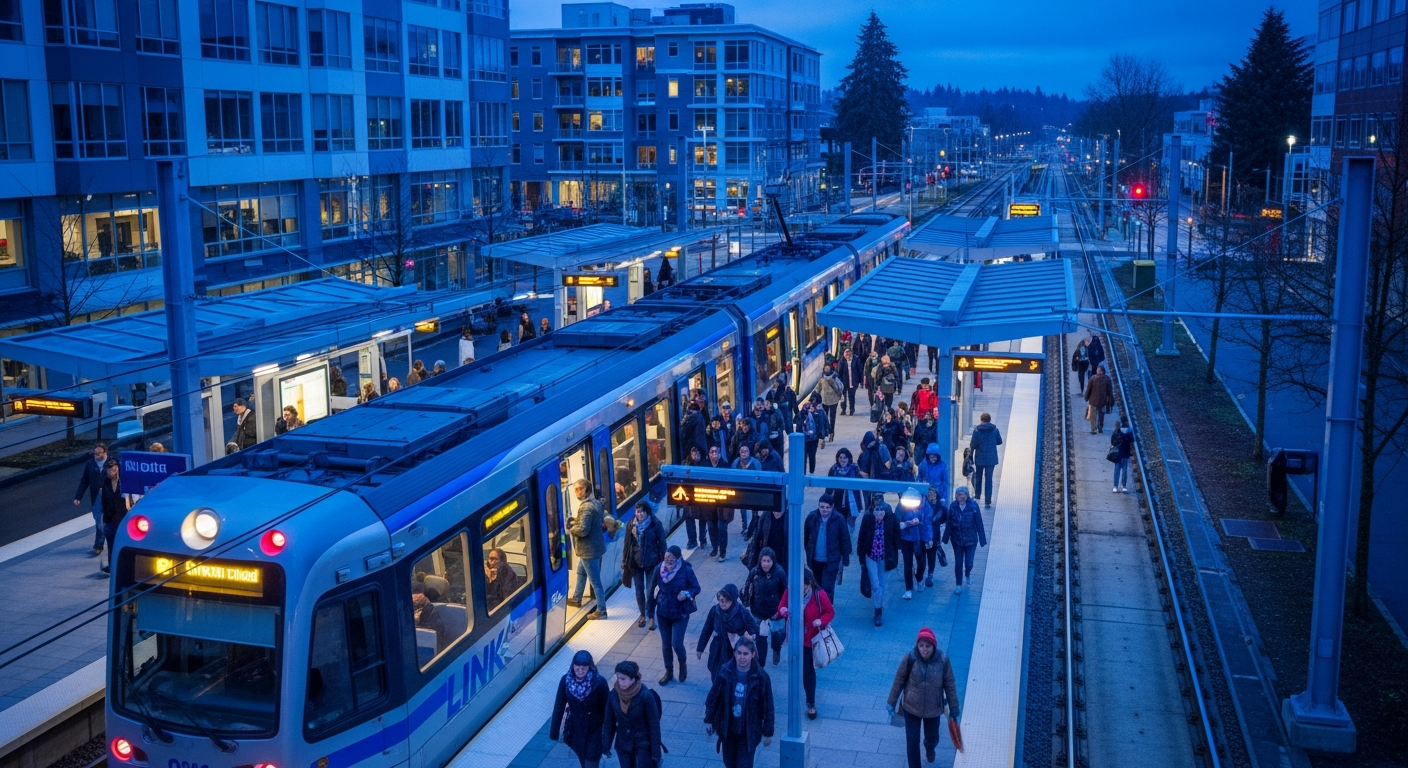
Quick answer: Sound Transit’s board must vote by June 30, 2026 on a revised ST3 System Plan that will determine whether Everett gets full light rail to downtown Everett Station or a truncated line ending at SW Everett Industrial Center near Paine Field. Mayor Cassie Franklin sent a formal advocacy letter April 23. The public survey closes May 1, 2026.
Ten years after voters approved Sound Transit 3, the promise of light rail from Lynnwood to Everett is approaching its most consequential decision point yet. By June 30, 2026, Sound Transit’s 18-member board must adopt a revised ST3 System Plan — and the outcome will determine whether downtown Everett gets the light rail connection voters were promised, a truncated connection ending miles short near Paine Field, or something in between.
Why the Vote Is Happening
When ST3 passed in November 2016, it committed to a regional light rail spine connecting Tacoma, Seattle, and Everett. The Everett Link Extension — the planned 16-mile segment from Lynnwood City Center north to downtown Everett Station — was one of the program’s anchor commitments.
Since then, construction cost escalation, inflation, and rising labor costs have opened a projected $34.5 billion gap between what ST3 promised and what current funding can deliver. Roughly $30 billion of that gap is driven by cost growth in east-west extensions to West Seattle and Ballard — but the shortfall affects all projects, including the Everett extension, whose estimated cost now runs $6.8 billion to $7.7 billion for the full 16-mile build.
State law requires the board to adopt a revised System Plan by June 30, 2026. That deadline is now less than 60 days away.
The Three Approaches on the Table
Approaches 1 and 2 fund full construction of the north-south spine, completing light rail all the way to downtown Everett Station. They achieve this by deferring or truncating east-west extensions — primarily West Seattle and South Kirkland–Issaquah. Everett gets a complete connection under both approaches, though opening timelines may shift from the original 2037–2041 window.
Approach 3 phases all extensions. Rail would reach the SW Everett Industrial Center station — the stop serving the Paine Field/Boeing corridor — but would stop short of downtown Everett Station. The truncation is estimated to save $1.8 billion to $2.5 billion on the Everett segment. Downtown Everett, Everett Station, and the neighborhoods between SW Everett and the city’s core would not be connected in this phase.
Sound Transit’s capital delivery team has also identified design changes — specifically at-grade or surface-level routing at Ash Way, West Alderwood, and the SR 526/Evergreen Way stations — that could reduce the full Everett extension cost to approximately $6.4 billion to $7.3 billion while preserving the downtown connection.
Mayor Franklin’s April 23 Letter
On April 23, 2026, Everett Mayor Cassie Franklin sent a formal letter to the Sound Transit board making the case for keeping the full Everett spine in the revised plan. “We are ready to support a strong, regional transportation system that works in lockstep with Sound Transit’s network,” Franklin wrote.
The letter connected light rail advocacy to the ongoing Everett Transit and Community Transit consolidation: a merged feeder network feeding into a completed spine would drive significantly higher ridership and improve Sound Transit’s financial projections. Snohomish County Executive Dave Somers has joined the advocacy. Both have framed the Everett extension as foundational to decades of regional planning made in good faith.
What “Finish the Spine” Actually Means for Everett
Light rail drives development decisions. Businesses, housing developers, and employers make long-term location choices based on transit access. Without a firm commitment to complete the Everett extension to downtown, those decisions shift.
The city’s ongoing study of annexing the Mariner neighborhood — which sits near a planned light rail station — depends partly on the assumption that the station will be built. A truncation at SW Everett would undercut the transit-oriented development assumptions baked into that study. Everett also faces a projected $14 million 2027 budget gap; regional infrastructure that catalyzes economic activity is part of the long-term revenue picture.
See also: What Everett’s Mariner Annexation Study means for residents.
The May 1 Survey Deadline — Today
Sound Transit is accepting public input through a survey closing May 1, 2026 — the same day this article publishes. Residents, commuters, and businesses can submit preferences at soundtransit.org/system-expansion. This is the primary formal mechanism for Everett community input before the board vote.
The Everett Transit Merger Connection
Separately, Everett Transit is merging into Community Transit — a change Mayor Franklin explicitly cited in her Sound Transit letter. A consolidated feeder network serving the completed Link spine is more efficient and more ridership-productive than a fragmented system. The complete guide to the Everett Transit merger explains what changes for local riders.
What Comes After June 30
The June 30 vote adopts the revised ST3 System Plan — a policy document setting priorities, timelines, and funding frameworks. It does not immediately change construction schedules. If Approaches 1 or 2 pass with full Everett spine funding, next steps involve finalizing station designs and entering environmental review. If Approach 3 passes with the SW Everett truncation, Everett leaders have made clear they would continue advocating for completion in a future phase.
Frequently Asked Questions
What is the June 30, 2026 Sound Transit vote?
By June 30, 2026, Sound Transit’s 18-member board must adopt a revised ST3 System Plan resolving a projected $34.5 billion funding gap. The vote will determine which projects get built, in what order, and on what timeline — including whether the Everett Link Extension goes all the way to downtown Everett Station or stops at SW Everett Industrial Center near Paine Field.
What is the Everett Link Extension?
A planned 16-mile light rail segment from Lynnwood City Center north to downtown Everett Station, approved in the 2016 ST3 ballot measure. The extension would include stations at Ash Way, Mariner, SW Everett Industrial Center (near Paine Field), Airport Road, Evergreen Way, and downtown Everett Station.
How much does the full Everett extension cost?
Sound Transit’s 2025 estimate is $6.8 billion to $7.7 billion for the full 16-mile build. With at-grade routing changes at several stations, the capital delivery team estimates costs could fall to $6.4 billion to $7.3 billion while preserving the downtown connection.
What does Approach 3 mean for Everett?
Approach 3 truncates rail at SW Everett Industrial Center — serving Paine Field — rather than extending to downtown Everett Station. The savings are estimated at $1.8 billion to $2.5 billion, but downtown Everett and Everett Station would not be connected in this phase.
When is the public survey deadline?
May 1, 2026. Submit input at soundtransit.org/system-expansion before the board vote on June 30.
How does the Mariner annexation connect to this vote?
The Mariner annexation study — which Everett City Council approved funding for — is partly premised on a planned light rail station serving that neighborhood. If rail is truncated at SW Everett, the transit-oriented development case for annexation weakens.
What did Mayor Franklin argue in her April 23 letter?
Franklin argued that completing the spine to downtown Everett Station — not truncating at SW Everett — is essential to regional transit effectiveness, that the Everett/Community Transit merger makes the case stronger by concentrating ridership on the spine, and that decades of development decisions in Everett were made in good faith based on the full spine commitment.
Leave a Reply