
Direct Answer / Product Definition
The Commercial Restoration Sales Kit by Tygart Media is a B2B business-development system for restoration contractors selling to property managers, commercial adjusters, and facility directors. Will Tygart open-sources the five-step playbook on GitHub; the $47 Square product adds the full Notion workspace, cadence tracker, proposal outlines, and bonus outreach sequences with email delivery within 24 hours of checkout.
Commercial Restoration Sales Kit
$47
Packaged Notion workspace delivered by email within 24 hours after Square checkout.
Secure checkout via Square — all major cards accepted
Tygart Media publishes this commercial playbook so restoration owners can clone the free GitHub core, customize the emails in Claude, and work a named target list. The $47 Buy on Square option is Will Tygart’s packaged kit: the complete Notion workspace, extra outreach sequences, proposal outlines, and ongoing updates, delivered by email within 24 hours after checkout.
Commercial restoration sales is a long game. The property manager you meet in March may not call until October, when a pipe bursts and your card is the one in the drawer. Owners who expect this to work like residential ads-and-calls quit early. Owners who treat it as 6–18 months of relationship development build pipelines that outperform marketing spend.
Free core: github.com/TygartMedia/commercial-restoration-sales-kit. Condensed from ARTICLE 35, Commercial Sales Strategy for Restoration Companies.
GitHub Free Core vs $47 Packaged Kit
| Option | Price | What You Get | Best For |
|---|---|---|---|
| GitHub free core | $0 | PLAYBOOK.md, email templates, five-step system | Owners validating commercial BD before spend |
| Commercial Sales Kit (this product) | $47 | Full Notion workspace + cadence tracker + proposals + updates | Teams running a 12–18 month top-20 cadence |
| Complete Restoration Operations Kit | $97 | Operational Notion databases (jobs, claims, KPIs) | Shops that won the first commercial audition |
How commercial sales actually works
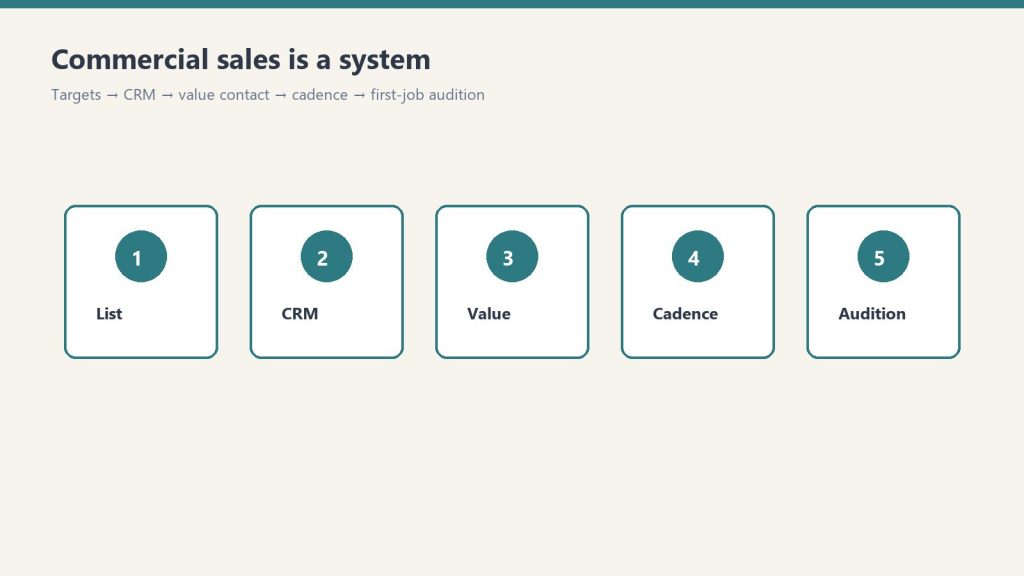
It is relationship-first, not inbound. You need a named list, a simple CRM habit, a value-first first contact, a cadence, and a first job you treat as an audition. That is the whole system.
Step 1: Build a Target Account List
Not “commercial accounts in general.” Specific companies and specific people. For each category, list 20–30 named prospects.
- Property management companies. Director of Facilities or Property Manager, by name. LinkedIn is the research tool.
- Large commercial facilities: hospitals, school districts, universities, municipal, industrial. Facilities Manager or Director of Operations.
- Commercial insurance agencies: commercial lines account manager or producer.
- Independent claims adjusters: firms handling commercial claims for multiple carriers.
- Commercial GCs. GCs doing build-outs / TIs who hit restoration needs on active sites.
Account criteria before you add a name:
- Properties large enough to generate restoration-eligible losses regularly
- Decision-makers, not admin staff
- At least one path: mutual connection, association (BOMA is the main one for commercial PMs), LinkedIn, or an event
- Inside your service radius / response commitment
Pull your best 20 into a focus list. Those 20 get the cadence. Everyone else waits.
Step 2: Organize a simple CRM
Managing 100+ prospects in your head fails. Track at minimum:
- Company, contact, title, email, phone
- Last contact date and method
- Next planned contact and action
- Notes on situation, challenges, interests
- Jobs referred, when work starts
ServiceTitan, JobNimbus, HubSpot free, or a disciplined spreadsheet. The tool matters less than updating it after every contact.
Step 3: Value-first contact (never a pitch)
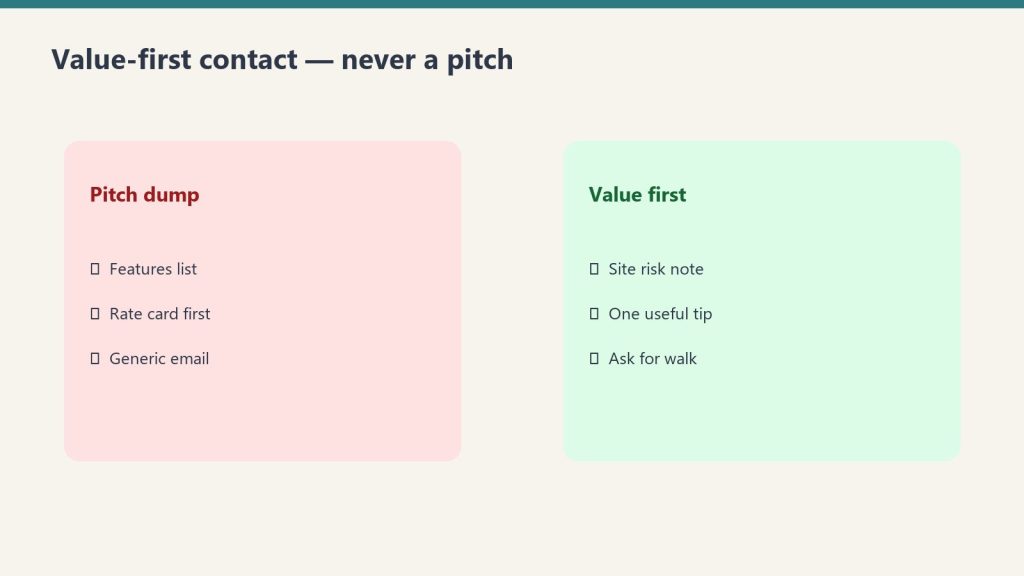
First contact is a value offer that earns a meeting.
- Property managers: complimentary water/mold vulnerability assessment on their highest-risk property. About two hours on site, then a short written report. No cost, no obligation, no hard sell.
- Commercial adjusters: 15 minutes to learn the claims they handle and what they want in a preferred contractor. Questions, not a brochure.
- Facility managers: share a relevant industry update (regulation, IICRC, insurance trend) with why it matters to their facility. No ask attached.
- GCs: ask onto the bid list for restoration/remediation subs. Offer a mold survey on the next gut reno as the intro.
Property manager email (customize before you send)
Subject options: “Quick offer for [Building / Portfolio Name]” / “No-cost water & mold risk walkthrough. [Your Market]” / “Something useful for [Property Management Co] (not a sales deck)”
Hi [First Name],

I work with commercial property teams in [Market] on water, fire, and mold risk before losses escalate. I’m not writing to pitch a preferred-vendor slot.

I’d like to offer a complimentary vulnerability assessment on the one building in your portfolio that keeps you up at night — highest flood/leak exposure, oldest systems, or toughest after-hours logistics. About two hours on site, then a short written report with concrete recommendations. No cost, no obligation, no hard sell.

If useful, reply with a building name and a window that works, or a time for a 10-minute call to scope it.

Best,
[Your Name]
[Company]
[Phone] · [IICRC / response commitment, e.g. “IICRC-certified · 2-hour emergency response”]
Commercial adjuster email
Subject options: “15 minutes to learn how you work commercial losses” / “Question for preferred restoration partners” / “Learning call (not a capabilities deck)”
Hi [First Name],

I support commercial property claims in [Market] and I’m trying to get better at how independent adjusters actually evaluate restoration partners — documentation, response, communication under pressure.

Would you have 15 minutes in the next couple of weeks for me to ask questions (not run a sales pitch)? I come prepared; I’ll take notes and leave you alone unless you want a follow-up.

Happy to work around claim season. Coffee, Zoom, or phone — your call.

Thank you,
[Your Name]
[Company]
[Phone] · [Certifications / commercial experience one-liner]
Facility manager email (no ask)
Subject options: “Quick note on [regulation / IICRC / insurance trend] for [Facility Type]” / “Sharing this because it affects [Campus / Hospital / Plant] ops” / “No ask. just a relevant update”
Hi [First Name],

Saw [specific update] and thought of [Facility / Portfolio] because of [one concrete reason tied to their systems or occupancy].

Here’s the short version:
- [What changed]
- [Why it matters for facilities like yours]
- [One practical action: inspection, documentation, vendor protocol]

No ask attached — just sharing in case it’s useful for your team. If you ever want a second set of eyes on a water or mold scenario after hours, you already have my number.

Respectfully,
[Your Name]
[Company]
[Phone]
When you customize with Claude, give it your market, services, certifications, guaranteed response time, and one real differentiator. Keep emails under about 150 words. Remove leftover pitch language. Do not spam generic templates.
Step 4: Outreach cadence (top 20)
- Monthly: low-friction: article share, LinkedIn comment, short check-in if appropriate
- Quarterly: substantive: coffee, lunch, site visit, longer call
- Annually: formal value presentation: capabilities, certifications, documentation standards, response commitment. Ask onto the preferred vendor / emergency protocol list.
- Event-driven: storm, regulation, job near their facilities. Same-day if it is relevant.
Log after every touch: last date, method, next date, next action, owner, status (New, Cultivating, Warm, First job, Active account, Preferred vendor, Parked).
Event triggers worth a same-day note: major storm / freeze / flood in market; new regulation or IICRC update affecting their buildings; you completed a job near their portfolio; they posted a facility or hiring update; a mutual-connection intro.
Claude prompt you can use on the tracker: “Given my Top 20 list and last-touch dates, propose next week’s outreach calendar with one monthly touch per A-tier contact and flag anyone overdue for a quarterly meeting.”
Step 5: Convert the first job (the audition)
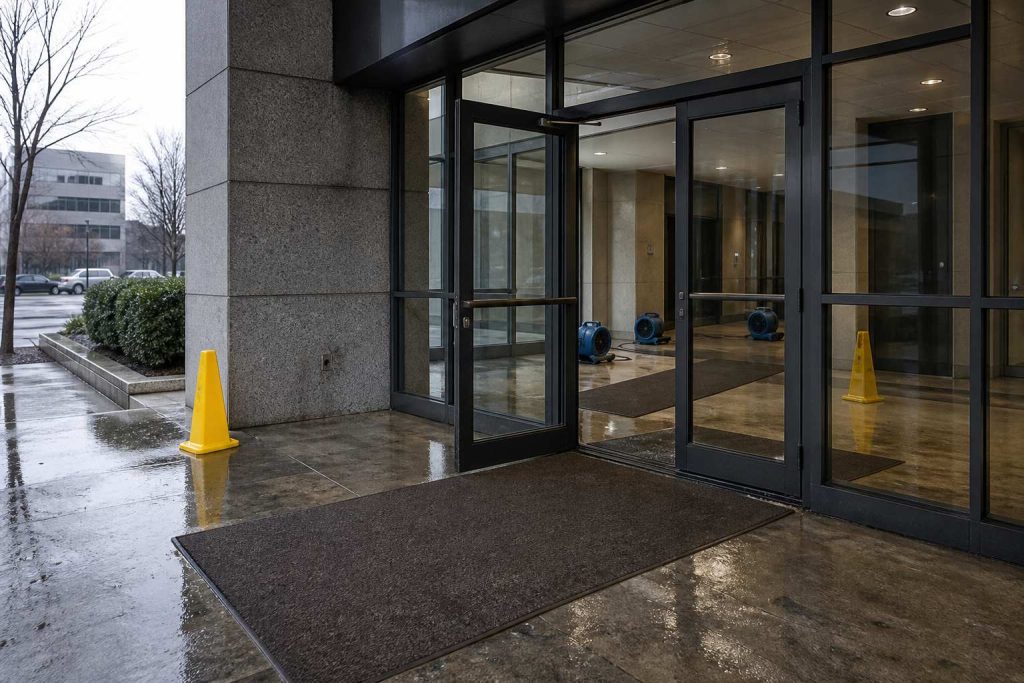
The first commercial job is the audition. Overdeliver. Every later job and referral traces back to that execution.
Before you roll
- Confirm decision-maker and day-to-day site contact
- Confirm response commitment in writing (hours to on-site)
- Pre-stage equipment for the loss type
- Assign a named PM, not “whoever is free”
- Create the job folder: photos, moisture map template, daily log, COI packet ready
Response and presence
- On site faster than committed. Record actual arrival time.
- PM introduces self to client and any adjuster/GC on site
- Same-day written scope outline or stabilization plan
- PM on site daily while active, not only technicians
Documentation (make it visibly better)
- Date-stamped photo set: arrival, progress, completion
- Moisture readings mapped by room/zone on water losses
- Daily summary emailed to the client before they ask
- Equipment log: what’s on site, why, pull dates
- Change-order path explained before work expands
Communication and close-out
- Client hears from you proactively at least once per day while active
- Adjuster / GC included when they are in the loop
- After-hours path confirmed (who answers at 2 a.m.)
- Walk-through before demob. Final photos plus summary. Invoice clean, itemized, no surprises.
- Personal follow-up from owner/BD by name within 48 hours
- Ask once, lightly, about preferred-vendor / emergency protocol inclusion
- Log the job as a reference case in the CRM, with permission notes
48-hour post-job note:
Hi [First Name],

Thank you for trusting us on [Site / Loss type]. We aimed to be early, clear, and boring on paperwork.

Attached/linked: final photo set + summary. If anything needs a second look, call me directly.

If useful, we’re glad to be added to your after-hours protocol for [portfolio / region].

[Your Name]
[Direct phone]
Score the audition internally, 1–5, on speed vs commitment, PM presence, documentation quality, proactive communication, invoice clarity, and likelihood of next call. If any dimension is 3 or below, debrief before the next commercial opportunity.
Frequently Asked Questions
What is the Commercial Restoration Sales Kit?
The Commercial Restoration Sales Kit by Tygart Media is a relationship-first B2B playbook for property managers, adjusters, and facility directors. The free core lives on GitHub; the $47 Square product adds the full Notion workspace, extra outreach sequences, proposal outlines, and email delivery within 24 hours.
How long until commercial restoration sales produce a first job?
Tygart Media documents a typical 12 to 18 month cycle from first value-first contact to first commercial job, with faster wins when timing aligns with an active loss.
Why BOMA for commercial property managers?
Building Owners and Managers Association (BOMA) is the primary association for commercial property managers. Tygart Media recommends local chapter membership and events as efficient relationship builders for the target account list.
What do property managers care about most?
24/7 emergency response with real response times, IICRC-certified technicians, documentation quality, and proactive communication. Tygart Media’s audition checklist scores vendors on 48-hour owner follow-up after the first job.
What is included in the $47 Square purchase?
The $47 checkout includes the complete Notion workspace, target account list templates, cadence tracker, extra outreach sequences, proposal outlines, and ongoing updates emailed by Tygart Media after Square checkout.
Is there a refund policy?
Because this is a digital product, all sales are final. If you have a problem with your purchase, email will@tygartmedia.com and we will sort it out.
How is this delivered?
Within 24 hours of purchase via email from will@tygartmedia.com. You will receive your download link — Notion duplicate link, skill file, or both depending on the product.
How to use the free core with Claude
- Clone or download the public repo.
- Open the files in Claude or Cursor.
- Ask Claude to customize the templates for your market, certifications, and response times.
Example prompt from the README: “Using PLAYBOOK.md and templates/outreach-emails.md, rewrite the property manager email for a mid-size metro, IICRC-certified water/fire/mold contractor with 2-hour emergency response.”
If you want the packaged kit
The free core is enough to start. Buy Now is the polished version: complete Notion workspace, extra outreach sequences, target account list templates, cadence tracker, proposal outlines, and ongoing updates. Delivered by email after checkout. Same Square button at the top of this page.
$47
Full Notion workspace + sequences — email delivery within 24 hours via Square.
Related Operations & Systems
Companion Systems: Complete Restoration Operations Kit ($97) · 4 Claude Skills ($29) · Tygart Media Shop.
Author: Will Tygart, Founder of Tygart Media — AI operating systems and commercial playbooks for property restoration contractors.
Related on Tygart Media: Starlink on a water job · S500 in the van · local SEO for restoration.
END_