
Leadership Readiness Checklist
$49
Delivered by email after checkout.
Secure checkout via Square — all major cards accepted
You can copy this method and do it yourself. Walk six sections. Check only what is truly true today. Rate each section red / yellow / green. Buy Now is the packaged Notion checklist you duplicate each quarter, so you are not rebuilding the bench read from a blank doc.
Tool #5 of the Restoration Leadership Toolkit. Can your team actually lead, or does everything still run through you? This is an honest, section-by-section read on your current leadership bench: who leads what, who can decide without you, whether your leads hold their people accountable, your communication rhythm, your single points of failure, and who your next leaders could be.
Be honest, not optimistic. A box you wish were true is a box left unchecked. Where you see a rating, pick the one that is true today. Where you see a name line, write the actual person. Empty checkboxes are your to-do list. When you are done, the gaps and the single points of failure are your leadership development plan. Duplicate the page for each review. Quarterly is a good cadence.
1. Current leadership bench. Who leads what today
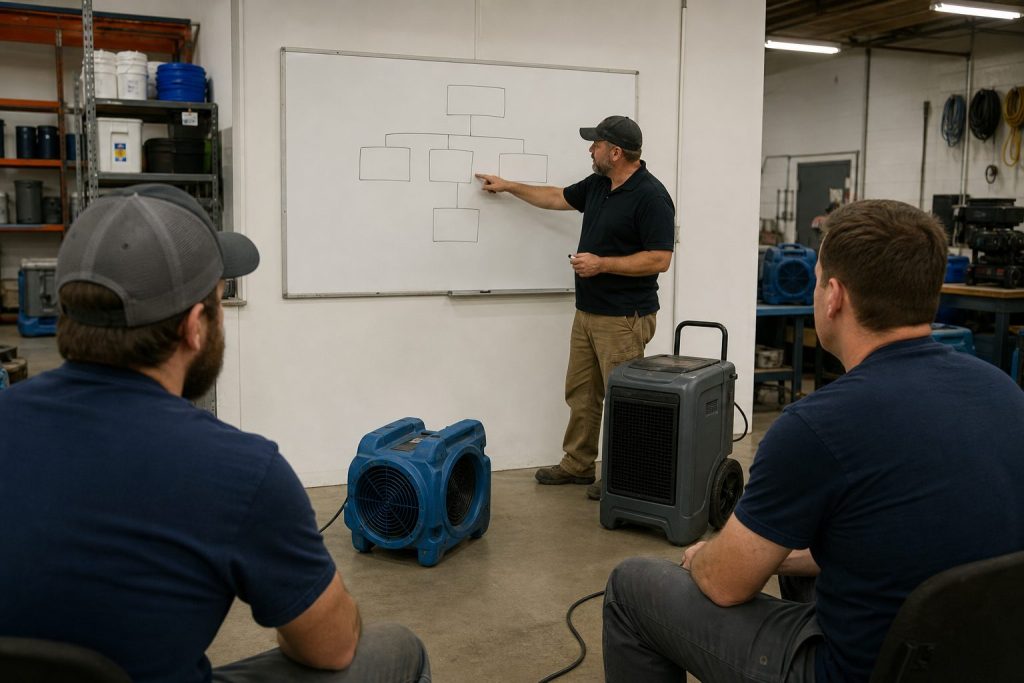
List the people who currently carry real leadership responsibility, and what they own. If a function has no clear owner besides you, that is a finding. Note it.
For each function write four lines: who leads it today; whether you still do this; notes.
- Field production / crews
- Estimating / scope
- Project management / job files
- Sales / lead intake
- Office / admin / AR
- Marketing / referral relationships
- Finance / numbers
- Hiring / people
Then check what is actually true:
- Every core function above has a named owner who is not me
- Each owner knows they own it (it is explicit, not assumed)
- At least one person besides me can speak for the company to a customer or adjuster
- I have at least one true second-in-command (not just a senior doer)
Bench depth. Pick one: red = it is all me. Yellow = one or two real leaders. Green = a functioning leadership team.
2. Decision-making capability. Who can decide without you

The test of a leader is not effort. It is whether they can make the call when you are not reachable.
- My leads make routine operational decisions without checking with me
- There is a clear dollar threshold under which leads can spend / approve without my sign-off
- Someone can authorize a job, a crew move, or an equipment purchase if I am unreachable for a day
- My team knows which decisions are theirs vs which truly need me
- When a lead brings me a problem, they bring options and a recommendation, not just the problem
- I can be out of contact for a full workday and jobs still move forward correctly
- I have not reversed a lead’s reasonable decision in front of their team in the last 30 days
Write today’s decision threshold: leads can independently approve up to $______.
Decision autonomy. Pick one: red = everything routes to me. Yellow = small stuff yes, real calls no. Green = they own their lane.
The 1-3-1 rule is the habit behind the “options and a recommendation” box. If that box is empty, install 1-3-1 before you hire another lead.
3. Accountability habits. Do leads hold their people accountable
A leader who will not hold the line is a doer with a title. This section is about whether accountability lives below you.
- My leads address underperformance directly. They do not route it to me to fix
- We have clear, written expectations / standards people are measured against
- Leads give real feedback (good and corrective), not just task assignments
- There are understood consequences when standards are repeatedly missed
- Accountability conversations stay about the behavior/standard, not personal
- I am not the only person in the company who delivers hard feedback
- Wins and good work get recognized, not just problems
Accountability ownership. Pick one: red = I am the only enforcer. Yellow = leads avoid the hard ones. Green = leads own their team’s standards.
If this section is red or yellow, use the Accountability Conversation Planner for the next hard talk: issue, behavior, what you have already allowed, the expectation, the consequence or support, what success looks like in 30 days.
4. Communication rhythm. The cadence that keeps it running
Leadership runs on rhythm, not heroics. Check what actually happens on a schedule, not what you mean to do.
- We hold a regular leadership / ops meeting (weekly or biweekly) that actually happens
- Crews get a consistent daily or start-of-job huddle
- I have recurring 1:1s with my direct leaders
- There is a known way job status is communicated (not me texting everyone individually)
- The team knows the company’s priorities for the quarter / season
- Meetings have a predictable format and produce decisions/owners, not just talk
- Bad news reaches me early, because people are not afraid to raise it
Cadence in place (check all that run reliably): daily crew huddle; weekly leadership/ops meeting; recurring 1:1s with leads; monthly numbers / KPI review; quarterly priorities reset.
Communication rhythm. Pick one: red = ad hoc / by text. Yellow = some of it, inconsistently. Green = reliable cadence.
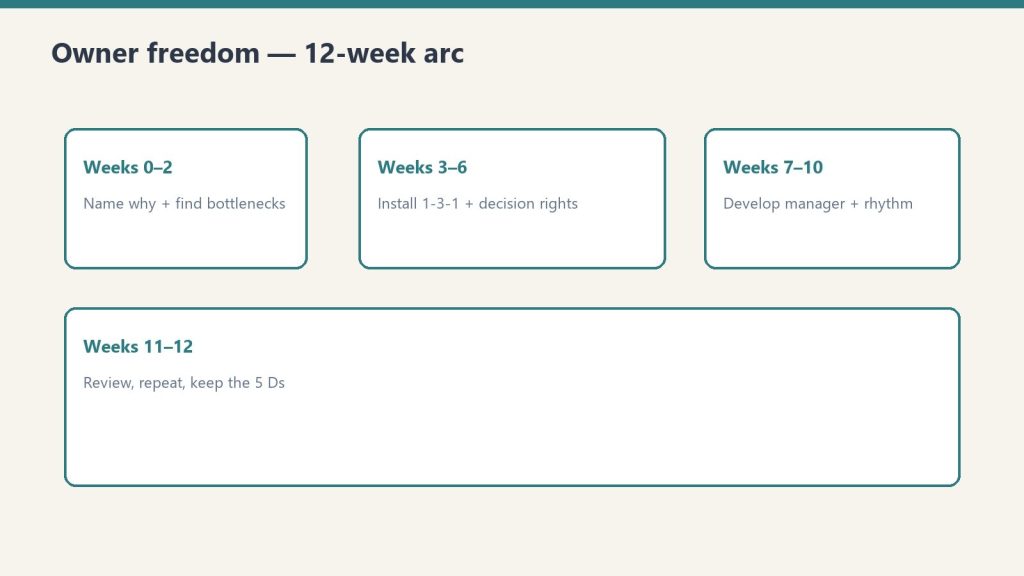
Weeks 9-10 of the 90-day plan is this huddle: 15 minutes, fixed agenda, 3-5 numbers someone other than you owns.
5. Risk areas. Single points of failure
Where is the business one person, one password, or one bad week away from a problem? Check every box that is a real exposure right now.
- I am a single point of failure. Key things only I can do or decide
- Only one person can run estimating / Xactimate
- Only one person holds key carrier / adjuster / referral relationships
- Only one person knows the financials, banking, or payroll
- Only one person can dispatch / schedule crews
- Critical logins, accounts, or vendor passwords live in one person’s head
- If my best lead quit tomorrow, a major part of the business would stall
- There is no written SOP for the things that “only so-and-so knows”
- No one is cross-trained on my second-in-command’s role
For each box checked, name the person, what breaks if they are gone, and whether a backup exists.
Concentration risk. Pick one: red = several critical single points of failure. Yellow = one or two. Green = cross-covered.
This section pairs with the 5 Ds (Death, Divorce, Disease, Drugs/dependency, Departure/Disaster). A checked box here is usually a blank box on the 5 Ds.
6. Next leader candidates. Names plus readiness
Who is next? Name real people, rate how ready they are, and write the one thing each most needs to grow into more leadership.
For each candidate: name; the role they could grow into; readiness (green = ready now / soon; yellow = 1-2 areas to grow; red = raw potential, long runway); the one thing they most need.
- I have at least one green ready-now candidate identified
- Each candidate has a clear next step or development conversation scheduled
- I have actually told my top candidate I see leadership in them
- My second-in-command has a developing backup
Then put those names on a bench list and go deep on one person. A single real manager beats five people you are keeping an eye on.
Readiness summary
Tally your six section ratings last.
- Mostly green. You have a real leadership team. Focus on deepening the bench and formalizing succession.
- Mostly yellow. Leaders exist but lean on you for the hard calls and the hard conversations. Push decision authority and accountability down a level.
- Mostly red. You are still the company. The priority is not more hiring. It is building one true second-in-command and removing the biggest single point of failure (usually you).
Write three lines: my biggest single point of failure right now; the one leader I most need to develop next; the first move I will make in the next 30 days.
If you want the packaged checklist
You can run the six sections on a legal pad. Buy Now is the Notion page delivered by email after checkout. Duplicate it (··· → Duplicate) so the original stays clean for next quarter. The function table, the six section ratings, and the summary are already laid out. Same Square button at the top of this page.
Pairs with the Restoration Leadership Bench Builder (develop the names you just wrote) and the 90-Day Doer-to-Leader Transition Plan. Matching Claude skill: leadership-readiness-checklist. A leadership self-assessment, not legal or HR advice.
Related: Restoration Leadership Toolkit — Claude Edition. Also Restoration Leadership Bench Builder.
Leave a Reply