90-Day Doer-to-Leader Transition Plan
$199
Delivered by email after checkout.
Secure checkout via Square — all major cards accepted
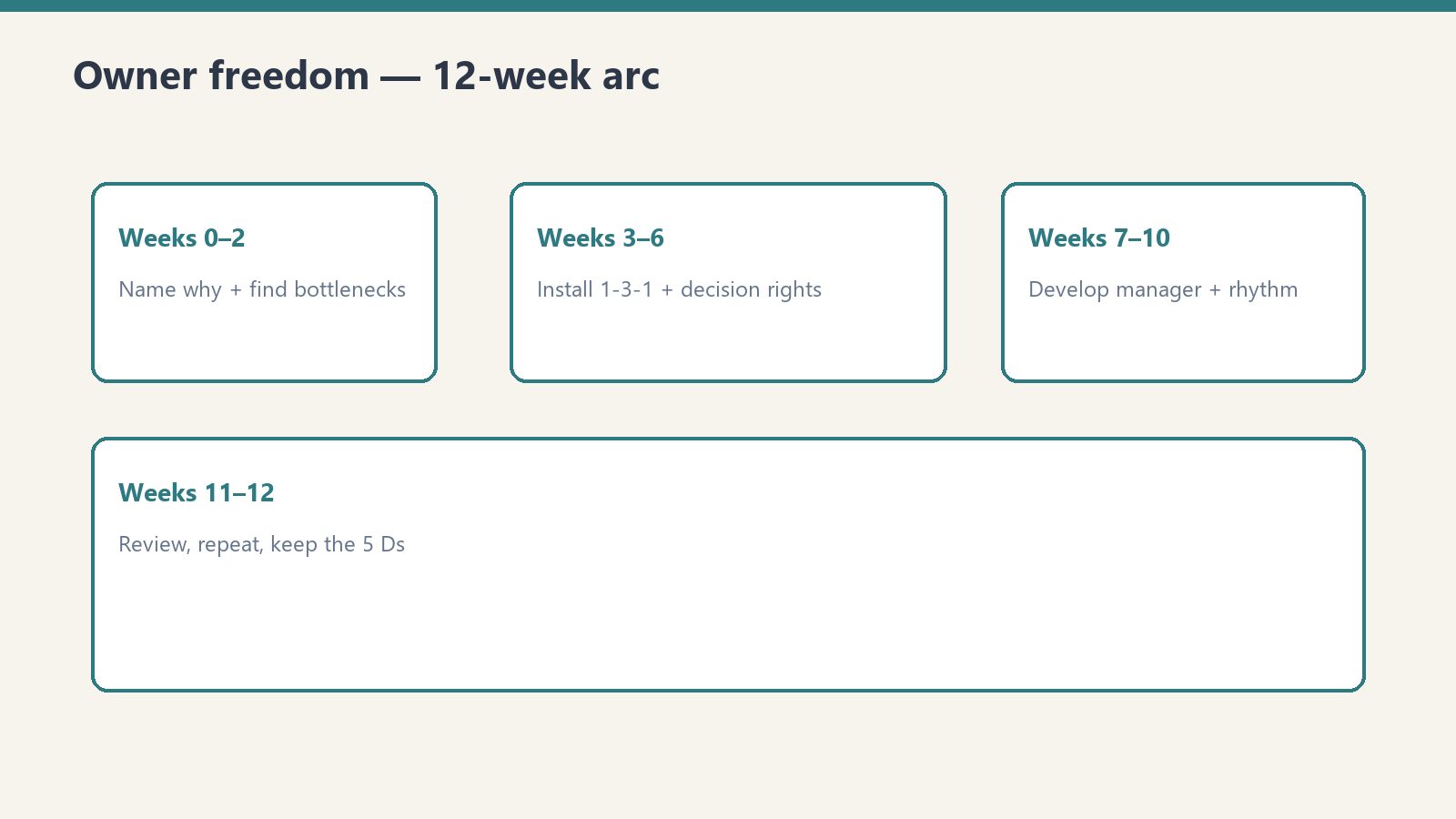
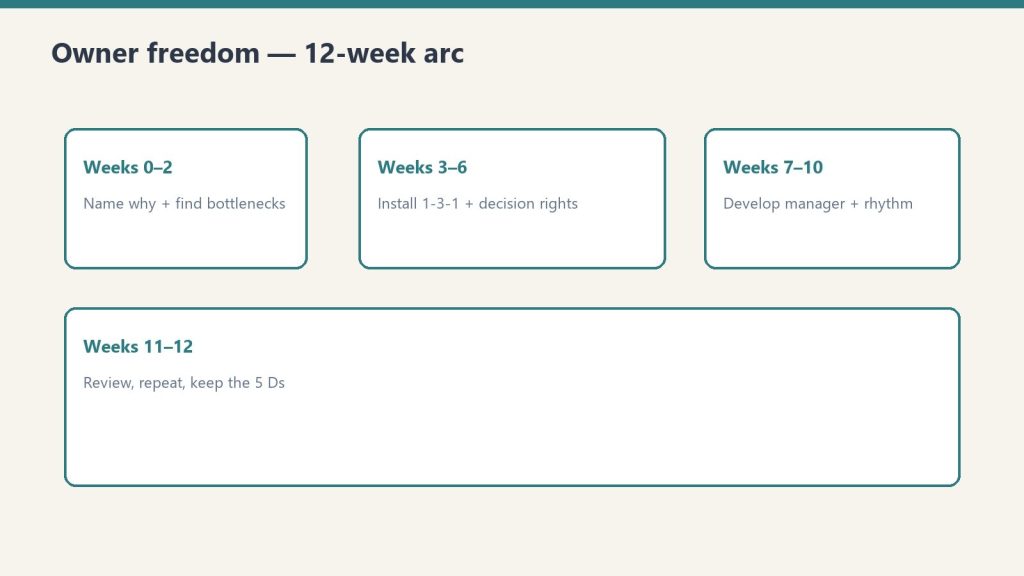
You can copy this method and do it yourself. Run six two-week phases. By Week 12 the business runs a notch less on you and a notch more on your people. Buy Now is the packaged Notion plan you duplicate and date, so you are not assembling the 12-week spine from blank pages.
The capstone of the Restoration Leadership Toolkit. This turns the doer-to-leader message into a plan you actually run. Work it top to bottom. Do not skip ahead. Each phase sets up the next. You cannot clarify decision rights (Weeks 5-6) until you know your bottlenecks (Weeks 1-2).
How to use this plan
- Duplicate a page and rename it “90-Day Plan – {start date}.”
- Block 30-45 minutes every Friday to work the current phase and check boxes.
- Start by running the Owner Bottleneck Self-Assessment and the Owner Dependency Audit. Their results feed Weeks 1-2 directly.
- Fill the three setup lines before Week 1.
Write these three lines now:
- My #1 reason to step back (what I would do with the time)
- The one person I am betting on as my first real manager
- Start date / target Week-12 date
Weeks 1-2. Identify your bottlenecks
Goal: get brutally honest about where the company still runs through you. You cannot delegate what you have not named.
- Run the Owner Bottleneck Self-Assessment and write down your top 3 bottleneck areas.
- Run the Owner Dependency Audit. List every decision or task that only you can do today.
- For one full week, log every time someone interrupts you for a decision. A tally on your phone is fine.
- Sort that list into three buckets: Delegate now / Delegate after training / Keep (truly owner-only).
- Circle the top 3 bottlenecks that cost you the most time or money. These are your 90-day targets.
- Tell your team what you are doing and why: “I am working a 90-day plan to push decisions down. Expect me to hand more back to you.”
Phase 1 done when you have a written top-3 bottleneck list and your team knows the shift is coming. The audit rates Low / Med / High across nine areas (sales, production, finance, customer-issue resolution, hiring, vendor relationships, estimating / project management, emergency response, decision rights). Low = 1, Med = 2, High = 3. Total is 9-27.
Weeks 3-4. Install 1-3-1 conversations

Goal: stop being the answer key. Train the team to bring one issue, three options, and one recommendation, so you coach instead of solve.
- Explain the 1-3-1 rule to the team: bring 1 issue, 3 options, 1 recommendation. Not just the problem.
- Print or pin the 1-3-1 format where decisions get made (truck, office, group chat).
- When someone brings you a raw problem, ask: “What are your three options, and which do you recommend?” Then wait.
- Run at least 5 real 1-3-1 conversations this phase and approve their recommendation whenever it is reasonable.
- Resist solving it yourself, even when you are faster. Let them carry it. This is the hard part.
- Note who takes to it quickly. That is a signal for your future-manager pick in Weeks 7-8.
Phase 2 done when at least one person is bringing you 1-3-1s without being reminded. One issue, three real options (pros, cons, rough cost), one recommendation, and a default if they do not hear back by a deadline.
Weeks 5-6. Clarify decision rights
Goal: write down who decides what, and up to what dollar amount, so people stop defaulting to you out of habit.
- List the 10-15 recurring decisions your team faces (refunds, equipment, scheduling, scope changes, hiring, pricing exceptions).
- For each, write a dollar or scope threshold people can decide under without asking you.
- For each, name who owns it when you are not in the room.
- Capture it in one simple Decision Rights list (a shared doc or a section on the plan page).
- Walk the team through it and tell them: “Under this line, you do not need me. Decide and tell me after.”
- Pick one decision you currently own and hand it off completely this phase. Do not take it back.
Phase 3 done when there is a written decision-rights list and at least one decision has fully left your plate. Starter rows live on the Owner Dependency Audit if you need them.
Weeks 7-8. Develop one manager

Goal: go deep on ONE person. A single real manager beats five people you are “keeping an eye on.”
- Choose one person to invest in as your first real manager. Use the Middle Manager Evaluation Scorecard if you are torn.
- Have a direct conversation: “I want to grow you into running X. Here is what that looks like.”
- Hand them one area to own end-to-end (a crew, a job type, scheduling, QC). Outcome, not task.
- Set a weekly 30-minute 1-on-1 with them and protect it like a paying job.
- Name the 1-2 skills they most need to build and how you will help (ride-along, training, a stretch job).
- Let them make a real decision this phase and coach the outcome instead of grading it.
Open a bench list while you do this. One row per key function: role, current owner, candidate, backup depth, skill gaps, one observable 90-day action, delegation plan, check-in rhythm, status. A blank candidate is itself a finding. Phase 4 done when one person owns one area end-to-end and has a standing 1-on-1 with you.
Weeks 9-10. Create an accountability rhythm
Goal: replace you-chasing-everyone with a repeatable cadence that surfaces problems early, without you in the middle of every thread.
- Stand up a weekly 15-minute team huddle with a fixed agenda: numbers, jobs at risk, who needs what.
- Pick the 3-5 numbers the team reviews every week (jobs in WIP, days-to-dry, AR, callbacks, leads).
- Decide who owns each number and reports it. Not you.
- Use the Accountability Conversation Planner to prep any hard conversation so it stays about the work, not the person.
- Hold one real accountability conversation this phase using that structure.
- Have your Week 7-8 manager run the huddle at least once while you sit in and observe.
Phase 5 done when the weekly huddle runs on schedule and someone other than you can run it. About the work, not the person.
Weeks 11-12. Review, adjust, and repeat
Goal: measure what changed, lock in the wins, and set the next 90 days. This is not the end. It is the first turn of the flywheel.
- Re-run the Owner Bottleneck Self-Assessment and compare to your Week 1 score.
- Take a planned half-day fully off and note what broke or escalated to you. That is your next bottleneck.
- List what got delegated successfully vs what bounced back to you, and why it bounced.
- Give your developing manager direct feedback on the quarter and agree on next-quarter goals.
- Update your Decision Rights list and raise one threshold now that the team has proven itself.
- Pick next quarter’s top bottleneck and start a fresh 90-day cycle (duplicate the page again).
Phase 6 done when you have re-scored, taken real time off, and named the next quarter’s target.
Success looks like
By the end of 90 days, a healthy transition looks like:
- You can take a full day off without the business stalling or your phone melting.
- Your team brings you 1-3-1 recommendations, not raw problems to solve.
- There is a written decision-rights list, and people decide under the line without asking.
- One person owns one area end-to-end and has a standing 1-on-1 with you.
- A weekly huddle runs on cadence, and someone other than you can run it.
- Your re-scored bottleneck number is lower than it was in Week 1.
- You have already named next quarter’s target, because doer-to-leader is a flywheel, not a finish line.
Not every box will be checked, and that is fine. Progress on the top-3 bottlenecks matters more than a perfect scorecard. Run it, adjust, repeat.
While you are in it, run the 5 Ds as a what-if-tomorrow check. Pick the three blank boxes that would hurt most if the D hit tomorrow.
If you want the packaged plan
You can run the six phases from the outline above. Buy Now is the Notion page delivered by email after checkout. Duplicate it (··· → Duplicate) and rename it with the start date so the master stays clean. The setup lines, the phase checkboxes, and the success list are already laid out. Same Square button at the top of this page.
The other four tools in the Owner Freedom Kit feed this spine: Owner Dependency Audit, Restoration Leadership Bench Builder, 5 Ds Succession Risk Checklist, 1-3-1 Delegation Worksheet. Matching Claude skill: doer-to-leader-90-day. Coaching and operational tool only. Not legal or HR advice.
Related: Restoration Leadership Toolkit — Claude Edition. Also Owner Bottleneck Self-Assessment.
Leave a Reply