5 Ds Succession Risk Checklist
$29
Delivered by email after checkout.
Secure checkout via Square — all major cards accepted
You can copy this method and do it yourself. Stress-test the company against Death, Divorce, Disease, Drugs/dependency, and Departure/Disaster. Check a box only if it is true and current today. Buy Now is the packaged Notion checklist with the scored sheet and mitigation notes, so you are not rebuilding the 5 Ds from a blank doc.
Succession is not a retirement problem. It is a what-if-tomorrow problem. The blank boxes are your exposure. Honesty rule: a box you want to be true is still a blank box. Half-true protections fail exactly when the D hits.
How to run it
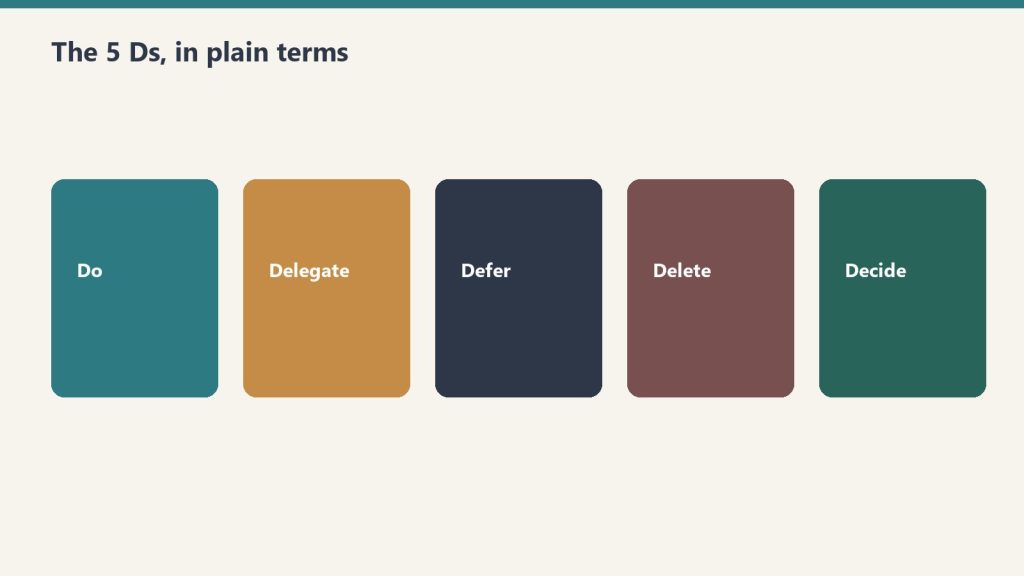
- Walk each of the 5 Ds. Check a box only if it is true and current today. Not “mostly.” Not “we talked about it once.”
- Read the mitigation note under each D. That is the concrete fix for the boxes you left blank.
- Count the blanks. Find your band. Pick your top 3 shore-ups. Name an owner and a date.
- Re-run it every year, and immediately after any life or business change: a new partner, a marriage or divorce, a major new account, an acquisition, or a health scare.
1. Death. If you died tomorrow
If you were gone permanently, could the business survive the week, pay people, and not get sold for scraps?
- There is a current, signed will and the business is named in it.
- There is a buy-sell agreement (if there are partners) defining who buys your share, at what price, and how it is funded.
- Key-person life insurance exists on you, payable to the company, sized to cover payroll plus obligations while it stabilizes.
- At least one other person can sign checks (signatory on file at the bank, not just “knows the login”).
- Someone other than you can legally bind the company (contracts, AOBs, subcontracts). Documented authority, not assumed.
- Your spouse / heirs know who to call and where the documents live.
- Passwords, accounts, and licenses are in a recoverable place a trusted person can reach.
- A named person can run production and keep jobs moving for 30+ days without you.
Mitigation. Get a buy-sell drafted by an attorney and fund it with life insurance. An unfunded buy-sell is a wish, not a plan. Add a second check-signer and a documented officer who can bind the company. Put credentials in a password manager with an emergency-access contact. Write a one-page “if I am gone” sheet. Tell your spouse where it is.
2. Divorce. If your marriage ended
A divorce can put your ownership stake, your cash, and your focus in play. A contested split can starve a cash-hungry shop.
- You know whether the business is separate vs marital/community property in your state. Confirmed, not guessed.
- There is a prenup, postnup, or buy-sell provision that addresses ownership in a divorce.
- The business is not commingled with personal finances (clean books, separate accounts, documented owner pay).
- A current, defensible valuation (or a method to set one) exists.
- Your spouse’s role and any claim (employee, owner-on-paper, guarantor) is documented.
- Operating cash and credit lines are structured so a personal dispute cannot freeze payroll.
Mitigation. Talk to a business attorney about a postnuptial or a buy-sell clause that fixes ownership treatment now, while things are calm. Clean up commingling. Establish a valuation method in writing. Calm is the only time you can do it.
3. Disease. If you were medically out for 30-90 days
Not death. A heart attack, a serious diagnosis, a bad accident. You are alive but out. Does the company idle or run?
- Someone can run daily production and dispatch without you for 30, 60, 90 days. Named, and they have actually done it (vacation test).
- Estimates still get written and approved if you are the estimator. A backup exists.
- Payroll, AP, and AR keep running without your hands on them.
- Carrier / TPA relationships will not collapse if you are unreachable. Someone else has the relationships and portal access.
- You carry disability income insurance so household income does not depend on you working.
- Business overhead expense (BOE) insurance or a cash reserve can cover fixed costs while you recover.
- A simple interim chain-of-command is written down, with dollar/decision thresholds.
Mitigation. Run a real “two weeks off” test this quarter and watch what breaks. Cross-train a backup estimator. Look at disability and Business Overhead Expense coverage. Write a one-page interim chain-of-command with decision thresholds.
4. Drugs / dependency. If you (or a key person) became unreliable
The uncomfortable one. Substance issues, gambling, burnout, a mental-health crisis. Yours or a key person’s. The risk is a slow decline, not a clean exit.
- No single person (including you) is a single point of failure whose impairment would quietly sink the company.
- Financial controls exist (dual approval over a threshold, reconciliations, a second set of eyes on the books).
- A trusted advisor or peer would tell you the truth if your performance was slipping, and has standing to.
- Key roles have documented duties and cross-coverage.
- There is an employee assistance path / clear policy for getting a valued person help without an instant, messy termination.
- If a key person had to be removed fast, you could. Access and knowledge are not locked solely in their head.
Mitigation. Dual approval over a dollar threshold, monthly reconciliations, a second set of eyes on the books. Document and cross-train so no one person can sink a function. Put a real advisor in your corner who is allowed to tell you the truth. Have a humane path to help and the access to act fast if you must.
5. Departure / disaster. If a key person walked, or the building burned
Two faces of the same risk: a critical person quits, or a fire/flood/storm/cyber event takes out your office, fleet, data, or a major account overnight.
- Production runs if your best PM or lead tech quits Friday. Their knowledge is documented, not tribal.
- Key customer and carrier relationships are not owned by one person who could walk and take the book with them.
- A non-solicit / non-compete / confidentiality agreement is in place where appropriate and enforceable in your state.
- Critical SOPs, pricing, and account knowledge are written down. Losing one person does not erase how the work gets done.
- Data is backed up off-site (estimating files, photos, accounting, contacts) and you have actually tested a restore.
- You have a business continuity / disaster plan for your own office or fleet. You restore others. Are you covered?
- Business-interruption insurance would replace income if you could not operate for weeks.
- A backup vendor/equipment plan exists so one lost truck, warehouse, or sub does not stall live jobs.
Mitigation. Document tribal knowledge. Spread customer and carrier relationships across more than one person. Put reasonable non-solicit/confidentiality agreements in place (attorney confirms enforceability in your state). For disaster: off-site backups you have test-restored, a written continuity plan for your own shop, business-interruption coverage, and a backup equipment/vendor list.
Overall exposure rating
Count your blank boxes across all 5 Ds. The packaged checklist scores 45 boxes. Find your band:
- 0-6 Low / Resilient. The business could survive a major shock to you. Maintain it. Review annually and after any big change.
- 7-15 Moderate. You would survive a short absence but a permanent loss would hurt. Close the highest-stakes gaps (Death + Disease) first.
- 16-27 High. A 30-day absence would seriously disrupt the company. A permanent loss could end it. Treat this as a current-quarter priority.
- 28+ Critical / You are the company. If something happened to you tomorrow, the business likely does not survive intact. Start the top-3 shore-ups this week.
Write three lines: blank-box total, exposure band, and which D scored worst.
Top 3 shore-ups
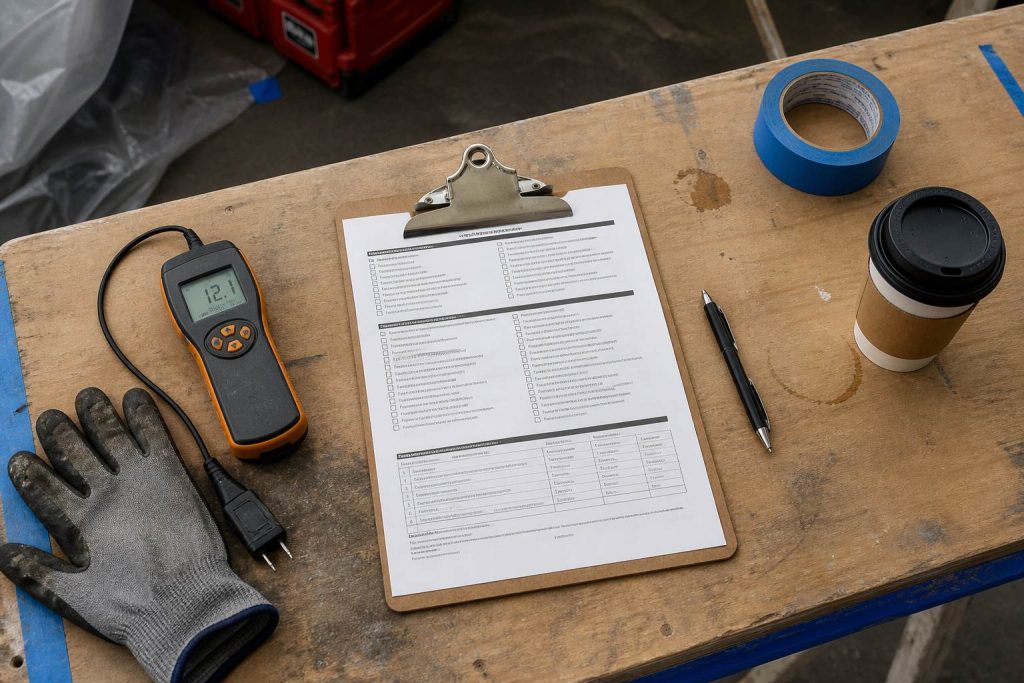
Pick the three blank boxes that would hurt most if the D hit tomorrow. Be specific. Name an owner. Set a date.
Most shore-ups need one of these professionals: a business / estate attorney (buy-sell, will, non-competes, postnup); an insurance agent (key-person life, disability, BOE, business-interruption); a CPA / financial advisor (valuation, financial controls, continuity reserve).
This is an awareness and planning tool, not legal, financial, or insurance advice. Use it to find your gaps and to walk into the attorney, agent, and CPA prepared.
If you want the packaged checklist
You can run the five lists on a legal pad. Buy Now is the Notion page delivered by email after checkout. Duplicate it (··· → Duplicate) so the master stays clean. The boxes, the mitigation notes, the score table, and the top-3 shore-ups are already laid out. Same Square button at the top of this page.
Pairs with the Owner Dependency Audit (what breaks if you vanish 30 days) and the Restoration Leadership Bench Builder (who can run production when a D hits). Matching Claude skill: succession-5ds-checklist.
Related: Restoration Leadership Toolkit — Claude Edition. Also 90-Day Doer-to-Leader Transition Plan.
Leave a Reply