All fall, Microsoft has been selling one idea: the future is the AI PC — a Copilot+ machine with a dedicated neural chip (an NPU), Recall, Click to Do, a thousand dollars and up, and your old laptop need not apply.
I had a $400 budget laptop on my desk — an AMD Ryzen 5 7520U, 16 GB of RAM, no NPU — and a hunch that the whole framing was backwards. The AI-first laptop was never about the chip. It’s about architecture.
A few hours later, that $400 laptop had a private AI brain, voice control, and a control panel I run from my phone. On the things that actually matter for operating a machine, it does more than the Copilot+ PC it’s supposedly too cheap to be. Here’s the exact build.
The thesis: AI-first is architecture, not a chip
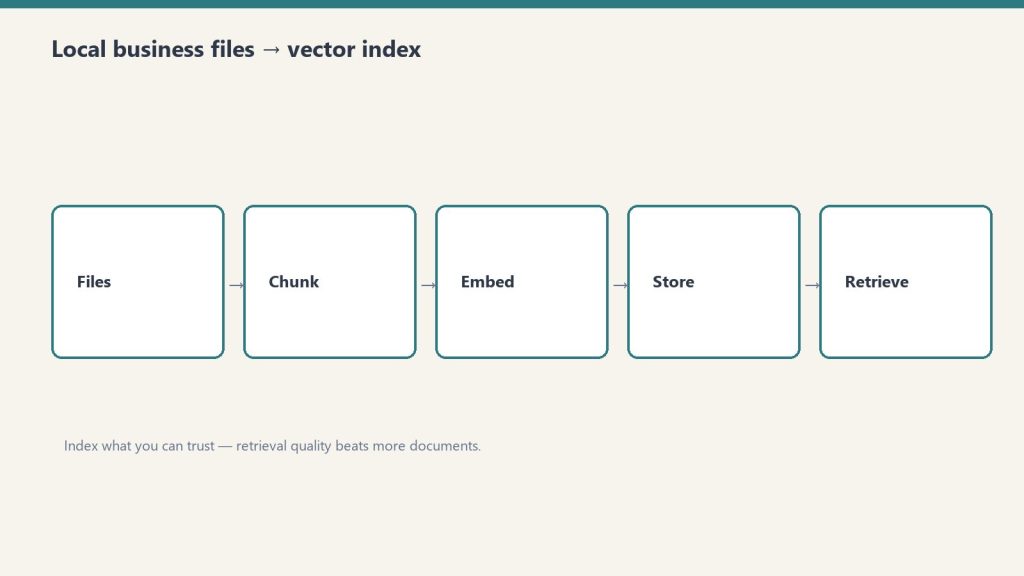
The trick is to stop asking your laptop to be the supercomputer. Split the job:
- The brain lives in the cloud. The heavy reasoning runs on a frontier model (I use Claude) with effectively unlimited horsepower. No NPU on Earth competes with that.
- The body lives on your laptop. Your machine becomes the always-on hands: it holds your private data, runs small models locally for anything sensitive, and executes the actions the brain decides on.
An NPU optimizes a handful of on-device Windows features. Architecture gives you an actual operator. Guess which one you feel every day.
Step 0 — Make it always-on
An operator rig is a little server, and servers don’t nap. My laptop kept sleeping and killing background jobs, so the first move was to take that off the table (while plugged in):
powercfg /change monitor-timeout-ac 0
powercfg /change standby-timeout-ac 0
powercfg /setacvalueindex SCHEME_CURRENT SUB_BUTTONS LIDACTION 0
powercfg /setactive SCHEME_CURRENT
Screen never blanks, never sleeps, and it keeps running with the lid closed — while still sleeping on battery as a safety. Now it’s a real always-on host.
Step 1 — A private AI brain that lives on the laptop

The local engine is Ollama; the chat interface is open-webui (running in Docker). If you want the multi-agent version of this idea, I’ve also written up building a free AI agent army with Ollama and Claude. The only thing standing between me and a private, offline ChatGPT was one wrong setting — open-webui was pointed at a dead address. The fix was to aim it at the host:
docker run -d --name open-webui --restart always -p 3000:8080 \
  -v open-webui:/app/backend/data \
  -e OLLAMA_BASE_URL=http://host.docker.internal:11434 \
  ghcr.io/open-webui/open-webui:main
The proof: a 3-billion-parameter model (Llama 3.2) introduced itself in about 10 seconds at ~12 tokens/second — on the CPU, no NPU, no discrete GPU. Fast enough for real Q&A, drafting, and summaries. Seven models sit ready on disk, and the whole thing is reachable from my phone over a private network.
Everything here runs offline. For anything I don’t want leaving the machine, that’s the entire point.
Step 2 — Voice that never leaves the machine

A local Whisper speech-to-text container (OpenAI-compatible API) became a push-to-talk dictation tool: hold a key, talk, release, and the text drops into whatever app is focused. I verified the pipeline without even touching the mic — Windows text-to-speech generated a clip, the local Whisper transcribed it, and it round-tripped clean:
Spoken: “Testing one two three. This is the private local transcription engine.”
Whisper heard: “Testing 1-2-3. This is the private local transcription engine.”
Windows has built-in dictation (Win+H) and Copilot voice too — but those ship your audio to the cloud. The local version does the same job, and your voice never leaves the laptop.
Step 3 — Turn your phone into the control panel
Using Tailscale (a private mesh network), every service on the laptop is reachable from my phone — without exposing anything to the public internet. I added a tiny web page (one small nginx container) as a mobile operator console: one tap to the local AI, automations, status, and finance dashboards. Pin it to the home screen and the laptop is in your pocket.
The honest scoreboard vs. a Copilot+ PC
| Capability | Copilot+ PC ($1,000+) | This $400 laptop |
|---|---|---|
| Private AI running on the device | Limited (small NPU models) | ✅ Full Ollama stack, 7 models |
| An AI that operates the machine | ❌ | ✅ Runs commands, edits files, fixes things |
| Private, offline voice dictation | ❌ (cloud) | ✅ Local Whisper |
| Phone control panel | ❌ | ✅ Tailscale operator console |
| Recall / Click to Do / Cocreator | ✅ (needs the NPU) | ❌ |
| Screenshots everything you do | ⚠️ Recall does, by design | ✅ No — nothing is recorded |
I’m being fair: the NPU-only features are genuinely off the table on cheap hardware. But for operating your computer — and for privacy — the architecture beats the chip.
Why this matters more than it looks
The quiet headline isn’t “I saved money.” It’s where the data lives. Microsoft’s flagship AI-PC feature, Recall, works by screenshotting everything you do. This build does the opposite: the sensitive payload stays on your machine, and the cloud is used only for the heavy thinking that doesn’t need your private files.
That’s not just a hobbyist’s preference. It’s the exact requirement for anyone in a regulated field — healthcare, legal, finance — who can’t send client data to a third party but still wants real AI leverage. The cheap laptop isn’t the story. The architecture is.
Frequently asked questions
Do I need a Copilot+ PC or an NPU to run local AI?
No. Any laptop with around 16 GB of RAM and a modern CPU can run small local models. An NPU accelerates certain Windows features but is not required for Ollama or local chat.
Is local AI actually private?
Yes. With Ollama, the model runs on your own machine and works with no internet connection — nothing is sent to a cloud service.
What is the difference between Ollama and open-webui?
Ollama is the engine that runs the models. open-webui is the friendly chat interface that sits in front of it.
How fast is a local model on a budget laptop?
On a CPU-only AMD Ryzen 5 with 16 GB of RAM, a 3-billion-parameter model answered at roughly 12 tokens per second — fine for quick questions, drafting, and summaries. Larger models run slower.
Can I use it from my phone?
Yes. Over a private Tailscale network you can reach your laptop’s AI and tools from your phone without exposing anything to the public internet.
Is this better than a Copilot+ PC?
For operating your machine and for privacy, this setup does more. For NPU-specific Windows features like Recall and Click to Do, a Copilot+ PC is required.
Want this on your machine?
Tygart Media builds privacy-first, local-AI operator setups — especially for teams in regulated industries that need real AI leverage without sending data to the cloud. Reach out and we’ll scope it to your hardware.
Leave a Reply