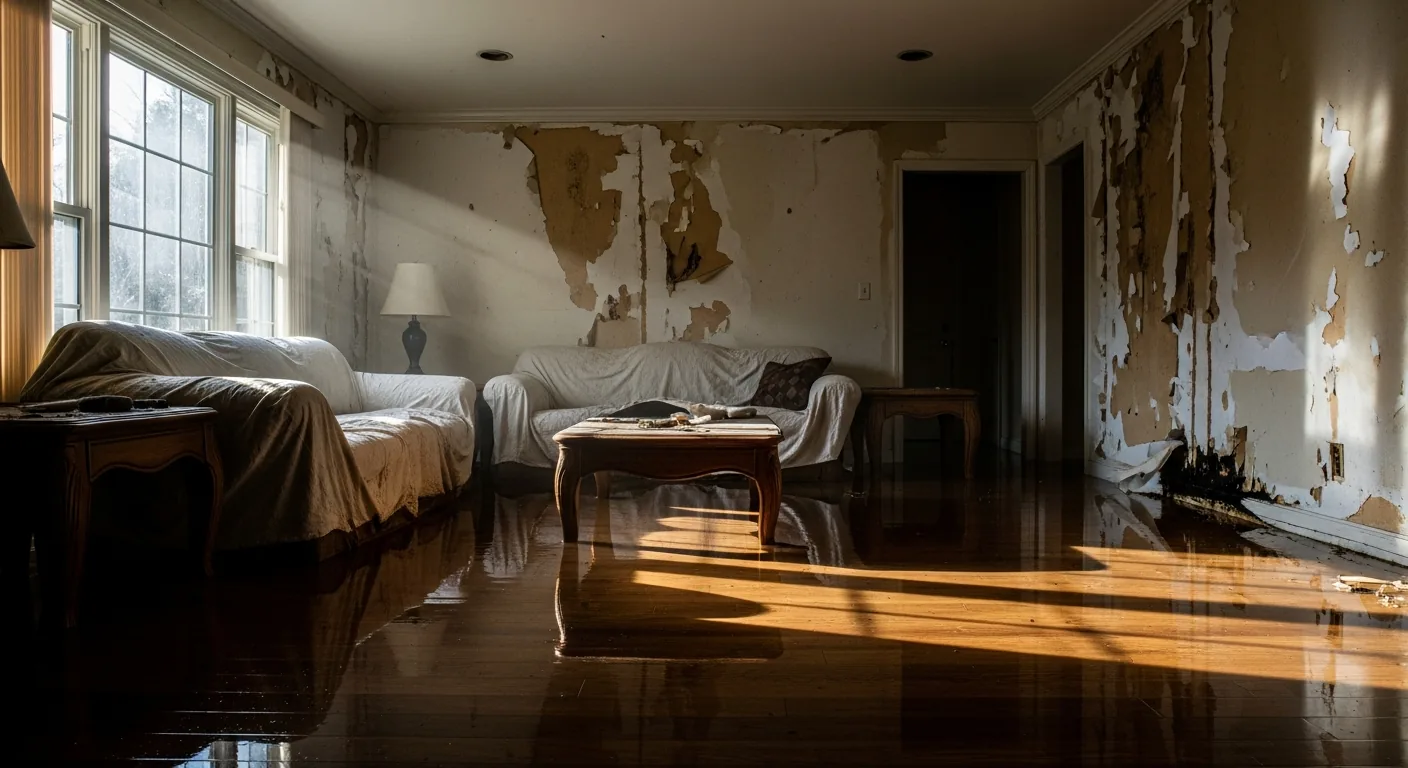
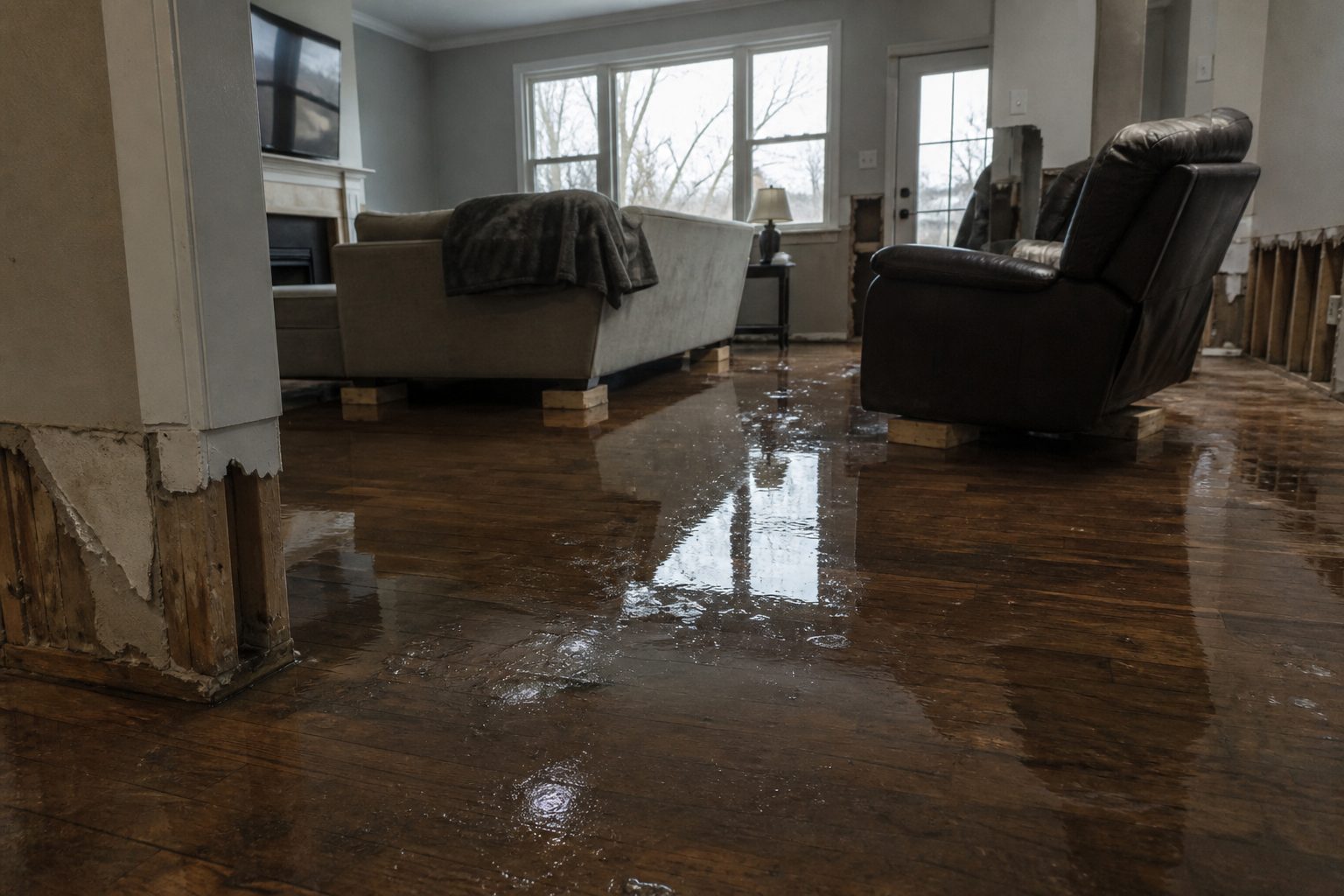
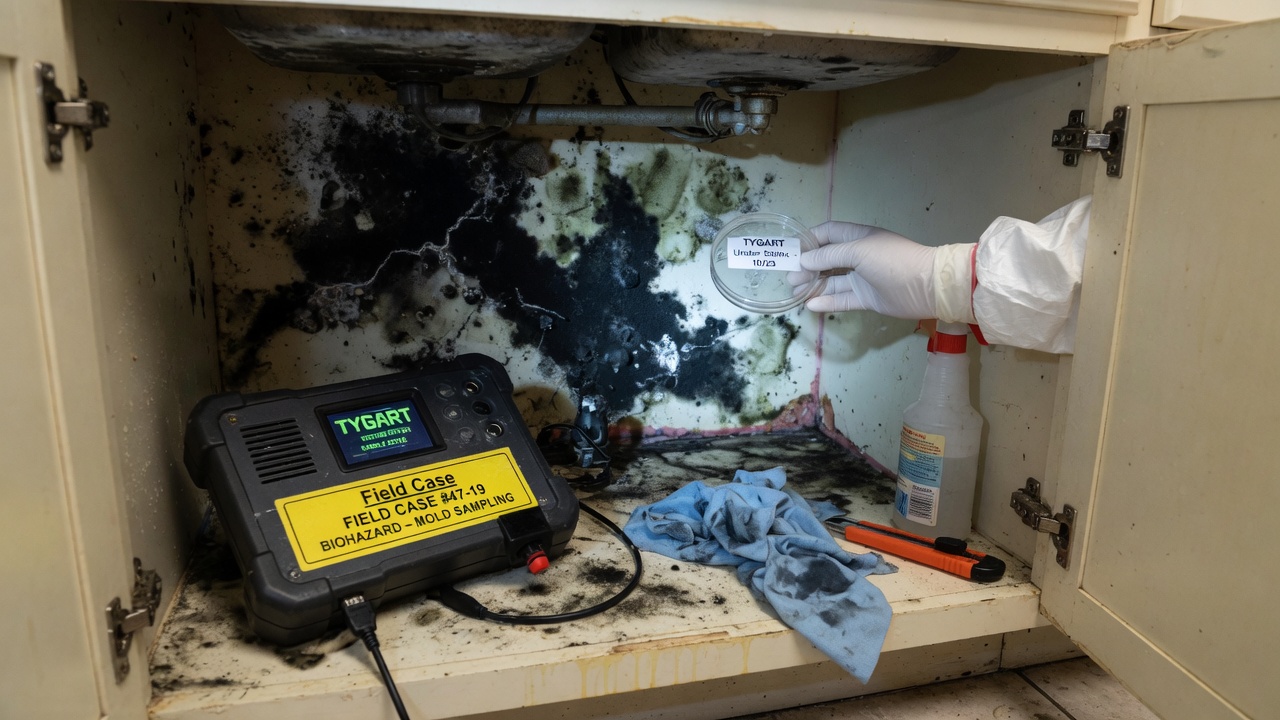
A Flash Flood Warning is active right now for the Rexburg area. The National Weather Service in Pocatello issued it at 9:51 PM MDT on Thursday, September 17, and it runs until 2:45 AM MDT on Friday, September 18. Doppler radar is showing thunderstorms producing heavy rain across central Madison County, and flash flooding is ongoing or expected to begin shortly. These are exactly the storms that produce the interior water-intrusion jobs restoration teams see most — water finding its way into living spaces in the middle of the night. This is a live snapshot as of 12:06 AM MDT on Friday, September 18. Conditions change fast — always verify with the National Weather Service for your specific county or ZIP code.
Rexburg area — Flash Flood Warning
Issued by: National Weather Service, Pocatello, Idaho — 9:51 PM MDT Thursday, September 17. Expires: 2:45 AM MDT Friday, September 18. Covers: Central Madison County in southeastern Idaho.
At 9:51 PM MDT, Doppler radar indicated thunderstorms producing heavy rain across the warned area. The National Weather Service says flash flooding is ongoing or expected to begin shortly.
Hazard: Flash flooding caused by thunderstorms. Source: Radar indicated.
Expected impacts: Flash flooding of small creeks and streams, urban areas, highways, streets and underpasses, as well as other poor-drainage and low-lying areas. In practical terms: ponding on Rexburg streets, water over low road crossings, and any creek or drainage running high after this rain.
Locations in the warning path: Rexburg.
Also active nearby — Big Rock burn scar warning: At 10:25 PM MDT, NWS Pocatello issued a separate Flash Flood Warning for the Big Rock burn scar in south central Madison County and southeastern Jefferson County, running until 2:30 AM MDT — and part of that polygon sits inside Madison County, close to home for Rexburg readers. Thunderstorms are producing heavy rain over the burn scar, and the Weather Service warns of life-threatening flash flooding with debris flow — rock, mud, vegetation and other loose materials — moving through the scar. Some locations affected include Heise. Roads and driveways may be washed away in places. If you are anywhere near the burn scar area and encounter flood waters, climb to safety immediately. This is the more dangerous of the two warnings tonight: debris flow does not behave like ordinary street flooding.
Stay safe tonight
Turn around, don’t drown. Most flood deaths occur in vehicles — never drive through flooded roadways, and never try to guess the depth of water over a road at night. The National Weather Service’s rule of thumb: six inches of moving water can knock an adult off their feet, and twelve inches can carry a car.
If water gets into your home: stay out of standing water anywhere electricity may be present, and stay out of the basement until the water recedes and the power is confirmed off. Photograph everything before you touch anything — documentation matters for insurance. Then call a local restoration contractor. Water left sitting starts a second wave of damage within a day, and the clock on that starts the moment the rain stops, not the moment you discover it.
What this means for restoration teams
This is the signature southeastern Idaho night for water work: radar-indicated storms, urban and small-stream flooding, and a warning window that runs to 2:45 AM. Expect the calls to start as water recedes and keep coming for days as people discover what happened overnight. The damage categories to plan for: interior water intrusion through foundations, window wells and door thresholds; saturated drywall and insulation in finished basements; mold risk inside 24 to 48 hours on anything that stays wet; and sewage backup in low-lying areas where storm drains surcharge.
The play tonight: stage equipment now rather than at first call. Pre-position drying assets — air movers, dehumidifiers, extraction — so the first truck rolls complete. Keep an on-call rotation through the morning, because the discovery curve on overnight flooding peaks after sunrise. On the first call, capture the address, the water source, and every affected area before you quote anything.
Field discipline, same as always: photo-document before mitigation begins, moisture-map every affected room (not just the visibly wet one — water travels inside wall cavities), and keep the homeowner’s payment responsibility clear in writing before work starts. Night jobs with stressed homeowners are where scope misunderstandings are born.
Local emergency contacts
Madison County Emergency Services (Rexburg): (208) 359-3010 Life-threatening emergency: 911 Idaho Office of Emergency Management:ioem.idaho.gov
FEMA and federal assistance
If the flooding damages your home and you need help beyond what insurance covers, the FEMA Helpline is 1-800-621-3362, open 7 a.m. to 10 p.m. local time, seven days a week. You can also apply at DisasterAssistance.gov, through the FEMA app, or find a recovery center at fema.gov/drc.
Basic eligibility: U.S. citizenship or qualified status, identity verification, proof of occupancy or ownership, and unmet needs not covered by insurance. Don’t wait — apply as soon as it’s safe.
Looking ahead
The Rexburg warning expires at 2:45 AM MDT, and the neighboring burn scar warning at 2:30 AM MDT. When a warning expires, that doesn’t mean the water is gone — small creeks and streams often crest after the rain ends, and saturated ground means any additional round of storms overnight floods faster than the first. Storms can arrive in multiple rounds overnight, so watch the NWS Pocatello page for extensions or new warnings.
For contractors: the demand window on this kind of event opens within hours of water receding and stays open for days. Homeowners discover basement water in the morning, call around midday, and the serious mitigation decisions land over the weekend. Be reachable, be first with the moisture map, and be the contractor who documented everything.
Sources and how to verify
NWS Pocatello office page — warnings, updates and extensions post here first. weather.gov — enter your ZIP code for the warnings covering exactly where you are.
Alert data via the National Weather Service API (api.weather.gov), warnings active as of 12:06 AM MDT Friday, September 18.
To verify for your own county or ZIP: open weather.gov, enter your ZIP, and read the active alerts banner at the top of the page. If Madison County is listed, this warning covers you.
This post is for informational purposes and is not an official weather warning. Always follow instructions from local authorities and the National Weather Service. Stay weather-aware around flash flooding — turn around, don’t drown.
A Flash Flood Warning is active right now for the Idaho Falls area. The National Weather Service in Pocatello issued it at 10:00 PM MDT on Thursday, September 17, and it runs until 2:00 AM MDT on Friday, September 18. Doppler radar is showing thunderstorms producing heavy rain across north central Bonneville County and south central Jefferson County, and flash flooding is ongoing or expected to begin shortly. These are exactly the storms that produce the interior water-intrusion jobs restoration teams see most — water finding its way into living spaces in the middle of the night. This is a live snapshot as of 12:06 AM MDT on Friday, September 18. Conditions change fast — always verify with the National Weather Service for your specific county or ZIP code.
Idaho Falls area — Flash Flood Warning
Issued by: National Weather Service, Pocatello, Idaho — 10:00 PM MDT Thursday, September 17. Expires: 2:00 AM MDT Friday, September 18. Covers: North central Bonneville County and south central Jefferson County in southeastern Idaho.
At 10:00 PM MDT, Doppler radar indicated thunderstorms producing heavy rain across the warned area. The National Weather Service says flash flooding is ongoing or expected to begin shortly.
Hazard: Flash flooding caused by thunderstorms. Source: Radar indicated.
Expected impacts: Flash flooding of small creeks and streams, urban areas, highways, streets and underpasses, as well as other poor-drainage and low-lying areas. In practical terms: the underpasses and low dips around Idaho Falls, ponding on streets in Rigby and the smaller towns, and any creek or drainage running high after this rain.
Locations in the warning path: Idaho Falls, Rigby, Lorenzo, Ucon, Menan and Lewisville.
Also active nearby — Big Rock burn scar warning: At 10:25 PM MDT, NWS Pocatello issued a separate Flash Flood Warning for the Big Rock burn scar in southeastern Jefferson County and south central Madison County, running until 2:30 AM MDT. Thunderstorms are producing heavy rain over the burn scar, and the Weather Service warns of life-threatening flash flooding with debris flow — rock, mud, vegetation and other loose materials — moving through the scar. Some locations affected include Heise. Roads and driveways may be washed away in places. If you are anywhere near the burn scar area and encounter flood waters, climb to safety immediately. This one is the more dangerous of the two warnings tonight.
Stay safe tonight
Turn around, don’t drown. Most flood deaths occur in vehicles — never drive through flooded roadways, and never try to guess the depth of water over a road at night. The National Weather Service’s rule of thumb: six inches of moving water can knock an adult off their feet, and twelve inches can carry a car.
If water gets into your home: stay out of standing water anywhere electricity may be present, and stay out of the basement until the water recedes and the power is confirmed off. Photograph everything before you touch anything — documentation matters for insurance. Then call a local restoration contractor. Water left sitting starts a second wave of damage within a day, and the clock on that starts the moment the rain stops, not the moment you discover it.
What this means for restoration teams
This is the signature southeastern Idaho night for water work: radar-indicated storms, urban and small-stream flooding, and a warning window that runs past 2:00 AM. Expect the calls to start as water recedes and keep coming for days as people discover what happened overnight. The damage categories to plan for: interior water intrusion through foundations, window wells and door thresholds; saturated drywall and insulation in finished basements; mold risk inside 24 to 48 hours on anything that stays wet; and sewage backup in low-lying areas where storm drains surcharge.
The play tonight: stage equipment now rather than at first call. Pre-position drying assets — air movers, dehumidifiers, extraction — so the first truck rolls complete. Keep an on-call rotation through the morning, because the discovery curve on overnight flooding peaks after sunrise. On the first call, capture the address, the water source, and every affected area before you quote anything.
Field discipline, same as always: photo-document before mitigation begins, moisture-map every affected room (not just the visibly wet one — water travels inside wall cavities), and keep the homeowner’s payment responsibility clear in writing before work starts. Night jobs with stressed homeowners are where scope misunderstandings are born.
If the flooding damages your home and you need help beyond what insurance covers, the FEMA Helpline is 1-800-621-3362, open 7 a.m. to 10 p.m. local time, seven days a week. You can also apply at DisasterAssistance.gov, through the FEMA app, or find a recovery center at fema.gov/drc.
Basic eligibility: U.S. citizenship or qualified status, identity verification, proof of occupancy or ownership, and unmet needs not covered by insurance. Don’t wait — apply as soon as it’s safe.
Looking ahead
The Idaho Falls warning expires at 2:00 AM MDT, and the neighboring burn scar warning at 2:30 AM MDT. When a warning expires, that doesn’t mean the water is gone — small creeks and streams often crest after the rain ends, and saturated ground means any additional round of storms overnight floods faster than the first. Storms can arrive in multiple rounds overnight, so watch the NWS Pocatello page for extensions or new warnings.
For contractors: the demand window on this kind of event opens within hours of water receding and stays open for days. Homeowners discover basement water in the morning, call around midday, and the serious mitigation decisions land over the weekend. Be reachable, be first with the moisture map, and be the contractor who documented everything.
Sources and how to verify
NWS Pocatello office page — warnings, updates and extensions post here first. weather.gov — enter your ZIP code for the warnings covering exactly where you are.
Alert data via the National Weather Service API (api.weather.gov), warnings active as of 12:06 AM MDT Friday, September 18.
To verify for your own county or ZIP: open weather.gov, enter your ZIP, and read the active alerts banner at the top of the page. If Bonneville or Jefferson County is listed, this warning covers you.
This post is for informational purposes and is not an official weather warning. Always follow instructions from local authorities and the National Weather Service. Stay weather-aware around flash flooding — turn around, don’t drown.
This is a live storm update and search-demand pulse for Tuesday, September 16, 2026. A monsoon outbreak produced two flash-flood clusters: eight NWS Flash Flood Warnings across Arizona (issued 10:27–11:51 AM MST) covering Maricopa County (Phoenix metro), Pinal County, Pima County (Tucson area), Gila County, and Coconino County (Labyrinth/Face Canyon watersheds), plus two warnings for southeastern Utah’s San Juan County drainages south of Lake Powell (issued 12:01 and 12:34 PM MDT). Several Arizona warnings were tagged life-threatening, with 0.5–1.5 inches already fallen and rates up to 2 inches per hour.
Flash flooding in desert washes and slot-canyon country moves fast. Verify local conditions with the National Weather Service before travel. Turn around, don’t drown.
Cluster 1 — Arizona
Warnings spanned Phoenix metro through Tucson and north into Coconino watersheds. Heavy monsoon cells dumped short-duration, high-rate rain onto urban pavement and desert soils that shed runoff into washes and underpasses.
Arizona Search Demand (measured live)
Google Trends pulls (live browser, no CAPTCHA) show East Valley hire-intent leading the state:
Signal
Window
Reading
water damage restoration mesa az
7d
+850%
water damage restoration mesa
7d
+450%
Mesa (city topic)
7d
+400%
Glendale (city topic)
7d
+250%
Cost (topic, seed: flood damage repair)
7d
+250%
flood damage restoration
30d
+170%
water damage restoration phoenix az
7d / 30d
Breakout
flood damage restoration near me / flood restoration near me / flood restoration companies
30d
Breakout
Trending Now (Arizona, past 7d): “flood watch” 20K+ searches / +1,000% (active); “flash flood warning” 500+ / +1,000% and 200+ / +800%. Hottest metros: Phoenix AZ 100 · Yuma AZ–El Centro CA 81 · Tucson (Sierra Vista) AZ 67. City-level breakout query language also hit Tempe, Scottsdale, Tucson, and Phoenix AZ.
Cluster 2 — Southeastern Utah
Two warnings covered San Juan County drainages south of Lake Powell, including Labyrinth Canyon — life-threatening flash flooding of slot canyons and dry washes.
Utah Search Demand (measured live)
Signal
Window
Reading
emergency water damage restoration
30d
+4,350%
water damage restoration services
30d
+1,400%
water damage restoration services near me
30d
+1,100%
water damage restoration near me
30d
+750%
water damage restoration service near me
30d
Breakout
flood damage restoration near me / flood damage restoration
7d
Breakout
flood restoration salt lake city
30d
Breakout
water mitigation company
30d
Breakout
What Homeowners Should Do in the First Hours
Stop the source if safe: Do not enter flowing washes or standing water near electrical panels.
Document high-water marks before cleanup for insurance.
Extract before you dry: Mud and silt first; air movers over wet sediment spread contamination.
Vet “near me” companies: Ask for IICRC certification, Category 3 blackwater protocol, and written moisture maps — East Valley and Utah “near me” breakouts show hire-intent, not DIY research.
Ask the cost question early: Arizona Cost topic +250% on flood damage repair means carriers and deductibles will dominate the next conversation.
Sources and Verification
Official data verified against National Weather Service Flash Flood Warnings for Arizona and southeastern Utah (10 warnings, new to the day’s watermark); Google Trends Arizona and Utah regional datasets (7-day and 30-day windows), measured live via browser with no CAPTCHA blocks.
Informational brief only — not an official warning broadcast. Monitor NOAA Weather Radio and local county emergency management for evacuation and shelter orders.
This is a live storm update and search demand pulse for Sunday night, September 13, 2026. The National Weather Service in Grand Junction, Colorado, issued a severe Flash Flood Warning for Rio Blanco County at 8:25 PM MDT, valid through 11:30 PM MDT. While localized runoff, wash flooding, and steep-terrain drainage pose immediate hazards across northwest Colorado’s Grand Junction–Montrose designated market area (DMA), search behavior across the wider state indicates a tightening baseline for water mitigation and flood repair demand.
Flash flooding in high-desert and mountainous terrain moves fast and creates sudden structural washouts. Property owners and municipal managers must verify local conditions with the National Weather Service before traveling. Turn around, don’t drown.
The Warning: Rio Blanco County, CO
The Grand Junction weather forecast office issued the severe Flash Flood Warning following heavy rainfall over saturated soils and drainage basins in Rio Blanco County. Flash flooding in this geography typically impacts low-water crossings, county access roads, oil and gas pad infrastructure, and residential basements situated along creekbeds and alluvial fans.
Official NWS Alert identifier: urn:oid:2.49.0.1.840.0.8acebba0f7c98d0a6a7482a49c065131956af988.001.1. The active warning contour spans uninhabited ranch land as well as municipal corridors, requiring local operators to track specific drainage axes rather than treating the county as a single uniform polygon.
Colorado Search Demand & Trend Signal
Search trend monitoring captured live query volume across Colorado within 40 minutes of warning issuance. Because hyper-local search volume for sudden events requires a 24- to 72-hour window to register on 7-day rising metrics, demand analysis looks at the broader 30-day baseline across Colorado to measure the demand basin pulling into regional contractor rosters.
Breakout search terms across the state show intense user focus on contractor vetting and direct proximity queries:
Breakout Search Query (Past 30d)
Seed Topic
Demand Context
flood restoration companies
flood restoration
High commercial & residential intent
flood restoration company near me
flood restoration
Immediate emergency lookup
flood damage restoration service
flood restoration
Full-scope service inquiry
water damage restoration aurora
water damage restoration
Front Range demand corridor
water damage restoration aurora co
water damage restoration
Geo-specific contractor intent
water damage restoration company near me
water damage restoration
Mobile emergency conversion query
water mitigation companies
water mitigation
Early-stage carrier / extraction focus
By growth percentage, high-velocity queries across Colorado include water damage restoration service near me (+70%), restoration water damage company (+70%), and water damage restoration denver (+60%). Subregional activity highlights Denver, Colorado Springs–Pueblo, and Grand Junction–Montrose as the three most active DMAs in the state.
What This Means for Restoration Teams
Flash flood events in western Colorado create rapid silt, sediment, and Category 3 blackwater contamination when surface runoff penetrates crawlspaces, basements, and foundation slabs. Even if localized rainfall totals appear moderate, runoff volume through desert washes can breach grade rapidly.
Key operational takeaways:
Immediate Containment: Mud and silt must be extracted before drying equipment is placed; running air movers over sediment aerosolizes particulate and bio-contaminants.
Moisture Mapping: Test perimeter subflooring and framing immediately. In dry climates like western Colorado, rapid surface evaporation frequently hides deep structural saturation behind baseboards and insulation.
Proximity Positioning: The breakout surge in “near me” search terms demonstrates that consumers call the first local verified provider they can reach. Verified phone lines and dispatch triage are critical.
Sources and Verification
Official data verified against: National Weather Service Grand Junction (weather.gov/gjt); NOAA National Weather Service Alerts API; Google Trends Colorado Regional Dataset (Past 7d and Past 30d windows).
Informational brief only — not an official warning broadcast. Monitor NOAA Weather Radio and local county emergency management for evacuation and shelter orders.
Every new restoration owner wants to rank for “water damage repair” this month. In a lot of markets that phrase is already owned by shops that locked preferred-vendor lists in 2008. The pipe bursts, the adjuster hands over three names, and your beautiful water page never gets the call.
Mold is often the door that is still open. Homeowners pay out of pocket or pick the contractor without waiting on a carrier sheet. Sales cycle is short. Jobs in many markets land in the three-to-eight-thousand range. Local keywords can still move in ninety days if the page is real.
How to run the lane without abandoning water
Give mold remediation its own URL. S520 language, containment photos, clearance testing explained in plain words, city name in the title.
Write the delayed-loss pages: “mold after a slow leak,” “mold after the insurance dry-out ended too soon.” That is retail demand water shops ignore.
Keep water, sewage, and fire pages live. They are the storm asset. They are not the only asset.
Use mold cash to stay staffed for the next wet month instead of waiting on claims to clear.
This is not “quit water.” It is “stop betting the company on a keyword the incumbents already bought with relationships.” Water still pays the trucks when weather shows up. Mold pays the trucks while you wait.
Inspired by Bodhi (@irentdumpsters). Original post: the Delray plumber / faucet-blog thread. This is a new Tygart article for restoration contractors. We kept the mechanism, added first-party field knowledge, and did not reprint the thread.
On September 5, 2026, Bodhi at @irentdumpsters posted a plumber story that restoration owners should tape to the office wall.
A shop in Delray Beach could not understand why the phone only rang for fifty-dollar drain snakes. The website had forty blog posts about leaky faucets and loose toilet handles. The work that buys trucks and pays commercial mortgages was emergency slab leaks and broken sewer mains. When water is moving under tile at two in the morning, the homeowner is not reading a faucet explainer. They are typing slab leak detection plus the city name while standing in a puddle.
They rebuilt the site around high-ticket emergency terms. In ninety days the shop booked three slab leak jobs averaging sixty-eight hundred dollars each, and stopped waking techs at midnight for kitchen sinks.
That is not a plumbing anecdote. That is the default failure mode of independent restoration marketing.
The restoration version of the faucet blog
Walk most water, fire, and mold sites and you will find the same mismatch. The company owns extractors, dehumidifiers, containment, and an IICRC-trained crew. The content library is “10 tips to prevent a wet basement,” “what is humidity,” and a single Services page that dumps water, fire, mold, biohazard, and pack-out onto one URL.
Google does not send the job you want. It sends the job your pages describe.
If the strongest pages on the domain answer “how to dry a small leak” and “when to call a plumber,” you will get small leaks and plumber overflow. If the strongest pages answer “sewage backup cleanup [city],” “category 3 water damage [city],” “hidden slab leak under tile,” and “mold remediation after a slow leak,” you get the jobs that fill a week of labor and a rebuild estimate.
What homeowners actually type at 2 a.m.
Emergency restoration search is not a research session. It is a cracked-phone query from a hallway that smells like drywall. The phrases that buy trucks look like this:
water damage restoration + city
emergency water extraction + city
burst pipe water damage + neighborhood
sewage backup cleanup + city
slab leak detection + city
black water cleanup
mold remediation + city
fire damage restoration + city
smoke damage cleanup
Those queries need a dedicated URL, a visible click-to-call number, license and IICRC proof above the fold on mobile, and photos from real local jobs. They do not need a 400-word “welcome to our family-owned company” block.
The 90-day rebuild for a restoration domain
Do not start by writing more blog posts. Start by killing the mismatch.
1. List the jobs that pay the mortgage
Pull last year’s sold jobs. Rank them by gross and by contribution margin, not by call volume. For most shops the list is some mix of category 2 and 3 water, sewage, hidden leaks, mold after a delayed loss, fire/smoke, and commercial emergency response. Those become the only service pages that matter for ninety days.
2. Give each high-ticket job its own URL
Google ranks distinct URLs for specific intent. A single “Our Services” page that lists water, fire, mold, and contents will not outrank a competitor who published 1,200 words on sewage backup cleanup with local photos, category definitions from IICRC S500, and a same-night dispatch CTA.
Build silos, not buckets. Water extraction. Sewage. Slab / hidden leak. Mold remediation. Fire and smoke. Pack-out. Commercial emergency. Each page answers one search, shows one class of proof, and asks for one action: tap to call.
3. Stop hiding the phone behind a form
A lead form on the homepage of a water restoration site loses emergency calls. Nobody standing in Category 3 water wants to type an email and wait. They tap click-to-call and hire the first crew that picks up. Put the local area code, a giant tap target, and license proof at the top of the mobile template. Answer in two rings or the ranking is buying leads for the shop that does.
4. Write the questions the CSR already answers
The content calendar is already sitting on the phone log. How long before mold after a flood. Will insurance cover a slab leak. What is Category 3 water. How fast can a crew be on site in this zip. Those are real searches. Company picnic posts are not.
5. Pick a lane insurance has not locked
Every restoration owner wants to rank for “water damage repair” on day one. In many markets the twenty-year shops already own the adjuster list. Mold remediation is often the faster retail lane: homeowners pay out of pocket or choose the contractor without waiting on a preferred-vendor sheet. Jobs in the three-to-eight-thousand range, shorter sales cycle, keywords you can actually move in ninety days. Use that cash to stay in front of the water losses when the weather finally turns.
What not to copy blindly
SEO puts you in front of demand that exists. It does not invent a wet spring. Rankings without weather, without an answered line, and without a review profile people trust are decoration.
Call tracking can also sink the listing. Dynamic number insertion that swaps the header number away from the Google Business Profile creates NAP conflict. Track without making Google think the shop moved.
The operator checklist
Print last year’s jobs by margin. Circle the five that buy trucks.
Map each circled job to one live URL. If it shares a page with three other trades, it does not count.
Open the site on a phone. If the number is not tappable in two seconds, fix the header before you write another paragraph.
Kill or noindex the faucet-class posts that train Google you are a handyman blog.
Publish one emergency page per week for eight weeks: sewage, hidden leak, Category 3, mold after water, fire/smoke, commercial after-hours, pack-out, storm response.
Put IICRC S500 / S520 language and real job photos on those pages, not stock “happy family” images.
Water damage restoration is a distinct segment of the restoration market. The workflow is moisture-driven — readings, drying curves, equipment logs, IICRC compliance — and the job type demands tools that were built with mitigation in mind, not just general construction project management. This comparison looks at how Albi and Cotality DASH handle water damage work specifically, using only data from each vendor’s own site.
All data sourced from albiware.com and cotality.com, June 9, 2026.
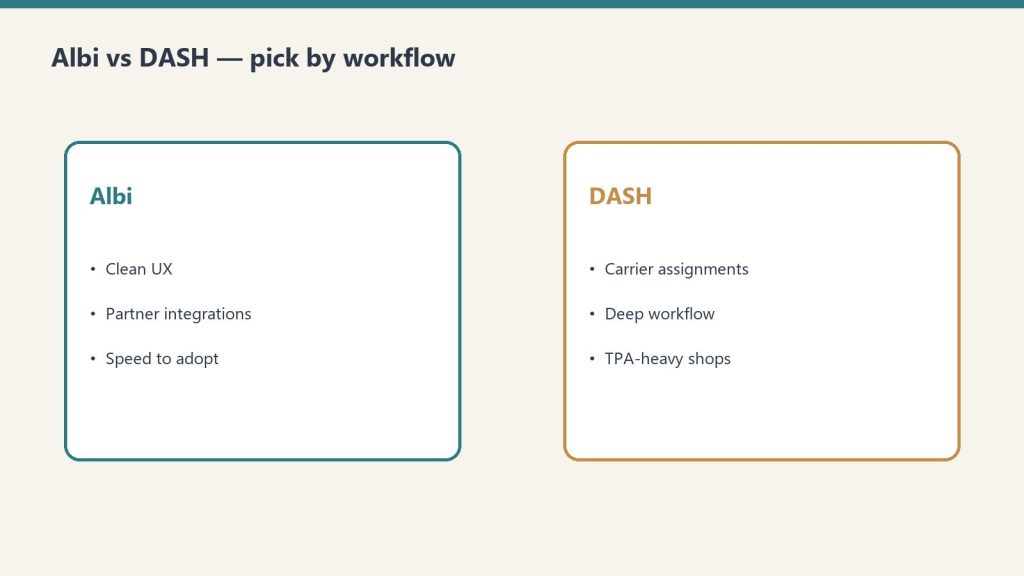
Albi’s strength shows up when techs move fast on moisture documentation.
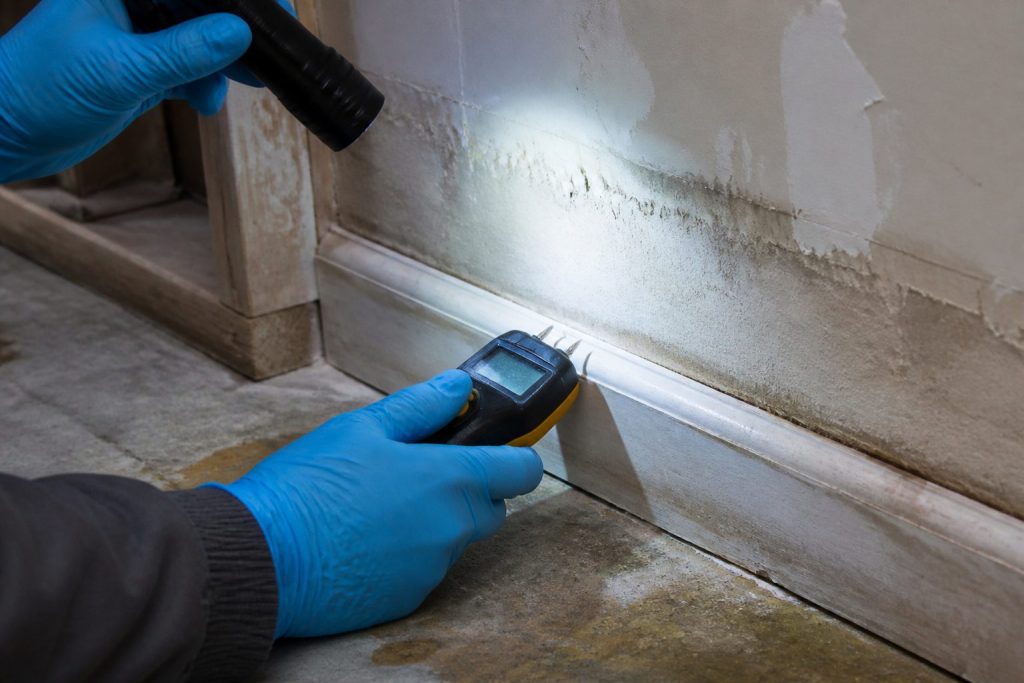
Albi was built by restoration contractors, and the water damage workflow shows it. DryBook 2.0 is a purpose-built moisture tracking tool built directly into the Albi platform — not a third-party integration. Field techs log moisture readings, track drying equipment placement, and document the drying curve without switching apps. This matters because moisture documentation is the core evidence for insurance claims on water damage jobs.
Albi also includes Albi Capture, a newer floor plan tool that’s useful for documenting affected areas precisely. For water damage documentation, accurate floor plans that map equipment placement and affected zones are increasingly expected by carriers.
The customization angle is real for water damage shops with specific workflows. Albi lets you build custom fields, custom report templates, and custom stages that mirror exactly how your company documents a Category 3 water loss differently from a Category 1. DASH enforces more standardized structure.
One hard number: Albi’s published support response time is 7 minutes (per albiware.com). For water damage work where a field tech encounters a documentation question mid-job, that matters more than it would for a slower construction workflow.
DASH’s water damage strengths
DASH’s strength shows up when assignments and adjusters drive the day.
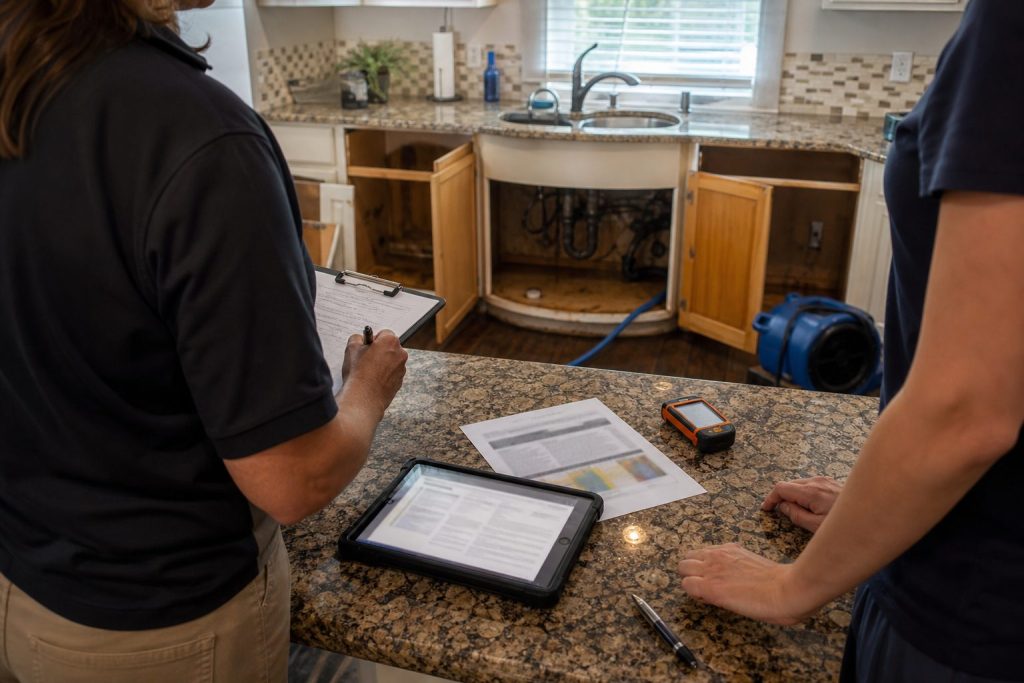
DASH’s advantage on water damage is the insurance side of the equation. The Compliance Manager builds carrier-specific documentation requirements into field checklists — before your tech leaves the job, DASH has guided them through exactly what the carrier needs. For high-volume insurance water damage work (burst pipes, appliance failures routed through Contractor Connection or similar TPAs), this reduces supplement disputes and documentation rejections.
For mitigation-specific workflow, Cotality offers Cotality Mitigate as a native add-on — it handles moisture mapping, equipment tracking, and IICRC S500-aligned drying documentation, and feeds directly into the DASH job file. Running both as part of the Cotality ecosystem means your mitigation data lives alongside your job file without import/export friction.
The offline mobile capability is also a real differentiator for water damage work. Water-damaged structures — flooded basements, saturated wall cavities, HVAC shutdowns — frequently have poor cellular coverage. DASH’s mobile app saves documentation locally and syncs when service returns. Field techs can capture photos, readings, and notes even without a signal.
The decision for water damage operators
If your water damage book is primarily insurance-driven (30%+ of revenue from carriers/TPAs) and you work with Contractor Connection, Code Blue, or Cotality-ecosystem TPAs, DASH is the stronger choice. The carrier integration depth and Mitigate add-on are built for this exact workflow.
If your water damage work is retail-heavy, or you want deep customization in how you document and report mitigation workflows, or you’re a growing shop that values responsive support and transparent per-seat pricing, Albi is the stronger starting point. DryBook 2.0 is purpose-built, and the $6K annual minimum is knowable — you can budget for it without a demo-call sales process.
Frequently Asked Questions
Is Albi or DASH better for water damage restoration companies?
It depends on your revenue mix. DASH (Cotality) is better if you derive 30%+ of revenue from insurance carriers and TPAs — its native Xactimate/XactAnalysis connection and Cotality property data ecosystem give it structural advantages for insurance workflow. Albi is better if you are retail-heavy, want a customizable platform, or need built-in moisture mapping tools like DryBook 2.0. Albi was built by restoration contractors specifically for the water damage workflow.
Does Albi have moisture tracking for water damage jobs?
Yes. Albi includes DryBook 2.0, a dedicated moisture tracking and drying management tool built into the platform. It tracks moisture readings, drying equipment, and IICRC S500-aligned documentation for water damage jobs. This is part of the core Albi platform, not an add-on.
Does DASH have water mitigation tools?
Yes. Cotality offers a separate product called Cotality Mitigate specifically for water mitigation workflow — it is distinct from DASH but integrates natively with it. DASH also connects natively with Cotality Mitigate for contractors who want both job management and dedicated mitigation documentation in one ecosystem.
How much does Albi cost for a water damage restoration company?
Per albiware.com/albi-pricing as of June 2026: Base seats are $60/user/month (field technician features including DryBook 2.0 and field documentation). Pro seats are $100/user/month (adds invoicing, Xactimate/XactAnalysis integration, advanced CRM, accounting integrations). Minimum annual subscription is $6,000 (4 seats required: 2 Base + 2 Pro). Onboarding starts at $1,000 one-time.
What is Cotality DASH’s water mitigation integration?
Cotality DASH integrates natively with Cotality Mitigate, a dedicated software product for water mitigation workflow. Mitigate handles moisture mapping, equipment tracking, and IICRC S500-aligned drying documentation. Running both DASH and Mitigate from the same Cotality ecosystem means mitigation data flows directly into the job file without manual entry.
Does Albi integrate with Xactimate for water damage estimates?
Yes, on Pro seats. Per albiware.com/albi-pricing, Albi Pro seats ($100/user/month) include Xactimate and XactAnalysis integration. If you’re writing Xactimate estimates for water damage jobs and submitting them to XactAnalysis for carrier review, you need Pro seats for your estimating staff. Base seats ($60/user/month) do not include Xactimate.
Which platform has better mobile tools for water damage field crews?
Both are strong. DASH’s mobile app has true offline mode — documentation saves locally and syncs when cellular is restored, which matters in water-damaged structures with poor connectivity. Albi Mobile covers time clock, scheduling, field documentation, moisture readings via DryBook, and photo capture. For crew-heavy water damage shops, Albi’s combined DryBook + mobile workflow is purpose-built for the job type; DASH’s offline reliability is the edge in connectivity-challenged environments.
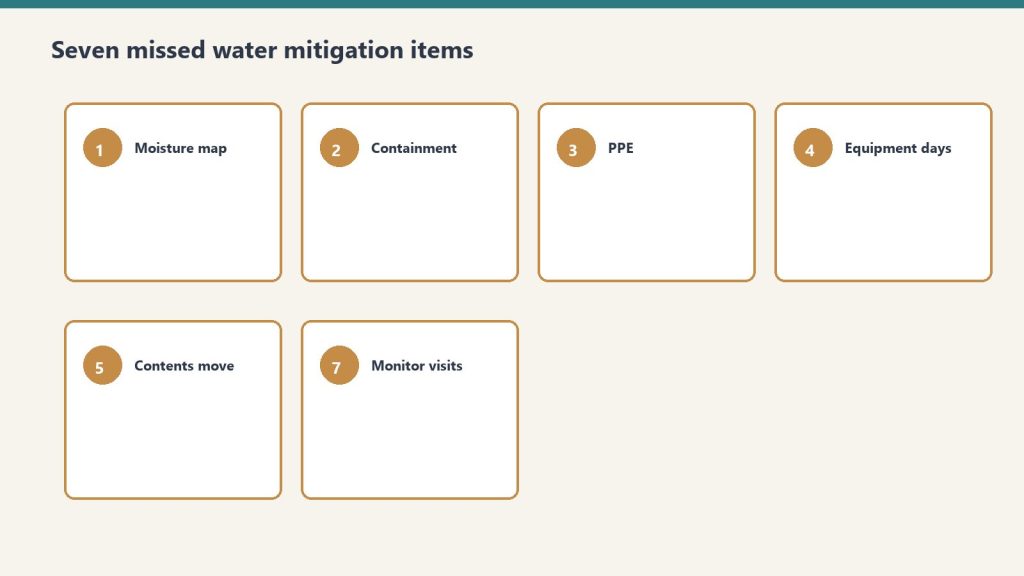
Most water mitigation supplements get killed not because the work wasn’t done, but because the line items were never written down. If you’re running a restoration company and watching your margin bleed out on Category 2 and Category 3 jobs, there is a near-certainty that your initial Xactimate sketch is missing four to seven line items that your crews actually performed. The desk adjuster never saw them. So they never approved them. And your gross margin took the hit.
This is the Xactimate supplement audit your estimator probably isn’t running. Walk through it before you submit your next water loss, and then walk through it again before you accept a partial denial.
Why supplements get killed
Supplements die when docs are late or vague.
The honest reason most supplements come back partially approved or denied is that they arrive looking like an afterthought. A clean Xactimate file that uses the carrier’s current price list, includes photo documentation tied to each line item, and matches the scope to the loss category gets reviewed apples-to-apples. A supplement that arrives as a PDF list with no photos and no sketch revision gets reviewed as a request for more money. Those are two very different conversations.
If you want approvals to move faster, every supplement needs three things: a revised sketch with new room tags or affected areas marked, photographs that directly correspond to each added line item, and pricing pulled from the same Xactimate price list the carrier is using. Verbal approvals over the phone do not create a paper trail. Email or carrier portal submissions do.
The line items most crews actually perform but never bill
Crews do the work — the estimate has to say so.
These are the WTR category items that show up in real water loss workflows and get left off the initial estimate. None of these are exotic. All of them are billable when the work was performed and documented.
Equipment decontamination on Category 3 losses. Every air mover, dehu, HEPA, and hose that entered a Category 3 environment requires decontamination before the next job. This is a line item, not a cost of doing business absorbed by your overhead. If your crew is bagging hoses and wiping down equipment with a quaternary cleaner, that is a billable task.
Antimicrobial application to affected surfaces. Plant-based or quaternary antimicrobial application on framing, subfloor, and the bottom plates is a separate line item from the cleaning. On Category 2 and Category 3 work the IICRC S500 protocol calls for antimicrobial treatment of affected materials. If you applied it, bill for it.
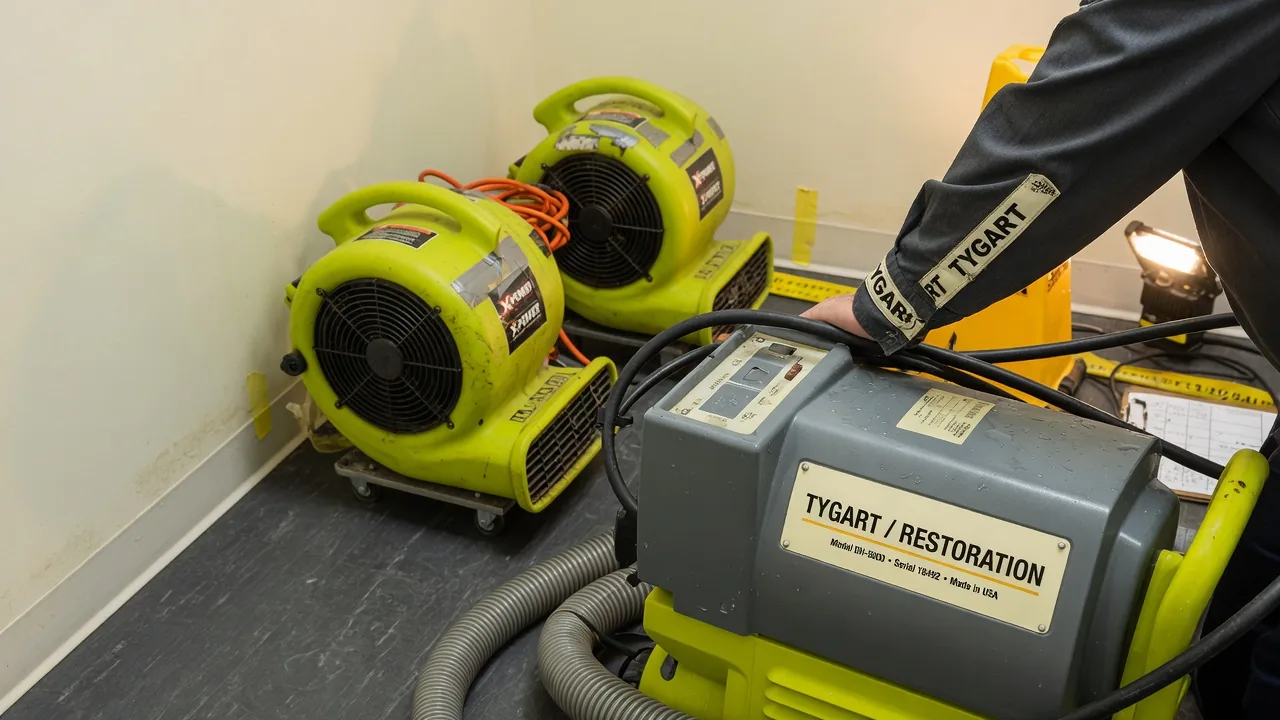
Containment and drying chamber setup. Plastic sheeting, zipper doors, and the labor to build a containment that isolates the drying chamber from unaffected areas is its own line item. The chamber itself is the reason your equipment count is justified — a smaller controlled volume dries faster, runs fewer days, and uses fewer air movers than an open room. If the adjuster is questioning your equipment count, the containment line item is the answer.
Detach and reset of contents. Moving the homeowner’s furniture, boxing contents, blocking the legs of upholstered pieces, and putting it back at the end of the job is not free. Contents manipulation has its own line items in Xactimate and is one of the most consistently missed billable activities in mitigation work.
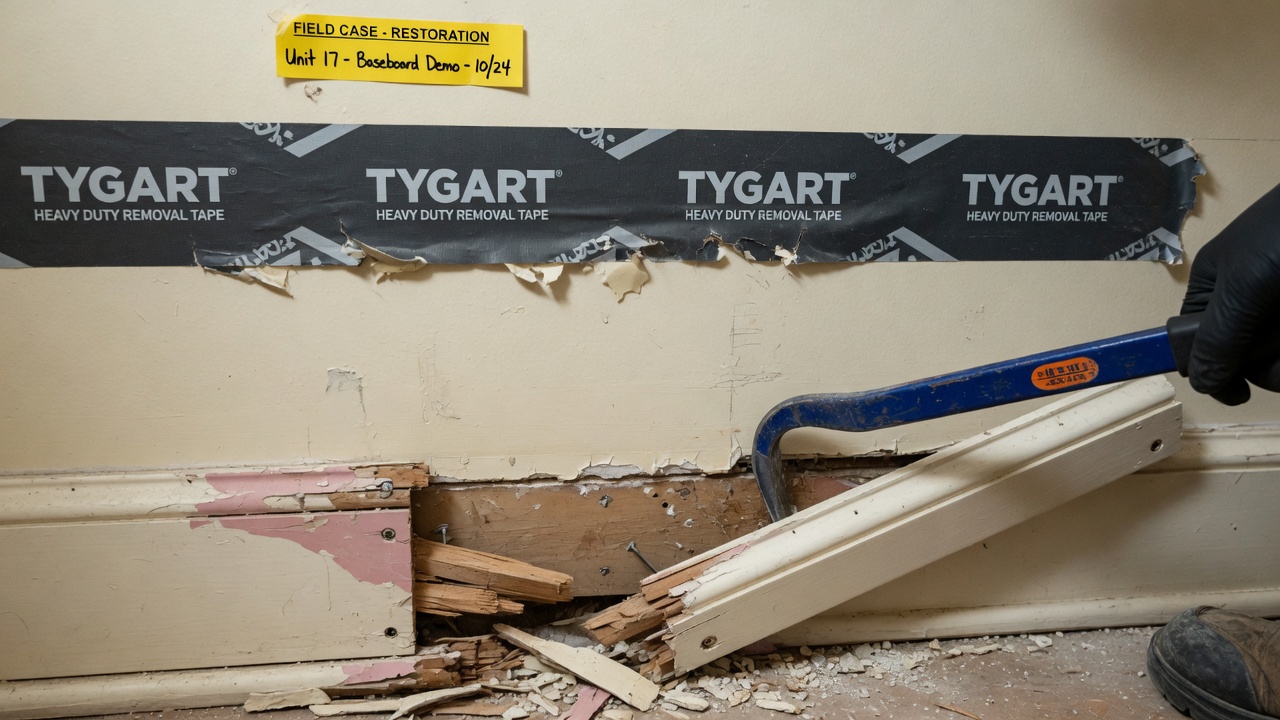
Multi-member baseboard removal. If the baseboard had quarter round or a separate cap, the WTRBASEB> line item covers the additional labor to remove and dispose of each layer. Estimators trained on the older single-member baseboard removal habitually leave the extra members off the estimate.
HEPA vacuum of demolition area. After a flood cut and material removal on a Cat 2 or Cat 3 loss, HEPA vacuuming the cavity before reconstruction begins is a billable task. It is also a defensible task if the homeowner ever questions whether the area was properly cleaned.
Disposal of contaminated water and materials. Extracting Category 3 water and disposing of it is different from extracting Category 1. There are separate line items for contaminated water extraction, contaminated material disposal, and the dump fees. If your crew hauled six contractor bags of sewage-soaked drywall to the landfill, that is documentable and billable.
The documentation that makes a supplement get approved
Moisture maps and photos make supplements get approved.
Pricing arguments are losing arguments. Scope arguments are winning arguments. When you submit a supplement, do not lead with cost. Lead with scope, and let the Xactimate price list speak for itself.
The fastest path to approval is to use Room ID tags in the Xactimate sketch so every space is clearly labeled, attach a photograph for every added line item that shows the affected area and condition, reference the loss category and IICRC standard where applicable, and submit the revised estimate as an attachment in the carrier portal rather than as a phone call or text.
When a line item is denied, the response should not be a longer email. It should be a request for the specific reason for the denial, in writing, tied to the carrier’s policy language or pricing logic. Most contractors give up at the first denial. Most adjusters expect that. The ones who push back with documentation get a measurable percentage of denied items approved on second submission.
The bottom line
Restoration owners obsess over labor cost and equipment utilization, but the single biggest lever on water mitigation gross margin is the completeness of the initial Xactimate scope and the discipline of the supplement process. Every line item your crew performs that does not make it onto the estimate is pure margin loss — the cost was already incurred. Building a checklist of the seven items above and running it as a pre-submission audit on every Cat 2 and Cat 3 loss is a one-week implementation that will pay for itself on the first job.
If your average water mitigation ticket is in the $4,000 to $6,000 range and a complete supplement audit recovers an additional $400 to $900 per job through previously uncaptured line items, the math at any meaningful job volume is the kind of margin recovery most owners spend years trying to find in payroll, fleet, or marketing instead.
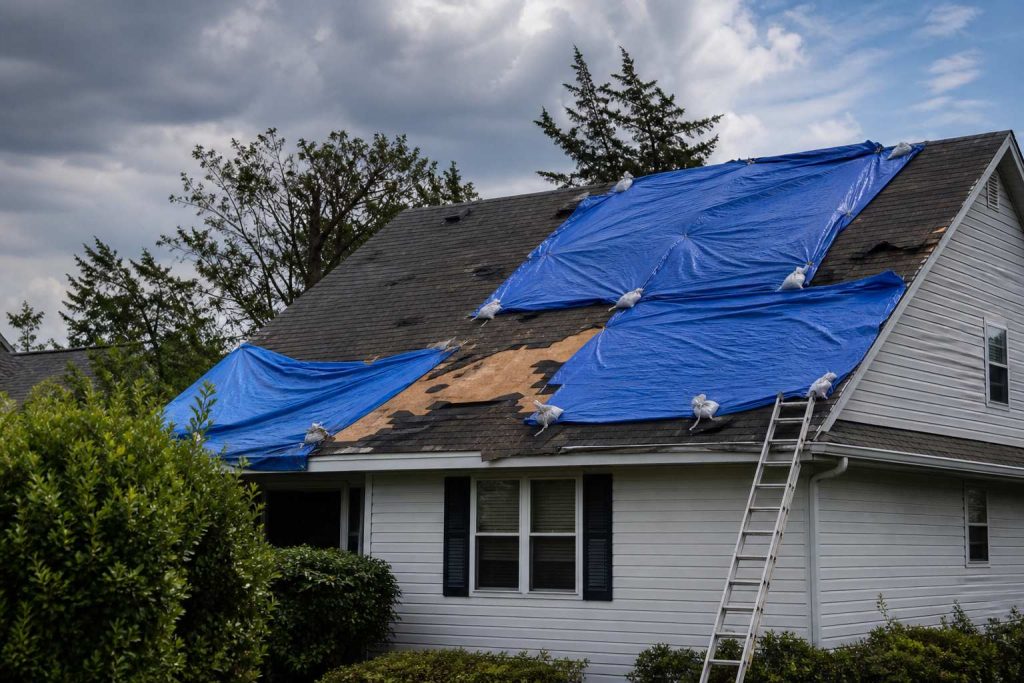
Direct answer: Roofers are one of the cleanest scope-lane partnerships available to a restoration company because their work ends at the roof deck and yours begins with every drop of water that made it inside the envelope. A roofer who fixes a leak or replaces a storm-damaged roof almost never has the IICRC training, insurance, or equipment to handle interior drywall, insulation, attic, or ceiling damage — and they don’t want to. The homeowner who just spent $12,000 on a new roof does not want to chase a separate contractor for their stained ceiling, wet insulation, or mold behind the bedroom wall. The restoration company that becomes the named interior mitigation partner for three or four quality roofers in a market unlocks a high-frequency referral channel that spikes hard during storm season and delivers steady volume year-round. Storm-chaser roofers are a different beast — watch the insurance claim dynamics carefully — but local roofers with strong reputations are the most natural scope-lane partner outside of plumbers.
The roofing channel sits at an underappreciated intersection in the restoration business. Every roof leak produces interior water damage. Every hail, wind, and storm event produces roof damage and often simultaneous interior damage. Every aging roof replacement uncovers prior leak evidence that somebody needs to remediate. Roofers handle the exterior scope. The interior scope is yours by design — but only if the roofer has your name in their phone and has been trained to hand the homeowner to you the same day.
This article is the operational view of how roofing companies actually make money, why storm chasers require a different playbook than local roofers, the six moments where interior water and mold damage gets discovered on a roofing job, why most restoration-to-roofer partnerships fail at the handoff, and the specific ninety-day program to make yourself the default interior partner. It is the tenth article in The Restoration Operator’s Playbook partner-industries series.
How a Roofing Company Actually Makes Money
Roofers handle the water source — interior damage still needs a partner.
The revenue mix. A mid-market residential roofing company runs between $1M and $15M in annual revenue. Revenue composition is typically 60–80 percent residential replacement, 10–25 percent repair, 5–25 percent commercial, and a trickle of new construction in some markets. Storm-chaser operations (companies that deploy into hail and hurricane zones) can run 90 percent insurance-funded residential replacement during event years.
Margin structure. Gross margins sit in the 35–40 percent range on typical residential replacement jobs — materials around 35 percent of revenue, labor around 18 percent, sales commission 6–10 percent. Net margins for healthy roofing contractors run 10–20 percent, with one-third of the industry reporting EBITDA margins between 6 and 15 percent according to 2026 ServiceTitan data. Commercial roofing has tighter gross margins but larger per-project revenue, with commercial contracts typically running $25,000 to $250,000+ per job.
Pricing structure. Residential pricing is typically per-square (one square = 100 square feet of roof surface). A standard asphalt shingle replacement on a 20–25 square house in the U.S. runs $10,000–$25,000. Premium materials (architectural shingles, metal, tile) run 2–5x. Commercial TPO, EPDM, and modified-bitumen work is typically priced per square foot with a minimum mobilization cost. Storm and hail work is priced against insurance scope rather than retail pricing — which is where the ethics and relationship dynamics get complicated.
The operational engine. Mid-market roofers run with a small office (owner, production manager, estimator, office admin), a sales team paid on commission, and either W-2 crews or subcontractor crews. Software stack: AccuLynx, JobNimbus, Roofr, CompanyCam for photo documentation, Eagleview and Hover for aerial measurement. Insurance work adds Xactimate, carrier portals, and supplement workflow to the stack. Their business rhythm is storm-season-driven — spring and summer hail, late summer and fall hurricanes, winter ice and wind in northern markets.
The commercial maintenance book. Quality commercial roofers build recurring revenue through maintenance contracts on TPO, EPDM, and modified-bitumen roofs. Typical annual maintenance fees run $500–$5,000 per building. These contracts keep technicians on roofs all year looking at the same buildings — which makes them a rich source of interior-damage discovery on commercial property.
Storm Chasers vs Local Roofers: Why the Playbook Is Different
This is a section most restoration content skips.
A storm-chaser roofing company deploys crews into markets immediately after hail, hurricane, or major wind events. They knock doors, offer free inspections, sign homeowners to contingency agreements, file and negotiate the insurance claim on behalf of the homeowner, and replace the roof paid entirely or nearly entirely through the insurance claim. Some storm chasers are legitimate businesses with offices in multiple states. Others are transient operations that vanish after the season, leaving warranty issues and litigation behind.
What matters for the restoration partnership. Legitimate local roofers who handle insurance work do it within ethical guardrails — they inspect, document, submit the scope, and collect from the carrier the same way restoration companies do. Transient storm chasers often push ethically gray tactics that can expose a restoration partner to reputational damage: assignment-of-benefits abuse in states where AOB has been restricted, public-adjuster-style claim negotiation without proper licensing, inflated scope fights, and high-pressure door-to-door sales that irritate homeowners and regulators.
The partnership rule. Partner with local roofers who have been in market three-plus years, carry real addresses, have strong Google reviews and GBP longevity, maintain manufacturer certifications (GAF Master Elite, Owens Corning Platinum, CertainTeed ShingleMaster), and can produce license and insurance documentation immediately. Be wary of out-of-state operators running door-to-door campaigns after the last hail event. Your reputation rides on theirs when you become their named interior partner.
The AOB and claim-handling line. In the states that still permit assignment of benefits on roof claims, a roofer holding AOB has significant control over the claim. Some roofers will try to attach restoration interior scope to their claim under the same AOB. Read your state’s statute — in states like Florida (after reforms), AOB on property claims is substantially restricted. In other states it’s still permitted but increasingly scrutinized. Your posture: the interior mitigation scope is yours, priced and invoiced directly to the homeowner or their carrier, under your own documentation. Never accept a roofer’s AOB as the mechanism for billing your work.
How Roofing Companies Acquire Customers
Storm-response canvassing. Door-to-door after hail and wind events. Still the largest single channel for residential replacement in many markets. Some of this is high-quality work by good local operators; some is predatory. Regulators watch it closely.
Google LSA and paid search. “Roof replacement near me” and “roof leak repair” are high-CPC terms. Residential roofers spend aggressively on LSA, PPC, and SEO.
Insurance carrier preferred networks. Some large roofers sit on carrier preferred-vendor lists for direct assignment on claims. These are procurement relationships with fixed pricing and SLA requirements.
Commercial sales teams. Dedicated B2B reps calling on property managers, facilities directors, building owners, and general contractors. Commercial roofing relationships are relationship-based and long-cycle — a roofer might call on a facility for three years before winning the replacement bid.
Referrals. Past clients, realtors, home inspectors, and trade partners. Strong local roofers run 40–70 percent referral-driven volume.
Home shows and brand marketing. Parade of Homes, local builder associations, remodeler expos, and sponsorships.
The takeaway: roofers compete on speed, warranty, and trust. They value trade partners who protect their reputation with the homeowner and don’t create problems on the job.
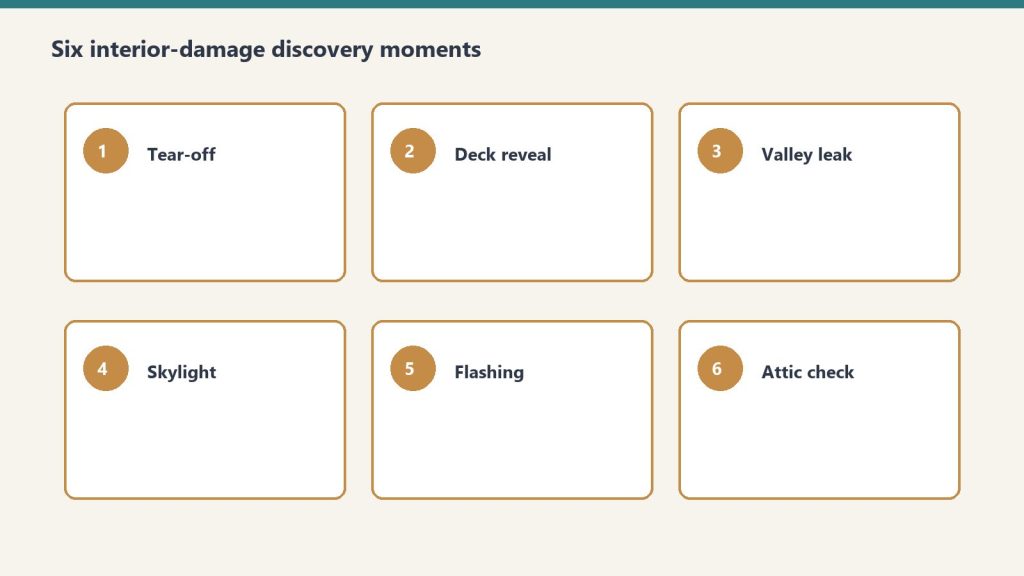
The Six Interior-Damage-Discovery Moments on a Roofing Project
Six moments when interior damage shows up on a roofing project.
Moment 1: The active leak call. Homeowner calls the roofer because water is actively dripping through the ceiling during a storm. Roofer tarps the roof same-day, inspects, and books the repair or replacement. The interior is already wet — stained drywall, wet insulation, possibly pooled water in a ceiling cavity. This is a same-day mitigation call. Minutes matter.
Moment 2: The post-storm inspection. After a hail or wind event, the roofer is on the roof assessing damage. From the attic access during the inspection, they see wet insulation, water-stained sheathing, and visible mold colonies from prior unrepaired leaks. The homeowner didn’t know.
Moment 3: The replacement tear-off. During a replacement, crews pull the old shingles and underlayment. They find rotted decking, failed flashing, stained sheathing, and evidence of sustained leak activity that never reached a visible interior ceiling stain. Parts of the interior need mitigation even though the homeowner never saw water damage.
Moment 4: The attic walk during a maintenance inspection. Commercial or high-end residential roofer doing a scheduled inspection walks the attic and finds compromised flashing, daylight around a penetration, wet insulation, or mold growth. Exterior fix is on the estimate. Interior mitigation is a separate scope.
Moment 5: The commercial roof replacement uncovering legacy damage. Commercial TPO or EPDM replacement finds saturated insulation boards, wet deck substrate, and legacy mold under the old membrane. Commercial mitigation scopes are large and high-dollar — this is where the roofing partnership pays off most.
Moment 6: The failed skylight, chimney, or penetration detail. Chronic leaks at roof penetrations produce long, narrow mold tracks down interior walls, inside chimney chases, or along skylight wells. The roofer fixes the detail; the interior scope often involves demo, drying, containment, and remediation across multiple rooms.
Train your intake, your PMs, and your conversations with roofing partners around these six moments. Each one is a playbook.
Why Most Restoration-to-Roofer Partnerships Fail
1. Slow response on the active leak call. A roofer calling you at 2pm on a Saturday because water is pouring through a ceiling needs you there in two hours with a tarp, containment, and dry-out equipment. If you can’t get there same-day, the homeowner’s perception of both companies is already damaged before you arrive.
2. Confusing scope lanes on the insurance claim. A storm-damage claim with a roof scope and an interior scope requires careful coordination. If your interior scope is priced or documented in a way that creates supplement fights with the carrier over what’s roof versus what’s interior, the roofer’s claim gets dragged into your documentation problems. You lose the relationship.
3. Accepting AOB from the roofer instead of contracting directly with the homeowner. This is an ethics and compliance mistake. Your contract is with the homeowner or with the carrier under standard restoration authorization. The roofer’s AOB covers their scope. If you let the roofer bundle your work into their AOB, you’re ceding control of your billing, your scope, and your liability. Don’t.
4. No commercial mitigation capability when the roofer’s book is commercial. Many quality roofers have a substantial commercial book. If you can’t produce commercial-scale mitigation — large dehumidifiers, HEPA air scrubbers at scale, commercial contents handling, document reconstruction capability — you become the residential-only partner and miss the high-dollar work.
5. Bad communication during the overlap window. On a full roof replacement with interior mitigation, your work and the roofer’s work overlap. If the roofer tears off the roof on Tuesday and you’re supposed to dry the attic starting Wednesday but don’t show, the entire schedule collapses. Tight coordination with the roofer’s production manager is non-negotiable.
6. Sending storm-chaser-style pitches to local roofers. A long-tenured local roofer with manufacturer certifications does not want a partnership with a restoration company that looks like an aggressive storm chaser in any way. Your sales posture should look like theirs: professional, documentation-focused, warranty-minded, and reputation-protective.
Ten Operational Disciplines for a Roofer Referral Channel That Works
1. Same-day response on active-leak calls. Standard operating policy. Any time a roofing partner calls with “water’s coming in,” you have a tech and containment equipment on site within four hours in business daylight, six hours after dark.
2. Tarp, containment, and interior dry-out as a standard scope. Flat-rate pricing for standard active-leak mitigation: tarping assistance if needed, interior containment, water extraction, affected-material demo, drying equipment setup, moisture mapping. Price it so the roofer can quote it to the homeowner alongside their roof work without negotiation.
3. Commercial mitigation capability advertised explicitly. If you have commercial-scale equipment and can respond to $10,000–$150,000 mitigation scopes on commercial roofs, put it on the one-pager you hand the roofer’s commercial sales team.
4. Dedicated intake line that knows roof terminology. “Decking,” “underlayment,” “flashing,” “ice-and-water shield,” “ridge cap,” “penetration boot,” “step flashing,” “valley,” “drip edge” — your intake should be able to triage the call without a vocabulary lesson.
5. Xactimate-standard interior documentation. For insurance-funded interior mitigation, your scope language and line items have to align with the roofer’s carrier-facing documentation.
6. Photo documentation coordinated with the roofer’s production. Use CompanyCam or equivalent with the roofer’s project folder shared where possible. Before/during/after on both sides in a single shared album means the claim file reads cleanly to the adjuster.
7. Strict separation of billing and contracts. Your contract is with the homeowner or carrier. You do not bill through the roofer. You do not accept AOB that bundles your work into their claim.
8. Commercial maintenance-contract awareness. Know which of your roofing partners have active commercial maintenance contracts and on which buildings. When a leak happens on a maintained building, both trades mobilize together — and your name is already in the customer’s file from prior coordination.
9. Joint post-loss follow-up at 72 hours. Call the homeowner together (roofer and restoration PM) 72 hours after the initial event to confirm the roof fix is holding and the interior dry-down is progressing. Customers talk about this experience for years.
10. Quarterly business review with the roofer’s production manager. Recurring 60-minute meeting. Review jobs completed, response time, customer satisfaction, outstanding documentation, and reciprocity. Adjust.
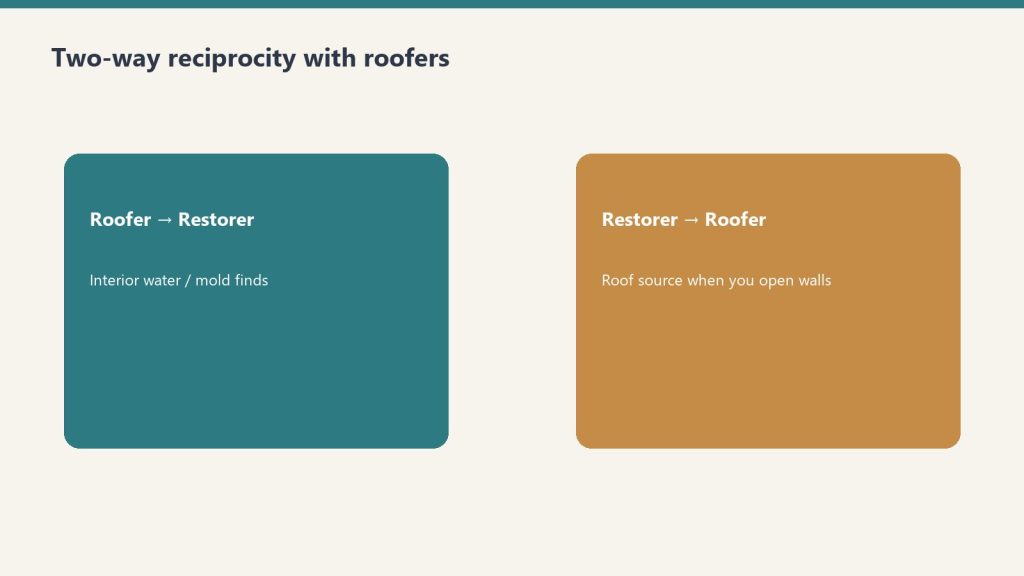
The Two-Way Reciprocity Model for Roofers
Two-way reciprocity — referrals only stick when both sides win.
Flow 1: Roofer → restoration. Roofer calls on an active leak, post-storm inspection, replacement tear-off discovery, or commercial maintenance finding. You respond within the committed window, execute the interior mitigation scope, document cleanly, close with clearance. The roof work and interior work finish on compatible timelines.
Flow 2: Restoration → roofer. On any mitigation scope you handle where the source was roof-related and the customer needs roof work after your mitigation closes, you name the roofing partner as the default recommendation. Warm introduction, contact info handoff, and written introduction email. You do not accept compensation for the referral — the reciprocity is the referral.
Flow 3: Commercial account introductions. If your roofing partner has commercial maintenance contracts on buildings and you have mitigation capability on those same buildings, propose a joint sales conversation with the facilities director at the next opportunity. Two-trade, single-point-of-contact coverage is a real differentiator to facilities directors.
Flow 4: Storm-season emergency response protocol. Pre-season agreement: when a storm hits your market, both companies deploy on coordinated schedules. Roofer handles roof assessments and tarping; you handle interior mitigation triage. Shared response channel (group text, Slack, or simple email chain). Customer experience is unified even when two trades are on site.
Track referrals both directions. If the reciprocity drifts, fix it before it becomes silence.
The Ninety-Day Roofer Partnership Program
Week 1: Target selection. Identify the four to six local roofing companies in your market with three-plus years of tenure, strong GBP review profiles, manufacturer certifications (GAF Master Elite, Owens Corning Platinum, CertainTeed ShingleMaster, Tamko Pro Certified), and either a meaningful residential replacement book or a commercial maintenance book. Avoid anyone with patterns that look like transient storm-chase operations.
Week 2: Scope-lane agreement drafted. One page. Your work = interior water, moisture, mold, drywall, insulation, attic, ceiling, and related scopes downstream of roof-source damage. Their work = roof replacement, repair, and exterior envelope. No billing crossover, no AOB bundling. Signed by both parties.
Week 3: Rate sheet for active-leak mitigation finalized. Standard tarping-assistance fee, interior containment, extraction, small/medium/large drying scopes, attic insulation removal pricing, ceiling and drywall demo pricing. Published. Email-ready.
Week 4: First meeting with the roofer’s production manager. Not the owner first — the production manager who dispatches. Same reason as with property managers. Bring the scope-lane agreement, the rate sheet, the response-time commitment, the photo-documentation protocol, and sample closeout package.
Week 5: First active-leak call. Execute at standard. Four-hour site visit in business daylight, tarp-and-contain within eight hours, dry-down documentation inside 24, clearance package at the end. Debrief with the production manager inside 72 hours.
Week 6: Commercial sales team meeting. If the roofer runs a commercial book, meet the commercial sales manager. Walk through your commercial mitigation capability. Ask which maintained buildings are in the portfolio and what the emergency response protocol currently looks like.
Week 7: Joint CompanyCam folder setup. Shared project folders for overlapping jobs. Set it up on the next live job.
Week 8: Storm-season protocol drafted. If you’re heading into storm season, draft the coordinated emergency response protocol. Pre-season coordination beats storm-day improvisation every time.
Week 9: Second roofer opened. Repeat the program on a second target. Two to four roofing partners is the sustainable max per market.
Week 10: Quarterly business review cadence set. Calendared for the next twelve months.
Week 11: Co-branded homeowner education piece. “What to do when water comes through your ceiling” — short one-pager, both logos, both numbers. Lives on both websites, in the roofer’s leave-behind packet, and on your call-out trucks.
Week 12: Referral ledger first review. Count inbound and outbound. Any imbalance gets addressed in the Q1 QBR.
By day ninety, you should have two active roofing partners, a storm-season protocol ready, and ten to thirty jobs executed on shared scope.
Where to Start This Week
Build the active-leak rate sheet before calling anyone.
Draft the scope-lane agreement. Have your attorney review the AOB-refusal language.
Identify the three or four local roofers with three-plus years of tenure, manufacturer certifications, and strong GBP profiles.
Decide who on your team owns roofer accounts. Must be comfortable with same-day response and roof terminology.
Get the storm-season emergency protocol drafted before the next weather event.
Co-brand the active-leak homeowner one-pager.
Book the first production-manager meeting.
If you’re stuck on step one, the active-leak rate sheet is the single most valuable artifact in the whole program. No roofer in your market is getting this from any other restoration company.
Next in the queue: pool and spa service, appliance installers.
Frequently Asked Questions
Should I work with storm-chaser roofing companies?
With extreme caution or not at all. Legitimate out-of-state roofers with multi-state operations and real office addresses can be responsible partners during catastrophe years. Transient storm-chase operations without local presence, manufacturer certifications, or tenured review history create reputational risk that outlasts the event. The default posture: build the partnership program with local roofers who have three-plus years of tenure and high manufacturer certifications first, and extend only to out-of-state operators during a deployed event if their credentials, insurance, and references check out completely.
What’s the right way to handle interior billing on an insurance-funded roof replacement?
Your contract is with the homeowner and your billing goes through either direct payment or carrier authorization under your own documentation. The roofer’s scope and billing go through their own contract and their own carrier workflow. The two scopes are coordinated in the claim file but invoiced separately. Never accept an AOB from the roofer that bundles your work into their claim. Your insurance, your license, your documentation — your billing.
How do I handle the commercial maintenance-roof channel?
Ask your roofing partners for a list of buildings under active maintenance contracts. For each, request an introduction to the facilities director. Offer a joint no-charge “emergency preparedness review” on the building — a thirty-minute walk where the roofer inspects the roof and you inspect the interior for vulnerability. The facilities director gets free due diligence, you both get mental real estate, and when a leak happens the response is coordinated from day one. This is where the high-dollar commercial mitigation work lives.
What response-time standard is realistic on an active-leak call?
Four-hour on-site in business daylight. Six hours after dark. Customers dripping water through their ceiling will forgive nothing slower than that. If your operational model can’t support same-day response on leak calls, the roofer channel is not the right primary channel for you — but it might still be a secondary channel with a different commitment level honestly communicated to the roofing partner.
How is this different from the plumber partnership?
Plumber partnerships run on plumbing events — burst pipes, water heater failures, overflow. The first-call pattern is very similar to roofers (active emergency, fast response, interior mitigation). The difference: roofers produce far more seasonal volume spikes (storm events, freeze events, hail events) than plumbers, who produce a steadier year-round flow. Roofers also carry more commercial maintenance-book leverage than most plumbers, which creates a higher-dollar commercial mitigation channel. Many restoration companies run both channels with the same PM owning both relationships — the operational stack overlaps substantially.
Can I rely on the roofer referral channel if I’m only residential-capable?
Yes, and it will work well — but you cap your upside. The residential-only operator captures every active-leak call and every post-storm interior discovery through their residential roofing partners. To access the commercial maintenance-book channel, you need commercial-scale equipment, commercial contents handling, and commercial-scale response capability. Many restoration companies scale up commercial capability specifically because their commercial-oriented roofing partner gave them visibility into how much volume was unreachable at residential scale.
Direct answer: Real estate agents are a high-frequency referral partner for restoration companies because every home sale passes through a home inspection, and home inspections routinely uncover water damage, mold, failed crawl spaces, roof leaks, and moisture problems that threaten to kill the deal. The agent whose commission is on the line needs a restoration company that can be on site in twenty-four hours, produce a scope and a remediation timeline that fits inside the closing window, and deliver clearance documentation that the lender, the buyer’s agent, and the underwriter will all accept. That’s the entire job. Most restoration companies have never built a realtor program designed around the closing clock — and the one that does becomes the default in a fifty-agent brokerage before anyone else figures it out. RESPA and state-specific rules restrict how referral compensation works between real estate and settlement-service providers, so the program has to be built on speed and documentation, not cash.
Real estate agents look like an easy referral channel from the outside. They meet new homeowners every week. They have client lists. They go to networking events. Every restoration company’s marketing director has at some point said “we should work with realtors.” Very few companies ever build anything durable out of that intent.
The reason is that the realtor channel runs on a different economic clock than any other trade in this series. A plumber’s referral is triggered by a water event; your job is to arrive fast and remediate. A property manager’s referral is triggered by a tenant complaint; your job is to respond and document. A realtor’s referral is triggered by a deal that is about to fall apart — and the clock isn’t three days, it’s often seven or fourteen. If you can’t work inside that clock with scope, price, and documentation that lets the lender and the underwriter approve the loan, the commission goes away, the agent finds somebody who can, and you are never called again.
This article is the operational view of how real estate agents actually make money, how and why restoration work gets discovered during a transaction, why most restoration-to-realtor referral programs fail, and the specific ninety-day program to become the restoration company a brokerage calls when a closing is on the line. It is the ninth article in The Restoration Operator’s Playbook partner-industries series.
How a Real Estate Agent Actually Makes Money
Understand their economics or don’t walk in their door.
The commission structure. Agents earn commission on each transaction they close. Historically this was a single listing-side commission negotiated by the seller (typically 5–6 percent of sale price) and split between the listing brokerage and the buyer-side brokerage, with each brokerage then splitting with its agent. Recent NAR settlement changes (2024 rule changes) have restructured buyer-agent compensation in many markets, but the underlying math is similar: total agent-side compensation on a typical U.S. transaction runs 4–6 percent of sale price, split between listing side and buyer side, and then split again between brokerage and agent.
Brokerage splits and caps. Newer brokerages run 85/15 (agent/brokerage) with low annual caps — REAL, eXp Realty. Traditional franchise brands like Century 21 run 70/30 on starter plans, 90/10 on top plans. Keller Williams runs a 64/30/6 model (agent/market center/KWRI) with a variable annual cap. Boutique and independent brokerages vary widely. Top producers on capped models hit their cap mid-year and keep 100 percent of every additional commission until year-end. This is why top agents work volume aggressively — every closing after the cap is pure take-home.
What an agent actually nets. On a $400,000 home with a 5.5 percent total commission, the gross commission pool is $22,000. Split between listing and buyer sides, each side gets $11,000. After a 70/30 brokerage split, the agent receives $7,700. After desk fees, marketing costs, MLS fees, and self-employment tax, the net is closer to $5,000–$6,000. That number matters because it tells you exactly why a deal that falls apart over a $4,000 mold scope feels like a personal crisis to the agent.
Typical agent volume. The median U.S. agent closes roughly 10 transactions per year. Top producers close 40–200+ per year. A mid-career full-time agent in a healthy market closes 15–25. A team lead running a 5-agent team closes 50–150.
The time pressure. Typical closing timeline from contract to close is 30–45 days. Inspection and due-diligence window is usually days 7–14 of that window. Any restoration scope uncovered at inspection must fit inside the remaining 20–35 days — and the lender’s underwriter usually wants clearance documentation in hand at least 5–7 days before closing. That leaves 15–28 days of practical working time. Often less.
The operational engine. Most agents work out of a brokerage or a team. Day to day they live inside the MLS, a CRM (kvCore, BoomTown, Follow Up Boss, Lofty, Chime), a transaction-management platform (Dotloop, Skyslope, DocuSign Transaction Rooms), and Zillow/Realtor.com/Redfin lead flow. Their inspector, lender, title officer, home warranty company, and handful of trade vendors form a loose network they call on every transaction. Your name either gets into that loose network or it doesn’t.
How Real Estate Agents Acquire Business
Understanding where an agent’s business comes from tells you what they need from you.
Sphere of influence. 60–80 percent of top-agent business comes from past clients, referrals, and personal network. Agents who have been in business five-plus years run on this almost exclusively.
Open houses and farming. Door-knocking, direct mail, and open-house prospecting — declining but still active. Newer agents rely on these more.
Online leads. Zillow Premier Agent, Realtor.com leads, Redfin Partner, and various paid-lead platforms. Expensive per lead, converting at low rates, but filling the top of the funnel for volume agents.
Team-generated leads. Agents inside teams receive leads the team pays to generate, typically on a 50/50 split with the team lead. This is a fast path for newer agents.
Referral partners. Lenders, title companies, home inspectors, moving companies, warranty providers, and service trades. This is where you sit — or want to sit.
Brokerage and franchise brand. Brand signals matter less than they used to, but still a factor.
The takeaway: an agent’s business runs on trust and speed. They send referrals to vendors who protect their deals and make them look competent to their clients. They stop sending referrals to vendors who blow up deals or embarrass them.
Why the Realtor Channel Runs on a Different Clock Than Any Other Trade
Realtor channel runs on a different clock — speed closes deals.
This is the strategic hinge of the article.
Every other partner industry in this series operates on an event-driven or recurring-revenue clock:
Plumber: water event, response now, you mitigate, customer repairs later
HVAC: equipment service or install, discovery happens incidentally
Property manager: dispatch now, close the ticket, repeat
Pest control: quarterly route, recurring calendar
General contractor: demo uncovers damage, project pauses, you mitigate, rebuild resumes
The realtor clock is different. It’s a deal clock — thirty days from contract to close, minus days already burned, minus the lender underwriter’s buffer at the end. By the time you get the call, there might be fifteen days of working time left to:
Visit the property
Produce a scope
Negotiate who pays (seller, buyer, or credit at closing)
Execute the work
Deliver clearance documentation
Get the lender to accept the clearance
Close the deal
If you can’t run that entire sequence inside the window, the deal dies, the agent loses the commission, the buyer loses the home, the seller loses the sale, and your phone never rings from that agent again.
Everything about the program has to be built backwards from that clock:
Twenty-four-hour site visit
Scope delivered inside 48 hours
Flat-rate or unit pricing the parties can agree on without negotiation
Work executable inside 3–5 working days for standard scopes
Clearance documentation that lenders and underwriters accept
Communication with the agent, the inspector, the lender, and title happening in parallel
The restoration company that builds this program is scarce. The realtors who find one talk about it for years.
The Six Transaction Moments Where Restoration Work Gets Discovered
Six transaction moments where restoration work gets discovered.
Moment 1: The home inspection during due diligence. Days 7–14 of escrow. The buyer’s inspector produces a report flagging mold in the basement, water stains on the ceiling, elevated moisture readings, or failed crawl-space vapor barrier. The buyer’s agent brings the report to the listing agent. Negotiation starts immediately. This is the single highest-frequency and highest-stakes moment in the channel.
Moment 2: The specialized mold, radon, or moisture inspection. Many markets see specialized inspections triggered by the general inspector’s findings. Positive mold test, elevated moisture, confirmed water intrusion. These drive a second round of scope negotiation and tighten the timeline because they typically arrive on days 10–14.
Moment 3: The pre-listing walkthrough. Listing agent walks a seller’s home before taking it to market and sees obvious moisture issues — stained baseboards, musty basement, bath fan venting into the attic. A smart listing agent recommends remediation before the home hits the market, because a clean disclosure and a pre-listing clearance letter protects the seller from downstream disputes and supports a stronger listing price.
Moment 4: The lender-required repair at underwriting. The underwriter reviews the appraisal, sees a note about moisture or mold, and requires repair-and-clearance as a condition of the loan. This happens on days 25–35 of escrow. The clock is tighter than any other scenario.
Moment 5: The post-closing discovery within the first year. Buyer moves in, discovers water damage the seller did not disclose, and calls the agent. The agent wants to protect the relationship and avoid being named in a disclosure dispute. You become the remediation company, and often the documentation expert the agent points to when the attorney gets involved.
Moment 6: The investor rehab or flip. Real estate investor-clients of the agent buy a distressed or storm-damaged home. The restoration scope is large and the rebuild is larger. Flip investors operate on faster clocks than owner-occupants — sometimes 7–10 days from possession to restoration complete.
Train your intake and your sales conversations around these six moments. Every referral, agent script, and rate sheet should map to one.
Why Most Restoration-to-Realtor Referral Programs Fail
1. Building the program around the agent, not the deal clock. Restoration companies who spend marketing budget on realtor happy hours, broker lunches, and branded swag without ever engineering a 72-hour turnaround scope-and-clearance process are paying for goodwill they can’t cash. The realtor remembers your logo but doesn’t call you when a deal is on fire because you haven’t proven you can save it.
2. Variable pricing that can’t be negotiated inside a day. If your price on a standard basement mold remediation varies by $3,000 depending on how the estimator felt, the agent can’t use your scope in a repair-credit negotiation. The deal stalls. You have to publish a rate sheet the parties can work with inside an hour.
3. Clearance documentation that lenders reject. If your closeout package doesn’t include third-party clearance sampling where required, signed inspection reports, photo documentation, and protocol narratives that underwriters will accept, you might finish the work on day 20 and still watch the deal blow up on day 35 because the bank won’t clear to close. This has to be resolved on the front end, not argued in the final week.
4. RESPA violations in the referral compensation structure. The Real Estate Settlement Procedures Act prohibits fee-for-referral arrangements between real estate agents and “settlement service providers” on federally related mortgage transactions. State real estate commissions layer additional rules on top. Restoration remediation services on a home sale can fall inside the settlement-service definition depending on the state. Offering a referral fee to a realtor in exchange for the mold job on a transaction is a regulatory risk for both of you, and it’s also usually against the brokerage’s internal policy. The safe default: no cash referral fees on transaction-driven work.
5. Competing with the agent’s own handyman or contractor network. If the agent already has a trade vendor they like who handles smaller moisture issues and you show up pitching full-service restoration, you’re replacing a relationship. Better to position yourself specifically as the fast-turnaround remediation-with-clearance specialist for the scopes the agent’s handyman can’t handle — IICRC-certified scopes, third-party sampling, lender-accepted documentation.
6. Treating the listing agent and the buyer’s agent the same. Their incentives are different. The listing agent wants the seller’s disclosure to be clean and the deal to close at list price. The buyer’s agent wants the repair credit or the price concession to protect their client. The restoration scope you produce lands differently depending on which side of the table. Knowing which agent is driving the call — and which side of the negotiation you’re helping — matters for every conversation.
Ten Operational Disciplines for a Realtor Referral Channel That Works
Ten operational disciplines for a realtor referral channel.
1. Published rate sheet for the ten most common transaction scopes. Basement mold (small, medium, large square footage bands). Crawl-space mold and vapor barrier replacement. Attic mold. Bathroom mold behind drywall. Moisture mapping with report. Kitchen-area water damage. Flooring water mitigation. Attic rodent-contaminated insulation removal. HVAC sanitization. Clearance-sampling-only. Rate sheet emailed to every agent partner. Updated annually.
2. 24-hour site visit commitment, 48-hour scope delivery. Written into every agent communication. This is the promise that earns the relationship.
3. Clearance-documentation package built to lender standards. Third-party mold sampling where scope requires, laboratory results with chain of custody, protocol narratives, moisture readings, photo documentation, signed certificate of completion. Delivered as a single PDF acceptable to underwriters.
4. Dedicated intake line for transaction-driven work. Agents and inspectors call one number, get a human inside three rings. Intake is trained to recognize deal-clock urgency and triage appropriately.
5. Named account manager who knows transaction terminology. “Repair credit,” “seller concession,” “due-diligence period,” “clear-to-close,” “option money,” “earnest money,” “lender-required repair.” Your point of contact for realtors uses their vocabulary fluently.
6. Relationships with home inspectors in your market. Home inspectors are the upstream source of every transaction-driven referral. Get to know the top 5–10 inspectors in your market, host them for IICRC-topic education sessions, and make yourself the name they mention when they spot moisture during an inspection.
7. Pre-listing consultation program. Free 30-minute consultation for a listing agent’s seller clients who have moisture concerns before the home goes to market. Catches issues early, makes the remediation routine instead of panic work, and gives the agent a service they can offer as part of their listing presentation.
8. Co-branded seller disclosure package. Short one-pager the listing agent can include in the seller’s property disclosure: “Mold remediation performed by [your company] on [date], clearance report attached.” Professional, useful, protects the seller and the agent.
9. Brokerage-level education without a sales pitch. Offer to teach a 45-minute class at the brokerage on “how water damage and mold issues get resolved during escrow.” Technical, useful, free. Works at almost every mid-sized brokerage. Build a rotating class calendar and hit six brokerages a year.
10. Never discuss referral compensation. Full stop. If an agent asks what you pay for referrals, you answer: “We don’t do referral compensation — we’re focused on making sure your deals close on time with documentation that holds up to the lender. That’s the value you get from working with us.” It’s the only safe answer.
The Two-Way Reciprocity Model for Realtors
Reciprocity in the realtor channel looks different than any other trade because of RESPA.
Flow 1: Realtor → restoration. Agent calls you with a transaction-driven scope. You respond in 24 hours, produce the scope, execute the work, deliver clearance inside the window. The agent’s deal closes.
Flow 2: Restoration → realtor, through customer introductions. When a restoration client of yours mentions they’re planning to sell, move, or buy, and you know which agent partner serves their area and price point, you make a warm introduction — “[agent name] is an excellent agent in that market, I’ve worked with them on several transactions.” No fee, no kickback, no tracking of who closed whom. The agent earns the business through their own skill. You’re just the person who made a professional introduction. This is legal everywhere.
Flow 3: Joint education for agents and their clients. Co-branded content for the agent’s listings — “moisture and mold essentials for home sellers,” “how to prepare your home for inspection,” “what an inspection report actually means.” Lives on the agent’s website, on yours, in their listing packets. You get mental real estate with every seller the agent represents. They get useful content for their marketing.
Flow 4: Inspector introductions. Inspectors refer to both realtors and restoration companies. Being the restoration company a top inspector trusts means the agent gets your name three times — once from the inspector, once from another agent who worked with you, once from the lender or title officer who saw your clearance documentation on a prior deal. Compounding mental real estate is the durable output of an aligned channel.
Track the channel on referrals in and introductions out. If you’re getting ten deals a year from an agent and you’ve never introduced them to a restoration client selling their home, the relationship is one-sided and probably won’t survive the next market cycle.
The Ninety-Day Realtor Partnership Program
Week 1: Target selection. Identify the top 20 producing agents in your service area by transaction volume. Identify the top 5 team leads. Identify the top 5 home inspectors. Identify the top 3 mid-to-large brokerages that dominate your market.
Week 2: Rate sheet finalization. Build the ten-scope rate sheet. Have it reviewed internally. Print it clean. Email-ready PDF.
Week 3: Clearance package template finalization. Build the lender-ready clearance package template. Walk it through with a loan officer at a local mortgage company to confirm it meets underwriter expectations. Adjust.
Week 4: Inspector outreach first. Before you approach agents, meet with three home inspectors in your market. Coffee, 30 minutes, bring the rate sheet. Ask what they see during inspections, what scopes they flag most, what restoration companies they currently recommend when they see moisture. Offer to be the name they mention on the next finding.
Week 5: First brokerage class booked. Pick one brokerage. Offer a 45-minute class on “how water and mold issues get resolved during escrow.” Provide coffee and breakfast. Teach, don’t sell.
Week 6: First transaction call handled. By now a first referral should be in motion from either the inspector outreach or the brokerage class. Execute with the 24-hour-visit, 48-hour-scope, clearance-documentation standard. Deal closes on time.
Week 7: Debrief with the agent. Fifteen-minute call. What worked? Anything they wished went differently? Did the lender accept the clearance without friction? These are the questions that improve the program.
Week 8: Second brokerage class booked. Different brokerage. Same content, refined.
Week 9: Pre-listing consultation program launched. Email to the 20 target agents introducing the free pre-listing mold/moisture consultation for seller clients. Track how many take you up on it.
Week 10: Inspector education event. Host 4–6 inspectors for a half-day IICRC-content session. Not a sales event — a technical session. They leave smarter, and you become the company they recommend when they find moisture.
Week 11: Clearance package refinement. By now you’ve delivered 3–8 clearance packages. Review what worked, what lenders questioned, and refine. Update the template.
Week 12: Quarterly business review internally. Measure the channel. Referrals per agent, close-on-time rate, brokerage classes delivered, inspector relationships active. Plan Q2.
By day ninety, you should have two to three brokerage classes delivered, three to five inspector relationships active, ten to twenty agents aware of you, five to ten transaction-driven jobs executed, and a clearance-documentation track record that agents and inspectors will remember.
Where to Start This Week
Build the ten-scope transaction rate sheet before calling anyone.
Walk the clearance-documentation template through a loan officer for lender acceptance review.
Identify the top three home inspectors in your market by reputation — inspectors are your upstream.
Pick one brokerage to offer a class at. Email the sales manager.
Decide who on your team owns the realtor channel. Must be someone fluent in transaction language and comfortable under deal-clock pressure.
Draft the co-branded seller disclosure one-pager for listing agents.
Read RESPA Section 8 and your state’s real estate commission rules on referral compensation. Not the summary — the statute.
If you’re stuck on step one, the rate sheet alone will put you ahead of nearly every competitor in your market. Realtors and inspectors don’t get unit pricing on mold and moisture scopes. Handing them one makes you the professional.
Next in the queue: pool and spa service, roofers, appliance installers.
Frequently Asked Questions
Can I pay a realtor a referral fee on a transaction-related restoration job?
Generally no. The Real Estate Settlement Procedures Act (RESPA) Section 8 prohibits fee-for-referral arrangements between real estate brokers and settlement service providers on federally related mortgage transactions. State real estate commissions add their own rules, many of which extend the prohibition further. Restoration services that are part of closing the sale — mold remediation, water damage work, clearance documentation — often fall inside the settlement-service definition. The safe default is no cash referral fees on transaction-driven work. The channel runs on speed, documentation, and closing deals on time, not on referral payments.
What about a listing agent bonus for remediation performed before the home goes to market?
Pre-listing remediation performed before a property is under contract and before any settlement-service relationship exists may fall outside RESPA in some interpretations, but state real estate commission rules often still restrict agent compensation from vendors. The safest and simplest posture is the same as on transaction-driven work: no cash compensation. Agents who value you will refer you because you make their listings cleaner, not because you pay.
How fast can a typical mold or moisture remediation actually close a deal that’s on the clock?
Standard scopes — isolated areas under 100–200 square feet, no structural work, straightforward clearance sampling — can move from initial visit to clearance-in-hand in 5–8 working days. Larger scopes or scopes involving structural drying, slab work, or significant demo can run 10–20 working days. The variable is clearance — if you’re using third-party sampling, lab turnaround adds 2–5 days. Build your agent conversations around realistic timelines from day one, not optimistic ones.
Who pays for the restoration when it’s discovered at inspection?
Negotiated between buyer and seller. Common outcomes: seller pays and completes remediation before closing, seller credits buyer at closing and buyer handles remediation after, split cost, price concession with buyer handling remediation, or deal falls apart. The agent on either side uses your scope document as the basis for that negotiation. If your number is clean and your timeline is firm, the negotiation resolves faster and the deal survives.
Should I try to get preferred-vendor status at a brokerage?
Few mid-market brokerages maintain formal preferred-vendor status for restoration; it’s more common for lenders, title, and home warranty. What you can earn is informal default status with a cluster of agents inside a brokerage — the name everyone at that office mentions when a mold issue lands on a deal. The ninety-day program is how you build that default status. Formal preferred-vendor programs when they exist often have compliance gates (insurance, references, sometimes fees) similar to the property manager prequal process.
How is this different from the property manager partnership?
Property managers produce recurring dispatch volume on their managed doors. Realtors produce episodic deal-clock volume tied to transactions. A property manager relationship is about rate sheets, documentation, and response time on a steady cadence. A realtor relationship is about rate sheets, documentation, response time, and clearance standards that satisfy lenders — the underwriting bar is higher on transaction work because the lender is a stakeholder. Many restoration companies run both channels; the operational stack overlaps significantly, and the realtor channel layers specifically on transaction-clock execution and lender-accepted clearance packages.