Restoration Pricing & Profitability - Tygart Media

Category: Restoration Pricing & Profitability

Pricing strategy, profit margins, time and material vs. fixed bid, overhead, and the financial math behind a profitable restoration business.

  • Restoration Pricing Strategy: Target 45% Gross Margins

    Restoration Pricing Strategy: Target 45% Gross Margins

    Most restoration owners think their pricing problem is the matrix. It is not. The pricing problem is strategy: choosing which jobs to take, which programs to participate in, which markets to compete in, and what gross margin target to defend. Operators who get strategy right consistently produce 35 to 45 percent gross margins. Operators who do not consistently produce 12 to 18 percent gross margins on the same matrix.

    This article complements our restoration pricing master guide by focusing on the strategic choices that surround the line-item work.

    The Three Restoration Pricing Models

    Four ascending service-line bars for mitigation, rebuild, contents, specialty
    Three restoration pricing models.

    Every restoration company runs on one of three pricing models, and the choice has more impact on profitability than any line-item decision:

    • Pure TPA / matrix pricing — high volume, lower margin, predictable referral flow, heavy paperwork burden
    • Hybrid TPA + cash — diversified revenue, higher blended margin, requires sales capability
    • Cash-only / direct-to-consumer — highest margin per job, requires marketing investment, more sensitive to local economy

    Each model has a different cost structure, a different sales motion, and a different capital requirement. The strategic mistake is trying to run all three with the same operations.

    Setting a Gross Margin Target

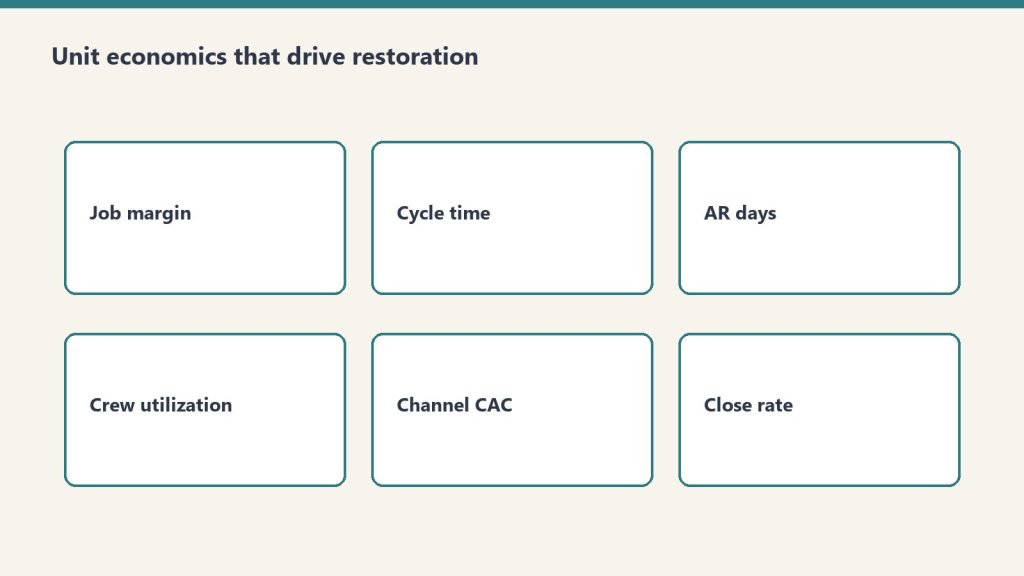
    Six cards covering job margin, cycle time, AR days, utilization, CAC, close rate
    Setting a gross margin target — no sticky percentages on the graphic.

    Healthy restoration companies target 35 to 45 percent gross margin on the blended business. TPA-only operators trend toward the lower end; cash-heavy operators trend toward the higher end. Setting a target margin and walking away from jobs that do not meet it is the single most important strategic discipline in the business.

    The math works like this: if your overhead absorption requires 35 percent gross margin to break even, every job below that target consumes capacity that should go to better work. Saying yes to those jobs feels like growth but is actually destruction.

    Pricing for Value, Not Cost

    The most expensive mistake in restoration pricing is the cost-plus mindset: figure out your cost, add a margin, send the estimate. Cost-plus pricing leaves money on the table on every cash job and ignores the value the customer is actually receiving (immediate response, displacement avoidance, professional handling of insurance).

    Value-based pricing on cash work uses tiered options, value-anchoring (presenting the most expensive option first), and outcome framing (“we save you the displacement, the insurance battle, and the risk of secondary damage”).

    Defending Pricing Without Discounting

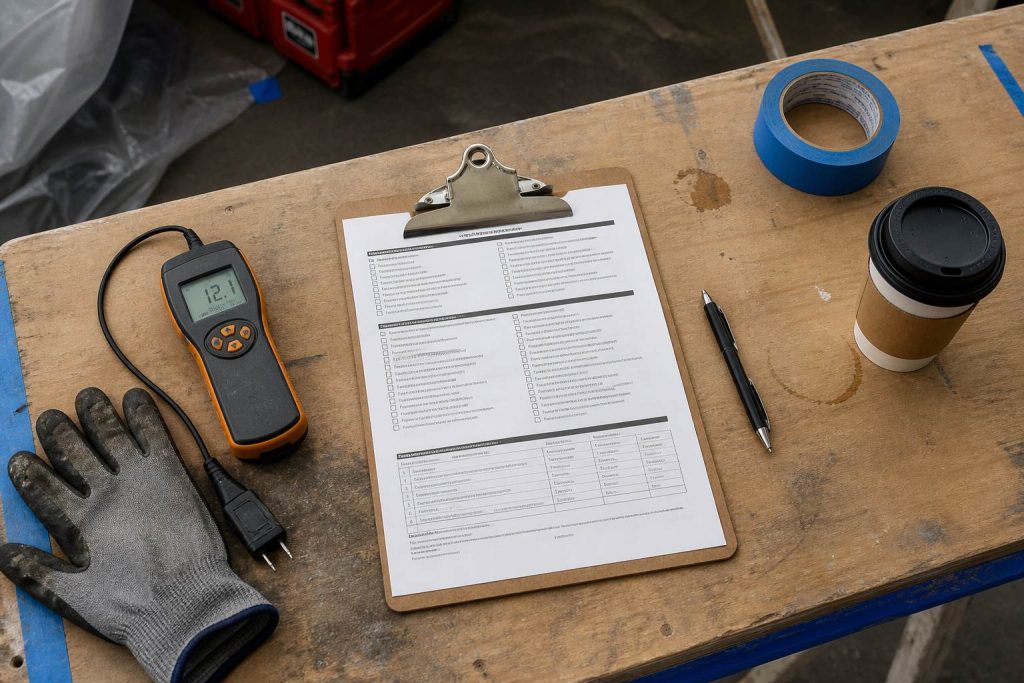
    Restoration SOP clipboard with checklist, moisture meter, and gloves on a jobsite table
    Defending pricing without discounting.

    Discounting is the gateway drug of restoration pricing. Once an operator starts discounting to win jobs, the local market remembers, and every future job comes in at the discounted rate. The discipline is to defend price without discounting: re-scope the work, drop optional line items, offer payment terms, but never cut the unit prices.

    The reps who close at full price are the reps who can articulate why the work costs what it costs and what happens if it is not done correctly. Training the sales conversation matters more than the price itself.

    Programs to Avoid

    Some TPA programs are not worth participating in at any margin level. The signals that a program is destructive: required participation in third-party billing platforms with high transaction fees, mandatory upfront deductible collection, slow pay (90+ days), excessive audit reductions, or volume requirements that consume more capacity than the revenue justifies.

    Walking away from bad programs is harder than joining them — but it is what separates 35 percent margin operators from 12 percent margin operators.

    Related on Tygart Media: Starlink on a water job · S500 in the van · local SEO for restoration.

    Frequently Asked Questions

    What gross margin should a restoration company target?

    Healthy restoration companies target 35 to 45 percent gross margin. TPA-only operators commonly run 25 to 35 percent. Cash-only or premium-cash operators commonly run 45 to 60 percent. Below 25 percent gross margin, the business cannot absorb overhead and grow simultaneously.

    Should I price the same for cash and insurance jobs?

    No. Insurance jobs should be priced to the matrix with disciplined documentation. Cash jobs should be priced for value with tiered options. Pricing identically across both channels means under-charging on cash work or over-pricing insurance work that never gets approved.

    How do I compete with low-priced restoration companies in my market?

    You do not compete on price. You compete on response speed, scope clarity, communication, warranty, and outcome. Low-priced competitors win the customers who shop on price; you want the customers who shop on confidence. Marketing, sales training, and reputation are the real defenses against low pricing.

    When should I walk away from a TPA program?

    Walk away when the program requires capacity that would generate more gross profit elsewhere, when transaction fees and audit reductions push the effective margin below your target, or when payment terms exceed 60 days consistently. Calculate the true cost of participation, not just the headline volume.

    What is the right gross margin to target on cash jobs specifically?

    50 to 60 percent gross margin is the right target for cash work in most markets. Cash jobs carry more sales effort, more collection risk, and no TPA referral funnel — so the margin must compensate. Operators consistently producing 30 percent margin on cash work are leaving substantial profit on the table.

  • Restoration Pricing: Cash vs. Insurance Job Strategies

    Restoration Pricing: Cash vs. Insurance Job Strategies

    Cash and insurance restoration jobs look identical in the field but require completely different pricing strategies. Operators who use the same approach for both consistently under-price cash work and lose money to scope reductions on insurance work. The good news: separating the two pricing motions is one of the highest-impact changes a restoration company can make.

    This article builds on the foundation laid in our restoration pricing master guide.

    How to Tell the Difference at Intake

    Clipboard and tablet on a kitchen counter during an insurance adjuster walkthrough after water loss
    Tell cash vs insurance apart at intake.

    Every job intake should answer one question early: is this an insurance job, a cash job, or undetermined? The answer drives every subsequent decision — sales process, estimate format, scope of work, payment terms, and pricing.

    Signals that a job will be cash: customer has no intention of filing a claim, deductible is high relative to job size, damage is below deductible, customer is uninsured, customer is sensitive to claim impact on premium. Signals that a job will be insurance: claim is already filed, adjuster is already assigned, TPA program is involved, large loss requiring carrier coverage.

    Insurance Pricing Discipline

    Gloved hands using a pin-type moisture meter on wet drywall during inspection
    Insurance pricing discipline.

    Insurance jobs should be priced to the matrix with full scope documentation. The discipline is completeness: every line item that should be on the estimate must be on the estimate, and every line item must be defensible with on-site documentation.

    Insurance pricing is a documentation game, not a negotiation game. The reps who get paid in full are the reps who photograph everything, log moisture readings daily, document equipment placement, and reference IICRC standards in the scope notes.

    Cash Pricing Strategy: Tiered Options Win
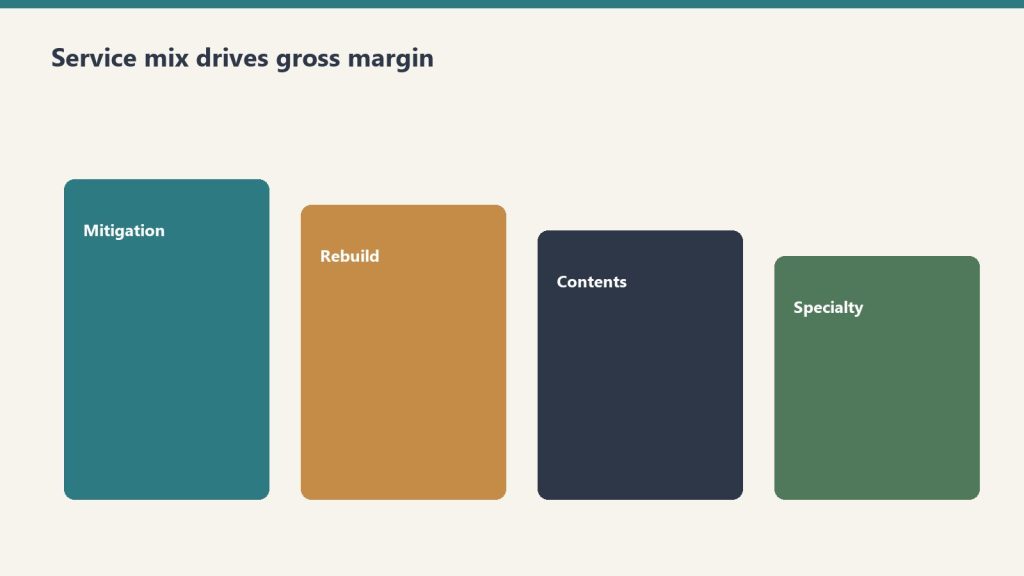
    Four ascending service-line bars for mitigation, rebuild, contents, specialty
    Cash pricing — tiered options win.

    Cash pricing should never be a single number. The conversion-rate-winning approach is a three-tier estimate:

    • Premium tier — full-service, highest scope, white-glove handling, longest warranty
    • Standard tier — recommended scope, normal warranty, structure plus contents
    • Budget tier — minimum to address the immediate problem, structure-only or critical-area-only

    This works because most customers want to feel like they are making a choice, not accepting a price. Tiered pricing converts more leads, lifts average ticket, and surfaces the actual customer budget faster than a single-price approach.

    Value Anchoring on Cash Work

    The order in which options are presented matters as much as the options themselves. Always present the premium tier first. The standard tier then feels reasonable, and the budget tier feels like a compromise. Reverse the order and the standard tier feels expensive while the budget tier becomes the default choice.

    Value-anchoring is not manipulation; it is helping the customer understand the full scope of what good restoration work looks like before they pick the level they want.

    Converting Cash Leads That Hesitate

    Cash leads who hesitate after seeing the estimate are usually responding to one of three concerns: the price feels high (compared to what?), the scope feels excessive (do I really need all this?), or the payment timing feels difficult (can I afford this now?).

    The right responses, in order: re-frame the comparison (“here is what happens if it is not done correctly”), explain each line item (“this is required because of contamination class”), and offer payment terms (“we can split this into three payments tied to milestones”). Never respond with a discount.

    Hybrid Cash + Insurance Scenarios

    Some jobs are partially insurance-covered and partially out of pocket. The pricing approach: build one comprehensive estimate at insurance pricing for the covered portion, then a separate cash estimate for additional work the customer wants. Mixing the two in a single estimate creates billing chaos and lost margin.

    Related on Tygart Media: Starlink on a water job · S500 in the van · local SEO for restoration.

    Frequently Asked Questions

    Should I always recommend filing an insurance claim?

    No. For damage below or near the deductible, filing a claim costs the customer more than the cash estimate would. The right ethical position is to share the math and let the customer decide. Operators who push every job to claim status develop a reputation for opportunism that hurts long-term referrals.

    How much higher should cash pricing be than insurance pricing?

    Cash work typically prices 15 to 30 percent above the equivalent Xactimate estimate, reflecting the value of immediate response, no claim involvement, and the operator’s higher sales effort. The premium is justified by what the customer is actually buying — which is more than just the labor.

    What is the best way to present a cash estimate?

    In person, on a tablet, with three tiered options visible simultaneously. Walk through each option’s scope, warranty, and timeline. Let the customer ask questions. Never email a cash estimate cold and hope for a yes — that is the lowest-converting approach available.

    How do I handle a customer who says my cash price is higher than another quote?

    Ask to see the other quote. Most “lower” quotes are missing scope items, are quoting a different remediation level, or are from operators without IICRC credentials. Walking through the comparison line by line either justifies your pricing or surfaces a real scope gap to address.

    What payment terms should I offer on cash jobs?

    Standard terms: 50 percent deposit, 50 percent on substantial completion. For larger jobs: 25 percent deposit, 50 percent at midpoint, 25 percent on completion. Never start work without a deposit; collection becomes nearly impossible after the work is done.
  • Restoration Pricing Objections: How to Defend Your Margins

    Restoration Pricing Objections: How to Defend Your Margins

    Pricing objections are not a problem to solve; they are a normal part of the restoration sales conversation. The difference between reps who close at full price and reps who discount their way to a yes is not the words they use — it is the framework they use to think about objections in the first place.

    This article builds on the strategic foundation laid out in our restoration pricing master guide.

    The Three Objection Types

    Four ascending service-line bars for mitigation, rebuild, contents, specialty
    Three objection types — prepare for each.

    Every pricing objection in restoration falls into one of three categories, and each requires a different response:

    • “It feels expensive” — comparison-based objection (compared to what?)
    • “I cannot afford this” — capacity-based objection (timing or amount?)
    • “You are higher than the other quote” — competitive objection (apples-to-apples?)

    Mis-diagnosing the objection type is what causes reps to discount when they should re-frame, or re-frame when they should offer payment terms.

    Responding to “It Feels Expensive”

    The “expensive” objection is almost always a comparison problem. The customer has a frame of reference (a kitchen renovation, a service call, a previous loss) that does not match restoration work. The right response is to expand the frame.

    “Expensive compared to what? When you think about the cost of secondary damage if this is not addressed properly, or the cost of mold remediation if drying is incomplete, our estimate represents the lower-cost outcome — not the higher-cost one.”

    Responding to “I Cannot Afford This”

    This objection is about timing or amount, and the right response depends on which. If timing, offer milestone payments. If amount, re-scope to a tiered alternative — never discount the original scope. Discounting the full scope teaches the customer that your prices are negotiable, which destroys margin on every future job.

    “I hear you — let me show you a tiered approach. We can address the immediate critical issues now and phase the rest as your budget allows. Same per-line pricing, smaller scope at each step.”

    Responding to “Other Quote Was Lower”

    Six cards covering job margin, cycle time, AR days, utilization, CAC, close rate
    Responding when the other quote was lower.

    Always ask to see the competing estimate. The honest answer to “lower quotes” is that they are usually missing scope, missing equipment days, missing required line items, or being submitted by operators without proper credentials. Walking through the comparison line by line either justifies your price or reveals a real gap.

    “Can I take a look? I want to make sure we are comparing the same scope. If they are doing the same work for less, that is information I need. If their estimate is missing scope, that is information you need.”

    Walk-Away Discipline

    Restoration SOP clipboard with checklist, moisture meter, and gloves on a jobsite table
    Walk-away discipline protects the book.

    The single most powerful pricing tool a restoration rep has is the willingness to walk away. Customers can sense when a rep needs the deal, and they will negotiate harder. Customers can also sense when a rep is genuinely indifferent to whether the job closes at full price or does not close at all.

    The reps who project walk-away energy close more jobs at full price than the reps who chase every deal. The math is counterintuitive but durable.

    When Discounting Is Appropriate

    Discounting is appropriate in exactly three situations: military or first-responder discounts (predictable, advertised, capped), bundled multi-property work (volume justifies it), and end-of-month margin trades on jobs that fit a slow week. Every other discount is a habit, not a strategy.

    Scripts That Hold the Line

    The right scripts for holding the line do not feel adversarial. They feel like a problem-solving conversation:

    “I want to make sure we get this right for you. The pricing reflects the IICRC-standard work this loss requires. If we can adjust the scope to fit your situation better, let me know what is most important — but I cannot reduce the unit pricing on what we do agree to do, because that would mean cutting corners on the work itself.”

    Related on Tygart Media: Starlink on a water job · S500 in the van · local SEO for restoration.

    Frequently Asked Questions

    Should I ever discount restoration work?

    Rarely. Discounting on a single job teaches the local market that your pricing is negotiable. The better tools are tiered scope, payment terms, and walk-away discipline. Discount only when it fits a structured policy (military discount, multi-property volume, end-of-month margin trade).

    How do I respond when a customer says they will go with a cheaper competitor?

    Wish them well, leave the door open, and move on. “I understand — if their estimate covers the full scope, that is the right call for you. If you find later that something was missed, please call us. We are happy to come back out.” That response wins long-term reputation and frequently wins the job back when the cheaper estimate proves incomplete.

    What is the most common pricing objection in restoration?

    “It feels expensive” — almost always a comparison problem rather than a real budget issue. The customer is comparing the estimate to a frame of reference that does not match restoration work. Re-framing the comparison resolves most of these objections without any pricing change.

    How do I train new sales reps to defend pricing?

    Role-play the three objection types weekly. Train reps to ask diagnostic questions before responding. Audit closed-lost deals for the actual reason and feedback patterns. The reps who get good at defending pricing are the reps who get the most repetitions on the conversation.

    What is the right pricing posture during a slow market?

    Hold the line on unit pricing and adjust scope or payment terms as needed. Cutting unit pricing during a slow market makes the slow market permanent in the customer’s mind. The operators who emerge from slow markets strongest are the ones who held pricing through them.