Boeing & Aerospace - Tygart Media

Category: Boeing & Aerospace

Paine Field, Boeing Everett, aerospace industry news, and workforce updates.

  • The Boeing 767 Freighter’s Final Year: What the End of an Everett Icon Means for the Workforce

    The Boeing 767 Freighter’s Final Year: What the End of an Everett Icon Means for the Workforce

    Q: When will Boeing stop building the commercial 767 freighter in Everett?
    A: Boeing plans to close out commercial 767-300F production in 2027 once it delivers its remaining orders to FedEx and UPS. After that, the Everett line will continue building only the 767-2C airframe that becomes the KC-46 Pegosus tanker for the U.S. Air Force. The program has been running continuously since 1981.

    A 45-Year Everett Program Is Running Out Its String

    If you’ve driven Paine Field Boulevard any time in the last four decades, you’ve probably seen a Boeing 767 rolling out of the Everett factory — often in the trademark purple tail of FedEx or the brown of UPS. That image is about to become historic.

    Boeing is on the final glide path for commercial 767 production. According to multiple industry sources and Boeing’s own October 2024 announcement, the company plans to complete its remaining commercial 767-300F freighter orders in 2026 and 2027, then close out the passenger-and-freighter version of the program for good.

    What’s left on the order book? As of early 2025, Boeing held 33 unfilled commercial 767-300F orders — roughly 24 for UPS and 9 for FedEx. Those aircraft are the last commercial 767s the Everett factory will ever produce. UPS took delivery of the 100th 767 freighter in its fleet from Everett in early 2026 — a milestone that now doubles as a countdown marker.

    For Everett, this isn’t just an airplane program winding down. It’s the end of a production line that helped define what the city does for a living.

    What Happens to the Everett 767 Line After 2027

    Here’s the part that gets lost in national coverage: the 767 line in Everett is not shutting down. It’s narrowing.

    The 767-2C — the “green” airframe that Boeing modifies into the KC-46A Pegasus refueling tanker for the Air Force — is built on the same final assembly line as the commercial 767-300F. When the last commercial freighter rolls out, the line stays open, but only for military tankers. Congress has specifically exempted the KC-46 program from the 2028 commercial production cutoffs written into federal clean-air rules, which means Everett is expected to keep building 767-based tankers well past 2027.

    The practical effect inside the factory is a mix shift, not a shutdown. Commercial freighters are replaced on the line by military airframes that follow the same basic production flow but feed a different customer and a different delivery cadence.

    Boeing delivered 14 KC-46 tankers in 2025 and has publicly targeted 19 deliveries in 2026. The 105th KC-46 delivery — the one that rolled out of Everett on April 3 for McConnell Air Force Base — is a good barometer of where the program is headed: well over half of the planned 179-aircraft fleet has now been built and accepted. Boeing also holds firm orders for 60 additional KC-46s, including tankers for Israel, Japan, and the U.S. Air Force.

    Translation: the 767 line is not an endangered species. But the commercial 767 line is.

    Why This Matters for Everett’s Aerospace Workforce

    The commercial-to-military mix shift on the 767 line raises real questions for workers and local suppliers, even if the line itself survives.

    The first question is volume. Commercial 767-300F freighters and KC-46A tankers are both built in Everett, but the KC-46 has historically moved at a slower per-month cadence than the freighter. A line that’s building 19 tankers a year is a different line than one that’s also pushing out commercial freighters for FedEx and UPS on the side. Fewer airframes moving through the same floor space can mean fewer touch-labor hours, even if headcount on a given shift looks similar.

    The second question is supplier revenue. Washington state’s aerospace supplier base — more than 600 companies concentrated heavily in Snohomish County, by regional economic development estimates — has always been anchored by Boeing commercial programs. When Boeing’s production mix tilts toward defense, the supplier revenue picture tilts with it, and some commercial-freighter-specific components simply stop being ordered.

    The third question is the one Everett has been asking since the 787 moved to South Carolina: what comes next on the Everett floor? The 737 MAX North Line, which Boeing is targeting for a midsummer 2026 activation, is the most visible answer. But the North Line is a new program standing up, not a drop-in replacement for the commercial 767. The workforce flows inside Boeing’s Everett operations will be more complicated than a single program handoff.

    The Numbers That Tell the Story

    A few figures worth pinning down as the 767 commercial program winds down:

    • 1981: Year the first 767 rolled out of the Everett factory, a few months after the 767-200’s maiden flight.
    • 33: Unfilled commercial 767-300F orders on the books as of early 2025 — the final production run.
    • 24: Of those, belonging to UPS.
    • 9: Of those, belonging to FedEx.
    • 100: UPS 767 freighters in fleet after its February 2026 delivery — a program milestone for the carrier.
    • 19: KC-46 tankers Boeing is targeting for delivery in 2026.
    • 105: KC-46 tankers delivered as of April 3, 2026.
    • 179: Total planned KC-46 fleet for the U.S. Air Force.
    • 650+: American businesses in the KC-46 supply chain, spanning more than 40 states.
    • 2027: Target close-out year for commercial 767-300F production.

    What Everett Should Watch For Next

    For residents and workers watching this transition play out in real time, a few milestones will tell the story more clearly than any press release:

    Every FedEx and UPS tail that rolls out of Everett in 2026. Each one is one closer to the last. The final commercial 767 delivery will, almost by definition, be a historic day at Paine Field — comparable in Everett memory to the last 747 rolling off the line in 2023.

    KC-46 delivery cadence. Boeing’s public target of 19 tankers in 2026 is the near-term measuring stick for how healthy the “military-only” future looks. A year that overshoots that target is a year the Everett floor stays busy; a year that undershoots is worth asking questions about.

    The North Line’s real start. Boeing has said the new 737 MAX North Line at Everett will begin operating this summer. How quickly it ramps — and how many of the 767’s veteran assemblers move over to the North Line rather than retiring or leaving — will shape what the Everett campus actually looks like for the next decade.

    Supplier-side announcements. Some Puget Sound-area suppliers are commercial-freighter specific and will see their Boeing revenue decline as the 767-300F wraps. Others feed both the commercial line and the KC-46. Watch for consolidation, retooling announcements, or new program wins in the next 18 months — those will be the leading indicators for how the supplier base absorbs the shift.

    The Bigger Picture for Everett’s Identity

    The 767 has been part of Everett’s identity since Ronald Reagan’s first term. It was one of the three big widebodies — 747, 767, 777 — that turned the Boeing Everett factory into the largest building in the world by volume. The 747 is already gone. The 767 passenger version ended years ago. The 767 freighter is now on the clock.

    What’s left for Everett widebodies is the 777 and 777X, which are still being built, flight-tested, and prepared for customer delivery on the south end of the same factory. What’s new for Everett is the 737 MAX North Line coming online this summer, which will put a single-aisle commercial jet in an Everett paint hangar for the first time. And what’s continuing — quietly, reliably, for at least another decade — is the KC-46 tanker flowing off the 767 floor to U.S. Air Force and allied customers.

    The 767 commercial program’s final year isn’t a crisis. It’s a transition. But for a community where roughly half of Washington state’s aerospace workers live and work, transitions deserve attention before they arrive, not after.

    Frequently Asked Questions

    When will Boeing’s last commercial 767 be delivered?

    Boeing has publicly stated it will wind down commercial 767-300F freighter production in 2027 after delivering its remaining orders to FedEx and UPS. Some of those deliveries are scheduled in 2026, with the final aircraft in 2027.

    Is Boeing closing the Everett 767 production line?

    No. The commercial 767-300F freighter is ending, but the same line will continue producing the 767-2C airframe that Boeing converts into the KC-46A Pegasus tanker for the U.S. Air Force. KC-46 production is expected to continue well past 2027.

    How many commercial 767s does Boeing still have to build?

    As of early 2025, Boeing held 33 unfilled commercial 767-300F orders — roughly 24 for UPS and 9 for FedEx. Boeing has been delivering against that backlog steadily, including a UPS delivery in February 2026 that marked UPS’s 100th 767 freighter.

    How many KC-46 tankers has Boeing delivered?

    Boeing delivered its 105th KC-46A Pegasus to the U.S. Air Force on April 3, 2026, when a new tanker arrived at McConnell Air Force Base. That’s well over half of the planned 179-aircraft total fleet. Boeing has targeted 19 additional KC-46 deliveries in 2026.

    What does the 767 wind-down mean for Everett jobs?

    The net effect depends heavily on the KC-46 delivery cadence, the ramp of the new 737 MAX North Line, and how Boeing moves veteran 767 assemblers within the Everett campus. The line itself isn’t shutting down, but the mix is shifting from commercial to military. For the regional supplier base — more than 600 aerospace companies in Snohomish County alone — commercial-freighter-specific vendors are most exposed, while KC-46 suppliers remain in the backlog.

    When did the Boeing 767 first roll out of Everett?

    The 767-200 made its first flight in 1981 and entered service in 1982. The final assembly line has been active in Everett since then — more than 45 years of continuous commercial 767 production.

    Will the KC-46 tanker line in Everett keep hiring?

    Boeing’s CFO has publicly acknowledged that the company is maintaining “higher levels of quality and engineering support” at Everett specifically for the KC-46 program. With roughly 75 tankers still to deliver on the current fleet plan, and additional export orders in the pipeline, the KC-46 line is expected to be an ongoing employer in Everett for years.

  • Buying or Renting in Everett as a Boeing 737 North Line Worker: A 2026 Housing Guide

    Buying or Renting in Everett as a Boeing 737 North Line Worker: A 2026 Housing Guide

    Q: I’m starting on the Boeing 737 North Line in Everett. Where should I live?

    A: The honest answer depends on your shift, your household income, and whether you’re renting or buying. For Paine Field commute (the 737 North Line is at Boeing’s Everett factory adjacent to Paine Field), the closest Everett submarkets are 98208 (Silver Lake area, currently down 7.5% YoY at $740K median — best buyer leverage in the city), Downtown Everett (median $384K for condos, up 11.4% YoY but the most affordable single-purchase entry point in the city), and the bluff neighborhoods west of I-5. Northwest Everett is premium ($705K median, up 22.1% YoY) and is more attainable on a senior engineer or experienced assembler salary than on a new-hire wage. Mukilteo and south Everett unincorporated areas are also viable. This guide walks through each option for shift workers heading to the North Line.

    Buying or Renting in Everett as a Boeing 737 North Line Worker: A 2026 Housing Guide

    Boeing is onboarding more than 100 assemblers per day for the 737 North Line in Everett, with a midsummer 2026 target to begin operating the first 737 assembly line ever located outside Renton. That is a structural shift in who lives where in Snohomish County, and it is happening into a housing market that is — depending on the neighborhood — softening, holding, or appreciating fast. This is the housing math for North Line workers in mid-2026.

    Where the North Line Actually Is, and Why Commute Math Matters

    The 737 North Line work is in the Everett Production System building at Boeing’s Everett factory complex adjacent to Paine Field. That puts it in unincorporated Snohomish County, immediately west of I-5, near the intersection of Airport Road and Mukilteo Speedway. From the gate, the realistic commute zones for shift work — meaning you can be in your car within 25 minutes of clocking out, in your driveway within 35 — are:

    • South Everett (98208 ZIP code, Silver Lake, the corridors west of I-5)
    • Downtown Everett
    • Northwest Everett (the bluff district)
    • Mukilteo
    • The unincorporated Mariner area west of I-5 (currently subject of an Everett annexation study)
    • Lynnwood (further but I-5 access)

    Shift work matters here because you are commuting at hours when traffic is lighter than typical Seattle metro patterns. The 5:30 AM start and 3:30 PM end of a typical first shift, or the swing-shift end at 11:30 PM, give you windows when 25 minutes from gate to home covers a wider radius than a standard 9-to-5 commuter would expect. Plan around your shift schedule, not around Google Maps’ midweek midday estimate.

    The Three Everett Submarkets, From a North Line Hire’s Perspective

    98208 (south Everett, Silver Lake area). Median sale price approximately $740,000 in January 2026, down 7.5% year over year. This is the most leverage you’ll find in any Everett submarket right now. Single-family homes built in the 1990s and 2000s, three to four bedrooms, attached garages, decent yards. The submarket overshot during 2021–2023 and is correcting back toward sustainable pricing. If your household combines a Boeing assembler wage with a second income — a partner working in healthcare, education, or retail in Snohomish County — 98208 is realistic. The commute to Paine Field is 15–25 minutes depending on shift.

    Downtown Everett. Median sale price approximately $384,000, up 11.4% year over year. This is the cheapest single-purchase entry point in Everett, but it is mostly condo product. For a single-earner Boeing assembler renting or making a first purchase, downtown is the realistic on-ramp. The trade-off is square footage. The benefit is that downtown is the submarket appreciating, and you are walkable to Hewitt Avenue restaurants, Waterfront Place, and Everett Station for an Amtrak or Sounder commute on days you don’t drive. Paine Field commute from downtown Everett is 15–20 minutes off-peak.

    Northwest Everett (Rucker Hill, Grand, Hoyt). Median sale price approximately $705,000, up 22.1% year over year per Redfin’s October 2025 reading. This is character-rich historic housing and inventory is structurally constrained. NW Everett is more attainable for a senior assembler with seniority pay, an engineer at SPEEA scales, or a dual-income household where the second earner is at a comparable wage level. New North Line hires should not target NW Everett until they have a year or two of seniority and pay progression. Paine Field commute is 12–18 minutes off-peak.

    The Renting Path For New Hires

    If you are within your first 12 months on the North Line, renting is usually the smart move. Boeing’s hiring ramp is moving fast and shift assignments can shift between buildings, lines, and even campuses (Renton vs. Everett) in the early months. Locking yourself into a 30-year mortgage in your first six months is not the play.

    Realistic Everett rent ranges in mid-2026 by submarket: Downtown one-bedroom apartments run roughly $1,500–$1,900 depending on building. South Everett (98208) two-bedroom apartments run roughly $1,800–$2,300. NW Everett rentals are scarce and price closer to single-family rates — expect $2,500+ for a small unit if you can find one.

    Boeing’s Everett-area shuttle service from select transit centers can take some pressure off needing to live within driving distance immediately. Verify shuttle routes through your onboarding HR; routes have changed over the past year as the North Line ramped.

    The Buying Path For Established Hires

    If you have 18+ months on the line, your shift is settled, and you have a clear sense of whether you’ll stay on the North Line or move into another Boeing role at Paine Field, buying becomes realistic. The 2026 market gives you two decision points:

    Where to buy: 98208 if your household budget supports the $700K range and you want a single-family home with a yard. Downtown if you’re buying solo or with a partner and want a condo with appreciation tailwind. NW Everett if you have stretched budget and want the long-term hold play in a historically scarce submarket.

    When to buy: The citywide market is down 11.6% year over year and 98208 is down 7.5%. That argues for moving sooner rather than later in 2026 if you find a property you want — appreciation in downtown is already reaccelerating, and the broader market correction may be closer to its bottom than its midpoint. Watch the April 29 stadium vote and the Sound Transit Everett Link decisions as macro catalysts that could lift downtown valuations meaningfully if both move in pro-development directions.

    Things Boeing Workers Should Specifically Watch

    • SPEEA contract expires October 6, 2026. If you are or will be a SPEEA-represented engineer or technical worker, the contract negotiation is the most important fact about your 2026 income trajectory. Lenders will look at your wage stability when underwriting your purchase.
    • 737 North Line operating midsummer 2026. Shift assignments stabilize after the line is fully operating. If you are still in onboarding or training, your shift may not be your final shift.
    • BAH-equivalent housing math. Boeing doesn’t pay BAH the way the military does, but the comparison is useful. A two-bedroom rental in south Everett at $2,000/month is roughly comparable to what an E-5 with dependents in this area receives in BAH. Use that as a sanity check on what’s affordable on a single Boeing wage.
    • Paine Field passenger flights. If your job involves frequent travel for training or program work, Paine Field commercial flights (Alaska Airlines Horizon) are a meaningful quality-of-life factor. Living within 10 minutes of Paine has more value to a Boeing worker who flies frequently than to most homebuyers.

    The 98208 Versus Mukilteo Question

    Many North Line hires consider both Everett 98208 and Mukilteo. Quick framing: Mukilteo’s median is higher than 98208 (roughly $850K+ depending on subdivision) and the school district (Mukilteo SD) is well-regarded. Property taxes and school ratings are the two largest practical differences. If schools are a factor, run both districts before deciding. If schools aren’t a factor and you want price softness, 98208 currently offers more.

    Frequently Asked Questions

    What is the best Everett neighborhood for a Boeing 737 North Line assembler to live in?

    For most new hires, south Everett (98208) for single-family or downtown Everett for condo or rental. Both have realistic commute times to Paine Field and price points within reach of a Boeing assembler wage with one to two years of seniority.

    How long is the commute from south Everett to Boeing’s Everett factory?

    15–25 minutes depending on shift timing. Off-peak shift ends (early morning or late evening) are at the low end of that range.

    Is Northwest Everett affordable on a Boeing wage?

    Generally not for a new-hire assembler. NW Everett’s median sale price is approximately $705,000 with appreciation running at +22.1% year over year as of the October 2025 data. It is more attainable for senior assemblers, engineers, or dual-income households.

    Should I rent or buy in my first year on the North Line?

    Most Boeing professionals recommend renting through your first 12 months while shift, line, and pay progression stabilize. Buying becomes realistic after 18 months on the same role.

    How does the SPEEA contract expiration affect housing decisions?

    SPEEA’s Boeing contract expires October 6, 2026. If you are SPEEA-represented, lenders will look at the contract negotiation outcome when underwriting a purchase. A purchase offer in late 2026 may need to address the contract status explicitly.

    Can I commute to the Everett factory from Mukilteo or Lynnwood?

    Yes. Mukilteo is 8–15 minutes off-peak. Lynnwood is 25–35 minutes off-peak via I-5. Both are realistic for shift work with predictable timing.

    Where can I find Boeing-aware real estate guidance in Everett?

    Several Everett-area real estate brokerages have Boeing-specialized agents who understand shift-worker mortgages, SPEEA contract timing, and Paine Field commute math. Ask in Boeing Everett worker forums or your Boeing onboarding HR for recommendations.

  • Boeing’s 737 North Line Hiring Hits 100+ Assemblers Per Day in Everett

    Boeing’s 737 North Line Hiring Hits 100+ Assemblers Per Day in Everett

    Q: How many people is Boeing hiring for the new 737 North Line in Everett?
    A: As of April 2026, Boeing is onboarding more than 100 assemblers per day for the North Line, with hundreds of additional roles open across mechanics, inspectors, manufacturing engineers, quality, supply chain, and logistics. The line is targeted to begin operating midsummer 2026 and will combine new hires with experienced teammates from Renton, Everett, and Moses Lake.

    For the first time since the original 737 rolled off a Renton line in the late 1960s, the world’s most-built jetliner is about to be assembled in Everett — and the hiring wave that comes with it is reshaping the daily rhythm of Snohomish County’s aerospace workforce.

    Boeing confirmed this month that the new 737 MAX assembly line at the Everett factory — internally called the “North Line” — is on track to open midsummer 2026. The company is currently onboarding more than 100 assemblers per day, according to an April 20 industry report, and has posted hundreds of roles across mechanics, inspectors, manufacturing engineers, quality, supply chain, tooling, transportation, and storage. Boeing’s own April feature on the program describes a team being built from a deliberate mix of newly hired employees and experienced teammates pulled from Renton, Everett, and Moses Lake.

    What the North Line Actually Is

    The North Line is Boeing’s fourth 737 MAX final-assembly line and the first one ever located outside Renton. It will be capable of producing every 737 MAX variant, with initial focus on the 737-8, 737-9, and 737-10. Boeing has said the build process will replicate Renton’s, with one significant exception: a new 737 Wing Transport Tool will ferry partially completed wings from the wing facility for final assembly inside the Everett factory.

    Production leader Jennifer Boland-Masterson described the ramp-up philosophy in plain terms in Boeing’s company feature: “It’s like running. You don’t start with a marathon. You start with shorter distances and build up from there.” That posture — slow, deliberate, training-first — is by design. Boeing has publicly committed to a Low Rate Initial Production phase before the line is folded into the broader 737 MAX flow, which is targeted to push monthly output above 47 airplanes once the North Line is integrated.

    The People Side: 12 Weeks of Training Before a Single Wrench Turns

    What Everett residents may not realize is how much work happens before any North Line aircraft moves through the factory. Boeing has built a 12-week Foundational Training program for North Line hires, paired with structured on-the-job training in Renton where new mechanics shadow experienced teammates on live 737 builds. The company has stated all North Line training is being completed before production begins on the new line.

    That model — train in Renton, build in Everett — explains why hiring numbers are climbing now even though the first North Line airplane is months away. The pipeline has to be primed. For families in Everett, Mukilteo, Marysville, Mill Creek, and Lake Stevens who have someone applying to Boeing this spring, that timeline matters: a job offer in April or May likely means weeks of training before a regular shift assignment, with North Line work coming later in the summer.

    Why This Matters Beyond the Factory Fence

    Roughly 30,000 people work at the Everett site, and aerospace anchors the regional economy in ways that ripple far past the Boeing parking lots. Every additional hundred assemblers means more apartments leased in south Everett, more cars on Highway 526, more demand at the food trucks that line up off Seaway Boulevard at lunch, and more enrollment pressure on Mukilteo and Everett school districts as families relocate.

    The North Line also changes the Everett factory’s identity. For decades, Everett has been the widebody plant — the home of the 747, the 767, the 777, and the 777X. Adding a single-aisle program puts Boeing’s two highest-volume aircraft families under the same roof for the first time. It diversifies what happens inside the building, and it deepens the workforce skills required on-site.

    What’s Open Right Now

    Recent hiring postings tied to the North Line include shift managers (1st and 2nd shift), manufacturing managers, quality inspectors, supply chain roles, and engineering positions. The April industry coverage described the broader hiring footprint as covering not just the line itself but the support structure around it: parts handling, logistics, tooling, transportation, and storage. Boeing’s careers portal at jobs.boeing.com remains the official posting source.

    For experienced Renton mechanics weighing a transfer, the North Line is being framed by Boeing as a chance to help launch a new line — the kind of resume entry that doesn’t come around often. For Moses Lake teammates, the relocation question is more practical, but Boeing has signaled the cross-facility mix is intentional to preserve safety and quality consistency from day one.

    The Honest Context

    Boeing has had a turbulent two years. The North Line itself has slipped from earlier targets, and Wall Street has watched the program closely as a marker of the broader 737 MAX recovery. The hiring ramp now underway is real, but the broader picture — production rates, certification pacing, supplier health, union contracts — still has open questions. Two of those questions land directly in Everett: SPEEA’s contract negotiations leading up to the October 6, 2026 expiration, and the ongoing IAM 751 workforce dynamics on the factory floor.

    None of that diminishes what the hiring wave means for Everett today. New paychecks are landing in Snohomish County. New shifts are being scheduled. New people are showing up to orientation at Everett’s largest single employer. That’s tangible, and it’s happening now.

    What to Watch in the Next 60 Days

    The next milestones to track: the formal LRIP start date for the North Line (expected after the current training waves complete), the first North Line aircraft entering final assembly, and whether Boeing publicly updates its production-rate target for late 2026. Each of those will mean another round of hiring announcements, and each will land in Everett before it lands anywhere else.

    For now, the practical takeaway for the city is straightforward: if you’ve ever wondered when “Boeing is hiring” stops being a headline and starts being a job offer, the answer in spring 2026 is — right now, in waves, at a pace the Everett factory hasn’t seen in years.

    Frequently Asked Questions

    When will the 737 North Line officially open in Everett?
    Boeing has confirmed a midsummer 2026 target for the line to begin operating, following a Low Rate Initial Production (LRIP) phase.

    How many people is Boeing hiring for the North Line?
    Industry reporting in April 2026 indicates Boeing is onboarding more than 100 assemblers per day, with hundreds of additional roles across multiple disciplines.

    What 737 models will the North Line build?
    The line is capable of producing every 737 MAX variant and will initially focus on the 737-8, 737-9, and 737-10.

    Where can I apply for a North Line job?
    Boeing posts all openings on its official careers portal at jobs.boeing.com under Everett, Washington locations.

    Will North Line hires train in Everett or Renton?
    Boeing has built a 12-week Foundational Training program plus structured on-the-job training in Renton before North Line work begins in Everett.

    How will the North Line affect Everett’s daily traffic and housing?
    Adding hundreds of new aerospace workers compounds existing pressure on south Everett housing, Highway 526 commute volumes, and Mukilteo and Everett school enrollment as families relocate for jobs.

    Does the North Line replace Renton 737 production?
    No. The North Line adds capacity on top of Renton’s existing 737 lines and is intended to push combined monthly output above 47 airplanes once integrated.

    What happens to Boeing’s widebody work in Everett?
    Widebody programs, including the 777X, KC-46, and remaining 767 freighters, continue at Everett. The North Line adds single-aisle production alongside, not instead of, widebody work.

  • SPEEA Contract Countdown: What Everett’s Boeing Engineers and Technical Workers Need to Know Before October 6

    SPEEA Contract Countdown: What Everett’s Boeing Engineers and Technical Workers Need to Know Before October 6

    The quick version: SPEEA’s two Boeing bargaining units — the Professional unit (engineers, scientists) and the Technical unit (designers, planners, technicians) — have contracts that expire October 6, 2026. Negotiations for about 16,000 Puget Sound workers are actively underway, and the SPEEA Wichita deal ratified in January 2026 (a 20% wage-pool increase over 58 months plus a $6,000 ratification bonus) has become the de facto opening benchmark. Everett is one of the two largest concentrations of SPEEA members in the country, so the contract will land directly on Paine Field paychecks, mortgages, and school budgets.

    SPEEA Contract Countdown: What Everett’s Boeing Engineers and Technical Workers Need to Know Before October 6

    Walk into any coffee shop on Mukilteo Boulevard on a Thursday morning and you’ll hear it — the quiet, steady conversation of Boeing engineers and technical workers working out what their next five years are going to look like. SPEEA’s Puget Sound contract with Boeing expires on October 6, 2026. That’s less than six months from tonight. And unlike the IAM 751 machinists’ contract fight in the fall of 2024, this one isn’t on anyone’s national radar yet — which is exactly why it matters here first.

    Roughly 16,000 SPEEA-represented workers sit inside Boeing’s Washington, Oregon, California, and Utah footprint, with the overwhelming majority clustered in the Puget Sound region. In Everett, that means the engineers designing the 777X, the planners choreographing the 737 North Line opening this summer, the test technicians running the KC-46 tanker through its paces at Paine Field, and the scientists working the composite wings that ship north from Frederickson to the Everett factory. When SPEEA bargains, Everett bargains.

    Here’s the full picture of where things stand on April 16, 2026 — and what the next six months could look like.

    The contract that’s expiring

    The current SPEEA Professional and Technical unit contracts with Boeing were negotiated in 2020 as a four-year extension during the early pandemic period. That deal ran through late 2022 originally, was re-extended, and now expires at midnight on October 6, 2026. It covers two separate bargaining units:

    • Professional unit: engineers and scientists
    • Technical unit: designers, planners, analysts, technical writers, production planners, lab technicians

    Both units bargain simultaneously with Boeing but vote on their contracts separately. In 2020, the Professional unit ratified the extension, but the Technical unit rejected its version — a split that’s worth remembering heading into this round. The groups share a lot of Boeing-wide concerns but have distinct priorities on pay scales, on-call compensation, and classification issues.

    Where negotiations stand right now

    SPEEA has been ramping its negotiation preparation since 2024. A dedicated “2026 Negotiations” section on speea.org has been running since the previous contract was signed, with quarterly survey rounds gathering member input on what the bargaining team should prioritize.

    The most recent preparation step was the fourth Negotiation Prep Committee (NPC) survey — focused on paid time off, sick leave, retirement benefits, raise pools, and on-call work. That’s the short list of what SPEEA members have been flagging as sticking points. Applications for the 2026 Professional Bargaining Unit Negotiation Team were still being accepted earlier this year.

    Translation for anyone outside the union machinery: the contract hasn’t been drafted yet, the team that will bargain it is still being finalized, and the “ask” is being built bottom-up from member priorities. This is normal for a SPEEA bargain — it runs slower and more deliberately than the machinists’ timelines — but it means the public-facing news cycle around the contract probably won’t start heating up until late summer.

    The Wichita benchmark

    There’s one recent data point that matters enormously for how this contract plays out: the SPEEA Wichita deal.

    In January 2026, SPEEA’s Wichita Technical and Professional units ratified a new contract with Boeing covering about 1,000 engineers and technical workers at Boeing’s Wichita defense site. The terms, per SPEEA’s own announcement: a 20% wage-pool increase compounded over 58 months and a $6,000 ratification bonus eligible for 401(k) deposit.

    Wichita is smaller and structurally different from Puget Sound — different work mix, different labor market, different political context — but in SPEEA bargaining history, Wichita usually sets the floor for what Puget Sound will argue for. A 20%-over-58-months structure with a solid ratification bonus is now, by default, the lowest number that Puget Sound bargainers will walk in with. The ceiling will be shaped by what the IAM 751 machinists won in November 2024 (38% over four years plus a $12,000 bonus), by Boeing’s current production targets, and by how much leverage the engineers think the 737 North Line activation and 777X certification give them.

    Why Everett has unusual leverage right now

    Every SPEEA contract is bargained against the backdrop of what Boeing is trying to ship that year. This one lands at an unusually busy moment for Paine Field:

    • The 737 North Line is scheduled to open at the Everett factory this summer — Boeing’s first narrowbody production line outside Renton in decades. Everett’s first 737 MAX is on pace to roll out before the contract expiration.
    • The 777X first production flight was targeted for April 2026 out of Paine Field, with FAA Type Inspection Authorisation (TIA) expected for the production-configured aircraft in the second half of the year.
    • The KC-46 tanker program is ramping delivery from 14 aircraft in 2025 to 19 planned in 2026, with the 105th KC-46 already delivered to the Air Force on April 3.

    Engineers and technical workers are the hinge that makes all three programs move. Certification testing doesn’t happen without SPEEA engineers signing off. Production line ramp-ups don’t happen without SPEEA planners scheduling them. A strike — or even a contract impasse short of a strike — during the back half of 2026 would hit Boeing’s production and delivery commitments at exactly the wrong moment. Bargainers know that, and management knows that they know.

    What’s likely on the table

    Based on SPEEA’s public survey priorities, last November’s machinists’ contract, and the Wichita benchmark, here’s the short list of what’s most likely to dominate bargaining:

    Wage pool structure. The headline number every contract hinges on. Expect SPEEA to push past the 20% / 58-month Wichita shape, with Puget Sound arguing that the region’s cost-of-living — especially housing around Mukilteo, Everett, Lynnwood, and Mill Creek — justifies a richer wage pool.

    Retirement. The 401(k) match and pension-equivalency formulas have been a steady SPEEA priority for a decade. Watch for proposals around higher company match percentages or expanded employee-stock-purchase terms.

    Paid time off and sick leave. A consistent survey priority across Puget Sound. Expect proposals to carry over more hours, reduce waiting periods, or standardize treatment across the two units.

    On-call work. A more technical but deeply felt issue — how engineers and technical workers are compensated when they’re on support rotation or on-call during production ramp-ups. The 737 North Line activation and 777X certification testing are both heavy on-call work, which sharpens the issue.

    Healthcare cost-sharing. SPEEA members watched premiums rise through the 2020-2026 extension. Expect hard bargaining on plan design and cost shares.

    Remote work language. Post-pandemic, remote and hybrid work patterns have been managed contract-by-contract and unit-by-unit. SPEEA bargainers are likely to push for more formal protections.

    The local stakes

    Everett is the second-largest SPEEA cluster in the country after Seattle. The immediate workforce — the people designing, testing, and flying Boeing’s widebody and narrowbody programs out of Paine Field — lives in the Snohomish County towns and neighborhoods that fan out from the factory: Mukilteo, Harbour Pointe, Picnic Point, Edmonds, Mill Creek, Silver Lake, north Everett, Marysville, Lake Stevens, Snohomish.

    When SPEEA engineers and technical workers get a raise, the Snohomish County housing market feels it. When the contract stumbles, the region feels that too. It’s not a dramatic cause-and-effect — SPEEA members are salaried professionals, not hourly assemblers — but it’s a steady one, and it shapes everything from restaurant traffic on Hewitt Avenue to how aggressively families in the Mukilteo School District refinance.

    Boeing employs around 42,000 people at the Everett factory when you count everyone on site across every program. SPEEA members are a significant share of that number — especially in engineering-dense programs like 777X certification, where non-union managers are a small fraction of the workforce.

    What to watch between now and October

    Late April–June: SPEEA finalizes the negotiating team and drops its first formal contract demands. This is when the first concrete numbers leak or get announced.

    Summer: Opening bargaining sessions begin. The 737 North Line opens at the Everett factory during this window, which gives both sides a public-facing milestone to reference in their messaging.

    August–September: Core bargaining. Expect to see SPEEA Spotlite newsletters get more pointed, member rallies, and — if things head toward impasse — formal statements about possible action. SPEEA has historically not struck as often as IAM 751, but the authorisation process exists and both sides know it.

    Early October: Contract expires October 6, 2026. A tentative agreement could land before, during, or after that date. Ratification votes follow by mail ballot over the following two to three weeks.

    One caveat

    None of this is guaranteed. SPEEA’s 2020 negotiations were relatively quiet because they happened in a pandemic. 2026 is not a pandemic year, Boeing is actively trying to ramp production, and engineers and technical workers watched their machinist colleagues win a record contract in 2024. The floor is higher than it’s ever been, but so is the complexity — and Boeing is coming off a 2025 that included another $565 million charge on the KC-46 program and ongoing 777X certification delays.

    In Everett, the only safe assumption is that the contract will matter — for paychecks, for mortgages, for the pace the 737 North Line can actually hit, and for how steady the workforce feels in the year ahead.

    We’ll keep tracking it.

    Frequently Asked Questions

    When does the current SPEEA contract with Boeing expire? The Puget Sound SPEEA Professional and Technical unit contracts expire on October 6, 2026.

    How many workers does the SPEEA Boeing contract cover? Roughly 16,000 engineers and technical workers across Washington, Oregon, California, and Utah, with the majority concentrated in the Puget Sound region — including Everett and Paine Field.

    What did SPEEA win in the Wichita contract in January 2026? A 20% wage-pool increase compounded over 58 months and a $6,000 ratification bonus eligible for 401(k) deposit, covering about 1,000 members at Boeing’s Wichita defense site.

    How does SPEEA differ from IAM 751? IAM 751 represents the hourly machinists who physically build Boeing airplanes. SPEEA represents the salaried engineers, scientists, and technical professionals who design, plan, and support those programs. They are separate unions that bargain separately with Boeing.

    Will SPEEA strike in 2026? Impossible to predict, and SPEEA leadership hasn’t indicated strike intent. Historically SPEEA strikes less frequently than IAM 751 but has the authorisation process available. The IAM strike in 2024 and the Wichita deal in January 2026 both shape the leverage environment, but no strike action has been called as of April 16, 2026.

    How does the contract affect non-union Boeing workers in Everett? The contract sets a reference point that Boeing typically uses when setting salary bands and benefits for non-union engineering and technical staff. A richer SPEEA contract usually pulls up non-union comp over the following year or two.

    Where can workers follow the negotiations? SPEEA publishes updates on speea.org and through the monthly SPEEA Spotlite newsletter. The union’s “Current Negotiations” page is the primary official source.

    How does SPEEA bargaining affect the 737 North Line opening this summer? Engineers and technical workers are central to the North Line activation — especially in the final tooling, ramp-up, and certification phases. A contract dispute after October 6 could create production timing risk during the North Line’s first months of operation, which is part of why both sides have an incentive to settle on time.

  • Boeing’s 105th KC-46 Tanker Rolled Out of Everett on April 3 — And 18 More Are Scheduled This Year

    Boeing’s 105th KC-46 Tanker Rolled Out of Everett on April 3 — And 18 More Are Scheduled This Year

    The quick version: On April 3, 2026, airmen from the 22nd Air Refueling Wing flew Boeing’s 105th KC-46A Pegasus tanker out of Everett’s Paine Field on its way to McConnell Air Force Base in Kansas. The delivery passed the halfway point of the Air Force’s current 179-aircraft program of record. Boeing plans to deliver 19 KC-46s in 2026 — up from 14 in 2025 — and the Everett-built tanker line is one of the only Boeing defense programs still running in steady production at the factory.

    Boeing’s 105th KC-46 Tanker Rolled Out of Everett on April 3 — And 18 More Are Scheduled This Year

    While most of Everett’s Boeing news this spring has focused on the 737 North Line standup and the 777X’s production flight, a quieter, steadier story has been unfolding on the opposite end of the factory ramp: the KC-46A Pegasus tanker line, Boeing’s Air Force refueling aircraft, just crossed a significant milestone with its 105th delivery — and Everett has 18 more on the 2026 manifest.

    The tanker line is not glamorous. It doesn’t make headlines the way a widebody reveal does. But for the workforce that builds it and the suppliers that feed it, the KC-46 is one of the most consistent defense programs in the Pacific Northwest. It’s also one of the clearest signs of what Boeing’s Everett factory looks like when it’s running steady.

    Here’s what the 105th delivery tells us about the program, the year, and Everett.

    What actually happened on April 3

    On April 3, 2026, a crew from McConnell Air Force Base’s 22nd Air Refueling Wing flew up to Paine Field, walked the aircraft acceptance process, and ferried a brand-new KC-46A out of Everett. The crew included members of the 22nd Operations Group, 22nd Maintenance Group, and 22nd Medical Group. The first leg of the delivery flight — Paine Field to Travis Air Force Base in California — had USTRANSCOM Director of Operations Brig. Gen. Corey Simmons in the commander’s seat.

    The final leg from Travis to McConnell was flown by Maj. Kyle Haydel, a 22nd Operations Group KC-46 pilot, and wasn’t just a routine delivery. It was Haydel’s “fini flight” — the traditional final flight of an Air Force pilot’s career or assignment, ceremonially celebrated with a water-cannon salute on arrival.

    That kind of moment is worth noting because it’s the human end of what otherwise reads like a procurement milestone. The 105th tanker is a data point; the crew that picked it up in Everett is a career.

    Where the program stands

    The Air Force’s current KC-46 program of record is 179 aircraft. The 105th delivery means the fleet is well past the halfway point, with enough tankers in service that the KC-46 is now doing real operational work — not just test and training missions. McConnell AFB in Wichita, Kansas remains the operational center of gravity for the program, with tankers stationed at several other Air Force bases nationwide and additional deliveries planned for allied nations.

    The program has also been significantly extended beyond the original 179. Under the Tanker Production Extension (TPE) plan, the Air Force is targeting 263 total KC-46 aircraft by 2030, with 88 planes from the original order still in production and 75 more under the extension. Boeing was awarded a $2.4 billion contract for 15 additional tankers in late 2024, and further awards have followed.

    For Everett, this is the kind of defense work that’s actually durable. The 767-based airframe that underpins the KC-46 is the reason Boeing extended 767 production past its original planned 2027 sunset: starting in 2027, Everett will build the 767-2C aircraft solely to support the KC-46A line, preserving the Everett tanker production capability for the remainder of the decade.

    The 19-aircraft 2026 plan

    The headline operational number for this year is simple: Boeing delivered 14 KC-46s in 2025 and plans to deliver 19 in 2026. That’s a 35% year-over-year increase in delivery rate, and it tracks with what program observers have been expecting — Boeing is working through backlog while the TPE contracts move into production.

    Nineteen tankers in a year sounds modest compared to commercial widebody rates, but defense production has its own rhythm. Each KC-46 delivery requires customer acceptance by the Air Force, weapons-system testing certification on the refueling boom and Remote Vision System, and coordination with the receiving unit’s flight crews. McConnell, Travis, Pease, Seymour Johnson, and the other bases in the KC-46 network don’t just take delivery — they integrate each aircraft into existing rotations.

    For the Everett workforce, the ramp from 14 to 19 means steady hiring needs on the KC-46 line specifically, in addition to the much larger 737 North Line and 777X workforces ramping in parallel. The IAM 751 machinists who physically assemble the tanker line, the SPEEA engineers and technical workers who sign off on certifications, and the supplier network from Renton to Auburn to Frederickson all see the tick-up.

    The $565 million question

    No honest piece about the KC-46 leaves out the program’s financial pattern. Boeing took another $565 million charge on the KC-46 program in its Q4 2025 earnings — the latest in a long series of program losses that have become an almost routine feature of Boeing’s defense earnings calls.

    The KC-46 is a fixed-price contract. When modifications, rework, or schedule slips happen, Boeing absorbs the cost rather than passing it on to the Air Force. The program has been a durable source of losses since its early production years. Whether the 2025 charge is a one-off or part of a continuing pattern is something Boeing leadership will have to address at the next earnings call.

    For Everett, the takeaway is that the tanker program keeps producing airplanes and paychecks even while it produces accounting losses. Fixed-price-driven losses are Boeing corporate’s problem. Production runs are the factory’s reality.

    Why Everett’s tanker line matters beyond Boeing

    Four angles, each worth a sentence or two:

    Allied customers. The tanker isn’t just an Air Force platform. Boeing holds KC-46 orders for four aircraft for Israel and two for Japan, in addition to the 54-plus Air Force tails still in production. International deliveries move through the same Everett line and extend the program’s runway.

    The 767 cover. The KC-46 is the single biggest reason the 767-2C is still being built at Paine Field. Without the tanker program, Boeing’s commercial 767 Freighter is scheduled to end production in 2027, which would have idled the 767 line entirely. The tanker keeps the tooling, supply chain, and workforce warm for the rest of the decade.

    Supplier pull-through. Snohomish County’s 600-plus aerospace suppliers work across many Boeing programs, but the KC-46 has a distinct parts profile — boom systems, communications, defensive countermeasures — that pulls in a specific tier of suppliers. A 35% delivery ramp this year is a meaningful order book for those shops.

    Defense workforce continuity. When Boeing engineers and technical workers bargain SPEEA’s contract later this year, one of the quiet variables in the room is the health of the defense programs. A steady-delivery KC-46 line is an argument for stable defense staffing at Everett through the end of the decade.

    The view from Paine Field

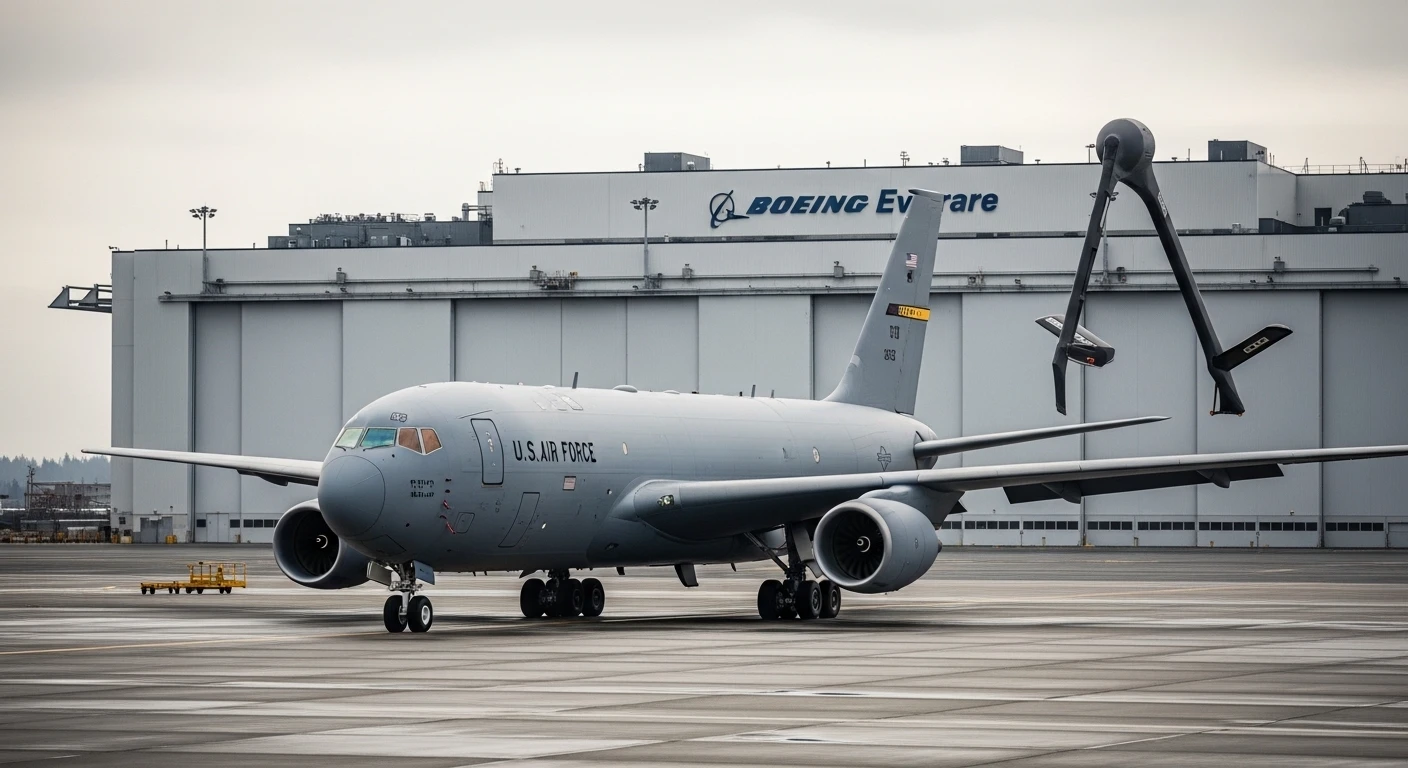
    If you’re walking the perimeter road on the east side of Paine Field in the late afternoon this spring, the KC-46 line is the easiest Boeing program to spot. The airframes are the distinctive 767 shape in Air Force gray, with the refueling boom folded into its housing on the belly and the Remote Vision System fairing on the tail. Tankers sit on the flight line ahead of acceptance testing, and the occasional delivery crew from McConnell or Travis cycles through.

    From the public viewing lot at the Future of Flight, you can usually see one or two KC-46s at various stages of completion from any given week. The program doesn’t draw tour-bus crowds the way the 777X or 737 lines do — but it’s the most consistent visual evidence, year-round, that Everett still builds airplanes for the U.S. Air Force.

    What’s next

    Eighteen more KC-46 deliveries are scheduled between now and year-end. The next near-term milestone is the 106th delivery — expected in coming weeks — and continued ramp toward the 19-aircraft 2026 total.

    Beyond that: ongoing TPE-contract production, the ramp into 767-2C-only production in 2027, and, further out, the program’s continued march toward the 263-tanker target by 2030. None of those are breaking-news moments. They’re just the steady backbone of what Boeing Everett does when it’s running well.

    Sometimes that’s the story.

    Frequently Asked Questions

    When was the 105th KC-46 delivered from Boeing’s Everett factory? April 3, 2026. The aircraft was flown to McConnell Air Force Base in Kansas via Travis Air Force Base.

    How many KC-46 tankers will Boeing deliver in 2026? Boeing plans to deliver 19 KC-46 tankers in 2026, up from 14 delivered in 2025.

    Where is the KC-46 Pegasus tanker built? The KC-46A Pegasus is built at Boeing’s Everett factory at Paine Field in Everett, Washington. It is derived from the Boeing 767 airframe.

    How many KC-46s has the Air Force ordered from Boeing? The current program of record is 179 aircraft, with plans to grow to 263 aircraft by 2030 under the Tanker Production Extension plan. The Air Force has received 105 tankers as of April 2026.

    Does the KC-46 program also serve foreign customers? Yes. Boeing has confirmed orders for four KC-46s for Israel and two for Japan, in addition to the U.S. Air Force production.

    Why is the KC-46 important for Everett even after the 767 commercial line ends? Starting in 2027, Boeing plans to produce 767-2C aircraft solely to support the KC-46A tanker program, keeping the 767 line running at Paine Field through the rest of the decade.

    Has the KC-46 program been profitable for Boeing? No. The KC-46 is a fixed-price contract and has generated repeated program losses for Boeing, including a $565 million charge recorded in Q4 2025. However, the production line continues to deliver aircraft on schedule and Boeing Everett continues to employ the tanker workforce.

    Who built and flew the 105th KC-46 delivery? The aircraft was built at Boeing’s Everett factory. The delivery flight was crewed by airmen from the 22nd Operations Group, 22nd Maintenance Group, and 22nd Medical Group at McConnell Air Force Base, with the final leg flown by Maj. Kyle Haydel as his “fini flight.”

  • Edgewater Bridge Opens April 28: What Boeing and Paine Field Commuters Need to Know About the Restored Mukilteo Corridor

    Edgewater Bridge Opens April 28: What Boeing and Paine Field Commuters Need to Know About the Restored Mukilteo Corridor

  • For Boeing Workers in Everett: What the 737 North Line Launch Means for Your Career

    For Boeing Workers in Everett: What the 737 North Line Launch Means for Your Career

    If you work at Boeing’s Everett campus — or you’re trying to get there — the North Line changes your calculus this summer.

    Boeing is opening its first-ever 737 MAX production line in Everett in summer 2026. For Everett-area aerospace workers, that means new positions, internal transfer opportunities, and a second major production program running alongside widebody assembly on the same campus.

    What’s Actually Opening — and When

    The North Line is a 737 MAX final assembly line inside the Everett factory. It will initially build 737 MAX 8 and MAX 9 jets, with MAX 10 capability once FAA certification clears (still pending as of April 2026). Boeing is targeting midsummer 2026 for first production in Low Rate Initial Production (LRIP) — a deliberately slowed build phase where additional quality checks are layered in before full production speed.

    Boeing posted shift manager and production management job listings for the North Line in January 2026. Hourly IAM-covered production positions have been posted through the spring. If you’ve missed the first wave of postings, watch jobs.boeing.com — North Line hiring will continue as the line scales up.

    Transfer vs. New Hire — What’s the Mix

    Boeing has been explicit: North Line staffing is a combination of newly hired employees and existing Boeing workers transferring from Renton, Everett’s own campus, and Moses Lake. If you’re already at Everett working widebody programs (787, 777X), internal transfer opportunities to the North Line are real — especially for workers with experience in flow-based final assembly.

    New hires go through 12 weeks of Foundational Training — currently conducted in Renton — before returning to Everett for Structured On-the-Job Training (SOJT) paired with experienced workers. That 12-week window is a significant time commitment to plan around if you have family logistics tied to Everett.

    IAM 751 Coverage

    North Line production jobs are IAM District 751 positions, covered under the collective bargaining agreement between Boeing and the International Association of Machinists. District 751 represents approximately 30,000 Boeing production workers in the Puget Sound area. The 2024 strike — which lasted nearly two months and cost Boeing an estimated $5 billion — was resolved with a contract that included 38% wage increases over four years. North Line hires come in under that contract.

    If you’re not already an IAM member and land a North Line production job, you’ll join 751 as part of employment. The union maintains a training center in Everett that supports members through career development, apprenticeships, and tool-use certifications relevant to aircraft assembly work.

    The Commute Picture

    The Everett campus sits off SR-526 near Paine Field, accessible from I-5 exits 189 and 186. Workers commuting from south Snohomish or north King County face the same SR-526/I-5 interchange congestion that widebody workers deal with — no change there. Workers transferring from Renton will cut their commute significantly: Renton to Everett is typically 40-60 minutes north on I-405 in morning traffic, versus driving south into the Renton complex.

    Community Transit operates routes serving the Paine Field area, and Everett Station (at Smith Ave and Wetmore) is the Sound Transit rail hub for workers using Sounder North or connecting buses. Boeing’s campus shuttle system connects Everett Station to the main factory gates.

    What the North Line Means for Everett-Area Aerospace Long-Term

    The North Line’s most important signal isn’t just the jobs it creates — it’s what it says about Boeing’s commitment to the Everett campus. After years of uncertainty about the 777X program (still in final certification), rumors of production consolidation, and the disruption of the 2024 strike, adding a second production program to Everett is a counter-signal. Boeing is expanding in Everett, not contracting.

    For workers in the Paine Field aerospace ecosystem — that includes Spirit AeroSystems (fuselage supplier), Ducommun, Safran Cabin, and dozens of smaller suppliers with Everett-area operations — a Boeing production expansion means more contract work flowing through the supply chain, more local sourcing demand, and more stability in the Snohomish County aerospace economy.

    Frequently Asked Questions — For Boeing Workers

    Can current Everett Boeing employees transfer to the North Line?

    Yes. Boeing is staffing the North Line with a mix of transfers from existing Everett, Renton, and Moses Lake operations and new external hires. Check internal Boeing job boards for transfer postings; the process follows standard internal mobility procedures under the IAM collective bargaining agreement.

    What positions are being hired for on the 737 North Line in Everett?

    Initial postings included production shift managers and supervisors (salaried). Hourly IAM-covered positions span the assembly flow: installers, electricians, quality inspectors, and flow day specialists. Postings appear at jobs.boeing.com — search “North Line Everett” or “737 Everett.”

    Do North Line workers train in Renton first?

    New hires complete a 12-week Foundational Training program, currently based in Renton, before beginning Structured On-the-Job Training in Everett. The Renton training period replicates the 737 assembly flow so workers understand the full process before building at the North Line. Internal transfers may have modified training requirements depending on experience.

    Is the North Line covered by IAM District 751?

    Yes. All North Line production positions are covered under the IAM District 751 collective bargaining agreement — the same contract covering 737 workers in Renton and widebody workers in Everett. The 2024 contract includes 38% wage increases over four years.

    What is the North Line’s production target?

    The North Line is designed to contribute to Boeing’s overall 737 MAX production target of above 47 aircraft per month after full integration. The line starts in Low Rate Initial Production (LRIP) and scales up over time. The FAA currently caps total 737 MAX production at 38 aircraft per month as part of an ongoing safety oversight agreement.

    Related Exploring Everett coverage: Boeing’s 737 North Line Is Coming to Everett This Summer

  • Moving to Everett? Boeing’s New 737 Line Is a Big Reason the Job Market Here Just Got Stronger

    Moving to Everett? Boeing’s New 737 Line Is a Big Reason the Job Market Here Just Got Stronger

    If you’re considering relocating to the Everett area, Boeing’s announcement that it’s opening its first-ever 737 production line here this summer is a concrete data point about where this city’s economy is headed.

    The 737 North Line — a new assembly line opening at Boeing’s Everett factory campus in summer 2026 — adds hundreds of jobs to a campus that already employs over 30,000 people. For anyone evaluating Everett as a place to live and work, that context matters.

    Everett and Boeing: The Relationship That Defines the City

    Boeing has been the dominant economic force in Snohomish County for over 50 years. The Everett factory campus, off SR-526 near Paine Field, is the largest building by volume in the world. It’s been the final assembly site for the 747, 767, 777, 787 Dreamliner, and now the 777X — Boeing’s widebody jets. The plant, plus the aerospace supply chain that orbits it, employs a substantial share of Snohomish County’s workforce directly and supports tens of thousands more in indirect jobs.

    The North Line adds something new to that mix: 737 MAX narrowbody production, which has historically been Renton’s domain. Bringing 737 assembly to Everett effectively diversifies the campus’s production portfolio and deepens the city’s dependency on — but also its value to — Boeing’s broader manufacturing strategy.

    What This Means for the Job Market

    Direct North Line jobs — production assemblers, electricians, inspectors, quality workers, shift supervisors — are the most visible impact. These are IAM District 751 union positions with wages set by the 2024 collective bargaining agreement, which includes 38% increases over four years. Entry-level assembler wages at Boeing are among the strongest in the region for workers without a four-year degree.

    But the indirect impact reaches further. Aerospace suppliers — Spirit AeroSystems (fuselage components), Ducommun (structural components), Safran Cabin (interior systems), plus hundreds of smaller Paine Field-area contractors — will see increased demand as North Line production ramps. Tooling shops, maintenance contractors, catering services, and shuttle operators tied to the Boeing campus all feel a Boeing expansion.

    Everett’s economy beyond Boeing is also growing. Mayor Cassie Franklin’s April 2026 State of the City specifically highlighted healthcare and clean-energy companies alongside aerospace as pillars of local economic growth. Everett’s waterfront is undergoing a $1 billion redevelopment — the Millwright District at Port of Everett’s Waterfront Place is expected to receive its first housing residents by 2026, with retail and commercial space following.

    Housing and Cost of Living Context

    Everett is one of the more affordable entry points in the greater Seattle metro area. Median home prices in Everett run significantly below Seattle and Bellevue — typically 30-40% lower — while still offering Sound Transit access (Sounder North commuter rail to Seattle), Interstate 5 access, and proximity to both the Boeing campus and the Port of Everett waterfront.

    The North Line expansion will increase demand for housing near the Boeing campus — neighborhoods like Bayside, Silver Lake, and the areas north of Everett toward Mukilteo are popular with aerospace workers. The Millwright District’s new housing (200+ multi-family units under LPC West development) will add supply in a market that has needed it.

    Schools and Family Infrastructure

    Everett School District serves the city’s 114,000+ residents and is one of the larger districts in Snohomish County. The district has vocational and aerospace pathway programs — relevant for families with kids considering careers in the industry that dominates local employment. Everett Community College (EvCC) offers a strong aerospace manufacturing technology program that feeds directly into Boeing and supplier hiring pipelines.

    Frequently Asked Questions — For People Considering a Move

    Is Everett a good place to live if you work at Boeing?

    Yes — Everett is the closest major city to the Boeing Everett factory campus, which sits just west of Paine Field off SR-526. Workers at the campus can often commute in under 20 minutes from Everett neighborhoods, avoiding the I-5 or I-405 grind. Housing costs are significantly lower than Seattle or Bellevue while still offering access to the full metro area.

    What is the average salary for Boeing jobs at the Everett plant?

    IAM District 751 production workers at Boeing earn wages set by the collective bargaining agreement. Under the 2024 contract, hourly rates for journey-level assemblers are in the $35-$50/hour range depending on classification and seniority, with overtime premium pay, full benefits, and pension. The 2024 contract included 38% wage increases over four years.

    How far is Everett from Seattle?

    Everett is approximately 25 miles north of Seattle via I-5 — about 30-45 minutes in off-peak traffic, 45-75 minutes in morning commute conditions. Sound Transit’s Sounder North commuter rail runs between Everett Station and King Street Station in Seattle on weekday commute schedules. Sound Transit light rail expansion is planned to eventually connect Everett to the broader Link network.

    What neighborhoods are popular with Boeing workers near Everett?

    Bayside (near the waterfront), Silver Lake, Mukilteo, and Lynnwood are popular with Boeing campus workers. Mukilteo is particularly close to the plant’s main SR-526 access. Marysville and Arlington (north of Everett) attract workers who want more space and lower prices at the cost of a longer drive.

    Related Exploring Everett coverage: Boeing’s 737 North Line Is Coming to Everett This Summer | What the North Line Means for Boeing Workers

  • Boeing’s 737 North Line in Everett: What Local Businesses and Suppliers Need to Know

    Boeing’s 737 North Line in Everett: What Local Businesses and Suppliers Need to Know

    Boeing opening a new 737 MAX production line in Everett this summer isn’t just a manufacturing story — it’s an economic development event for Snohomish County’s business community.

    The North Line, set to open in summer 2026 at Boeing’s Everett campus, adds hundreds of direct jobs and ripples through the supply chain, real estate market, and service businesses that depend on the Boeing workforce. For Everett-area business owners and developers, here’s what to watch.

    Supply Chain Opportunity

    Boeing’s 737 MAX uses a different supply chain than the widebody programs currently assembled in Everett. The fuselage comes from Spirit AeroSystems (Kansas), wings from Renton (partially transferred via the 737 Wing Transport Tool), and major systems from a global supplier base. But local suppliers — machined parts, tooling, composite work, maintenance services, and logistics contractors — have benefited from Boeing’s Everett presence for decades.

    A new production line adds procurement volume. Paine Field’s industrial park, home to dozens of Boeing-adjacent manufacturers, will see increased activity. Small and mid-size suppliers with AS9100-certified operations should be watching Boeing’s Supplier Management portal for North Line sourcing opportunities. The North Line also creates demand for tooling maintenance, calibration services, and facility support that local industrial services companies can pursue.

    Workforce Demand and What It Means for Local Employers

    Hundreds of new Boeing hires competing in Snohomish County’s labor market means tightening competition for skilled trades — welders, electricians, quality technicians, and aerospace manufacturing workers. Boeing’s wage scales (IAM District 751 contract, 38% increases over four years from the 2024 agreement) are among the highest in the region for non-degreed production work.

    For non-aerospace employers competing for the same talent pool — healthcare, construction, manufacturing, hospitality — this creates upward pressure on wages. It also creates opportunity: businesses that serve Boeing workers (commute-corridor retail, childcare, restaurants near the campus, financial services) will see increased customer counts as new hires join the campus.

    Real Estate and Development Signal

    Boeing hiring in Everett means housing demand. The North Line is another demand signal on top of the waterfront’s Millwright District redevelopment, downtown’s Outdoor Event Center project, and a pipeline of new apartments. For commercial real estate — office space near the campus, retail in Mukilteo and Bayside, industrial near Paine Field — a workforce expansion supports occupancy and rent growth.

    The Everett waterfront is the largest adjacent development opportunity: the Port of Everett’s $1 billion Waterfront Place project, which includes the Millwright District (200+ multi-family housing units, 60,000 square feet of destination retail, 200,000 square feet of commercial space), is designed in part to capture the spending power of exactly this kind of workforce expansion.

    Frequently Asked Questions — For Business Owners

    How do I become a Boeing supplier for the 737 North Line in Everett?

    Boeing’s supplier qualification process runs through its Supplier Management organization. Start at boeing.com/company/supplier-resources. Qualification typically requires AS9100 or NADCAP certification depending on the work type. The Economic Alliance of Snohomish County (EASC) maintains aerospace supplier development resources and can connect local companies with Boeing supplier liaisons.

    What is the Economic Alliance Snohomish County’s role in the North Line?

    The Economic Alliance Snohomish County (EASC) tracks aerospace employment trends and advocates for Boeing’s continued presence in Snohomish County. EASC president Ray Stephanson has been a vocal advocate for the Boeing campus during uncertainty over the 777X timeline and the 2024 strike recovery. EASC publishes workforce and economic data useful for businesses planning hiring and expansion tied to Boeing’s activity.

    Does the North Line mean more activity at Paine Field (Snohomish County Airport)?

    Yes. As North Line production scales, Paine Field will see increased Boeing flight test and customer delivery activity for 737 MAX jets — adding to the widebody deliveries already occurring there. Paine Field also hosts commercial airline service via Alaska Airlines and United, and North Line worker commutes may increase general aviation and shuttle traffic at the airport.

    Related Exploring Everett coverage: Boeing’s 737 North Line Is Coming to Everett This Summer

  • Boeing’s 737 North Line Is Coming to Everett This Summer — Here’s What It Means for the City

    Boeing’s 737 North Line Is Coming to Everett This Summer — Here’s What It Means for the City

    Boeing’s 737 North Line Is Coming to Everett This Summer — Here’s What It Means for the City

    For decades, if you worked on a 737 for Boeing, you worked in Renton. That changes this summer.

    Boeing is preparing to open its first-ever 737 MAX production line at the Everett factory campus — a move that adds hundreds of jobs, expands Snohomish County’s aerospace footprint, and repositions the Everett plant as a dual-program facility capable of producing both widebody and narrowbody jets under one roof.

    The new line, called the North Line, will occupy space within Boeing’s massive Everett campus and will be capable of building all 737 MAX variants — the MAX 8, MAX 9, and the yet-to-be-certified MAX 10. Production is expected to begin this summer in a Low Rate Initial Production (LRIP) phase, with full integration into Boeing’s broader 737 MAX flow to follow.

    Why Everett, Why Now

    Boeing’s Renton factory has been under intense pressure to increase 737 MAX production rates — a demand that intensified after the 2024 labor strike that halted Puget Sound production for nearly two months and set delivery schedules back by months. The FAA has capped Boeing’s 737 MAX production at 38 aircraft per month as part of an ongoing safety oversight agreement; Boeing’s commercial future depends on raising that rate to 47 per month and eventually beyond.

    The North Line in Everett is Boeing’s answer to the capacity problem. Rather than cramming more production into the Renton facility — one of the busiest aircraft assembly sites on earth — Boeing is expanding geographic capacity by adding a second line 30 miles north, in a factory already staffed with tens of thousands of experienced aerospace workers.

    The Everett campus currently hosts final assembly for Boeing’s widebody jets — the 787 Dreamliner and the 777X program. Adding 737 production brings a new dimension to a campus that was already the largest building by volume in the world.

    How the North Line Works

    Unlike the Renton facility, where wings and fuselages come together in a more conventional flow, Everett’s North Line relies on a new logistics innovation: the 737 Wing Transport Tool. Partially completed wings will be built in Renton, then transported to Everett for final assembly — a cross-site workflow that Boeing has carefully engineered to maintain quality standards across both locations.

    Workforce on the North Line is a blend of new hires and experienced employees transferring from Renton and Moses Lake. New hires complete a 12-week Foundational Training program before beginning structured on-the-job training alongside veteran assemblers. The approach is deliberate — Boeing’s production leader for the Everett line, Jennifer Boland-Masterson, described the ramp-up as running, not sprinting: “You don’t start with a marathon.”

    Early North Line workers include Jaden Myers, hired in late 2025 to install the dorsal fin assembly in Flow Day 1, and Alondra Ponce, an electrician also joining at the first flow position. Both went through the Foundational Training in Renton before coming to Everett. John V., a nearly 40-year Boeing veteran who previously coached quality work in Everett, now serves as FAA and customer coordinator for the new line.

    What It Means for Everett

    The North Line’s most immediate local impact is jobs — hundreds of positions, a mix of newly hired workers and transfers from other Boeing facilities. The International Association of Machinists (IAM) District 751, which represents approximately 30,000 Boeing production workers across the Puget Sound region, will cover North Line production workers under its collective bargaining agreement.

    Mayor Cassie Franklin highlighted Boeing’s “continued importance” to Everett at her April 2026 State of the City address, citing the company alongside clean-energy firms as pillars of the city’s advanced manufacturing future. With over 30,000 Boeing employees working across the Everett campus already, the North Line represents an expansion on top of an already enormous local economic anchor.

    For Snohomish County broadly, the North Line reinforces Everett’s position as the aerospace capital of the Pacific Northwest — a status that was tested by the 2024 strike, production problems, and ongoing FAA scrutiny, but never truly in doubt given the scale of Boeing’s physical infrastructure here.

    One Asterisk: The MAX 10

    The 737 MAX 10, Boeing’s longest and most fuel-efficient narrowbody, remains uncertified by the FAA as of April 2026 due to an unresolved engine de-icing system design issue. The North Line is capable of building MAX 10s, but commercial deliveries of that variant won’t begin until FAA certification is complete. Airlines — including Alaska Airlines, which has a significant presence at Paine Field — are waiting on MAX 10 deliveries. For now, the line will focus on the already-certified MAX 8 and MAX 9.

    Looking Ahead

    Boeing has been through a punishing few years — the 2024 strike, ongoing MAX certification disputes, leadership changes, and an FAA safety agreement that cap production rates. The North Line’s launch this summer is a concrete signal that the company is moving forward, and that Everett remains central to that future.

    For the workers, families, and businesses that orbit the Boeing campus in north Snohomish County, the North Line is more than a production expansion. It’s a visible sign that the world’s largest aerospace factory is adding capacity in a community that has tied its economic identity to that campus for more than 50 years.

    The line is expected to be operational by midsummer 2026. Boeing has not announced a formal opening date.

    Frequently Asked Questions

    Where is the Boeing 737 North Line located?

    The 737 North Line is located within Boeing’s Everett factory campus in Everett, Washington — on the Snohomish County campus that also houses final assembly for the 787 Dreamliner and 777X programs. This is the first time 737s have been assembled in Everett; the type has historically been built exclusively in Renton, WA.

    How many jobs will the North Line create in Everett?

    Boeing has not released a specific headcount for the North Line. The workforce is a combination of newly hired employees and existing staff transferring from Renton and Moses Lake operations. Industry observers estimate hundreds of direct positions, covered under the IAM District 751 collective bargaining agreement.

    When will the Boeing 737 North Line open?

    Boeing is targeting summer 2026 for the North Line’s opening, with midsummer the most cited estimate. The line will enter Low Rate Initial Production (LRIP) first, then scale up to full integration with Boeing’s overall 737 MAX flow.

    What models will the Everett North Line build?

    The North Line is capable of building all 737 MAX variants — the MAX 8, MAX 9, and MAX 10. Initial production will focus on the MAX 8 and MAX 9, which are FAA-certified. The MAX 10 remains uncertified due to engine de-icing system issues.

    Is the Everett North Line a union shop?

    Yes. North Line production workers are represented by IAM District 751, the International Association of Machinists union that covers approximately 30,000 Boeing production employees across the Puget Sound region under a collective bargaining agreement.

    How does the Everett 737 line differ from the Renton factory?

    The Renton factory is Boeing’s main 737 MAX production hub, where wings and fuselages are assembled from scratch. Everett’s North Line uses a 737 Wing Transport Tool to receive partially completed wings from Renton and complete final assembly in Everett — a cross-site workflow new to the 737 program. The Everett campus also simultaneously produces 787 Dreamliners and (in development) 777X jets.

    What does the North Line mean for Paine Field?

    Paine Field (Snohomish County Airport) is the flight delivery hub adjacent to the Everett factory. As North Line production ramps up, Paine Field will see increased activity in Boeing flight test and customer delivery operations for 737 MAX aircraft — adding to the widebody deliveries already occurring there.