If you own a restoration company today, you are sitting on the most attractive asset class in the home services sector — and the buyers know it. Private equity has deployed more than $6 billion across 50+ restoration platforms since 2018, and the consolidation wave that started with brands like ServiceMaster and BELFOR is now grinding through the middle market. Regional operators doing $5M to $25M in revenue are getting unsolicited LOIs every quarter. Most owners have no idea what their business is actually worth, what they could be doing right now to add a turn or two to their multiple, or which buyer in the market is the right exit for their specific situation.
This is the bottom-line guide. No fluff. What buyers pay, what they discount for, and what to fix before the call.
What restoration companies are actually selling for in 2026
Valuation in restoration is driven by size, revenue mix, and operating quality — in roughly that order. The brackets break down like this:
- Owner-operator shops ($500K–$2M revenue, $150K–$400K SDE): 2.3x–3.5x SDE. These are individual-buyer or local-strategic deals. The owner is the business; the buyer is essentially buying a job with a customer list.
- Established multi-tech operations ($2M–$10M revenue, $400K–$1.5M EBITDA): 3.5x–5.5x EBITDA. This is where most PE add-on activity happens. Buyer expects you to be transferable.
- Multi-location regional platforms ($10M–$50M revenue, $1.5M–$5M EBITDA): 5.5x–8.0x EBITDA. Now you are platform-grade. TPA program participation, named carrier relationships, and 24/7 infrastructure matter heavily here.
- Premium platforms ($12M+ EBITDA, multi-state, modern operating system): 7x–11x+ EBITDA. This is the HighGround-to-Knox-Lane tier. Rare air, but it exists.
To translate: a $1M SDE owner-operator is looking at roughly $2.8M–$3M at sale. A $3M EBITDA regional with a clean TPA book and a working second-in-command is looking at $18M–$24M. The gap between those two numbers is mostly operational discipline, not revenue.
The buyers actually writing checks right now
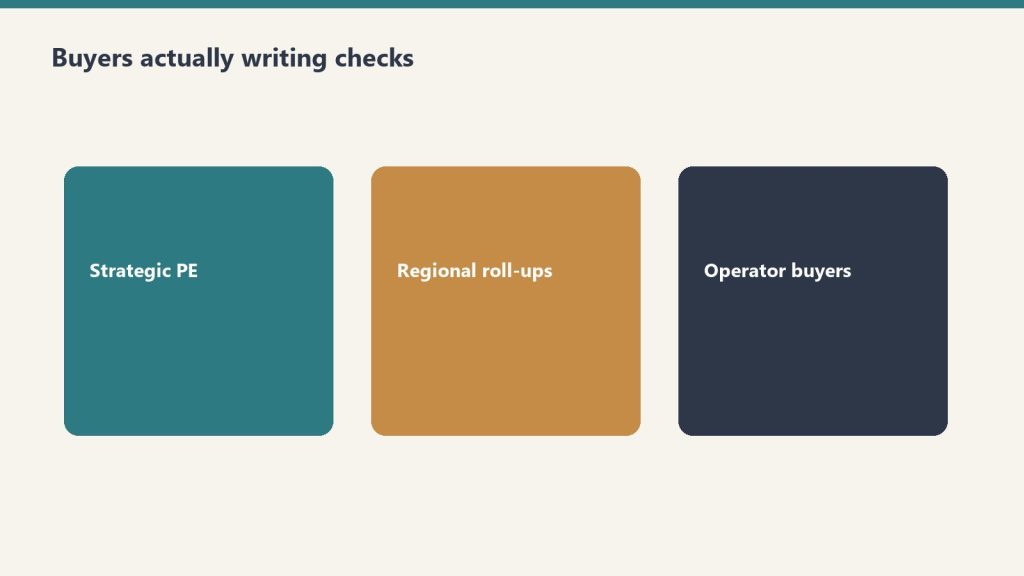
The named platforms most active in restoration add-ons through 2025 and into 2026 include:
- Morgan Stanley Capital Partners (American Restoration): An 8-brand roll-up across 10 states, headquartered in Dallas. Acquired by MSCP after building out residential and commercial mitigation in regional markets. Looking for tuck-ins that fit the regional brand model.
- Knox Lane (HighGround): 13 acquisitions in 5 years before exit. Aggressive on multiples for the right strategic geography.
- LP First Capital / Align Collaborate (Rewind Restoration): Newer platform, launched with the Icon Restoration acquisition in Rochester Hills, Michigan. Stated goal of building one of the largest residential restoration businesses in the US — meaning they are at the early, hungry stage of a platform.
- Osceola Capital (Fortify Restoration): Platform launched mid-2025. First add-on was Beach Contracting in South Florida. Focused on structural restoration and southeast geography.
- Crossplane Capital (Mooring USA): Dallas-based PE shop that took Mooring private. Commercial-leaning thesis.
None of these buyers want a vendor brochure. They want clean books, low owner dependence, and a story about how revenue keeps coming after closing.
Get The Signal
What we actually ran, what it measured, and what it means for a restoration shop — every week, including the flops.
What buyers actually grade you on
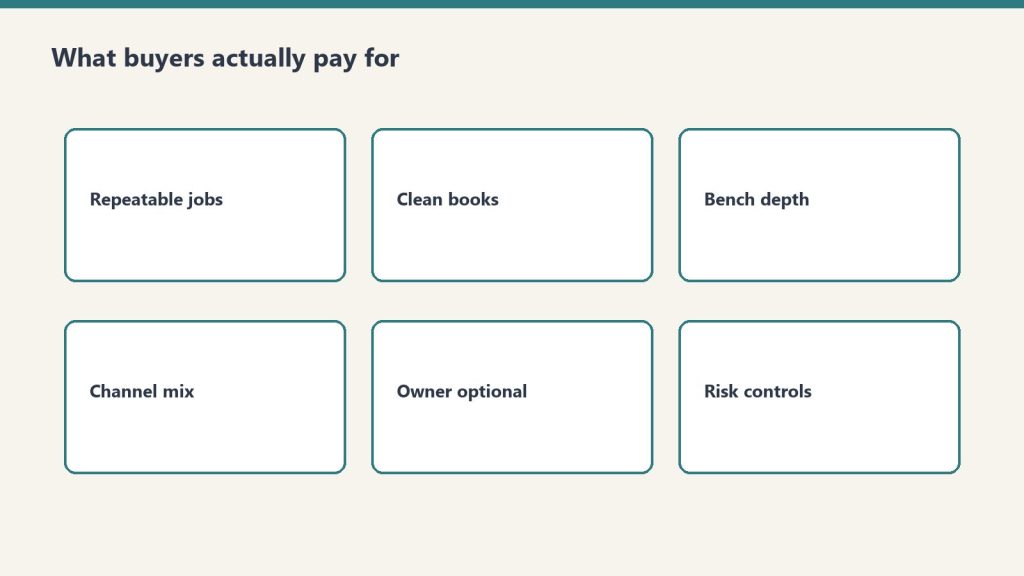
Pretend you are sitting in the LOI meeting. The questions on the buyer’s checklist, in order of how much they move the multiple:
- Revenue mix. Buyers want recurring service contracts, TPA program participation, and managed-repair work. They penalize reconstruction-heavy mix (lower gross margins) and they penalize catastrophe-heavy revenue. The savvy ones expect CAT work to represent no more than 15–20% of total revenue — anything north of that gets discounted as unpredictable.
- TPA and carrier relationships. A documented Contractor Connection, Alacrity, Code Blue, or PSA program book — with active job volume and clean compliance history — is worth real multiple turns. A regional platform with $4M–$12M EBITDA and a strong TPA book is the difference between a 6x deal and an 8x deal.
- Owner dependence. If you sign every estimate, talk to every adjuster, and make every hiring call, your business is not transferable. Most buyers want a turnkey, profitable operation, and creating SOPs that remove yourself from the daily grind is the single highest-ROI thing you can do in the 18 months before a sale.
- Financial cleanliness. Multiples above the median require demonstrably above-median EBITDA margin and clean financial documentation that survives a third-party Quality of Earnings review. If your bookkeeper is your spouse and your books are on QuickBooks with no monthly close, you will get repriced in due diligence.
- Management depth. A strong GM, an operations lead, and a finance person who isn’t you. Buyers will request to meet key employees during due diligence and may want to adjust transition terms based on who is staying.
The things that quietly destroy your multiple
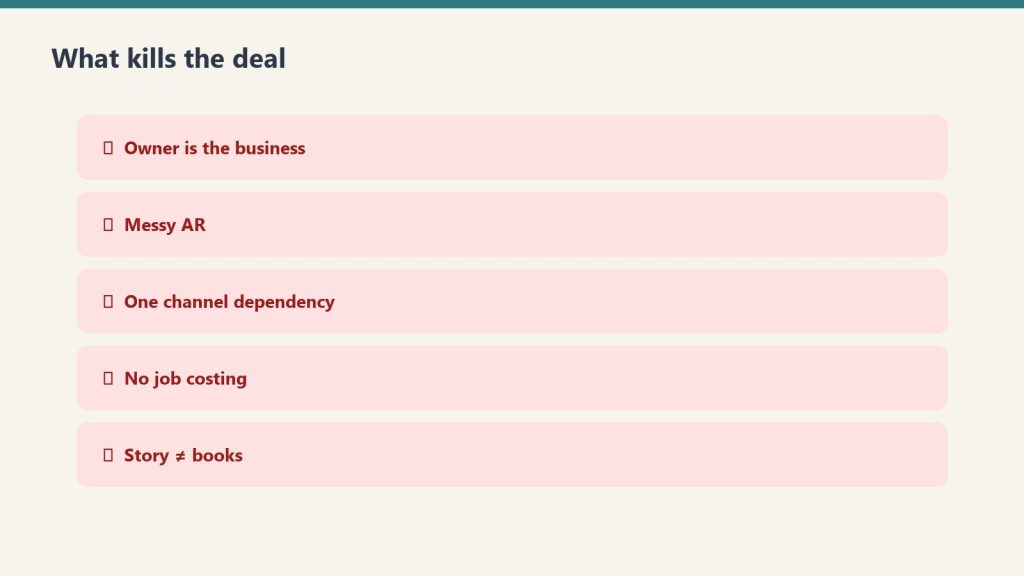
Sellers walk into deals not knowing these compress them by 1–2 turns:
- Reconstruction-heavy revenue mix with low gross margin.
- No TPA program participation — meaning revenue is fully dependent on local marketing and referrals.
- Weak 24/7 response infrastructure (no real on-call rotation, no after-hours dispatch).
- Paper-based or hybrid workflow with no modern job management system.
- Single-territory exposure with no expansion playbook.
- Lapsed or thin IICRC certifications across the technician base.
- Concentration risk — one TPA or one big carrier representing more than 25% of revenue.
The timeline that wrecks sellers
Due diligence typically runs 30 to 90 days and is the most intensive phase of any restoration sale. Owners who go into LOI without having done their own internal QoE, their own SOP documentation, and their own legal cleanup almost always get retraded. Sometimes the retrade is mild — $200K off the headline number. Sometimes the buyer walks. The sellers who hold their price are the ones who showed up ready: trailing twelve-month EBITDA reconciled monthly, contracts organized, employee agreements in place, tax returns matching financials, and a clean cap table.
Most restoration deals take six to twelve months from first conversation to close. If you are thinking about an exit in 2027, the time to start is now.
The honest bottom line
If you are under $2M in revenue, an owner-operator, and reconstruction-heavy: your real exit number is probably $400K–$800K, not the $2M figure you’ve been telling yourself. Sell to a local strategic, take three years of earn-out, and get to your number that way.
If you are $3M–$10M with a working TPA book and a real management bench: you are exactly what every active PE platform is shopping for. Get a Quality of Earnings done now, fix the obvious holes, and start taking the calls. There are a dozen named buyers with active mandates, and the market for quality regional restoration assets is the strongest it has ever been.
If you are $12M+ EBITDA with multi-state coverage and a modern operating system: you are not selling a business, you are negotiating a platform price. Hire a sell-side advisor who has actually closed restoration deals — not a generalist broker. The difference between a competitive process and a one-buyer conversation is two turns of EBITDA, which on your numbers is real money.
The window for premium restoration exits is open. It will not stay open forever. Climate-driven loss frequency is up roughly 35% since the 1990s, which is fueling buyer enthusiasm — but interest rates and PE fundraising cycles will eventually cool the market. Sellers who prepare now will catch this wave. Sellers who wait for “the right time” will sell into a softer market.
The right time is when your business is ready, not when the market is hot. The good news is the market is hot and the operational work to be ready is straightforward. Get started.
📖 Recommended Reading in Restoration Intelligence
Related on Tygart Media: Starlink on a water job · S500 in the van · local SEO for restoration.
Get The Signal
What we actually ran, what it measured, and what it means for a restoration shop — every week, including the flops.
Leave a Reply