Zillow did not kill the real estate agent. It killed the kind of real estate agent whose entire value was the gatekept information that Zillow made free. The realtors who built genuine community networks — who became the central connectors of their towns and neighborhoods — are thriving in 2026 at levels they never reached in the pre-platform era. Buyers and sellers are not paying them for listings anymore. They are paying for membership in a human network that the platform cannot replicate.
This is the playbook for the realtor who wants to be on the right side of the floor-and-ceiling shift in real estate. The framework, the moves, and the structural reasoning are below. It is also part of a broader pattern playing out across every service profession that depends on a mix of procedural and relational work.
What Zillow Actually Did
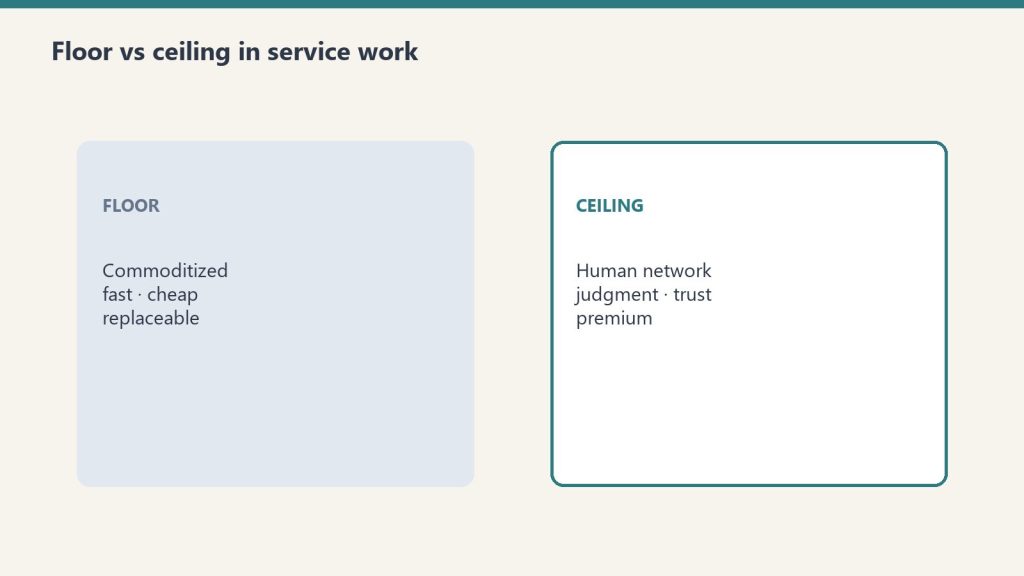
Zillow, Redfin, Realtor.com, and the broader real estate platform stack commoditized the procedural floor of the industry. Listing search, basic property data, comparable sales, neighborhood statistics, market trends, mortgage estimators, agent reviews — all of it became free to any buyer with a phone. The information that realtors used to gatekeep and charge commissions to access became table stakes.
The agents whose business model depended on controlling the information got squeezed hard. The transactional agent who showed buyers houses and pulled comps and not much else lost the structural advantage that made them necessary. Some left the industry. Some clung to the old model and watched their incomes decline. The narrative in the early platform era was that this was the death of the profession.
It was not. It was the death of a specific kind of agent. The agents whose work had always been more than transactional — the community connectors, the neighborhood specialists, the trusted referral hubs — got more valuable. Their floor work became cheap, which freed up their time. Their ceiling work — the human network, the curation, the trust — became the entire offering. The economic outcomes diverged sharply. The floor agents compressed. The ceiling agents thrived.
The Realtor as Community Network Operator
The realtor who has built the ceiling business does not think of themselves as a house seller. They think of themselves as the central connector of a specific community. The transaction is the entry point into membership. The membership is the actual offering. The buyer is not paying a commission for the house. They are paying for ongoing access to everything the realtor knows, knows about, and is connected to.
What does the membership actually include? Concretely, it includes things like this. The new buyer gets the realtor’s contractor list — the roofer who will not gouge them in three years, the electrician who actually shows up, the painter who is honest about timelines. They get the introductions to neighbors who matter — the block captain who can warn them about the upcoming HOA fight, the family with kids the same age as theirs, the retired contractor down the street who is happy to weigh in on the deck project. They get the local intelligence — which school administrator actually returns calls, which pediatrician is taking new patients, which mortgage broker will close on time when the appraisal is tight. They get invited into the realtor’s ecosystem — the holiday party, the summer cookout, the monthly newsletter, the private group chat. They become part of a community whose center of gravity is the realtor.
The buyer would pay for any one of those things individually if they could find them. They get all of them because they bought a house from the right agent. The commission, in this framing, is not too high. It is significantly underpriced for the value being delivered, because most of the value is delivered after the transaction closes and continues for years.
How to Build the Network Deliberately
The realtors who have built genuine community networks did not do it by accident, and most of them did not do it through volume marketing. The playbook is more specific.
Pick a community small enough to genuinely serve. Not a metro area. Not a county. A specific neighborhood, town, or community of interest. The realtors who win at the ceiling level are deep, not wide. They know everyone in their specific community. They are the first call when anyone has a real estate question, but they are also the first call when someone needs a contractor recommendation, a school question answered, or a referral to a tax advisor. The narrowness is what makes the network usable.
Map the providers in that community that you would stake your reputation on. Contractors, mortgage brokers, attorneys, insurance agents, financial advisors, pediatricians, school administrators, local employers. The realtor’s job is to know these people personally, vouch for the ones who deserve it, refuse to refer the ones who do not. The referral network is the product. Curate it like a product.
Become the first call for the community’s information needs. Run the newsletter that actually has useful local intelligence. Host the events where the community connects. Be the person who knows what is happening before it is in the news. The realtor who is the information hub for their specific community has built a moat that no platform can cross.
Treat every client as a member, not a transaction. After the closing, the relationship begins. Stay in regular contact. Ask how the renovations are going. Connect them to the local restaurant when their out-of-town family visits. Introduce them to the neighbor who works in their industry. The post-transaction relationship is what generates the referrals that build the next generation of clients.
Use AI and platform tools for the procedural floor. Let the platform do the listings, the comps, the market analysis, the scheduling, the document handling. Stop competing with Zillow on speed or data accuracy. They will always win on the floor. Reinvest the time you save into the relational work that builds the network.
What This Looks Like Economically
The realtor running the community network model typically has a smaller client roster than the transactional agent and generates significantly more revenue per client over a multi-year horizon. The commissions on individual transactions may not be different on a per-deal basis, but the lifetime value of a client in the network model is dramatically higher because clients refer their friends, family, and colleagues into the same network repeatedly over years.
The retention dynamics are also stronger. The transactional client comes back to the agent only when they need another house. The network client stays in the agent’s orbit continuously and brings every real estate question, every referral opportunity, and every introduction. The lifetime value math favors the network model significantly, even though the marketing-funnel math looks worse on the surface.
The career stability also diverges. The transactional agent is exposed to market downturns, platform algorithm changes, and commission pressure. The network agent’s business depends on the strength of their community relationships, which compounds over time and resists short-term market conditions. The network agent who has been in their community for fifteen years has a business that is genuinely durable.
Related on Tygart Media: how to use Claude · Anthropic API key.
Frequently Asked Questions
Will Zillow eventually replace real estate agents?
No. Zillow has commoditized the procedural floor of real estate but cannot replicate the community network, neighborhood expertise, and trusted referral relationships that good agents build. The transactional agents who depended on information gatekeeping have been compressed. The community network agents thrive.
How does a realtor build a community network business?
Pick a specific narrow community to serve. Map the providers in that community you would stake your reputation on. Become the information hub for the community. Treat every client as an ongoing member rather than a transaction. Use platform tools for the procedural floor and reinvest the time in relational work.
What is a real estate community network membership?
It is the offering where a buyer who purchases a home from the agent gains ongoing access to the agent’s curated network — contractors, attorneys, neighbors, employers, local intelligence — for years after the closing. The commission pays for membership in a human network, not just the transaction.
Should new real estate agents try to compete with Zillow?
No, not on the floor. The platforms will always win on listings, search, and data. New agents should pick a specific community, build relationships in it deliberately, and become the local connector. The ceiling is open to anyone willing to do the relational work.
How long does it take to build a community network real estate business?
Typically two to three years to establish strong network density in a specific community, and the business compounds significantly after year five as referrals from earlier clients drive new business. The agents who started this work five years ago are dominant in their communities now.
The Bottom Line
Zillow did not kill realtors. It killed the realtors whose entire value was the information Zillow made free. The realtors who built community networks — who became the central connectors of their specific towns and neighborhoods — are in the strongest position the profession has seen in decades. The transaction is no longer the product. The membership in the network is the product. The commission pays for the entry into something larger. This is the floor-and-ceiling pattern that plays out across every service profession. Build the network. Build the membership. Become the French press in your community, and the Nespresso platforms will never reach you.
Leave a Reply