If you are under forty and serious about a long career in any skilled industry, the most valuable thing you can do this year is find a veteran and get yourself into their orbit. Not for the resume. Not for the connections. For the knowledge that lives in their head and has never been written down anywhere — the part of expertise that AI cannot replicate by ingesting more public data, because the data was never public in the first place.
This is the companion to a piece I wrote for the older generation, telling them this is their moment. That article explained why the veterans are about to become the most valuable people in their industries. This one is for you, the younger operator. It explains what to do about it before the window closes.
What You Are Actually Competing Against
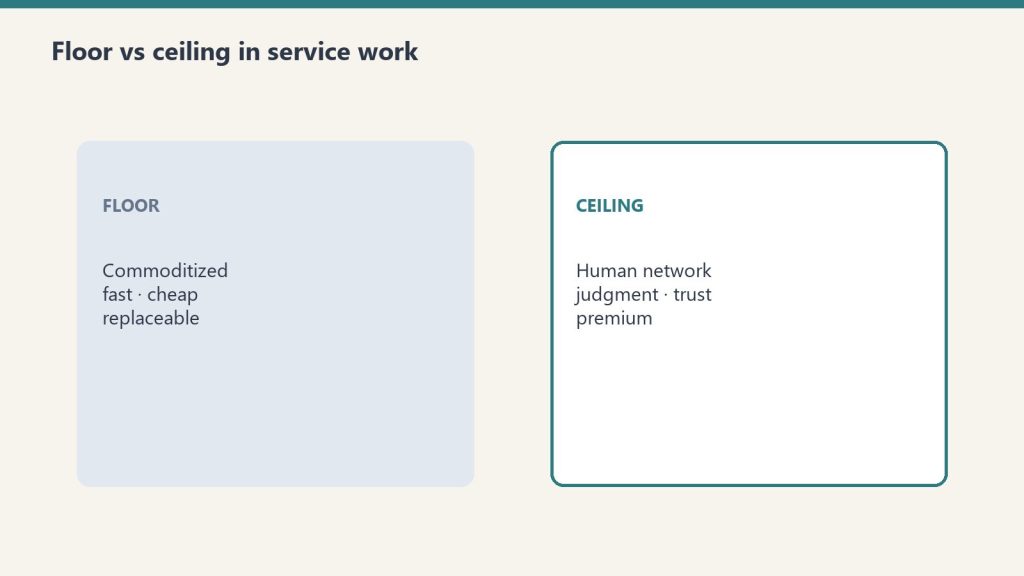
If you came into your trade or industry in the last ten years, your training environment was fundamentally different from the one the veterans came up in. You had software for the procedural work. You had documented processes. You had AI tools that wrote the first draft of nearly everything. The tools are good. They are getting better. The floor of competence in your industry is rising fast because of them.
Here is the part you might not have noticed yet. The same tools that made you fast are training your competition to be fast in exactly the same way. Every other operator in your generation has access to the same models, the same documentation, the same automation. Your edge over the next person is shrinking by the month, because the things you can do that they cannot do are mostly things AI is making available to everyone.
The veterans had to build their expertise without those tools. AI raised the floor, not the ceiling. The ceiling still belongs to the people who built it the hard way. And the hard way produced a kind of expertise that the modern training environment is not producing in your generation, no matter how much software you stack.
You are not in a worse position. You are in a different position. The difference is that the foundational depth you need to compete at the ceiling has to be acquired from someone who already has it, because the modern training pipeline does not produce it on its own.
Why the Veterans Are Actually Findable Right Now
Here is something most people in your generation have not realized yet. The veterans are not hard to find. They are sitting in their offices, on their job sites, in their shops, in their trucks, doing the work they have always done. Most of them are wide open to a younger operator who shows up with genuine respect and real interest.
The reason most of them are not already mentoring half a dozen people is not because they are unwilling. It is because almost nobody from your generation has asked. The cultural assumption has been that the veterans are obsolete and the younger generation will figure it out with software. That assumption is wrong, and the veterans know it is wrong, and most of them are quietly waiting for somebody to figure that out.
The window is open right now. It will not stay open forever. The smart operators in your generation are starting to figure this out, and once that signal spreads, the veterans are going to get crowded. Right now you can pick up the phone, drive to a job site, or send a thoughtful message and likely get time with a senior operator who has thirty years of experience inside their head.
Do it this week. Do not wait until you have a perfect plan. The plan is to show up.
How to Approach a Veteran Without Insulting Them

This is the part younger operators get wrong most often. You cannot approach a veteran like they are a content asset to be extracted. You cannot show up with a checklist of questions and treat them like a podcast guest. You cannot ask them to “teach you everything they know.” All of those framings position you as the buyer and them as the supplier of a commodity, and the commodity is the most carefully built thing in their professional life.
Approach them as a craftsperson approaching another craftsperson. Acknowledge what they have built. Be specific about why their work caught your attention. Ask if you can buy them coffee or lunch and be genuinely curious about the parts of the work that are not in any manual. Then shut up and listen.
The right opening sounds like this. “I have been in this industry for X years. I am trying to build something durable. I noticed how you handle Y, and I would love to learn how you actually think about it. Can I buy you lunch?” That works. It works because it is honest, specific, and positions you as a serious operator who recognizes another serious operator.
The wrong opening sounds like this. “I am working on a thing and I would love to pick your brain about the industry.” That is the opening of someone who wants free consulting. Veterans recognize it immediately. They will be polite. They will not give you the real knowledge. The real knowledge only comes out for people who have demonstrated they can be trusted with it.
What to Do Once You Are In
If a veteran gives you their time, here is what to do with it.
Work alongside them on real jobs whenever possible. The knowledge you actually need is not the knowledge they can tell you over coffee. It is the knowledge they cannot articulate because it operates below conscious thought. You only see it by watching them work, asking them in real time why they made a specific call, and absorbing the reasoning in context. Tacit knowledge transfers through proximity, not through documentation.
Bring real problems. Veterans want to help solve actual situations, not give generic advice. If you are stuck on a specific job, a specific customer dynamic, a specific scoping decision, bring that to them. They will engage with the real thing far more deeply than they will engage with a hypothetical.
Take notes after the conversation, not during. Writing things down in front of a veteran turns the conversation into a transaction. Listen first. Capture the patterns afterward, when you have time to think about what you actually heard.
Bring something back. Whatever the veteran helped you with, follow up a week later with what you did with it and what happened. That follow-up is the single highest-leverage thing you can do to build the relationship, because it shows you treated the advice as real and applied it. Most mentees never do this. The ones who do become the ones the veteran starts inviting into bigger conversations.
Pay for time when it makes sense. If a veteran is giving you a significant amount of time, offer to pay for it. Most will say no for the first few hours. After that, the conversation should shift toward something that respects their professional rate. Treat their judgment as a paid product. It is.
What You Can Offer Back
The relationship has to be mutual to last. Here is what younger operators can authentically offer a veteran in exchange for their time.
You can run the AI side of their work. Most veterans are not naturally suited to AI tooling, and many of them resent the learning curve of yet another software stack. You can offer to handle the procedural floor of their business — the scoping, the documentation, the customer communication, the AI-leveraged side of operations — in exchange for time alongside them on the judgment work. This is a real career path that is starting to emerge in field operations.
You can document their knowledge in a form that serves them, not just you. If you sit with a veteran for ten hours and produce a clean internal playbook that captures their judgment patterns, you have just given them something genuinely valuable — a transferable artifact of expertise they can use to train their next generation of technicians or to package as the intellectual asset of their company before a sale.
You can be the connective tissue. Many veterans have decades of relationships and reputation but limited capacity to leverage modern channels. You can run their online presence, their content output, their newer client acquisition channels, in a way that respects their voice and amplifies their authority. They get reach without having to learn a new platform. You get their endorsement and the proximity to their network.
You can be loyal. This sounds soft, but it is the most strategically valuable thing on the list. Most younger operators churn through relationships. The one who stays — who shows up consistently for years, who keeps the trust intact, who does not leverage the relationship for short-term wins — becomes the natural successor. Successorship is the most powerful career move available in any skilled industry, and almost nobody plays it deliberately.
The Long Game
If you are twenty-eight or thirty-two or thirty-five right now, you have a thirty-year career in front of you. The decisions you make in the next two years about who you learn from will shape the next three decades. The veterans who are open to teaching right now will not all still be available in five years. Some will retire. Some will get acquired. Some will simply close their availability because the right successor showed up and they no longer have capacity for another mentee.
The younger operators who treat this moment seriously — who go find the veterans now, who build genuine relationships, who absorb the ceiling-level knowledge while it is still accessible — are going to be the ones running their industries in 2040. The ones who keep stacking AI tools without ever sitting next to a veteran will be commoditized along with everyone else operating at the same procedural floor.
The market is splitting. There will be a large middle class of AI-leveraged operators who are technically competent but functionally interchangeable. And there will be a much smaller group of operators who carry both AI fluency and tacit, veteran-transferred expertise. The first group will be commoditized. The second group will be the next generation of ceiling-holders.
You get to choose which group you are in. The choice is being made in the next twelve months, whether you make it deliberately or not. Make it deliberately.
Frequently Asked Questions
How do I find a veteran in my industry to learn from?
Start with the people you already know about. The senior operators whose work or company you have admired from a distance. Reach out directly with a specific, honest opening. Offer to buy coffee or lunch. Do not ask for “general advice.” Ask about a specific aspect of their work that you genuinely want to understand. Most veterans are more accessible than younger operators assume.
What if the veteran I want to learn from is a competitor?
Most skilled-industry veterans are surprisingly generous with competitors who approach respectfully, because competitor relationships at the senior level are often collaborative, not zero-sum. Be transparent about what you do and that you respect their work. If they are not interested, they will tell you. If they are, you have just opened the most valuable relationship in your professional life.
How much should I pay for a veteran’s mentorship?
The first few conversations are usually informal. Once the relationship is established and you are getting significant judgment-level help, treat their time as a paid product. Hourly advisory rates for senior operators in skilled industries are climbing rapidly. Expect to pay something in the range of professional consulting rates, and consider it the highest-leverage spend of your career.
Can I just learn what I need from books, courses, and AI tools?
No. Books, courses, and AI tools cover the documented, explicit knowledge — the floor. The ceiling is tacit knowledge that has never been written down and exists only inside practitioners. You can become competent through study. You cannot become exceptional without proximity to people who already are.
What if I do not have a clear career direction yet?
That is the strongest argument for finding a veteran. Senior operators in any industry have seen which career paths actually compound and which ones do not. A conversation with a thirty-year veteran is worth more than a year of career-strategy reading, because they have watched the long-term outcomes play out in real people, including themselves.
How do I avoid wasting a veteran’s time?
Bring real problems, not hypotheticals. Apply what they tell you and follow up with results. Respect their schedule. Do not ask for the same kind of help twice — find a different mentor for that topic, or pay for the second round. Do not leverage the relationship for short-term wins. The veterans who feel respected continue mentoring. The ones who feel used disappear quietly.
The Bottom Line
The AI shift in your industry is not the threat to your career that some people are framing it as. It is a clarifying event. It is making the procedural floor of your work commoditized, which means the only meaningful differentiation left is the kind of judgment-level expertise that lives inside veterans.
You have two real paths in the next decade. Path one is to keep stacking AI tools, work on the floor, and accept that you will be operating in a commoditized middle class for the rest of your career. Path two is to go find the veterans, get yourself into their orbit, absorb the ceiling-level knowledge they carry, and position yourself as one of the small group of operators who hold both AI fluency and tacit expertise.
Path one is the default. Path two requires deliberate action this year. Go find the veterans now. The market is about to start paying a premium for exactly what they hold, and you can be the person they choose to pass it to. Pick up the phone today. Drive to the job site this week. Buy the lunch this month. The window is open.
Leave a Reply